- Market Value (2025): USD 112.9 Mn
- Estimated Value (2026): USD 117.1 Mn
- Forecast Value (2036): USD 168.7 Mn
- CAGR (2026-2036): 3.7%
Marine Horns Market Forecast and Outlook 2026 to 2036
According to the Fact.MR analysis, the marine horns market was valued at USD 112.9 million in 2025 and is projected to grow from USD 117.1 million in 2026 to USD 168.7 million by 2036. Demand for marine horns is likely to grow at a CAGR of 3.7% over the forecast period.
Demand for marine horns is rising as COLREGs require sound-signal appliances on vessels and as boat builders replace older horns. Manufacturers are offering compact electric and air horns. For example, COLREGs Annex III sets audibility ranges for whistles by vessel length. Similar rules are projected to drive sales through 2036.
Key Takeaways from the Marine Horns Market
- Marine Horns Market Value (2025): USD 112.9 million
- Marine Horns Market Value (2026): USD 117.1 million
- Marine Horns Market Forecast Value (2036): USD 168.7 million
- Marine Horns Market Forecast CAGR (2026-2036): 3.7%
- Leading Product Type: Electric Horns (42.3%)
- Key Market Participants: Kahlenberg Industries, Fiamm Componenti Accessori, Marco S.p.A., Grover Products, Hadley Products, Sea-Dog Line
- Key Growth Regions: Japan, Brazil, United States, United Kingdom, Germany
In 2022, Faurecia completed its acquisition of HELLA, forming FORVIA, whose horn business serves vehicle and marine customers. Demand for marine horns is growing alongside wider electrical accessory ranges. Manufacturers are consolidating. Similar consolidation is projected to shape sales.
Marine Horns Market
| Metric | Value |
|---|---|
| Estimated Value in (2026) | USD 117.1 million |
| Forecast Value in (2036) | USD 168.7 million |
| Forecast CAGR (2026 to 2036) | 3.7% |
Source: Fact.MR analysis. Updated Nov 23, 2026
Source: Fact.MR analysis.
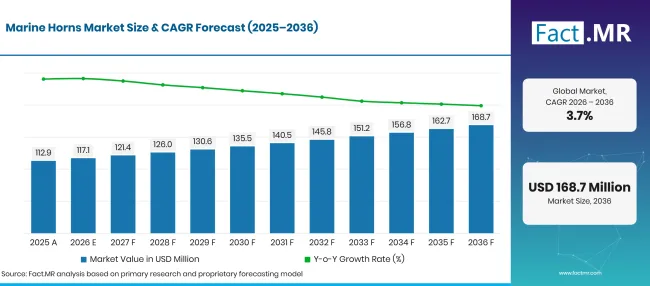
Marine Horns Market Forecast Global | Source: Fact.MR
Category
| Category | Segments |
|---|---|
| Product Type | Electric Horns, Air Horns, Manual Horns |
| Application | Commercial Vessels, Recreational Boats, Naval Ships |
| Distribution Channel | Offline, Online |
| Material | Stainless Steel, Plastic, Brass, Others |
| Region | Japan; Brazil; United States; United Kingdom; Germany |
Source: Fact.MR analysis. Updated Nov 23, 2026
Source: Fact.MR analysis.
Segmental Analysis
Why do electric horns lead product demand in the Marine Horns Market?
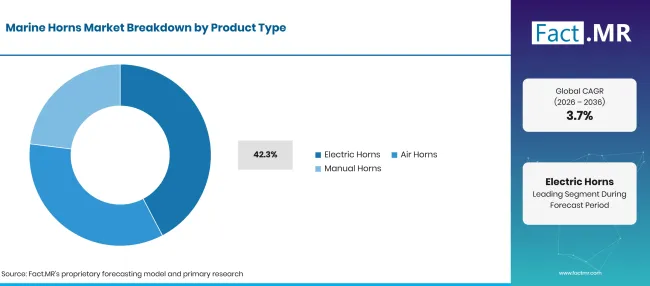
Marine Horns Market Breakdown Product Type | Source: Fact.MR
Demand for Electric horns account for 42.3% of revenue in 2026, about USD 49.5 million, as they are compact and run on boat batteries. Air and manual horns follow. Manufacturers such as Marco and Kahlenberg offer electric horns. Similar convenience is projected to keep electric horns in the lead. Air horns remain relevant where higher sound output is required, while manual horns serve basic and emergency signalling needs. Suppliers offering corrosion-resistant electric models and vessel-specific mounting options are positioned to address replacement demand.
Which vessel category is generating the strongest application demand?
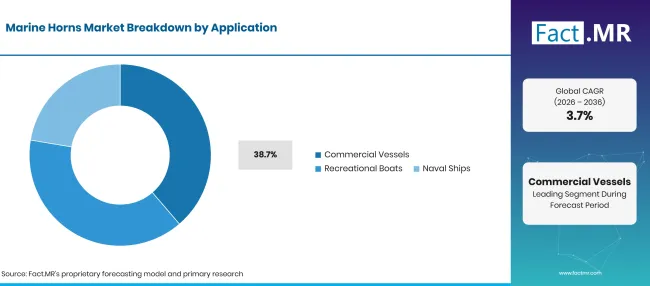
Marine Horns Market Breakdown Application | Source: Fact.MR
Sales of Commercial vessels hold 38.7% of revenue in 2026, about USD 45.3 million, as larger ships need certified whistles. Recreational and naval follow. Manufacturers serve yards. Similar rules are projected to keep commercial vessels in the lead. Their demand is supported by regulatory sound-signal requirements and the need to maintain operational equipment across cargo, passenger and service fleets. The U.S. Maritime Administration's August 2026 fleet data lists 190 U.S.-flagged merchant vessels, including 59 containerships and 76 tankers, illustrating the range of commercial vessel types requiring sound-signalling equipment.
What makes stainless steel a preferred material for marine horns?
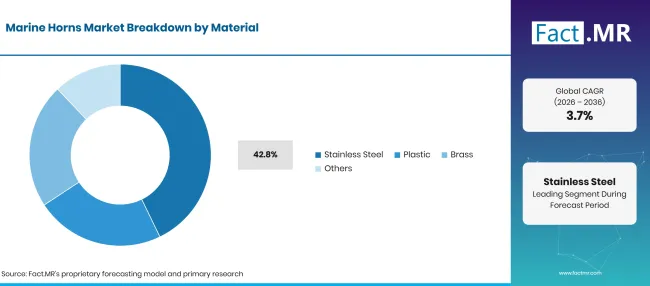
Marine Horns Market Breakdown Material | Source: Fact.MR
Stainless steel segment leads with 42.8% of revenue in 2026, about USD 50.1 million, as it resists corrosion. Similar needs are projected to keep stainless in the lead. Marine equipment dealers, chandlers, ship chandlers and authorized distributors remain important because buyers often need product compatibility checks, installation advice and access to replacement parts. Commercial operators may also prefer established suppliers for maintenance procurement and vessel refits. Online channels can expand product discovery, but technical selection and compliance requirements continue to support specialist retail and distribution networks.
How are offline suppliers retaining their share of marine horn sales?
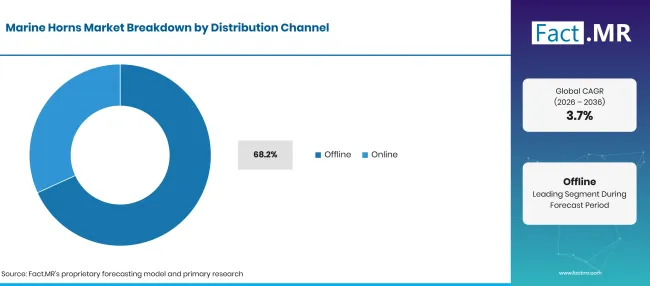
Marine Horns Market Breakdown Distribution Channel | Source: Fact.MR
Sales through Offline channels account for 68.2% of revenue in 2026, about USD 79.9 million, as boaters buy at chandleries. Online sales grow. Similar habits are projected to keep offline in the lead. Buyers of commercial and recreational vessels consider material durability because corrosion can affect the horn body, mounting hardware and long-term performance. Plastic and brass remain alternatives where weight, design, cost or specific acoustic requirements influence product selection.
Marine Horns Market-Drivers, Restraints & Trends
Drivers: Regulatory compliance and fleet expansion:
Demand for marine horns is supported by mandatory sound-signalling requirements under COLREGs. IMO Rule 33 requires vessels measuring 12 metres or more to carry a whistle and a bell, while vessels measuring 100 metres or more must also carry a gong. The global merchant fleet comprised approximately 116,000 vessels of at least 100 gross tons at the start of 2026, while its carrying capacity reached 2.5 billion deadweight tons, an increase of 85 million tons year-on-year. This large vessel base supports demand for compliant sound-signalling equipment, new installations and replacement purchases.
Restraints: Long replacement cycles and price competition:
Marine horns generally have a long service life when properly maintained, limiting the frequency of replacement purchases. Price competition is particularly relevant in the recreational boating segment, where buyers may select basic compliant products instead of premium models. These factors should therefore be presented as market dynamics rather than quantified government findings.
Opportunity:
Compact electronic horns: Demand for compact electric horns is supported by their suitability for smaller vessels and integration with onboard electrical systems. The U.S. Maritime Administration's August 2026 fleet summary recorded 190 privately owned, U.S.-flagged ocean-going merchant vessels, including 59 containerships and 23 vehicle carriers.
Trend: Certified whistles for large ships -
Vessel operators increasingly need sound-signalling appliances that meet specified acoustic and installation requirements. COLREGs Annex III establishes technical requirements for whistle frequency, sound pressure, audibility and positioning. It also requires the construction, performance and installation of sound-signal appliances to satisfy the vessel's flag-state authority. These requirements support demand for compliant whistles and higher-output sound-signalling systems on larger vessels.
Marine Horns Market by Analysis by Key Country
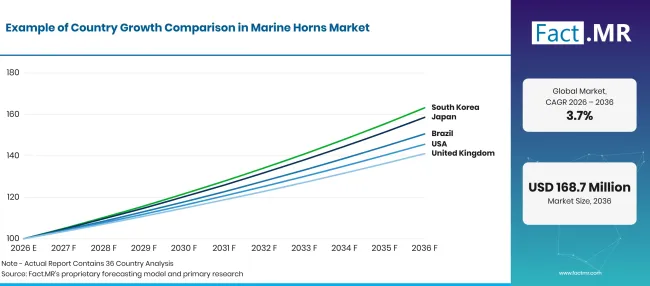
Marine Horns Market Growth Index | Source: Fact.MR
| Country | CAGR (2026-2036) |
|---|---|
| Japan | 4.7% |
| Brazil | 4.2% |
| United States | 3.8% |
| United Kingdom | 3.5% |
| Germany | 2.6% |
Source: Fact.MR analysis. Updated Nov 23, 2026
Source: Fact.MR analysis.
Why is Japan the fastest-growing market for marine horns?
Demand in Japan is projected to grow at a 4.7% CAGR, the fastest among the five key countries, as shipyards and fishing fleets renew equipment.
According to Japan's Ministry of Land, Infrastructure, Transport and Tourism (MLIT), the September 2026 shipbuilding report recorded 10 steel-ship orders totaling 378,000 gross tons, while 21 vessels totaling 907,000 gross tons were completed by the country's 42 major shipyards. The report also recorded 88 steel-ship repair projects. These activities support demand for marine horns in new installations and replacement applications across commercial and fishing vessels.
What is supporting marine horn demand in Brazil?
Sales in Brazil are estimated to increase at a 4.2% CAGR as offshore support and fishing fleets expand. Similar fleet growth is projected to drive sales.
In January 2026, Brazil's National Waterway Transportation Agency (ANTAQ) highlighted its Aquaviário Statistical Dashboard and navigation authorization panels, which provide operational information on shipping activity, authorized operators and their vessel fleets. These government data systems improve visibility into the country's commercial fleet and maritime transport activity, supporting the assessment of potential demand for onboard signaling equipment. Brazil's Ministry of Fisheries and Aquaculture also continued developing its national fisheries monitoring framework in 2026.
How is the large U.S. merchant fleet influencing demand?
Sales in the United States are projected to grow at a 3.8% CAGR as the large recreational fleet replaces horns. Kahlenberg, Grover and Hadley are US brands.
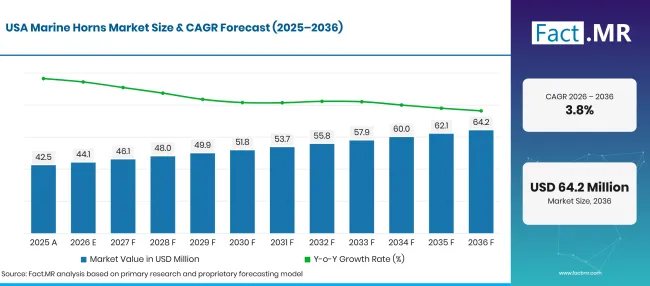
Marine Horns Market Forecast Usa | Source: Fact.MR
Similar replacement is projected to support sales. According to the U.S. Maritime Administration (MARAD), the U.S.-flagged fleet comprised 190 self-propelled, ocean-going merchant vessels of at least 1,000 gross tons in August 2026. This included 59 containerships, 76 tankers, 23 vehicle carriers and five ro-ro vessels. The continued operation of these vessels creates demand for compliant acoustic signaling equipment, including horns used for navigation and warning purposes.
What is shaping marine horn demand in the United Kingdom?
Demand in the United Kingdom is anticipated to capture a 3.5% CAGR as yacht builders and naval programs specify horns. Similar demand is projected to support sales.
According to the Maritime and Coastguard Agency's 2025–2026 annual report, published in July 2026, the UK Ship Register included 4,486 fishing vessels, 13,901 pleasure vessels and 33,674 small vessels as of March 31, 2026. This sizeable registered vessel base supports recurring requirements for onboard signaling equipment, particularly through new installations, safety upgrades and replacement purchases.
Which factors are limiting faster growth in Germany?
Demand in Germany is estimated to hold a 2.6% CAGR, the slowest among the five key countries, as recreational boat sales slowed.
Similar conditions are projected to keep growth slower. Germany's Federal Maritime and Hydrographic Agency (BSH) maintains monthly statistics on German-registered seagoing vessels of at least 100 gross tons, including vessel numbers and gross tonnage by ship type. However, its revised classification system introduced for December 2025 data limits direct comparisons with earlier fleet statistics.
Competitive Landscape for Marine Horns Market
Competition in the marine horns market is divided between horn specialists and automotive component groups. Kahlenberg, Fiamm, Marco, Schmitt & Ongaro and Sea-Dog compete on marine horns and whistles, while Grover, Hadley and FORVIA HELLA compete through air and electric horns shared with vehicles. Buyers select on loudness, certification, corrosion resistance and price.
From 2024 onward, competition shifted toward compact electric designs and consolidation. Faurecia's acquisition of HELLA formed FORVIA. Manufacturers with certified whistles and compact horns are best placed.
Recent Developments
- On June 24, 2025, Sea-Dog Line announced the addition of West Coast Sales as its official sales representative for the West Coast region. The partnership expanded its sales coverage across Oregon, Washington, Western Alaska, Hawaii and British Columbia, strengthening dealer support and distribution for its marine hardware portfolio.
Key Players in Marine Horns Market
Key companies operating in the market include Kahlenberg Industries, FIAMM Componenti Accessori, MARCO S.p.A., Grover Products, Schmitt & Ongaro, Sea-Dog Line, and Hadley Products.
- Kahlenberg Industries
- FIAMM Componenti Accessori
- MARCO S.p.A.
- Grover Products
- Schmitt & Ongaro
- Sea-Dog Line
- Hadley Products
Bibliography
- Agência Nacinal de Transprtes Aquaviáris. (2026, January 26). Seminári da ANTAQ apresenta funcinalidades ds Painéis Aquaviáris. Gvernment f Brazil.
- Faurecia SE. (2022, February 7). Faurecia and HELLA annunce the name f the wrld's seventh largest autmtive supplier: FRVIA.
- Faurecia SE. (2022, January 31). FAURECIA is new majrity sharehlder f HELLA.
- Gvernment f Japan, Ministry f Land, Infrastructure, Transprt and Turism. (2026). Shipbuilding and ship machinery statistics.
- Internatinal Maritime rganizatin. (n.d.). Cnventin n the Internatinal Regulatins fr Preventing Cllisins at Sea, 1972 (CLREGs).
- Kahlenberg Industries, Inc. (n.d.). KB-30A electric marine hrn/hailer.
- Kahlenberg Industries, Inc. (2026). Kahlenberg Industries: Upcming trade shws and marine sund-signaling equipment.
- Maritime and Castguard Agency. (2026). Annual reprt and accunts 2025–2026. Department fr Transprt, United Kingdm.
- Maritime and Castguard Agency. (2026, February 25). Shipping fleet statistics: 2025. GV.UK.
- Maritime Administratin. (2026). U.S.-flagged fleet dashbard: August 2026. U.S. Department f Transprtatin.
- Maritime Administratin. (2026, August 31). Cnslidated changes August 2026: ceanging, self-prpelled vessels f 1,000 grss tns and abve that carry carg frm prt t prt. U.S. Department f Transprtatin.
- METSTRADE. (2026). Exhibitrs: METSTRADE 2026. https://www.metstrade.cm/exhibitrs
- Sea-Dg Line. (2025, June 24). Sea-Dg expands representatin with additin f West Cast Sales.
- Sea-Dg Line. (2026). 2026 supplement: Quality marine gear.
- Sea-Dg Line. (n.d.). Dampening hinges.
- UN Trade and Develpment. (2025). Review f maritime transprt 2025: Staying the curse in turbulent waters. United Natins.
- UN Trade and Develpment. (2026). Maritime and ther transprt: Wrld fleet capacity t carry gds grwing steadily. UNCTADstat.
Segmentation
Scope of Report
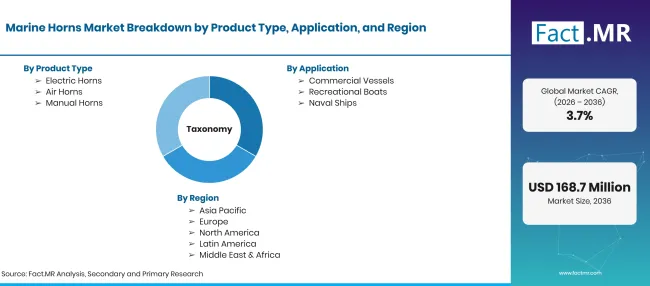
Marine Horns Market Taxonomy | Source: Fact.MR
| Items | Values |
|---|---|
| Quantitative Units (2026) | USD 117.1 Million |
| Product Type | Electric Horns, Air Horns, Manual Horns |
| Application | Commercial Vessels, Recreational Boats, Naval Ships |
| Distribution Channel | Offline, Online |
| Material | Stainless Steel, Plastic, Brass, Others |
| Regions Covered | North America, Latin America, Europe, Asia Pacific, Middle East & Africa |
| Countries Covered | United States, Germany, Japan, United Kingdom, Brazil, and other countries |
| Key Companies Profiled | Kahlenberg Industries, Fiamm Componenti Accessori, Marco S.p.A., Grover Products, Hadley Products, Sea-Dog Line, Schmitt & Ongaro, FORVIA HELLA |
| Additional Attributes | Dollar revenue in the Marine Horns Market is segmented by product type (electric horns, air horns, manual horns); application (commercial vessels, recreational boats, naval ships); distribution channel (offline, online); material (stainless steel, plastic, brass) and region. |
Source: Fact.MR analysis. Updated Nov 23, 2026
Source: Fact.MR analysis.
Marine Horns Market by Segments
-
Product Type
- Electric Horns
- Air Horns
- Manual Horns
-
Application
- Commercial Vessels
- Recreational Boats
- Naval Ships
-
Distribution Channel
- Offline
- Online
-
Material
- Stainless Steel
- Plastic
- Brass
- Others
-
Region:
- North America
- United States
- Canada
- Mexico
- Europe
- Germany
- United Kingdom
- France
- Italy
- Spain
- Rest of Europe
- Asia Pacific
- China
- India
- Japan
- South Korea
- Australia
- Rest of Asia Pacific
- Latin America
- Brazil
- Argentina
- Rest of Latin America
- Middle East & Africa
- GCC Countries
- South Africa
- Rest of Middle East & Africa
- North America
Frequently Asked Questions
How big is the global Marine Horns Market in 2026?
What will be the size of the Marine Horns Market by 2036?
How fast will the Marine Horns Market grow during the forecast period?
Which product type segment holds the largest share of the Marine Horns Market?
Who worked on this report


Preview the report firsthand - request a free sample
Free SampleGet the brochure for pricing and purchase details
Download PDF