- Market Value (2025): USD 313.0 Mn
- Estimated Value (2026): USD 325.5 Mn
- Forecast Value (2036): USD 482.3 Mn
- CAGR (2026-2036): 4.0%
Offshore Overalls Market Forecast and Outlook 2026 to 2036
According to the Fact.MR analysis, the offshore overalls market crossed a valuation of USD 313.0 million in 2025 and is projected to grow from USD 325.5 million in 2026 to USD 482.3 million by 2036. Demand for offshore overalls is likely to grow at a CAGR of 4.0% over the forecast period.
Demand for offshore overalls is rising as oil and gas, offshore wind and marine crews need coveralls that resist flash fire, arc flash, oil and cold. Manufacturing company of offshore overalls are offering inherent flame-resistant fabrics, hi-vis trims and integrated buoyancy. For example, Petrobras' 2025 to 2029 strategic plan calls for about USD 111 billion of capital spending, much of it on offshore production. Similar offshore investment is projected to drive sales of offshore overalls through 2036.
Key Takeaways from the Offshore Overalls Market
- Offshore Overalls Market Value (2025): USD 313.0 million
- Offshore Overalls Market Value (2026): USD 325.5 million
- Offshore Overalls Market Forecast Value (2036): USD 482.3 million
- Offshore Overalls Market Forecast CAGR (2026-2036): 4.0%
- Leading Material Type: Cotton (35.8%)
- Key Market Participants: Portwest Ltd., Red Wing Safety, Bulwark FR, Lakeland Industries, Wenaas, Sioen Industries, Tranemo Workwear, Fristads, DuPont de Nemours, Carhartt Inc., Ansell Ltd., Drägerwerk AG
- Key Growth Regions: Brazil, United Kingdom, Japan, Germany, United States
In 2024, Honeywell sold its personal protective equipment business to Protective Industrial Products, and Ansell completed its purchase of Kimberly-Clark's PPE business. Demand for offshore overalls is growing as PPE specialists consolidate brands and channels. Manufacturing company are widening protective clothing portfolios. Similar consolidation is projected to shape sales of offshore overalls worldwide.
Offshore Overalls Market
| Metric | Value |
|---|---|
| Estimated Value in (2026) | USD 325.5 million |
| Forecast Value in (2036) | USD 482.3 million |
| Forecast CAGR (2026 to 2036) | 4.0% |
Source: Fact.MR analysis. Updated Nov 23, 2026
Source: Fact.MR analysis.
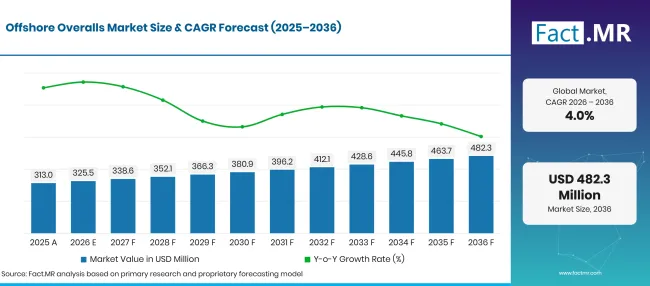
Offshore Overalls Market Forecast Global | Source: Fact.MR
Category
| Category | Segments |
|---|---|
| Material Type | Cotton, Polyester, Nylon, Others |
| Application | Oil & Gas, Marine, Construction, Others |
| End-User | Industrial, Commercial, Others |
| Distribution Channel | Specialty Stores, Online Stores, Others |
| Region | Brazil; United Kingdom; Japan; Germany; United States |
Source: Fact.MR analysis. Updated Nov 23, 2026
Source: Fact.MR analysis.
Segmental Analysis
Why does cotton lead material demand in the Offshore Overalls Market?
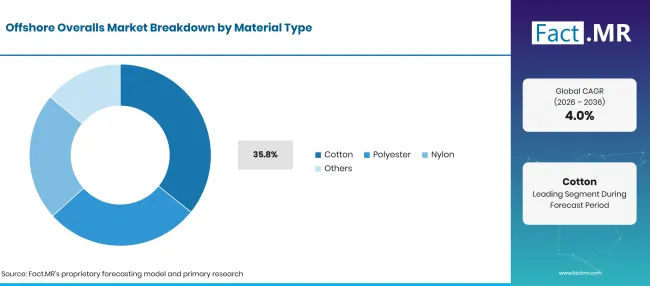
Offshore Overalls Market Breakdown Material Type | Source: Fact.MR
Demand for Cotton accounts for 35.8% of revenue in 2026, about USD 115 million, as flame-retardant treated cotton and cotton blends are comfortable in heat and cost less than aramids. Polyester and nylon serve outer shells and cold-weather layers. Manufacturers are offering FR cotton that meets NFPA 2112 and EN ISO 11612. Similar comfort needs are projected to keep cotton in the lead. The Indian Ministry of Textiles reported provisional cotton production of 290.91 lakh bales for the 2025–26 season in July 2026, highlighting the continued availability of cotton as an industrial textile input. Manufacturing company are developing flame-resistant cotton blends to combine wearer comfort with protection against thermal hazards.
Why does oil and gas lead application demand in the Offshore Overalls Market?
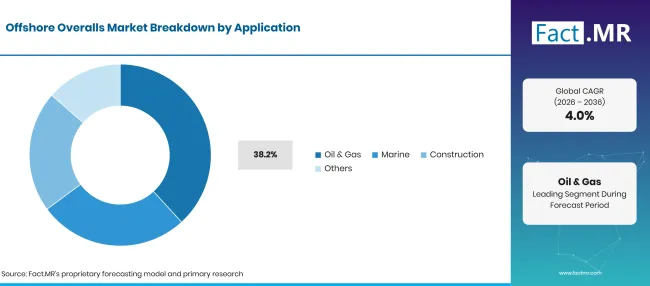
Offshore Overalls Market Breakdown Application | Source: Fact.MR
Sales of Oil and gas to generate 38.2% of revenue in 2026, about USD 125 million, as platform and drilling crews must wear flame-resistant coveralls. Marine and construction uses follow. Manufacturing company are serving operators through framework contracts. Similar offshore activity is projected to keep oil and gas in the lead. The U.S. Bureau of Ocean Energy Management estimated that offshore oil and gas activities supported approximately 245,000 jobs and generated USD 58.2 billion in economic output during FY 2025. This substantial industrial activity creates recurring procurement opportunities for flame-resistant coveralls, particularly among drilling contractors and offshore operators.
Why do industrial users lead end-user demand in the Offshore Overalls Market?
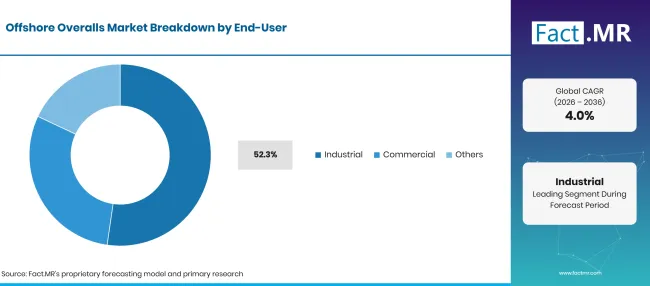
Offshore Overalls Market Breakdown End User | Source: Fact.MR
Industrial users segment holds 52.3% of revenue in 2026, about USD 170 million, as operators, drilling contractors and service companies issue coveralls to large workforces. Commercial users follow. Manufacturing company are offering laundering and rental programs. Similar workforce needs are projected to keep industrial users in the lead. The U.S. Department of Energy's 2026 United States Energy and Employment Report recorded 86,700 workers in offshore petroleum-related employment in 2025, including 33,500 in mining and extraction and 40,900 in manufacturing. This workforce creates recurring requirements for flame-resistant clothing, replacement coveralls and protective workwear.
Why do specialty stores lead distribution in the Offshore Overalls Market?
Offshore Overalls Market Breakdown Distribution Channel | Source: Fact.MR
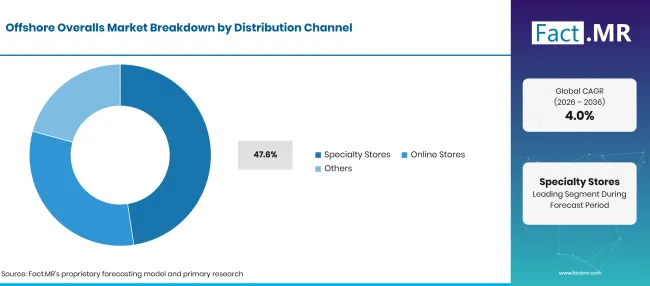
Sales through Specialty stores and PPE distributors to represent 47.6% of revenue in 2026, about USD 155 million, as buyers need certified, sized garments. Online sales grow for small firms. OSHA guidance requires employers to assess workplace hazards and select appropriate protective clothing, including flame-resistant garments where necessary. This creates opportunities for specialist distributors that can support product selection, compliance documentation and bulk procurement. Online channels are expanding, but technical purchasing requirements continue to favor specialist suppliers.
Offshore Overalls Market-Drivers, Restraints & Trends
Drivers: Expansion of Offshore Wind Projects
Demand for offshore overalls is increasing as offshore wind installations expand across the North Sea, the U.S. East Coast and Asia, creating requirements for protective clothing for installation, maintenance and commissioning crews. The U.S. Energy Information Administration reported in 2026 that developers had plans for approximately 5,089 MW of offshore wind generation capacity off New York, Rhode Island and Virginia. In Germany, 84 offshore wind turbines with 1.1 GW of capacity began supplying electricity during the first half of 2026. These developments are increasing the potential workforce requiring flame-resistant, high-visibility and weather-resistant workwear. Similar offshore construction activity is projected to support overalls sales through the forecast period.
Restraints: Oil Price Volatility and Extended Garment Replacement Cycles
Sales of offshore overalls faces uncertainty from fluctuations in oil prices, which can influence capital allocation for offshore exploration, drilling and maintenance projects. The U.S. Energy Information Administration's November 2026 outlook expected Brent crude prices to remain near USD 100 per barrel during the remainder of 2026, reflecting constrained supply and geopolitical disruptions. Although higher prices can support some upstream investment, volatility makes project budgeting and procurement less predictable. Additionally, industrial laundering and the durability of certified protective garments can extend replacement intervals, limiting repeat purchases. Manufacturers must demonstrate garment durability while developing rental and managed-workwear services to maintain recurring sales.
Opportunity: Multi-Hazard Protection: Growing Demand for Multi-Hazard Protective Clothing
Demand for offshore overalls offering combined protection against flash fires, electric arcs and chemical splashes is creating opportunities for manufacturers of advanced protective fabrics. The U.S. Occupational Safety and Health Administration requires employers to assess flame and electrical arc hazards and provide flame-resistant clothing with suitable arc ratings where applicable. The U.S. Department of Energy also identifies specialized safety training for offshore wind construction, maintenance and operating personnel as an important workforce requirement. These safety requirements are encouraging suppliers to develop multi-standard garments using flame-resistant fabrics, including Nomex-based materials, with integrated high-visibility and chemical-protection features. Similar workplace safety requirements are projected to support demand for multi-hazard offshore overalls.
Trend: Development of Offshore Wind-Specific Workwear
Demand for offshore wind-specific workwear is increasing as the sector requires technicians to perform installation, electrical maintenance and turbine servicing in exposed marine environments. A 2026 offshore wind workforce assessment published through the UK Government's research programme identified 39,898 offshore wind workers in the UK workforce in 2025, including 10,217 wind turbine technicians. The growing requirement for specialized personnel is encouraging workwear suppliers to develop lighter protective garments with flame resistance, visibility, weather protection and improved mobility for climbing and maintenance activities. Similar workforce requirements are projected to support sales of specialized offshore overalls.
Offshore Overalls Market by Analysis by Key Country
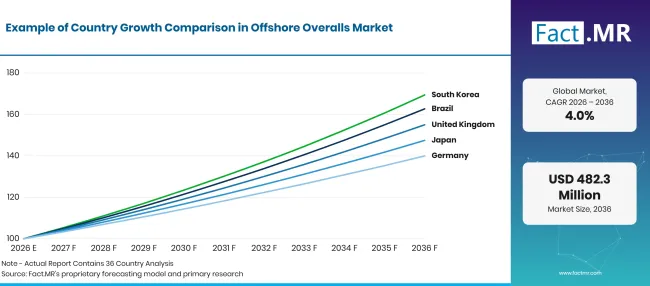
Offshore Overalls Market Growth Index | Source: Fact.MR
| Country | CAGR (2026-2036) |
|---|---|
| Brazil | 5.0% |
| United Kingdom | 4.5% |
| Japan | 4.0% |
| Germany | 3.4% |
| United States | 3.0% |
Source: Fact.MR analysis. Updated Nov 23, 2026
Source: Fact.MR analysis.
Why is Brazil the fastest-growing market for offshore overalls?
Sales of offshore overalls in Brazil are projected to grow at a 5.0% CAGR, the fastest among the five key countries, as Petrobras adds FPSOs in the pre-salt fields.
Manufacturing company serve operators through local distributors. Similar investment is projected to drive sales in Brazil. Brazil's National Agency of Petroleum, Natural Gas and Biofuels (ANP) reported that September 2026 petroleum production reached 4.711 million barrels per day, increasing 20.3% year over year. Offshore fields accounted for 98.1% of petroleum production, while pre-salt operations contributed 82.4% of total oil and gas output. This expanding offshore production base creates recurring demand for flame-resistant coveralls among platform operators, drilling contractors and maintenance crews.
What is shaping offshore overall demand in the United Kingdom?
Demand for offshore overalls in the United Kingdom is estimated to record at a 4.5% CAGR as offshore wind expansion offsets North Sea oil decline under the Energy Profits Levy.
Portwest and other suppliers serve UK crews. Similar shifts are projected to drive sales. The Department for Energy Security and Net Zero reported in its 2025–2026 annual performance report that the early-2026 renewable energy auction secured 8.4 GW of offshore wind capacity. This project pipeline provides opportunities for suppliers of flame-resistant and weather-resistant protective garments. Portwest and other PPE suppliers can serve contractors involved in offshore energy operations.
What is shaping offshore overall demand in Japan?
Demand in Japan is projected to increase at a 4.0% CAGR as offshore wind auctions add projects. Similar build-out is projected to drive sales.
Japan's Ministry of Economy, Trade and Industry reported in June 2026 that the country had formed an offshore wind project pipeline of up to 6.4 GW under its offshore renewable energy development framework. This includes approximately 1.8 GW from the second auction round and 1.1 GW from the third round in selected projects. Continued project development is expected to create procurement opportunities for protective overalls used by offshore technicians and vessel crews.
What is shaping offshore overall demand in Germany?
Germany's Federal Network Agency reported that installed offshore wind capacity reached approximately 11.539 GW by September 2026, compared with 9.733 GW in 2025.
The increase represents approximately 18.5% year-over-year growth in installed capacity. This expanding infrastructure supports demand for durable protective garments among offshore technicians, contractors and maintenance teams. Drägerwerk is an established German safety-equipment supplier. Demand in Germany is anticipated to grow at a 3.4% CAGR as North Sea and Baltic wind farms are built. Drägerwerk supplies safety equipment. Similar build-out is projected to support sales.
Why is offshore overall growth slower in the United States?
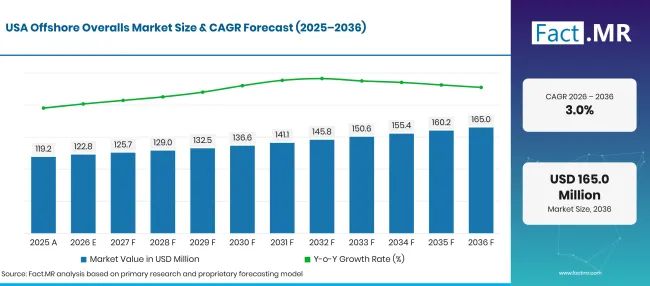
Sales in the United States are projected to increase at a 3.0% CAGR, the slowest among the five key countries, as offshore wind projects faced federal permitting pauses in 2025.
Offshore Overalls Market Forecast Usa | Source: Fact.MR
Gulf of Mexico oil remains steady. Similar uncertainty is projected to keep growth slower. The Bureau of Ocean Energy Management (BOEM) confirms that federal offshore wind leasing and new project approvals are temporarily paused pending a review of federal leasing and permitting practices. BOEM also reported that 474 of 2,059 active Outer Continental Shelf leases were producing oil and gas as of May 2026. Continued offshore petroleum operations provide a demand base for flame-resistant workwear.
Competitive Landscape for Offshore Overalls Market
Competition in the offshore overalls market is divided among protective clothing manufacturers, PPE suppliers and industrial workwear brands. DuPont de Nemours competes on protective fibers, Ansell, Lakeland Industries and Drägerwerk compete on protective equipment, while Portwest, Red Wing Safety, Bulwark FR, Wenaas, Sioen Industries, Tranemo Workwear, Fristads and Carhartt compete on industrial workwear and protective garments. Buyers select products based on safety certifications, flame resistance, comfort and durability.
From 2024 onward, competition increasingly emphasized multi-norm protection, garment performance and compliance with offshore safety requirements. Manufacturers offering certified flame-resistant, antistatic and multi-hazard protective overalls are better positioned to strengthen their market presence.
Recent Developments
- In 2024, Honeywell sold its PPE business to Protective Industrial Products.
- In 2024, Ansell completed its acquisition of Kimberly-Clark's PPE business.
- In November 2024, Petrobras published its 2025 to 2029 strategic plan.
- In November 2026, Tranemo introduced HTFR Dots, a new reinforcement fabric featuring a Tera TX-based ripstop weave for improved tear strength and abrasion resistance. The material provides 50% higher tear strength and combines inherent flame-retardant protection with a PFAS-free finish. The company plans to gradually incorporate the updated reinforcement into its existing workwear products.
- In March 2026, Fristads launched Multinorm Green, a protective clothing collection combining flame protection, electric arc protection, anti-static properties and liquid chemical protection. The range includes coveralls, bib-and-brace overalls, trousers, jackets and tops. It uses organic cotton and traceable lyocell, with reinforced ripstop in high-wear areas. The collection carries Environmental Product Declarations (EPDs) and is PFAS-free.
- In October 2026, Carhartt introduced its Steel Series on October 7, 2026, featuring reinforced workwear designed for demanding working conditions. The collection includes the Steel Braddock Bib Overall, Steel Braddock Jacket, Steel Bridgeport Sweatshirt and several work trousers. Selected products feature nylon-cotton fabrics engineered for abrasion resistance, tensile strength and stretch.
- In November 2026, Sioen announced the SYNQ & SEEN collection on November 18, 2026. The range is certified under EN 17353 for enhanced visibility in medium-risk working environments. It includes work trousers, T-shirts, polos, sweatshirts, midlayers and softshell jackets. The garments incorporate recycled materials and are designed for comfort and visibility.
Bibliography
- Ansell Limited. 2024. Completion of Kimberly-Clark PPE acquisition. Melbourne: Ansell.
- Honeywell International. 2024. Honeywell completes sale of PPE business. Charlotte, NC: Honeywell.
- Petrobras. 2024. Strategic Plan 2025-2029. Rio de Janeiro: Petrobras.
- Ansell Limited. (2024, July 2). Ansell completes acquisition of Kimberly-Clark’s personal protective equipment business.
- Bureau of Ocean Energy Management. (2026). Economic contribution of U.S. Outer Continental Shelf energy development. U.S. Department of the Interior.
- Bureau of Ocean Energy Management. (2026). Oil and gas energy. U.S. Department of the Interior.
- Bureau of Ocean Energy Management. (2026, May 1). Combined leasing report: Outer Continental Shelf lease statistics. U.S. Department of the Interior.
- Bundesnetzagentur. (2026). EE-Statistik Marktstammdatenregister.
- Carhartt. (2026, October 7). Carhartt introduces Steel Series, next level workwear engineered to take on the toughest jobs.
- Federal Ministry for Economic Affairs and Energy. (2026, June 24). 経済産業省説明資料 [Ministry of Economy, Trade and Industry briefing materials]. Government of Japan.
- German Offshore Wind Energy Foundation. (2026). Status of offshore wind energy development in Germany: First half of 2026.
- Honeywell International Inc. (2024, November 22). Honeywell to sell personal protective equipment business to Protective Industrial Products.
- Honeywell International Inc. (2025, May 22). Honeywell completes sale of personal protective equipment business to Protective Industrial Products.
- Ministry of Textiles, Government of India. (2026, July 24). Cotton production. Press Information Bureau.
- Occupational Safety and Health Administration. (n.d.). 1910.269 Appendix E: Protection from flames and electric arcs. U.S. Department of Labor.
- Occupational Safety and Health Administration. (n.d.). Electric power generation, transmission, and distribution: Personal protective equipment—Flame-resistant clothing. U.S. Department of Labor.
- Occupational Safety and Health Administration. (n.d.). Electric power generation, transmission and distribution standard: Frequently asked questions. U.S. Department of Labor.
- Offshore Renewable Energy Catapult. (2026, August 24). Skills and workforce for offshore wind in Chile [Report]. UK Government.
- Petrobras. (2024, November 21). Petrobras has released its business plan 2025–2029 with investments of USD 111 billion.
- Sioen Industries. (2026, November 18). SYNQ launches new EN 17353 workwear collection.
- U.S. Energy Information Administration. (2026, November 10). Short-term energy outlook. U.S. Department of Energy.
- U.S. Energy Information Administration. (2026). Where wind power is harnessed. U.S. Department of Energy.
- U.S. Government Accountability Office. (2026). Offshore energy and workforce-related reports.
- U.S. Department of Energy. (2026). United States energy and employment report 2026.
- Wind Energy Network. (2026, July 21). Status offshore windenergie 1. Halbjahr 2026 [Offshore wind energy status, first half of 2026].
Segmentation
Key Players in Offshore Overalls Market
Key companies operating in the market include Portwest Ltd., Red Wing Safety, Bulwark FR, Lakeland Industries, Wenaas, Sioen Industries, Tranemo Workwear, Fristads, DuPont de Nemours, Carhartt Inc., Ansell Ltd., and Drägerwerk AG.
- Portwest Ltd.
- Red Wing Safety
- Bulwark FR
- Lakeland Industries
- Wenaas
- Sioen Industries
- Tranemo Workwear
- Fristads
- DuPont de Nemours
- Carhartt Inc.
- Ansell Ltd.
- Drägerwerk AG
Scope of Report
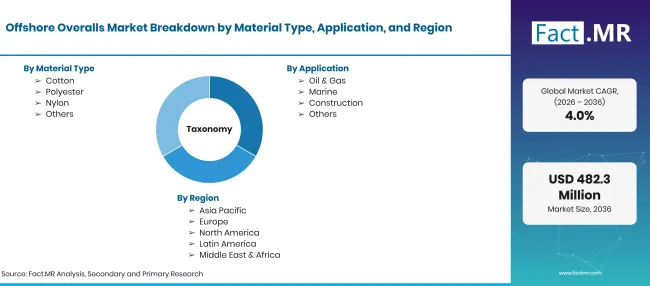
Offshore Overalls Market Taxonomy | Source: Fact.MR
| Items | Values |
|---|---|
| Quantitative Units (2026) | USD 325.5 Million |
| Material Type | Cotton, Polyester, Nylon, Others |
| Application | Oil & Gas, Marine, Construction, Others |
| End-User | Industrial, Commercial, Others |
| Distribution Channel | Specialty Stores, Online Stores, Others |
| Regions Covered | North America, Latin America, Europe, Asia Pacific, Middle East & Africa |
| Countries Covered | United States, Germany, Japan, United Kingdom, Brazil, and other countries |
| Key Companies Profiled |
|
| Additional Attributes | Dollar revenue in the Offshore Overalls Market is segmented by material type (cotton, polyester, nylon); application (oil & gas, marine, construction); end-user (industrial, commercial); distribution channel (specialty stores, online stores) and region. |
Source: Fact.MR analysis. Updated Nov 23, 2026
Offshore Overalls Market by Segments
-
Material Type
- Cotton
- Polyester
- Nylon
- Others
-
Application
- Oil & Gas
- Marine
- Construction
- Others
-
End-User
- Industrial
- Commercial
- Others
-
Distribution Channel
- Specialty Stores
- Online Stores
- Others
-
Region:
- North America
- United States
- Canada
- Mexico
- Europe
- Germany
- United Kingdom
- France
- Italy
- Spain
- Rest of Europe
- Asia Pacific
- China
- India
- Japan
- South Korea
- Australia
- Rest of Asia Pacific
- Latin America
- Brazil
- Argentina
- Rest of Latin America
- Middle East & Africa
- GCC Countries
- South Africa
- Rest of Middle East & Africa
- North America
Frequently Asked Questions
How big is the global Offshore Overalls Market in 2026?
What will be the size of the Offshore Overalls Market by 2036?
How fast will the Offshore Overalls Market grow during the forecast period?
Which material type segment holds the largest share of the Offshore Overalls Market?
Who worked on this report


Preview the report firsthand - request a free sample
Free SampleGet the brochure for pricing and purchase details
Download PDF