- Base Value(2025): 28.6 Bn
- Estimated Value(2026): 30.4 Bn
- Forecast Value (2036): 52.9 Bn
- CAGR (2026 - 2036): 5.7%
MDI Variants for Rigid Foam Insulation Market Forecast and Outlook By Fact.MR
Valuation of the MDI Variants for Rigid Foam Insulation market stood at USD 28.6 billion in 2025. According to Fact MR, demand for MDI-based rigid foam insulation materials is expected to reach USD 30.4 billion in 2026 and USD 52.9 billion by 2036. A CAGR of 5.7% is projected for the forecast timeline.
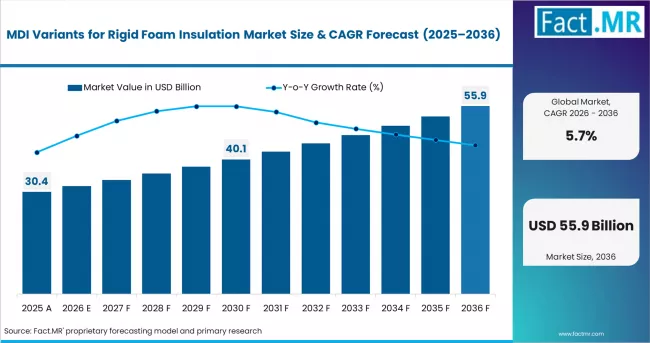
Mdi Variants For Rigid Foam Insulation Market Market Value Analysis | Source: Fact.MR
MDI Variants for Rigid Foam Insulation Market
| Metric | Details |
|---|---|
| Industry Size (2026E) | USD 30.4 billion |
| Industry Value (2036F) | USD 52.9 billion |
| CAGR (2026 to 2036) | 5.7% |
Source: Fact.MR analysis. Updated Apr 15, 2026
Summary of the MDI Variants for Rigid Foam Insulation Market
- Market Definition
- The MDI Variants for Rigid Foam Insulation Market includes methylene diphenyl diisocyanate based intermediates such as polymeric MDI, pure MDI, and modified MDI used in polyurethane and polyisocyanurate rigid foam systems that provide thermal insulation, compressive strength, and moisture resistance across construction panels, refrigeration units, industrial insulation systems, and appliance insulation components.
- Demand Drivers
- Stable demand for rigid polyurethane insulation materials supporting thermal efficiency across residential and commercial construction structures
- Increasing utilization of polymeric MDI formulations supporting dimensional stability across closed cell insulation foam systems
- Continued consumption of rigid foam materials supporting temperature control performance across refrigeration and cold chain logistics infrastructure
- Consistent incorporation of polyurethane insulation systems supporting structural strength across industrial equipment and pipe insulation applications
- Key Segments Analyzed
- Product Type: Polymeric MDI accounts for 48% share supported by suitability for high density closed cell foam structures
- End Use Industry: Building and construction represents 54% share driven by demand for high performance insulation panels and spray foam systems
- Application: Construction insulation demonstrates stable consumption across wall assemblies, roofing systems, and structural insulation components
- Geography: North America and Europe demonstrate steady demand across energy efficient building material manufacturing environments
- Analyst Opinion at Fact MR
- Shambhu Nath Jha, Principal Consultant, Fact MR, opines, "In this updated edition of the MDI Variants for Rigid Foam Insulation Market report, demand remains aligned with continued utilization of polymeric MDI chemistry supporting thermal insulation performance, structural durability, and dimensional stability across construction and refrigeration insulation systems through 2036."
- Strategic Implications Executive Takeaways
- Maintain stable supply chain access to aromatic isocyanate feedstock supporting polyurethane foam production continuity
- Strengthen formulation compatibility supporting controlled foam cell structure and thermal conductivity performance
- Monitor regulatory frameworks influencing occupational safety compliance requirements for isocyanate handling
- Optimize processing efficiency supporting consistent polymeric MDI reactivity across rigid foam insulation manufacturing environments
- Methodology
- Primary interviews conducted with isocyanate manufacturers, polyurethane formulators, and insulation material producers
- Desk research based on polymer chemistry literature, technical datasheets, regulatory documentation, and industry publications
- Hybrid top-down insulation demand assessment combined with bottom-up MDI variant consumption benchmarking
- Validation through supplier data triangulation, expert consultation, and monitoring of rigid foam insulation adoption trends
An increase of USD 22.5 billion indicates incremental but structurally durable expansion driven by steady demand for high-performance insulation in construction and cold chain infrastructure. Growth remains supported by energy efficiency regulations, while constraints persist from isocyanate handling compliance costs, petrochemical feedstock volatility, and substitution competition from alternative insulation materials.
The United Kingdom leads with a projected CAGR of 6.2%, supported by stable demand for rigid polyurethane insulation across residential and commercial construction applications. Germany follows with a CAGR of 6.0%, driven by consistent use of MDI-based foam systems across building envelope insulation solutions. The United States records a CAGR of 5.7%, reflecting steady consumption of rigid foam insulation materials across infrastructure and building renovation activities. France shows a CAGR of 5.5%, supported by gradual replacement of traditional insulation materials across construction projects. Japan records the slowest growth at 5.1%, reflecting a mature market where demand is largely tied to replacement cycles within established building insulation systems. Mature markets generate a significant share of replacement demand as insulation performance requirements remain aligned with thermal efficiency standards and building material durability expectations across construction applications.
Segmental Analysis
MDI Variants for Rigid Foam Insulation Market Analysis by End Use Industry
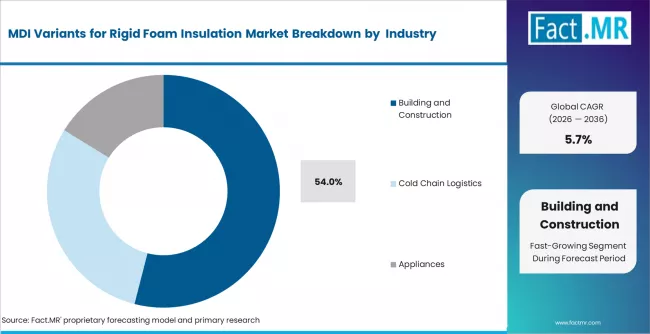
Mdi Variants For Rigid Foam Insulation Market Analysis By End Use Industry | Source: Fact.MR
- Market Overview: Based on Fact MR assessment, building and construction industry is projected to account for 54% share of the MDI variants for rigid foam insulation market in 2026. Methylene diphenyl diisocyanate is incorporated into polyurethane rigid foam systems requiring controlled thermal conductivity and dimensional stability across insulation panel structures. Construction materials incorporate rigid foam insulation within wall assemblies, roofing systems, and structural panels requiring resistance to heat transfer and moisture penetration. Polyurethane foam formation supports closed cell structure development enabling stable insulation performance across varied environmental exposure conditions encountered in residential and commercial construction applications.
- Demand Drivers:
- Thermal Insulation Requirements: Rigid polyurethane foam demonstrates low thermal conductivity supporting energy efficiency performance across building envelope structures.
- Structural Stability Parameters: Foam insulation materials maintain dimensional integrity across temperature fluctuation conditions affecting building material performance.
- Material Compatibility Needs: Polyurethane foam systems integrate within composite insulation panels requiring stable adhesion to metal, wood, and concrete substrates.
MDI Variants for Rigid Foam Insulation Market Analysis by Product Type
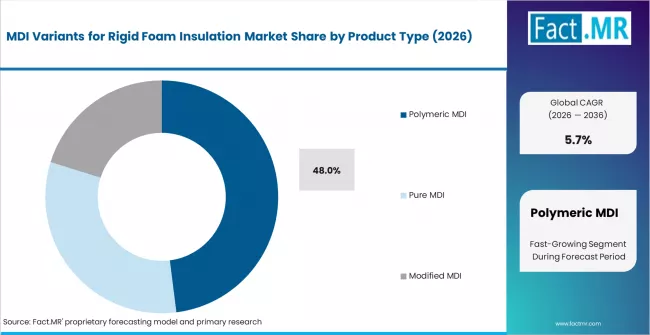
Mdi Variants For Rigid Foam Insulation Market Analysis By Product Type | Source: Fact.MR
- Market Overview: Polymeric MDI is estimated to hold 48% share of the MDI variants for rigid foam insulation market in 2026 due to suitability for production of high density polyurethane foam structures requiring controlled crosslink density and mechanical strength characteristics. Polymeric MDI composition supports formation of rigid cellular foam networks enabling compressive strength performance across insulation board and spray foam applications. Chemical structure compatibility supports reaction with polyols forming stable urethane linkages required for development of rigid insulation materials demonstrating resistance to deformation under load conditions.
- Demand Drivers:
- Foam Density Control Requirements: Polymeric MDI supports formation of closed cell foam structures enabling mechanical strength across insulation material applications.
- Crosslinking Performance Parameters: Polymer network formation supports structural rigidity required across load bearing insulation panel configurations.
Processing Compatibility Needs: Polymeric MDI demonstrates stable reactivity with polyol components enabling predictable foam expansion behavior across insulation manufacturing workflows.
Key Dynamics
MDI Variants for Rigid Foam Insulation Market Drivers, Restraints, and Opportunities
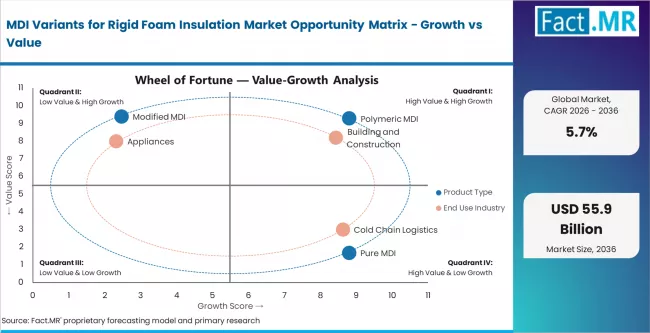
Mdi Variants For Rigid Foam Insulation Market Opportunity Matrix Growth Vs Value | Source: Fact.MR
Fact MR analysis indicates that the MDI variants market for rigid foam insulation developed from polyurethane chemistry used to produce closed-cell foams with low thermal conductivity and structural stability. Historically, polymeric MDI and monomeric MDI enabled production of rigid polyurethane foam widely used in construction panels, refrigeration insulation, and industrial thermal barriers. The current market valuation reflects sustained demand from building insulation systems where rigid foam provides high insulation efficiency and dimensional stability. Demand persists because MDI-based polyurethane foams deliver low thermal conductivity and structural strength required for energy-efficient building envelopes.
A structural shift is occurring as conventional insulation materials such as mineral wool and expanded polystyrene compete with high-performance rigid polyurethane and polyisocyanurate foams. Traditional insulation materials remain widely used where cost efficiency and installation familiarity remain priorities. Polymeric MDI enables improved foam cell structure and insulation performance but involves higher raw material costs and controlled formulation processes. Regulatory pressure related to building energy efficiency requirements is increasing adoption of higher-performance insulation materials. Even with moderate construction growth, higher per-unit value of advanced insulation foams supports steady market value expansion.
- High Efficiency Insulation: Manufacturers use polymeric MDI and modified MDI variants to produce rigid polyurethane and polyisocyanurate foams with strong thermal insulation properties.
- Building Energy Standards: Regulations promoting energy-efficient construction, including thermal performance codes, increase demand for rigid foam insulation materials.
- Asia Construction Growth: China and Southeast Asia maintain high construction activity levels supporting demand for insulation-grade polyurethane foam systems.
Regional Analysis
Regions Covered and Geographic Segmentation
The MDI Variants for Rigid Foam Insulation Market is assessed across North America, Europe, Asia Pacific, Latin America, and Middle East & Africa, segmented by country-level demand in construction insulation materials, refrigeration insulation systems, and energy-efficient building applications. Regional demand reflects thermal performance standards, building efficiency regulations, and specialty polyurethane formulation development. The full report offers market attractiveness analysis.
.webp "Top Country Growth Comparison Mdi Variants For Rigid Foam Insulation Market Cagr (2026 2036)")
Top Country Growth Comparison Mdi Variants For Rigid Foam Insulation Market Cagr (2026 2036) | Source: Fact.MR
| Country | CAGR (2026–2036) |
|---|---|
| United Kingdom | 6.2% |
| Germany | 6.0% |
| United States | 5.7% |
| France | 5.5% |
| Japan | 5.1% |
Source: Fact.MR analysis. Updated Apr 15, 2026
Source: Fact MR analysis, based on proprietary forecasting model and primary research
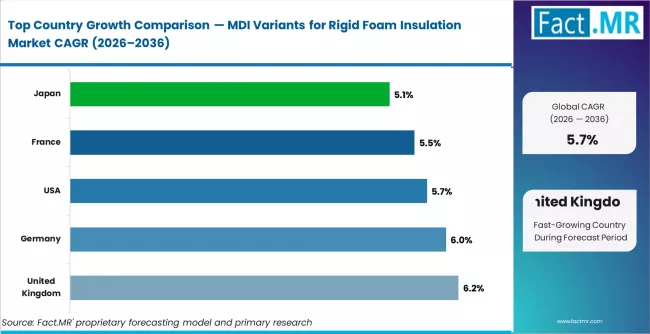
Mdi Variants For Rigid Foam Insulation Market Cagr Analysis By Country | Source: Fact.MR
Europe
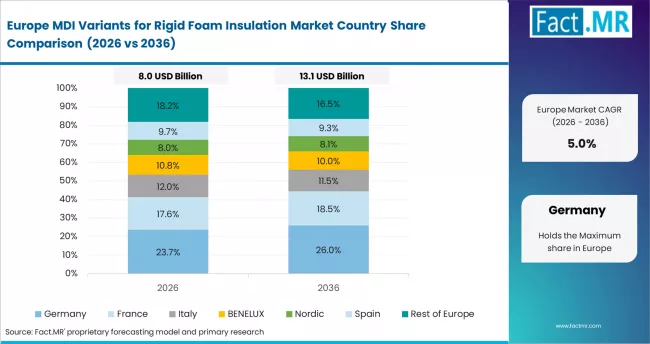
Mdi Variants For Rigid Foam Insulation Market Europe Country Market Share Analysis, 2026 & 2036 | Source: Fact.MR
Europe functions as the energy-efficient insulation regulatory laboratory for polyurethane foam materials, supported by structured building performance frameworks and specialty polymer innovation ecosystems. Covestro AG strengthens MDI-based polyurethane formulation capabilities. BASF SE expands rigid foam insulation material innovation. Huntsman Corporation supports specialty isocyanate derivative production.
- United Kingdom: Demand for MDI variants for rigid foam insulation in United Kingdom is projected to rise at 6.2% CAGR through 2036. The UK Future Homes Standard update (Department for Levelling Up, Housing and Communities, 2021) supports high-performance insulation adoption. Covestro AG expanded rigid foam polyurethane formulation capabilities (March 2023), supporting market growth.
- Germany: Demand for MDI variants for rigid foam insulation in Germany is projected to rise at 6.0% CAGR through 2036. The Energy Efficiency Strategy for Buildings update (Federal Ministry for Economic Affairs and Climate Action, 2022) supports advanced insulation material demand. BASF SE expanded polyurethane insulation material production capacity (February 2023), supporting adoption.
- France: Demand for MDI variants for rigid foam insulation in France is projected to rise at 5.5% CAGR through 2036. The French Thermal Regulation framework update (Ministry for Ecological Transition, 2021) supports high-performance insulation adoption. Huntsman Corporation expanded isocyanate derivative supply capabilities (January 2023), supporting market expansion.
North America
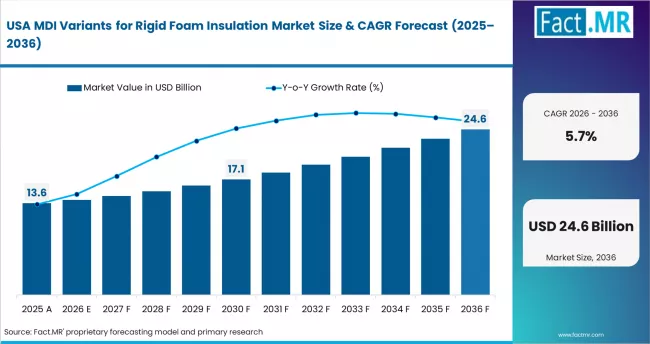
Mdi Variants For Rigid Foam Insulation Market Country Value Analysis | Source: Fact.MR
North America functions as the advanced building insulation material commercialization and polyurethane resin innovation hub, supported by strong demand for thermal efficiency solutions in residential and commercial construction. Dow Inc. strengthens polyurethane insulation formulation capabilities. Huntsman Corporation expands rigid foam material innovation portfolio. BASF SE supports high-performance insulation material development.
- United States: Demand for MDI variants for rigid foam insulation in United States is projected to rise at 5.7% CAGR through 2036. The Energy Conservation Code update (U.S. Department of Energy, 2021) supports adoption of energy-efficient insulation materials. Dow Inc. expanded rigid foam insulation material development initiatives (April 2023), supporting market demand.
Asia Pacific
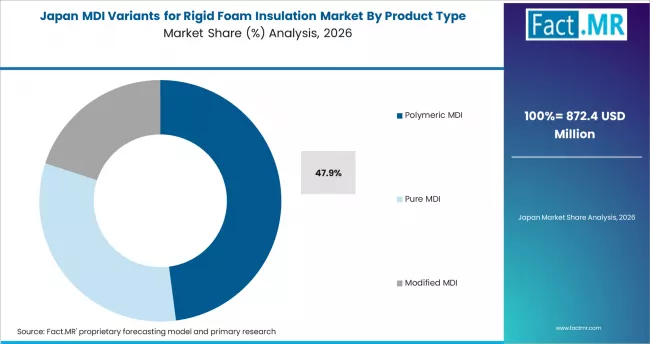
Mdi Variants For Rigid Foam Insulation Market Japan Market Share Analysis By Product Type | Source: Fact.MR
Asia Pacific serves as the polyurethane insulation material manufacturing and building efficiency solution market, supported by expanding construction activity and specialty polymer demand. Mitsui Chemicals, Inc. strengthens polyurethane material production capabilities. Tosoh Corporation expands specialty polymer manufacturing portfolio. Sumitomo Chemical Co., Ltd. supports rigid foam formulation innovation.
- Japan: Demand for MDI variants for rigid foam insulation in Japan is projected to rise at 5.1% CAGR through 2036. The Building Energy Efficiency Act update (Ministry of Land, Infrastructure, Transport and Tourism, 2021) supports thermal insulation material adoption. Mitsui Chemicals, Inc. expanded polyurethane material production capabilities (May 2023), supporting market growth.
Fact MR's analysis of MDI variants for rigid foam insulation market in global regions consists of country-wise assessment that includes United Kingdom, Germany, United States, France, and Japan. Readers can find insulation material demand trends, polyurethane formulation developments, regulatory frameworks, and competitive positioning across key markets.
Competitive Landscape
Competitive Structure and Buyer Dynamics in the MDI Variants for Rigid Foam Insulation Market
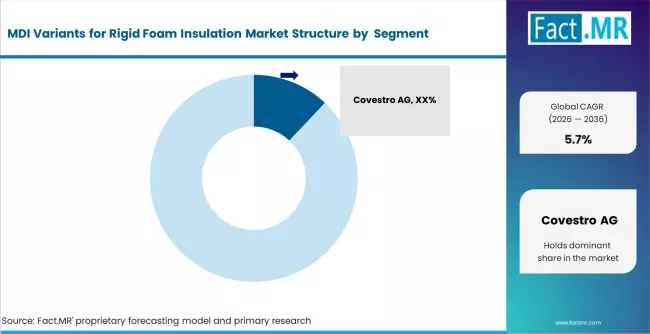
Mdi Variants For Rigid Foam Insulation Market Analysis By Company | Source: Fact.MR
The competitive structure of the MDI Variants for Rigid Foam Insulation Market is moderately concentrated, with a limited number of global chemical manufacturers controlling a significant share of isocyanate production capacity. Companies such as Covestro AG, BASF SE, Wanhua Chemical Group Co. Ltd., Huntsman Corporation, Dow Inc., and Mitsui Chemicals Inc. maintain strong positions through established polyurethane feedstock manufacturing infrastructure and global supply networks. Additional participants including Tosoh Corporation, Kumho Mitsui Chemicals Inc., LANXESS AG, and Sadara Chemical Company contribute through regional production capabilities and specialty chemical intermediates. Competition is primarily influenced by product consistency, thermal insulation performance, formulation compatibility, and cost efficiency in large scale foam production applications.
Several companies maintain structural advantages through vertically integrated isocyanate manufacturing and access to feedstock required for polyurethane chemistry. Firms such as Covestro AG, BASF SE, and Wanhua Chemical Group Co. Ltd. benefit from large scale production infrastructure supporting stable raw material availability. Huntsman Corporation and Dow Inc. maintain advantages through strong formulation expertise and established relationships with insulation manufacturers. Industrial buyers typically adopt multi supplier sourcing strategies to reduce dependence on a single chemical provider and ensure supply continuity. Procurement decisions evaluate suppliers based on product reliability, regulatory compliance, and long term availability, moderating supplier pricing leverage across the market.
Key Players of the MDI Variants for Rigid Foam Insulation Market
- Covestro AG
- BASF SE
- Wanhua Chemical Group Co. Ltd.
- Huntsman Corporation
- Dow Inc.
- Tosoh Corporation
- Kumho Mitsui Chemicals Inc.
- Mitsui Chemicals Inc.
- LANXESS AG
- Sadara Chemical Company
Bibliographies
- [1] BorsodChem. (2021). Isocyanates for rigid polyurethane foams: Polymeric MDI for insulation and structural foams. BorsodChem product brochure.
- [2] Arpadis. (n.d.). Polymeric MDI (pMDI) – CAS 9016-87-9: Technical profile for rigid polyurethane insulation boards and spray foam systems. Arpadis isocyanates.
- [3] BASF. (2019). MDI handbook – Methylene diphenyl diisocyanate chemistry and applications in rigid and spray polyurethane foams. BASF Chemicals.
- [4] Borrero-López, A. M., et al. (2022). A review of rigid polymeric cellular foams and their insulation properties: Polyurethane, polyisocyanurate, and phenolic systems. Polymers, 14(18), 3845.
- [5] Haltermann-Carless. (2022). Building regulations: Thermal insulation more important than ever – EU EPBD and national energy-performance codes. Haltermann-Carless.
This Report Addresses
- Market size estimation and revenue forecasts for the MDI Variants for Rigid Foam Insulation Market from 2026 to 2036, based on polyurethane insulation demand benchmarks.
- Growth opportunity mapping across construction insulation, refrigeration insulation, industrial insulation, pipe insulation, and appliance insulation applications.
- Segment and regional revenue forecasts covering polymeric MDI, pure MDI, and modified MDI variants used in rigid polyurethane foam systems.
- Competition strategy assessment of Covestro AG, BASF SE, Wanhua Chemical Group Co Ltd, Huntsman Corporation, and Dow Inc.
- Regulatory impact analysis covering building energy efficiency standards, isocyanate handling regulations, and insulation material performance requirements.
- Market report delivery in PDF, Excel, PPT, and interactive dashboard formats for polyurethane insulation material benchmarking.
- Supply chain vulnerability assessments examining petrochemical feedstock price exposure, polyurethane formulation complexity, insulation material substitution risk, and compliance costs related to isocyanate handling frameworks.
MDI Variants for Rigid Foam Insulation Market Definition
MDI Variants for Rigid Foam Insulation Definition Paragraph
The MDI Variants for Rigid Foam Insulation Market includes methylene diphenyl diisocyanate based chemical variants such as polymeric MDI and modified MDI used as reactive components in polyurethane and polyisocyanurate rigid foams that provide thermal insulation, structural strength, and moisture resistance in construction panels, refrigeration equipment, and industrial insulation systems.
MDI Variants for Rigid Foam Insulation Market Inclusions
The report includes global and regional market size estimates, forecast analysis, and segmentation by MDI variant type, foam formulation, insulation application, end use industry, pricing structure, and supply chain distribution patterns across rigid polyurethane insulation systems.
MDI Variants for Rigid Foam Insulation Market Exclusions
The scope excludes TDI based flexible foam chemicals, finished insulation boards, non isocyanate insulation materials such as polystyrene or mineral wool, and polyurethane additives not based on MDI chemistry.
MDI Variants for Rigid Foam Insulation Market Research Methodology
- Primary Research: Interviews were conducted with isocyanate manufacturers, polyurethane formulators, insulation material producers, distributors, and construction material specialists.
- Desk Research: Public sources included polymer chemistry literature, company technical datasheets, regulatory documentation, trade statistics, and industry publications related to polyurethane insulation chemistry.
- Market-Sizing and Forecasting: A hybrid model combining top-down insulation material demand evaluation and bottom-up analysis of MDI variant consumption in rigid foam production was applied.
- Data Validation and Update Cycle: Outputs were validated through cross comparison of supplier data, expert consultation, and periodic monitoring of insulation material adoption trends.
Segmentation
Report Scope
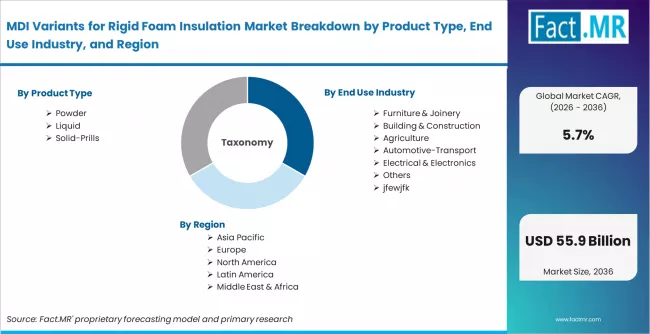
Mdi Variants For Rigid Foam Insulation Market Breakdown By Product Type, End Use Industry, And Region | Source: Fact.MR
| Metric | Value |
|---|---|
| Quantitative Units | USD 30.4 billion (2026) to USD 52.9 billion (2036), at a CAGR of 5.7% |
| Market Definition | The MDI variants for rigid foam insulation market includes production and commercialization of methylene diphenyl diisocyanate formulations used in polyurethane rigid foam systems designed to provide thermal insulation, structural strength, and energy efficiency across construction and industrial applications. |
| Product Type Segmentation | Polymeric MDI, Pure MDI, Modified MDI |
| Application Segmentation | Construction insulation, Refrigeration insulation, Industrial insulation, Pipe insulation, Appliance insulation |
| End Use Industry Segmentation | Building and construction, Cold chain logistics, Industrial manufacturing, Appliances |
| Regions Covered | North America, Latin America, Europe, East Asia, South Asia, Oceania, Middle East and Africa |
| Countries Covered | United States, Canada, Mexico, Brazil, Germany, France, United Kingdom, Italy, Spain, Netherlands, China, Japan, South Korea, India, Thailand, Indonesia, Saudi Arabia, United Arab Emirates, and 40+ countries |
| Key Companies Profiled | Covestro AG, BASF SE, Wanhua Chemical Group Co. Ltd., Huntsman Corporation, Dow Inc., Tosoh Corporation, Kumho Mitsui Chemicals Inc., Mitsui Chemicals Inc., LANXESS AG, Sadara Chemical Company |
| Forecast Period | 2026 to 2036 |
| Approach | Hybrid top-down and bottom-up market estimation based on polyurethane rigid foam consumption ratios, insulation material demand benchmarking, construction sector thermal efficiency requirements, cold chain infrastructure expansion trends, and validation through primary interviews with isocyanate manufacturers, foam producers, and industrial material suppliers. |
Source: Fact.MR analysis. Updated Apr 15, 2026
MDI Variants for Rigid Foam Insulation Market Key Segments
-
Product Type:
- Polymeric MDI
- Pure MDI
- Modified MDI
-
Application:
- Construction Insulation
- Refrigeration Insulation
- Industrial Insulation
- Pipe Insulation
- Appliance Insulation
-
End Use Industry:
- Building and Construction
- Cold Chain Logistics
- Industrial Manufacturing
- Appliances
-
Region:
- North America
- USA
- Canada
- Mexico
- Europe
- Germany
- UK
- France
- Italy
- Spain
- Nordic Countries
- BENELUX
- Rest of Europe
- Asia Pacific
- China
- Japan
- South Korea
- India
- Australia
- Rest of Asia Pacific
- Latin America
- Brazil
- Argentina
- Rest of Latin America
- Middle East and Africa
- Kingdom of Saudi Arabia
- United Arab Emirates
- South Africa
- Rest of Middle East and Africa
- Other Regions
- Oceania
- Central Asia
- Other Markets
- North America
Frequently Asked Questions
How large is the demand for MDI Variants for Rigid Foam Insulation in the global market in 2026?
What will be the market size of MDI Variants for Rigid Foam Insulation in the global market by 2036?
What is the expected demand growth for MDI Variants for Rigid Foam Insulation in the global market between 2026 and 2036?
Which company is identified as a leading manufacturer in the MDI Variants for Rigid Foam Insulation market?
Which end use industry is projected to dominate MDI variants demand by 2026?
Why are MDI variants widely used in rigid foam insulation applications?
What is driving demand for MDI variants for rigid foam insulation in the United Kingdom?
What is the growth outlook for the MDI Variants for Rigid Foam Insulation market in the United Kingdom?
Why is Germany an important market for rigid foam insulation materials?
What is the growth outlook for the MDI Variants for Rigid Foam Insulation market in Germany?
How is demand for MDI variants evolving in the United States construction sector?
What is the growth outlook for the MDI Variants for Rigid Foam Insulation market in the United States?
What is the growth outlook for the MDI Variants for Rigid Foam Insulation market in France?
How is Japan positioned in the MDI Variants for Rigid Foam Insulation market?
What is the growth outlook for the MDI Variants for Rigid Foam Insulation market in Japan?
What are MDI variants and what are they mainly used for in rigid foam insulation?
What does the MDI Variants for Rigid Foam Insulation market include in this report?
What applications are included in the scope of the MDI Variants for Rigid Foam Insulation market?
What is excluded from the scope of the MDI Variants for Rigid Foam Insulation market report?
What does market forecast mean in the MDI Variants for Rigid Foam Insulation market report?
How is the MDI Variants for Rigid Foam Insulation market forecast developed in this report?
What does primary validation indicate in the MDI Variants for Rigid Foam Insulation market analysis?
Who worked on this report


Preview the report firsthand - request a free sample
Free SampleGet the brochure for pricing and purchase details
Download PDF