- Base Value(2025): 2.1 Bn
- Estimated Value(2026): 2.3 Bn
- Forecast Value (2036): 4.2 Bn
- CAGR (2026 - 2036): 6.2%
Soft Insulation Adhesives Market Forecast and Outlook By Fact.MR
The soft insulation adhesives market was valued at USD 2.1 billion in 2025. The market is projected to reach USD 2.3 billion in 2026 and USD 4.2 billion by 2036, expanding at a CAGR of 6.2% during 2026-2036. Acrylic adhesives are expected to lead chemistry type with a 34.8% share in 2026. Elastomeric foam is projected to remain the leading substrate type with a 37.6% share in 2026. HVAC is expected to lead end-user demand with a 42.9% share in 2026.
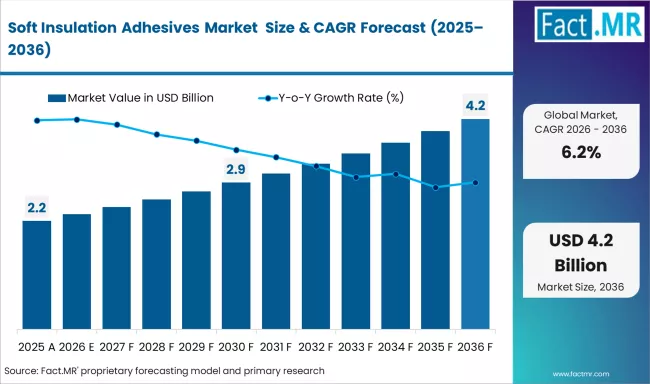
Soft Insulation Adhesives Market Market Value Analysis | Source: Fact.MR
Key Drivers
- Retrofit intensity: Energy-efficiency upgrades in buildings are lifting adhesive demand for ducting, pipe insulation, and flexible foam installation.
- Condensation control: HVAC operators need secure bonding that supports thermal continuity and limits moisture ingress.
- Fire-code pressure: Installers are under pressure to use insulation systems that hold performance under tighter building-safety standards.
Key Segments Analyzed in the Report
- Product type: acrylic, polyurethane, silicone, rubber-based, and others
- Workflow: brush and trowel application, spray application, pressure-sensitive lamination, and others
- End user: HVAC, building construction, industrial equipment, automotive, and others
- Region: North America, Latin America, Europe, Asia Pacific, and Middle East and Africa
Analyst Opinion
Shambhu Nath Jha, Principal Consultant at Fact.MR says, "Value in this market will be aligned toward installers that need bond reliability across uneven jobsite conditions. Suppliers should focus on developing adhesives that are easy to apply and hold insulation in place over time."
Soft Insulation Adhesives Market Definition
The soft insulation adhesives market includes bonding materials used to install and seal flexible thermal and acoustic insulation systems across buildings, mechanical equipment, transport assets, and industrial lines. It covers acrylic, polyurethane, silicone, rubber-based, and related specialty adhesive systems used with elastomeric foam, fiberglass, mineral wool, and other soft insulation substrates. These products serve HVAC contractors, building-envelope installers, industrial maintenance teams, and transport manufacturers that require durable adhesion across temperature-sensitive insulation assemblies.
Soft Insulation Adhesives Market Inclusions
- Adhesives sold for bonding flexible thermal and acoustic insulation materials
- Revenue generated from installation-grade, laminating, and specialty insulation adhesive systems
- Demand across North America, Latin America, Europe, Asia Pacific, and Middle East and Africa
Soft Insulation Adhesives Market Exclusions
- Rigid structural insulation boards except as a benchmark for specification trends
- Finished insulation product sales
- General sealants and mastics with no insulation-bonding role
Soft Insulation Adhesives Market Research Methodology
This study evaluates the soft insulation adhesives market across chemistry type, substrate type, end use industry, and region, with 2025 as the base year and forecasts extending from 2026 to 2036. Market value is expressed in USD billion. The assessment incorporates building-efficiency policy trends, insulation-product literature, company annual reports, adhesive product portfolios, and technical documentation from insulation and construction-material suppliers. Triangulation combines retrofit demand, installed HVAC base, insulation substrate intensity, and supplier positioning to produce segment-level estimates and long-range market conclusions.
Key Drivers, Restraints, and Trends in Soft Insulation Adhesives Market
Drivers
Energy-efficiency retrofits are raising demand for insulation systems across commercial and residential buildings, which increases consumption of adhesives used in duct wraps, pipe insulation, and foam-sheet installation. HVAC insulation remains a large application pool. Moisture control is another demand engine as flexible insulation loses value when joints open, edges lift, or condensation penetrates the assembly. That keeps adhesive performance central to insulation durability. Building-safety scrutiny also matters because adhesive choice affects how insulation assemblies behave under service stress and code review.
Restraints
Product substitution remains common as users shift to tapes or mechanical fastening on simpler jobs. VOC and worker-safety rules can complicate chemistry selection in some regions. Long replacement cycles in installed insulation systems also slow volume growth.
Trends
The market is moving toward easier-to-apply systems that shorten installation time and support cleaner site work. Suppliers are putting more emphasis on low-emission products, digital specification tools, and jobsite productivity. Sika’s 2025 sustainability reporting also points to stronger product-level transparency, which matters in construction procurement. Buyers are paying closer attention to adhesive compatibility with modern elastomeric foam and retrofit-oriented HVAC packages.
Segmental Analysis
Soft Insulation Adhesives Market Analysis by Product Type
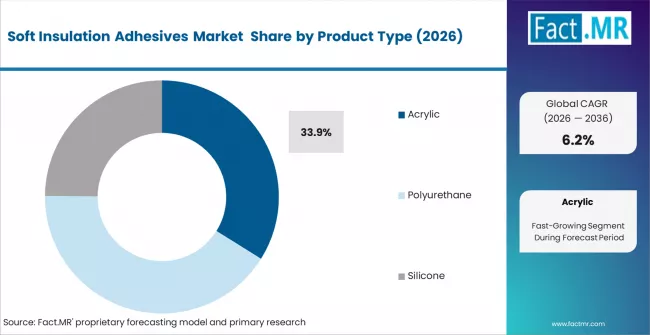
Soft Insulation Adhesives Market Analysis By Product Type | Source: Fact.MR
Acrylic adhesives are likely to hold a leading share of 33.9% in 2026 as they offer a workable balance of tack, spreadability, cost control, and compatibility across flexible insulation jobs. They fit contractor economics well in ducting and building services. Their water-based profile also supports broader use where installers face indoor air or handling constraints. Henkel and Sika both continue to expand construction-chemistry portfolios around application efficiency and lower-emission product design.
Soft Insulation Adhesives Market Analysis by Workflow
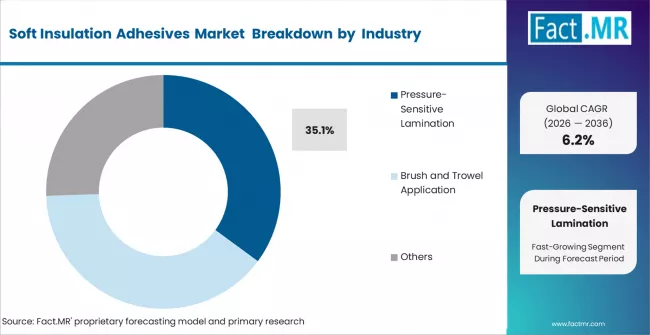
Soft Insulation Adhesives Market Analysis By Workflow | Source: Fact.MR
Pressure-sensitive lamination is likely to account for 35.1% share in 2026 owing to its demand in prefabricated insulation. This workflow solves labor intensity on repetitive HVAC and building-envelope jobs, especially where installers need clean placement on ducts, lines, and panels. It also reduces curing uncertainty compared with open wet-applied systems.
Competitive Aligners for Market Players
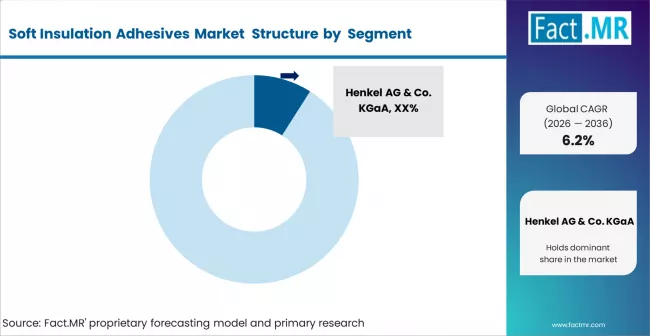
Soft Insulation Adhesives Market Analysis By Company | Source: Fact.MR
Leading firms combine formulation depth with insulation-system understanding and contractor access. Sika continues to frame construction solutions around durable building performance and sustainability validation. Henkel keeps expanding materials capabilities in specialty adhesive systems, while Owens Corning remains close to insulation specification and HVAC application demand. Leadership is being built around products that reduce installation errors, support compliance, and hold performance across long service cycles.
Key Players in Soft Insulation Adhesives Market
- Henkel AG & Co. KGaA
- Sika AG
- 3M Company
- H.B. Fuller Company
- Arkema S.A.
- Huntsman Corporation
- Mapei S.p.A.
- Saint-Gobain
- Owens Corning
- Carlisle Companies Inc.
Strategic Outlook by Fact.MR on Soft Insulation Adhesives Market
The market is shifting toward cleaner application systems tied to retrofit-driven insulation demand. Growth through 2036 will be shaped by HVAC upgrades, moisture-control requirements, and product acceptance under tighter building standards. Suppliers with strong contractor channels, substrate know-how, and easy-to-use low-emission systems are best placed to capture value.
Bibliography
- Sika AG. 2026. Annual Report 2025.
- Owens Corning. 2025. Sustainability Report 2024.
- Owens Corning. Fiberglas Pipe Insulation Environmental Product Declaration.
- Henkel AG & Co. KGaA. 2026. Annual Report 2025.
- International Energy Agency. 2025. Global Energy Review 2025.
Segmentation
Scope of the Report
| Metric | Value |
|---|---|
| Market Value | USD 2.1 billion in 2025 to USD 4.2 billion by 2036 |
| CAGR | 6.2% from 2026 to 2036 |
| Base Year | 2025 |
| Forecast Period | 2026 to 2036 |
| Product Type Segmentation | Acrylic, Polyurethane, Silicone, Rubber-based, Others |
| Workflow Segmentation | Brush and Trowel Application, Spray Application, Pressure-sensitive Lamination, Others |
| End User Segmentation | HVAC, Building Construction, Industrial Equipment, Automotive, Others |
| Regions Covered | North America, Latin America, Europe, Asia Pacific, Middle East and Africa |
Source: Fact.MR analysis. Updated Mar 16, 2026
Frequently Asked Questions
What is the projected size of the Soft Insulation Adhesives Market by 2036?
What is the CAGR of the Soft Insulation Adhesives Market from 2026 to 2036?
Which chemistry type leads the Soft Insulation Adhesives Market in 2026?
Which substrate type dominates the Soft Insulation Adhesives Market?
Which end-use industry leads the Soft Insulation Adhesives Market in 2026?
What is driving growth in the Soft Insulation Adhesives Market?
Who worked on this report


Preview the report firsthand - request a free sample
Free SampleGet the brochure for pricing and purchase details
Download PDF