- Base Value(2026): 4.7 Bn
- Estimated Value(2026): 4.7 Bn
- Forecast Value (2036): 10.9 Bn
- CAGR (2026 - 2036): 8.9%
Zero Emission Building Insulations Market Forecast and Outlook 2026 to 2036
The global market for zero emission building insulations is undergoing a profound strategic realignment, projected to expand from USD 4.65 billion in 2026 to USD 10.91 billion by 2036, advancing at an 8.9% CAGR. This growth trajectory is fundamentally driven by the evolution of building codes and certification systems beyond operational energy efficiency to encompass full lifecycle carbon accounting.
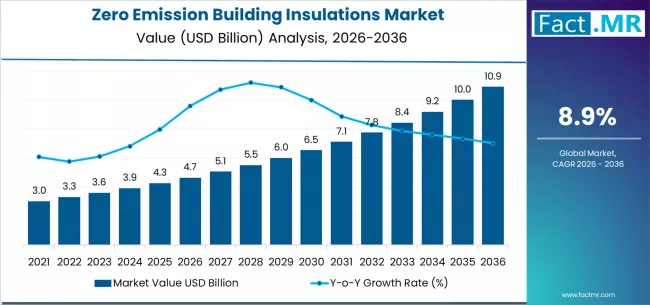
Zero Emission Building Insulations Market Market Value Analysis | Source: Fact.MR
Summary of Zero Emission Building Insulations Market
- Market Snapshot
- Global zero emission building insulations market revenue stood at approximately USD 4.27 billion in 2025 and is forecast to reach USD 10.91 billion by 2036.
- At an 8.9% CAGR from 2026 to 2036, this market is set to expand 2.3x in value, adding USD 6.26 billion in absolute opportunity as building codes globally evolve from operational energy efficiency to full lifecycle carbon accounting.
- Insulation material selection is shifting from R-value optimisation alone to integrated evaluation of global warming potential across production, use phase, and end-of-life — fundamentally repositioning insulation as a core decarbonisation asset within building finance and green lending frameworks.
- Demand and Growth Drivers
- Mandatory building energy codes and net-zero carbon building standards incorporating embodied carbon limits — led by the EU Energy Performance of Buildings Directive recast, Germany's Energiewende legislation, and progressive US state codes in California and New York — are creating compliance-driven demand that converts insulation upgrades from voluntary sustainability actions into legally required investments.
- Rising energy costs and utility price volatility are strengthening the economic return on high-performance insulation, while green financing and preferential lending rates for certified buildings accelerate procurement cycles by reducing the effective cost of capital for advanced insulation system investment.
- Shift toward bio-based and carbon-storing materials including advanced cellulose, wood fibre, and mycelium-based foams is transforming insulation from a passive thermal barrier into an active carbon sink, creating a new performance dimension that conventional mineral wool and foam products cannot match under whole-lifecycle embodied carbon assessment frameworks.
- Product and Segment View
- Mineral wool including rock and glass wool holds 30% of material type share in 2026 at USD 1.395 billion, forecast to reach USD 3.273 billion by 2036, retaining its foundational position through non-combustibility, acoustic performance, moisture resistance, and an accelerating shift toward high-recycled-content manufacturing that aligns its production profile with circular economy requirements.
- Residential buildings account for 46% of building type share in 2026 at USD 2.139 billion, forecast to reach USD 5.019 billion by 2036 as the primary adoption driver, where stringent energy code updates for new homes and government-backed retrofit programmes targeting existing housing stock generate the largest volume demand for zero emission insulation solutions.
- Walls and facades represent 39% of application area share in 2026 at USD 1.814 billion, forecast to reach USD 4.255 billion by 2036, reflecting the greatest envelope surface area, most complex thermal bridging challenges, and the growing integration of insulation as a core structural component in advanced facade systems including ventilated rainscreens and prefabricated insulated panels.
- Geography and Competitive Outlook
- United States market stood at approximately USD 744 million in 2026, forecast to reach USD 1.621 billion by 2036 at an 8.1% CAGR, shaped by aggressive state-level building codes, LEED and Living Building Challenge certification driving low-embodied-carbon specification in commercial and high-end residential projects, and federal incentive programmes accelerating energy retrofit activity.
- Germany market stood at approximately USD 372 million in 2026, forecast to reach USD 911.8 million by 2036 at a 9.4% CAGR, directly fuelled by near-zero operational energy mandates for new buildings, deep thermal retrofit obligations for existing stock, Energiewende subsidy frameworks, and a market culture demanding verified environmental product declarations for all specified insulation materials.
- France market stood at approximately USD 279 million in 2026, forecast to reach USD 637.3 million by 2036 at an 8.6% CAGR, driven by a national renovation strategy targeting millions of homes, the Tertiary Decree mandating progressive energy reductions in commercial real estate, and growing demand for insulation with thermal mass and phase-change properties addressing summer heat resilience requirements.
- Key companies active in this market include Saint-Gobain, Rockwool Group, Owens Corning, Knauf Insulation, and Kingspan Group.
Zero Emission Building Insulations Market - At a Glance
| Attribute | Details |
|---|---|
| Market Value 2025 | USD 4.27 billion |
| Market Value 2026 | USD 4.65 billion |
| Market Value 2036 | USD 10.91 billion |
| Absolute Dollar Opportunity 2026-2036 | USD 6.26 billion |
| Total Growth 2026-2036 | 134.6% |
| CAGR 2026-2036 | 8.9% |
| Growth Multiple | 2.3x |
| Key Demand Theme | Mandatory building energy codes incorporating embodied carbon limits, rising energy cost economics, and shift toward bio-based carbon-storing insulation materials positioning zero emission insulation as a core decarbonisation asset within green finance and building certification frameworks |
| Leading Segment by Material Type (2026) | Mineral Wool (Rock and Glass) |
| Material Type Segment Share (2026) | 30.0% |
| Leading Segment by Building Type (2026) | Residential Buildings |
| Building Type Segment Share (2026) | 46.0% |
| Leading Segment by Application Area (2026) | Walls and Facades |
| Application Area Segment Share (2026) | 39.0% |
| Fastest Growing Country | China |
| China CAGR (2026-2036) | 9.8% |
| Key Growth Countries | China 9.8%, Germany 9.4%, France 8.6%, USA 8.1%, Japan 7.5% |
| Key Growth Regions | East Asia, Western Europe, North America |
| Top Companies | Saint-Gobain, Rockwool Group, Owens Corning, Knauf Insulation, Kingspan Group |
| Segmentation by Material Type | Mineral Wool (Rock and Glass), Cellulose-Based Insulation, Bio-Based Foams, Aerogels, Others |
| Segmentation by Building Type | Residential Buildings, Commercial Buildings, Industrial Buildings, Institutional Buildings |
| Segmentation by Application Area | Walls and Facades, Roofs and Ceilings, Floors and Basements, HVAC and Duct Insulation |
| Segmentation by Region | North America, Latin America, Western Europe, Eastern Europe, East Asia, South Asia and Pacific, Middle East and Africa |
Source: Fact.MR analysis. Updated Mar 26, 2026
Key Takeaways from the Zero emission Building Insulations Market
- Market Value for 2026: USD 4.65 Billion
- Market Value for 2036: USD 10.91 Billion
- Forecast CAGR (2026-2036): 8.9%
- Leading Material Type Segment (2026): Mineral Wool (Rock & Glass) (30%)
- Leading Building Type Segment (2026): Residential Buildings (46%)
- Leading Application Area Segment (2026): Walls & Facades (39%)
- Key Growth Countries: China (9.8% CAGR), Germany (9.4% CAGR), USA (8.1% CAGR), France (8.6% CAGR), Japan (7.5% CAGR)
- Key Players in the Market: Saint-Gobain, Rockwool Group, Owens Corning, Knauf Insulation, Kingspan Group
The market's progression is characterized by the critical integration of embodied carbon metrics into material selection, where insulation choices are evaluated not only on R-value but on the global warming potential of their production, use, and end-of-life. Key trends include the rapid scaling of circular economy principles, fostering demand for insulation produced from recycled content and designed for future deconstruction and material recovery.
There is a marked shift toward bio-based and carbon-storing materials, such as advanced cellulose, wood fiber, and mycelium-based foams, which transform insulation from a passive barrier into an active carbon sink within the building envelope.
Innovation is increasingly focused on hyper-efficient materials like aerogels and vacuum insulation panels that enable dramatic reductions in wall thickness while meeting ultra-low energy standards, a crucial factor for deep energy retrofits in space-constrained urban environments.
This market is becoming the backbone of true net-zero construction, where insulation performance is intrinsically linked to decarbonization timelines and the financial valuation of building assets under evolving green finance and disclosure regimes.
Category
| Category | Segments |
|---|---|
| Material Type | Mineral Wool (Rock & Glass), Cellulose-Based Insulation, Bio-Based Foams, Aerogels, Others |
| Building Type | Residential Buildings, Commercial Buildings, Industrial Buildings, Institutional Buildings |
| Application Area | Walls & Facades, Roofs & Ceilings, Floors & Basements, HVAC & Duct Insulation |
| Region | North America, Latin America, Western Europe, Eastern Europe, East Asia, South Asia & Pacific, MEA |
Source: Fact.MR analysis. Updated Mar 26, 2026
Segmental Analysis
By Material Type, Which Segment Maintains a Dominant Market Position?
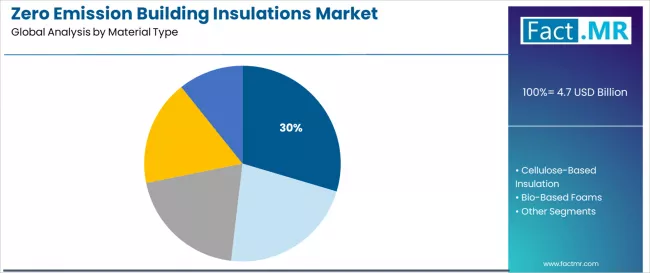
Zero Emission Building Insulations Market Analysis By Material Type | Source: Fact.MR
Mineral wool, encompassing both rock and glass wool, holds a leading 30% market share. This dominance is anchored in its established performance profile, including non-combustibility, acoustic benefits, and moisture resistance, coupled with a significant shift toward production using high recycled content and lower-carbon manufacturing processes.
Its durability and alignment with circularity goals, due to potential recyclability at end-of-life, make it a default technical and sustainable choice for many core applications in both new zero emission construction and major renovation projects, ensuring its continued foundational role.
By Building Type, Which Segment is the Primary Adoption Driver?
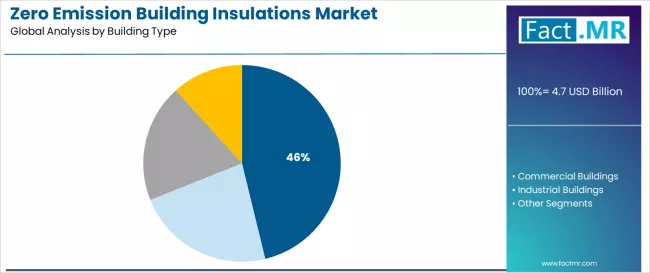
Zero Emission Building Insulations Market Analysis By Building Type | Source: Fact.MR
Residential buildings constitute the leading segment with a 46% share, driven by a global wave of stringent energy code updates for new homes and substantial government-backed retrofit programs targeting existing housing stock.
The scale of the residential sector, combined with homeowner and developer responsiveness to energy cost savings and sustainability certifications, creates massive volume demand. Insulation is the most impactful single upgrade for residential energy performance, making it the primary investment in achieving zero emission standards for this building type.
By Application Area, Where is Insulation Most Critically Applied?
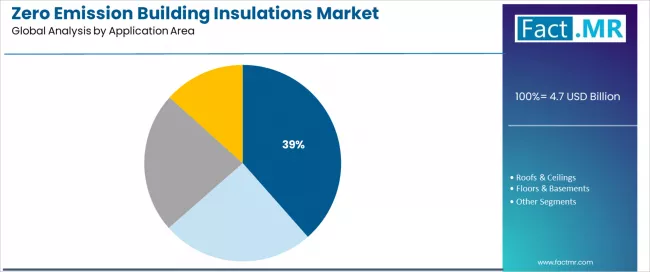
Zero Emission Building Insulations Market Analysis By Application Area | Source: Fact.MR
Walls and facades represent the largest application area with a 39% share. This reflects the greatest surface area of the building envelope and the most complex thermal bridging challenges. Achieving the continuous, high-performance thermal barrier required for zero emission standards demands meticulous insulation detailing across walls.
The evolution of advanced facade systems, including ventilated rainscreens and prefabricated insulated panels, integrates insulation as a core structural and performance component, driving innovation and material consumption in this segment.
What are the Drivers, Restraints, and Key Trends of the Zero emission Building Insulations Market?
The primary market driver is the global proliferation of mandatory building energy codes and voluntary net-zero carbon building standards that explicitly include embodied carbon limits. Policies such as the EU's Energy Performance of Buildings Directive (EPBD) recast and local ordinances mandating building lifecycle assessments create compliance-driven demand. The rising cost of energy and volatility in utility prices enhance the economic return on high-performance insulation investments. Green financing and preferential lending rates for certified buildings further accelerate adoption.
A significant market restraint is the higher upfront cost of advanced bio-based and ultra-high-performance insulation materials compared to conventional options, creating a first-cost barrier despite lifecycle savings. The complexity of designing and executing high-performance building envelopes to avoid thermal bridging and ensure durability requires skilled labor, which is in short supply. Varied and evolving standards for measuring and reporting embodied carbon can also create confusion and slow specification processes.
Key trends include the digitalization of insulation through building information modeling (BIM) libraries that provide instant embodied carbon data. There is growing integration of smart insulation materials with phase-change properties to manage peak thermal loads. The prefabrication of entire wall and roof cassettes with factory-installed insulation is improving quality and reducing waste. A strong trend toward health and wellness is driving demand for insulation that contributes to superior indoor air quality through low VOC emissions and inherent mold resistance.
Analysis of the Zero emission Building Insulations Market by Key Countries
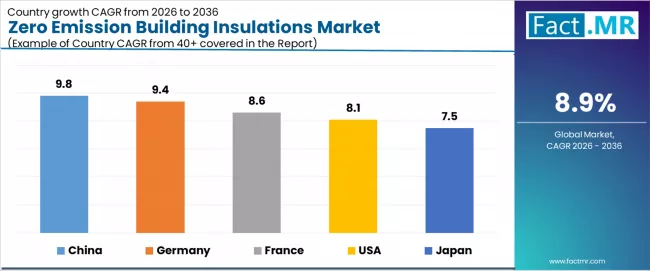
Zero Emission Building Insulations Market Cagr Analysis By Country | Source: Fact.MR
| Country | CAGR (2026-2036) |
|---|---|
| China | 9.8% |
| Germany | 9.4% |
| France | 8.6% |
| USA | 8.1% |
| Japan | 7.5% |
Source: Fact.MR analysis. Updated Mar 26, 2026
How is China's Unparalleled Construction Scale and Carbon Neutrality Pledge Influencing Growth?
China's leading CAGR of 9.8% is propelled by its dual focus on massive new urban construction and a national mandate to peak carbon emissions before 2030. The sheer volume of building activity, governed by increasingly strict local energy codes, creates immense baseline demand. Chinese policy is actively promoting ultra-low energy and near-zero energy building pilot projects, driving uptake of advanced insulation systems. Domestic manufacturing capacity for both conventional and novel insulation materials is scaling rapidly to meet this demand, influencing global supply chains.
What is the Impact of Germany's Legislative Stringency and Energiewende (Energy Transition) Policy?
Germany's 9.4% growth is directly fueled by some of the world's most ambitious building energy laws, mandating near-zero operational energy for new buildings and deep thermal retrofits for existing stock. The German market is characterized by extremely high performance thresholds and a meticulous approach to building physics, favoring high-quality, durable insulation systems with verified environmental product declarations (EPDs). Germany’s Energiewende provides substantial subsidy frameworks for building renovation, creating a stable, policy-driven market for high-performance insulation products.
Why Does France's Focus on Renovation and Tertiary Decree Drive Specific Demand?
France's 8.6% CAGR is heavily influenced by its national renovation strategy targeting millions of homes and the stringent Tertiary Decree, which mandates progressive energy reductions in commercial real estate. This creates a robust market for insulation solutions tailored for retrofit, where factors like installation ease, minimal thickness, and interior-applied systems are critical. French regulations also emphasize summer comfort and resilience to heat waves, driving demand for insulation with high thermal mass or phase-change capabilities, beyond just winter R-value.
How is the USA's Patchwork of State Codes and Market-Driven Certification Shaping Adoption?
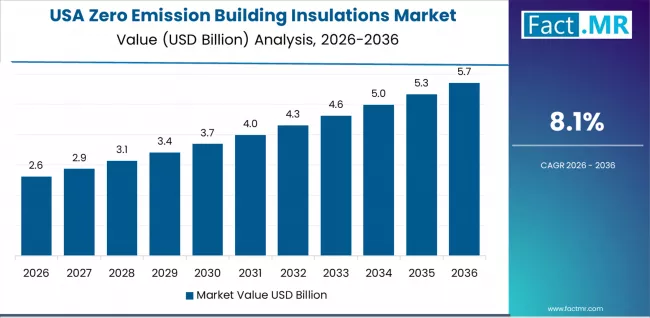
Zero Emission Building Insulations Market Country Value Analysis | Source: Fact.MR
The USA's 8.1% growth occurs within a diverse regulatory landscape, where leading states like California and New York enact aggressive codes while federal incentives push adoption. The strong market penetration of voluntary certification systems like LEED and the Living Building Challenge, which reward low embodied carbon, drives specification of advanced insulations in commercial and high-end residential projects. The focus is often on innovative material solutions that achieve high performance in wall assemblies compatible with North American wood-frame construction.
What Role Does Japan's Unique Seismic and Thermal Comfort Requirements Play?
Japan's 7.5% CAGR reflects its specific building challenges, including seismic safety and high humidity. Insulation materials must accommodate structural movement and provide excellent moisture management. Japan’s push for ZEH (Zero Energy House) standards and the need for insulation in both heating and cooling-dominated climates create demand for versatile, high-performance materials. The market favors quality-controlled, system-based solutions that integrate seamlessly with Japan’s precise construction methodologies and space-efficient design priorities.
Competitive Landscape of the Zero emission Building Insulations Market
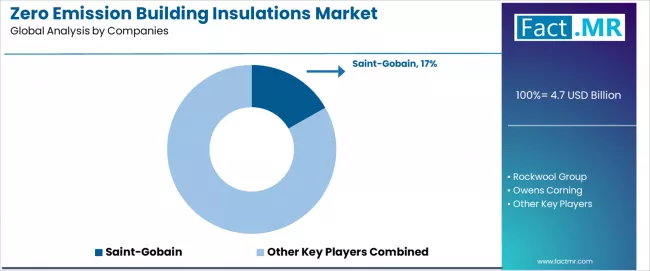
Zero Emission Building Insulations Market Analysis By Company | Source: Fact.MR
The competitive landscape is characterized by established multinational insulation manufacturers pivoting their portfolios toward circular and low-carbon products, competing with agile innovators specializing in novel bio-based and high-tech materials. Competition centers on the ability to provide robust environmental product declarations, cradle-to-cradle certification, and digital tools for architects to calculate carbon impact. Success is increasingly tied to securing specifier confidence through third-party verified health and sustainability credentials, and to developing strong recycling and take-back networks to secure future raw material flows in a circular economy.
Key Players in the Zero emission Building Insulations Market
- Saint-Gobain
- Rockwool Group
- Owens Corning
- Knauf Insulation
- Kingspan Group
Segmentation
Scope of Report
| Items | Values |
|---|---|
| Quantitative Units | USD Billion |
| Material Type | Mineral Wool (Rock & Glass), Cellulose-Based Insulation, Bio-Based Foams, Aerogels, Others |
| Building Type | Residential Buildings, Commercial Buildings, Industrial Buildings, Institutional Buildings |
| Application Area | Walls & Facades, Roofs & Ceilings, Floors & Basements, HVAC & Duct Insulation |
| Key Countries | China, Germany, France, USA, Japan |
| Key Companies | Saint-Gobain, Rockwool Group, Owens Corning, Knauf Insulation, Kingspan Group |
| Additional Analysis | Comparative lifecycle assessment (LCA) of mainstream insulation materials; impact of thermal bridging on whole-building performance; fire safety and toxicity profiles of bio-based insulations; policy benchmarking of leading national building codes; economic analysis of deep retrofit insulation strategies; supply chain analysis for recycled and bio-based feedstock. |
Source: Fact.MR analysis. Updated Mar 26, 2026
Market by Segments
-
Material Type :
- Mineral Wool (Rock & Glass)
- Cellulose-Based Insulation
- Bio-Based Foams
- Aerogels
- Others
-
Building Type :
- Residential Buildings
- Commercial Buildings
- Industrial Buildings
- Institutional Buildings
-
Application Area :
- Walls & Facades
- Roofs & Ceilings
- Floors & Basements
- HVAC & Duct Insulation
-
Region :
-
North America
- USA
- Canada
-
Latin America
- Brazil
- Mexico
- Argentina
- Rest of Latin America
-
Western Europe
- Germany
- UK
- France
- Spain
- Italy
- BENELUX
- Rest of Western Europe
-
Eastern Europe
- Russia
- Poland
- Czech Republic
- Rest of Eastern Europe
-
East Asia
- China
- Japan
- South Korea
- Rest of East Asia
-
South Asia & Pacific
- India
- ASEAN
- Australia
- Rest of South Asia & Pacific
-
MEA
- Saudi Arabia
- UAE
- Turkiye
- Rest of MEA
-
References
- Arena, A. P., & de Rosa, C. (2024). Life cycle assessment of innovative insulation materials based on agricultural by-products. Journal of Cleaner Production, 434, 140112.
- Cabeza, L. F., & de Gracia, A. (2023). Innovation in insulation materials for nearly zero-energy buildings (nZEB). Renewable and Sustainable Energy Reviews, 188, 113827.
- Häkkinen, T., & Ruuska, A. (2024). Implications of embodied carbon requirements in building regulations for insulation material selection. Building and Environment, 250, 111203.
- Hollberg, A., & Ruth, J. (2023). Detailed assessment of embodied carbon of building insulation at the scale of a neighborhood. Energy and Buildings, 278, 112634.
- Ibn-Mohammed, T., & Koh, S. C. L. (2024). Circular economy strategies for building insulation: A review of end-of-life management pathways. Resources, Conservation and Recycling, 200, 107289.
- Jelle, B. P., & Gao, T. (2023). State-of-the-art review of vacuum insulation panels and aerogel-enhanced building materials. Energy and Buildings, 275, 112465.
- Pittau, F., & Lumia, G. (2024). Carbon storage in bio-based building insulation materials: Quantification and policy implications. Sustainable Materials and Technologies, 39, e00861.
- Rock, M., & Hollberg, A. (2023). Building materials as a carbon sink: The role of biogenic carbon in insulation. IOP Conference Series: Earth and Environmental Science, 1176(4), 042051.
- Sattler, S., & Klinge, A. (2024). Hygrothermal performance and durability of cellulose-based insulation in retrofitted building envelopes. Construction and Building Materials, 411, 134567.
- Zhou, Z., & Wang, C. (2023). A comparative study on the environmental and economic performance of mineral wool and bio-based insulation in life cycle. Journal of Building Engineering, 76, 107323.
Frequently Asked Questions
How big is the zero emission building insulations market in 2026?
What will be the size of zero emission building insulations market in 2036?
How much will be the zero emission building insulations market growth between 2026 and 2036?
What are the key product types in the zero emission building insulations market?
Which building type segment to contribute significant share in the zero emission building insulations market in 2026?
Who worked on this report


Preview the report firsthand - request a free sample
Free SampleGet the brochure for pricing and purchase details
Download PDF