- Base Value(2025): 3.1 Bn
- Estimated Value(2026): 3.3 Bn
- Forecast Value (2036): 6.1 Bn
- CAGR (2026 - 2036): 6.4%
Medical Connectors Market Forecast and Outlook (2026 to 2036) by FACT.MR
- In 2025, the medical connectors market was valued at USD 3.1 billion.
- Based on Fact.MR analysis, demand for medical connectors is estimated to reach to USD 3.3 billion in 2026 and USD 6.1 billion by 2036.
- Fact.MR projects a CAGR of 6.4% during the forecast period.
- The market is forecast to add nearly USD 2.8 billion in revenue value by 2036.
- Growth reflects rising connected medical equipment installations and stronger replacement demand for disposable and sterilizable connector systems across healthcare facilities.
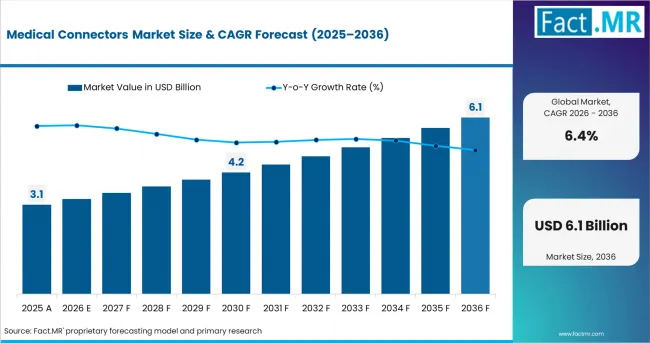
Medical Connectors Market Value Analysis | Source: Fact.MR
Summary of medical connectors market
- Demand Drivers
- Hospitals are increasing investment in connected monitoring systems because patient data transfer reliability is becoming more important in critical care equipment.
- -connector demand is rising as infection control standards strengthen across hospitals and ambulatory surgical centers.
- Compact medical electronics are increasing miniature connector installation across wearable devices and portable diagnostic equipment.
- Key Segments Analyzed
- By Product: Disposable plastic connectors account for 24% share in 2026 because single use medical devices and infection control protocols increase sterile connector demand.
- By Application: Patient monitoring devices hold 21% share in 2026 due to rising installation of connected monitoring systems across hospitals and intensive care units.
- By End User: Hospitals & clinics account for 52% share in 2026 because healthcare facilities operate the largest installed base of diagnostic and therapeutic equipment.
- By Material: Plastic connectors hold 46% share in 2026 because lightweight construction and lower production cost support large scale medical device integration.
- By Connectivity: Wired medical connectors account for 68% share in 2026 because hospitals require stable data transmission and uninterrupted equipment connectivity.
- By Geography: India is projected to expand at 7.8% CAGR through 2036 as healthcare infrastructure investment and domestic medical device manufacturing.
- Analyst Opinion at Fact.MR
- Shambhu Nath Jha, Principal Consultant at Fact.MR, opines, Compact medical electronics and infection control standards are increasing demand for disposable and high reliability connector systems. Companies expanding miniature connector production and high speed connectivity capability are improving competitive positioning across diagnostic and patient monitoring equipment markets.’
- Strategic Implications
- Medical connector manufacturers should increase production of disposable connector systems for hospitals and surgical centers focused on infection control.
- Companies should strengthen miniature connector development because wearable devices and portable diagnostic equipment need compact connectivity systems.
- Healthcare electronics suppliers should expand high-speed data connector capability to support connected imaging and monitoring equipment.
| Metric | Value |
|---|---|
| Estimated Value in 2026 | USD 3.3 billion |
| Forecast Value in 2036 | USD 6.1 billion |
| Forecast CAGR (2026 to 2036) | 6.4% |
Source: Fact.MR analysis. Updated Jun 2, 2026
India is projected to expand at 7.8% CAGR through 2036 as hospital equipment manufacturing and healthcare infrastructure investment increase across urban medical networks. China is expected to rise at 7.4% CAGR due to domestic medical electronics production growth and wider diagnostic equipment installation. The United States is forecast at 6.3% CAGR supported by patient monitoring equipment upgrades and connected healthcare adoption. Germany is estimated to expand at 5.9% CAGR because medical device compliance standards increase high reliability connector demand. Japan is projected at 5.6% CAGR as compact medical electronics production supports miniature connector installation.
Segmental Analysis
Medical Connectors Market Analysis by Product
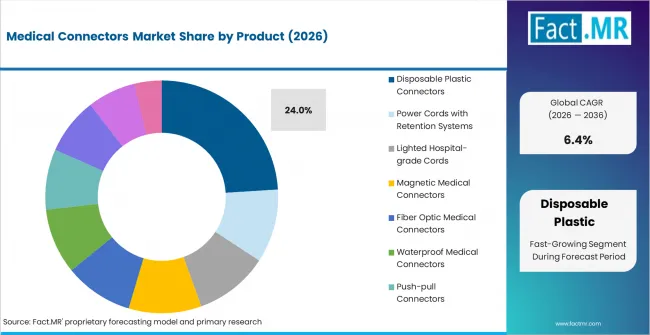
Medical Connectors Market Analysis By Product | Source: Fact.MR
Disposable plastic connectors are projected to account for 24% of the market share in 2026 as healthcare facilities increasingly prefer sterile and single-use connectivity systems across patient care equipment. Rising focus on infection prevention and patient safety is driving adoption of disposable components in hospitals and clinical settings.
- Infection Control Demand: Hospitals are using more disposable connector systems to reduce contamination risk in patient monitoring and respiratory equipment.
- Lightweight Connector Adoption: Medical equipment manufacturers prefer plastic connectors because lower weight supports handheld and wearable devices.
- TE Connectivity Expands Medical Connector Prototyping Network: TE Connectivity expanded its PROPELUS Prototype Center network in the United States to accelerate development of next-generation medical devices and connectivity solutions. The new facilities support rapid prototyping, 3D printing, and connector system development for interventional catheters and surgical robotics applications.
Medical Connectors Market Analysis by Application
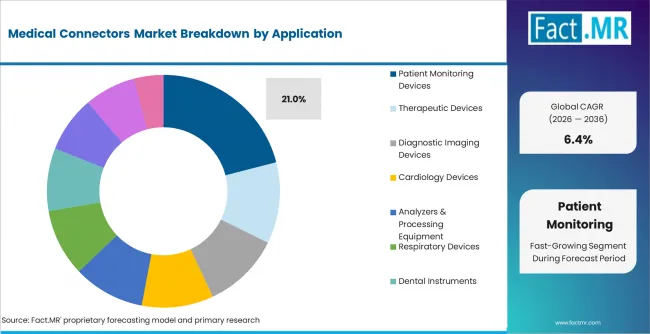
Medical Connectors Market Analysis By Application | Source: Fact.MR
Patient monitoring devices hold 21% share in 2026 due to rising installation of connected monitoring systems across hospitals and intensive care units. Medical connectors with secure signal transfer are gaining wider use as hospitals add bedside monitors and multi-parameter monitoring systems.
- Critical Care Equipment Expansion: Hospitals are increasing installation of monitoring systems linked with emergency care and intensive care unit upgrades.
- Connected Monitoring Demand: Wireless patient monitoring systems are increasing requirement for stable signal transmission connectors.
- Amphenol Expands Connector Portfolio with Trexon Acquisition: Amphenol Corporation announced plans to acquire Trexon for approximately $1 billion to strengthen its high-reliability interconnect and cable assembly business. The acquisition will expand Amphenol’s advanced connectivity solutions portfolio across medical, industrial, and high-performance electronics applications.
Medical Connectors Market Analysis by End User
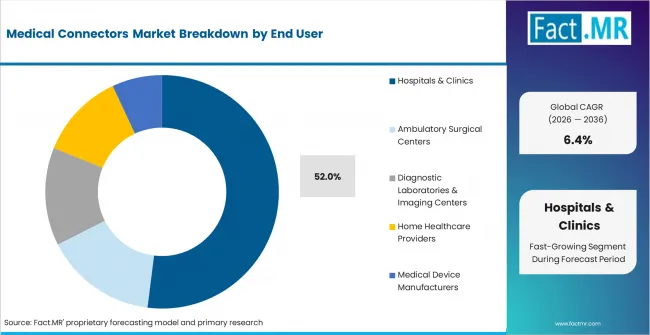
Medical Connectors Market Analysis By End User | Source: Fact.MR
Hospitals & clinics account for 52% share in 2026 because healthcare facilities operate the largest installed base of diagnostic and therapeutic equipment. Medical connectors are used more as hospitals expand patient monitoring and surgical equipment across care departments.
- Hospital Equipment Expansion: Multi-specialty hospitals are increasing investment in connected healthcare systems and imaging equipment.
- Surgical Center Growth: Ambulatory surgical centers are increasing installation of compact therapeutic and monitoring equipment.
- Molex Expands Connectivity Portfolio with Teramount Acquisition: Molex announced an agreement to acquire Teramount Ltd. to strengthen its high-performance optical connectivity and co-packaged optics capabilities.
Medical Connectors Market Analysis by Material
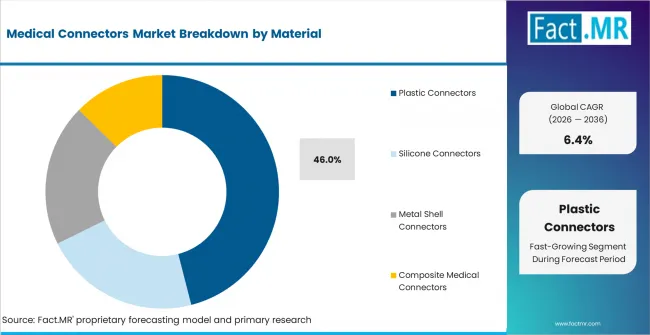
Medical Connectors Market Analysis By Material | Source: Fact.MR
Plastic connectors hold 46% share in 2026 because lightweight construction and lower production cost support large scale medical device integration. Plastic connectors are used more in disposable devices and portable equipment because they are lightweight and cost efficient.
- Lightweight Device Preference: Portable medical devices are increasing preference for compact plastic connector systems.
- Sterilization Compatibility: Silicone and composite materials are gaining adoption across reusable medical connector systems.
- Durable Connector Requirement: Metal shell connectors are increasing usage across imaging and high reliability healthcare equipment.
Medical Connectors Market Analysis by Connectivity
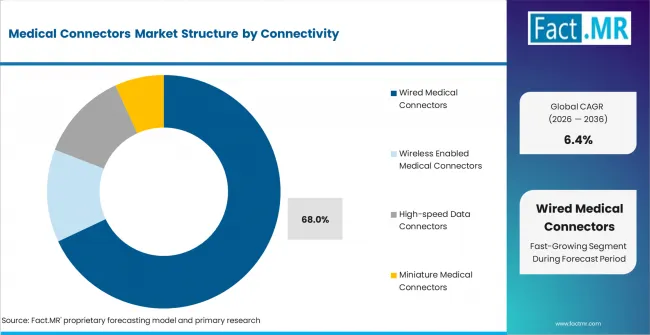
Medical Connectors Market Analysis By Connectivity | Source: Fact.MR
Wired medical connectors account for 68% share in 2026 because hospitals require stable data transmission and uninterrupted equipment connectivity. Wired connector demand is rising because monitoring systems and surgical equipment need steady power and signal transfer.
- High Speed Data Requirement: Imaging systems and monitoring equipment require reliable wired connectivity for continuous data transfer.
- Wireless Device Expansion: Wireless enabled connectors are increasing adoption across wearable healthcare and portable diagnostic devices.
- TE Connectivity Launches 56G MezzaWave Connectors: TE Connectivity launched its 56G MezzaWave connectors and cable assemblies designed for high-speed and high-density connectivity applications. The product supports advanced medical electronics, diagnostic systems, and connected healthcare technologies requiring strong signal integrity and compact connector performance.
Drivers, Restraints, and Opportunities
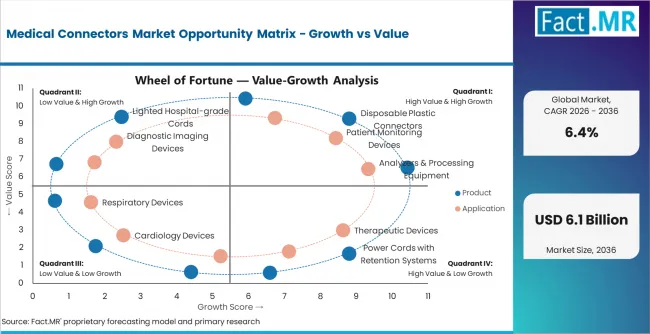
Medical Connectors Market Opportunity Matrix Growth Vs Value | Source: Fact.MR
Fact.MR analysts observe the medical connectors market is supported by healthcare equipment upgrades and the need for stable device connectivity. Hospitals and medical device manufacturers are adding more connected electronics to patient monitoring systems.
Demand for older bulky connectors is slowing in compact healthcare electronics. Miniature and disposable connector systems are increasing adoption because healthcare facilities need portability and better infection control.
- Amphenol Expands Connectivity Business Through Acquisitions: Amphenol is accelerating acquisitions to strengthen its high-speed interconnect and connectivity portfolio amid rising AI infrastructure demand. The strategy supports expansion across advanced connector systems used in healthcare electronics, data centers, and next-generation digital technologies. [5]
- Infection Control Pressure: Disposable medical connectors are increasing adoption across respiratory and patient monitoring devices due to stronger sterilization requirements.
- Wearable Healthcare Growth: Portable diagnostic devices and wearable monitoring equipment are increasing demand for compact and lightweight connector systems.
Regional Analysis
.webp "Top Country Growth Comparison Medical Connectors Market Cagr (2026 2036)")
Top Country Growth Comparison Medical Connectors Market Cagr (2026 2036) | Source: Fact.MR
The medical connectors market is assessed across North America, Europe, Asia Pacific, Latin America, and Middle East & Africa covering 40+ countries segmented by healthcare electronics demand, medical device manufacturing, and hospital equipment installation activity. The full report offers market attractiveness analysis by region and country.
| Country | CAGR (2026 to 2036) |
|---|---|
| India | 7.8% |
| China | 7.4% |
| United States | 6.3% |
| Germany | 5.9% |
| Japan | 5.6% |
Source: Fact.MR analysis. Updated Jun 2, 2026
Source: Fact.MR analysis, based on proprietary forecasting model and primary research
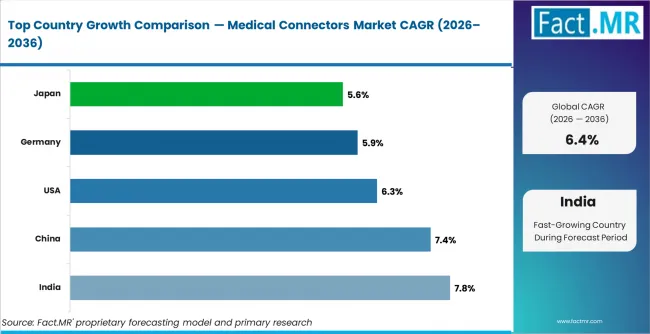
Medical Connectors Market Cagr Analysis By Country | Source: Fact.MR
Asia Pacific Medical Connectors Market Analysis
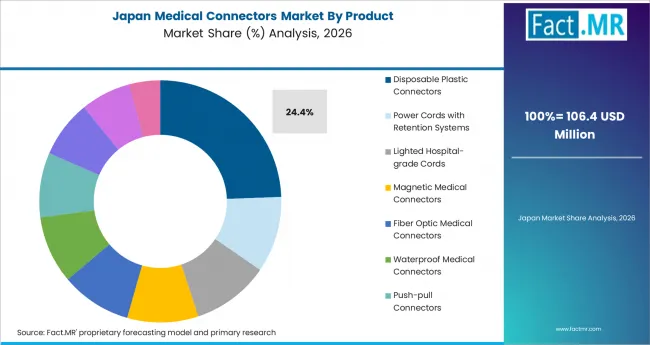
Medical Connectors Market Japan Market Share Analysis By Product | Source: Fact.MR
Asia Pacific is the fastest-growing regional market for medical connectors due to rising healthcare infrastructure investment and expanding medical electronics manufacturing activity. Regional medical device companies are increasing production of compact and high-performance connectors for diagnostic systems and patient monitoring equipment.
- India: India is projected to expand at 7.8% CAGR as domestic medical device manufacturing and hospital infrastructure improve across urban healthcare networks. Rising installation of diagnostic equipment and connected healthcare systems is supporting connector demand in private hospitals and specialty clinics. Government support for local medical device production is also contributing to market expansion.
- China: China is forecast to rise at 7.4% CAGR because local medical electronics production and hospital equipment upgrades are increasing. Domestic connector manufacturers are improving supply capacity for patient monitoring systems and imaging equipment. Growing investment in smart healthcare infrastructure is further supporting demand.
- Japan: Japan is projected to grow at 5.6% CAGR by 2036 as compact medical electronics manufacturing and wearable healthcare device production increase across healthcare technology companies. Aging population growth is supporting higher patient monitoring equipment demand.
Fact.MR’s analysis of the medical connectors market in Asia Pacific consists of country-wise assessment including China, India, Japan, ASEAN, South Korea, and Australia & New Zealand. Readers can find medical electronics demand trends, healthcare equipment installation activity, and hospital modernization analysis.
North America Medical Connectors Market Analysis
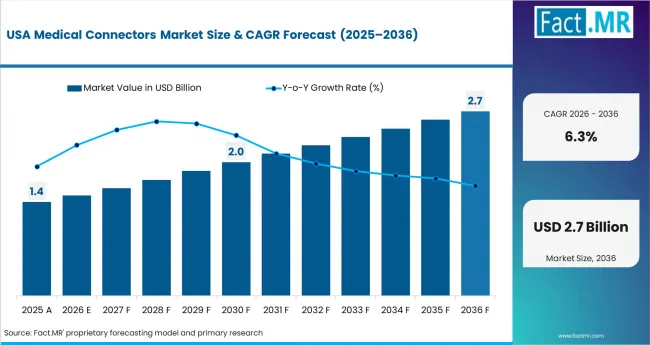
Medical Connectors Market Country Value Analysis | Source: Fact.MR
North America is a high-value healthcare electronics market supported by connected patient monitoring systems and advanced diagnostic equipment. Major medical device manufacturers are maintaining strong market presence through integrated healthcare technology development and increasing investment in digital healthcare solutions.
- United States: The United States is expected to expand at 6.3% CAGR due to rising use of connected patient monitoring systems and advanced imaging equipment in hospitals and ambulatory surgical centers. Demand for miniature connectors is increasing in wearable medical devices and portable healthcare technologies. Home healthcare and remote patient monitoring devices are also supporting market expansion.
Fact.MR’s analysis of the medical connectors market in North America consists of country-wise assessment including the United States, Canada, and Mexico. Readers can find connected healthcare trends, diagnostic equipment demand, and wearable medical device analysis.
Europe Medical Connectors Market Analysis
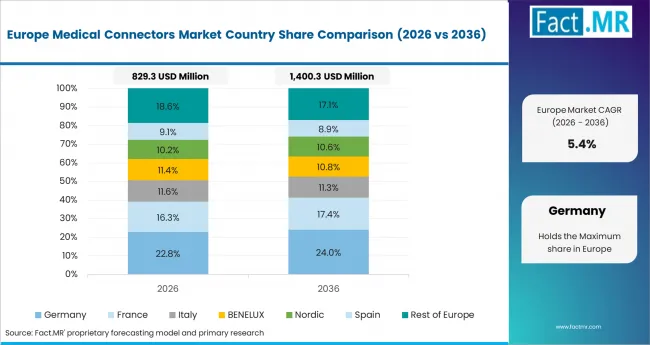
Medical Connectors Market Europe Country Market Share Analysis, 2026 & 2036 | Source: Fact.MR
Europe is a compliance-focused medical connectors market shaped by strict medical device safety standards and hospital equipment upgrades. Regional healthcare facilities are adopting high-reliability connector systems across diagnostic imaging and patient monitoring devices. Growing focus on healthcare efficiency and digital integration is also supporting demand for advanced medical connectivity solutions.
- Germany: Germany may expand at 5.9% CAGR because healthcare equipment manufacturers need stable connector performance for high-precision diagnostic systems. Hospital modernization is increasing the use of connected medical electronics. Rising demand for reliable and compliant medical components is also supporting connector adoption.
Fact.MR’s analysis of the medical connectors market in Europe consists of country-wise assessment including Germany, the United Kingdom, France, Italy, Spain, Nordic Countries, and BENELUX. Readers can find healthcare equipment modernization trends, compliance standards analysis, and diagnostic system installation activity.
Competitive Aligners for Market Players
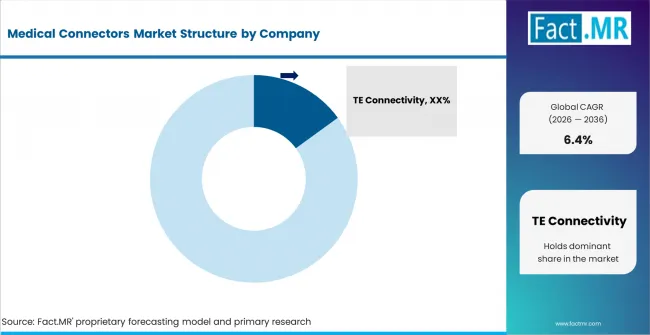
Medical Connectors Market Analysis By Company | Source: Fact.MR
Competition in the medical connectors market is shifting toward compact design capability and high reliability performance. Hospitals and medical device manufacturers prefer suppliers that support stable data transfer and sterilization compatibility.
Disposable connector systems are becoming more important in respiratory devices and patient monitoring systems. Infection control standards are pushing healthcare facilities toward single-use connectors with lower contamination risk. Companies increasing sterile connector production can strengthen hospital supply relationships.
Miniature connectors are becoming a key competitive factor in wearable healthcare and portable diagnostic equipment. Medical electronics manufacturers prefer suppliers that support lightweight designs and compact device layouts. Faster customization can improve supplier positioning in advanced healthcare electronics projects. Distribution capability is shaping competition. Connector suppliers with local inventory and technical support can improve delivery timelines for hospitals and medical device producers. Large healthcare equipment companies prefer suppliers that can support stable production and reliable component availability.
High-speed data connectivity is increasing importance in imaging systems and connected monitoring equipment. Companies investing in signal integrity and durable connector materials can improve access to premium healthcare electronics projects.
Key Players
- TE Connectivity
- Amphenol Corporation
- Molex LLC
- Smiths Interconnect
- Fischer Connectors
Bibliography
- [1] TE Connectivity. (2025, November 20). TE Connectivity expands medical device prototyping capabilities into United States.
- [2] Amphenol Corporation. (2025). Amphenol Corporation to acquire Trexon.
- [3] Molex LLC. (2026). Molex announces agreement to acquire Teramount Ltd. to accelerate scalable co-packaged optics adoption.
- [4] TE Connectivity. (2026). TE Connectivity launches 56G MezzaWave connectors and cable assemblies.
- [5] Simply Wall St. (2026). Amphenol’s acquisition spree targets AI data centers and tests valuation.
This Report Addresses
- Strategic intelligence covering medical connector demand across product, application, end user, material, and connectivity segments linked with healthcare electronics and diagnostic equipment markets.
- Market forecast from USD 3.3 billion in 2026 to USD 6.1 billion by 2036 at 6.4% CAGR with opportunity assessment across disposable and miniature connector systems.
- Growth opportunity mapping across India healthcare infrastructure investment, China medical electronics production growth, and United States connected healthcare equipment demand.
- Segment analysis across product, application, connectivity, and end user with regional CAGR forecasts and leading segment share benchmarks for 2026.
- Regional outlook covering Asia Pacific healthcare equipment manufacturing, North America connected healthcare adoption, and Europe medical device modernization activity.
- Competitive analysis of TE Connectivity, Amphenol Corporation, Molex LLC, Smiths Interconnect, and Fischer Connectors based on connector reliability, compact design capability, and healthcare electronics integration.
- Regulatory analysis covering infection control standards, medical device safety compliance, and healthcare electronics connectivity requirements across hospitals and diagnostic facilities.
- Report delivered in PDF, Excel, and presentation formats supported by healthcare equipment shipment analysis and interviews with medical electronics specialists.
Medical Connectors Market Definition
The medical connectors market covers electrical and signal connectivity systems used across medical equipment and healthcare electronics. These connectors support data transfer and power transmission across patient monitoring systems, imaging devices, respiratory equipment, surgical instruments, and wearable healthcare products. Medical connectors improve device reliability and support stable operation across hospital and diagnostic environments. Core end use includes hospitals, ambulatory surgical centers, laboratories, and medical device manufacturing facilities.
Medical Connectors Market Inclusions
The study covers global and regional forecasts from 2026 to 2036 across product, application, end user, material, and connectivity segments. It includes disposable connectors, push-pull connectors, medical cables, imaging connectors, and high speed connectivity systems used across healthcare equipment installations.
Medical Connectors Market Exclusions
The study excludes industrial connectors and consumer electronic connector systems outside healthcare applications. It omits telecom connectivity products and automotive electronic connectors not integrated into medical equipment systems. General electrical wiring accessories are outside the defined scope.
Medical Connectors Market Research Methodology
- Primary Research
- Primary research includes interviews with hospital equipment managers, medical electronics distributors, connector manufacturers, and healthcare technology consultants across North America, Europe, and Asia Pacific.
- Desk Research
- Desk research uses company disclosures from TE Connectivity, Amphenol Corporation, and Molex LLC. It includes medical electronics updates and healthcare equipment announcements from 2024, 2025, and January 2026.
- Market-Sizing and Forecasting
- Market sizing applies a hybrid top-down and bottom-up model using medical equipment shipment data, healthcare electronics installation trends, and connector pricing benchmarks. Segment forecasts are developed separately across product, application, and connectivity categories.
- Data Validation and Update Cycle
- Outputs are validated through company revenue disclosures and healthcare equipment shipment analysis from 2024 and 2025 filings. Cross-checks are completed through interviews with healthcare equipment specialists and medical electronics distributors.
Segmentation
Scope of the Report
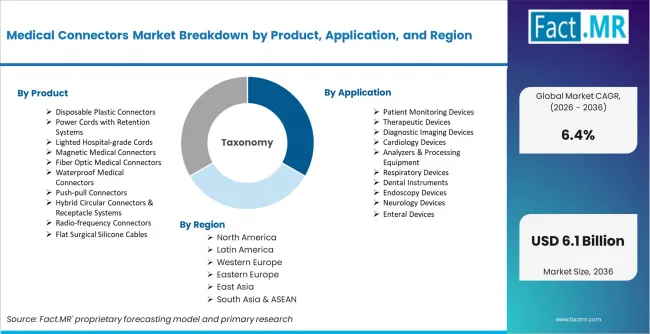
Medical Connectors Market Breakdown By Product, Application, And Region | Source: Fact.MR
| Attribute | Details |
|---|---|
| Quantitative Units | USD 3.3 billion (2026) to USD 6.1 billion (2036) at a CAGR of 6.4% |
| Market Definition | Electrical and signal connectivity systems used across healthcare and medical equipment applications |
| Product Segmentation | Push-pull Connectors, Hybrid Circular Connectors, Radio-frequency Connectors, Disposable Plastic Connectors, Magnetic Medical Connectors, Fiber Optic Medical Connectors |
| Application Segmentation | Patient Monitoring Devices, Therapeutic Devices, Diagnostic Imaging Devices, Respiratory Devices, Endoscopy Devices, Wearable Medical Devices |
| End User Segmentation | Hospitals & Clinics, Ambulatory Surgical Centers, Diagnostic Laboratories & Imaging Centers, Home Healthcare Providers, Medical Device Manufacturers |
| Material Segmentation | Plastic Connectors, Silicone Connectors, Metal Shell Connectors, Composite Medical Connectors |
| Connectivity Segmentation | Wired Medical Connectors, Wireless Enabled Medical Connectors, High-speed Data Connectors, Miniature Medical Connectors |
| Regions Covered | North America, Europe, Asia Pacific, Latin America, Middle East & Africa |
| Countries Covered | United States, Canada, Mexico, Germany, United Kingdom, France, China, Japan, South Korea, India, ASEAN |
| Key Companies Profiled | TE Connectivity, Amphenol Corporation, Molex LLC, Smiths Interconnect, Fischer Connectors |
| Forecast Period | 2026 to 2036 |
| Approach | Hybrid top-down and bottom-up model using healthcare equipment shipment data and connector pricing benchmarks |
Source: Fact.MR analysis. Updated Jun 2, 2026
Medical Connectors Market by Segments
-
By Product
- Push-pull Connectors
- Hybrid Circular Connectors & Receptacle Systems
- Radio-frequency Connectors
- Flat Surgical Silicone Cables
- Embedded Electronics Connectors
- Disposable Plastic Connectors
- Power Cords with Retention Systems
- Lighted Hospital-grade Cords
- Magnetic Medical Connectors
- Fiber Optic Medical Connectors
- Waterproof Medical Connectors
-
By Application
- Patient Monitoring Devices
- Therapeutic Devices
- Diagnostic Imaging Devices
- Cardiology Devices
- Analyzers & Processing Equipment
- Respiratory Devices
- Dental Instruments
- Endoscopy Devices
- Neurology Devices
- Enteral Devices
- Wearable Medical Devices
- Robotic Surgery Systems
-
By End User
- Hospitals & Clinics
- Ambulatory Surgical Centers
- Diagnostic Laboratories & Imaging Centers
- Home Healthcare Providers
- Medical Device Manufacturers
-
By Material
- Plastic Connectors
- Silicone Connectors
- Metal Shell Connectors
- Composite Medical Connectors
-
By Connectivity
- Wired Medical Connectors
- Wireless Enabled Medical Connectors
- High-speed Data Connectors
- Miniature Medical Connectors
-
By Region
- North America
- United States
- Canada
- Mexico
- Latin America
- Brazil
- Argentina
- Colombia
- Rest of Latin America
- Western Europe
- Germany
- United Kingdom
- France
- Italy
- Spain
- Nordic Countries
- BENELUX
- Rest of Western Europe
- East Asia
- China
- Japan
- South Korea
- South Asia & Pacific
- India
- ASEAN
- Australia & New Zealand
- Middle East & Africa
- UAE
- Saudi Arabia
- South Africa
- Rest of Middle East & Africa
- North America
Frequently Asked Questions
How large is the global medical connectors market in 2025?
What will the medical connectors market size be in 2026?
What is the projected medical connectors market size by 2036?
What is the expected CAGR for the medical connectors market from 2026 to 2036?
Which connectivity segment leads the medical connectors market through 2036?
Which country shows the fastest growth in the medical connectors market?
Who worked on this report


Preview the report firsthand - request a free sample
Free SampleGet the brochure for pricing and purchase details
Download PDF