- Market Value (2025): USD 11.3 Bn
- Estimated Value (2026): USD 12.3 Bn
- Forecast Value (2036): USD 28.1 Bn
- CAGR (2026-2036): 8.6%
What is the Medical Device Testing Market forecast to be worth by 2036?
USD 12.3 billion in 2026 to USD 28.1 billion by 2036 at an 8.6% CAGR.
- The medical device testing market stood at USD 11.3 billion in 2025, spread across biological safety, sterility, electrical and performance work.
- Revenue will grow from USD 12.3 billion in 2026 to USD 28.1 billion by 2036, as quality system rules and standard revisions add test steps to each product cycle.
- An 8.6% CAGR will reflect steady outsourcing by manufacturers that prefer accredited external laboratories to building their own capacity.
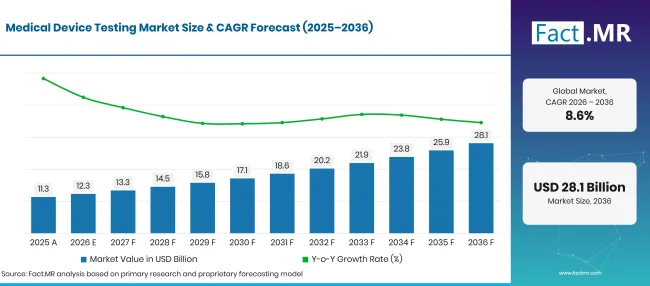
Medical Device Testing Market Forecast Global | Source: Fact.MR
| Year | Basis | Market Value (USD billion) |
|---|---|---|
| 2025 | Actual | 11.3 |
| 2026 | Estimate | 12.3 |
| 2036 | Forecast | 28.1 |
| CAGR 2026 to 2036 | Forecast period | 8.6% |
Source: Fact.MR analysis. Updated Nov 4, 2026
What are the defining numbers behind Medical Device Testing Market growth?
The 2026 to 2036 period will add USD 15.8 billion in new value, concentrated in biological evaluation, sterility assurance and electrical safety work for Class II devices.
- Demand Drivers in the Market
- Biological evaluation is being reworked across the industry. On 25 May 2026 the FDA gave partial recognition to the sixth edition of ISO 10993-1, published in November 2025, which places biological evaluation inside a device risk management process [1].
- Quality system obligations in the United States changed on 2 February 2026, when the FDA’s Quality Management System Regulation took effect and incorporated ISO 13485:2016 by reference [2].
- Notified body procedures in Europe are being standardised. Commission Implementing Regulation (EU) 2026/977 of 4 May 2026 lays down uniform quality management and procedural requirements for conformity assessment under the EU device regulations [3].
- Sterile single-use products keep microbiology laboratories busy. Bioburden, endotoxin and sterilisation validation testing are repeated whenever a material, supplier or sterilisation process changes.
- Key Segments Analyzed
- By Service Type: Testing will hold 48.3% of 2026 revenue, since laboratory data feeds every regulatory submission while inspection and certification follow later in the product cycle.
- By Device Class: Class II will account for 51.4% in 2026, given the volume of monitoring, diagnostic and therapeutic products in this moderate-risk band.
- By Testing Type: Biocompatibility Testing will capture 28.4% of 2026 value, as any device touching tissue, blood or mucosa needs a biological evaluation file.
- By End-User: Hospitals will command 38.2% of 2026 spending, owing to the large fleets of equipment they must accept, maintain and requalify.
- Analyst Opinion at Fact.MR
- Shambhu Nath Jha, Principal Consultant at Fact.MR, states, “Device makers are discovering that a change to one material or one software release can reopen several test files at once. Laboratories that pair biological, sterility and electrical capability under one quality system will win longer programmes from these clients. Turnaround time will become the main point of competition once the 2026 rule changes settle into routine audits.”
- Strategic Implications
- Manufacturers should bring biocompatibility and electrical safety testing into early design reviews, so that material or circuit changes are caught before a submission is filed.
- Testing laboratories should combine biological, microbiological and electrical capability within one accredited quality system, which shortens client programmes and reduces sample transfers. Packaging integrity know-how can also be offered to suppliers in clinical trial packaging.
- Hospital engineering teams should align equipment acceptance testing with manufacturer documentation, cutting duplicated checks when new devices enter service.
- Investors should look at laboratory capacity near device clusters in Germany, the United States and Japan, where turnaround time often decides which provider wins the contract.
Only 3.7 percentage points separate the United States at 10.0% from Brazil at 6.3%. The United States will keep a 1.3-point lead over Germany at 8.7%, helped by a registered establishment base of more than 29,000 sites that all fall under the new quality system rule. German demand will stay 0.5 points ahead of Japan at 8.2%, since EU notified body procedures and EUDAMED registration add documentation work. A steady flow of reviews at the Japanese regulator leaves Japan 0.7 points clear of the United Kingdom at 7.5%. British growth in turn will run 1.2 points above Brazil, where ANVISA’s new list of recognised standards is only beginning to shape test plans.
How does the Medical Device Testing Market break down by segment?
Testing will lead Service Type at 48.3%; Class II will head Device Class at 51.4%; Biocompatibility Testing will top Testing Type at 28.4%; Hospitals will hold End-User at 38.2% in 2026.
Which Service Type leads?
Testing takes 48.3% of 2026 sales.
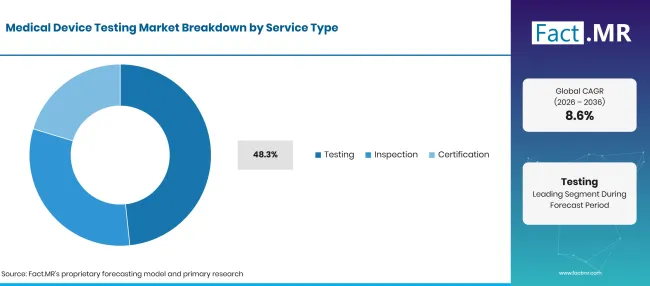
Medical Device Testing Market Breakdown Service Type | Source: Fact.MR
| Service Type | Share (2026) |
|---|---|
| Testing (Leading segment) | 48.3% |
| Other segments combined | 51.7%* |
| Total | 100.0% |
Source: Fact.MR analysis. Updated Nov 4, 2026
Every regulatory route begins with measured evidence. A manufacturer cannot file for clearance, CE marking or Japanese approval without laboratory data on biological safety, sterility, electrical behaviour and function. Testing work is also repeated through the life of a product, because design changes, supplier switches and new standard editions each trigger fresh studies. Inspection services check production sites, incoming components and finished lots against specifications. Certification covers quality system audits and conformity assessment by notified bodies and approved bodies. Both depend on test reports produced earlier, so their revenue tends to follow testing volumes with a lag.
What supports Class II within Device Class?
Class II represents 51.4% of 2026 revenue.
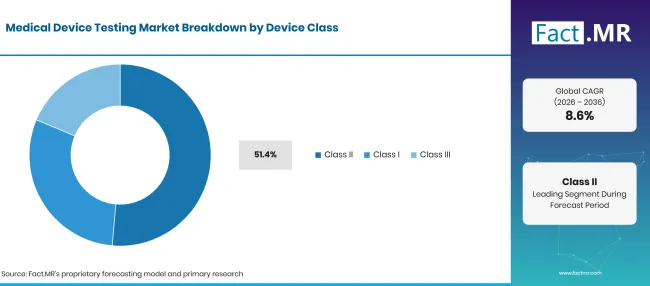
Medical Device Testing Market Breakdown Device Class | Source: Fact.MR
| Device Class | Share (2026) |
|---|---|
| Class II (Leading segment) | 51.4% |
| Other segments combined | 48.6%* |
| Total | 100.0% |
Source: Fact.MR analysis. Updated Nov 4, 2026
Infusion pumps, patient monitors, powered surgical tools, diagnostic analysers and many wound care products fall into the moderate-risk band. Each of these products needs biocompatibility, electrical safety or sterility data before market entry, and the band contains far more products than Class III. Intraoperative nerve monitoring devices are a typical example of powered equipment in this band. Many Class II devices in the United States reach the market through premarket notification, which relies heavily on bench and laboratory testing. Class I products need lighter evidence, usually limited to basic safety and labelling checks. Class III implants and life-supporting devices require the deepest test programmes, including long-term biological studies, but the number of products is smaller.
How does Testing Type shape demand?
Biocompatibility Testing accounts for 28.4% of 2026 value.
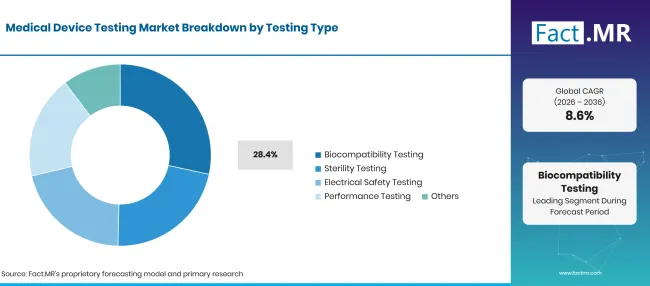
Medical Device Testing Market Breakdown Testing Type | Source: Fact.MR
| Testing Type | Share (2026) |
|---|---|
| Biocompatibility Testing (Leading segment) | 28.4% |
| Other segments combined | 71.6%* |
| Total | 100.0% |
Source: Fact.MR analysis. Updated Nov 4, 2026
Materials that touch skin, blood, tissue or bone must be evaluated for cytotoxicity, sensitisation, irritation and systemic effects according to contact type and duration. The sixth edition of ISO 10993-1 brings this work inside the risk management file, and the FDA’s May 2026 recognition will push manufacturers to revisit older biological evaluation reports [1]. Sterility testing confirms microbial control for sterile-labelled products. Electrical safety testing to the IEC 60601 series covers powered equipment, and performance testing shows that a device works as intended. Packaging integrity, shelf-life ageing and durability studies are grouped under Others.
What makes Hospitals the leading End-User?
Hospitals generate 38.2% of 2026 demand.
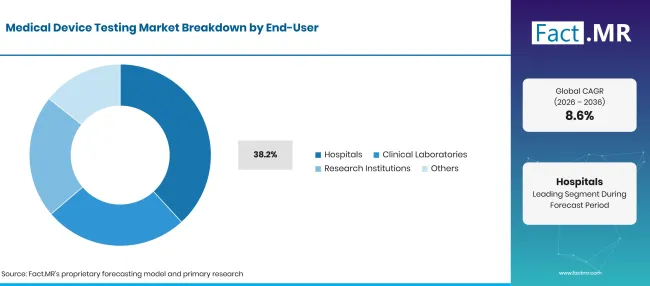
Medical Device Testing Market Breakdown End User | Source: Fact.MR
| End-User | Share (2026) |
|---|---|
| Hospitals (Leading segment) | 38.2% |
| Other segments combined | 61.8%* |
| Total | 100.0% |
Source: Fact.MR analysis. Updated Nov 4, 2026
Large hospitals run thousands of devices across imaging, monitoring, surgery and therapy. Biomedical engineering teams test equipment at acceptance, after repair and at scheduled intervals, and many contract parts of this work to external laboratories. Electrical safety checks and performance verification account for most of these orders. Units such as brain monitoring devices in neurology and intensive care wards need regular leakage current and alarm testing. Clinical laboratories focus on the accuracy of analysers and the reliability of diagnostic instruments. Research institutions buy testing during early device development and preclinical work. The Others group covers device manufacturers, contract research organisations and technology developers that buy testing as their product moves toward submission.
What is accelerating Medical Device Testing Market adoption, and what is holding it back?
New quality system rules, revised biological evaluation standards and tighter notified body procedures keep test volumes rising in 2026. Connected devices also add electrical and wireless test points. On the other side, accredited laboratory space is costly to build, studies can take months, and experienced toxicologists and microbiologists are scarce.
Drivers Impact Analysis
| DRIVER | (~) % IMPACT ON CAGR | GEOGRAPHIC RELEVANCE | IMPACT TIMELINE |
|---|---|---|---|
| DRIVER | (~) % IMPACT ON CAGR | GEOGRAPHIC RELEVANCE | IMPACT TIMELINE |
| Increasing regulatory emphasis on medical device safety and quality | +1.5% | Global | Short term (<=2 years) |
| Rising demand for biocompatibility and sterility assessments | +1.2% | North America, Europe, East Asia | Medium term (2 to 4 years) |
| Growing complexity of electronic and connected medical devices | +0.9% | North America, Europe, East Asia | Medium term (2 to 4 years) |
| Expansion of medical device manufacturing in emerging economies | +0.7% | South Asia & Pacific, Latin America | Long term (>=4 years) |
Source: Fact.MR analysis. Updated Nov 4, 2026
Opportunity Impact Analysis
| OPPORTUNITY | (~) % IMPACT ON CAGR | GEOGRAPHIC RELEVANCE | IMPACT TIMELINE |
|---|---|---|---|
| OPPORTUNITY | (~) % IMPACT ON CAGR | GEOGRAPHIC RELEVANCE | IMPACT TIMELINE |
| Expansion of specialised biocompatibility testing facilities | +0.8% | Global | Short term (<=2 years) |
| Development of integrated testing and certification services | +0.6% | North America, Europe, Asia Pacific | Medium term (2 to 4 years) |
| Increasing demand for electrical safety and performance testing | +0.5% | North America, East Asia, Europe | Medium term (2 to 4 years) |
| Growth of outsourced testing among emerging medical device manufacturers | +0.4% | South Asia & Pacific, Latin America | Long term (>=4 years) |
Source: Fact.MR analysis. Updated Nov 4, 2026
Restraints Impact Analysis
| RESTRAINT | (~) % IMPACT ON CAGR | GEOGRAPHIC RELEVANCE | IMPACT TIMELINE |
|---|---|---|---|
| RESTRAINT | (~) % IMPACT ON CAGR | GEOGRAPHIC RELEVANCE | IMPACT TIMELINE |
| High investment requirements for specialised testing infrastructure | -0.6% | Global | Short term (<=2 years) |
| Extended testing and validation timelines | -0.4% | Global | Short term (<=2 years) |
| Shortage of skilled laboratory and regulatory personnel | -0.3% | North America, Europe, Asia Pacific | Medium term (2 to 4 years) |
| Differences in regulatory requirements across countries | -0.2% | Global | Long term (>=4 years) |
Source: Fact.MR analysis. Updated Nov 4, 2026
Which countries are scaling the Medical Device Testing Market through 2036?
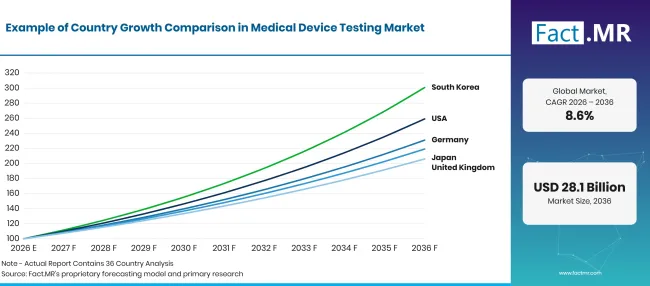
Medical Device Testing Market Growth Index | Source: Fact.MR
| Country | CAGR (2026 to 2036) |
|---|---|
| United States | 10.0% |
| Germany | 8.7% |
| Japan | 8.2% |
| United Kingdom | 7.5% |
| Brazil | 6.3% |
Source: Fact.MR analysis. Updated Nov 4, 2026
What is driving the United States’ adoption?
10.0% CAGR, driven by the new quality system rule and a very large registered establishment base.
In FY 2025, 29,178 medical device establishments registered with the FDA, of which 13,328 were domestic and 15,850 were foreign [4]. Each of these sites must now meet the Quality Management System Regulation, which became effective on 2 February 2026 [2]. Growth in monitoring products such as those covered in blood glucose monitoring devices adds further electrical and biocompatibility work for US laboratories.
What supports Germany’s adoption?
8.7% CAGR, backed by EU procedural reform and new laboratory capacity.
The first four EUDAMED modules, covering actor registration, UDI and device registration, notified bodies and certificates, and market surveillance, became mandatory on 28 May 2026 [5]. German manufacturers also face Implementing Regulation (EU) 2026/977, which sets uniform procedures for the notified bodies that review their test files [3]. Laboratory supply is responding. Nelson Labs added four laboratories in Wiesbaden in August 2025 for packaging and microbiological testing [6], and in April 2026 UL Solutions began building an electromagnetic and wireless testing laboratory at Neu-Isenburg that will evaluate medical devices among other products [7].
How is Japan developing demand?
8.2% CAGR, helped by active review of software-based and wearable devices.
The Pharmaceuticals and Medical Devices Agency published a review summary on 9 March 2026 for software that analyses home-use pulse wave information, approved on 5 November 2025 as an improved medical device with clinical data [8]. Japanese demand for electrophysiology devices and similar powered equipment keeps electrical safety and EMC laboratories in steady use.
How is the United Kingdom scaling demand?
7.5% CAGR, reflecting tighter post-market surveillance and an evolving device framework.
Revised post-market surveillance requirements apply to devices placed on the market or put into service in Great Britain from 16 June 2025 [9]. Manufacturers must gather and assess field data continuously, which often leads to retesting after complaints or design changes. The MHRA published an in vitro diagnostics roadmap on 15 December 2025 and opened a 2026 consultation on continued recognition of CE marked devices [10].
How is Brazil developing demand?
6.3% CAGR, as recognised technical standards give manufacturers clearer test references.
ANVISA published its first list of recognised technical standards for medical devices on 1 September 2026, linking them to the safety and performance requirements of RDC 848/2024 [11]. Three lists now cover transversal standards, orthopaedic implant materials and materials for health use. ANVISA said on 22 October 2026 that the lists help manufacturers and importers plan development and prepare technical dossiers, and that they will be revised continuously [12]. Local makers of products such as ready-to-use laboratory test kits will gain a clearer route to accepted test methods.
Who leads the Medical Device Testing Market?
Three groups compete for this work. Broad testing, inspection and certification groups such as SGS, Intertek and UL Solutions sell electrical safety, EMC and certification packages across many device types and win clients that want one supplier for several markets. Specialist life science laboratories, including NAMSA, Nelson Labs and Eurofins Scientific, compete on depth in biocompatibility, microbiology and sterility.
Nelson Labs announced in June 2025 a doubling of cleanroom capacity at its Salt Lake City headquarters for sterility assurance services [13], and in September 2025 launched its RapidCert biological indicator sterility test to shorten time to results [14]. Element Materials Technology covers mechanical, orthopaedic and electrical testing for Class I to III devices, while BSI works mainly as a notified body and approved body. Accreditation breadth and turnaround time will decide which providers keep long programmes.
Which companies are the key providers?
Key companies in the Medical Device Testing Market include SGS, Intertek, UL Solutions, Eurofins Scientific, Element Materials Technology, NAMSA, Nelson Labs and BSI.
- SGS
- Intertek
- UL Solutions
- Eurofins Scientific
- Element Materials Technology
- NAMSA
- Nelson Labs
- BSI
Bibliography
- [1] U.S. Food and Drug Administration. (2026, May 25). Recognized Consensus Standards: ISO 10993-1 Sixth edition 2025-11, Biological evaluation of medical devices, Part 1: Requirements and general principles.
- [2] U.S. Food and Drug Administration. (2026, February 2). Quality Management System Regulation (QMSR).
- [3] European Union. (2026, May 4). Commission Implementing Regulation (EU) 2026/977 laying down certain uniform quality management and procedural requirements for the conformity assessment activities carried out by a notified body.
- [4] U.S. Food and Drug Administration. (2026, May 13). Annual Report on Inspections of Establishments: FY 2025.
- [5] European Commission. (2026, June 1). The first four modules of EUDAMED became mandatory since 28 May 2026.
- [6] Nelson Labs. (2025, August 26). Nelson Labs Expands Laboratory Capacity and Services in Wiesbaden, Germany to Meet Growing Demand for Packaging and Microbiological Testing.
- [7] UL Solutions. (2026, April 29). UL Solutions Begins Construction of New Electromagnetic and Wireless Testing Laboratory in Germany.
- [8] Pharmaceuticals and Medical Devices Agency. (2026, March 9). Review Summary: Software for analysis of home use pulse wave information.
- [9] Medicines and Healthcare products Regulatory Agency. (2025, September 5). Medical devices: post-market surveillance requirements: Introduction and scope.
- [10] Medicines and Healthcare products Regulatory Agency. (2026, March 12). Implementation of medical devices future regime.
- [11] Agência Nacional de Vigilância Sanitária. (2026, September 1). Lista de Normas Técnicas Reconhecidas pela Anvisa para Dispositivos Médicos.
- [12] Agência Nacional de Vigilância Sanitária. (2026, October 22). Conheça as normas técnicas reconhecidas pela Anvisa para dispositivos médicos.
- [13] Nelson Labs. (2025, June 11). Nelson Labs to Double Cleanroom Capacity to Support Growing Demand for Sterility Assurance Services.
- [14] Nelson Labs. (2025, September 30). Nelson Labs Launches New RapidCert Biological Indicator (BI) Sterility Testing to Significantly Accelerate Confirmation of Sterility.
This Report Answers
- How is revenue split by service type, device class, testing type and end-user in 2026?
- Why does laboratory testing take the biggest share of service revenue, and how do inspection and certification relate to it?
- What keeps Class II devices at the centre of test demand?
- Which regulatory changes in 2025 and 2026 alter biocompatibility, sterility and quality system work?
- How far apart are the United States, Germany, Japan, the United Kingdom and Brazil in growth, and why?
- Where do broad certification groups and specialist life science laboratories compete?
What does the Medical Device Testing Market cover?
This market measures revenue from independent and contract services that evaluate medical devices for safety, quality and performance. Biocompatibility, sterility, electrical safety and performance studies are included alongside inspection and certification work.
Values are service revenues in USD billion at the provider level, across all device risk classes and end-user groups. Testing carried out by manufacturers in their own laboratories is counted only where it is sold as a service to others.
What is included in the scope?
Laboratory testing, inspection and certification services for medical devices.
Class I, Class II and Class III devices, including software functions regulated as devices. Biocompatibility, sterility, electrical safety, performance, packaging, shelf-life and chemical characterisation testing. Services bought by hospitals, clinical laboratories, research institutions, manufacturers and contract research organisations.
What is excluded from the scope?
Sales of medical devices, implants, instruments and consumables themselves.
Hospital treatment revenue and clinical care not linked to device testing.
Pharmaceutical, food, environmental and general industrial testing.
Consulting and certification unrelated to medical devices.
How Was the Analysis Built?
The analysis draws on 120+ sources, 35+ company portfolios, 25+ countries, and more than 20 industry interviews.
- Primary Research: Primary research includes discussions with manufacturers, service providers, technology developers, distributors, end users, and subject-matter experts. These conversations examine purchasing priorities, product adoption, operational challenges, approval requirements, competitive positioning, and the factors that influence wider market acceptance.
- Desk Research: Desk research covers government statistics, regulatory publications, company filings, trade data, technical studies, industry associations, standards, public policy, and other authoritative sources. Every source used in the analysis is documented in the bibliography.
- Market Sizing and Forecasting: Market estimates combine historical performance, demand indicators, pricing and volume trends, segment shares, company participation, country-level growth, adoption patterns, investment activity, and barriers to market expansion.
- Data Validation and Update Cycle: Findings are validated by comparing primary interviews with public data, company activity, regulatory changes, trade patterns, and industry developments. Regular updates review new product launches, capacity changes, partnerships, approvals, and shifts in commercial adoption.
Segmentation
What is the report’s scope and coverage?
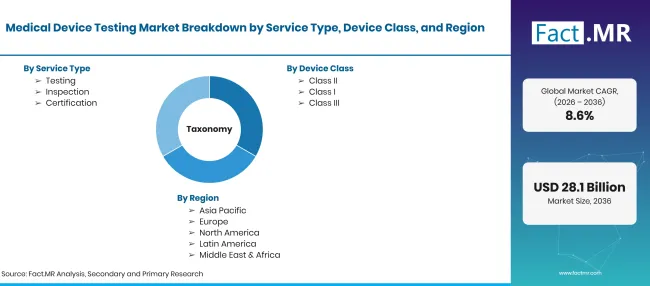
Medical Device Testing Market Taxonomy | Source: Fact.MR
| Attribute | Details |
|---|---|
| Quantitative Units | USD billion |
| Market Definition | Testing, inspection and certification services that assess the safety, quality, biological compatibility and performance of medical devices. |
| Service Type | Testing; Inspection; Certification |
| Device Class | Class I; Class II; Class III |
| Testing Type | Biocompatibility Testing; Sterility Testing; Electrical Safety Testing; Performance Testing; Others |
| End-User | Hospitals; Clinical Laboratories; Research Institutions; Others |
| Regions Covered | North America; Latin America; Western Europe; Eastern Europe; East Asia; South Asia & Pacific; Middle East & Africa |
| Countries Covered | United States; Germany; Japan; United Kingdom; Brazil |
| Companies Profiled | SGS; Intertek; UL Solutions; Eurofins Scientific; Element Materials Technology; NAMSA; Nelson Labs; BSI |
| Forecast Period | 2026 to 2036 |
| Approach | Hybrid top-down and bottom-up model combining service portfolios, device-class demand, testing requirements, end-user mix and country growth rates. |
Source: Fact.MR analysis. Updated Nov 4, 2026
How is the market segmented?
-
By Service Type
- Testing
- Inspection
- Certification
-
By Device Class
- Class I
- Class II
- Class III
-
By Testing Type
- Biocompatibility Testing
- Sterility Testing
- Electrical Safety Testing
- Performance Testing
- Others
-
By End-User
- Hospitals
- Clinical Laboratories
- Research Institutions
- Others
-
By Region
- North America
- Latin America
- Western Europe
- Eastern Europe
- East Asia
- South Asia & Pacific
- Middle East & Africa
Frequently Asked Questions
How large is the medical device testing market in 2026?
What growth rate will the medical device testing market record?
Which service type leads?
Which device class leads?
Which testing type leads?
Which end-user leads?
Which country will grow quickest?
Who are the main companies?
What holds the market back?
Who worked on this report


Preview the report firsthand - request a free sample
Free SampleGet the brochure for pricing and purchase details
Download PDF