- Market Value (2025): USD 83.3 Bn
- Estimated Value (2026): USD 90.0 Bn
- Forecast Value (2036): USD 194.3 Bn
- CAGR (2026-2036): 8.0%
What is the Medical Device CDMO Market forecast to be worth by 2036?
USD 90.0 billion in 2026 to USD 194.3 billion by 2036 at 8.0% CAGR.
- The medical device CDMO market reached USD 83.3 billion in 2025.
- Demand is projected to increase from USD 90.0 billion in 2026 to USD 194.3 billion by 2036.
- The market is forecast to record 8.0% CAGR from 2026 to 2036 as buyers place more weight on quality systems and release support.
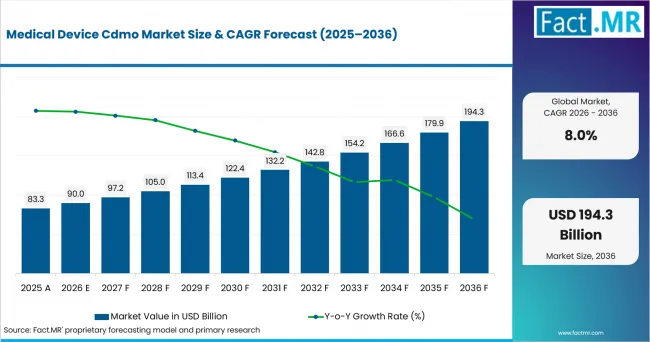
Medical Device Cdmo Market Value Analysis | Source: Fact.MR
What are the defining numbers behind Medical Device CDMO Market growth?
USD 104.3 billion absolute opportunity by 2036.
- Demand Drivers in the Market
- Finished device outsourcing is expected to gain preference when OEM teams need one supplier to manage validated production and release documents.
- Cardiology programs are likely to keep CDMO demand active because many devices need careful assembly and proof for clinical use.
- Medical Device OEMs are expected to use external partners when internal capacity or cleanroom access slows product transfer.
- Key Segments Analyzed
- By Product Type: Finished Medical Devices are expected to hold 36.7% share in 2026 because OEMs can assign clear responsibility for release-ready supply.
- By Application: Cardiology is projected to account for 28.9% share in 2026 as procedure-tied products need precise assembly and validation support.
- By End User: Medical Device OEMs are anticipated to capture 29.2% share in 2026 since outsourcing decisions start with specification control.
- By Distribution Channel: Direct OEM Contracts are estimated to represent 30.0% share in 2026 due to their fit with long qualification cycles.
- By Service Type: Product Design and Development is forecast to hold 36.2% share in 2026 because early engineering choices affect approval timing.
- Analyst Opinion at Fact.MR
- Shambhu Nath Jha, Principal Consultant at Fact.MR, states, “For medical device CDMOs the test is simple. Buyers want proof that design work and manufacturing controls can move together without creating another review burden.”
- Strategic Implications
- Device OEMs should define the manufacturing risk before price comparison begins. Demand for cardiovascular device programs becomes easier to approve when the CDMO can show component history and release evidence.
- Suppliers can improve proposals by explaining how design transfer affects tooling and validation work. This is useful for orthopedic devices when material control influences acceptance.
- Investors should separate full-device CDMOs from providers that handle narrow component work. Demand for medical device packaging becomes relevant when labeling and sterile handling affect release readiness.
South Korea is expected to record a 6.4% CAGR from 2026 to 2036 through technology-led manufacturing and supplier qualification. USA follows at 10.4%. Germany is projected at 8.8% through engineering review. UK is estimated at 8.0% through service accountability. Australia is forecast at 5.6% through supply continuity. Japan and Canada are projected at 9.6% and 7.2% respectively.
How does the Medical Device CDMO Market break down by segment?
Finished Medical Devices are expected to lead Product Type at 36.7% share in 2026. Cardiology is projected to lead Application at 28.9% share in 2026.
Why does Finished Medical Devices lead Product Type?
Finished Medical Devices are projected to account for 36.7% share in 2026.
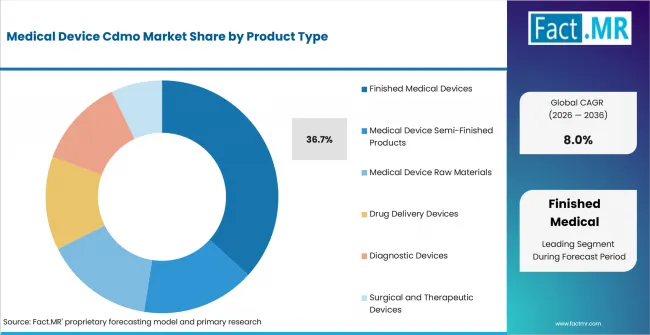
Medical Device Cdmo Market Analysis By Product Type | Source: Fact.MR
Finished devices lead Product Type because OEMs can place release responsibility with one qualified partner. Cardiovascular Devices and Orthopedic Devices remain important when procedure type changes validation work.
Why does Cardiology lead Application?
Cardiology is expected to hold 28.9% share in 2026.
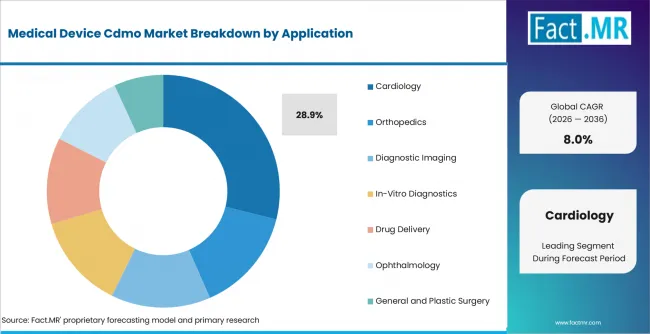
Medical Device Cdmo Market Analysis By Application | Source: Fact.MR
Cardiology leads Application because many products need steady build quality and clean documentation before clinical users accept supply. Cardiac rhythm management devices need supplier discipline.
Why does Medical Device OEMs lead End User?
Medical Device OEMs are anticipated to represent 29.2% share in 2026.
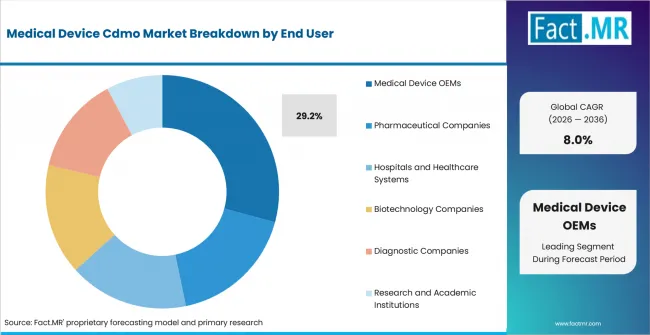
Medical Device Cdmo Market Analysis By End User | Source: Fact.MR
OEMs lead End User because they control specifications and supplier approval. Global device manufacturers use CDMOs to protect capacity. Specialty manufacturers rely on outsourcing when cleanroom access is limited.
Why does Direct OEM Contracts lead Distribution Channel?
Direct OEM Contracts are estimated to hold 30.0% share in 2026.
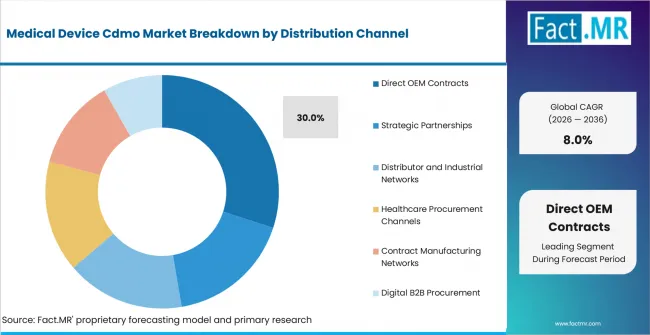
Medical Device Cdmo Market Analysis By Distribution Channel | Source: Fact.MR
Direct contracts fit long qualification cycles because quality duties and change-control steps are set early. Long-term agreements support repeat volume after approval.
Why does Product Design and Development lead Service Type?
Product Design and Development is forecast to account for 36.2% share in 2026.
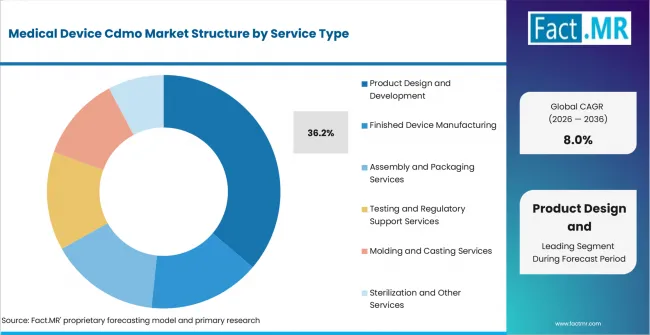
Medical Device Cdmo Market Analysis By Service Type | Source: Fact.MR
Early design work leads Service Type because manufacturability is easier to protect before tooling choices are locked. Finished device manufacturing gains value when validated designs move into routine production.
What is accelerating Medical Device CDMO Market adoption, and what is holding it back?
Demand is expected to rise as companies outsource finished device production and seek design-transfer support. Heavy validation work and reimbursement pressure may slow adoption.
Drivers Impact Analysis
| DRIVER | (~) % IMPACT ON CAGR | GEOGRAPHIC RELEVANCE | IMPACT TIMELINE |
|---|---|---|---|
| Finished device outsourcing | +2.2% | South Korea and USA | Short term (<= 2 years) |
| Cardiology workflow support | +1.8% | USA and Germany | Short term (<= 2 years) |
| OEM capacity pressure | +1.5% | South Korea and Germany | Medium term (2-4 years) |
| Direct contract governance | +1.2% | UK and Australia | Medium term (2-4 years) |
| Design-transfer support | +0.9% | Japan and Canada | Long term (>= 4 years) |
Source: Fact.MR analysis. Updated Jul 31, 2026
- Finished device outsourcing: OEMs are expected to value suppliers that can combine production discipline with controlled release documentation.
- Cardiology workflow support: Device programs in cardiology are likely to require assembly proof before supply is expanded.
- OEM capacity pressure: Outsourcing is anticipated to rise when in-house engineering time and cleanroom space delay product transfer.
Opportunity Impact Analysis
| OPPORTUNITY | (~) % IMPACT ON CAGR | GEOGRAPHIC RELEVANCE | IMPACT TIMELINE |
|---|---|---|---|
| Cardiology device programs | +1.3% | USA and Germany | Medium term (2-4 years) |
| Integrated design-to-build services | +1.1% | South Korea and Japan | Medium term (2-4 years) |
| Validation documentation packages | +0.8% | UK and Canada | Long term (>= 4 years) |
| Specialty device outsourcing | +0.6% | Australia and selected OEM clusters | Long term (>= 4 years) |
Source: Fact.MR analysis. Updated Jul 31, 2026
- Cardiology device programs: Suppliers that explain assembly controls and test duties are expected to improve conversion with device OEMs.
- Integrated design-to-build services: Providers that connect early design choices with production release are likely to gain demand from drug delivery devices.
- Validation documentation packages: Buyers are expected to favor CDMOs that reduce approval work without weakening accountability.
Restraints Impact Analysis
| RESTRAINT | (~) % IMPACT ON CAGR | GEOGRAPHIC RELEVANCE | IMPACT TIMELINE |
|---|---|---|---|
| Validation workload | -1.3% | Global | Short term (<= 2 years) |
| Reimbursement pressure on device programs | -1.0% | USA and Europe | Short term (<= 2 years) |
| Supplier qualification time | -0.8% | OEM-heavy markets | Medium term (2-4 years) |
| Capacity and tooling constraints | -0.5% | Specialty device clusters | Long term (>= 4 years) |
Source: Fact.MR analysis. Updated Jul 31, 2026
- Validation workload: Device buyers may delay outsourcing when supplier evidence does not match internal release requirements.
- Reimbursement pressure on device programs: Cost review can slow orders when hospital economics make adoption harder to defend.
- Supplier qualification time: A new CDMO must pass audits and process checks before an OEM can shift routine production.
Which countries are scaling Medical Device CDMO Market fastest?
- South Korea leads through strong technology manufacturing and local supplier networks. The USA follows with large OEM demand and strict documentation checks.
- Germany grows through engineering-focused supplier approval. The UK and Australia form the middle group as buyers review service quality and supply continuity.
- Japan and Canada remain below the global rate because companies require deeper qualification proof and dependable long-term operations before outsourcing production.
- Comparable CAGRs can produce different entry conditions. Deployment timing depends on audit readiness and supplier proximity. The next test is whether design transfer can move into routine manufacturing.
The full report provides country-level CAGR analysis across the major regional markets.
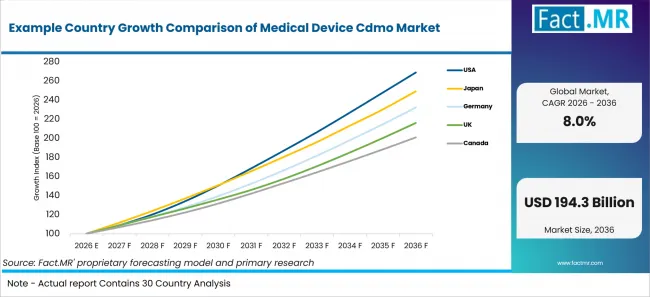
Example Country Growth Comparison Of Medical Device Cdmo Market | Source: Fact.MR
| Country | CAGR (2026-2036) |
|---|---|
| South Korea | 6.4% |
| USA | 10.4% |
| Germany | 8.8% |
| UK | 8.0% |
| Australia | 5.6% |
| Japan | 9.6% |
| Canada | 7.2% |
Source: Fact.MR analysis. Updated Jul 31, 2026
What supports South Korea adoption?
6.4% CAGR, supported by technology-led manufacturing and supplier qualification depth.
South Korea’s growth reflects fast engineering response. OEMs are expected to compare quality evidence before pilot orders scale.
What supports USA adoption?
10.4% CAGR, supported by OEM scale and documentation-led purchasing.
USA growth is tied to buyers that expect clear evidence before external production. Cardiology programs place weight on traceability and release support.
How is Germany developing demand?
8.8% CAGR, backed by engineering review and supplier discipline.
Germany’s route is expected to move through cautious qualification. Medical Device OEMs are likely to compare process control before approval.
What shapes the UK route to adoption?
8.0% CAGR, led by life-cycle value checks and service accountability.
UK buyers are expected to review outsourcing through cost control and regulatory fit. Direct OEM Contracts support clear responsibilities.
How does Australia perform through 2036?
5.6% CAGR, supported by service coverage and supply continuity needs.
Australia’s growth reflects a market where distance and service availability influence supplier choice. Product Design and Development gains relevance before production transfer.
What supports Japan adoption?
9.6% CAGR, backed by quality-focused procurement and reliability expectations.
Japan’s market is shaped by careful qualification. Finished Medical Devices must match expectations for process control and release documentation.
How is Canada positioned?
7.2% CAGR, supported by service access across a broad geography.
Canada’s growth is expected to remain measured because buyers require dependable coverage across dispersed sites. Cardiology outsourcing can reduce supply uncertainty.
Who leads the Medical Device CDMO Market?
Jabil Inc. show the clearest direct relevance. Integer Holdings Corporation and FLEX Ltd. add outsourced device manufacturing depth.
Jabil Inc. adds regulated manufacturing scale. Integer Holdings Corporation contributes device engineering for wearable medical devices. FLEX Ltd. and Sanmina Corporation broaden the provider set. Celestica Inc. supports electronics-led programs. Phillips-Medisize and Plexus Corp. add device development and manufacturing depth.
Which companies are the key providers?
Key companies include Jabil Inc.; Integer Holdings Corporation; FLEX Ltd.; Sanmina Corporation; Celestica Inc.; Phillips-Medisize; Plexus Corp.
- Jabil Inc.
- Integer Holdings Corporation
- FLEX Ltd.
- Sanmina Corporation
- Celestica Inc.
- Phillips-Medisize
- Plexus Corp.
How is the market segmented?
-
By Product Type
- Finished Medical Devices
- Cardiovascular Devices
- Orthopedic Devices
- Medical Device Semi-Finished Products
- Molded Components
- Machined Components
- Medical Device Raw Materials
- Medical-Grade Polymers
- Medical-Grade Metals
- Drug Delivery Devices
- Auto-Injectors
- Inhalation and Infusion Devices
- Diagnostic Devices
- In-Vitro Diagnostic Devices
- Point-of-Care Diagnostic Devices
- Surgical and Therapeutic Devices
- Minimally Invasive Surgical Devices
- Electrosurgical Devices
- Finished Medical Devices
-
By Application
- Cardiology
- Cardiac Rhythm Management Devices
- Interventional Cardiology Devices
- Orthopedics
- Orthopedic Implants
- Trauma and Extremity Devices
- Diagnostic Imaging
- Imaging Equipment Components
- Ultrasound and Diagnostic Systems
- In-Vitro Diagnostics
- Molecular Diagnostics
- Clinical Chemistry and Immunoassay Devices
- Drug Delivery
- Auto-Injectors and Pen Injectors
- Infusion and Delivery Systems
- Ophthalmology
- Intraocular Devices
- Ophthalmic Surgical Instruments
- General and Plastic Surgery
- Surgical Instruments
- Plastic and Reconstructive Devices
- Cardiology
-
By End User
- Medical Device OEMs
- Global Medical Device Manufacturers
- Specialty Device Manufacturers
- Pharmaceutical Companies
- Drug Delivery Device Developers
- Combination Product Manufacturers
- Hospitals and Healthcare Systems
- Hospital-Owned Device Programs
- Healthcare System Procurement
- Biotechnology Companies
- Emerging Biotechnology Companies
- Established Biotechnology Companies
- Diagnostic Companies
- Clinical Diagnostic Manufacturers
- Point-of-Care Diagnostic Companies
- Research and Academic Institutions
- University Research Programs
- Clinical Research Organizations
- Medical Device OEMs
-
By Distribution Channel
- Direct OEM Contracts
- Long-Term Manufacturing Agreements
- Design and Development Contracts
- Strategic Partnerships
- Co-Development Partnerships
- Technology Licensing Partnerships
- Distributor and Industrial Networks
- Specialized Medical Device Distributors
- Industrial Component Distributors
- Healthcare Procurement Channels
- Hospital Procurement Programs
- Group Purchasing Organizations
- Contract Manufacturing Networks
- Regional Contract Manufacturing Networks
- Global Supply Chain Partners
- Digital B2B Procurement
- Online Industrial Marketplaces
- Digital Procurement Platforms
- Direct OEM Contracts
-
By Service Type
- Product Design and Development
- Concept Development and Prototyping
- Design for Manufacturing
- Finished Device Manufacturing
- Component Manufacturing
- Full Device Manufacturing
- Assembly and Packaging Services
- Device Assembly
- Secondary Packaging and Labeling
- Testing and Regulatory Support Services
- Product Testing and Validation
- Regulatory Documentation and Support
- Molding and Casting Services
- Injection Molding
- Metal Casting and Forming
- Sterilization and Other Services
- Ethylene Oxide Sterilization
- Gamma and E-Beam Sterilization
- Product Design and Development
-
By Region
- North America
- Latin America
- Europe
- East Asia
- South Asia and Oceania
- Middle East and Africa
Bibliography
- U.S. Food and Drug Administration. (2024, February 2). Medical devices; Quality System Regulation amendments: Final regulatory impact analysis.
- Regulatory Policy Committee. (2024, October 31). The Medical Devices (Post-market Surveillance Requirements) (Amendment) (Great Britain) Regulations 2024: RPC opinion. GOV.UK.
- Medicines and Healthcare products Regulatory Agency. (2025, January 15). Medical devices: Post-market surveillance requirements. GOV.UK.
- Integer Holdings Corporation. (2024, January 8). Integer Holdings Corporation announces preliminary unaudited sales results and acquisition of Pulse Technologies.
This Report Answers
- The report provides strategic intelligence on Product Type and Application choices that shape medical device outsourcing programs.
- Segment analysis covers Finished Medical Devices and Cardiology as the share leaders within the 2026 market.
- Country outlook evaluates South Korea and USA alongside Germany and UK. Australia and Japan complete the view with Canada.
- Competitive analysis profiles Jabil Inc. alongside Integer Holdings Corporation and FLEX Ltd.
- Service assessment covers Product Design and Development and Finished Device Manufacturing. Assembly support and testing complete the view with regulatory work and sterilization.
What does the Medical Device CDMO Market cover?
Medical device CDMOs support outsourced work where device companies need design support and release evidence inside regulated quality systems. Coverage includes drug delivery devices when a device program needs controlled production support.
The Medical Device CDMO Market covers finished devices and related manufacturing services. Coverage extends to cardiovascular devices and orthopedic devices. It includes diagnostic imaging and ophthalmic devices when buyers contract a supplier for production support.
What is included in the scope?
Medical device CDMO services are used by OEMs and specialty manufacturers. Pharmaceutical companies and healthcare systems are included when they contract support for device development or production.
The scope includes Product Type and Application. It covers End User with Distribution Channel and Service Type. Design and finished device manufacturing are included. Assembly and testing follow when they support release work.
What is excluded from the scope?
General corporate outsourcing and unrelated manufacturing activity remain outside the scope of this market.
The scope excludes services that do not support medical device development or production. Distribution-only activity is excluded when the provider does not support design or regulated production evidence.
How Was the Analysis Built?
The analysis draws on 120+ sources and 35+ company portfolios. It covers 25+ countries and more than 20 industry interviews.
- Primary Research: Primary research includes discussions with manufacturers and service providers. Interviews cover purchase priorities and approval needs. They examine operating problems and wider market acceptance.
- Desk Research: Desk research covers government statistics and regulatory publications. It reviews company filings and trade data. Technical studies and public policy are used when they support the market point.
- Market Sizing and Forecasting: Market estimates combine historical performance with demand indicators and segment shares. Forecasts review company participation and country growth. Adoption patterns and barriers shape the final model.
- Data Validation and Update Cycle: Findings are validated against public data and company activity. Updates review launches and capacity changes. Partnerships and procurement shifts are checked during refresh cycles.
Segmentation
What is the report's scope and coverage?
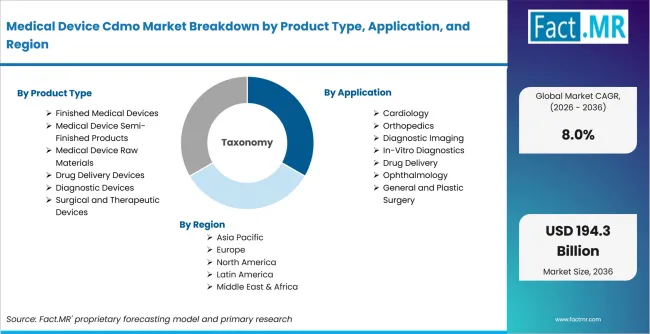
Medical Device Cdmo Market Breakdown By Product Type, Application, And Region | Source: Fact.MR
| Attribute | Details |
|---|---|
| Quantitative Units | USD billion in 2026 to USD billion by 2036 at CAGR |
| Market Definition | Outsourced design, development, manufacturing, assembly, testing, packaging, and support services used by device companies to move regulated products into supply |
| Product Type | Finished Medical Devices; Cardiovascular Devices; Orthopedic Devices; Medical Device Semi-Finished Products; Medical Device Raw Materials; Drug Delivery Devices; Auto-Injectors; Diagnostic Devices; Surgical and Therapeutic Devices |
| Application | Cardiology; Orthopedics; Diagnostic Imaging; In-Vitro Diagnostics; Drug Delivery; Ophthalmology; General and Plastic Surgery |
| End User | Medical Device OEMs; Global Medical Device Manufacturers; Specialty Device Manufacturers; Pharmaceutical Companies; Healthcare Systems; Biotechnology Companies; Diagnostic Companies; Research Institutions |
| Distribution Channel | Direct OEM Contracts; Long-Term Manufacturing Agreements; Design and Development Contracts; Strategic Partnerships; Distributor Networks; Healthcare Procurement Channels; Contract Manufacturing Networks; Digital B2B Procurement |
| Service Type | Product Design and Development; Finished Device Manufacturing; Assembly and Packaging; Testing and Regulatory Support; Molding and Casting; Sterilization and Other Services |
| Regions Covered | North America; Latin America; Europe; East Asia; South Asia and Oceania; Middle East and Africa |
| Countries Covered | South Korea; USA; Germany; UK; Australia; Japan; Canada |
| Key Companies Profiled | Jabil Inc.; Integer Holdings Corporation; FLEX Ltd.; Sanmina Corporation; Celestica Inc.; Phillips-Medisize; Plexus Corp. |
| Forecast Period | 2026 to 2036 |
| Approach | Hybrid top-down and bottom-up approach using outsourcing demand; service mix; OEM qualification patterns; country adoption; supplier portfolio review; and company participation |
Source: Fact.MR analysis. Updated Jul 31, 2026
Frequently Asked Questions
Which Product Type leads the market?
Which Application leads the market?
Which End User leads the market?
Which Distribution Channel leads the market?
Which Service Type leads the market?
Which country records the highest listed CAGR?
What is the primary driver in this market?
What is the main restraint?
Why do Medical Device OEMs lead demand?
Who worked on this report


Preview the report firsthand - request a free sample
Free SampleGet the brochure for pricing and purchase details
Download PDF