- Base Value(2025): 1.8 Bn
- Estimated Value(2026): 1.9 Bn
- Forecast Value (2036): 3.4 Bn
- CAGR (2026 - 2036): 6.0%
Cardiac POC Testing Devices Market Analysis and Forecast by Fact.MR
The global market for cardiac poc testing devices is estimated to be around USD 1.9 billion in 2026 and has been forecast to expand at a CAGR of 6.0% to end up at USD 3.4 billion by 2036. The Cardiac POC Testing Devices segment is led by Cardiac Biomarker POCT Devices, which is anticipated to account for 52.0% of the product segment in 2026, while Emergency Cardiac Diagnosis is expected to remain the leading application with around 57.0% share. The market was valued at USD 1.8 billion in 2025 and is poised for steady growth driven by evolving industry dynamics and regional demand patterns.
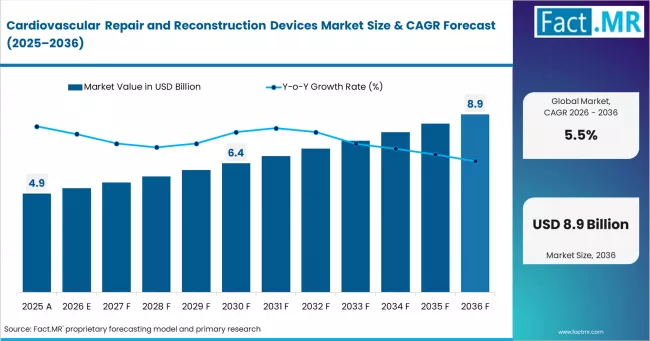
Cardiovascular Repair And Reconstruction Devices Market Market Value Analysis | Source: Fact.MR
Summary of Cardiac POC Testing Devices Market
- Market Snapshot
- In 2025, the global Cardiac POC Testing Devices Market was valued at approximately USD 1.8 billion.
- The market is estimated to reach USD 1.9 billion in 2026 and is projected to attain USD 3.4 billion by 2036
- The cardiac poc testing devices market is likely to expand at a CAGR of 6.0% during the forecast period.
- The market is anticipated to create an absolute dollar opportunity of USD 1.5 billion between 2026 and 2036.
- Cardiac Biomarker POCT Devices account for 52.0% of market share in 2026.
- India (7.5%) and Germany (6.9%) are the key growth markets during the forecast period
- Demand and Growth Drivers
- Demand is shaped by the need for rapid triage of chest pain presentations, where minutes-to-diagnosis directly affects patient outcomes and emergency department throughput.
- Growth reflects the broadening clinical adoption of high-sensitivity troponin assays at the point of care, which have compressed rule-out timelines from hours to minutes.
- Adoption is increasing due to the global cardiovascular disease burden, which continues to drive baseline volumes for cardiac marker testing across hospitals and ambulatory care.
- Product and Segment View
- Cardiac biomarker POCT devices lead the product segment with a 52% share in 2026, supported by rapid troponin, CK-MB, and BNP assay use across emergency and critical care settings.
- Emergency cardiac diagnosis holds 57% of the application segment, anchored by acute chest pain rule-out protocols in hospital emergency departments.
- Hospitals account for 61% of end-use demand, while diagnostic laboratories and ambulatory surgical centers are growing faster as decentralized testing expands.
- Geography and Competitive Outlook
- North America remains the largest regional market, supported by high emergency department visit volumes, reimbursement for rapid cardiac diagnostics, and broad provider access to POCT platforms.
- Asia Pacific is the fastest-growing region, led by India and emerging cardiovascular disease burden expansion alongside private hospital network growth.
- The competitive field is led by LifeSign LLC, F. Hoffmann-La Roche AG, Danaher Corporation, and Bio-Rad Laboratories, with specialist players such as Nano-Ditech Corporation and PTS Diagnostics holding differentiated positions in rapid assay formats.
- Analyst Opinion
- Cardiac POC testing is a category where clinical outcomes and commercial economics align unusually well. The shift from central-lab cardiac marker testing to point-of-care troponin assays has been driven by emergency department pressure to accelerate rule-out timelines, and the commercial result is a steadily growing consumables-led revenue base. The commercial lever that matters is assay sensitivity combined with analyzer placement depth, because hospitals buying into a POCT platform lock in multi-year consumables flow. Players that pair high-sensitivity troponin performance with broad analyzer installed bases will capture disproportionate share, while commodity assay vendors without platform anchoring will continue to compete on price in a shrinking pool.
Why is Cardiac POC Testing Devices Market Growing?
- Growth reflects the shift of cardiac biomarker testing from central laboratories to decentralized POCT platforms at the bedside and in emergency departments.
- Demand is shaped by adoption of high-sensitivity troponin assays, which have redefined the rule-out protocol for acute coronary syndromes.
- Adoption is increasing due to the global cardiovascular disease burden and aging demographics that sustain chest pain presentation volumes across emergency and ambulatory care.
The demand base rests on emergency department throughput pressure. Chest pain is one of the highest-volume complaint categories in emergency medicine, and time-to-rule-out directly affects bed turnover, triage accuracy, and clinical outcomes. POCT troponin platforms have compressed rule-out windows from four hours or more to as little as one hour, which has material economic and clinical consequences for hospital operators. This pressure is structural and not subject to reversal.
High-sensitivity troponin has been the most important clinical advance in the category over the past decade. Fifth-generation assays detect troponin at concentrations that earlier generations missed, which allows faster rule-out of myocardial infarction in low-risk patients and more accurate risk stratification in intermediate-risk patients. The rollout of these assays onto POCT analyzers has lifted per-patient test utilization and reinforced the commercial case for decentralized testing.
The third driver is demographic and epidemiological. Aging populations in developed markets and rising cardiovascular disease prevalence in emerging markets both sustain baseline chest pain evaluation volumes. Combined with the expansion of POCT infrastructure into smaller hospitals, ambulatory centers, and select home-based settings, these trends underpin a steady mid-single-digit growth trajectory.
Segment-wise Analysis of Cardiac POC Testing Devices Market
- Cardiac biomarker POCT devices lead the product segment with 52% share in 2026, anchored by troponin, CK-MB, and BNP assay adoption at the bedside.
- Emergency cardiac diagnosis dominates the application segment at 57%, reflecting the clinical urgency of chest pain rule-out protocols.
- Hospitals hold 61% of end-use demand, while diagnostic laboratories and ambulatory surgical centers are scaling faster as decentralized testing expands.
The segmentation view shows clear concentration around troponin-centric biomarker testing in emergency department settings. Competitive advantage sits with suppliers that combine high-sensitivity assay performance, small-analyzer footprint, and broad test menu. Growth over the forecast period is expected to tilt toward multiplex assay kits and connected analyzer platforms rather than single-marker point solutions.
Why Do Cardiac Biomarker POCT Devices Lead the Product Segment?
Cardiac biomarker POCT devices lead the product segment because they deliver the clinical data that drives acute coronary syndrome decisions. Troponin assays are the cornerstone of myocardial infarction diagnosis, and BNP or NT-proBNP assays guide heart failure evaluation at the bedside. When these tests move from the central lab to the point of care, turnaround time drops from hours to minutes, which changes clinical workflow and patient disposition decisions.
The segment leadership is reinforced by consumables economics. Each troponin test consumes a dedicated cartridge or strip, which creates a predictable per-patient revenue stream for the analyzer manufacturer. High-sensitivity assay adoption has also lifted per-patient test utilization, because serial testing protocols often require two measurements rather than one. The combination of analyzer installation, assay menu depth, and repeat consumable usage produces durable commercial economics.
Why Does Emergency Cardiac Diagnosis Dominate the Application Segment?
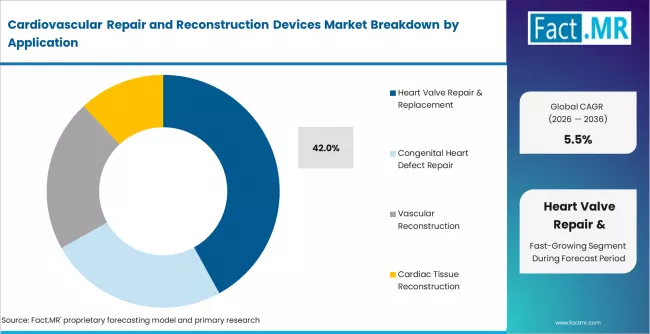
Cardiovascular Repair And Reconstruction Devices Market Analysis By Application | Source: Fact.MR
Emergency cardiac diagnosis dominates the application segment because chest pain is one of the largest-volume complaint categories in emergency medicine worldwide. Every ED visit with suspected acute coronary syndrome requires cardiac biomarker testing, and many require serial testing to confirm or exclude myocardial infarction. POCT platforms have become standard in high-volume EDs because they compress rule-out timelines and reduce length of stay for low-risk patients.
Growth within emergency cardiac diagnosis is being lifted by the adoption of accelerated diagnostic protocols that rely on high-sensitivity troponin. These protocols allow safe discharge of low-risk patients within one to two hours, which has significant implications for ED throughput and inpatient admission rates. Hospital operators are investing in POCT infrastructure to capture these operational benefits.
Key Growth Drivers, Constraints, and Market Scope
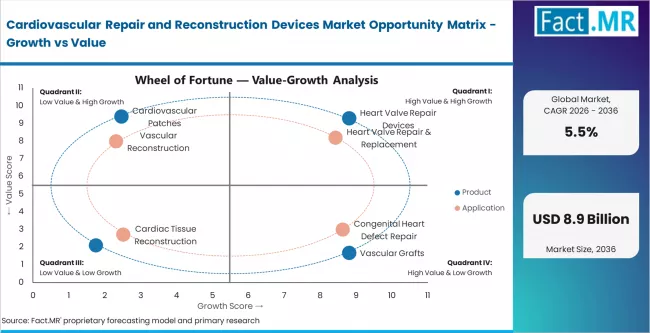
Cardiovascular Repair And Reconstruction Devices Market Opportunity Matrix Growth Vs Value | Source: Fact.MR
- Cardiovascular disease prevalence and ED chest pain volumes are the structural demand foundations.
- High-sensitivity troponin assay adoption is the key compositional shift driving per-patient utilization.
- Assay cost, analyzer placement economics, and operator training remain the leading constraints.
The market scope is shaped by steady, consumables-driven demand combined with technology substitution toward high-sensitivity assays and connected analyzer platforms. Competitive advantage sits in assay menu depth, analyzer installed base, and clinical evidence generation rather than in price alone.
Growth Drivers
The primary driver is cardiovascular disease prevalence, which sustains emergency department chest pain volumes globally. A second driver is the rollout of high-sensitivity troponin assays onto POCT platforms, which has compressed clinical decision times and lifted per-patient test utilization. A third driver is the expansion of POCT infrastructure into smaller hospitals, ambulatory surgical centers, and select home healthcare settings, which widens the addressable installed base. These three forces combine to deliver a steady mid-single-digit growth trajectory with limited cyclical exposure.
Constraints
The leading constraint is assay cost, which is meaningfully higher than central-lab equivalents and limits adoption in budget-constrained health systems. A second constraint is analyzer placement economics. POCT analyzers require local calibration, quality control, and operator training, which raises the total cost of ownership relative to central-lab testing. A third constraint is regulatory complexity around CLIA-waived versus moderate-complexity testing in the US, which affects which personnel can run the assays and where they can be deployed.
Opportunities
The strongest opportunity lies in multiplex assay expansion, where combined troponin plus BNP or troponin plus D-dimer kits deliver broader clinical utility per test. A second opportunity is emerging market penetration, particularly in India and Brazil, where expanding private hospital networks are building cardiac care capacity from a lower installed base. A third opportunity is connected analyzer platforms that integrate POCT results into electronic medical records, which addresses one of the persistent friction points in decentralized testing workflows.
Regional Outlook Across Key Markets
.webp "Top Country Growth Comparison Cardiovascular Repair And Reconstruction Devices Market Cagr (2026 2036)")
Top Country Growth Comparison Cardiovascular Repair And Reconstruction Devices Market Cagr (2026 2036) | Source: Fact.MR
- India leads country-level growth at 7.5% CAGR, supported by private hospital expansion, rising cardiovascular disease prevalence, and growing POCT analyzer adoption.
- Germany follows at 6.9%, driven by aging demographics, statutory insurance funding, and high hospital density.
- North America remains the largest regional pool by absolute value, with the USA at 5.7% supported by high ED chest pain volumes and mature POCT infrastructure.
- European demand is led by Germany at 6.9% and the UK at 5.1%, with NHS and statutory system coverage supporting steady volumes.
Country CAGR Table
| Country | CAGR (%) |
|---|---|
| India | 7.5% |
| Germany | 6.9% |
| Brazil | 6.3% |
| USA | 5.7% |
| UK | 5.1% |
| Japan | 4.5% |
Source: Fact.MR analysis. Updated Apr 24, 2026
Source: Fact.MR analysis, based on proprietary forecasting model and primary research.
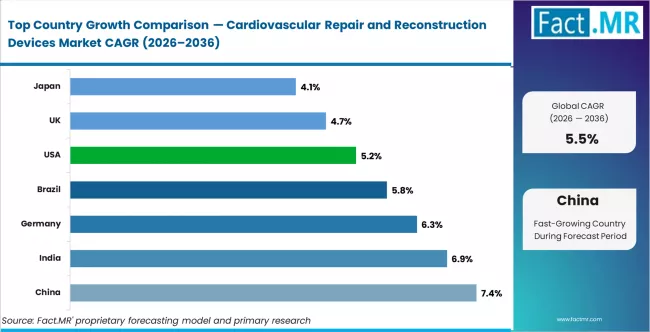
Cardiovascular Repair And Reconstruction Devices Market Cagr Analysis By Country | Source: Fact.MR
Regional dynamics split into three profiles. Asia Pacific leads on growth rate, with India anchoring expansion through private hospital build-out and rising cardiovascular burden. Europe grows at steady mid-single-digit rates driven by aging demographics and mature reimbursement frameworks. North America remains the largest dollar market, anchored by US ED chest pain volumes and an established POCT analyzer installed base.
United States
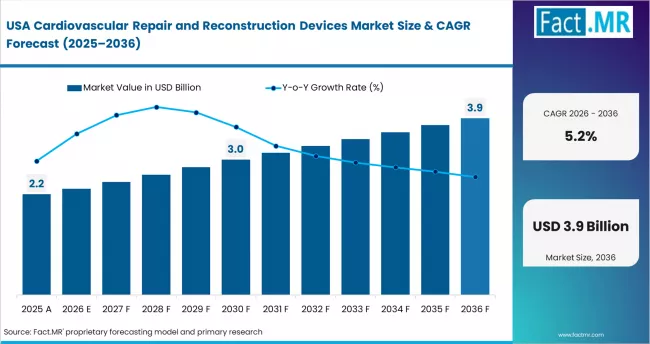
Cardiovascular Repair And Reconstruction Devices Market Country Value Analysis | Source: Fact.MR
The United States anchors global demand through its high-volume emergency department infrastructure, established reimbursement for cardiac POCT, and a mature analyzer installed base. High-sensitivity troponin adoption has accelerated over recent years, supported by clinical society guidelines and by operational pressure on ED throughput. Group purchasing organizations and hospital consolidation shape contracting dynamics, favoring scaled suppliers with broad assay menus.
- High ED chest pain volumes sustain baseline cardiac biomarker testing demand.
- High-sensitivity troponin adoption has lifted per-patient test utilization.
- GPO contracting concentrates analyzer placements with scaled suppliers.
Canada
Canada represents a steady mid-single-digit growth market shaped by provincial health system procurement and by gradual adoption of POCT cardiac biomarker testing across ED networks. Large academic hospitals have deployed high-sensitivity troponin on POCT platforms, while community hospitals are following as reimbursement and laboratory accreditation frameworks mature. Cross-border sourcing from US manufacturers sustains product availability.
- Provincial health system procurement concentrates contracts with scaled suppliers.
- Academic hospitals lead high-sensitivity troponin POCT adoption.
- Cross-border sourcing from US manufacturers sustains product availability.
United Kingdom
The United Kingdom market is shaped by NHS emergency department pathways and by NICE guidance on rapid cardiac assessment protocols. NHS trusts have progressively deployed POCT troponin in ED settings to support one-hour and two-hour rule-out protocols, while private hospitals contribute premium product demand. Laboratory accreditation frameworks from UKAS influence analyzer deployment decisions.
- NHS rapid cardiac assessment protocols drive POCT troponin adoption.
- NICE guidance supports high-sensitivity assay use in ED settings.
- Private hospital networks add premium product demand beyond NHS pathways.
Germany
Germany leads European growth on the strength of dense hospital infrastructure, statutory health insurance funding for cardiac diagnostics, and strong regulatory oversight from BfArM. Aging demographics and high cardiovascular disease prevalence sustain testing volumes, while university hospitals drive early adoption of advanced assay formats. Hospital group procurement consolidation concentrates demand with scaled suppliers.
- Aging demographics and cardiovascular prevalence sustain testing volumes.
- Statutory health insurance coverage supports predictable reimbursement.
- University hospitals lead adoption of advanced assay formats.
India
India is the fastest-growing country in the forecast, driven by private hospital chain expansion, rising cardiovascular disease burden, and growing adoption of POCT analyzers across metropolitan and tier-2 cities. Apollo, Fortis, Max, and other corporate hospital groups are deploying POCT troponin in emergency departments, while diagnostic laboratory chains such as Dr Lal PathLabs and Metropolis are expanding decentralized cardiac testing capabilities.
- Private hospital chain expansion drives POCT analyzer placement growth.
- Rising cardiovascular disease prevalence anchors testing volume growth.
- Diagnostic laboratory chains are expanding decentralized cardiac testing capacity.
Japan
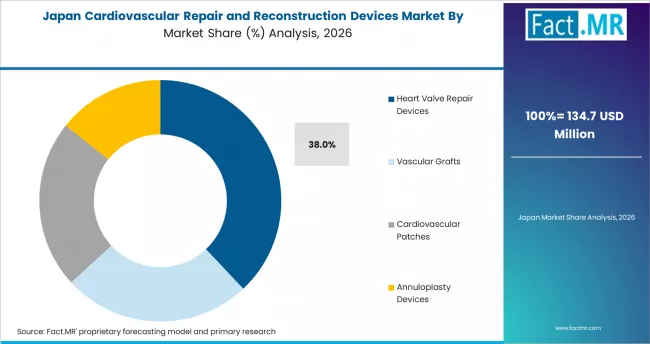
Cardiovascular Repair And Reconstruction Devices Market Japan Market Share Analysis By Product | Source: Fact.MR
Japan represents a mature but slower-growing market shaped by high cardiovascular disease prevalence, aging demographics, and established hospital POCT infrastructure. Demand is concentrated in large hospital cardiology departments and emergency medicine centers, while ambulatory care adoption is progressing more gradually. Domestic players such as Sekisui Medical hold strong positions alongside international brands.
- Aging demographics support sustained cardiac testing volumes.
- Established hospital POCT infrastructure limits incremental growth pace.
- Domestic players hold strong positions alongside international brands.
Competitive Benchmarking and Company Positioning
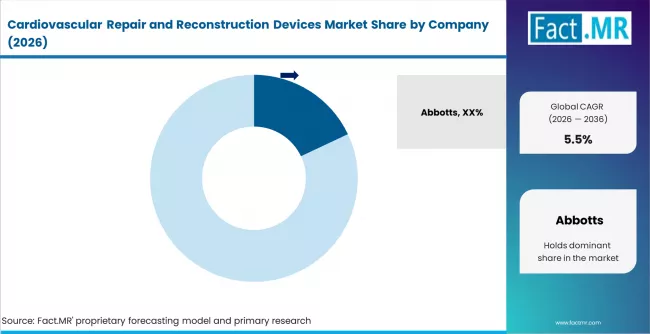
Cardiovascular Repair And Reconstruction Devices Market Analysis By Company | Source: Fact.MR
- LifeSign LLC leads with an estimated 15% share, supported by its cardiac biomarker assay portfolio and specialist positioning in rapid lateral flow formats.
- F. Hoffmann-La Roche AG, Danaher Corporation (Beckman Coulter), and Bio-Rad Laboratories compete through broad assay menus, global analyzer installed bases, and deep clinical evidence portfolios.
- Specialist players such as Nano-Ditech Corporation, Nexus Dx, PTS Diagnostics, and Nova Biomedical hold differentiated positions in rapid assay formats and niche analyzer platforms.
The competitive field is moderately fragmented, with LifeSign LLC holding a specialist lead through its cardiac biomarker rapid assay portfolio. F. Hoffmann-La Roche AG competes through the Cobas h 232 POCT platform and broad cardiac assay menu, while Danaher Corporation leverages its Beckman Coulter and Radiometer POCT portfolios to reach emergency medicine buyers. Bio-Rad Laboratories maintains relevance through specialty immunoassay capabilities and established hospital laboratory relationships.
The second tier of the market is occupied by specialists including Nano-Ditech Corporation, Nexus Dx, PTS Diagnostics, Nova Biomedical, Sekisui Medical, and Medtronic plc in specific form factors. These companies compete through differentiated assay performance, analyzer form factor, or regional strength rather than through full platform breadth. Private-label supply and OEM partnerships with larger brands provide additional volume support.
Strategic priorities across the field include expanding high-sensitivity troponin assay portfolios, deepening multiplex panel capability, and investing in connected analyzer platforms that integrate with electronic medical records. Suppliers that combine clinical evidence depth with hospital contracting scale will capture the bulk of forecast period growth.
Competitive Analysis
Competitive positioning rests on three dimensions: assay sensitivity and menu depth, analyzer installed base, and connectivity capability. F. Hoffmann-La Roche AG leads on assay menu depth through its cardiac biomarker portfolio, while Danaher Corporation competes through Radiometer and Beckman Coulter POCT platforms. LifeSign LLC and Nano-Ditech Corporation hold differentiated positions in rapid lateral flow formats. Nova Biomedical anchors its position through specialty blood-gas and cardiac marker integration.
Second-tier competitors maintain relevance through niche clinical capabilities, regional channel strength, or differentiated analyzer form factors. The gap between platform-level diagnostic companies and point-product suppliers continues to widen as hospital procurement consolidates around fewer, higher-quality partners. Players without connected analyzer capability face growing commercial pressure as hospitals prioritize EMR-integrated testing workflows.
Benchmarking Table
| Company | Scale Reach | Assay Menu Depth | Analyzer Installed Base | Connectivity |
|---|---|---|---|---|
| F. Hoffmann-La Roche AG | Global | Strong | Strong | High |
| Danaher Corporation | Global | Strong | Strong | High |
| Bio-Rad Laboratories Inc. | Global | Medium-Strong | Medium | Medium-High |
| LifeSign LLC | Global | Medium | Medium | Medium |
| Nano-Ditech Corporation | Select Markets | Medium | Medium | Medium |
| Nexus Dx, Inc. | Select Markets | Medium | Medium | Medium |
| Nova Biomedical Corporation | Global | Medium-Strong | Medium | Medium-High |
Source: Fact.MR analysis. Updated Apr 24, 2026
Recent Developments
- In 2025, F. Hoffmann-La Roche AG continued the rollout of its high-sensitivity troponin POCT platform, targeting expanded emergency department deployment.
- In 2025, Danaher Corporation strengthened its Radiometer POCT portfolio with upgraded cardiac and blood gas analyzer integration.
- In 2026, LifeSign LLC expanded its cardiac biomarker rapid assay portfolio with extended multiplex panel capability.
Leading Companies Shaping Cardiac POC Testing Devices Market
-
Major Players
- LifeSign LLC
- F. Hoffmann-La Roche AG
- Danaher Corporation
- Bio-Rad Laboratories Inc.
- Nova Biomedical Corporation
- Medtronic plc
- Sekisui Medical Co. Ltd.
-
Emerging Players
- Nano-Ditech Corporation
- Nexus Dx, Inc.
- PTS Diagnostics
- Abbott Laboratories
- Siemens Healthineers
- Becton Dickinson and Company
- Quidel Corporation
- Trinity Biotech
Sources and Research References
- United States Food and Drug Administration (FDA) - 510(k) Clearance Database for Cardiac Biomarker POCT Assays
- Centers for Medicare and Medicaid Services (CMS) - Laboratory Reimbursement Policies for Cardiac Biomarker Testing
- World Health Organization (WHO) - Global Cardiovascular Disease Reports
- European Society of Cardiology (ESC) - Guidelines on Acute Coronary Syndromes
- F. Hoffmann-La Roche AG - Annual Report and Diagnostics Segment Disclosures
- Danaher Corporation - Annual Report and Diagnostics Platform Updates
- Primary interviews with emergency medicine physicians, POCT coordinators, and cardiac diagnostic device manufacturers
This bibliography is provided for reader reference and is not exhaustive. The full report contains the complete reference list and detailed citations.
Key Questions This Report Addresses
- What is the current and future size of the cardiac POC testing devices market?
- How fast is the market expected to grow between 2026 and 2036?
- Which product segment is likely to lead the market by 2026?
- Which application segment will account for the highest demand by 2026?
- How is high-sensitivity troponin adoption reshaping testing volumes?
- Why are India and Germany emerging as key growth markets?
- Which countries are projected to show the fastest growth through 2036?
- Who are the key companies active in the cardiac POC testing devices market?
- How does the shift from central lab to POCT testing affect the market structure?
Cardiac POC Testing Devices Market Definition
The cardiac POC testing devices market covers portable and bedside diagnostic systems used to detect and measure cardiac biomarkers, electrical signals, and related parameters outside centralized laboratory settings. This includes cardiac biomarker POCT analyzers, portable ECG and handheld ECG systems, multiplex cardiac test kits, and the supporting consumables such as assay cartridges, lateral flow strips, and pre-calibrated reagent packs used in emergency, critical care, and ambulatory environments.
Cardiac POC Testing Devices Market Inclusions
The scope includes cardiac biomarker POCT devices, ECG-based POCT devices, multiplex cardiac test kits, and portable analyzer devices. It covers applications across emergency cardiac diagnosis, acute myocardial infarction detection, chest pain evaluation, cardiac risk assessment, early disease screening, preventive cardiac testing, hospital bedside testing, and outpatient testing. Coverage spans hospitals, emergency departments, cardiology units, diagnostic laboratories, ambulatory surgical centers, and home healthcare from 2026 to 2036.
Cardiac POC Testing Devices Market Exclusions
The scope excludes central laboratory cardiac marker analyzers sold for high-throughput hospital core labs, implantable cardiac monitoring devices, stationary 12-lead ECG machines without POCT capability, and investigational diagnostic products without regulatory clearance. It also excludes pharmacological cardiac treatments, cardiac imaging equipment such as echocardiography and CT systems, and general laboratory information systems unrelated to cardiac POCT workflows.
Cardiac POC Testing Devices Market Research Methodology
- Primary Research: Interviews with emergency medicine physicians, cardiology leads, POCT coordinators, hospital procurement managers, and device manufacturers to validate assay volumes, analyzer placement trends, and clinical adoption patterns.
- Desk Research: Review of FDA 510(k) clearances for cardiac biomarker assays, CE mark filings for POCT analyzers, CMS reimbursement coverage for rapid cardiac testing, and published clinical evidence on high-sensitivity troponin.
- Market Sizing: Demand-side model built on ED chest pain visit volumes, cardiac marker testing frequency, analyzer installed base, and consumable unit economics, triangulated with top-down shipment benchmarks.
- Data Validation: Cross-validation across primary interviews, regulatory filings, and hospital laboratory benchmarks, with sensitivity checks on high-sensitivity troponin adoption rates and decentralized testing trajectories.
Segmentation
Scope of Analysis
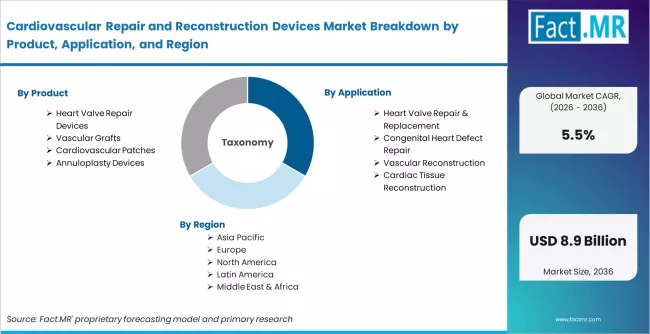
Cardiovascular Repair And Reconstruction Devices Market Breakdown By Product, Application, And Region | Source: Fact.MR
| Parameter | Details |
|---|---|
| Quantitative Units | USD 1.89 billion to USD 3.39 billion, at a CAGR of 6.0% |
| Market Definition | The cardiac POC testing devices market covers portable and bedside diagnostic systems used to detect cardiac biomarkers and related parameters outside centralized laboratory settings, including biomarker POCT analyzers, ECG-based devices, and multiplex cardiac test kits. |
| Regions Covered | North America, Latin America, Europe, East Asia, South Asia and Pacific, Middle East and Africa |
| Countries Covered | USA, Canada, UK, Germany, India, Brazil, Japan, 30 plus countries |
| Key Companies | LifeSign LLC, F. Hoffmann-La Roche AG, Danaher Corporation, Bio-Rad Laboratories Inc., Nova Biomedical Corporation, Medtronic plc, Sekisui Medical Co. Ltd. |
| Forecast Period | 2026 to 2036 |
| Approach | Hybrid demand-side and top-down methodology built on ED chest pain visit volumes, cardiac biomarker testing frequency, analyzer installed base, consumable unit economics, and primary interviews across emergency physicians, POCT coordinators, and device manufacturers |
Source: Fact.MR analysis. Updated Apr 24, 2026
Market Segmentation Analysis
-
Cardiac POC Testing Devices Market Market Segmented by Product:
- Cardiac Biomarker POCT Devices
- Troponin Testing Devices
- CK-MB Rapid Test Devices
- Troponin Testing Devices
- ECG-Based POCT Devices
- Portable ECG Monitors
- Handheld ECG Diagnostic Systems
- Portable ECG Monitors
- Multiplex Cardiac Test Kits
- Multi-Marker Assay Kits
- Combined Troponin & BNP Kits
- Multi-Marker Assay Kits
- Portable Analyzer Devices
- Handheld Cardiac Analyzers
- Bedside Diagnostic Systems
- Handheld Cardiac Analyzers
- Cardiac Biomarker POCT Devices
-
Cardiac POC Testing Devices Market Market Segmented by Application:
- Emergency Cardiac Diagnosis
- Acute Myocardial Infarction Detection
- Chest Pain Evaluation
- Acute Myocardial Infarction Detection
- Cardiac Risk Assessment
- Early Disease Screening
- Preventive Cardiac Testing
- Early Disease Screening
- Hospital Bedside Testing
- ICU & ER Diagnostics
- Rapid Patient Triage Systems
- ICU & ER Diagnostics
- Outpatient Testing
- Clinic-Based Cardiac Screening
- Ambulatory Diagnostics
- Clinic-Based Cardiac Screening
- Emergency Cardiac Diagnosis
-
Cardiac POC Testing Devices Market Market Segmented by End Use:
- Hospitals
- Emergency Departments
- Cardiology Units
- Emergency Departments
- Diagnostic Laboratories
- Central Clinical Labs
- Reference Testing Facilities
- Central Clinical Labs
- Ambulatory Surgical Centers
- Outpatient Care Units
- Day Care Diagnostic Centers
- Outpatient Care Units
- Home Healthcare
- Remote Cardiac Monitoring Users
- Chronic Heart Patients
- Remote Cardiac Monitoring Users
- Hospitals
-
Cardiac POC Testing Devices Market Market Segmented by Technology:
- Immunoassay Technology
- Rapid Lateral Flow Assays
- Fluorescence Immunoassays
- Electrochemical Biosensors
- Signal-Based Detection Systems
- Enzyme Linked Detection Platforms
- Optical Detection Systems
- Chemiluminescence Assays
- Photometric Analysis Systems
- Digital POCT Integration
- Smartphone Connected Diagnostics
- Cloud-Based Result Analysis
-
Cardiac POC Testing Devices Market Market Segmented by Distribution Channel:
- Hospital Procurement
- Direct Hospital Supply Contracts
- Government Healthcare Tenders
- Direct Hospital Supply Contracts
- Specialty Medical Distributors
- Diagnostic Equipment Suppliers
- Cardiology Device Vendors
- Diagnostic Equipment Suppliers
- Online Medical Supply
- B2B Healthcare Platforms
- Digital Procurement Systems
- B2B Healthcare Platforms
- Hospital Procurement
-
Cardiac POC Testing Devices Market Market Segmented by Packaging:
- Single-Use Diagnostic Kits
- Pre-Calibrated Test Cartridges
- Disposable POCT Cassette Kits
- Pre-Calibrated Test Cartridges
- Portable Device Kits
- Handheld Analyzer Packs
- Battery-Integrated Diagnostic Sets
- Handheld Analyzer Packs
- Sterile Test Packs
- Sealed Medical Test Enclosures
- Hospital Ready Kits
- Sealed Medical Test Enclosures
- Single-Use Diagnostic Kits
-
Cardiac POC Testing Devices Market Market by Region:
- North America
- USA
- Canada
- Mexico
- Latin America
- Brazil
- Chile
- Rest of Latin America
- Western Europe
- Germany
- UK
- Italy
- Spain
- France
- Nordic
- BENELUX
- Rest of Western Europe
- Eastern Europe
- Russia
- Poland
- Hungary
- Balkan & Baltic
- Rest of Eastern Europe
- East Asia
- China
- Japan
- South Korea
- South Asia and Pacific
- India
- ASEAN
- Australia & New Zealand
- Rest of South Asia and Pacific
- Middle East & Africa
- Kingdom of Saudi Arabia
- Other GCC Countries
- Turkiye
- South Africa
- Other African Union
- Rest of Middle East & Africa
- North America
Frequently Asked Questions
How big is the cardiac POC testing devices market in 2026?
What will be the size of the cardiac POC testing devices market in 2036?
How much will the cardiac POC testing devices market grow between 2026 and 2036?
Which product segment is expected to lead the market in 2026?
Which country is the fastest-growing market?
Why is Germany a key growth market?
What does the cardiac POC testing devices market cover?
How is the market forecast estimated and validated?
Who worked on this report


Preview the report firsthand - request a free sample
Free SampleGet the brochure for pricing and purchase details
Download PDF