- Base Value(2026): 31.2 Bn
- Estimated Value(2026): 31.2 Bn
- Forecast Value (2036): 55.9 Bn
- CAGR (2026 - 2036): 6.0%
Medical Videoscopes Market Analysis and Forecast by Fact.MR
- The Medical Videoscopes Market is expected to grow from USD 31.2 billion in 2026 to USD 55.9 billion by 2036, at a 6.0% CAGR.
- The market is driven by expanding clinical demand, technology advancement, and healthcare infrastructure development that broadens patient access.
- Flexible Videoscopes account for 32.8% product share, while Hospitals contribute 46.3% of end-use demand.
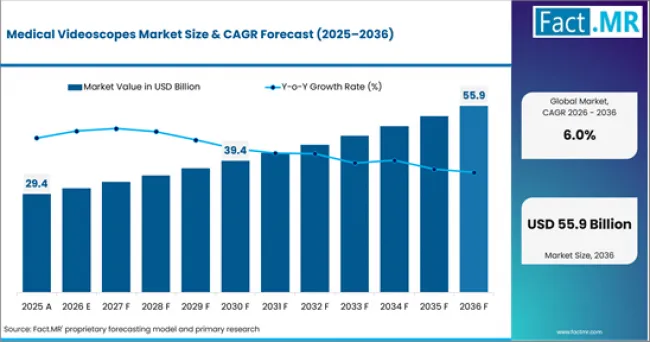
Medical Videoscopes Market Value Analysis | Source: Fact.MR
Summary of Medical Videoscopes Market
- Market Snapshot
- In 2025, the global Medical Videoscopes Market was valued at approximately USD 29.4 billion.
- The market is estimated to reach USD 31.2 billion in 2026 and is projected to attain USD 55.9 billion by 2036.
- The market is likely to expand at a CAGR of 6.0% during the forecast period.
- The market is anticipated to create an absolute dollar opportunity of USD 24.7 billion between 2026 and 2036.
- Flexible Videoscopes accounts for 32.8% of product segment share in 2026.
- China (8.1%) and India (7.5%) are the key growth markets.
- Demand and Growth Drivers
- Growing clinical demand driven by aging populations, rising disease prevalence, and expanding diagnostic and treatment awareness creates sustained procurement for flexible videoscopes and related product or service categories.
- Healthcare infrastructure investment including hospital construction, department expansion, and equipment modernization creates capital procurement pipelines across established and emerging market hospital systems.
- Technology advancement in flexible videoscopes and integrated visualization systems improves clinical outcomes, procedural efficiency, and patient access, supporting adoption across primary treatment settings.
- Regulatory pathway development and reimbursement coverage expansion improve market access and financial viability for medical videoscopes procurement in both public and private healthcare systems.
- Product and Segment View
- Flexible Videoscopes accounts for 32.8% of the product segment in 2026, reflecting established clinical utilization and broad institutional adoption.
- Hospitals represents 46.3% of end use demand in 2026, reflecting procurement concentration among primary healthcare institutional buyers.
- Integrated Visualization Systems lead the system configuration segment with 39.5% share in 2026, supported by clinical workflow integration and outcome improvement documentation.
- Key segmentation includes:
- Product Type: Flexible Videoscopes, Rigid Videoscopes, Capsule Videoscopes, and Disposable Videoscopes
- End Use: Hospitals, Ambulatory Surgical Centers, Specialty Clinics, and Academic & Research Institutes
- System Configuration: Integrated Visualization Systems, Portable Videoscope Systems, Modular Videoscope Systems, and Sterile Single-use Systems
- These capabilities enable:
- Primary clinical capability addressing core diagnostic, therapeutic, or procedural requirements across end use settings.
- Workflow integration improving procedural efficiency, patient throughput, and resource utilization in institutional healthcare environments.
- Clinical outcome documentation supporting reimbursement justification and institutional procurement decision-making.
- Geography and Competitive Outlook
- North America maintains a significant share supported by established healthcare infrastructure, regulatory frameworks, and reimbursement coverage.
- Asia Pacific is the fastest-growing region, with China (8.1%) and India (7.5%) leading through hospital expansion and growing patient access.
- Europe maintains steady demand with Germany supported by EU regulatory compliance and GKV reimbursement structures.
- Key companies include Olympus Corporation, Stryker Corporation, KARL STORZ GmbH & Co. KG, Fujifilm Holding Corporation, Hoya Corporation among others.
- Analyst Opinion
- Shambhu Nath Jha, Principal Consultant at Fact.MR, says "The medical videoscopes market reflects the convergence of clinical demand growth, technology advancement, and healthcare infrastructure expansion that creates sustained procurement across established and emerging markets. Access expansion is a key growth factor as hospital construction, insurance coverage, and regulatory pathways improve in high-growth markets. Companies that position portfolios across both premium and cost-effective tiers will capture the broadest share of this expansion."
Key Growth Drivers, Constraints, and Opportunities
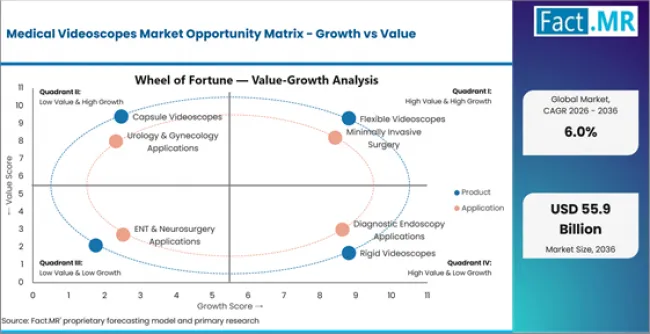
Medical Videoscopes Market Opportunity Matrix Growth Vs Value | Source: Fact.MR
Key Factors Driving Growth
- Clinical demand growth driven by aging demographics, disease prevalence, and expanding treatment awareness creates sustained procurement across institutional healthcare settings.
- Healthcare infrastructure expansion including hospital construction and department modernization creates capital equipment and service procurement pipelines.
- Technology advancement improves clinical outcomes and procedural efficiency, supporting adoption and upgrade cycles.
Key Market Constraints
- High capital or service costs limit adoption in resource-constrained healthcare settings and emerging markets.
- Regulatory complexity across jurisdictions increases compliance costs and market access timelines.
- Trained workforce availability constrains adoption in markets where clinical expertise for specialized procedures is limited.
Key Opportunity Areas
- Emerging market healthcare infrastructure development creates incremental demand as hospital networks and clinical capacity expand.
- Technology innovation at lower cost points expands the addressable market to previously underserved facilities.
- Digital health integration and remote delivery models create new access pathways beyond traditional institutional settings.
Segment-wise Analysis of the Medical Videoscopes Market
- Flexible Videoscopes holds 32.8% of the product segment in 2026 through established clinical utilization.
- Hospitals accounts for 46.3% of end use demand in 2026, reflecting primary institutional procurement.
- Emerging categories grow faster as technology and access expansion create new clinical applications.
The market is segmented by product, application, end use, technology, system configuration, distribution channel, and region. Lead segments maintain dominant positions through established clinical acceptance, while emerging categories grow faster driven by technology advancement and access expansion.
Which Product Segment Dominates the Medical Videoscopes Market?
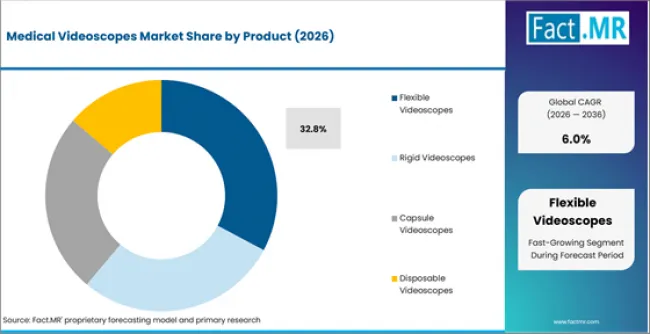
Medical Videoscopes Market Analysis By Product | Source: Fact.MR
Flexible Videoscopes accounts for 32.8% of the product segment in 2026. Its leadership reflects established clinical utilization, broad institutional adoption, and documented outcome evidence across primary healthcare settings.
Supporting segments hold growing positions as technology advancement and clinical guideline evolution create demand for specialized product and service categories.
Which End-Use Segment Dominates the Medical Videoscopes Market?
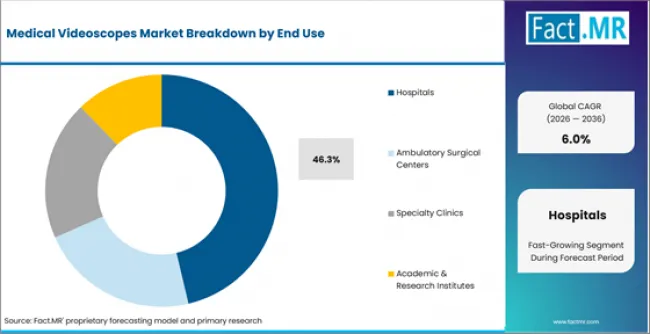
Medical Videoscopes Market Analysis By End Use | Source: Fact.MR
Hospitals is expected to lead the end use segment with a 46.3% share in 2026, reflecting procurement concentration among primary healthcare institutional buyers managing the largest patient volumes.
Secondary channels hold growing positions as outpatient, ambulatory, and community-based settings expand clinical service delivery beyond traditional hospital environments.
Which Technology or Clinical Trend is Shaping the Next Phase of Growth in the Medical Videoscopes Market?
Technology advancement in flexible videoscopes and integrated visualization systems is the most significant trend, with next-generation platforms delivering improved clinical performance, workflow efficiency, and outcome documentation that supports adoption across both premium and cost-sensitive institutional settings.
The second dimension is access expansion through infrastructure development, insurance coverage growth, and regulatory pathway maturation in emerging markets, which structurally expands the addressable patient population and institutional procurement base for medical videoscopes products and services.
Regional Outlook Across Key Markets
- China leads growth at 8.1%, supported by hospital expansion, growing patient access, and domestic manufacturing capability.
- India follows at 7.5%, driven by Ayushman Bharat healthcare expansion and private hospital investment.
- North America and Europe maintain significant shares through established healthcare infrastructure and reimbursement coverage.
- Germany leads European growth at 6.9%, supported by EU MDR compliance, GKV reimbursement, and institutional procurement.
.webp "Top Country Growth Comparison Medical Videoscopes Market Cagr (2026 2036)")
Top Country Growth Comparison Medical Videoscopes Market Cagr (2026 2036) | Source: Fact.MR
CAGR Table
| Country | CAGR (%) |
|---|---|
| China | 8.1% |
| India | 7.5% |
| Germany | 6.9% |
| Brazil | 6.3% |
| USA | 5.7% |
Source: Fact.MR analysis. Updated Jun 11, 2026
Source: Fact.MR analysis, based on proprietary forecasting model and primary research.
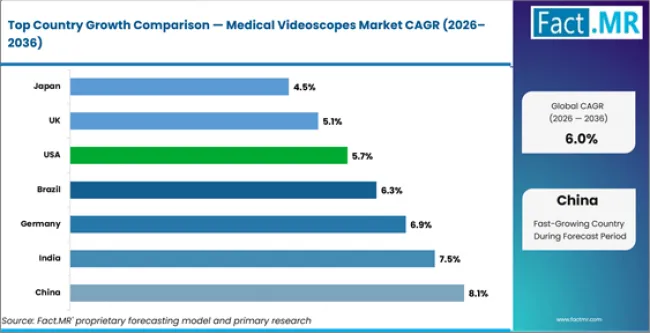
Medical Videoscopes Market Cagr Analysis By Country | Source: Fact.MR
Medical Videoscopes Demand Trends in the United States
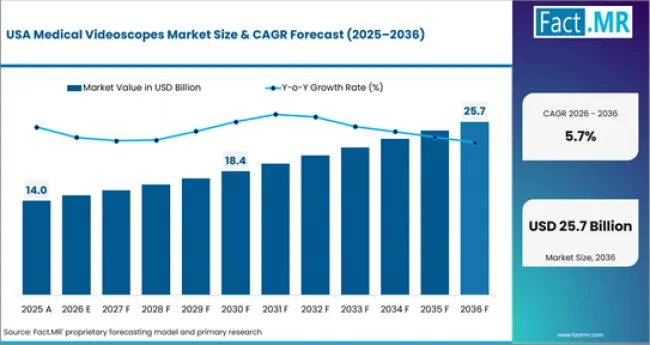
Medical Videoscopes Market Country Value Analysis | Source: Fact.MR
The USA market is projected to grow at a CAGR of 5.7% through 2036 as hospitals and ASCs require endoscopy, bronchoscopy, and laparoscopic visualization across surgical and diagnostic departments. FDA regulatory clearance for 4K and 3D videoscope platforms creates technology upgrade cycles as hospitals transition from standard definition to high-definition and ultra-high-definition imaging. Single-use videoscope adoption is growing in infection-sensitive applications where reprocessing risk and turnaround time justify disposable device economics, creating a parallel procurement channel alongside traditional reusable videoscope capital purchases.
- Single-use videoscope adoption in infection-sensitive applications creates a growing procurement channel alongside traditional reusable flexible videoscope capital equipment purchases.
- Hospital and ASC 4K visualization upgrade cycles drive capital procurement for next-generation flexible videoscope and integrated imaging system platforms.
China Medical Videoscopes Growth Assessment
China is projected to grow at a CAGR of 8.1% through 2036 as hospital construction and surgical suite expansion support medical videoscope procurement. Domestic manufacturers including Mindray, SonoScape, and Shanghai Aohua are capturing growing market share in flexible videoscope and integrated visualization system categories through cost-competitive platforms serving tier-2 and tier-3 hospital tenders. Government medical device self-sufficiency policies drive procurement preference for domestically manufactured videoscope platforms, while technology gap closure in image sensor resolution and optical quality is narrowing the performance advantage of Olympus and Karl Storz systems.
- Over 35,000 hospitals requiring visualization capability create the largest regional procurement opportunity for flexible videoscope and integrated imaging systems.
- Domestic manufacturers Mindray and Shanghai Aohua capture growing videoscope market share through cost-competitive platforms for tier-2 and tier-3 hospital deployment.
India Medical Videoscopes Market Opportunity Outlook
Ayushman Bharat hospital modernization and private healthcare investment in endoscopy and surgical departments at Apollo, Fortis, and Narayana Health create growing procurement demand for flexible videoscopes and integrated visualization systems. Cost-effectiveness remains the primary selection criterion, with refurbished Olympus and Karl Storz videoscopes competing against new domestic and Chinese-manufactured alternatives in price-sensitive institutional procurement. PLI medical device manufacturing incentives are encouraging domestic videoscope production capability development, which would improve local supply availability and reduce import dependency for a market currently served primarily by Japanese and German manufacturers.
- Ayushman Bharat hospital modernization creates videoscope procurement demand for endoscopy and surgical departments in newly equipped facilities.
- PLI medical device incentives encourage domestic videoscope production capability development, reducing import dependency for flexible and rigid visualization platforms.
Germany Medical Videoscopes Demand Analysis
EU MDR compliance and reprocessing validation requirements under EU Regulation 2020/1207 define the regulatory framework for medical videoscope placement and maintenance in Germany. Karl Storz, headquartered in Tuttlingen, maintains dominant specification influence in German hospital procurement through direct institutional relationships and the concentration of endoscopy instrument manufacturing in the Tuttlingen medical technology cluster. GKV procedural reimbursement through DRG-based billing shapes hospital economics for endoscopy departments, influencing videoscope capital equipment selection based on throughput efficiency and image quality specifications.
- EU MDR and reprocessing regulation compliance define videoscope placement and maintenance requirements, favoring Karl Storz and Olympus with established certification portfolios.
- Tuttlingen medical technology cluster concentration gives Karl Storz direct institutional relationships and specification influence in German hospital videoscope procurement.
Competitive Benchmarking and Company Positioning
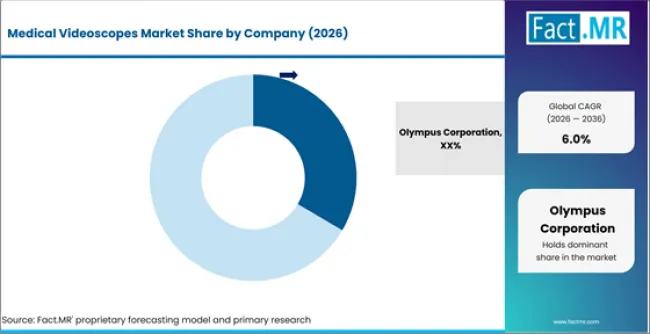
Medical Videoscopes Market Analysis By Company | Source: Fact.MR
Medical Videoscopes Market Analysis By Company
- Leading companies hold strong positions through comprehensive portfolios, established clinical relationships, and sustained R&D investment.
- Mid-tier competitors differentiate through focused specialties, regional strength, and cost-competitive positioning.
- Clinical evidence documentation, regulatory certification, and institutional relationship depth are key competitive differentiators.
The competitive landscape combines multinational medical technology and healthcare service companies with regional specialists. Leading companies compete through broad portfolios and established institutional relationships.
Strategic priorities include expanding product and service portfolios, strengthening emerging market presence, and building digital health capabilities.
Key Companies in the Medical Videoscopes Market
- Olympus Corporation, Stryker Corporation, KARL STORZ GmbH & Co. KG are among the leading participants with established portfolios.
- Fujifilm Holding Corporation, Hoya Corporation, Richard Wolf GmbH hold positions through focused categories and regional strength.
- Smith and Nephew, ConMed Corporation compete through specialized offerings.
Recent Industry Developments
- Olympus, EZ1500 Series Endoscopes with EDOF Technology
- Olympus received FDA clearance in 2025 for its EZ1500 series endoscopes with Extended Depth of Field technology. The scopes are part of the EVIS X1 endoscopy system and are designed to keep a wider area in focus during gastrointestinal procedures.
- Karl Storz, IMAGE1 S Rubina Surgical Visualization System
- Karl Storz should be used as a product capability item rather than a confirmed 2025 launch. The IMAGE1 S Rubina system combines 4K, 3D, and NIR/ICG fluorescence imaging for surgical endoscopy. This supports demand for videoscope systems that help surgeons view tissue, blood flow, and anatomy more clearly during procedures.
- Fujifilm, ELUXEO 8000 Endoscopic Imaging System Launch
- Fujifilm launched the ELUXEO 8000 Endoscopic Imaging System in October 2025. The system offers 4K imaging and LED multi-light technology, with LCI, BLI, and Amber-Red Color Imaging modes.
Leading Companies Shaping the Medical Videoscopes Market
- Olympus Corporation
- Stryker Corporation
- KARL STORZ GmbH & Co. KG
- Fujifilm Holding Corporation
- Hoya Corporation
- Richard Wolf GmbH
- Smith and Nephew
- ConMed Corporation
- XION GmbHTechnologies Inc.
Sources and Research References
- Fujifilm. (2025, October 22). Fujifilm launches next-generation ELUXEO® endoscopic imaging system with enhanced LED multi-light technology.
- Fujifilm. (2025, June 27). FUJIFILM reveals new slim colonoscope for ELUXEO® 8000.
- Olympus Corporation. (2025, May 28). Olympus announces FDA clearance of its most advanced imaging endoscopes.
- Olympus Canada Inc. (2025, October 14). Olympus Canada Inc. announces launch of advanced imaging endoscopes as part of the EVIS X1™ Endoscopy System.
- U.S. Food and Drug Administration. (2025). 510(k) premarket notification: Colonovideoscope CF-EZ1500DL, Colonovideoscope CF-EZ1500DI, K250432.
- U.S. Food and Drug Administration. (2025). 510(k) premarket notification: FUJIFILM Processor EP-8000 and FUJIFILM Endoscope Model EG-860R, K243260.
This bibliography is provided for reader reference and is not exhaustive.
Key Questions This Report Addresses
- What is the current and future size of the Medical Videoscopes Market?
- How fast is the market expected to grow between 2026 and 2036?
- Which product type leads by 2026?
- Which end-use accounts for highest demand?
- What are the primary growth drivers?
- How is technology advancement influencing the market?
- Which countries show the fastest growth?
- Who are the key companies?
- How does Fact.MR validate the forecast?
Medical Videoscopes Market Definition
The Medical Videoscopes Market covers specialized products, devices, or services serving healthcare institutions across diagnostic, therapeutic, and procedural applications.
Medical Videoscopes Market Inclusions
- The scope covers global and regional market size and forecasts for 2026 to 2036 across product type, end use, formulation, and region.
- It includes all major product categories and service formats for primary healthcare applications.
- The report covers technology, regulatory, and reimbursement trends alongside the competitive landscape.
Medical Videoscopes Market Exclusions
- The scope excludes general-purpose medical supplies not specific to this market category.
- It excludes upstream component and raw material supply chains.
- The report excludes downstream patient outcomes data and health economics assessments.
Medical Videoscopes Market Research Methodology
- The methodology combines secondary research, primary interviews, and forecast modelling.
- It draws on 90+ secondary sources and benchmarks 45+ company portfolios.
- Market sizing covers 30+ countries through a demand-side model supported by top-down validation.
- Key inputs include healthcare spending data, regulatory tracking, and clinical adoption rates.
- Primary validation includes 25+ interviews across manufacturers, clinicians, and hospital procurement.
Segmentation
Scope of Analysis
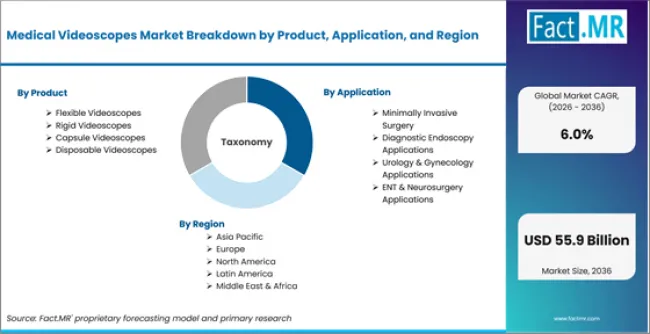
Medical Videoscopes Market Breakdown By Product, Application, And Region | Source: Fact.MR
| Parameter | Details |
|---|---|
| Quantitative Units | USD 31.2 billion to USD 55.9 billion, at a CAGR of 6.0% |
| Market Definition | The Medical Videoscopes Market covers specialized healthcare products and services. |
| Regions Covered | North America, Latin America, Europe, East Asia, South Asia and Pacific, Middle East and Africa |
| Countries Covered | USA, Canada, UK, Germany, China, India, 30 plus countries |
| Key Companies | Olympus Corporation, Stryker Corporation, KARL STORZ GmbH & Co. KG, Fujifilm Holding Corporation, Hoya Corporation, Richard Wolf GmbH, Smith and Nephew, ConMed Corporation |
| Forecast Period | 2026 to 2036 |
| Approach | Hybrid demand-side methodology built on healthcare data, regulatory tracking, and primary interviews. |
Source: Fact.MR analysis. Updated Jun 11, 2026
Medical Videoscopes Market Segmentation
-
Medical Videoscopes Market Segmented by Product:
- Flexible Videoscopes
- Flexible Gastrointestinal Videoscopes
- Upper GI Videoscopes
- Colonoscopy Videoscopes
- Flexible Pulmonary Videoscopes
- Bronchoscopy Videoscopes
- Thoracic Diagnostic Videoscopes
- Flexible Gastrointestinal Videoscopes
- Rigid Videoscopes
- Rigid Surgical Videoscopes
- Laparoscopic Videoscopes
- Arthroscopic Videoscopes
- Rigid Diagnostic Videoscopes
- ENT Diagnostic Videoscopes
- Urology Videoscopes
- Rigid Surgical Videoscopes
- Capsule Videoscopes
- Wireless Capsule Systems
- Small Bowel Capsule Videoscopes
- Colon Capsule Systems
- Smart Capsule Platforms
- AI Assisted Capsule Imaging
- Remote Data Transmission Capsules
- Wireless Capsule Systems
- Disposable Videoscopes
- Single Use Bronchoscopes
- ICU Disposable Bronchoscopes
- Emergency Care Bronchoscopes
- Single Use GI Videoscopes
- Disposable Colonoscopy Systems
- Disposable Endoscopic Imaging Systems
- Single Use Bronchoscopes
- Flexible Videoscopes
-
Medical Videoscopes Market Segmented by Application:
- Minimally Invasive Surgery
- Laparoscopic Surgical Applications
- Abdominal Surgery Procedures
- Gynecological Surgery Procedures
- Thoracoscopic Surgical Applications
- Pulmonary Surgery Procedures
- Cardiothoracic Procedures
- Laparoscopic Surgical Applications
- Diagnostic Endoscopy Applications
- Gastrointestinal Diagnostic Applications
- Digestive Tract Imaging Procedures
- Polyp Detection Procedures
- Respiratory Diagnostic Applications
- Airway Examination Procedures
- Pulmonary Infection Diagnosis
- Gastrointestinal Diagnostic Applications
- Urology & Gynecology Applications
- Urology Imaging Applications
- Bladder Visualization Procedures
- Kidney Stone Diagnosis Procedures
- Gynecological Imaging Applications
- Uterine Diagnostic Procedures
- Fertility Assessment Procedures
- Urology Imaging Applications
- ENT & Neurosurgery Applications
- ENT Diagnostic Applications
- Sinus Visualization Procedures
- Laryngeal Examination Procedures
- Neurosurgical Visualization Applications
- Spinal Visualization Procedures
- Brain Surgery Imaging Procedures
- ENT Diagnostic Applications
- Minimally Invasive Surgery
-
Medical Videoscopes Market Segmented by End Use:
- Hospitals
- Public Hospitals
- Government Surgical Hospitals
- Regional Diagnostic Hospitals
- Private Hospitals
- Corporate Multi Specialty Hospitals
- Advanced Surgical Centers
- Public Hospitals
- Ambulatory Surgical Centers
- Outpatient Surgery Centers
- Day Care Surgical Facilities
- Minimally Invasive Surgery Centers
- Specialty Ambulatory Clinics
- ENT Procedure Clinics
- GI Endoscopy Centers
- Outpatient Surgery Centers
- Specialty Clinics
- Gastroenterology Clinics
- Digestive Disorder Clinics
- Colonoscopy Diagnostic Centers
- Pulmonology Clinics
- Respiratory Care Clinics
- Bronchoscopy Procedure Centers
- Gastroenterology Clinics
- Academic & Research Institutes
- Medical Universities
- Clinical Training Laboratories
- Surgical Education Centers
- Research Organizations
- Endoscopy Research Institutes
- Medical Imaging Innovation Centers
- Medical Universities
- Hospitals
-
Medical Videoscopes Market Segmented by Technology:
- High Definition Imaging Technology
- HD CMOS Imaging Systems
- Digital CMOS Sensor Platforms
- Low Noise Imaging Systems
- HD CCD Imaging Systems
- Enhanced Color Reproduction Systems
- High Contrast Imaging Platforms
- HD CMOS Imaging Systems
- Narrow Band Imaging Technology
- Optical Filtering Systems
- Mucosal Visualization Platforms
- Vascular Enhancement Imaging Systems
- Digital Image Enhancement Systems
- Contrast Enhancement Platforms
- Real Time Image Processing Systems
- Optical Filtering Systems
- 3D Visualization Technology
- Stereo Imaging Systems
- Dual Lens Visualization Platforms
- Depth Perception Imaging Systems
- Immersive Surgical Visualization
- 3D Surgical Navigation Systems
- Augmented Visualization Platforms
- Stereo Imaging Systems
- AI Assisted Imaging Technology
- Machine Learning Imaging Systems
- Automated Lesion Detection Platforms
- AI Guided Diagnostic Imaging
- Computer Vision Systems
- Real Time Image Analysis Platforms
- Pattern Recognition Imaging Systems
- Machine Learning Imaging Systems
- High Definition Imaging Technology
-
Medical Videoscopes Market Segmented by Formulation:
- Integrated Visualization Systems
- Camera Integrated Platforms
- Digital Camera Video Platforms
- Integrated Sensor Imaging Systems
- Display Integrated Systems
- Touchscreen Visualization Platforms
- 4K Display Imaging Systems
- Camera Integrated Platforms
- Portable Videoscope Systems
- Handheld Visualization Platforms
- Battery Powered Videoscopes
- Compact Mobile Imaging Systems
- Transportable Diagnostic Systems
- Emergency Care Videoscopes
- ICU Portable Imaging Platforms
- Handheld Visualization Platforms
- Modular Videoscope Systems
- Interchangeable Scope Systems
- Multi Specialty Scope Platforms
- Reusable Scope Handle Systems
- Upgradeable Imaging Platforms
- Software Upgradable Imaging Systems
- Expandable Diagnostic Platforms
- Interchangeable Scope Systems
- Sterile Single Use Systems
- Disposable Imaging Platforms
- Pre Sterilized Videoscope Systems
- Single Procedure Visualization Devices
- Infection Prevention Systems
- Cross Contamination Reduction Systems
- Sterile Barrier Visualization Platforms
- Disposable Imaging Platforms
- Integrated Visualization Systems
-
Medical Videoscopes Market Segmented by Distribution Channel:
- Direct Sales Channels
- Hospital Procurement Contracts
- Public Healthcare Procurement Agreements
- Private Hospital Supply Contracts
- Enterprise Healthcare Partnerships
- Integrated Healthcare Network Agreements
- Multi Facility Equipment Contracts
- Hospital Procurement Contracts
- Medical Device Distributors
- Regional Device Suppliers
- Endoscopy Equipment Distributors
- Imaging System Supply Firms
- Specialized Surgical Distributors
- GI Procedure Equipment Suppliers
- ENT Device Distribution Firms
- Regional Device Suppliers
- Online Healthcare Platforms
- B2B Medical Platforms
- Digital Procurement Portals
- Medical Equipment E Commerce Systems
- Manufacturer Direct Platforms
- OEM Ordering Portals
- Subscription Based Equipment Platforms
- B2B Medical Platforms
- Third Party Service Providers
- Equipment Leasing Providers
- Endoscopy Equipment Rental Services
- Short Term Imaging Device Leasing
- Managed Service Providers
- Integrated Imaging Service Contracts
- Procedure Based Equipment Supply Services
- Equipment Leasing Providers
- Direct Sales Channels
-
Medical Videoscopes Market by Region:
- North America
- USA
- Canada
- Mexico
- Latin America
- Brazil
- Chile
- Rest of Latin America
- Western Europe
- Germany
- UK
- Italy
- Spain
- France
- Nordic
- BENELUX
- Rest of Western Europe
- Eastern Europe
- Russia
- Poland
- Hungary
- Balkan & Baltic
- Rest of Eastern Europe
- East Asia
- China
- Japan
- South Korea
- South Asia and Pacific
- India
- ASEAN
- Australia & New Zealand
- Rest of South Asia and Pacific
- Middle East & Africa
- Kingdom of Saudi Arabia
- Other GCC Countries
- Turkiye
- South Africa
- Other African Union
- Rest of Middle East & Africa
- North America
Frequently Asked Questions
How big is the medical videoscopes market in 2026?
What will be the size of the medical videoscopes market in 2036?
What CAGR is expected for the medical videoscopes market between 2026 and 2036?
What are the key products in the medical videoscopes market?
Which application segment is expected to contribute the leading share in the medical videoscopes market in 2026?
Who worked on this report


Preview the report firsthand - request a free sample
Free SampleGet the brochure for pricing and purchase details
Download PDF