- Market Value (2025): USD 1.09 Bn
- Estimated Value (2026): USD 1.16 Bn
- Forecast Value (2036): USD 2.16 Bn
- CAGR (2026-2036): 6.4%
What is the Medical Pillows Market forecast to be worth by 2036?
USD 1.16 billion in 2026 to USD 2.16 billion by 2036 at a 6.4% CAGR.
- Demand for medical pillows was worth USD 1.09 billion in 2025, with cervical support products and hospital positioning aids accounting for much of that spend.
- Revenue will grow from USD 1.16 billion in 2026 to USD 2.16 billion by 2036 as orthopedic recovery, home care and online purchasing widen the buyer base.
- A 6.4% CAGR reflects steady replacement cycles in hospitals combined with new household demand from older adults managing neck, back and joint discomfort.
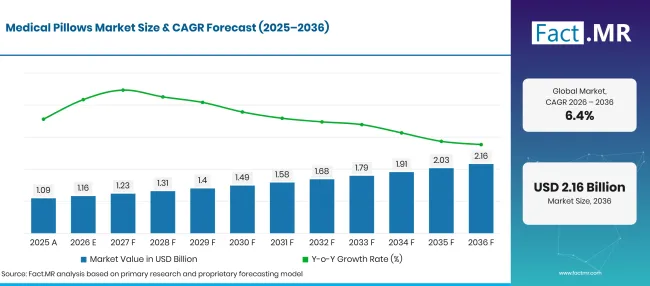
Medical Pillows Market Forecast Global | Source: Fact.MR
| Year | Basis | Market Value (USD billion) |
|---|---|---|
| 2025 | Actual | 1.09 |
| 2026 | Estimate | 1.16 |
| 2036 | Forecast | 2.16 |
| CAGR 2026 to 2036 | Forecast period | 6.4% |
Source: Fact.MR analysis. Updated Nov 4, 2026
What are the defining numbers behind Medical Pillows Market growth?
Between 2026 and 2036 the market will gain USD 1.0 billion in new value, with orthopedic support, patient positioning and home recovery products carrying most of that gain.
- Demand Drivers in the Market
- An older population is widening the pool of people who need extra support for the neck, back, hips and knees. WHO reports that people aged 60 and over will number 1.4 billion by 2030, or about one in six people worldwide [1]. Reduced mobility in later life raises daily use of positioning and cervical products in care homes and private households.
- Pressure injury prevention is shaping how hospitals plan patient positioning. The 2026 VA/DoD clinical practice guideline calls for turning and repositioning schedules set through an individual care plan, and it addresses the choice of support surfaces for high-risk patients [2]. Positioning pillows work alongside mattresses and specialist surfaces in these protocols, and they do not replace a clinical assessment.
- Orthopedic surgery and the recovery that follows create steady demand for knee, leg and body pillows. Patients need to keep limbs in a set position while resting, and physiotherapists often prescribe a specific shape for home use after discharge.
- Neck and back strain linked to long screen time is bringing younger, working-age buyers into the category. Retail ranges now place cervical pillows next to other ergonomic products.
- Key Segments Analyzed
- By Product Type: Cervical Pillows will hold 28.5% share in 2026, as neck alignment features in both clinical recovery and everyday use.
- By Material: Foam will account for 35.8% of 2026 value, given its range of densities and its ability to keep a molded contour.
- By Application: Orthopedic will capture 36.8% in 2026, since spinal and joint support remains the most common reason for a prescribed pillow.
- By End-User: Hospitals will represent 38.4% of 2026 demand, owing to recurring purchases across wards, theatres and intensive care.
- By Distribution Channel: Online Stores will command 41.2% in 2026, helped by wider product choice and detailed sizing information on retail sites.
- Analyst Opinion at Fact.MR
- Shambhu Nath Jha, Principal Consultant at Fact.MR, states, “Medical pillows will earn a firmer place in care pathways as hospitals and home care teams treat positioning as part of recovery. Suppliers that can show cleanable covers, consistent contours and clear intended-use guidance will win institutional contracts. Foam and gel engineering will keep improving, and buyers will reward products built for one clear clinical purpose.”
- Strategic Implications
- Manufacturers should build portfolios around distinct patient needs, offering cervical, lumbar, knee and body designs with fluid-resistant covers that survive hospital laundering.
- Distributors should train sales teams to match pillow shape and firmness to ward type, since procurement staff increasingly ask for positioning guidance with each order.
- Hospitals and care homes should standardize a short list of positioning shapes and sizes, which will simplify cleaning routines, stock control and staff training.
- Online retailers should publish dimensions, firmness ratings and intended use for every product so that shoppers can tell a therapeutic pillow from a standard bed pillow.
Brazil will post a 7.2% CAGR, the strongest of the five countries assessed, as private health plan activity and an ageing population lift purchases from a modest base. The United States follows at 6.3%, where large rehabilitation and home care networks add volume to an already mature market. Japan will grow at 5.9%, close behind, driven by the needs of a very old population in hospitals and long-term care. Germany at 5.0% and the United Kingdom at 4.6% trail because hospital purchasing there follows longer tender cycles and established replacement schedules.
How does the Medical Pillows Market break down by segment?
Cervical Pillows will lead Product Type at 28.5%; Foam will head Material at 35.8%; Orthopedic will lead Application at 36.8%; Hospitals will hold End-User at 38.4%; Online Stores will lead Distribution Channel at 41.2% in 2026.
Which Product Type leads?
Cervical Pillows take 28.5% of 2026 sales.
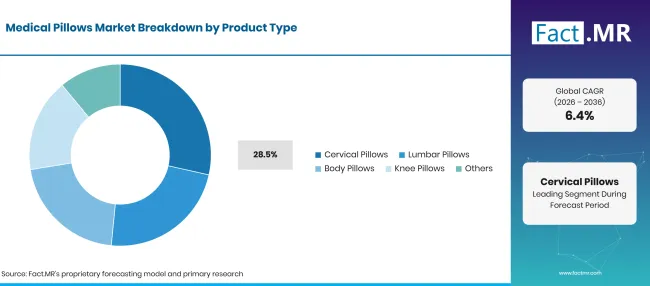
Medical Pillows Market Breakdown Product Type | Source: Fact.MR
| Product Type | Share (2026) |
|---|---|
| Cervical Pillows (Leading segment) | 28.5% |
| Other segments combined | 71.5%* |
| Total | 100.0% |
Source: Fact.MR analysis. Updated Nov 4, 2026
Neck pain sends patients to physiotherapists and orthopedic clinics more often than most other complaints, and a shaped pillow is one of the first aids recommended. Cervical designs use a raised edge and a central hollow to keep the head level with the spine during sleep. The same product sells to people with posture-related stiffness who never enter a clinic, which gives this category a wider customer base than other pillow shapes. Lumbar pillows serve seated and lying support for the lower back, while knee pillows keep hips aligned for side sleepers and post-surgical patients. Body pillows support pregnant women and people recovering from hip procedures, and the pregnancy pillow segment overlaps with maternity applications here.
What supports Foam within Material?
Foam claims 35.8% of 2026 revenue.
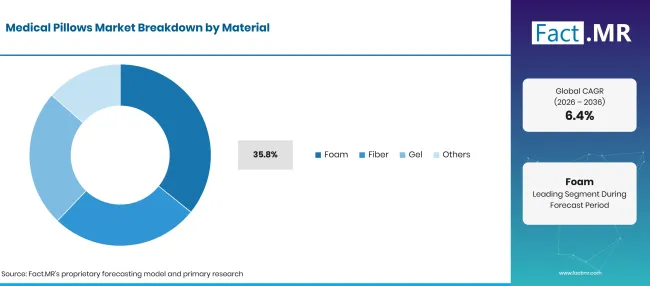
Medical Pillows Market Breakdown Material | Source: Fact.MR
| Material | Share (2026) |
|---|---|
| Foam (Leading segment) | 35.8% |
| Other segments combined | 64.2%* |
| Total | 100.0% |
Source: Fact.MR analysis. Updated Nov 4, 2026
Manufacturers favor foam since it can be cut, molded or zoned to almost any contour and produced in many firmness grades. Memory foam spreads pressure across the neck and shoulders, and high-resilience grades recover their shape quickly after a patient moves. Foam cores also accept fluid-resistant covers, which suits hospital infection control routines. Fiber fillings cost less and suit washable, general-purpose positioning pillows. Gel layers add cooling and pressure spreading, often bonded to a foam core. Other materials include water-based and air-filled inserts that let users adjust height.
What drives Orthopedic within Application?
Orthopedic accounts for 36.8% of 2026 value.
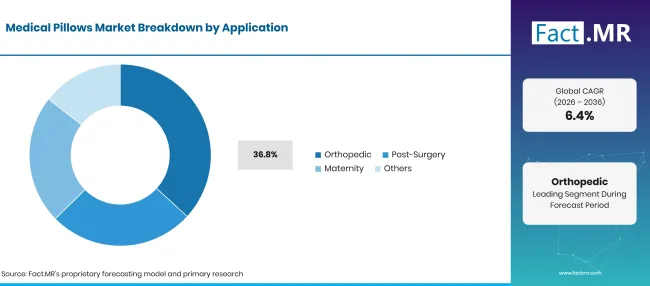
Medical Pillows Market Breakdown Application | Source: Fact.MR
| Application | Share (2026) |
|---|---|
| Orthopedic (Leading segment) | 36.8% |
| Other segments combined | 63.2%* |
| Total | 100.0% |
Source: Fact.MR analysis. Updated Nov 4, 2026
Patients treated for spinal conditions, fractures or joint replacement need sustained anatomical support while resting. Cervical and lumbar pillows maintain spinal posture, and knee and body pillows control limb placement after surgery. Physiotherapy plans often specify a shape for home use, so demand continues after discharge from hospital or clinic. Post-surgery applications cover positioning after abdominal, cardiac and other procedures where patients must avoid strain on a wound. Pressure injury risk links this group to advanced wound care protocols in hospitals. Maternity use covers support during pregnancy and nursing, while other applications include respiratory and palliative care positioning.
How does End-User shape demand?
Hospitals represent 38.4% of 2026 spend.
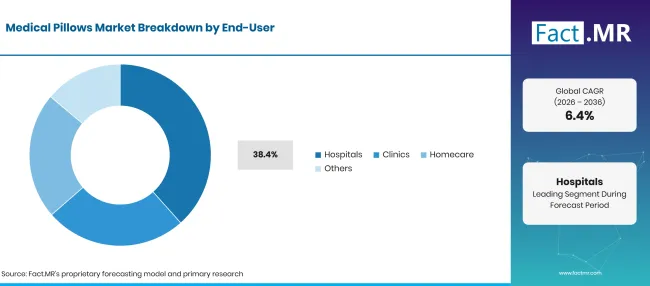
Medical Pillows Market Breakdown End User | Source: Fact.MR
| End-User | Share (2026) |
|---|---|
| Hospitals (Leading segment) | 38.4% |
| Other segments combined | 61.6%* |
| Total | 100.0% |
Source: Fact.MR analysis. Updated Nov 4, 2026
Inpatient wards, operating theatres and intensive care units each buy positioning aids in different shapes. Nurses use pillows to turn patients, raise limbs and offload pressure points, and worn or contaminated units must be replaced on a regular schedule. Central purchasing across several departments gives hospitals recurring, high-volume orders. Clinics use specialized pillows during physiotherapy and outpatient rehabilitation. Home care buyers include patients, family caregivers and agencies supporting people after discharge, a group served through wider home healthcare services. Other end-users include long-term care facilities and rehabilitation centers with long patient stays.
Why do Online Stores lead Distribution Channel?
Online Stores capture 41.2% of 2026 purchases.
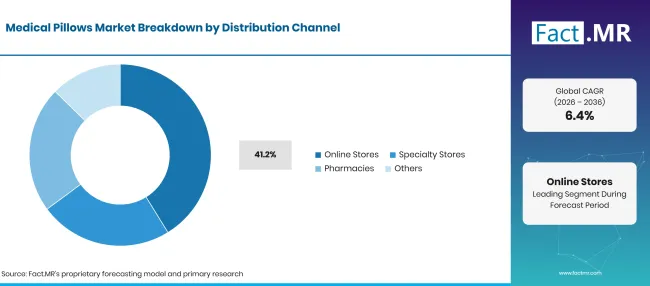
Medical Pillows Market Breakdown Distribution Channel | Source: Fact.MR
| Distribution Channel | Share (2026) |
|---|---|
| Online Stores (Leading segment) | 41.2% |
| Other segments combined | 58.8%* |
| Total | 100.0% |
Source: Fact.MR analysis. Updated Nov 4, 2026
Shoppers can compare shapes, firmness and dimensions side by side and read detailed product guidance before ordering. Core Products International expanded its cervical and neck support sleep range to Target.com in July 2026, which shows how specialist makers are reaching mass retail sites [3]. Specialty stores, including medical supply and orthopedic shops, offer fitting advice and remain important for prescribed products. Pharmacies sell a narrower range of cervical and travel pillows. Other channels include direct institutional supply contracts and physiotherapy practices.
What is accelerating Medical Pillows Market adoption, and what is holding it back?
An older population, steady orthopedic surgery volumes and greater attention to pressure injury prevention keep hospitals and households buying specialized pillows. Online retail makes therapeutic designs easier to find. Growth is limited by cheaper conventional pillows, uneven product quality, cleaning demands in institutions and the fact that each patient needs a different shape or firmness.
Drivers Impact Analysis
| DRIVER | (~) % IMPACT ON CAGR | GEOGRAPHIC RELEVANCE | IMPACT TIMELINE |
|---|---|---|---|
| DRIVER | (~) % IMPACT ON CAGR | GEOGRAPHIC RELEVANCE | IMPACT TIMELINE |
| Rising demand for cervical and orthopedic support products | +1.5% | Global | Short term (<=2 years) |
| Hospital requirements for patient positioning and recovery | +1.0% | North America, Western Europe, East Asia | Medium term (2-4 years) |
| Growth of home care and rehabilitation services | +0.8% | North America, Latin America, Western Europe | Medium term (2-4 years) |
| Attention to pressure injury prevention in care settings | +0.6% | Western Europe, North America, East Asia | Long term (>=4 years) |
Source: Fact.MR analysis. Updated Nov 4, 2026
Opportunity Impact Analysis
| OPPORTUNITY | (~) % IMPACT ON CAGR | GEOGRAPHIC RELEVANCE | IMPACT TIMELINE |
|---|---|---|---|
| OPPORTUNITY | (~) % IMPACT ON CAGR | GEOGRAPHIC RELEVANCE | IMPACT TIMELINE |
| Anatomically shaped cervical and lumbar designs | +0.8% | Global | Short term (<=2 years) |
| Wider use in home care and rehabilitation settings | +0.6% | North America, Western Europe, East Asia | Medium term (2-4 years) |
| Improved foam and gel support materials | +0.5% | Western Europe, North America, East Asia | Medium term (2-4 years) |
| Online availability of specialized medical pillows | +0.4% | Global | Long term (>=4 years) |
Source: Fact.MR analysis. Updated Nov 4, 2026
Restraints Impact Analysis
| RESTRAINT | (~) % IMPACT ON CAGR | GEOGRAPHIC RELEVANCE | IMPACT TIMELINE |
|---|---|---|---|
| RESTRAINT | (~) % IMPACT ON CAGR | GEOGRAPHIC RELEVANCE | IMPACT TIMELINE |
| Competition from conventional and lower-cost pillows | -0.6% | Global | Short term (<=2 years) |
| Differences in patient requirements and clinical suitability | -0.4% | Global | Short term (<=2 years) |
| Higher costs of specialized materials and designs | -0.3% | North America, Western Europe, East Asia | Medium term (2-4 years) |
| Cleaning, durability and replacement demands in institutions | -0.2% | Global | Long term (>=4 years) |
Source: Fact.MR analysis. Updated Nov 4, 2026
Which countries are scaling the Medical Pillows Market through 2036?
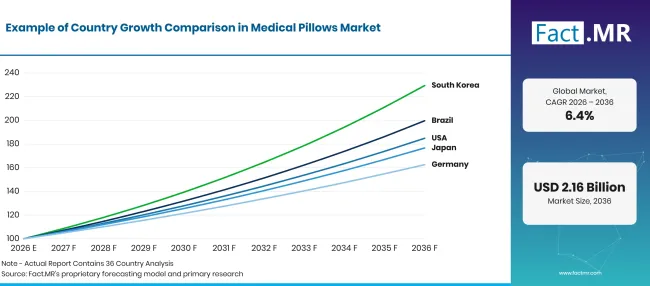
Medical Pillows Market Growth Index | Source: Fact.MR
| Country | CAGR (2026 to 2036) |
|---|---|
| Brazil | 7.2% |
| United States | 6.3% |
| Japan | 5.9% |
| Germany | 5.0% |
| United Kingdom | 4.6% |
Source: Fact.MR analysis. Updated Nov 4, 2026
How is Brazil developing demand?
7.2% CAGR, driven by private health plan activity and an ageing population.
Brazil’s National Supplementary Health Agency recorded about 2 billion procedures for private health plan members in 2025, including 9.9 million hospital admissions, up 8.9% on 2024 [4]. IBGE data show that people aged 60 and over formed 16.6% of the population in 2025 [5]. Hospital admissions and an older household base together widen demand for positioning and cervical products across both institutional and retail channels.
What is supporting United States adoption?
6.3% CAGR, backed by large hospital, rehabilitation and home care networks.
National health expenditure reached USD 5.3 trillion in 2024, a rise of 7.2%, according to CMS [6]. The Census Bureau counted about 61.2 million residents aged 65 and older in 2024, up 3.1% from the previous year [7]. Orthopedic rehabilitation, outpatient therapy and home recovery all draw on cervical, lumbar and knee pillows, and online retail gives shoppers direct access to therapeutic designs.
What supports Japan’s adoption?
5.9% CAGR, reflecting care needs in a very old population.
Japan’s Statistics Bureau reported 36.19 million people aged 65 and over in September 2025, a record 29.4% of the population [8]. Hospitals and long-term care facilities need positioning products for residents with limited mobility and long stays. Cervical, lumbar and body pillows also serve rehabilitation and home care, where family members often manage daily repositioning.
How is Germany scaling demand?
5.0% CAGR, helped by dense hospital capacity and steady inpatient volumes.
Destatis reported 1,807 hospitals with an average of 468,803 beds in 2025, treating 17.7 million inpatients [9]. Bed occupancy rose to 72.6%, up from 72.0% in 2024. This volume of inpatient care keeps replacement orders for positioning and orthopedic pillows steady, although tender cycles slow the uptake of new designs.
How does the United Kingdom perform?
4.6% CAGR, as rising health spending supports patient-care purchasing.
The Office for National Statistics put UK healthcare expenditure at about GBP 345 billion in 2025, a nominal rise of 7.7% and a real-terms rise of 3.9% [10]. Higher spending supports purchases of patient-support products in hospitals and community care.
Who leads the Medical Pillows Market?
Competition divides into three groups. Bedding brands such as Somnigroup International, through its Tempur-Pedic line, and Coop Sleep Goods compete on material technology and brand reach, selling neck and adjustable pillows to households through retail and online stores.
Specialist therapeutic makers, including Core Products International with its Therapeutica range, Mediflow and Contour Products, compete on anatomical design and clinician recommendation. Core Products took its cervical sleep range to Target.com in July 2026 [3] and in October 2026 highlighted its Wisconsin manufacturing and its Therapeutica facility in Canada [12]. Clinical suppliers such as Care of Sweden focus on patient positioning and pressure management for hospitals and care homes; its CuroCell iA surface won the delegates’ award for most innovative product at EPUAP 2026 [11]. Supply contracts with hospital groups and a credible place on large retail sites will decide which firms gain share through 2036.
Which companies are the key providers?
Key companies in the Medical Pillows Market include Somnigroup International Inc., Core Products International Inc., Mediflow Inc., Contour Products Inc., Coop Sleep Goods and Care of Sweden AB.
- Somnigroup International Inc.
- Core Products International Inc.
- Mediflow Inc.
- Contour Products Inc.
- Coop Sleep Goods
- Care of Sweden AB
Bibliography
- [1] World Health Organization. (2025, October 1). Ageing and health.
- [2] U.S. Department of Veterans Affairs and U.S. Department of Defense. (2026, August). VA/DoD Clinical Practice Guideline for the Prevention and Management of Pressure Injuries.
- [3] Core Products International. (2026, July 9). Core Products International Expands Ergonomic Neck Support and Cervical Sleep Solutions to Target.com.
- [4] Agência Nacional de Saúde Suplementar. (2026, June 30). Planos de saúde registram 2 bilhões de procedimentos em 2025.
- [5] Instituto Brasileiro de Geografia e Estatística. (2026). Características gerais dos domicílios e dos moradores 2025.
- [6] Centers for Medicare & Medicaid Services. (2026, January 14). National Health Expenditure Data: Historical.
- [7] U.S. Census Bureau. (2025, June 26). Older Adults Outnumber Children in 11 States and Nearly Half of U.S. Counties.
- [8] Statistics Bureau of Japan. (2025, September 14)
- [9] Statistisches Bundesamt (Destatis). (2026, October 28). 1,2 % mehr Krankenhausbehandlungen im Jahr 2025.
- [10] Office for National Statistics. (2026, April 29). Healthcare expenditure, UK Health Accounts: 2024 and 2025.
- [11] Care of Sweden. (2026, September 15). Successful Days for Care of Sweden at EPUAP 2026.
- [12] Core Products International. (2026, October 27). Employee-Owned Core Products Celebrates Wisconsin Manufacturing and the People Behind Its Comfort Products.
This Report Answers
- How is medical pillow revenue split across product type, material, application, end-user and distribution channel?
- Why do cervical pillows lead product demand, and where do lumbar, knee and body pillows fit?
- Which material properties steer the choice between foam, fiber and gel?
- How do Brazil, the United States, Japan, Germany and the United Kingdom differ in growth and in the forces behind it?
- Which companies compete in medical pillows, and what separates consumer brands from clinical suppliers?
- What role do pressure injury prevention and home recovery play in demand through 2036?
What does the Medical Pillows Market cover?
This study values pillows built for a defined therapeutic or clinical purpose, from cervical and lumbar supports to knee, body and positioning designs. Revenue is measured at manufacturer selling prices across all five segments and seven regions.
Products qualify when the maker states a medical, orthopedic or recovery use and designs the shape for it. Standard bed pillows sold for general comfort are left out of the valuation, even when buyers use them for support.
What is included in the scope?
Cervical, lumbar, body, knee and other shaped pillows used in orthopedic, post-surgical, maternity and related care.
Foam, fiber, gel and other filling types, including adjustable and water-based inserts.
Sales to hospitals, clinics, home care users and long-term care facilities, including products used with senior care technology in assisted living.
Purchases made through online stores, specialty medical retailers, pharmacies and direct institutional contracts.
What is excluded from the scope?
Conventional sleeping pillows and general home furniture such as bedding sold without a defined therapeutic use.
Hospital mattresses, pressure redistribution beds and powered support surfaces.
Seat cushions, wheelchair cushions and other positioning equipment not shaped as a pillow.
Nursing and geriatric care services, hospital furniture and unrelated orthopedic devices.
How Was the Analysis Built?
The analysis draws on 120+ sources, 35+ company portfolios, 25+ countries, and more than 20 industry interviews.
- Primary Research: Primary research includes discussions with manufacturers, service providers, technology developers, distributors, end users, and subject-matter experts. These conversations examine purchasing priorities, product adoption, operational challenges, approval requirements, competitive positioning, and the factors that influence wider market acceptance.
- Desk Research: Desk research covers government statistics, regulatory publications, company filings, trade data, technical studies, industry associations, standards, public policy, and other authoritative sources. Every source used in the analysis is documented in the bibliography.
- Market Sizing and Forecasting: Market estimates combine historical performance, demand indicators, pricing and volume trends, segment shares, company participation, country-level growth, adoption patterns, investment activity, and barriers to market expansion.
- Data Validation and Update Cycle: Findings are validated by comparing primary interviews with public data, company activity, regulatory changes, trade patterns, and industry developments. Regular updates review new product launches, capacity changes, partnerships, approvals, and shifts in commercial adoption.
How does the Medical Pillows Market break down by segment?
Cervical Pillows will lead Product Type at 28.5%; Foam will head Material at 35.8%; Orthopedic will lead Application at 36.8%; Hospitals will hold End-User at 38.4%; Online Stores will lead Distribution Channel at 41.2% in 2026.
Which Product Type leads?
Cervical Pillows take 28.5% of 2026 sales.
Medical Pillows Market Breakdown Product Type | Source: Fact.MR
| Product Type | Share (2026) |
|---|---|
| Cervical Pillows (Leading segment) | 28.5% |
| Other segments combined | 71.5%* |
| Total | 100.0% |
Source: Fact.MR analysis. Updated Nov 4, 2026
Neck pain sends patients to physiotherapists and orthopedic clinics more often than most other complaints, and a shaped pillow is one of the first aids recommended. Cervical designs use a raised edge and a central hollow to keep the head level with the spine during sleep. The same product sells to people with posture-related stiffness who never enter a clinic, which gives this category a wider customer base than other pillow shapes. Lumbar pillows serve seated and lying support for the lower back, while knee pillows keep hips aligned for side sleepers and post-surgical patients. Body pillows support pregnant women and people recovering from hip procedures, and the pregnancy pillow segment overlaps with maternity applications here.
What supports Foam within Material?
Foam claims 35.8% of 2026 revenue.
Medical Pillows Market Breakdown Material | Source: Fact.MR
| Material | Share (2026) |
|---|---|
| Foam (Leading segment) | 35.8% |
| Other segments combined | 64.2%* |
| Total | 100.0% |
Source: Fact.MR analysis. Updated Nov 4, 2026
Manufacturers favor foam since it can be cut, molded or zoned to almost any contour and produced in many firmness grades. Memory foam spreads pressure across the neck and shoulders, and high-resilience grades recover their shape quickly after a patient moves. Foam cores also accept fluid-resistant covers, which suits hospital infection control routines. Fiber fillings cost less and suit washable, general-purpose positioning pillows. Gel layers add cooling and pressure spreading, often bonded to a foam core. Other materials include water-based and air-filled inserts that let users adjust height.
What drives Orthopedic within Application?
Orthopedic accounts for 36.8% of 2026 value.
Medical Pillows Market Breakdown Application | Source: Fact.MR
| Application | Share (2026) |
|---|---|
| Orthopedic (Leading segment) | 36.8% |
| Other segments combined | 63.2%* |
| Total | 100.0% |
Source: Fact.MR analysis. Updated Nov 4, 2026
Patients treated for spinal conditions, fractures or joint replacement need sustained anatomical support while resting. Cervical and lumbar pillows maintain spinal posture, and knee and body pillows control limb placement after surgery. Physiotherapy plans often specify a shape for home use, so demand continues after discharge from hospital or clinic. Post-surgery applications cover positioning after abdominal, cardiac and other procedures where patients must avoid strain on a wound. Pressure injury risk links this group to advanced wound care protocols in hospitals. Maternity use covers support during pregnancy and nursing, while other applications include respiratory and palliative care positioning.
How does End-User shape demand?
Hospitals represent 38.4% of 2026 spend.
Medical Pillows Market Breakdown End User | Source: Fact.MR
| End-User | Share (2026) |
|---|---|
| Hospitals (Leading segment) | 38.4% |
| Other segments combined | 61.6%* |
| Total | 100.0% |
Source: Fact.MR analysis. Updated Nov 4, 2026
Inpatient wards, operating theatres and intensive care units each buy positioning aids in different shapes. Nurses use pillows to turn patients, raise limbs and offload pressure points, and worn or contaminated units must be replaced on a regular schedule. Central purchasing across several departments gives hospitals recurring, high-volume orders. Clinics use specialized pillows during physiotherapy and outpatient rehabilitation. Home care buyers include patients, family caregivers and agencies supporting people after discharge, a group served through wider home healthcare services. Other end-users include long-term care facilities and rehabilitation centers with long patient stays.
Why do Online Stores lead Distribution Channel?
Online Stores capture 41.2% of 2026 purchases.
Medical Pillows Market Breakdown Distribution Channel | Source: Fact.MR
| Distribution Channel | Share (2026) |
|---|---|
| Online Stores (Leading segment) | 41.2% |
| Other segments combined | 58.8%* |
| Total | 100.0% |
Source: Fact.MR analysis. Updated Nov 4, 2026
Shoppers can compare shapes, firmness and dimensions side by side and read detailed product guidance before ordering. Core Products International expanded its cervical and neck support sleep range to Target.com in July 2026, which shows how specialist makers are reaching mass retail sites [3]. Specialty stores, including medical supply and orthopedic shops, offer fitting advice and remain important for prescribed products. Pharmacies sell a narrower range of cervical and travel pillows. Other channels include direct institutional supply contracts and physiotherapy practices.
What is accelerating Medical Pillows Market adoption, and what is holding it back?
An older population, steady orthopedic surgery volumes and greater attention to pressure injury prevention keep hospitals and households buying specialized pillows. Online retail makes therapeutic designs easier to find. Growth is limited by cheaper conventional pillows, uneven product quality, cleaning demands in institutions and the fact that each patient needs a different shape or firmness.
Drivers Impact Analysis
| DRIVER | (~) % IMPACT ON CAGR | GEOGRAPHIC RELEVANCE | IMPACT TIMELINE |
|---|---|---|---|
| DRIVER | (~) % IMPACT ON CAGR | GEOGRAPHIC RELEVANCE | IMPACT TIMELINE |
| Rising demand for cervical and orthopedic support products | +1.5% | Global | Short term (<=2 years) |
| Hospital requirements for patient positioning and recovery | +1.0% | North America, Western Europe, East Asia | Medium term (2-4 years) |
| Growth of home care and rehabilitation services | +0.8% | North America, Latin America, Western Europe | Medium term (2-4 years) |
| Attention to pressure injury prevention in care settings | +0.6% | Western Europe, North America, East Asia | Long term (>=4 years) |
Source: Fact.MR analysis. Updated Nov 4, 2026
Opportunity Impact Analysis
| OPPORTUNITY | (~) % IMPACT ON CAGR | GEOGRAPHIC RELEVANCE | IMPACT TIMELINE |
|---|---|---|---|
| OPPORTUNITY | (~) % IMPACT ON CAGR | GEOGRAPHIC RELEVANCE | IMPACT TIMELINE |
| Anatomically shaped cervical and lumbar designs | +0.8% | Global | Short term (<=2 years) |
| Wider use in home care and rehabilitation settings | +0.6% | North America, Western Europe, East Asia | Medium term (2-4 years) |
| Improved foam and gel support materials | +0.5% | Western Europe, North America, East Asia | Medium term (2-4 years) |
| Online availability of specialized medical pillows | +0.4% | Global | Long term (>=4 years) |
Source: Fact.MR analysis. Updated Nov 4, 2026
Restraints Impact Analysis
| RESTRAINT | (~) % IMPACT ON CAGR | GEOGRAPHIC RELEVANCE | IMPACT TIMELINE |
|---|---|---|---|
| RESTRAINT | (~) % IMPACT ON CAGR | GEOGRAPHIC RELEVANCE | IMPACT TIMELINE |
| Competition from conventional and lower-cost pillows | -0.6% | Global | Short term (<=2 years) |
| Differences in patient requirements and clinical suitability | -0.4% | Global | Short term (<=2 years) |
| Higher costs of specialized materials and designs | -0.3% | North America, Western Europe, East Asia | Medium term (2-4 years) |
| Cleaning, durability and replacement demands in institutions | -0.2% | Global | Long term (>=4 years) |
Source: Fact.MR analysis. Updated Nov 4, 2026
Which countries are scaling the Medical Pillows Market through 2036?
Medical Pillows Market Growth Index | Source: Fact.MR
| Country | CAGR (2026 to 2036) |
|---|---|
| Brazil | 7.2% |
| United States | 6.3% |
| Japan | 5.9% |
| Germany | 5.0% |
| United Kingdom | 4.6% |
Source: Fact.MR analysis. Updated Nov 4, 2026
How is Brazil developing demand?
7.2% CAGR, driven by private health plan activity and an ageing population.
Brazil’s National Supplementary Health Agency recorded about 2 billion procedures for private health plan members in 2025, including 9.9 million hospital admissions, up 8.9% on 2024 [4]. IBGE data show that people aged 60 and over formed 16.6% of the population in 2025 [5]. Hospital admissions and an older household base together widen demand for positioning and cervical products across both institutional and retail channels.
What is supporting United States adoption?
6.3% CAGR, backed by large hospital, rehabilitation and home care networks.
National health expenditure reached USD 5.3 trillion in 2024, a rise of 7.2%, according to CMS [6]. The Census Bureau counted about 61.2 million residents aged 65 and older in 2024, up 3.1% from the previous year [7]. Orthopedic rehabilitation, outpatient therapy and home recovery all draw on cervical, lumbar and knee pillows, and online retail gives shoppers direct access to therapeutic designs.
What supports Japan’s adoption?
5.9% CAGR, reflecting care needs in a very old population.
Japan’s Statistics Bureau reported 36.19 million people aged 65 and over in September 2025, a record 29.4% of the population [8]. Hospitals and long-term care facilities need positioning products for residents with limited mobility and long stays. Cervical, lumbar and body pillows also serve rehabilitation and home care, where family members often manage daily repositioning.
How is Germany scaling demand?
5.0% CAGR, helped by dense hospital capacity and steady inpatient volumes.
Destatis reported 1,807 hospitals with an average of 468,803 beds in 2025, treating 17.7 million inpatients [9]. Bed occupancy rose to 72.6%, up from 72.0% in 2024. This volume of inpatient care keeps replacement orders for positioning and orthopedic pillows steady, although tender cycles slow the uptake of new designs.
How does the United Kingdom perform?
4.6% CAGR, as rising health spending supports patient-care purchasing.
The Office for National Statistics put UK healthcare expenditure at about GBP 345 billion in 2025, a nominal rise of 7.7% and a real-terms rise of 3.9% [10]. Higher spending supports purchases of patient-support products in hospitals and community care.
Who leads the Medical Pillows Market?
Competition divides into three groups. Bedding brands such as Somnigroup International, through its Tempur-Pedic line, and Coop Sleep Goods compete on material technology and brand reach, selling neck and adjustable pillows to households through retail and online stores.
Specialist therapeutic makers, including Core Products International with its Therapeutica range, Mediflow and Contour Products, compete on anatomical design and clinician recommendation. Core Products took its cervical sleep range to Target.com in July 2026 [3] and in October 2026 highlighted its Wisconsin manufacturing and its Therapeutica facility in Canada [12]. Clinical suppliers such as Care of Sweden focus on patient positioning and pressure management for hospitals and care homes; its CuroCell iA surface won the delegates’ award for most innovative product at EPUAP 2026 [11]. Supply contracts with hospital groups and a credible place on large retail sites will decide which firms gain share through 2036.
Which companies are the key providers?
Key companies in the Medical Pillows Market include Somnigroup International Inc., Core Products International Inc., Mediflow Inc., Contour Products Inc., Coop Sleep Goods and Care of Sweden AB.
- Somnigroup International Inc.
- Core Products International Inc.
- Mediflow Inc.
- Contour Products Inc.
- Coop Sleep Goods
- Care of Sweden AB
Bibliography
- [1] World Health Organization. (2025, October 1). Ageing and health.
- [2] U.S. Department of Veterans Affairs and U.S. Department of Defense. (2026, August). VA/DoD Clinical Practice Guideline for the Prevention and Management of Pressure Injuries.
- [3] Core Products International. (2026, July 9). Core Products International Expands Ergonomic Neck Support and Cervical Sleep Solutions to Target.com.
- [4] Agência Nacional de Saúde Suplementar. (2026, June 30). Planos de saúde registram 2 bilhões de procedimentos em 2025.
- [5] Instituto Brasileiro de Geografia e Estatística. (2026). Características gerais dos domicílios e dos moradores 2025.
- [6] Centers for Medicare & Medicaid Services. (2026, January 14). National Health Expenditure Data: Historical.
- [7] U.S. Census Bureau. (2025, June 26). Older Adults Outnumber Children in 11 States and Nearly Half of U.S. Counties.
- [8] Statistics Bureau of Japan. (2025, September 14)
- [9] Statistisches Bundesamt (Destatis). (2026, October 28). 1,2 % mehr Krankenhausbehandlungen im Jahr 2025.
- [10] Office for National Statistics. (2026, April 29). Healthcare expenditure, UK Health Accounts: 2024 and 2025.
- [11] Care of Sweden. (2026, September 15). Successful Days for Care of Sweden at EPUAP 2026.
- [12] Core Products International. (2026, October 27). Employee-Owned Core Products Celebrates Wisconsin Manufacturing and the People Behind Its Comfort Products.
This Report Answers
- How is medical pillow revenue split across product type, material, application, end-user and distribution channel?
- Why do cervical pillows lead product demand, and where do lumbar, knee and body pillows fit?
- Which material properties steer the choice between foam, fiber and gel?
- How do Brazil, the United States, Japan, Germany and the United Kingdom differ in growth and in the forces behind it?
- Which companies compete in medical pillows, and what separates consumer brands from clinical suppliers?
- What role do pressure injury prevention and home recovery play in demand through 2036?
What does the Medical Pillows Market cover?
This study values pillows built for a defined therapeutic or clinical purpose, from cervical and lumbar supports to knee, body and positioning designs. Revenue is measured at manufacturer selling prices across all five segments and seven regions.
Products qualify when the maker states a medical, orthopedic or recovery use and designs the shape for it. Standard bed pillows sold for general comfort are left out of the valuation, even when buyers use them for support.
What is included in the scope?
Cervical, lumbar, body, knee and other shaped pillows used in orthopedic, post-surgical, maternity and related care.
Foam, fiber, gel and other filling types, including adjustable and water-based inserts.
Sales to hospitals, clinics, home care users and long-term care facilities, including products used with senior care technology in assisted living.
Purchases made through online stores, specialty medical retailers, pharmacies and direct institutional contracts.
What is excluded from the scope?
Conventional sleeping pillows and general home furniture such as bedding sold without a defined therapeutic use.
Hospital mattresses, pressure redistribution beds and powered support surfaces.
Seat cushions, wheelchair cushions and other positioning equipment not shaped as a pillow.
Nursing and geriatric care services, hospital furniture and unrelated orthopedic devices.
How Was the Analysis Built?
The analysis draws on 120+ sources, 35+ company portfolios, 25+ countries, and more than 20 industry interviews.
- Primary Research: Primary research includes discussions with manufacturers, service providers, technology developers, distributors, end users, and subject-matter experts. These conversations examine purchasing priorities, product adoption, operational challenges, approval requirements, competitive positioning, and the factors that influence wider market acceptance.
- Desk Research: Desk research covers government statistics, regulatory publications, company filings, trade data, technical studies, industry associations, standards, public policy, and other authoritative sources. Every source used in the analysis is documented in the bibliography.
- Market Sizing and Forecasting: Market estimates combine historical performance, demand indicators, pricing and volume trends, segment shares, company participation, country-level growth, adoption patterns, investment activity, and barriers to market expansion.
- Data Validation and Update Cycle: Findings are validated by comparing primary interviews with public data, company activity, regulatory changes, trade patterns, and industry developments. Regular updates review new product launches, capacity changes, partnerships, approvals, and shifts in commercial adoption.
Segmentation
What is the report’s scope and coverage?
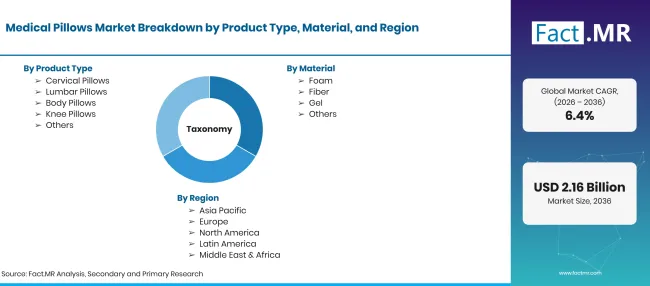
Medical Pillows Market Taxonomy | Source: Fact.MR
| Attribute | Details |
|---|---|
| Quantitative Units | USD billion |
| Market Definition | Pillows designed for cervical support, orthopedic positioning, post-surgical recovery, maternity support and other healthcare needs, sold to institutions and households. |
| Product Type | Cervical Pillows; Lumbar Pillows; Body Pillows; Knee Pillows; Others |
| Material | Foam; Fiber; Gel; Others |
| Application | Orthopedic; Post-Surgery; Maternity; Others |
| End-User | Hospitals; Clinics; Homecare; Others |
| Distribution Channel | Online Stores; Specialty Stores; Pharmacies; Others |
| Regions Covered | North America; Latin America; Western Europe; Eastern Europe; East Asia; South Asia & Pacific; Middle East & Africa |
| Countries Covered | Brazil; United States; Japan; Germany; United Kingdom |
| Companies Profiled | Somnigroup International Inc.; Core Products International Inc.; Mediflow Inc.; Contour Products Inc.; Coop Sleep Goods; Care of Sweden AB |
| Forecast Period | 2026 to 2036 |
| Approach | Hybrid top-down and bottom-up model linking hospital positioning demand, household orthopedic purchases, material mix and channel data with country growth assumptions. |
Source: Fact.MR analysis. Updated Nov 4, 2026
How is the market segmented?
-
By Product Type
- Cervical Pillows
- Lumbar Pillows
- Body Pillows
- Knee Pillows
- Others
-
By Material
- Foam
- Fiber
- Gel
- Others
-
By Application
- Orthopedic
- Post-Surgery
- Maternity
- Others
-
By End-User
- Hospitals
- Clinics
- Homecare
- Others
-
By Distribution Channel
- Online Stores
- Specialty Stores
- Pharmacies
- Others
-
By Region
- North America
- Latin America
- Western Europe
- Eastern Europe
- East Asia
- South Asia & Pacific
- Middle East & Africa
What is the report’s scope and coverage?
Medical Pillows Market Taxonomy | Source: Fact.MR
| Attribute | Details |
|---|---|
| Quantitative Units | USD billion |
| Market Definition | Pillows designed for cervical support, orthopedic positioning, post-surgical recovery, maternity support and other healthcare needs, sold to institutions and households. |
| Product Type | Cervical Pillows; Lumbar Pillows; Body Pillows; Knee Pillows; Others |
| Material | Foam; Fiber; Gel; Others |
| Application | Orthopedic; Post-Surgery; Maternity; Others |
| End-User | Hospitals; Clinics; Homecare; Others |
| Distribution Channel | Online Stores; Specialty Stores; Pharmacies; Others |
| Regions Covered | North America; Latin America; Western Europe; Eastern Europe; East Asia; South Asia & Pacific; Middle East & Africa |
| Countries Covered | Brazil; United States; Japan; Germany; United Kingdom |
| Companies Profiled | Somnigroup International Inc.; Core Products International Inc.; Mediflow Inc.; Contour Products Inc.; Coop Sleep Goods; Care of Sweden AB |
| Forecast Period | 2026 to 2036 |
| Approach | Hybrid top-down and bottom-up model linking hospital positioning demand, household orthopedic purchases, material mix and channel data with country growth assumptions. |
Source: Fact.MR analysis. Updated Nov 4, 2026
How is the market segmented?
-
By Product Type
- Cervical Pillows
- Lumbar Pillows
- Body Pillows
- Knee Pillows
- Others
-
By Material
- Foam
- Fiber
- Gel
- Others
-
By Application
- Orthopedic
- Post-Surgery
- Maternity
- Others
-
By End-User
- Hospitals
- Clinics
- Homecare
- Others
-
By Distribution Channel
- Online Stores
- Specialty Stores
- Pharmacies
- Others
-
By Region
- North America
- Latin America
- Western Europe
- Eastern Europe
- East Asia
- South Asia & Pacific
- Middle East & Africa
Frequently Asked Questions
How large is the medical pillows market in 2026?
What growth rate will the medical pillows market record?
Which product type leads?
Which material leads?
Which application leads?
Which end-user leads?
Which distribution channel leads?
Which country will grow quickest?
Who are the main companies?
What holds the market back?
Who worked on this report


Preview the report firsthand - request a free sample
Free SampleGet the brochure for pricing and purchase details
Download PDF