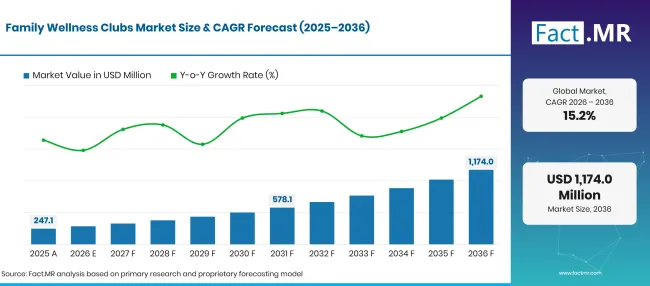
- Market Value (2025): USD 247.1 Mn
- Estimated Value (2026): USD 284.7 Mn
- Forecast Value (2036): USD 1174.0 Mn
- CAGR (2026-2036): 15.2%
What is the Family Wellness Clubs Market forecast to be worth by 2036?
USD 284.7 million in 2026 to USD 1174.0 million by 2036 at a 15.2% CAGR.
- The family wellness clubs market stood at USD 247.1 million in 2025, mostly from clubs pairing adult fitness floors with supervised children’s areas.
- Club revenue will grow from USD 284.7 million in 2026 to USD 1174.0 million by 2036 as nutrition coaching, parent-child sessions and preventive checks become standard parts of a family visit.
- A 15.2% CAGR reflects a small base that is widening quickly, with corporate family access and destination properties pulling in new households each year.
| Year | Basis | Market Value (USD million) |
|---|---|---|
| 2025 | Actual | 247.1 |
| 2026 | Estimate | 284.7 |
| 2036 | Forecast | 1,174.0 |
| CAGR 2026 to 2036 | Forecast period | 15.2% |
Source: Fact.MR analysis. Updated Nov 13, 2026
Family Wellness Clubs Market Forecast Global 1 | Source: Fact.MR
What are the defining numbers behind Family Wellness Clubs Market growth?
The 2026 to 2036 period adds USD 889.3 million in new value, led by coaching services, single-visit access and employer-funded group bookings.
- Demand Drivers in the Market
- Physical inactivity remains widespread, which gives families a clear reason to look for shared exercise. The WHO reports that 31% of adults are insufficiently active and that 86% of adolescents do not meet recommended activity levels. A club where parents and teenagers train in the same session addresses both gaps with one membership.
- Child weight concerns are pushing households toward nutrition guidance paired with exercise. According to the WHO, 20% of children and adolescents aged 5 to 19 were overweight in 2024, up from 8% in 1990. Family clubs answer this with meal planning, cooking classes and coached activity for the whole household.
- Screen time is being turned into movement time through active gaming formats. A 2025 WHO report on the GenMove programme describes active video games built to get children moving indoors or outdoors and to support mental wellbeing. Hybrid clubs use the idea for rainy-day sessions.
- Employers are extending wellness benefits to spouses and children, since family habits shape staff health. Company family days give clubs predictable off-peak revenue.
- Destination properties combine pools, trails and coached classes for a full family day on site. Longer stays raise spending per visit.
- Key Segments Analyzed
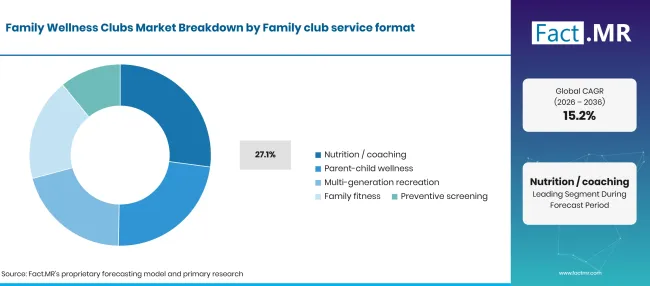
- By Family Club Service Format: Nutrition / Coaching will hold 27.1% share in 2026, since households want eating plans that every family member can follow at home.
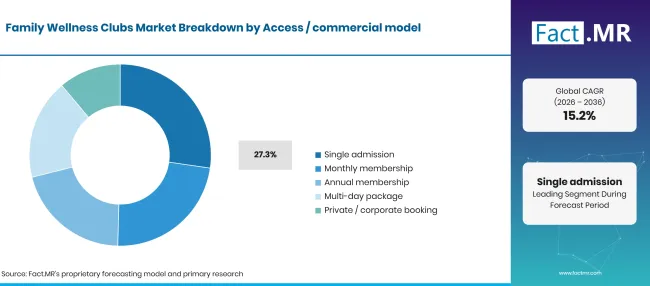
- By Access / Commercial Model: Single Admission will take 27.3% of 2026 revenue as families test facilities with a day visit before signing a recurring contract.
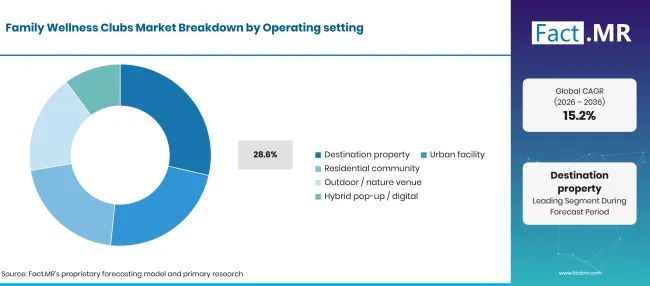
- By Operating Setting: Destination Property will capture 28.6% of 2026 value, given that its pools, outdoor areas and on-site dining keep families for a full day.
- By Core Visitor Group: Corporate Groups will account for 29.8% in 2026, helped by employers booking family days and benefit-funded sessions in bulk.
- Analyst Opinion at Fact.MR
- Shambhu Nath Jha, Principal Consultant at Fact.MR, states, “Family wellness clubs win when one visit serves a toddler and a grandparent without separate bookings. Operators that tie nutrition coaching and simple health checks to fun activity will convert day visitors into members far more often than clubs selling floor space alone. Over the next ten years, employer contracts and destination formats will decide which brands scale beyond their home cities.”
- Strategic Implications
- Club operators should design timetables where parent and child sessions run side by side, so one trip covers the whole household.
- Employers should test family access within staff benefit plans and track whether it lifts participation among employees with young children.
- Property developers should add supervised children’s zones and coached outdoor space to resort and residential projects to support year-round use.
- Investors should favour operators with a clear path from single visits to memberships, since that conversion rate drives long-term club economics.
Asia is setting the pace. China leads the comparison at 16.7%, driven by state-backed fitness facilities that now reach most urban neighbourhoods. South Korea follows closely at 16.5%, as rising sports participation turns into demand for organised family programmes. The United States records 15.0%, a slightly lower rate that reflects a larger installed base of athletic clubs where growth comes from adding family services. Germany trails at 14.1% because its strong club tradition competes with newer commercial formats. Japan closes the list at 13.8%, with an older population shifting demand toward multi-generational programmes in place of youth-led activity.
How does the Family Wellness Clubs Market break down by segment?
Nutrition / Coaching will lead Family Club Service Format at 27.1%; Single Admission will head Access / Commercial Model at 27.3%; Destination Property will lead Operating Setting at 28.6%; Corporate Groups will hold Core Visitor Group at 29.8% in 2026.
Which Family Club Service Format leads?
Nutrition / Coaching holds 27.1% of 2026 sales.
Family Wellness Clubs Market Breakdown Family Club Service Format 1 | Source: Fact.MR
| Family Club Service Format | Share (2026) |
|---|---|
| Nutrition / Coaching (Leading segment) | 27.1% |
| Other segments combined | 72.9%* |
| Total | 100.0% |
Source: Fact.MR analysis. Updated Nov 13, 2026
Parents who struggle to change a child’s diet alone are paying for guided sessions that turn advice into shared routines. Club dietitians run cooking demonstrations, lunchbox planning and goal tracking that link directly to the exercise timetable. Life Time describes its clubs as places where movement and nutrition coaching come together with a better-for-you cafe menu and programmes for the whole family. App-based tools, similar to those tracked in the AI health coaching platforms space, help families keep up the plan between visits. Family Fitness covers supervised workouts and recreational classes that parents and children join together. Multi-generation Recreation and Parent-child Wellness widen the offer to grandparents and toddlers. Preventive Screening adds body composition checks and basic health assessments that give coaching a measurable starting point.
What supports Single Admission within Access / Commercial Model?
Single Admission takes 27.3% of 2026 revenue.
Family Wellness Clubs Market Breakdown Access Commercial Model 1 | Source: Fact.MR
| Access / Commercial Model | Share (2026) |
|---|---|
| Single Admission (Leading segment) | 27.3% |
| Other segments combined | 72.7%* |
| Total | 100.0% |
Source: Fact.MR analysis. Updated Nov 13, 2026
Many families are unsure how often they will use a club, so a paid day visit lowers the risk of a first commitment. Holiday weeks, birthdays and rainy weekends all create one-off demand that recurring contracts miss. Operators often credit part of the entry price against a later membership. Monthly Membership and Annual Membership serve regular users who want lower per-visit cost. Multi-day Package suits school holidays, and Private / Corporate Booking covers exclusive use of pools or halls.
How does Operating Setting shape demand?
Destination Property represents 28.6% of 2026 value.
Family Wellness Clubs Market Breakdown Operating Setting 1 | Source: Fact.MR
| Operating Setting | Share (2026) |
|---|---|
| Destination Property (Leading segment) | 28.6% |
| Other segments combined | 71.4%* |
| Total | 100.0% |
Source: Fact.MR analysis. Updated Nov 13, 2026
Families planning a full day out prefer a single site that keeps every age group busy. Life Time opened its Lakewood Ranch club in October 2026 with a leisure pool, a lap pool and Kids Academy supervised care for young children. Water features of this type draw on the wider pool and spa supply chain for design and upkeep. Residential Community clubs depend on frequent short visits from nearby households. Outdoor / Nature Venue settings rely on trails and camps. Hybrid Pop-up / Digital formats run temporary sessions in schools or parks and keep families engaged through apps similar to those in the home fitness app category. Urban Facility sites focus on compact, time-efficient programmes.
How does Core Visitor Group shape demand?
Corporate Groups account for 29.8% of 2026 value.
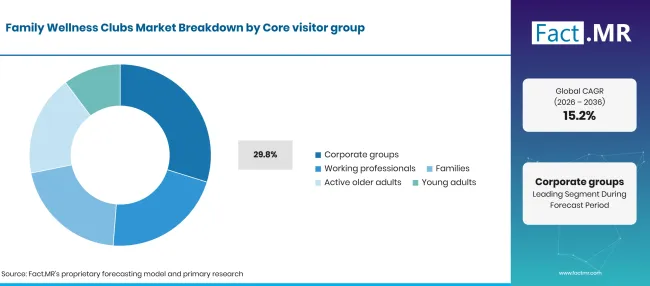
Family Wellness Clubs Market Breakdown Core Visitor Group 1 | Source: Fact.MR
| Core Visitor Group | Share (2026) |
|---|---|
| Corporate Groups (Leading segment) | 29.8% |
| Other segments combined | 70.2%* |
| Total | 100.0% |
Source: Fact.MR analysis. Updated Nov 13, 2026
Employers book whole facilities for family days and fund group sessions as part of staff wellbeing plans. Social exercise also keeps parents engaged, since Nuffield Health reported in September 2025 that 75% of parents with children under 18 feel more motivated when exercising in a group. Families booking on their own remain a steady base. Working Professionals often add children at weekends, Young Adults seek social classes, and Active Older Adults favour swimming with grandchildren.
What is accelerating Family Wellness Clubs Market adoption, and what is holding it back?
Rising concern over child weight and low adult activity is pushing families toward clubs that offer coaching and shared exercise in one place. Employer benefits and destination formats are widening access. High build costs for pools and supervised children’s areas slow new openings, and recurring fees stay hard to justify for lower-income households. Staffing programmes for several age groups also raises operating complexity.
Drivers Impact Analysis
| DRIVER | (~) % IMPACT ON CAGR | GEOGRAPHIC RELEVANCE | IMPACT TIMELINE |
|---|---|---|---|
| Demand for integrated family fitness and wellness programmes | +2.8% | Global | Short term (<=2 years) |
| Awareness of preventive healthcare and nutrition coaching | +2.4% | North America, Western Europe, East Asia | Medium term (2-4 years) |
| Participation in multi-generational recreation and parent-child activities | +2.1% | North America, Western Europe, East Asia | Medium term (2-4 years) |
| Corporate wellness benefits extended to employees’ families | +1.6% | Global | Long term (>=4 years) |
Source: Fact.MR analysis. Updated Nov 13, 2026
Opportunity Impact Analysis
| OPPORTUNITY | (~) % IMPACT ON CAGR | GEOGRAPHIC RELEVANCE | IMPACT TIMELINE |
|---|---|---|---|
| Destination properties built around family wellness stays | +1.4% | North America, Western Europe, East Asia | Medium term (2-4 years) |
| Family packages within corporate wellness contracts | +1.1% | Global | Medium term (2-4 years) |
| Hybrid services linking club sessions with digital follow-up | +0.8% | North America, East Asia, Western Europe | Short term (<=2 years) |
| Programmes for grandparents and grandchildren together | +0.5% | East Asia, Western Europe | Long term (>=4 years) |
Source: Fact.MR analysis. Updated Nov 13, 2026
Restraints Impact Analysis
| RESTRAINT | (~) % IMPACT ON CAGR | GEOGRAPHIC RELEVANCE | IMPACT TIMELINE |
|---|---|---|---|
| High capital and operating costs for pools and supervised children’s areas | -0.8% | Global | Short term (<=2 years) |
| Affordability of recurring memberships for lower-income families | -0.5% | Emerging markets | Medium term (2-4 years) |
| Complexity of staffing programmes for several age groups | -0.3% | Global | Long term (>=4 years) |
| Seasonal dependence of outdoor and nature venues | -0.2% | Western Europe, East Asia | Medium term (2-4 years) |
Source: Fact.MR analysis. Updated Nov 13, 2026
Which countries are scaling the Family Wellness Clubs Market through 2036?
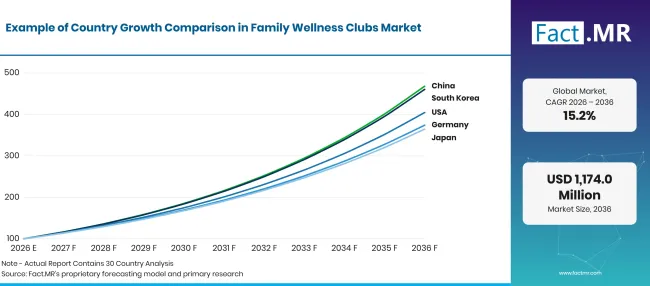
Family Wellness Clubs Market Growth Index 1 | Source: Fact.MR
| Country | CAGR (2026 to 2036) |
|---|---|
| China | 16.7% |
| South Korea | 16.5% |
| United States | 15.0% |
| Germany | 14.1% |
| Japan | 13.8% |
Source: Fact.MR analysis. Updated Nov 13, 2026
What supports China’s adoption?
16.7% CAGR, driven by wider neighbourhood access to sports facilities and rising spending on sports services.
China’s 2025 national fitness survey found that 38.52% of respondents regularly take part in physical exercise. The same survey reported that 90.4% of residents aged 19 and over have a sports facility within a 15-minute walk or bike ride. Services now account for 48.5% of sports consumption, which favours paid coaching and organised family programmes.
How is South Korea developing demand?
16.5% CAGR, backed by a steady rise in regular sports participation.
The Ministry of Culture, Sports and Tourism reported a 2025 regular sports participation rate of 62.9%, up 2.2 percentage points from the previous year. Korean households respond well to structured programmes with clear progress targets. Operators adding preventive checks and nutrition coaching to family classes fit this preference, and app-linked hybrid sessions suit busy dual-income parents.
What is supporting United States adoption?
15.0% CAGR, helped by a deep network of athletic clubs adding family services.
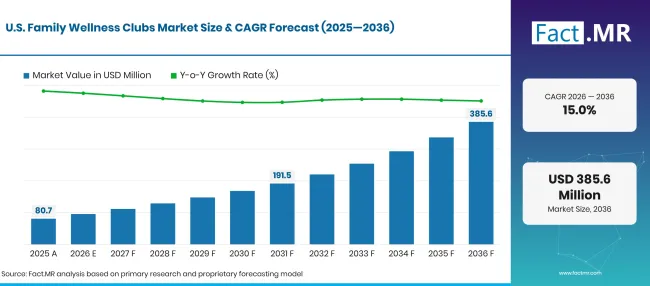
Family Wellness Clubs Market Forecast Usa 1 | Source: Fact.MR
The American Time Use Survey shows that 23.4% of people aged 15 and over took part in sports, exercise or recreation on an average day in 2025. The CDC states that physical activity improves sleep and thinking in children and lowers the risk of heart disease, stroke and type 2 diabetes. Athletic country clubs and community Ys already run pools and camps, so growth comes from bundling coaching and screening into family memberships.
How is Germany scaling demand?
14.1% CAGR, reflecting interest in preventive health within a strong sports club culture.
Destatis reported that 49% of Germany’s population lived in families in 2025. That steady family base supports clubs offering swimming, coached activity and nutrition advice under one roof. Non-profit sports associations remain a low-cost alternative, which keeps commercial operators focused on premium extras such as screening, spa areas and residential community facilities.
How does Japan perform?
13.8% CAGR, as an ageing society favours programmes that serve several generations at once.
The Cabinet Office reported that people aged 65 and over formed 29.3% of Japan’s population on 1 October 2024, about 36.24 million people. Grandparents often share childcare, which makes joint sessions for older adults and grandchildren a practical draw. Venues combining low-impact exercise, preventive screening and parent-child classes can serve these mixed groups on one timetable.
Who leads the Family Wellness Clubs Market?
The field splits into three groups. Premium chains such as Life Time, David Lloyd Leisure and Bay Club compete on facility scale. Their pools, courts and supervised children’s spaces let one membership cover the household.
Life Time added its Lakewood Ranch club in October 2026 and in November 2026 framed its clubs as whole-person health destinations with nutrition coaching. David Lloyd Leisure opened a new club in Boadilla, Spain during 2025, according to its February 2026 trading update. A second group pairs fitness with health services, led by Nuffield Health, which links its gyms with health assessments. Community and private-club operators form the third group: YMCA of the USA competes on affordability and youth programmes, while Invited Clubs relies on country club amenities. Through 2036, the edge will go to operators that turn day visitors into family members and win employer contracts.
Which companies are the key providers?
Key companies in the Family Wellness Clubs Market include Life Time; David Lloyd Leisure; Bay Club; YMCA of the USA; Invited Clubs; and Nuffield Health.
- Life Time
- David Lloyd Leisure
- Bay Club
- YMCA of the USA
- Invited Clubs
- Nuffield Health
Bibliography
- Cabinet Office, Government of Japan. (2025). 1 高齢化の現状と将来像: 令和7年版高齢社会白書(全体版).
- Centers for Disease Control and Prevention. (2025, December 4). Benefits of Physical Activity.
- David Lloyd Leisure. (2026, February 27). Excellent momentum across the Group.
- General Administration of Sport of China. (2025, December 30). 《2025年全民健身活动状况调查公报》发布.
- Life Time. (2026, October 12). Life Time Opens More Than 180,000-Square-Foot Athletic Country Club in Lakewood Ranch on Oct. 12.
- Life Time. (2026, November 4). Life Time Is the Definitive Destination for Whole-Person Health.
- Ministry of Culture, Sports and Tourism, Republic of Korea. (2026, January 19). ’25년 국민 생활체육 참여율 62.9%, 전년 대비 2.2%포인트 상승.
- Nuffield Health. (2025, September 22). Over 1 in 4 Brits now use exercise to socialise.
- Statistisches Bundesamt (Destatis). (2026, September 17). 49 % der Bevölkerung leben in Familien.
- U.S. Bureau of Labor Statistics. (2026, June 25). American Time Use Survey: 2025 Results.
- World Health Organization. (2025, March 10). Getting children moving using active video games: a report of the GenMove programme.
- World Health Organization. (2026, October 7). Obesity and overweight.
- World Health Organization. (2026, November 4). Physical activity.
This Report Answers
- How much will family wellness club revenue grow between 2026 and 2036?
- Which service format, access model, setting and visitor group lead each segment?
- Why do China and South Korea grow ahead of the United States, Germany and Japan?
- What role do employer contracts and destination properties play in attracting new families?
- How do single visits convert into recurring memberships?
- Which operators offer the broadest mix of family fitness, coaching and recreation?
What does the Family Wellness Clubs Market cover?
This market covers revenue earned by clubs and venues that design fitness, coaching and recreation for use by several family members together. Typical offers include parent-child classes, swimming, nutrition coaching and basic health checks.
Value is measured at the point of sale and includes admission fees, memberships, packages and private bookings. Food, retail and lodging income is counted only when sold as part of a family wellness package.
What is included in the scope?
Dedicated family clubs, athletic country clubs and community centres running family wellness programmes are covered.
Destination properties, residential community facilities, outdoor venues and hybrid pop-up formats with coached family sessions form part of the base.
Corporate family days and benefit-funded group sessions held at these venues are counted.
Club-run nutrition coaching and preventive screening sold to members or visitors are also within the boundary.
What is excluded from the scope?
Adult-only gyms and personal training studios without family programmes are left out.
Sales of gym equipment do not count toward club revenue. Retail of swimming gear is also left out.
Clinical treatment delivered by hospitals or medical practices is not counted.
Standalone apps and wearables, such as those covered under smart fitness products, are outside the boundary unless bundled with club access.
How Was the Analysis Built?
The analysis draws on 120+ sources, 35+ company portfolios, 25+ countries, and more than 20 industry interviews.
- Primary Research: Primary research includes discussions with manufacturers, service providers, technology developers, distributors, end users, and subject-matter experts. These conversations examine purchasing priorities, product adoption, operational challenges, approval requirements, competitive positioning, and the factors that influence wider market acceptance.
- Desk Research: Desk research covers government statistics, regulatory publications, company filings, trade data, technical studies, industry associations, standards, public policy, and other authoritative sources. Every source used in the analysis is documented in the bibliography.
- Market Sizing and Forecasting: Market estimates combine historical performance, demand indicators, pricing and volume trends, segment shares, company participation, country-level growth, adoption patterns, investment activity, and barriers to market expansion.
- Data Validation and Update Cycle: Findings are validated by comparing primary interviews with public data, company activity, regulatory changes, trade patterns, and industry developments. Regular updates review new product launches, capacity changes, partnerships, approvals, and shifts in commercial adoption.
Segmentation
What is the report’s scope and coverage?
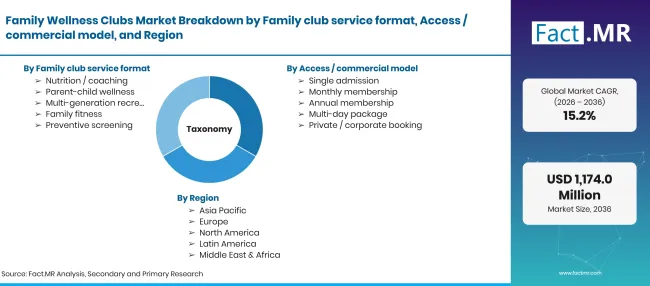
Family Wellness Clubs Market Taxonomy 1 | Source: Fact.MR
| Attribute | Details |
|---|---|
| Quantitative Units | USD million in 2026 to USD million by 2036 at CAGR |
| Market Definition | Clubs and venues that deliver fitness, nutrition coaching, preventive screening and recreation designed for use by several family members or generations together. |
| Family Club Service Format | Nutrition / Coaching; Family Fitness; Multi-generation Recreation; Parent-child Wellness; Preventive Screening |
| Access / Commercial Model | Single Admission; Monthly Membership; Annual Membership; Multi-day Package; Private / Corporate Booking |
| Operating Setting | Destination Property; Residential Community; Outdoor / Nature Venue; Hybrid Pop-up / Digital; Urban Facility |
| Core Visitor Group | Corporate Groups; Families; Working Professionals; Young Adults; Active Older Adults |
| Regions Covered | North America; Latin America; Western Europe; Eastern Europe; East Asia; South Asia & Pacific; Middle East & Africa |
| Countries Covered | China; South Korea; United States; Germany; Japan |
| Companies Profiled | Life Time; David Lloyd Leisure; Bay Club; YMCA of the USA; Invited Clubs; Nuffield Health |
| Forecast Period | 2026 to 2036 |
| Approach | Club revenue modelled by service format, access model, setting and visitor group, then checked against operator programmes and national activity data. |
Source: Fact.MR analysis. Updated Nov 13, 2026
How is the market segmented?
-
By Family Club Service Format
- Nutrition / Coaching
- Family Fitness
- Multi-generation Recreation
- Parent-child Wellness
- Preventive Screening
-
By Access / Commercial Model
- Single Admission
- Monthly Membership
- Annual Membership
- Multi-day Package
- Private / Corporate Booking
-
By Operating Setting
- Destination Property
- Residential Community
- Outdoor / Nature Venue
- Hybrid Pop-up / Digital
- Urban Facility
-
By Core Visitor Group
- Corporate Groups
- Families
- Working Professionals
- Young Adults
- Active Older Adults
-
By Region
- North America
- Latin America
- Western Europe
- Eastern Europe
- East Asia
- South Asia & Pacific
- Middle East & Africa
Frequently Asked Questions
Revenue for 2026 is valued at USD 284.7 million, rising to USD 1,174.0 million by 2036.
What growth rate will the family wellness clubs market record?
Which family club service format leads?
Which access model leads?
Which operating setting leads?
Which core visitor group leads?
Which country will grow quickest?
Who are the main companies?
What holds the market back?
Who worked on this report


Preview the report firsthand - request a free sample
Free SampleGet the brochure for pricing and purchase details
Download PDF