- Market Value (2025): USD 4.19 Bn
- Estimated Value (2026): USD 4.39 Bn
- Forecast Value (2036): USD 6.92 Bn
- CAGR (2026-2036): 4.7%
What is the Metal Cosmetic Packaging Market forecast to be worth by 2036?
USD 4.39 billion in 2026 to USD 6.9 billion by 2036, at a 4.7% CAGR.
- The metal cosmetic packaging market was valued at USD 4.19 billion in 2025.
- As per Fact.MR analysis, sales are projected to reach USD 4.39 billion in 2026 to USD 6.92 billion in 2036 as beauty brands add metal packs to selected skincare, haircare and makeup ranges.
- The 4.7% CAGR during 2026 to 2036 reflects purchasing decisions shaped by surface finish, packaging life and fit with existing filling and assembly lines.
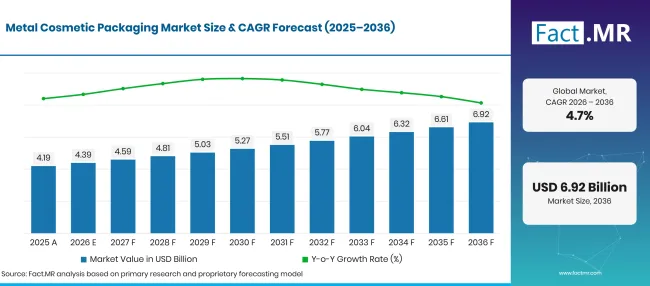
Metal Cosmetic Packaging Market Forecast Global | Source: Fact.MR
| Year | Basis | Market Value (USD billion) |
|---|---|---|
| 2025 | Actual | 4.19 |
| 2026 | Estimate | 4.39 |
| 2036 | Forecast | 6.9 |
| CAGR 2026 to 2036 | Forecast period | 4.7% |
Source: Fact.MR analysis. Updated Oct 23, 2026
What are the defining numbers behind Metal Cosmetic Packaging Market growth?
USD 2.5 billion absolute opportunity by 2036, with jars, tin and skincare forming major specified segments.
- Demand Drivers in the Market
- Skincare brand teams need jars that protect cream products during handling and make opening, closing and decoration feel consistent across production batches.
- Packaging engineers seek controlled metal forming and smooth internal surfaces so packs pass filling trials without damaging formulas or creating avoidable rejects.
- Retail merchandising teams value metal finishes that stay presentable under store lighting and allow a visible difference between standard and premium lines.
- Refill programme managers compare a reusable outer metal case with the price and complexity of replacement inserts before approving a pack for launch.
- Key Segments Analyzed
- By Product Type: Jars account for 31.4% share in 2026 as skincare brands use decorated containers for creams and balms.
- By Material: Tin hold 33.6% share in 2026 where shaped packs and printed surfaces suit cosmetic packaging needs.
- By Application: Skincare captures 42.5% share in 2026 as brands select jars and protective outer packs for regular-use products.
- By Distribution Channel: Offline Retail represents 61.3% share in 2026 because shoppers often handle beauty packaging before purchase.
- Analyst Opinion at Fact.MR
- Shambhu Nath Jha, Principal Consultant at Fact.MR, states, “A metal cosmetic pack needs to look good without making filling and assembly more difficult. Brands compare how the closure works, whether the outer case can be reused, and how reliably suppliers can repeat the finish. A pack that performs well in daily use offers more value than decoration alone.”
- Strategic Implications
- Brand owners should test cap fit and surface wear with the actual formula before extending a metal-pack design to several products.
- Metal converters should assess yield losses from stamping and coating when quoting decorated jars or compacts. Packaging reuse is examined alongside zero-waste beauty products.
- Packaging distributors should keep separate specifications for direct-contact metal containers and metal outer cases used with plastic inserts.
- Retail teams should test how metal packaging looks after repeated customer handling and whether the weight suits shipping cartons.
Germany is projected to post 5.8% CAGR through 2036, while the United Kingdom records 5.0%. Brazil follows at 4.3%, supported by cosmetic product development and packaging trade. The United States records 3.8% and Japan 3.4%, as brand teams balance pack finish against component cost and assembly requirements.
How does the Metal Cosmetic Packaging Market break down by segment?
Jars 31.4%; Tin 33.6%; Skincare 42.5%; Offline Retail 61.3% in 2026.
Which Product Type dominates?
Jars holds 31.4% share in 2026.
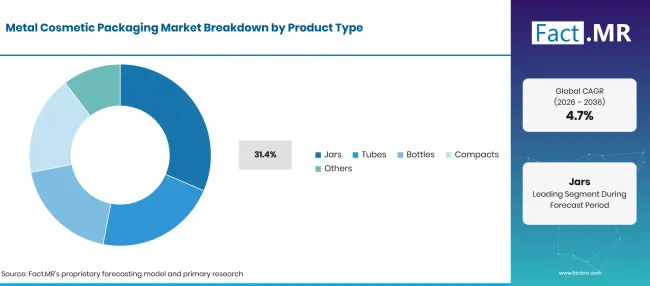
Metal Cosmetic Packaging Market Breakdown Product Type | Source: Fact.MR
| Product Type | Share (2026) |
|---|---|
| Jars (Leading segment) | 31.4% |
| Other segments combined | 68.6% |
| Total | 100.0% |
Source: Fact.MR analysis. Updated Oct 23, 2026
Jars fit creams and thicker skincare formulas where customers want controlled access to the product. A metal jar also offers space for printed decoration and an outer finish that can be matched across related products. Tubes suit products dispensed in measured amounts, while bottles work with different closures and pumps. Compacts depend on hinge life and the feel of the closure. A brand may use separate materials inside and outside a pack to protect the formula while retaining the chosen metal appearance.
Which Material accounts for the largest share?
Tin accounts for 33.6% share in 2026.
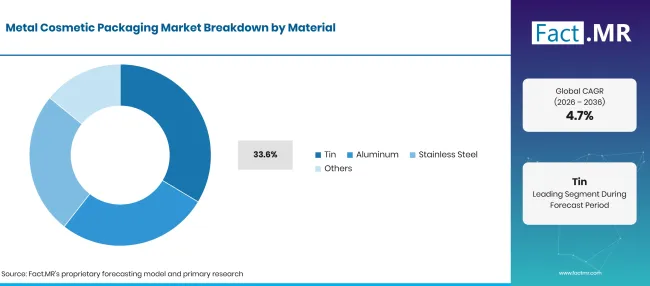
Metal Cosmetic Packaging Market Breakdown Material | Source: Fact.MR
| Material | Share (2026) |
|---|---|
| Tin (Leading segment) | 33.6% |
| Other segments combined | 66.4% |
| Total | 100.0% |
Source: Fact.MR analysis. Updated Oct 23, 2026
Tin is suited to pressed and decorated containers that need a firm shape and a familiar feel in the hand. Brands still have to check coatings and the contact surface against the formula being packed. Aluminum suits lightweight tubes and shaped cases, while stainless steel serves a smaller set of durable or reusable pack designs. Surface protection, forming quality and batch consistency guide the material decision more closely than the metal name alone.
What leads the Application segment?
Skincare leads with 42.5% share in 2026.
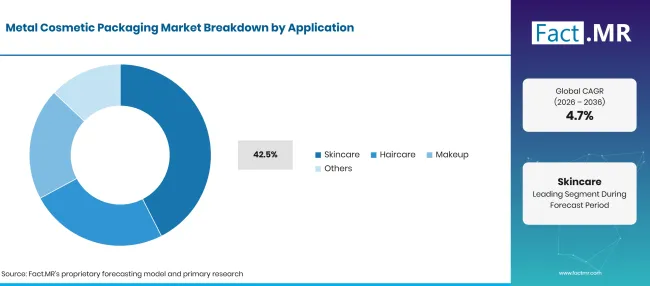
Metal Cosmetic Packaging Market Breakdown Application | Source: Fact.MR
| Application | Share (2026) |
|---|---|
| Skincare (Leading segment) | 42.5% |
| Other segments combined | 57.5% |
| Total | 100.0% |
Source: Fact.MR analysis. Updated Oct 23, 2026
Skincare brands use metal jars for selected balms and creams as well as outer shells around refills. The purchase decision depends on closure reliability and how the container performs after repeated opening. Haircare packs often place greater attention on controlled dispensing, and makeup designs may depend on compact hinges or decorated cases. Product compatibility testing remains necessary whenever a formulation can come into direct contact with a coated metal surface.
How are Distribution Channels divided?
Offline Retail holds 61.3% share in 2026.
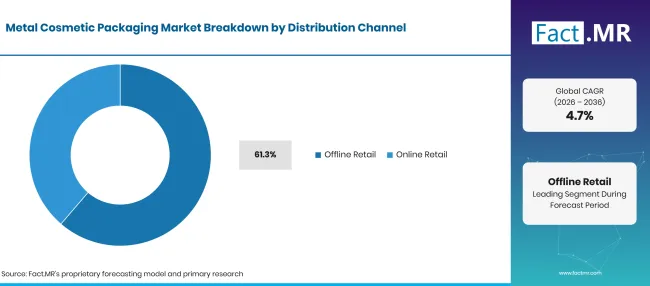
Metal Cosmetic Packaging Market Breakdown Distribution Channel | Source: Fact.MR
| Distribution Channel | Share (2026) |
|---|---|
| Offline Retail (Leading segment) | 61.3% |
| Other segments combined | 38.7% |
| Total | 100.0% |
Source: Fact.MR analysis. Updated Oct 23, 2026
Offline beauty stores allow shoppers to judge the finish, weight and opening action of a pack before buying. Metal cases can therefore influence how a skincare or makeup product is presented on a shelf. Online retail places more emphasis on protection during shipping and accurate product photographs. Brands supplying both channels need consistent labeling and packaging quality so an item purchased online matches the store sample.
What is accelerating Metal Cosmetic Packaging Market adoption, and what is holding it back?
Premium pack design and refillable outer cases support sales, while finishing costs and formula compatibility limit selection.
Drivers Impact Analysis
| DRIVER | (~) % IMPACT ON CAGR | GEOGRAPHIC RELEVANCE | IMPACT TIMELINE |
|---|---|---|---|
| Skincare pack upgrades | +1.0% | Global | Medium term (2–4 years) |
| Metal case reuse | +0.8% | Europe, UK | Medium term (2–4 years) |
| Retail shelf presentation | +0.7% | Global | Short term (<= 2 years) |
| Decorated jar orders | +0.5% | Germany, Japan | Medium term (2–4 years) |
| Brand consistency | +0.4% | Global | Long term (>= 4 years) |
Source: Fact.MR analysis. Updated Oct 23, 2026
Opportunity Impact Analysis
| OPPORTUNITY | (~) % IMPACT ON CAGR | GEOGRAPHIC RELEVANCE | IMPACT TIMELINE |
|---|---|---|---|
| Refill-ready outer cases | +0.8% | Europe | Medium term (2–4 years) |
| Custom short production runs | +0.6% | United States, UK | Short term (<= 2 years) |
| Lighter aluminum formats | +0.5% | Global | Medium term (2–4 years) |
| Specialist coating services | +0.4% | Global | Long term (>= 4 years) |
Source: Fact.MR analysis. Updated Oct 23, 2026
Restraints Impact Analysis
| RESTRAINT | (~) % IMPACT ON CAGR | GEOGRAPHIC RELEVANCE | IMPACT TIMELINE |
|---|---|---|---|
| Coating qualification cost | -0.8% | Global | Short term (<= 2 years) |
| Metal forming losses | -0.6% | Global | Medium term (2–4 years) |
| Mixed material separation | -0.5% | Europe, UK | Long term (>= 4 years) |
| Decorative finish defects | -0.4% | Global | Short term (<= 2 years) |
Source: Fact.MR analysis. Updated Oct 23, 2026
Which countries are scaling the Metal Cosmetic Packaging Market through 2036?
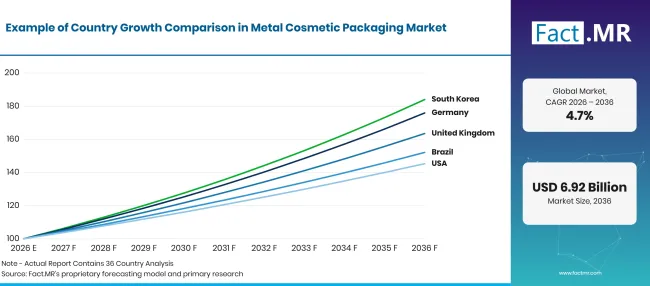
Metal Cosmetic Packaging Market Growth Index | Source: Fact.MR
| Country | CAGR (2026–2036) |
|---|---|
| Germany | 5.8% |
| United Kingdom | 5.0% |
| Brazil | 4.3% |
| United States | 3.8% |
| Japan | 3.4% |
Source: Fact.MR analysis. Updated Oct 23, 2026
Why is Germany expanding metal cosmetic packaging use?
5.8% CAGR through 2036, shaped by retail selection and European packaging rules.
German cosmetic brands compare metal jars by finish quality and by how well their protective liners work with skincare formulas. The German Federal Statistical Office reported in January 2026 that real retail sales for the wider pharmacy and cosmetic products category increased 3.4% during January to November 2025 [3]. This broader retail indicator helps explain the attention given to packaging presentation, although it covers more than cosmetics alone. European packaging rules that began applying in August 2026 encourage brands to examine metal material recovery and pack design [2].
How does the United Kingdom support metal beauty packaging?
5.0% CAGR through 2036, linked to skincare presentation and material recovery.
UK beauty brands use metal outer cases when a compact or refillable skincare pack needs a finish that holds up during regular handling. The Department for Environment, Food & Rural Affairs reported in September 2026 that the provisional recycling rate for UK metal packaging was 78.4% in 2025 [4].
What is shaping Brazil’s metal cosmetic packaging market?
4.3% CAGR through 2036, associated with cosmetic launches and regional trade.
Brazilian skincare brands use decorated jars and compact cases to give different product ranges a recognizable finish. Anvisa reported in its 2025 management summary, published in 2026, that it received 72,390 new notifications for cosmetics exempt from registration [5]. These notifications show the breadth of regulatory activity across cosmetics, with packaging forming one part of each commercial launch.
What guides purchasing in the United States?
3.8% CAGR through 2036, influenced by beauty retail formats and shipping needs.
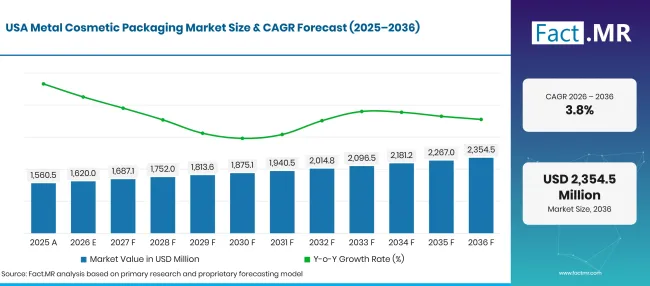
Metal Cosmetic Packaging Market Forecast Usa | Source: Fact.MR
In the United States, cosmetic packaging teams assess metal compacts and jars for shelf presentation and the protection needed during delivery. The U.S. Census Bureau reported in March 2026 that e-commerce accounted for 16.4% of total retail sales in 2025 [6]. That share concerns retail as a whole and gives brands a useful reason to test how decorated packs withstand shipping.
How is Japan approaching metal cosmetic packaging?
3.4% CAGR through 2036, linked to finish quality and careful supplier approval.
Japanese beauty brands give close attention to the fit of compact hinges and the appearance of decorated metal surfaces across repeat production batches. Japan’s Statistics Bureau reported in February 2026 that average monthly consumption expenditure for households of two or more people was JPY 314,001 in 2025 [7].
Who leads the Metal Cosmetic Packaging Market?
AptarGroup has a directly documented metal outer case used in a 2025 skincare refill launch [1]. HCP Packaging and Libo Cosmetics offer cosmetic packaging for makeup formats, including packaging structures where metal parts can be part of the final design.
Quadpack works with beauty brand packaging programmes, while Cosmopak supplies cosmetic packaging services. RPC Group is a legacy business name associated with Berry Global and should not be treated as a separately active competitor. Competition among verified suppliers rests on coating performance, finish consistency and whether the proposed pack fits the formula and filling process.
Which companies are the key providers?
Key companies include Axilone Group; AptarGroup Inc.; HCP Packaging; Quadpack Industries; Libo Cosmetics Company Ltd.; and Cosmopak USA LLC.
- Axilone Group
- AptarGroup Inc.
- HCP Packaging
- Quadpack Industries
- Libo Cosmetics Company Ltd.
- Cosmopak USA LLC
Bibliography
- [1] AptarGroup. (2025, October 6). Aptar Beauty and Clarins launch the new reloadable Total Eye Lift.
- [2] European Commission. (2026, August 11). New EU packaging rules start to apply, including restrictions on PFAS in food-contact packaging.
- [3] Statistisches Bundesamt (Destatis). (2026, January 7). Einzelhandelsumsatz im Jahr 2025 real voraussichtlich um 2,4 % höher als im Vorjahr.
- [4] Department for Environment, Food & Rural Affairs. (2026, September 23). UK statistics on waste.
- [5] Agência Nacional de Vigilância Sanitária. (2026, April 30). Sumário Executivo 2025.
- [6] U.S. Census Bureau. (2026, March 10). Quarterly retail e-commerce sales: Fourth quarter 2025.
- [7] Statistics Bureau of Japan. (2026, February 6). Family Income and Expenditure Survey: 2025 yearly average.
This Report Answers
- The analysis explains why metal jars serve selected skincare formulations and how buyers assess closure quality.
- Material coverage compares tin with aluminum and stainless steel in cosmetic packaging applications.
- Channel analysis compares direct in-store handling with requirements for online shipping.
- Country outlooks assess Germany, Brazil, the United States, the United Kingdom and Japan.
- Competitive coverage differentiates direct metal cosmetic packaging from broader beauty packaging services.
What does the Metal Cosmetic Packaging Market cover?
The market covers metal cosmetic jars, tubes, bottles, compacts and eligible outer cases used with beauty products. A pack may have coated metal in contact with the product or a metal shell around a separate inner container. The boundary depends on the component sold for cosmetic use, rather than on the cosmetic formula itself.
What is included in the scope?
Included items are metal packaging components sold for skincare, haircare or makeup applications. Decoration and fitted closures count where they are part of the finished metal pack. Suppliers may use liners or plastic inserts when the metal component is still a defined part of the packaging system. The analysis considers pack design and the practical checks needed before a customer accepts the component.
What is excluded from the scope?
The scope excludes cosmetics and their formulation ingredients as finished consumer products. Fully plastic or glass containers are outside the metal packaging comparison unless the sold packaging system contains a qualifying metal casing. Metal production equipment and raw metal commodity sales are separate from finished cosmetic packaging revenue.
How Was the Analysis Built?
The analysis draws on 120+ sources, 35+ company portfolios, 25+ countries, and more than 20 industry interviews.
- Primary Research: Primary research includes discussions with manufacturers, service providers, technology developers, distributors, end users, and subject-matter experts. These conversations examine purchasing priorities, product adoption, operational challenges, approval requirements, competitive positioning, and the factors that influence wider market acceptance.
- Desk Research: Desk research covers government statistics, regulatory publications, company filings, trade data, technical studies, industry associations, standards, public policy, and other authoritative sources. Every source used in the analysis is documented in the bibliography.
- Market Sizing and Forecasting: Market estimates combine historical performance, demand indicators, pricing and volume trends, segment shares, company participation, country-level growth, adoption patterns, investment activity, and barriers to market expansion.
- Data Validation and Update Cycle: Findings are validated by comparing primary interviews with public data, company activity, regulatory changes, trade patterns, and industry developments. Regular updates review new product launches, capacity changes, partnerships, approvals, and shifts in commercial adoption.
Segmentation
What is the report’s scope and coverage?
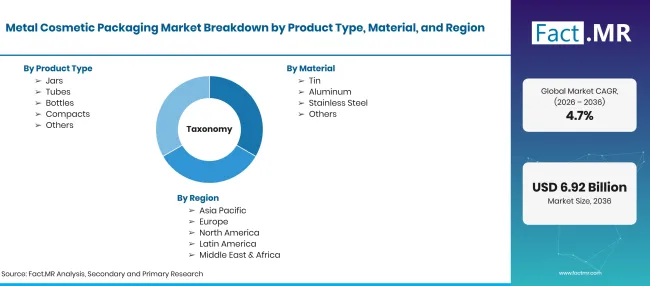
Metal Cosmetic Packaging Market Taxonomy | Source: Fact.MR
| Attribute | Details |
|---|---|
| Quantitative Units | USD billion in 2026 to USD billion by 2036, at CAGR |
| Market Definition | Metal jars, tubes, bottles, compacts and other metal cosmetic packaging or qualifying metal outer parts |
| Product Type | Jars; Tubes; Bottles; Compacts; Others |
| Material | Tin; Aluminum; Stainless Steel; Others |
| Application | Skincare; Haircare; Makeup; Others |
| Distribution Channel | Offline Retail; Online Retail |
| Regions Covered | North America; Latin America; Western Europe; Eastern Europe; East Asia; South Asia & Pacific; Middle East & Africa |
| Countries Covered | Germany; Brazil; United States; United Kingdom; Japan |
| Companies Profiled | Axilone Group; AptarGroup Inc.; HCP Packaging; Quadpack Industries; Libo Cosmetics Company Ltd.; and Cosmopak USA LLC. |
| Forecast Period | 2026 to 2036 |
| Approach | Product fit, metal design, buyer requirements, regulatory context and documented supplier activity |
Source: Fact.MR analysis. Updated Oct 23, 2026
How is the market segmented?
-
By Product Type
- Jars
- Tubes
- Bottles
- Compacts
- Others
-
By Material
- Tin
- Aluminum
- Stainless Steel
- Others
-
By Application
- Skincare
- Haircare
- Makeup
- Others
-
By Distribution Channel
- Offline Retail
- Online Retail
-
By Region
- North America
- Latin America
- Western Europe
- Eastern Europe
- East Asia
- South Asia & Pacific
- Middle East & Africa
Frequently Asked Questions
How big is the metal cosmetic packaging market in 2026?
What is the market CAGR from 2026 to 2036?
Which product type leads?
Which material has the leading share?
Who are the main companies in the metal cosmetic packaging market?
Who worked on this report


Preview the report firsthand - request a free sample
Free SampleGet the brochure for pricing and purchase details
Download PDF