- Market Value (2025):USD 155.3 Mn
- Estimated Value (2026): USD 176.6 Mn
- Forecast Value (2036): USD 637.7 Mn
- CAGR (2026-2036): 13.7%
What is the metal-organic framework market forecast to be worth by 2036?
USD 176.6 million in 2026 to USD 637.7 million by 2036, at 13.7% CAGR.
- The metal-organic framework market crossed a valuation of USD 155.3 million in 2025, influenced by carbon capture trials and advanced adsorbent qualification.
- Demand is projected to increase from USD 176.6 million in 2026 to USD 637.7 million by 2036.
- Market is anticipated to record a 13.7% CAGR from 2026 to 2036 as sorbent developers and specialty chemical producers qualify porous framework materials.
What are the defining numbers behind metal-organic framework market growth?
USD 461.1 million absolute opportunity by 2036, led by powder and gas storage and separation alongside energy and chemicals applications.
- Demand drivers in the market
- Carbon capture developers seek selective solid sorbents influenced by rising project pipelines and tighter industrial decarbonization schedules.
- Hydrogen system designers need porous materials with stable adsorption performance for safer storage and lower-pressure handling.
- Semiconductor gas teams require precision materials for hazardous gas capture as fab expansion raises filtration and abatement checks.
- Water technology developers depend on atmospheric sorbents suited to low-humidity operation and modular field deployment.
- Key segments analyzed
- By Type: Zeolitic imidazolate frameworks are expected to hold 29% share in 2026, reflected by gas separation and stable framework testing.
- By Application: Gas storage & separation is projected to account for 38% share in 2026, driven by hydrogen storage and specialty gas handling.
- By Form: Powder is anticipated to capture 61% share in 2026, shaped by screening workflows and lab-to-pilot transfer.
- By End use: Chemical & petrochemical is estimated to represent 34% share in 2026, owing to gas purification and sorbent testing needs.
- Analyst opinion at Fact.MR
- Shambhu Nath Jha, Senior Analyst at Fact.MR, says, “MOF commercialization has now moved beyond only being a surface-area factor. Adoption is expected to favor producers proving moisture stability and application performance under real plant cycles. Better-positioned suppliers are likely to combine scalable synthesis and customer testing support before claiming industrial readiness.”
- Strategic implications
- MOF producers are anticipated to validate powder and structured formats under cyclic humidity and gas-mixture stress before customer scale-up.
- Carbon capture developers are likely to compare MOF sorbents against amines and zeolites through energy and degradation data.
- Semiconductor gas teams are expected to prioritize qualified toxic gas handling materials with clear safety and documentation packages.
- Hydrogen system developers are projected to test pressure drop and thermal control before selecting storage materials.
Svante launched its Redwood filter manufacturing facility in May 2025, and the 141,000-square-foot site is equipped to make solid sorbent-based filters able to capture up to 10 million tonnes of CO2 annually. Svante states that its structured sorbent filters are coated with metal-organic frameworks, making the facility a direct signal for MOF demand tied to carbon capture hardware.
India is projected to record 15.5% CAGR by 2036, influenced by semiconductor manufacturing and clean-energy material development. China is expected to post 14.8% CAGR through 2036, driven by high-tech manufacturing and carbon management trials. Australia is anticipated to advance at 13.5% CAGR from 2026 to 2036, shaped by hydrogen production targets and CCS storage work. United Kingdom is estimated to hold 13.2% CAGR during the study period, owing to carbon capture clusters and monolithic MOF development. United States is forecast to record 13.0% CAGR between 2026 and 2036, reinforced by direct air capture hubs and toxic gas control applications.
How does the metal-organic framework market break down by segment?
Elastomer is estimated to lead at 61.0%, Magnetorheological elastomers are expected to dominate at 29.0%.
What is likely to lead the type segment?
Magnetorheological elastomers are anticipated to hold 29.0% share in 2026.
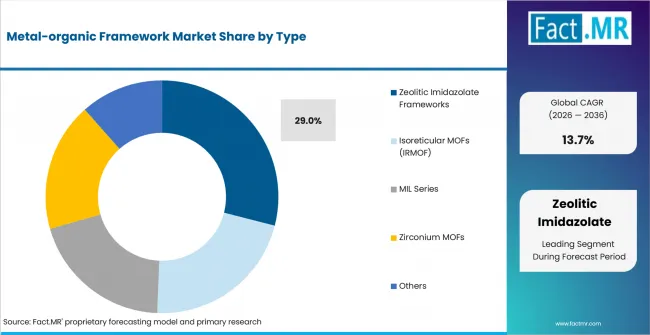
Metal Organic Framework Market Analysis By Type | Source: Fact.MR
Magnetorheological elastomers are expected to account for 29.0% share in 2026, reflected by tunable stiffness and vibration-control behavior. Ferrogels follow through soft material response and biomedical research uses. Magnetic shape-memory polymers and composites support controlled deformation and field-responsive material design. International Federation of Robotics reported in September 2025 stating 542,000 industrial robots to have been installed in 2024, influencing automation settings using sensing and field-responsive components.
What is anticipated to dominate the application segment?
Actuators are expected to garner 38.0% share in 2026.
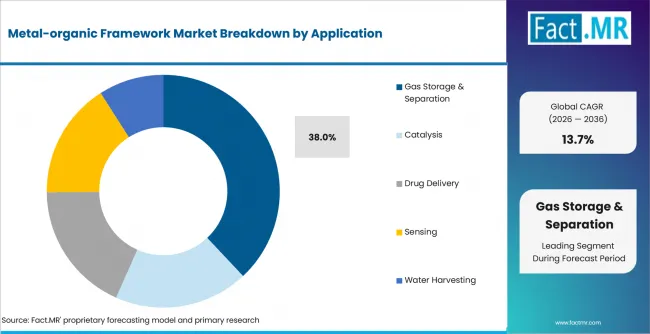
Metal Organic Framework Market Analysis By Application | Source: Fact.MR
Actuators are projected to hold 38.0% share in 2026, driven by controlled motion and compact device response. Sensors follow through field-linked detection and movement feedback. Vibration damping and drug delivery applications support use cases needing magnetic control and repeatable material movement. National Institute of Standards and Technology reported in August 2024 claiming 17 Manufacturing USA institutes in its strategic plan, reflecting structured validation networks for complex manufacturing systems.
What is likely to support Elastomer within form?
Elastomer is set to account for 61.0% share in 2026.
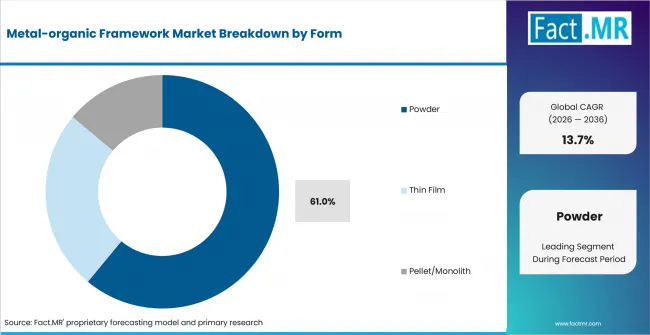
Metal Organic Framework Market Analysis By Form | Source: Fact.MR
Elastomer is anticipated to capture 61.0% share in 2026, owing to flexible polymer structures and field-responsive deformation. Gel follows through soft material and biomedical handling needs. Film supports compact response layers used in sensors and device formats. U.S. National Science Foundation announced in May 2024 a USD 9.5 million sustainable polymer research funding opportunity focused partly on data analytics for polymer discovery and manufacture.
How is end use predicted to shape demand?
Automotive is forecasted to secure 34.0% share in 2026.
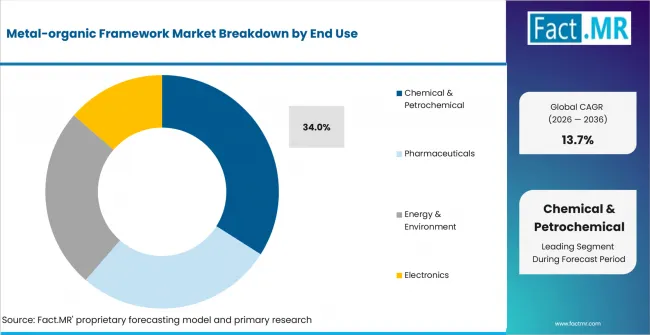
Metal Organic Framework Market Analysis By End Use | Source: Fact.MR
Automotive is estimated to represent 34.0% share in 2026, shaped by vibration control and compact actuation programs. Healthcare/biomedical follows through magnetic bead workflows and controlled material handling. Robotics and electronics support field-responsive motion and miniaturized device programs. International Energy Agency reported in 2026 announcing for electric car sales having exceeded 20 million in 2025, reaching 25% share of global car sales.
What is accelerating metal-organic framework market adoption, and what is holding it back?
Carbon capture qualification drives it, scale-up proof burden restrains it.
Drivers impact analysis
| Driver | (~) % impact on CAGR | Geographic relevance | Impact timeline |
|---|---|---|---|
| Carbon capture sorbent qualification | +1.4% | United States, Europe and China | Medium term (2-4 years) |
| Hydrogen storage material testing | +1.1% | Australia, India and China | Long term (>= 4 years) |
| Semiconductor toxic gas control | +0.8% | United States, China and India | Medium term (2-4 years) |
| Water harvesting trials | +0.6% | Australia, India and Middle East | Long term (>= 4 years) |
| AI-enabled material screening | +0.5% | United States, United Kingdom and China | Short term (<= 2 years) |
Source: Fact.MR analysis. Updated Jul 10, 2026
- Carbon capture sorbent qualification: Industrial emitters need capture systems with lower energy use and smaller equipment footprints. MOFs attract attention due to selective adsorption and regeneration potential. Global CCS Institute reported in October 2025 stating operational CCS projects rose 54% year over year as 27 new facilities came online, creating more buyer attention for sorbent options inside capture equipment.
- Hydrogen storage material testing: Hydrogen developers need storage routes beyond high-pressure tanks for selected stationary and mobility uses. MOFs are expected to gain testing attention due to tunable pore chemistry and lower-pressure storage concepts. A United Kingdom government-backed HySupply Phase 2 final report published in 2025 reported MOF-based hydrogen storage development across a 2 L test rig, a 20 L prototype tank and a nearly 200 L demonstrator tank installed on a hydrogen fuel cell bus, showing why packed-bed safety and refill-cycle data remain central before wider material approval.
- Semiconductor toxic gas control: Chip manufacturers use hazardous gases requiring exact delivery and safety handling. NuMat announced the launch of the SENTINEL MOF filtration platform in March 2024 for chemical protection applications. SEMI reported in October 2025 that global silicon wafer shipments were projected to rise 5.4% in 2025 to 12,824 million square inches, reinforcing why similar qualification depth is anticipated to support MOF adoption in semiconductor gas systems.
- Water harvesting trials: Atmospheric water harvesting developers need sorbents able to load water at low humidity and release it with less heat. MOFs are estimated to support modular devices after durability and cleaning cycles improve. WHO and UNICEF reported 106 million people drank directly from untreated surface sources in 2024, giving field trials a clear public-health need.
- AI-enabled material screening: Material teams use computational screening to narrow MOF candidates before synthesis. The updated CoRE MOF DB article published in June 2025 reported over 40,000 experimental MOFs, including 17,202 computation-ready structures and 23,635 not-computation-ready structures. The same workflow identified 34 MOFs predicted to outperform CALF-20 on CO₂/N₂ selectivity, highlighting why adoption is forecast to improve after proposed structures meet synthesis feasibility and scale-up checks.
Opportunity impact analysis
| Opportunity | (~) % impact on CAGR | Geographic relevance | Impact timeline |
|---|---|---|---|
| Structured MOF filters | +0.9% | North America and Europe | Medium term (2-4 years) |
| Monolithic MOF modules | +0.7% | United Kingdom and Japan | Medium term (2-4 years) |
| Semiconductor gas purification | +0.6% | United States, India and China | Short term (<= 2 years) |
| Atmospheric water harvesters | +0.5% | Australia, India and arid regions | Long term (>= 4 years) |
Source: Fact.MR analysis. Updated Jul 10, 2026
- Structured MOF filters: Capture equipment developers need sorbents placed into practical hardware without major dusting or pressure-drop problems. Structured filters are projected to shorten equipment integration compared with loose powders. Svante’s May 2025 Redwood facility release stated its filter output capacity equals emissions from more than 27 million cars, reinforcing the scale signal behind MOF-coated structured filters for carbon capture hardware.
- Monolithic MOF modules: Industrial users need higher sorbent density and better mechanical handling for contactors. UBE Corporation reported in February 2026 that Immaterial is commercializing densified monolithic MOFs for CO₂ capture, and Immaterial reported the same month that 2 new A2 investors joined while its Cambridge multi-tonne manufacturing facility was being commissioned. Such formats are expected to help industrial buyers evaluate MOF options beyond powders.
- Semiconductor gas purification: New fab construction raises need for materials used in specialty gas storage and abatement. SEMI reported in June 2025 stating global 300 mm semiconductor capacity is projected to reach 11.1 million wafers per month by 2028, with 7 nm and below capacity increasing 69% to 1.4 million wafers per month. MOFs are anticipated to compete in applications requiring molecule-specific capture as fab capacity expands.
- Atmospheric water harvesters: Water harvesting devices need sorbents being able to load moisture under dry-air conditions. MOF-based systems are likely to gain field trials in remote and disaster-response settings. UNICEF reported safely managed drinking water coverage rose from 68% to 74% between 2015 and 2024, showing progress while leaving a large access gap for new water technologies.
Restraints impact analysis
| Restraint | (~) % impact on CAGR | Geographic relevance | Impact timeline |
|---|---|---|---|
| Scale-up proof burden | -1.0% | Global | Medium term (2-4 years) |
| Moisture stability limits | -0.7% | Humid industrial regions | Medium term (2-4 years) |
| Binder and shaping difficulty | -0.5% | Global equipment users | Short term (<= 2 years) |
| Qualification time in regulated uses | -0.4% | Semiconductor and defense uses | Long term (>= 4 years) |
Source: Fact.MR analysis. Updated Jul 10, 2026
- Scale-up proof burden: MOF performance often changes after moving from grams to kilograms and structured formats. Plant teams need evidence on residual solvents and batch consistency before pilot orders move into commercial supply. A United Kingdom government-backed Immaterial final report published in 2026 reported a monolithic MOF synthesis scale-up from 10 mL to 30 L while maintaining material performance, reflecting why scale-up proof remains central before adoption expands.
- Moisture stability limits: Several MOF structures lose performance after exposure to acid gases or repeated heating. Carbon capture and water harvesting buyers need cycle data before approval. Royal Society of Chemistry reported in August 2025 that a zirconium MOF composite achieved 610 mg g⁻¹ water uptake at 30% relative humidity and delivered 365 mg g⁻¹ working capacity within 60 minutes, reinforcing why suppliers are projected to focus on stable zirconium frameworks for humid service.
- Binder and shaping difficulty: Powders alone rarely satisfy industrial handling requirements. Monoliths and coatings need binders preserving pore access and mechanical strength. A Nano-Micro Letters review published in August 2024 identified 6 main fabrication routes for 3D-printed MOF monoliths, including direct ink writing and selective laser sintering, reflecting why material producers are anticipated to face slower conversion from samples to full supply unless shaping know-how improves.
- Qualification time in regulated uses: Semiconductor and defense applications require safety review and long validation cycles. NuMat and Milliken announced a strategic supply relationship in November 2025 for MOF-enabled protective fabric solutions serving defense, first responder and industrial customers. NIOSH reported in September 2025 stating 436 self-contained breathing apparatus had approvals, highlighting why protective applications are expected to need longer approval paths before routine ordering.
Which countries are scaling metal-organic framework demand?
India 15.5%, China 14.8%, Australia 13.5%, United Kingdom 13.2%, United States 13.0% through 2036.
.webp "Top Country Growth Comparison Metal Organic Framework Market Cagr (2026 2036)")
Top Country Growth Comparison Metal Organic Framework Market Cagr (2026 2036) | Source: Fact.MR
Regional analysis covers North America, Latin America, Europe, East Asia, South Asia and Pacific, and Middle East and Africa.
| Country | CAGR |
|---|---|
| India | 15.5% |
| China | 14.8% |
| Australia | 13.5% |
| United Kingdom | 13.2% |
| United States | 13.0% |
Source: Fact.MR analysis. Updated Jul 10, 2026
What is driving India’s growth through 2036?
15.5% CAGR from 2026 to 2036, driven by semiconductor materials and clean-energy trials.
India is building an advanced materials base around carbon management and hydrogen-linked applications. Metal-organic framework demand in India is projected to record 15.5% CAGR through 2036 since local research teams and specialty material users move toward pilot qualification. In February 2026, the Press Information Bureau reported 10 approved semiconductor manufacturing projects, including 2 fabs and 8 packaging units. This supports a stronger testing base for gas filtration and specialty materials.
How is China scaling metal-organic framework demand?
14.8% CAGR through 2036, supported by high-tech manufacturing and carbon capture use cases.
China combines chemical manufacturing scale with rapid high-tech production growth. In February 2026, the National Bureau of Statistics of China reported that the output of service robots reached 18.581 million units in 2025, up 16.1% over the previous year. Demand in China is expected to post 14.8% CAGR by 2036, led by gas separation and carbon management teams expanding MOF testing near manufacturing clusters.
What is Australia likely to perform?
13.5% CAGR between 2026 to 2036, shaped by hydrogen targets and CCS storage work.
Australia links MOF demand to hydrogen storage trials and large-scale CO2 storage experience. Metal-organic framework sector in Australia is anticipated to advance at 13.5% CAGR from 2026 to 2036, due to project developers assessing sorbents for energy and industrial gases. Australia’s 2024 National Hydrogen Strategy set a target of at least 15 million tonnes of hydrogen production annually by 2050, with a 2030 milestone of 0.5 million tonnes annually. It promotes long-range material testing needs.
What supports the United Kingdom outlook?
13.2% CAGR between 2026 and 2036, owing to carbon capture clusters and monolithic MOF engineering.
United Kingdom demand is shaped by carbon capture clusters and structured sorbent development. In April 2025, the Department for Energy Security and Net Zero reported 27 hydrogen projects shortlisted for the second Hydrogen Allocation Round across England along with Scotland and Wales. Sales in the United Kingdom are estimated to hold 13.2% CAGR during the study period, reflected by Immaterial and Promethean Particles moving MOF formats closer to industrial hardware.
How is the United States developing metal-organic framework demand?
13.0% CAGR during the study period, shaped by direct air capture hubs and hazardous gas handling.
United States demand is supported by defense protection needs and semiconductor gas applications. Metal-organic framework sector in the United Staes is set to record 13.0% CAGR during the forecast period, backed by suppliers align MOF chemistry with field-ready filters and coated media. The U.S. Department of Energy reported in March 2024 stating the Regional DAC Hubs program would develop 4 hubs, each able to demonstrate technology with potential to capture at least 1 million metric tons of CO2 annually from the atmosphere.
Who leads the metal-organic framework market?
BASF and NuMat Technologies lead direct MOF coverage, while Svante and Promethean Particles strengthen structured sorbent scale-up.
BASF produces MOFs for CO2 capture on an industrial scale and positions such materials around large-surface-area adsorption. NuMat Technologies brings SENTINEL and ION-X platforms, with MOF-enabled chemistry used for semiconductor gas delivery and protection applications. Svante converts MOF-coated sorbents into structured filters for carbon capture systems, connecting materials with plant hardware.
Promethean Particles focuses on industrial-scale continuous-flow MOF production and reported a four-tonne MOF export in November 2025. novoMOF develops industrial-scale MOFs for carbon capture and related use cases. Immaterial develops densified monolithic MOF systems for CO2 capture, with UBE reporting a February 2026 investment in the company. Competition during the forecast period is expected to be shaped by shaped-product performance and customer validation depth.
Which companies are the key providers?
BASF and NuMat Technologies are key providers. Svante and Promethean Particles are also profiled. novoMOF and Immaterial complete the company set.
- BASF
- NuMat Technologies
- Svante
- Promethean Particles
- novoMOF
- Immaterial
Bibliography
- Australian Department of Climate Change, Energy, the Environment and Water. (2024, September 13). National Hydrogen Strategy 2024. Australian Government.
- BASF. (2025, December 3). Nobel Prize for MOFs: Nanostructures enable large-scale extraction of carbon dioxide from the air. BASF.
- Department for Energy Security and Net Zero. (2025). Monolithic MOFs for enhanced cryoadsorbed hydrogen storage: HySupply Phase 2 final report. United Kingdom Government.
- Department for Energy Security and Net Zero. (2025, April 7). Hydrogen Allocation Round 2 projects. United Kingdom Government.
- Department for Energy Security and Net Zero. (2026, May 13). Monolithic metal-organic frameworks (MOFs) for carbon capture. United Kingdom Government.
- Global CCS Institute. (2025, October 9). Carbon capture stays the course despite global headwinds, with 54% rise in operational projects. Global CCS Institute.
- Immaterial. (2026, February 16). Immaterial Ltd successfully adds more investors to the Series A2 funding round. Immaterial.
- International Energy Agency. (2025, April 30). CCUS projects around the world are reaching new milestones. International Energy Agency.
- International Energy Agency. (2025, September 12). Global Hydrogen Review 2025. International Energy Agency.
- Jiang, Y., Tan, H., Wei, B., Du, L., Zhang, J., & Lu, Z. (2025, August 13). Hygroscopic salt in a mesoporous zirconium metal-organic framework for atmospheric water harvesting. Journal of Materials Chemistry A, 13, 31469–31476.
- Molavi, H., Mirzaei, K., Barjasteh, M., Rahnamaee, S. Y., Saeedi, S., Hassanpouryouzband, A., & Rezakazemi, M. (2024, August 15). 3D-printed MOF monoliths: Fabrication strategies and environmental applications. Nano-Micro Letters, 16, Article 272.
- National Bureau of Statistics of China. (2026, February 28). Statistical communiqué of the People’s Republic of China on the 2025 national economic and social development. National Bureau of Statistics of China.
- National Institute for Occupational Safety and Health. (2025, September). Chemical, biological, radiological, and nuclear (CBRN) respiratory protection handbook (DHHS [NIOSH] Publication No. 2025-111, revised 09/2025). Centers for Disease Control and Prevention.
- Nobel Prize Outreach. (2025, October 8). Press release: Nobel Prize in Chemistry 2025. Nobel Prize Outreach.
- novoMOF. (2025, October 20). As MOFs win Nobel recognition, Swiss firm novoMOF leads the path to CO2 capture. novoMOF.
- NuMat Technologies. (2024, March 6). Numat announces launch of SENTINEL filtration platform, revolutionizing chemical protection technology for 21st century threats. NuMat Technologies.
- NuMat Technologies. (2025, November 25). Milliken & Company and Numat Technologies announce strategic partnership to deliver next-generation protection solutions. NuMat Technologies.
- Press Information Bureau. (2026, February 4). Semicon India Programme advances with approval of 10 semiconductor manufacturing projects. Government of India.
- Promethean Particles. (2025, November 3). Four-tonne MOF export is a major milestone for UK chemical firm Promethean Particles. Promethean Particles.
- SEMI. (2025, January 7). Eighteen new semiconductor fabs to start construction in 2025, SEMI reports. SEMI.
- SEMI. (2025, June 25). SEMI forecasts 69% growth in advanced chipmaking capacity through 2028 due to AI. SEMI.
- SEMI. (2025, October 28). SEMI reports global silicon wafer shipments to rebound 5.4% in 2025, with new record expected by 2028. SEMI.
- Svante. (2025, May 13). Svante launches world’s first commercial gigafactory for carbon capture and removal filters. Svante.
- UBE Corporation. (2026, February 16). Investment in Immaterial Ltd. UBE Corporation.
- UNICEF. (2025, August 25). Progress on household drinking water, sanitation and hygiene 2000–2024: Special focus on inequalities. UNICEF.
- U.S. Department of Energy. (2026). Regional direct air capture hubs. U.S. Department of Energy.
- World Health Organization and UNICEF. (2025, August 26). 1 in 4 people globally still lack access to safe drinking water. World Health Organization.
- Zhao, G., Brabson, L. M., Chheda, S., Huang, J., Kim, H., Liu, K., Mochida, K., Pham, T. D., Prerna, Terrones, G. G., Yoon, S., Zoubritzky, L., Coudert, F.-X., Haranczyk, M., Kulik, H. J., Moosavi, S. M., Sholl, D. S., Siepmann, J. I., Snurr, R. Q., & Chung, Y. G. (2025, June 4). CoRE MOF DB: A curated experimental metal-organic framework database with machine-learned properties for integrated material-process screening. Matter, 8(6), Article 102140.
This Report Addresses
- Report provides strategic intelligence on metal-organic framework demand across type and application choices shaping porous material qualification.
- Segment analysis covers Powder and Gas Storage & Separation as share leaders within the 2026 market structure.
- Regional outlook evaluates India, China, Australia, United Kingdom and United States across the supplied CAGR framework.
- Competitive analysis profiles BASF and NuMat Technologies alongside Svante, Promethean Particles, novoMOF and Immaterial.
- Type assessment covers Zeolitic Imidazolate Frameworks and Isoreticular MOFs across framework selection and gas-handling use.
- Application assessment covers gas storage & separation and catalysis alongside drug delivery and water harvesting.
- Form assessment covers powder and thin film alongside pellet/monolith formats across lab-to-pilot workflows.
What does the metal-organic framework market cover?
Zeolitic Imidazolate Frameworks, Isoreticular MOFs, MIL Series, Zirconium MOFs, and other MOF types used for adsorption, separation, storage, and catalytic functions.
Metal-organic framework market covers porous crystalline framework materials formed from metal nodes and organic linkers. Coverage includes Zeolitic Imidazolate Frameworks, Isoreticular MOFs, MIL Series, Zirconium MOFs and other MOF types across Powder, Thin Film and Pellet/Monolith forms.
Market scope differs from general porous materials because coverage focuses on MOFs used in gas storage and separation, catalysis, drug delivery, sensing and water harvesting. Zeolites, activated carbon and silica adsorbents remain outside scope unless compared directly against MOF-based materials.
What is included in the scope?
Metal-organic framework materials used in industrial, energy, environmental and electronics applications.
Scope includes powder, granule, pellet and structured MOF formats across zirconium-based, copper-based, zinc-based and iron-based frameworks. Coverage spans gas storage and separation, carbon capture, catalysis, water harvesting and toxic gas control. Energy and chemicals, semiconductors, environmental technology, pharmaceuticals and defense protection are included when a porous framework material is the purchased function. Commercial boundary includes MOF materials, structured sorbent media, coated filters and custom framework development. Adjacent carbon capture systems, hydrogen storage media and porous adsorbent comparisons are considered only for context around adoption and competing technologies.
What is included in the scope?
Metal-organic framework materials used across gas storage and separation and water harvesting.
Scope includes Zeolitic Imidazolate Frameworks, Isoreticular MOFs, MIL Series, Zirconium MOFs and other MOF types. Form coverage includes Powder, Thin Film and Pellet/Monolith. End-use coverage includes Chemical & Petrochemical, Pharmaceuticals, Energy & Environment and Electronics. Application coverage includes Gas Storage & Separation, Catalysis, Drug Delivery, Sensing and Water Harvesting.
How was the analysis built?
120+ sources, 40+ company portfolios, 25+ countries, 20+ interviews.
- Primary Research
- Primary research includes interviews with MOF producers, specialty chemical formulators, carbon capture developers and semiconductor gas teams. It also includes input from hydrogen system engineers, industrial filter suppliers, adsorbent distributors and application specialists involved in porous framework qualification.
- Desk Research
- Desk research reviews official carbon capture statistics, hydrogen policy updates, semiconductor capacity notices, drinking water access data and supplier product portfolios. Company announcements, technical pages, investment releases and MOF commercialization updates are also evaluated to assess market developments and competitive positioning.
- Market-Sizing and Forecasting
- Forecasting uses carbon capture project activity, hydrogen storage testing, semiconductor gas attachment rates, application-specific demand and product format preferences. Forecast models also consider powder-to-structured conversion, stability validation, country readiness and provider capacity signals across end-use applications.
- Data Validation and Update Cycle
- Forecasts are validated through technical interviews that test assumptions on material demand, form selection and application adoption. Portfolio mapping, country demand assessment and provider feedback help confirm market direction, while ongoing reviews of official statistics and company launches support forecast updates.
Segmentation
What is the report’s scope and coverage?
| Attribute | Details |
|---|---|
| Quantitative units | USD million in 2026 to USD million by 2036 at CAGR |
| Market definition | Porous crystalline framework materials formed from metal nodes and organic linkers for adsorption, separation, storage, capture and catalytic functions |
| Type | Zeolitic Imidazolate Frameworks; Isoreticular MOFs (IRMOF); MIL Series; Zirconium MOFs; Others |
| Application | Gas Storage & Separation; Catalysis; Drug Delivery; Sensing; Water Harvesting |
| Form | Powder; Thin Film; Pellet/Monolith |
| End use | Chemical & Petrochemical; Pharmaceuticals; Energy & Environment; Electronics |
| Regions covered | North America, Latin America, Europe, East Asia, South Asia and Pacific, Middle East and Africa |
| Countries covered | India, China, Australia, United Kingdom, United States |
| Key companies profiled | BASF, NuMat Technologies, Svante, Promethean Particles, novoMOF, Immaterial |
| Forecast period | 2026 to 2036 |
Source: Fact.MR analysis. Updated Jul 10, 2026
How is the market segmented?
-
By Type:
- Zeolitic Imidazolate Frameworks
- Isoreticular MOFs (IRMOF)
- MIL Series
- Zirconium MOFs
- Others
-
By Application:
- Gas Storage & Separation
- Catalysis
- Drug Delivery
- Sensing
- Water Harvesting
-
By Form:
- Powder
- Thin Film
- Pellet/Monolith
-
By End Use:
- Chemical & Petrochemical
- Pharmaceuticals
- Energy & Environment
- Electronics
-
By Region:
- North America
- United States
- Canada
- Latin America
- Brazil
- Mexico
- Europe
- Germany
- United Kingdom
- France
- Italy
- Spain
- East Asia
- China
- Japan
- South Korea
- South Asia and Pacific
- India
- Australia
- Indonesia
- Middle East and Africa
- UAE
- Saudi Arabia
- South Africa
- North America
Frequently Asked Questions
What type is expected to lead the metal-organic framework market?
What application is anticipated to dominate the metal-organic framework market?
What form is projected to garner the top share in the metal-organic framework market?
What end use is predicted to secure the major share in the Metal-Organic Framework Market?
Why is powder expected to lead demand?
Why are gas storage and separation applications anticipated to support market demand?
Who worked on this report


Preview the report firsthand - request a free sample
Free SampleGet the brochure for pricing and purchase details
Download PDF