- Market Value (2025): USD 1.76 Bn
- Estimated Value (2026): USD 1.88 Bn
- Forecast Value (2036): USD 3.65 Bn
- CAGR (2026-2036): 6.9%
What is the Microcellular Plastic Market forecast to be worth by 2036?
USD 1.9 billion in 2026 to USD 3.7 billion by 2036 at a 6.9% CAGR.
- As per Fact.MR analysis, the microcellular plastic market reached USD 1.76 billion in 2025.
- Sales are projected to rise from USD 1.88 billion in 2026 to USD 3.65 billion by 2036.
- The microcellular plastic market is forecast to record a 6.9% CAGR from 2026 to 2036 as automotive suppliers expand qualified lightweight component programs.
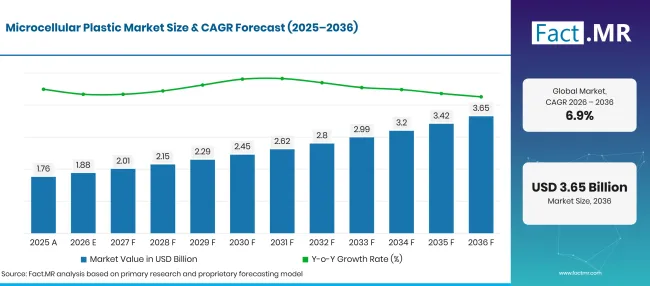
Factmr Microcellular Plastic Market Forecast Global | Source: Fact.MR
| Year | Basis | Market value (USD billion) |
|---|---|---|
| 2025 | Actual | 1.76 |
| 2026 | Estimate | 1.88 |
| 2036 | Forecast | 3.65 |
| CAGR 2026 to 2036 | Forecast Period | 6.9% |
Source: Fact.MR analysis. Updated Oct 14, 2026
What are the defining numbers behind Microcellular Plastic Market growth?
USD 1.8 billion absolute opportunity between 2026 and 2036.
- Demand Drivers in the Market
- Automotive engineers seek lighter trim and seating parts while preserving surface quality and durability.
- Polyurethane developers are assessing protective energy-absorbing components for vehicle batteries and adjacent parts.
- Building product makers assess cellular plastics for thermal management and lightweight panels. Product approval requires evidence of aging performance and fire behavior under the standards that apply to the finished use.
- Key Segments Analyzed
- By Type: Polyurethane accounts for 38.5% share in 2026, helped by its use in cushioning and impact-absorbing components.
- By Application: Automotive represents 42.3% share in 2026 as component makers assess weight reduction within established part designs.
- By Manufacturing Process: Injection Molding holds 45.2% share in 2026 because fine-cell structures can be formed in designed mold cavities.
- By Density: High Density captures 59.2% share in 2026 where part stiffness and dimensional stability remain critical.
- Analyst Opinion at Fact.MR
- Shambhu Nath Jha, Principal Consultant at Fact.MR, states, “For microcellular plastics, repeat orders depend on whether finished components pass customer testing and approval. Lower weight has commercial value only when a part also maintains its appearance and performance throughout regular use. Material suppliers can support factory trials by helping molders maintain a consistent cell structure from one production run to another.”
- Strategic Implications
- Polymer suppliers can provide material grades designed for specific applications. Clear molding guidelines and test results help customers choose the right option.
- Automotive suppliers often compare weight reduction benefits with the cost of tooling changes and approval requirements. Both factors influence material decisions.
- Molding equipment companies focus on stable production settings and consistent process control. This helps reduce material waste during production trials.
- Industrial manufacturers often test materials from different sources before making production changes. Careful planning helps reduce risks when moving high-volume parts to lighter material designs.
Germany is projected to grow at 8.6% CAGR as vehicle manufacturers increase the use of lighter materials. The United States follows at 8.0%, supported by demand from the automotive and construction sectors. The United Kingdom records 7.1%, driven by demand from selected manufacturing industries. Japan reaches 5.7% as suppliers focus on product performance and testing requirements. Brazil stands at 4.8%, where vehicle production levels and manufacturing costs influence adoption.
How does the Microcellular Plastic Market break down by segment?
Polyurethane leads Type at 38.5%; Automotive leads Application at 42.3%; Injection Molding leads Manufacturing Process at 45.2%; High Density leads Density at 59.2%.
Which material type holds the largest share?
Polyurethane is forecast to hold 38.5% share in 2026.
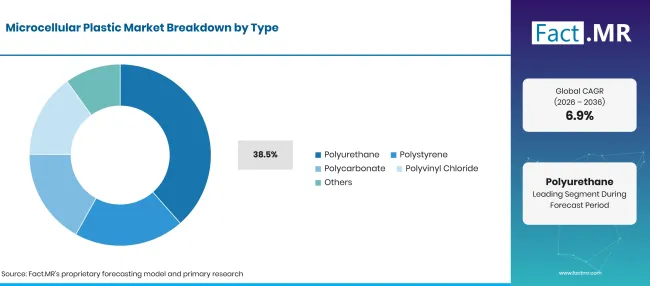
Factmr Microcellular Plastic Market Breakdown Type 1 | Source: Fact.MR
| Type | Share (2026) |
|---|---|
| Polyurethane (Leading segment) | 38.5% |
| Other segments combined | 61.5%* |
| Total | 100.0% |
Source: Fact.MR analysis. Updated Oct 14, 2026
Polyurethane allows manufacturers to adjust softness, cushioning, and impact absorption for different applications. Automotive parts and protective components need consistent performance during regular use. Polystyrene is often chosen for lightweight parts that require a rigid structure. Polycarbonate is used in applications where higher strength and heat resistance justify the added cost.
What leads the Application segment?
Automotive is projected to account for 42.3% share in 2026.
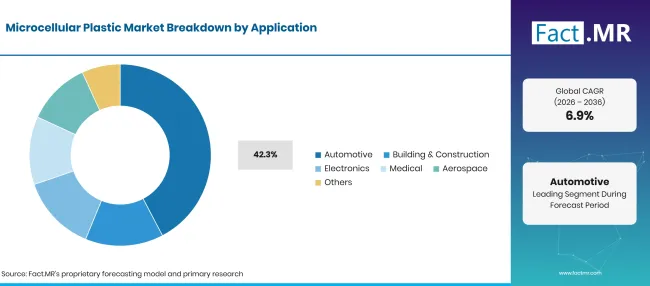
Factmr Microcellular Plastic Market Breakdown Application 1 | Source: Fact.MR
| Application | Share (2026) |
|---|---|
| Automotive (Leading segment) | 42.3% |
| Other segments combined | 57.7%* |
| Total | 100.0% |
Source: Fact.MR analysis. Updated Oct 14, 2026
Automotive applications provide a clear reason to use lighter materials in vehicle parts. Components such as instrument panels and seat parts must meet quality, durability, and appearance requirements before production begins. Construction applications focus on insulation performance and energy efficiency. In electronics, material selection often depends on product protection, shape, and design requirements.
How does Manufacturing Process affect selection?
Injection Molding is expected to lead with 45.2% share in 2026.
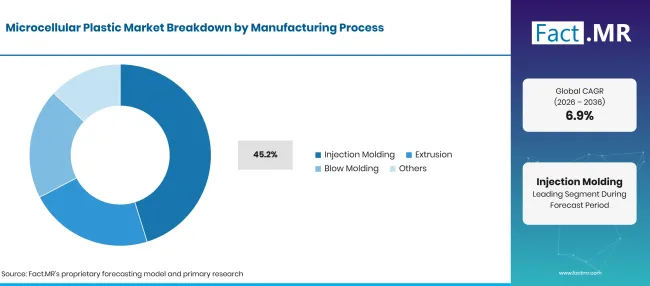
Factmr Microcellular Plastic Market Breakdown Manufacturing Process 1 | Source: Fact.MR
| Manufacturing Process | Share (2026) |
|---|---|
| Injection Molding (Leading segment) | 45.2% |
| Other segments combined | 54.8%* |
| Total | 100.0% |
Source: Fact.MR analysis. Updated Oct 14, 2026
Injection molding is suited to parts that require repeatable shapes, with a closed mold helping manufacturers control the final geometry. Process teams control melt conditions and gas introduction to manage the size and distribution of cells. Extrusion suits continuous sheets or profiles that later move into other production steps.
Why does High Density lead Density?
High Density is forecast to represent 59.2% share in 2026.
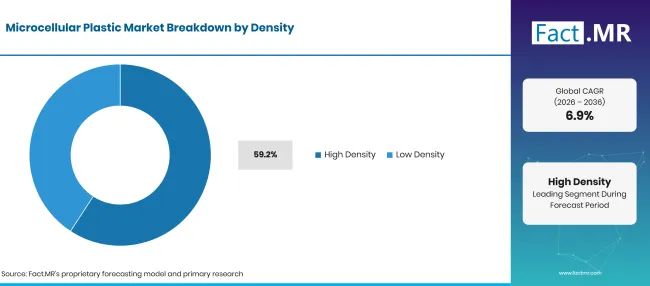
Factmr Microcellular Plastic Market Breakdown Density | Source: Fact.MR
| Density | Share (2026) |
|---|---|
| High Density (Leading segment) | 59.2% |
| Other segments combined | 40.8%* |
| Total | 100.0% |
Source: Fact.MR analysis. Updated Oct 14, 2026
High-density cellular plastics are often chosen when parts need both strength and consistent shape. Lower-density materials can reduce weight further, but their stiffness and surface finish need careful evaluation. Automotive engineers look at overall part performance rather than focusing only on weight reduction.
What is accelerating Microcellular Plastic Market adoption, and what is holding it back?
Lower weight and better material use encourage adoption. However, product testing, approval requirements, and production costs can slow wider use.
Drivers Impact Analysis
| DRIVER | (~) % IMPACT ON CAGR | GEOGRAPHIC RELEVANCE | IMPACT TIMELINE |
|---|---|---|---|
| Automotive part lightweighting | +1.0% | North America, Western Europe | Medium term (2–4 years) |
| Fine-cell injection molding | +0.8% | North America, Western Europe | Medium term (2–4 years) |
| Polyurethane performance tuning | +0.7% | Global | Medium term (2–4 years) |
| More efficient resin use | +0.6% | Global | Medium term (2–4 years) |
| Protective cellular components | +0.4% | Global | Medium term (2–4 years) |
Source: Fact.MR analysis. Updated Oct 14, 2026
Opportunity Impact Analysis
| OPPORTUNITY | (~) % IMPACT ON CAGR | GEOGRAPHIC RELEVANCE | IMPACT TIMELINE |
|---|---|---|---|
| Automotive interior redesign | +0.8% | Global | Medium term (2–4 years) |
| Gas-assisted molding upgrades | +0.7% | North America, East Asia | Medium term (2–4 years) |
| Component-level testing services | +0.5% | Western Europe, Japan | Medium term (2–4 years) |
| Polymer and equipment partnerships | +0.4% | Global | Medium term (2–4 years) |
Source: Fact.MR analysis. Updated Oct 14, 2026
Restraints Impact Analysis
| RESTRAINT | (~) % IMPACT ON CAGR | GEOGRAPHIC RELEVANCE | IMPACT TIMELINE |
|---|---|---|---|
| Part qualification costs | -0.8% | Global | Short to medium term |
| Surface-finish variation | -0.6% | Automotive manufacturing hubs | Short to medium term |
| Raw-material price exposure | -0.5% | Global | Short to medium term |
| Limited process expertise | -0.4% | Emerging manufacturing regions | Short to medium term |
Source: Fact.MR analysis. Updated Oct 14, 2026
Which countries are scaling the Microcellular Plastic Market through 2036?
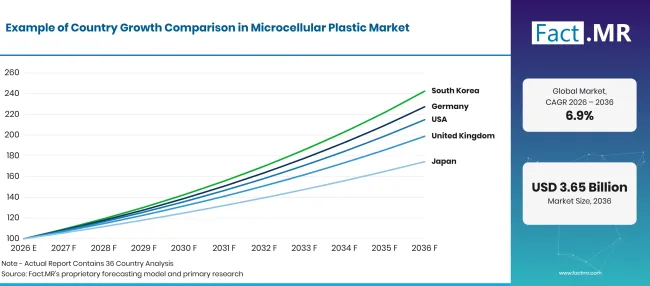
Factmr Microcellular Plastic Market Growth Index | Source: Fact.MR
| Country | CAGR (2026-2036) |
|---|---|
| Germany | 8.6% |
| United States | 8.0% |
| United Kingdom | 7.1% |
| Japan | 5.7% |
| Brazil | 4.8% |
Source: Fact.MR analysis. Updated Oct 14, 2026
Why is Germany leading microcellular plastic adoption?
8.6% CAGR, supported by automotive engineering and strict component qualification.
Germany has a strong automotive industry, which creates steady demand for lighter vehicle components. The German Association of the Automotive Industry reported 4.15 million passenger cars produced in 2025 [6]. This gives suppliers opportunities to develop lighter seats, and interior parts.
How is the United States expanding microcellular plastic use?
8.0% CAGR, driven by automotive molding and a broad construction customer base.
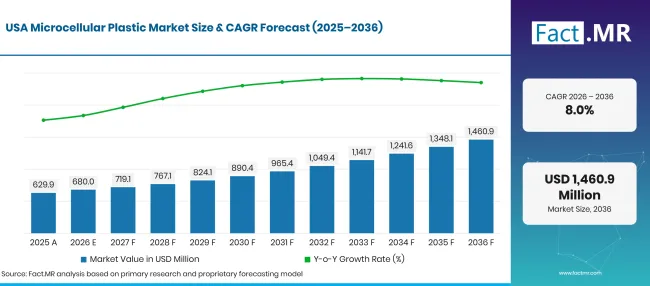
Factmr Microcellular Plastic Market Forecast Usa | Source: Fact.MR
The United States has strong demand from both the automotive and construction sectors. The U.S. Census Bureau reported USD 2,157.6 billion in annualized construction spending in July 2026 [4]. This gives cellular plastic suppliers opportunities across a wider range of applications. Companies can reduce material use through controlled molding processes.
What supports the United Kingdom’s microcellular plastic market?
7.1% CAGR, backed by specialist manufacturing and technical foam expertise.
The United Kingdom has a specialized manufacturing sector where many suppliers focus on improving individual components rather than producing very high volumes. The Department for Transport reported 2,617,000 vehicles registered for the first time in 2025 [5]. Cellular materials are used in vehicle and industrial parts that need cushioning and impact protection.
Why is Japan focused on controlled microcellular production?
5.7% CAGR, shaped by tight process control and demanding component standards.
Japan places strong importance on product quality and careful testing before materials are used in production. Suppliers can adjust material properties to suit different designs, but any material change needs thorough testing and documentation.
How is Brazil developing microcellular plastic adoption?
4.8% CAGR, linked to automotive production cycles and material-cost savings.
Brazil's market is strongly influenced by factory activity and the cost of reducing material use. Passenger car production reached 2,502,891 units in 2025 [7]. This creates demand for cellular plastics used in interior trim and vehicle components. Suppliers often focus on designs that use less material while maintaining consistent product quality.
Who leads the Microcellular Plastic Market?
Competition in this market includes resin suppliers, polyurethane companies, and foam material producers. BASF supplies polyurethane and thermoplastic polyurethane materials. The company also demonstrated foam technology for automotive interior components through a seating project developed with Hyundai Transys [1].
Covestro develops polyurethane foam materials for automotive applications. In July 2025, the company introduced a foam solution for battery cell encapsulation [2].
Zotefoams reported North American revenue of GBP 12.1 million in May 2026, supported in part by expanded production capacity [3]. The company noted growth across its broader foam business. The reported figure does not represent only microcellular plastics sales.
Which companies are the key providers?
Key companies include BASF SE; Dow Inc.; Huntsman Corporation; Evonik Industries AG; SABIC; Arkema Group; Covestro AG; Mitsubishi Chemical Corporation; Zotefoams Plc.
- BASF SE
- Dow Inc.
- Huntsman Corporation
- Evonik Industries AG
- SABIC
- Arkema Group
- Covestro AG
- Mitsubishi Chemical Corporation
- Zotefoams Plc
Bibliography
- [1] BASF SE. (2025, November 5). Hyundai Transys and BASF unveil modular concept seat using Elastollan® TPU with SCF injection foaming technology.
- [2] Covestro AG. (2025, July 16). Covestro launches advanced flame-retardant encapsulation foam for EV batteries.
- [3] Zotefoams plc. (2026, May 27). Strong Trading Period Reported Ahead of Annual General Meeting on the 27th May 2026.
- [4] U.S. Census Bureau. (2026, September 1). Construction Spending (Construction Put in Place): July 2026.
- [5] Department for Transport. (2026, April 29). Vehicle licensing statistics: 2025.
- [6] German Association of the Automotive Industry. (2026, January 5). Passenger car production in 2025 slightly above previous year's level.
- [7] German Association of the Automotive Industry. (2026, February 16). Automobile Production.
This Report Answers
- The report examines microcellular plastic sales by polymer type and finished use.
- Segmentation explains why polyurethane and automotive uses hold the stated 2026 shares.
- Country comparisons cover Germany, the United States, the United Kingdom, Japan and Brazil.
- Competitive analysis identifies firms supplying polymers, foam systems and technical cellular materials.
What does the Microcellular Plastic Market cover?
The Microcellular Plastic Market includes fine-cell plastic materials produced through controlled foaming where the resulting material or component is sold for industrial and commercial use.
What is included in the scope?
The scope includes injection molded cellular parts, extruded foam-based components and suitable blow-molded products.
What is excluded from the scope?
The scope excludes solid plastic products without a cellular structure and finished vehicles or buildings counted at their total selling price. It also excludes machines.
How Was the Analysis Built?
The analysis draws on 120+ sources, 35+ company portfolios, 25+ countries, and more than 20 industry interviews.
- Primary Research: Primary research includes discussions with manufacturers, service providers, technology developers, distributors, end users, and subject-matter experts. These conversations examine purchasing priorities, product adoption, operational challenges, approval requirements, competitive positioning, and the factors that influence wider market acceptance.
- Desk Research: Desk research covers government statistics, regulatory publications, company filings, trade data, technical studies, industry associations, standards, public policy, and other authoritative sources. Every source used in the analysis is documented in the bibliography.
- Market Sizing and Forecasting: Market estimates combine historical performance, demand indicators, pricing and volume trends, segment shares, company participation, country-level growth, adoption patterns, investment activity, and barriers to market expansion.
- Data Validation and Update Cycle: Findings are validated by comparing primary interviews with public data, company activity, regulatory changes, trade patterns, and industry developments. Regular updates review new product launches, capacity changes, partnerships, approvals, and shifts in commercial adoption.
Segmentation
What is the report’s scope and coverage?
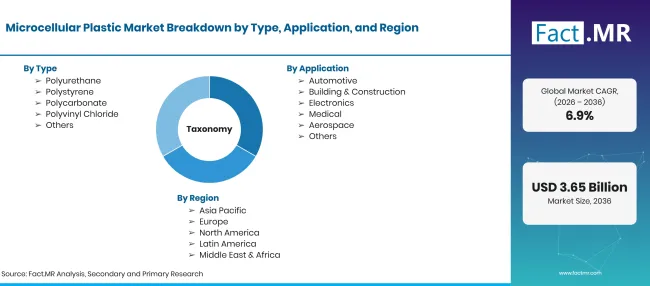
Factmr Microcellular Plastic Market Taxonomy | Source: Fact.MR
| Attribute | Details |
|---|---|
| Quantitative Units | USD billion in 2026 to USD billion by 2036 at CAGR |
| Market Definition | Fine-cell plastic materials and molded or formed components in the stated polymer families. |
| Type | Polyurethane; Polystyrene; Polycarbonate; Polyvinyl Chloride; Others |
| Application | Automotive; Building & Construction; Electronics; Medical; Aerospace; Others |
| Manufacturing Process | Injection Molding; Extrusion; Blow Molding; Others |
| Density | High Density; Low Density |
| Regions Covered | North America; Latin America; Western Europe; Eastern Europe; East Asia; South Asia & Pacific; Middle East & Africa |
| Countries Covered | Germany; Brazil; United States; United Kingdom; Japan |
| Companies Profiled | BASF SE; Dow Inc.; Huntsman Corporation; Evonik Industries AG; SABIC; Arkema Group; Covestro AG; Mitsubishi Chemical Corporation; Zotefoams Plc |
| Forecast Period | 2026 to 2036 |
| Approach | Component-level demand assessment using stated market forecasts, end-use analysis, process suitability and first-party technical evidence. |
| Validation | External factual claims checked against first-party official and company materials. |
Source: Fact.MR analysis. Updated Oct 14, 2026
How is the market segmented?
-
By Type
- Polyurethane
- Polystyrene
- Polycarbonate
- Polyvinyl Chloride
- Others
-
By Application
- Automotive
- Building & Construction
- Electronics
- Medical
- Aerospace
- Others
-
By Manufacturing Process
- Injection Molding
- Extrusion
- Blow Molding
- Others
-
By Density
- High Density
- Low Density
-
By Region
- North America
- Latin America
- Western Europe
- Eastern Europe
- East Asia
- South Asia & Pacific
- Middle East & Africa
Frequently Asked Questions
How big is the microcellular plastic market in 2026?
What CAGR does the market record from 2026 to 2036?
Which material type has the largest share?
Which application represents the largest share?
Which companies participate in related materials supply?
Who worked on this report


Preview the report firsthand - request a free sample
Free SampleGet the brochure for pricing and purchase details
Download PDF