- Market Value (2025): USD 765.9 Mn
- Estimated Value (2026): USD 880.0 Mn
- Forecast Value (2036): USD 3529.3 Mn
- CAGR (2026-2036): 14.9%
What is the Plastic-Free Dispersing Substrates market forecast to be worth by 2036?
USD 880.0 million in 2026 to USD 3529.3 million by 2036 at a 14.9% CAGR.
- The Plastic-Free Dispersing Substrates Market was valued at USD 765.9 million in 2025.
- Demand is projected to increase from USD 880.0 million in 2026 to USD 3529.3 million by 2036.
- The market is forecast to record 14.9% CAGR from 2026 to 2036 as converters and brand owners qualify dispersible substrates for unit-dose formats and food wraps.
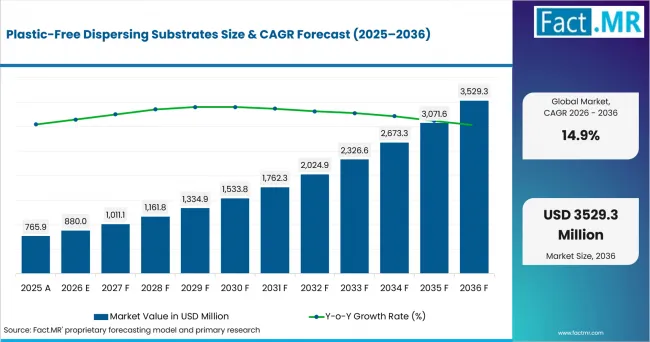
Plastic Free Dispersing Substrates Value Analysis | Source: Fact.MR
What are the defining numbers behind Plastic-Free Dispersing Substrates Market growth?
An absolute opportunity of USD 2649.3 million is expected between 2026 and 2036.
- Demand Drivers in the Market
- Detergent and home-care brands need plastic-free unit-dose substrates that keep filled packs stable before use and break down predictably after use.
- Foodservice operators need clear packaging windows and grease barriers that protect sandwiches, salads and wraps while reducing plastic layers in takeaway packs.
- Packaging converters need materials that run on existing coating, sealing and printing equipment so trials can proceed on current production lines.
- In June 2026, USDA ERS reported that inflation-adjusted U.S. food-away-from-home spending reached USD 1.41 trillion in 2025, highlighting the substantial scale of the U.S. foodservice market.
- Key Segments Analyzed
- By Substrate Base: Cellulose is expected to hold 33.0% share in 2026 because converters understand its film, paper and fiber behavior.
- By Dispersal Mode: Cold-water dispersible substrates are projected to account for 29.0% share in 2026, supported by unit-dose cleaning and refill formats.
- By Application: Unit-dose formats are anticipated to capture 28.0% share in 2026 as portion control creates a clear role for dispersible substrates.
- By Performance: Wet strength before use is estimated to represent 28.0% share in 2026 owing to leakage control and machine handling needs.
- Analyst Opinion at Fact.MR
- Shambhu Nath Jha, Principal Consultant at Fact.MR, states, “Plastic-free dispersing substrates are being judged by a practical question: does the pack survive filling, shipping and display before it breaks down in the intended route? Demand is expected to move toward suppliers that document dispersal behavior, seal life and barrier performance together. The most credible providers combine materials science with converter support and end-of-life proof.”
- Strategic Implications
- Material suppliers should document dispersal behavior by water temperature, residence time and substrate thickness so brands can compare formats clearly.
- Converters should test seal strength and print quality together because many applications require shelf appeal and filled-pack stability.
- Brand owners should match substrate choice to the disposal route stated on pack and avoid claims that outpace available testing evidence.
- PackUK set the Year 1 plastic packaging EPR base fee at GBP 423 per tonne for 2025 to 2026, creating a measurable cost consideration for packaging formats with higher plastic content.
The USA is projected to post 16.0% CAGR through 2036, driven by unit-dose cleaning formats and foodservice packaging scale. Japan is expected to record 15.4% CAGR as waste reduction and food packaging refinement shape material trials. The UK is forecast to advance at 14.5% CAGR, supported by EPR fee signals and food manufacturing depth. France is anticipated to reach 14.1% CAGR due to plastic-packaging recycling pressure. Germany is estimated to hold 13.7% CAGR as PPWR alignment and sorting discipline sharpen material requirements.
How does the Plastic-Free Dispersing Substrates Market break down by segment?
Cellulose leads Substrate Base at 33.0%; Cold-water dispersible leads Dispersal Mode at 29.0%.
Which Substrate Base dominates?
Cellulose is expected to hold 33.0% share in 2026.
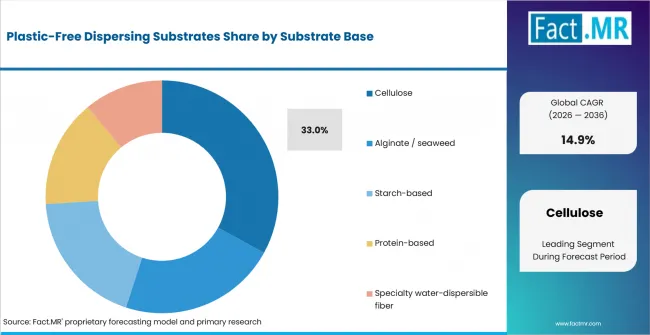
Plastic Free Dispersing Substrates Analysis By Substrate Base | Source: Fact.MR
Cellulose leads because it gives converters a familiar base for films, coated paper and specialty fibers. Its strength profile supports sachets, windows and wraps where the substrate must pass through filling equipment before reaching the disposal route.
What leads the Dispersal Mode segment?
Cold-water dispersible substrates are projected to account for 29.0% share in 2026.
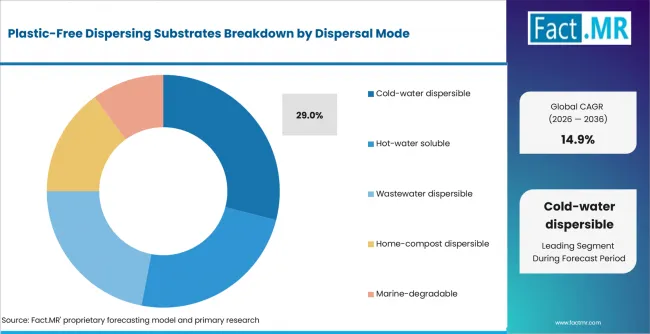
Plastic Free Dispersing Substrates Analysis By Dispersal Mode | Source: Fact.MR
Cold-water dispersible formats lead where the product is meant to dissolve or separate during normal use. Cleaning doses and small refill packs need controlled breakup at low temperatures while retaining enough strength for filling and transport. Suominen’s HYDRASPUN dispersible nonwovens show how plant-based substrates can combine in-use strength with dispersibility after disposal in water for personal-care and hygiene applications.
How does Application shape demand?
Unit-dose formats are anticipated to capture 28.0% share in 2026.
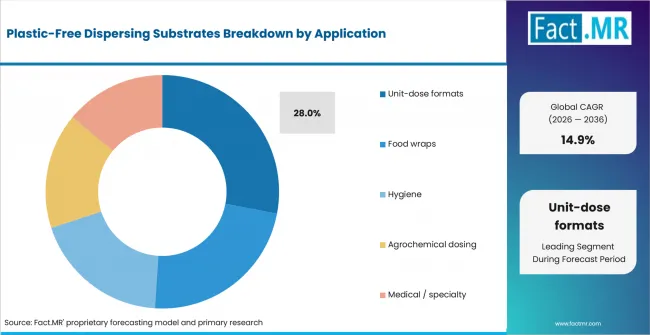
Plastic Free Dispersing Substrates Analysis By Application | Source: Fact.MR
Unit-dose formats lead because the substrate performs two jobs at once. It protects a measured product before use and then clears from the use route with fewer handling steps. Detergent, personal-care, agrochemical and specialty medical formats use similar commercial reasoning: dosage accuracy and package removal must be solved together.
What supports Performance demand?
Wet strength before use is estimated to represent 28.0% share in 2026.
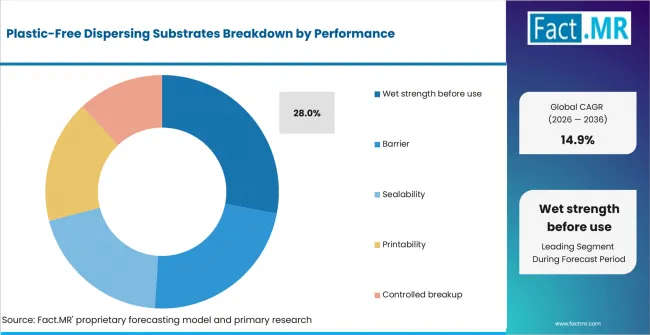
Plastic Free Dispersing Substrates Analysis By Performance | Source: Fact.MR
Wet strength before use leads because many dispersible substrates fail commercially before the disposal stage begins. Filled sachets, wraps and hygiene formats must resist moisture during conversion and storage.
What is accelerating Plastic-Free Dispersing Substrates Market adoption, and what is holding it back?
Demand is expected to rise through plastic-reduction policy, unit-dose formats and foodservice packaging redesign. Growth is constrained by performance testing, disposal-route proof and converter qualification time.
Drivers Impact Analysis
| DRIVER | (~) % IMPACT ON CAGR | GEOGRAPHIC RELEVANCE | IMPACT TIMELINE |
|---|---|---|---|
| Packaging recyclability rules in Europe | +1.7% | Western Europe | Short term (<= 2 years) |
| Unit-dose cleaning and refill formats | +1.4% | North America, East Asia | Medium term (2-4 years) |
| Food-to-go plastic-window replacement | +1.1% | UK, France, Germany | Short term (<= 2 years) |
| Specialty fiber conversion in hygiene formats | +0.8% | Global | Long term (>= 4 years) |
Source: Fact.MR analysis. Updated Sep 16, 2026
Opportunity Impact Analysis
| OPPORTUNITY | (~) % IMPACT ON CAGR | GEOGRAPHIC RELEVANCE | IMPACT TIMELINE |
|---|---|---|---|
| Plastic-free clear windows for food packs | +1.3% | Western Europe, North America | Medium term (2-4 years) |
| Water-dispersible sachets for refills | +1.0% | North America, East Asia | Medium term (2-4 years) |
| Specialty fibers for hygiene substrates | +0.7% | Global | Long term (>= 4 years) |
Source: Fact.MR analysis. Updated Sep 16, 2026
Restraints Impact Analysis
| RESTRAINT | (~) % IMPACT ON CAGR | GEOGRAPHIC RELEVANCE | IMPACT TIMELINE |
|---|---|---|---|
| End-of-life proof requirements | -0.8% | Europe, North America | Short term (<= 2 years) |
| Wet-strength and seal leakage trade-off | -0.6% | Global | Medium term (2-4 years) |
| Cost premium and converter qualification | -0.4% | North America, Europe | Medium term (2-4 years) |
Source: Fact.MR analysis. Updated Sep 16, 2026
Which countries are scaling the Plastic-Free Dispersing Substrates Market through 2036?
- The country comparison spans 2.3 percentage points and forms two practical growth bands across the forecast period.
- The USA remains 0.6 percentage point above Japan through foodservice scale and unit-dose cleaning demand.
- Japan remains 0.9 percentage point above the UK as waste-reduction policy and material refinement support adoption.
- The UK remains 0.4 percentage point above France as EPR fees and food manufacturing depth sharpen packaging choices.
- France remains 0.4 percentage point above Germany as plastic-packaging recycling gaps create material-replacement pressure.
- Germany closes the displayed range through PPWR alignment, sorting discipline and converter demand for documented performance.
Comparable CAGRs create different entry conditions because packaging regulation, end-of-life infrastructure and converter readiness vary by country. Full report coverage includes North America, Latin America, Western Europe, Eastern Europe, East Asia, South Asia & Pacific, Middle East & Africa.
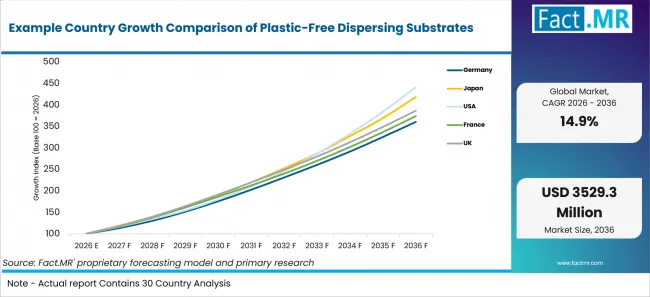
Example Country Growth Comparison Of Plastic Free Dispersing Substrates | Source: Fact.MR
| Country | CAGR (2026-2036) |
|---|---|
| United States | 16.0% |
| Japan | 15.4% |
| United Kingdom | 14.5% |
| France | 14.1% |
| Germany | 13.7% |
Source: Fact.MR analysis. Updated Sep 16, 2026
What supports USA adoption?
16.0% CAGR, supported by foodservice scale and recycling infrastructure programs.
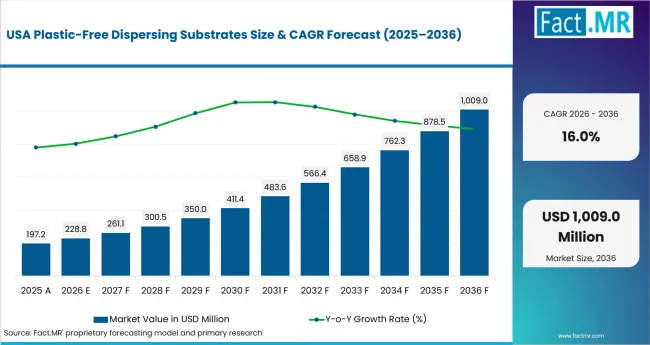
Plastic Free Dispersing Substrates Country Value Analysis | Source: Fact.MR
U.S. brands have a direct entry route through foodservice packaging and pre-measured cleaning products. EPA updated its Solid Waste Infrastructure for Recycling program in December 2025. The program is supported by USD 275 million in Infrastructure Investment and Jobs Act funding allocated from FY2022 through FY2026 to improve recycling and post-consumer materials-management infrastructure. That spending environment supports trials for substrates that reduce plastic layers while keeping packs practical for filling, transport and use.
How is Japan scaling demand?
15.4% CAGR, driven by packaging-waste attention and local material know-how.
Japan’s adoption path is shaped by compact retail formats, waste reduction and careful packaging quality expectations. The Ministry of the Environment reported in 2026 that FY2024 municipal solid waste generation reached 38,110,000 t. That waste-management context is expected to support dispersible substrate trials where brands need clean appearance, moisture control and reliable handling before use.
What supports the United Kingdom’s growth?
14.5% CAGR, backed by EPR fee signals and food manufacturing depth.
The UK combines fee pressure with a large food manufacturing base that uses wraps, windows, sachets and foodservice packs. ONS reported in July 2026 that food represented 22.9% of UK manufacturers’ product sales in 2025. That production mix is expected to support cellulose, coated paper and seaweed-based formats where brands can link performance to packaging EPR planning.
How is France developing demand?
14.1% CAGR, supported by plastic-reduction policy and agri-food packaging needs.
France is developing demand through plastic-packaging targets and agri-food modernization. The ecological transition ministry reported in June 2026 that 26% of plastic packaging was recycled in France. That gap gives converters a clear reason to test cellulose, seaweed and starch-based substrates in food wraps and small service packs.
What is supporting Germany’s adoption?
13.7% CAGR, supported by PPWR alignment and packaging-sorting discipline.
Germany’s market is shaped by disciplined sorting systems and strict expectations for material identification. UBA and ZSVR reported in January 2026 that around 5.5 million tonnes of packaging waste collected by Germany’s dual systems were recovered in 2024. That operating base favors dispersible substrates with clear documentation for fiber recovery, composting routes or controlled water breakup.
Who leads the Plastic-Free Dispersing Substrates Market?
Notpla adds a seaweed-based route for foodservice packs and clear windows, giving the market a visible food-to-go use case.
ANDRITZ and Suominen add depth in fiber-based substrates and dispersible nonwovens, while Mondi adds adjacent water-soluble polymer expertise. Competition therefore centers on proof of substrate performance before use and a credible route after use, along with converter support during qualification.
Which companies are the key providers?
Key companies include SmartSolve Industries, Notpla, ANDRITZ and Suominen. Adjacent material-technology players include SmartSolve Industries and Mondi.
- SmartSolve Industries
- Notpla
- ANDRITZ
- Suominen
- SmartSolve Industries
- Mondi
Bibliography
- Department for Environment, Food & Rural Affairs. (2025, June 30). Extended Producer Responsibility for Packaging: 2025 base fees.
- Directorate-General for Communication. (2026, August 12). New packaging rules for less waste and easier recycling. European Commission.
- German Environment Agency, & Central Agency Packaging Register. (2026, January 27). Facts against myths: Packaging waste recycling in Germany is working.
- Ministères Transition écologique, Aménagement du Territoire, Transports, Ville et Logement. (2026, June 18). Plan plastique : 12 leviers pour réduire, réemployer et recycler les emballages plastiques.
- Ministry of the Environment, Government of Japan. (2026, March 27). Municipal solid waste generation and disposal in FY2024.
- Notpla. (2026, May 8). The future of food-to-go packaging? A plastic-free window box built for real foodservice.
- Office for National Statistics. (2026, July 24). UK manufacturers' sales by product: 2025.
- Suominen. (2025). Suominen’s HYDRASPUN® nonwovens product family – Sustainable frontrunner in moist toilet tissues.
- U.S. Environmental Protection Agency. (2026, June 16). Solid Waste Infrastructure for Recycling Grants for Political Subdivisions.
- Zeballos, E., & Sinclair, W. (2026, June 1). Total food spending reached $2.51 trillion in 2025. U.S. Department of Agriculture, Economic Research Service.
This Report Answers
- The report explains where plastic-free dispersing substrates are used across substrate base and dispersal mode. It also covers application and performance.
- Segment analysis identifies the leading subsegments and the operating reasons converters prioritize them.
- Country analysis examines the listed markets and the policy or waste-system mechanisms supporting material qualification.
- Competitive analysis reviews current providers across cellulose films, seaweed coatings, coated paper and specialty dispersible fibers.
- Application analysis assesses how wet strength, sealability and controlled breakup influence supplier selection.
What does the Plastic-Free Dispersing Substrates Market cover?
The Plastic-Free Dispersing Substrates Market covers cellulose, alginate, seaweed, starch, protein and specialty fiber substrates used in packs designed to disperse or break apart under defined conditions. It includes substrates used before coating, lamination or converting when the substrate itself carries the plastic-reduction claim.
The assessment is adjacent to water-soluble packaging where dosing and clean use are central to the format. It also overlaps with dispersible bio films where thin substrates support controlled breakup. Food-to-go uses connect with flushable bio packaging films only when packaging behavior and disposal claims are properly separated. Material families are compared with biodegradable packaging materials where end-of-life positioning affects buyer approval. Fiber formats are also read against paper packaging materials where converters need practical alternatives to plastic layers.
What is included in the scope?
The scope includes substrate sales used in unit-dose packaging, food wraps, hygiene formats, agrochemical dosing and medical or specialty applications. Covered products must be designed around plastic-free substrate bases and must provide a defined performance pathway before and after use.
The scope includes paper barrier coatings when the coating works with a dispersible or plastic-free substrate. It covers PHA paper coatings only when the coating supports a compatible plastic-reduction format. It includes plastic-free snack packaging where dispersible films or windows form part of the pack. This scope also covers home-compostable food serviceware where substrate format and end-of-life behavior match this market boundary. Adjacent comparison extends to bioplastics for packaging when they compete with dispersing substrates.
What is excluded from the scope?
The scope excludes conventional plastic films, standard paper packaging, rigid plastic containers and compostable products that rely on plastic-bearing structures. It also excludes raw pulp, resin and additive sales when they are sold separately from a dispersible substrate format.
General recyclable packaging is outside the scope when dispersal, dissolution, composting or controlled breakup is absent from the product design. The assessment also excludes food products, detergents, agrochemical formulations and medical contents placed inside the packaging.
How Was the Analysis Built?
The analysis draws on 120+ sources, 35+ company portfolios, 25+ countries, and more than 20 industry interviews.
- Primary Research: Primary research includes discussions with material suppliers, converters, packaging engineers, brand owners, distributors and subject-matter experts. These conversations examine supplier selection, product adoption, testing requirements, performance limits and the factors that influence wider market acceptance.
- Desk Research: Desk research covers government statistics, regulatory publications, company filings, technical studies, industry associations, standards, public policy and other authoritative sources. Every source used in the analysis is documented in the bibliography.
- Market Sizing and Forecasting: Market estimates combine historical performance, application demand, pricing and volume trends, segment shares, country-level growth, adoption patterns, investment activity and barriers to market expansion.
- Data Validation and Update Cycle: Findings are validated by comparing primary interviews with public data, company activity, regulatory changes, trade patterns and industry developments. Regular updates review product launches, partnerships, approvals and shifts in commercial adoption.
Segmentation
What is the report’s scope and coverage?
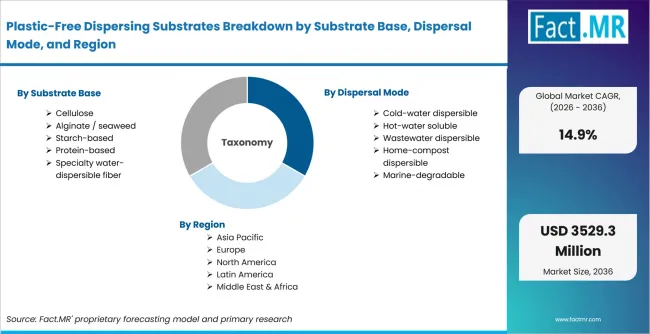
Plastic Free Dispersing Substrates Breakdown By Substrate Base, Dispersal Mode, And Region | Source: Fact.MR
| Attribute | Details |
|---|---|
| Quantitative Units | USD million |
| Market Definition | Plastic-free substrates designed to disperse, dissolve, compost or break apart under defined post-use conditions while delivering required strength, barrier and seal behavior before use. |
| Substrate Base | Cellulose; Alginate and seaweed; Starch-based; Protein-based; Specialty water-dispersible fiber |
| Dispersal Mode | Cold-water dispersible; Hot-water soluble; Wastewater dispersible; Home-compost dispersible; Marine-degradable |
| Application | Unit-dose formats; Food wraps; Hygiene; Agrochemical dosing; Medical and specialty |
| Performance | Wet strength before use; Barrier; Sealability; Printability; Controlled breakup |
| Regions Covered | North America; Latin America; Western Europe; Eastern Europe; East Asia; South Asia & Pacific; Middle East & Africa |
| Countries Covered | United States; Japan; United Kingdom; France; Germany |
| Key Companies / Adjacent Players Profiled | SmartSolve Industries; Notpla; ANDRITZ; Suominen; SmartSolve Industries; Mondi |
| Forecast Period | 2026 to 2036 |
| Approach | Hybrid top-down and bottom-up approach using substrate demand, application mix, converter qualification, country adoption and provider portfolio review. |
Source: Fact.MR analysis. Updated Sep 16, 2026
How is the market segmented?
-
By Substrate Base:
- Cellulose
- Alginate and seaweed
- Starch-based
- Protein-based
- Specialty water-dispersible fiber
-
By Dispersal Mode:
- Cold-water dispersible
- Hot-water soluble
- Wastewater dispersible
- Home-compost dispersible
- Marine-degradable
-
By Application:
- Unit-dose formats
- Food wraps
- Hygiene
- Agrochemical dosing
- Medical and specialty
-
By Performance:
- Wet strength before use
- Barrier
- Sealability
- Printability
- Controlled breakup
-
By Region:
- North America
- Latin America
- Western Europe
- Eastern Europe
- East Asia
- South Asia & Pacific
- Middle East & Africa
Frequently Asked Questions
How big is the plastic-free dispersing substrates market in 2026?
What is the CAGR of the plastic-free dispersing substrates market from 2026 to 2036?
Which substrate base leads the plastic-free dispersing substrates market?
Which dispersal mode leads the plastic-free dispersing substrates market?
Who are the leading companies in the plastic-free dispersing substrates market?
Who worked on this report


Preview the report firsthand - request a free sample
Free SampleGet the brochure for pricing and purchase details
Download PDF