- Market Value (2025): USD 2.6 Bn
- Estimated Value (2026): USD 2.9 Bn
- Forecast Value (2036): USD 10.3 Bn
- CAGR (2026-2036): 13.3%
What is the Plastic-Free Paper Coatings Market forecast to be worth by 2036?
USD 2.9 billion in 2026 to USD 10.3 billion by 2036 at a 13.3% CAGR.
- The Plastic-Free Paper Coatings Market reached USD 2.6 billion in 2025.
- Demand is projected to increase from USD 2.9 billion in 2026 to USD 10.3 billion by 2036.
- The market is forecast to record 13.3% CAGR from 2026 to 2036 as foodservice packaging and fiber-based packs require functional barriers without conventional plastic film lamination.
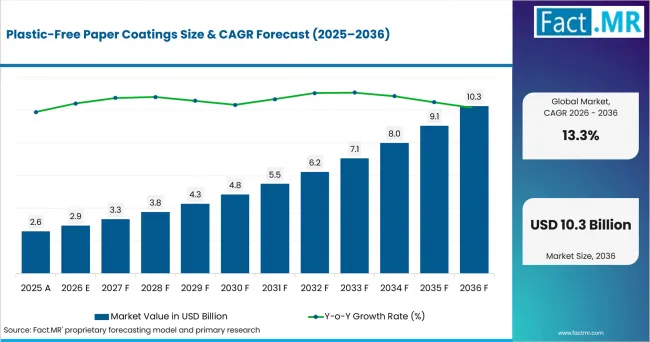
Plastic Free Paper Coatings Value Analysis | Source: Fact.MR
What are the defining numbers behind Plastic-Free Paper Coatings Market growth?
An absolute opportunity of USD 7.1 billion is expected between 2026 and 2036.
- Demand Drivers in the Market
- Foodservice converters need paper barrier coatings that control grease and moisture so cups, wraps, trays, and takeaway packs can retain a fiber-based structure during use.
- Flexible food-pack producers require reliable seals and product protection. Barrier paper formats are expected to support this shift where coating performance can replace a conventional polyethylene layer.
- Paperboard converters are expected to align coating choices with sustainable packaging rules that emphasize recyclability and material efficiency. Food-contact restrictions are expected to raise the value of documented barrier chemistry.
- Brand owners are expected to favor paper coating materials that run on familiar coating equipment. This approach is expected to reduce conversion friction when a package shifts from film lamination to a functional coating.
- Recyclers and mills are expected to favor coated when fiber recovery remains practical after use. As a result, suppliers must consider repulpability as well as barrier performance.paper packaging materials
- Key Segments Analyzed
- By Coating Chemistry: Aqueous biopolymer dispersion is expected to hold 36.0% share in 2026 because water-based application fits common paper-coating processes and supports thin functional layers.
- By Performance: Heat seal is projected to account for 31.0% share in 2026 as coated paper must close packs reliably on converting and filling lines.
- By Substrate: Paper is anticipated to represent 29.0% share in 2026 owing to its use across wraps, liners, sachet structures, and foodservice formats.
- By Application: Foodservice is estimated to capture 33.0% share in 2026 since cups, trays, wraps, and takeaway formats need oil, grease, and liquid resistance.
- Analyst Opinion at Fact.MR
- Shambhu Nath Jha, Principal Consultant at Fact.MR, states, “The commercial test is whether a coating replaces the barrier and sealing functions of a plastic layer. Demand is expected to favor systems that run on familiar equipment and have clear end-of-life guidance. Suppliers that combine application support with credible recovery data are expected to have a stronger route into high-volume paper packaging programs.”
- Strategic Implications
- Coating formulators should document bio-based barrier coatings on the actual paper or paperboard grade. Fiber porosity is expected to change coating holdout and sealing behavior.
- Converters should qualify waterproof coatings for paper and paperboard packaging at commercial line speeds before changing a high-volume specification. The test should cover barrier continuity after printing and sealing.
- Packaging brands should define the intended end-of-life route early so recyclability or compostability claims match the finished pack rather than the coating alone.
- Paper producers should coordinate surface treatment and coating chemistry because fiber quality influences coating holdout, barrier continuity, and repulping behavior.
China is forecast to record 14.7% CAGR through 2036 as parcel and foodservice activity expand. The USA is projected at 14.2%, Germany at 14.0%, France at 13.5%, and Japan at 12.3%, each shaped by local packaging use and recycling rules.
How does the Plastic-Free Paper Coatings Market break down by segment?
Aqueous biopolymer dispersion is projected to lead Coating Chemistry at 36.0% share in 2026; while Foodservice leads Application at 33.0% share.
Which Coating Chemistry dominates?
Aqueous biopolymer dispersion is expected to hold 36.0% share in 2026.
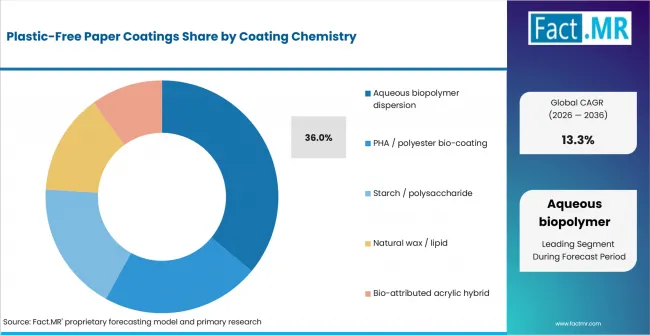
Plastic Free Paper Coatings Analysis By Coating Chemistry | Source: Fact.MR
Aqueous biopolymer dispersions are expected to lead because they form thin functional layers through familiar paper-coating processes. Biobased PHA coatings serve applications that place greater weight on moisture control or compostability. Starch and wax systems address narrower barrier requirements.
Solenis stated in August 2025 that its PHA coatings support flexographic and extrusion processes. Its TopScreen family uses water- and bio-wax formulations for oil, water, and grease protection.
What leads the Performance segment?
Heat seal is projected to account for 31.0% share in 2026.
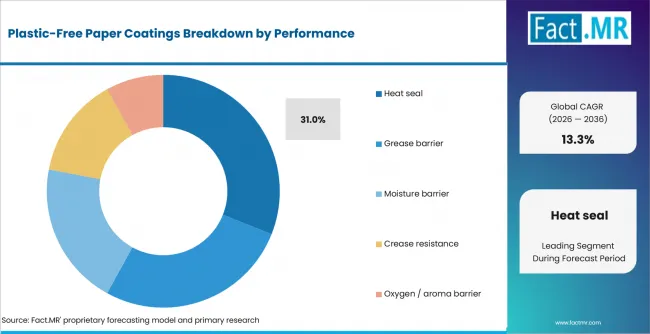
Plastic Free Paper Coatings Analysis By Performance | Source: Fact.MR
Heat seal leads because many coated paper packs must close reliably on existing converting lines. Grease barrier serves wraps and trays, moisture barrier supports cups, and oxygen / aroma barrier protects more sensitive contents.
How does Substrate shape demand?
Paper is anticipated to represent 29.0% share in 2026.
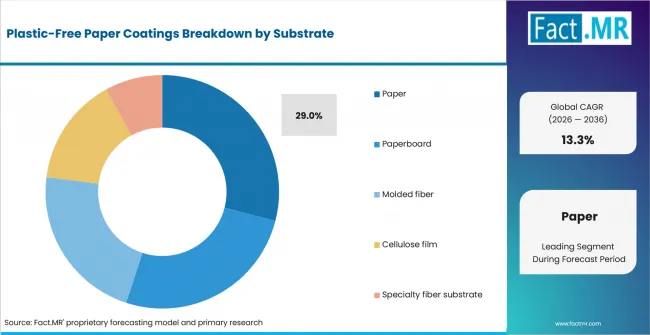
Plastic Free Paper Coatings Analysis By Substrate | Source: Fact.MR
Paper is expected to lead because flexible and foodservice formats can accept functional coatings while retaining a light fiber structure. Fresh food packaging creates a further route for coated paper where moisture and grease control influence pack performance. Paperboard and molded fiber follow for rigid formats.
UPM states that its packaging papers are certified recyclable and that Joncryl HPB has been shown not to negatively affect paper recyclability, while third-party testing of the complete structure remains ongoing.
What supports Foodservice within Application?
Foodservice is estimated to capture 33.0% share in 2026.
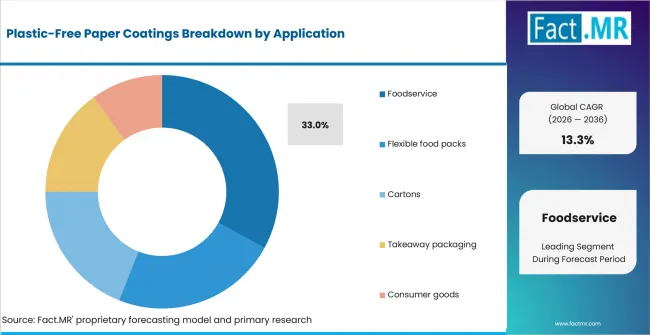
Plastic Free Paper Coatings Analysis By Application | Source: Fact.MR
Foodservice leads because cups, trays, wraps, and takeaway containers face liquids, oils, and grease during use. Flexible packs emphasize sealing and shelf protection, while cartons and consumer-goods packs place more weight on crease and print performance.
The U.S. Census Bureau reported in September 2026 that the value of shipments from U.S. food manufacturing reached approximately USD 1,054.3 billion in 2024. This large manufacturing base creates application opportunities for food-packaging formats requiring sealing and barrier performance.
What is accelerating Plastic-Free Paper Coatings Market adoption, and what is holding it back?
Fiber packaging and food-contact barrier needs support demand. Product qualification and end-of-life checks can slow adoption.
Drivers Impact Analysis
| DRIVER | (~) % IMPACT ON CAGR | GEOGRAPHIC RELEVANCE | IMPACT TIMELINE |
|---|---|---|---|
| Foodservice conversion to coated fiber | +1.9% | North America, Europe, East Asia | Short term (<= 2 years) |
| Recyclability-focused packaging rules | +1.4% | Europe | Medium term (2-4 years) |
| Heat-seal and grease-barrier requirements | +1.1% | Global | Short term (<= 2 years) |
| Paperization on existing converting lines | +0.8% | Global | Medium term (2-4 years) |
Source: Fact.MR analysis. Updated Sep 22, 2026
Opportunity Impact Analysis
| OPPORTUNITY | (~) % IMPACT ON CAGR | GEOGRAPHIC RELEVANCE | IMPACT TIMELINE |
|---|---|---|---|
| PFAS-free grease barriers | +1.2% | USA, Europe | Short term (<= 2 years) |
| Compostable coated food packaging | +0.9% | Europe, North America | Medium term (2-4 years) |
| Molded-fiber barrier systems | +0.7% | Global | Medium term (2-4 years) |
Source: Fact.MR analysis. Updated Sep 22, 2026
Restraints Impact Analysis
| RESTRAINT | (~) % IMPACT ON CAGR | GEOGRAPHIC RELEVANCE | IMPACT TIMELINE |
|---|---|---|---|
| Barrier trade-offs across paper grades | -0.7% | Global | Short term (<= 2 years) |
| Food-contact and end-of-life qualification | -0.5% | North America, Europe, East Asia | Medium term (2-4 years) |
| Industrial availability of fully plastic-free cup structures | -0.4% | France | Medium term (2-4 years) |
Source: Fact.MR analysis. Updated Sep 22, 2026
Which countries are scaling the Plastic-Free Paper Coatings Market through 2036?
- The country comparison spans 2.4 percentage points across the five profiled markets.
- China remains 0.5 percentage point above the USA; the National Bureau of Statistics reported catering-industry income of 5,798.2 billion yuan in 2025, indicating a large service-channel base relevant to takeaway and prepared-food packaging.
- The USA remains 0.2 percentage point above Germany as foodservice scale and food-contact changes support grease-resistant coated paper.
- Germany remains 0.5 percentage point above France as packaging collection volumes and EU packaging rules keep recyclability central to material selection.
- France remains 1.2 percentage points above Japan; INSEE reported that household spending on restaurants and accommodation, measured in volume, was more than 20% above its 2019 level in 2025.
- Japan closes the displayed range. Municipal paper-packaging collection plans provide an established recovery system for product qualification.
Comparable CAGRs create different entry conditions because foodservice volume, recycling systems, regulation, and converting economics vary by country. The report covers all major global regions.
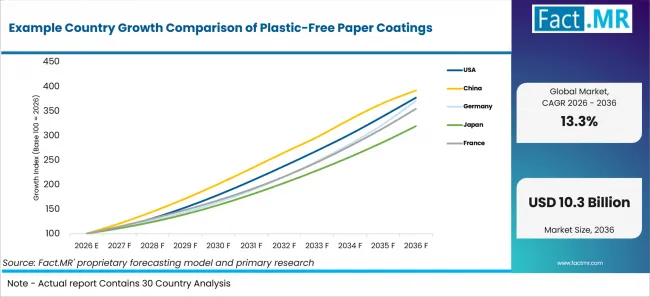
Example Country Growth Comparison Of Plastic Free Paper Coatings | Source: Fact.MR
| Country | CAGR (2026-2036) |
|---|---|
| China | 14.7% |
| United States | 14.2% |
| Germany | 14.0% |
| France | 13.5% |
| Japan | 12.3% |
Source: Fact.MR analysis. Updated Sep 22, 2026
What supports USA adoption?
14.2% CAGR, supported by large foodservice spending and paper food-packaging conversion.
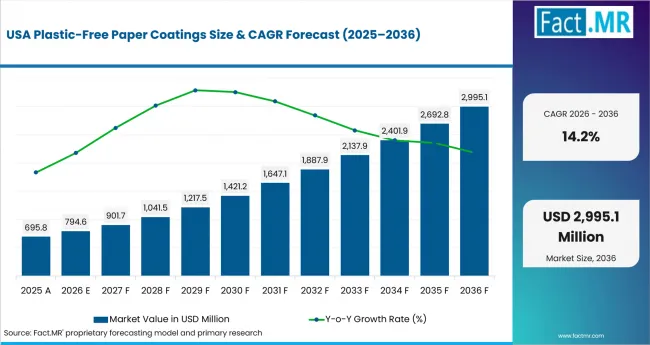
Plastic Free Paper Coatings Country Value Analysis | Source: Fact.MR
U.S. foodservice operators are expected to require grease and moisture control across cups and takeaway paper. The USDA Economic Research Service reported in June 2026 that inflation-adjusted food-away-from-home spending reached USD 1.41 trillion in 2025, expressed in 2025 dollars. That spending base is expected to support barrier-coated fiber formats that can run through high-volume service channels.
How is China scaling demand?
14.7% CAGR, driven by catering activity and high-volume conversion of paper-based service packaging.
China’s converters are expected to see wider use of coated paper across takeaway and prepared-food formats. The National Bureau of Statistics of China reported in January 2026 that catering income reached 5,798.2 billion yuan in 2025. That commercial base is expected to support grease-resistant paper and board structures where coating performance determines pack reliability.
What is supporting Germany’s adoption?
14.0% CAGR, supported by established packaging recovery systems and recyclable fiber design.
Germany’s packaging converters are expected to place greater weight on repulpability when qualifying functional coatings. The German Environment Agency and Central Agency Packaging Register reported in January 2026 that around 5.5 million tonnes of packaging waste collected by Germany’s dual systems were recovered in 2024. The recovery base is expected to favor barrier systems designed around fiber recycling.
How is France developing demand?
13.5% CAGR, backed by foodservice activity and conversion toward functional fiber packaging.
France’s foodservice packaging demand is expected to support coated paper formats that handle grease and moisture during service. INSEE reported in June 2026 that household spending on restaurants and accommodation, measured in volume, was more than 20% above its 2019 level in 2025. The service-channel expansion is expected to support paper cups and takeaway formats that require dependable barrier performance.
How does Japan perform?
12.3% CAGR, led by paper-packaging collection planning and precise performance requirements.
Japan’s paper packaging converters are expected to favor thin coatings that preserve print quality and reliable seals. Japan’s Ministry of the Environment reported in March 2026 that the expected separate-collection volume of paper containers and packaging for FY2026 was 97 thousand tonnes. The collection base is expected to support coating systems aligned with established fiber-recovery routes.
Who leads the Plastic-Free Paper Coatings Market?
Solenis offers water-based and PHA-based barrier coatings for paper packaging. Michelman provides Nuvita® coatings, and Archroma maintain portfolios of barrier solutions for paper and fiber-based packaging.
Buyers compare suppliers by barrier performance and processing compatibility. Performance in the intended application is also important. Michelman introduced Nuvita® Life 4002 and Nuvita® Life 4605 in April 2026 for fiber-based retail food packaging. Adjacent mineral oil barrier coating technologies also illustrate the growing role of migration-control performance in paper-packaging material selection.
Which companies are the key providers?
Profiled companies include Solenis; Siegwerk; Michelman; Archroma.
- Solenis
- SIEGWERK
- Michelman
- Archroma
Bibliography
- Solenis. (2025, August 13). Solenis to showcase sustainable paper and packaging solutions at FACHPACK 2025 and PACK EXPO Las Vegas 2025.
- Michelman. (2026, April 30). Michelman introduces Nuvita® Life 4002 & Nuvita® Life 4605: Bio-based barrier coatings for paper packaging applications.
- Zeballos, E., & Sinclair, W. (2026, June 11). Total U.S. food spending reached $2.51 trillion in 2025. U.S. Department of Agriculture, Economic Research Service.
- U.S. Census Bureau. (2026, September 3). Census Bureau releases new Annual Integrated Economic Survey data.
- U.S. Food and Drug Administration. (2025, January 3). FDA determines authorization for 35 food contact notifications related to PFAS are no longer effective.
- National Bureau of Statistics of China. (2026, January 20). Total retail sales of consumer goods in December 2025.
- German Environment Agency, & Central Agency Packaging Register. (2026, January 27). Facts against myths: Packaging waste recycling in Germany is working.
- Beretti, P.-A., & Pereira, É. (2026, June 16). Household consumption in 2025: Household consumption slowed despite a sharp deceleration in prices. Insee Première, (2110).
- European Commission, Directorate-General for Environment. (2026, August 11). New EU packaging rules start to apply, including restrictions on PFAS in food-contact packaging.
- Ministères de la Transition écologique, de l’Aménagement du territoire, des Transports, de la Ville et du Logement. (2025, December 31). Report de l’échéance d’interdiction des gobelets en plastique à usage unique.
This Report Answers
- The report explains where plastic-free paper coatings are used across coating chemistry, performance, substrate, and application. It also examines the country conditions that influence adoption and material qualification.
- Barrier-function analysis distinguishes grease, moisture, oxygen, and aroma control from broad decorative paper coating.
- Coating selection is assessed against application method, coat weight, drying behavior, and compatibility with the chosen paper grade.
- Substrate analysis covers paper, paperboard, molded fiber, cellulose film, and specialty fiber structures used in the defined applications.
- Application analysis examines foodservice, flexible food packs, cartons, takeaway packaging, and consumer-goods uses.
- Performance analysis covers heat sealing, grease resistance, moisture control, crease resistance, and oxygen or aroma protection.
- Country analysis reviews foodservice activity, recovery systems, and packaging rules. It shows how these factors affect coating approval.
- Competitive analysis reviews the supplied company set against active paper-barrier technologies and recent first-party developments.
- Chemistry analysis distinguishes aqueous biopolymer dispersions, PHA or polyester bio-coatings, starch systems, natural wax systems, and acrylic hybrids.
- End-of-life analysis considers recycling or compostability only where the finished package construction supports the stated route.
- Scope control keeps conventional standalone plastic films, decorative-only coatings, and unrelated packaging machinery outside the defined market.
What does the Plastic-Free Paper Coatings Market cover?
The market covers functional coatings that give fiber packaging heat-seal, grease, moisture, crease, oxygen, or aroma-barrier performance while fiber remains the primary structure.
Included chemistries cover the five defined coating-chemistry groups across the listed substrates and applications.
What is included in the scope?
The scope includes fiber-packaging coatings used to replace conventional standalone plastic-film lamination.
Food-contact uses require clear documentation. Recyclability or compostability claims should apply only when the finished package supports them.
What is excluded from the scope?
Excluded products include conventional plastic-film lamination, stand-alone plastic packs, decorative coatings without barrier function, and inputs or machinery sold without the defined coating function.
General sizing chemicals and independent films are excluded outside the defined coating function.
How Was the Analysis Built?
The analysis draws on 120+ sources, 35+ company portfolios, 25+ countries, and more than 20 industry interviews.
- Primary Research: Primary research includes discussions with manufacturers, service providers, technology developers, distributors, end users, and subject-matter experts. These conversations examine purchasing priorities, product adoption, operational challenges, approval requirements, competitive positioning, and the factors that influence wider market acceptance.
- Desk Research: Desk research covers government statistics, regulatory publications, company filings, trade data, technical studies, industry associations, standards, public policy, and other authoritative sources. Every source used in the analysis is documented in the bibliography.
- Market Sizing and Forecasting: Market estimates combine historical performance, demand indicators, pricing and volume trends, segment shares, company participation, country-level growth, adoption patterns, investment activity, and barriers to market expansion.
- Data Validation and Update Cycle: Findings are validated by comparing primary interviews with public data, company activity, regulatory changes, trade patterns, and industry developments. Regular updates review new product launches, capacity changes, partnerships, approvals, and shifts in commercial adoption.
Segmentation
What is the report’s scope and coverage?
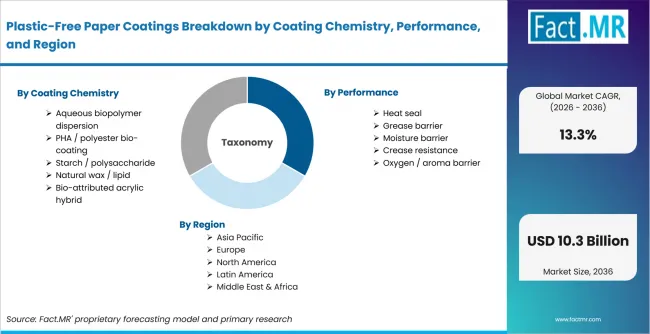
Plastic Free Paper Coatings Breakdown By Coating Chemistry, Performance, And Region | Source: Fact.MR
| Attribute | Details |
|---|---|
| Quantitative Units | USD billion |
| Market Definition | Functional coatings applied to paper, paperboard, molded fiber, cellulose film, or specialty fiber substrates to provide barrier or sealing performance while replacing conventional plastic-film lamination in the defined packaging application. |
| Coating Chemistry | Aqueous biopolymer dispersion; PHA / polyester bio-coating; Starch / polysaccharide; Natural wax / lipid; Bio-attributed acrylic hybrid |
| Performance | Heat seal; Grease barrier; Moisture barrier; Crease resistance; Oxygen / aroma barrier |
| Substrate | Paper; Paperboard; Molded fiber; Cellulose film; Specialty fiber substrate |
| Application | Foodservice; Flexible food packs; Cartons; Takeaway packaging; Consumer goods |
| Regions Covered | North America; Latin America; Western Europe; Eastern Europe; East Asia; South Asia & Pacific; Middle East & Africa |
| Countries Covered | United States; China; Germany; Japan; France |
| Key Companies Profiled | Solenis; SIEGWERK; Michelman; Archroma |
| Forecast Period | 2026 to 2036 |
| Approach | Hybrid top-down and bottom-up approach using coating-chemistry demand; substrate conversion; foodservice and flexible-pack usage; packaging regulation; country adoption; and provider portfolio review. |
Source: Fact.MR analysis. Updated Sep 22, 2026
How is the market segmented?
-
By Coating Chemistry:
- Aqueous biopolymer dispersion
- PHA / polyester bio-coating
- Starch / polysaccharide
- Natural wax / lipid
- Bio-attributed acrylic hybrid
-
By Performance:
- Heat seal
- Grease barrier
- Moisture barrier
- Crease resistance
- Oxygen / aroma barrier
-
By Substrate:
- Paper
- Paperboard
- Molded fiber
- Cellulose film
- Specialty fiber substrate
-
By Application:
- Foodservice
- Flexible food packs
- Cartons
- Takeaway packaging
- Consumer goods
-
By Region:
- North America
- Latin America
- Western Europe
- Eastern Europe
- East Asia
- South Asia & Pacific
- Middle East & Africa
Frequently Asked Questions
How big is the plastic-free paper coatings market in 2026?
What is the CAGR of the plastic-free paper coatings market from 2026 to 2036?
Which coating chemistry leads the plastic-free paper coatings market?
Which performance segment leads the plastic-free paper coatings market?
Which companies are profiled in the plastic-free paper coatings market?
Who worked on this report


Preview the report firsthand - request a free sample
Free SampleGet the brochure for pricing and purchase details
Download PDF