- Market Value (2025): USD 75.0 Mn
- Estimated Value (2026): USD 79.0 Mn
- Forecast Value (2036): USD 133.0 Mn
- CAGR (2026-2036): 5.3%
What is the Plastics Warpage Pigments Market forecast to be worth by 2036?
USD 79.0 million in 2026 to USD 133.0 million by 2036, at 5.3% CAGR.
- The market reached approximately USD 75.0 million in 2025, indicating a specialized but established need for colorants selected with dimensional stability in mind.
- Demand is forecast to advance from USD 79.0 million in 2026 to USD 133.0 million by 2036 as injection molders, compounders, and end users pay closer attention to pigment-related warpage in rigid packaging, vehicles, goods, and electrical parts.
- Growth at a 5.3% CAGR rests on wider use of polypropylene, tighter part tolerances, high-temperature processing, and color grades designed to reduce orientation and differential-shrinkage effects.
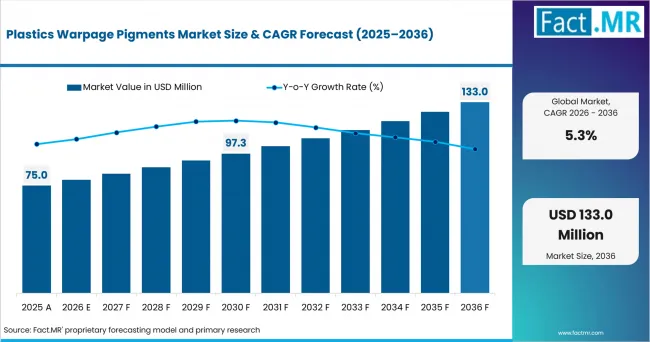
Plastics Warpage Pigments Market Value Analysis | Source: Fact.MR
What are the defining numbers behind Plastics Warpage Pigments Market growth?
USD 54.0 million absolute opportunity by 2036, led by Polypropylene and Injection molding within their respective segments.
- Demand Drivers in the Market
- Polypropylene molders need colors that do not amplify direction-dependent shrinkage in flat, thin, or tightly fitted parts.
- Automotive and electrical components place dimensional accuracy beside heat stability, migration, and plate-out in the approval sequence.
- Rigid packaging producers seek repeatable color without introducing distortion that affects stacking, sealing, labeling, or appearance.
- Simulation and controlled molding trials are making it easier to distinguish pigment effects from cooling, gate, packing, material, and wall-thickness causes.
- Key Segments Analyzed
- By Polymer Type: Polymer Type demand in 2026 is led by Polypropylene, the segment's top spot. Its semi-crystalline shrinkage behavior and broad use make dimensional effects commercially visible.
- By Molding Process: 2026 Molding Process demand concentrates on Injection molding because rapid filling, packing, cooling, and directional flow can expose small shrinkage differences in the finished part.
- By Pigment Chemistry: Phthalocyanine blue/green sits at the front of the 2026 Pigment Chemistry field since their strong color makes polymer-specific dimensional behavior important even at relatively low use levels.
- By End Use: The 2026 End Use lead is claimed by Rigid packaging because flatness, stacking, closure fit, and surface appearance can all reveal molding distortion.
- By Performance Need: Performance Need in 2026 is dominated by Low warpage since dimensional failure can make a correctly colored molded part unusable.
- Analyst Opinion at Fact.MR
- Shambhu Nath Jha, Senior Analyst at Fact.MR, states, "Low-warpage color is not a promise that the mold, polymer, and process can be ignored. Its value is the removal of one important source of shrinkage variation, giving processors a cleaner window in which to optimize the rest of the molding system."
- Strategic Implications
- Pigment suppliers should report warpage results in named polymers, geometries, loading levels, and molding conditions rather than treating suitability as universal.
- Compounders need side-by-side plaques or parts at equal color strength so apparent benefits are not created by a lower pigment dose.
- Molders should review cooling balance, gate location, packing, wall thickness, and material moisture before assigning all dimensional drift to colorant.
- OEM and packaging buyers can reduce late tool corrections by specifying dimensional tests during color approval, not after the shade is released.
Heubach's plastics and rubber coloration guide includes a dedicated Warpage+ suitability field for polyolefin pigments alongside heat and light-fastness data. That format signals an important procurement shift: dimensional behavior is becoming a selectable pigment attribute rather than an issue discovered only during a production run.
How does the Plastics Warpage Pigments Market break down by segment?
The leading segments are Polypropylene by Polymer Type and Injection molding by Molding Process.
Why does polypropylene dominate low-warpage pigment demand?
In 2026, the leading position goes to Polypropylene because its semi-crystalline shrinkage behavior and broad use make dimensional effects commercially visible.
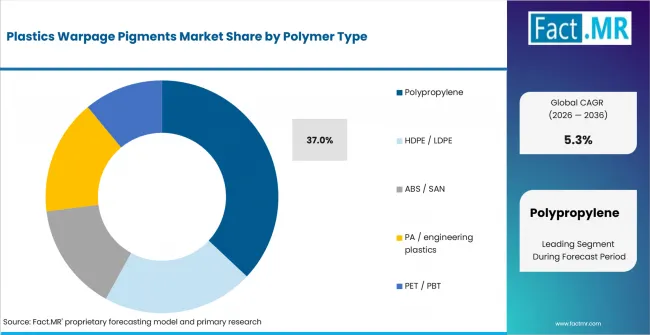
Plastics Warpage Pigments Market Analysis By Polymer Type | Source: Fact.MR
Polypropylene leads polymer demand and is especially relevant where colorants interact with crystallization and orientation. HDPE / LDPE follows, bringing another polyolefin base but a different combination of density, cooling, and part design. PA / engineering plastics and ABS / SAN face higher processing or tolerance demands that shift attention toward heat stability and resin-specific dispersion.
What makes injection molding the central process segment?
The 2026 leader is Injection molding because rapid filling, packing, cooling, and directional flow can expose small shrinkage differences in the finished part.
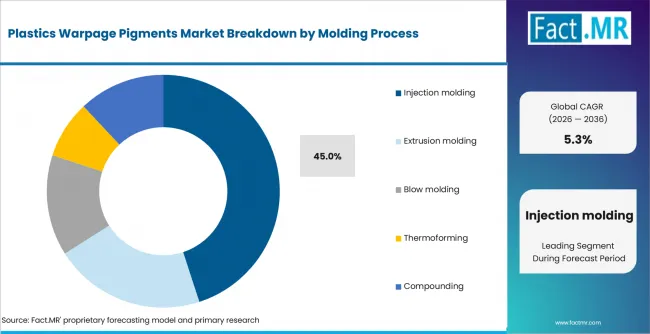
Plastics Warpage Pigments Market Analysis By Molding Process | Source: Fact.MR
Injection molding leads process demand, well ahead of extrusion molding. Its lead reflects the number of geometrically complex parts that must release from a mold and retain shape. Blow molding and compounding create different checkpoints, with color uniformity and downstream processing consistency often preceding a direct warpage test.
Why are phthalocyanine blue and green grades the largest chemistry group?
Phthalocyanine blue/green ranks first in 2026 because their strong color makes polymer-specific dimensional behavior important even at relatively low use levels.
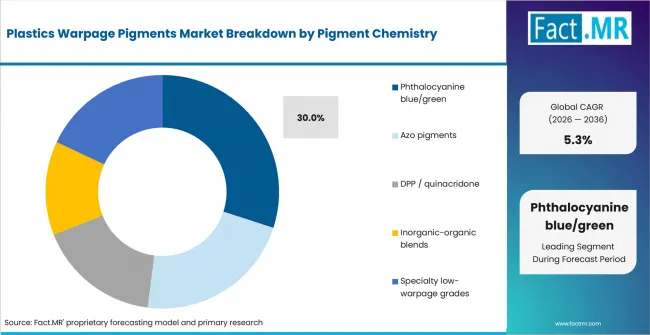
Plastics Warpage Pigments Market Analysis By Pigment Chemistry | Source: Fact.MR
Phthalocyanine blue/green pigments lead chemistry demand and are a core focus of warpage screening in polyolefins. Azo pigments follow, with performance varying by structure, heat exposure, and polymer. Specialty low-warpage grades and DPP / quinacridone round out the mix, showing a distinct market for engineered alternatives.
Why does rigid packaging lead end-use demand?
For End Use, the top 2026 position is Rigid packaging because flatness, stacking, closure fit, and surface appearance can all reveal molding distortion.
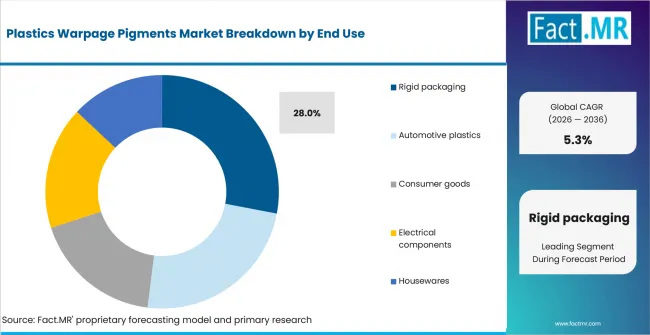
Plastics Warpage Pigments Market Analysis By End Use | Source: Fact.MR
Rigid packaging leads end use, narrowly ahead of automotive plastics. Packaging often combines high cavity counts with cost pressure, making a stable processing window valuable. Electrical components and consumer goods can carry tighter assembly or cosmetic requirements, while housewares add large, visible molded surfaces.
Why is low warpage the leading performance need?
The leading 2026 position belongs to Low warpage because dimensional failure can make a correctly colored molded part unusable.
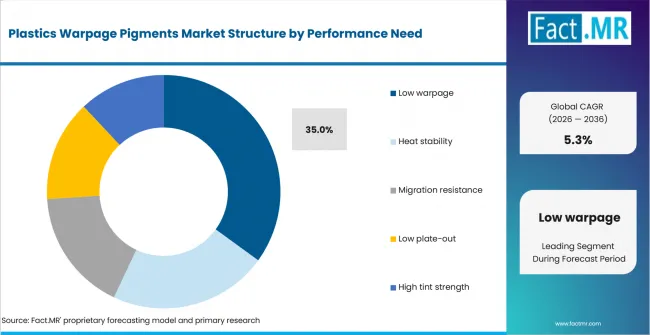
Plastics Warpage Pigments Market Analysis By Performance Need | Source: Fact.MR
Low warpage leads performance demand and defines the market's primary buying purpose. Heat stability follows, ensuring the pigment reaches the molded part without unacceptable shade or chemistry change. Migration resistance and low plate-out address longer-term transfer and processing cleanliness that must be solved alongside dimensional behavior.
What is accelerating Plastics Warpage Pigments Market adoption, and what is holding it back?
Tighter dimensional requirements in colored polyolefin and injection-molded parts are pulling low-warpage grades into earlier material selection. The limiting factor is causal complexity, because pigment, polymer, mold, geometry, cooling, packing, moisture, and reinforcement can all influence the same distorted part.
Drivers Impact Analysis
| DRIVER | (~) % IMPACT ON CAGR | GEOGRAPHIC RELEVANCE | IMPACT TIMELINE |
|---|---|---|---|
| Polypropylene part growth | +0.8% | Brazil and Latin America | Medium term (2-4 years) |
| Injection-molding tolerances | +0.7% | Global | Short term (<= 2 years) |
| Automotive assembly fit | +0.6% | United States and Germany | Long term (>= 4 years) |
| Molding simulation use | +0.5% | North America, Europe, and East Asia | Medium term (2-4 years) |
| High-temperature polymers | +0.4% | Germany, United States, and Italy | Long term (>= 4 years) |
Source: Fact.MR analysis. Updated Jul 20, 2026
- Polypropylene part growth: Polypropylene is the largest polymer segment. More colored parts expand the number of cases where pigment-related shrinkage behavior must be screened.
- Injection-molding tolerances: Injection molding leads the process mix and can translate uneven shrinkage into bow, twist, or poor fit. Low-warpage pigments provide value when the remaining process is already controlled.
- Automotive assembly fit: Colored trim and technical components may need to align with neighboring parts after cooling and conditioning. Dimensional color qualification can reduce later rework or tool adjustment.
Opportunity Impact Analysis
| OPPORTUNITY | (~) % IMPACT ON CAGR | GEOGRAPHIC RELEVANCE | IMPACT TIMELINE |
|---|---|---|---|
| PP warpage screening kits | +0.4% | Global compounders | Short term (<= 2 years) |
| Phthalocyanine alternatives | +0.4% | Asia Pacific and Europe | Medium term (2-4 years) |
| Simulation-linked color service | +0.3% | Automotive and electrical clusters | Long term (>= 4 years) |
| Low-plate-out formulations | +0.3% | Rigid packaging markets | Medium term (2-4 years) |
Source: Fact.MR analysis. Updated Jul 20, 2026
- PP warpage screening kits: Suppliers can offer matched shade sets with warpage data in a defined polypropylene grade. This gives compounders a faster starting point while preserving the need for a final part trial.
- Phthalocyanine alternatives: Blue and green pigments lead chemistry demand. Grades or blends that maintain chroma with lower dimensional influence can address a large recurring problem.
- Simulation-linked color service: Pigment data can be incorporated into a wider mold and material investigation rather than delivered as a standalone color plaque. Partnerships with compounders and molders can turn troubleshooting into a specification service.
Restraints Impact Analysis
| RESTRAINT | (~) % IMPACT ON CAGR | GEOGRAPHIC RELEVANCE | IMPACT TIMELINE |
|---|---|---|---|
| Multiple warpage causes | -0.4% | Global molding operations | Short term (<= 2 years) |
| Test-geometry dependence | -0.3% | Global laboratories | Medium term (2-4 years) |
| Shade reformulation cost | -0.2% | Brand-controlled consumer goods | Long term (>= 4 years) |
| Specialty-grade premium | -0.2% | Price-sensitive packaging markets | Short term (<= 2 years) |
Source: Fact.MR analysis. Updated Jul 20, 2026
- Multiple warpage causes: Cooling imbalance, wall variation, gate placement, packing, moisture, material, and pigment can produce similar distortion. Misdiagnosis can lead to an unnecessary colorant change.
- Test-geometry dependence: A flat plaque does not reproduce every flow path, rib, boss, or thickness transition in a commercial part. Low-warpage status must therefore be treated as evidence, not a guarantee.
- Shade reformulation cost: Replacing a problematic pigment can change hue, opacity, loading, or metamerism. The dimensional gain may require new masterbatch, mold, and customer approvals.
Where does demand for warpage-safe pigments concentrate?
United States 5.3% CAGR. Germany 5.2% CAGR. Brazil 6.1% CAGR.
Regional analysis covers country chapters on United States, China, India, Germany, and Brazil. Analysis on more than 30 countries is included in the full report.
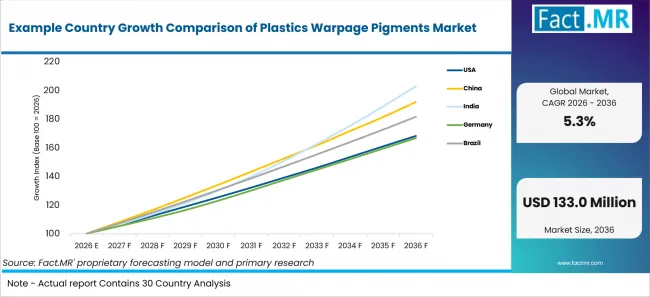
Example Country Growth Comparison Of Plastics Warpage Pigments Market | Source: Fact.MR
| COUNTRY | CAGR |
|---|---|
| United States | 5.3% |
| Germany | 5.2% |
| Brazil | 6.1% |
Source: Fact.MR analysis. Updated Jul 20, 2026
How is the United States market likely to develop?
A 5.3% CAGR is projected for United States during 2026-2036.
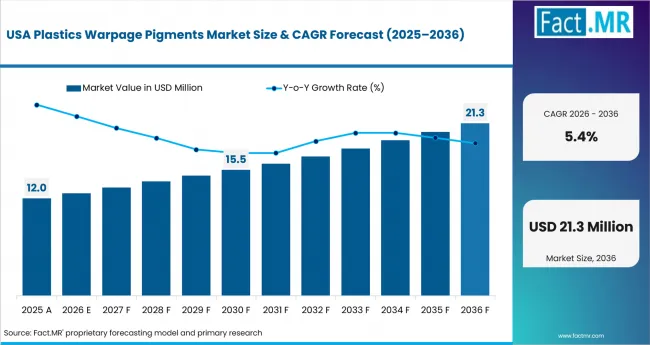
Plastics Warpage Pigments Market Country Value Analysis | Source: Fact.MR
US resin colorists increasingly treat warpage as a specification item because injection molders serving automotive and electrical customers already run dimensional inspection as standard practice, so a pigment-related shrinkage issue surfaces in the same quality data used for EPA and customer compliance records. A mature, high-volume molding base means a warpage problem traced to colorant choice can affect tooling amortized across large production runs, raising the cost of getting it wrong.
For plastics warpage pigments, buyers need dispersion and color performance that do not add avoidable shrinkage, distortion, or molding variability.
Because polypropylene packaging and automotive trim make up a large share of US colored-part volume, suppliers who can show warpage data in those specific part geometries -- not just a flat test plaque -- tend to move through molder qualification faster.
How is the Germany market likely to develop?
A 5.2% CAGR is projected for Germany during 2026-2036.
German molders operate under REACH substance tracking on the pigment side and some of the tightest dimensional-tolerance expectations in automotive and precision-component molding on the process side, so a colorant that shifts shrinkage by even a fraction of a percent can fail a tolerance stack-up before it fails any chemical review. Compounders here are more likely to request warpage data alongside standard REACH documentation rather than treat the two as separate approval steps.
For plastics warpage pigments, buyers need dispersion and color performance that do not add avoidable shrinkage, distortion, or molding variability.
The country's strength in engineering plastics and technical molding also means pigment evaluations often extend beyond polypropylene into PA and other engineering resins, where shrinkage behavior is less predictable and supplier data is thinner.
How is the Brazil market likely to develop?
A 6.1% CAGR is projected for Brazil during 2026-2036.
Brazil's molding sector is more exposed to import variability in both resin and pigment supply, so processors often build extra margin into their process settings to absorb material inconsistency -- a practice that can mask or worsen a colorant-driven warpage issue rather than isolate it. Regional supply patterns mean a compounder may need to requalify a pigment against more than one polypropylene source over a given product's life.
For plastics warpage pigments, buyers need dispersion and color performance that do not add avoidable shrinkage, distortion, or molding variability.
Distributor-level technical support therefore plays a larger role in Brazil than in more consolidated resin markets, since many molders lack in-house resources to separate a pigment-related shrinkage problem from a cooling, packing, or moisture-related one.
Who leads the Plastics Warpage Pigments Market?
Clariant, BASF Colors & Effects, Sudarshan Chemical, DIC, and Solar Organics compete through polymer-specific pigments, application testing, and regional color service.
Clariant and BASF Colors & Effects are named as the leading positions in the market evidence, followed by Sudarshan Chemical and DIC. Official Heubach and DIC materials show how plastics pigment selection is increasingly organized around polymer, process, heat, migration, dispersion, and warpage-related performance rather than color index alone.
Solar Organics also holds a position in the market and can compete through custom shade responsiveness and focused organic chemistry. Across the named set, the strongest differentiator is reproducible dimensional evidence at equal color strength in the customer's polymer and molding window.
Which companies are the key providers?
The company set includes Solar Organics, Clariant, BASF Colors & Effects, Sudarshan Chemical, and DIC.
- Solar Organics
- Clariant
- BASF Colors & Effects
- Sudarshan Chemical
- DIC
The named group leads the discussion, while the complete report reviews more than 30 companies in pigments, masterbatch, and compounding.
Bibliography
- Autodesk Moldflow warpage guidance.
- BASF injection-molding troubleshooting.
- Heubach plastics coloration guide.
- [US-1] U.S. Environmental Protection Agency. Chemicals under TSCA .
- [US-2] U.S. Census Bureau. Manufacturing.
- [DE-1] European Chemicals Agency. REACH restriction.
- [DE-2] Federal Statistical Office of Germany. Manufacturing statistics.
- [BR-2] Brazilian Institute of Geography and Statistics. Industry statistics.
This Report Addresses
- It presents the 2025 baseline and the revenue outlook for 2026-2036.
- It reviews United States, China, India, Germany, and Brazil, within coverage that reaches more than 30 countries.
- It reviews Clariant, BASF Colors & Effects, Sudarshan Chemical, DIC, and Solar Organics in the stated competitive structure.
- It compares five pigment chemistry groups across polypropylene, polyethylene, styrenics, engineering plastics, and polyesters.
- It links injection, extrusion, blow molding, thermoforming, and compounding to packaging and component demand.
- It grounds the forecast in shrinkage variation, heat, migration, plate-out, strength, geometry, cooling, orientation, and process control.
What does the Plastics Warpage Pigments Market cover?
The analysis captures pigment value sold specifically to reduce or control warpage risk in colored thermoplastics.
Polymer, molding process, chemistry, end use, performance need, country, and competitor form the report structure.
Commercial assessment extends to color strength, crystallization, dispersion, heat, migration, plate-out, shrinkage, and molding validation.
What is included in the scope?
Products qualify when low-warpage performance is marketed, tested, or specified for a source polymer and process.
Powders, preparations, and pigment-bearing concentrates are counted at attributable pigment revenue.
Applications in packaging, vehicles, consumer goods, electrical parts, and housewares remain included when dimensional stability is part of color approval.
What is excluded from the scope?
The boundary removes host polymer, tooling, molding, and generic colorant value.
Resin, fillers, reinforcement, additives, masterbatch carrier, molds, machines, simulation software, and finished-part value are excluded.
Pigments lacking a low-warpage use case and process changes with no attributable colorant sale are not counted.
How Was the Analysis Built?
The analysis draws on 120+ sources, 35+ company portfolios, 25+ countries, and more than 20 industry interviews.
- Primary Research: Primary research includes discussions with manufacturers, service providers, technology developers, distributors, end users, procurement teams, and subject-matter experts. These conversations examine purchasing priorities, product adoption, operational challenges, approval requirements, competitive positioning, and the factors that influence wider market acceptance.
- Desk Research: Desk research covers government statistics, regulatory publications, company filings, trade data, technical studies, industry associations, standards, public policy, and other authoritative sources. Every source used in the analysis is documented in the bibliography.
- Market Sizing and Forecasting: Market estimates combine historical performance, demand indicators, pricing and volume trends, segment shares, company participation, country-level growth, adoption patterns, investment activity, and barriers to market expansion.
- Data Validation and Update Cycle: Findings are validated by comparing primary interviews with public data, company activity, regulatory changes, trade patterns, and industry developments. Regular updates review new product launches, capacity changes, partnerships, approvals, procurement trends, and shifts in commercial adoption.
Segmentation
What is the report's scope and coverage?
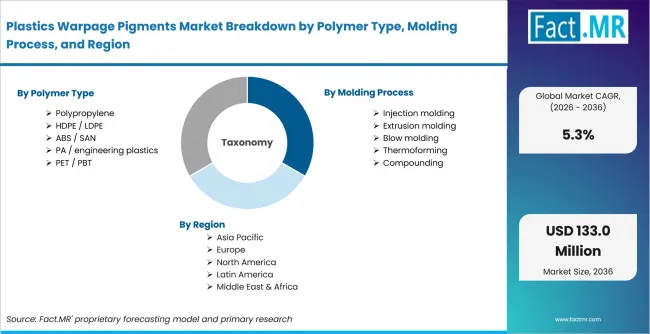
Plastics Warpage Pigments Market Breakdown By Polymer Type, Molding Process, And Region | Source: Fact.MR
| ATTRIBUTE | DETAILS |
|---|---|
| Quantitative Units | USD million in 2026 to USD million by 2036 at CAGR |
| Market Definition | Plastics warpage pigments are pigment grades, preparations, and concentrates sold for thermoplastic coloration where reduced pigment-related shrinkage distortion is a defined performance requirement. |
| Polymer Type | Polypropylene; HDPE / LDPE; ABS / SAN; PA / engineering plastics; PET / PBT |
| Molding Process | Injection molding; Extrusion molding; Blow molding; Thermoforming; Compounding |
| Pigment Chemistry | Phthalocyanine blue/green; Azo pigments; DPP / quinacridone; Inorganic-organic blends; Specialty low-warpage grades |
| End Use | Rigid packaging; Automotive plastics; Consumer goods; Electrical components; Housewares |
| Performance Need | Low warpage; Heat stability; Migration resistance; Low plate-out; High tint strength |
| Regions Covered | North America; Europe; Latin America |
| Countries Covered | United States;Germany; Brazil (analysis extends to 30+ countries) |
| Key Companies Profiled | Solar Organics; Clariant; BASF Colors & Effects; Sudarshan Chemical; DIC |
| Forecast Period | 2026 to 2036 |
| Approach | Demand is evaluated using colored paraffin output, application-specific dye loading, concentrate strength, delivery-form mix, supplier pricing, and buyer purchasing patterns. |
Source: Fact.MR analysis. Updated Jul 20, 2026
How is the market segmented?
-
By Polymer Type
- Polypropylene
- HDPE / LDPE
- ABS / SAN
- PA / engineering plastics
- PET / PBT
-
By Molding Process
- Injection molding
- Extrusion molding
- Blow molding
- Thermoforming
- Compounding
-
By Pigment Chemistry
- Phthalocyanine blue/green
- Azo pigments
- DPP / quinacridone
- Inorganic-organic blends
- Specialty low-warpage grades
-
By End Use
- Rigid packaging
- Automotive plastics
- Consumer goods
- Electrical components
- Housewares
-
By Performance Need
- Low warpage
- Heat stability
- Migration resistance
- Low plate-out
- High tint strength
-
By Region
- North America
- United States
- Europe
- Germany
- Asia Pacific
- Japan
- South Korea
- South Asia
- India
- Latin America
- Brazil
- Middle East and Africa
- Morocco
- Saudi Arabia
- Russia
- United Arab Emirates
- Italy
- United Kingdom
- North America
Frequently Asked Questions
What is the plastics warpage pigments market outlook?
Which polymer generates the most demand?
What molding process is largest?
Which pigment chemistry leads?
What end use has the top share?
Which performance requirement is largest?
How does country demand compare?
Which companies are included in the source comparison?
Who worked on this report


Preview the report firsthand - request a free sample
Free SampleGet the brochure for pricing and purchase details
Download PDF