- Market Value (2025): USD 0.9 Bn
- Estimated Value (2026): USD 1.0 Bn
- Forecast Value (2036): USD 2.5 Bn
- CAGR (2026-2036): 9.4%
What is the Plastic-Free Cartonboard Coatings Market forecast to be worth by 2036?
USD 1.0 billion in 2026 to USD 2.5 billion by 2036, recording a 9.4% CAGR.
- The market crossed USD 0.9 billion in 2025 as fiber-packaging qualification expanded across major converting regions.
- Plastic-free cartonboard coatings market is forecast to climb from USD 1.0 billion in 2026 to USD 2.5 billion by 2036.
- The market is forecast to record a 9.4% CAGR as mills replace fluorinated or plastic barrier layers.
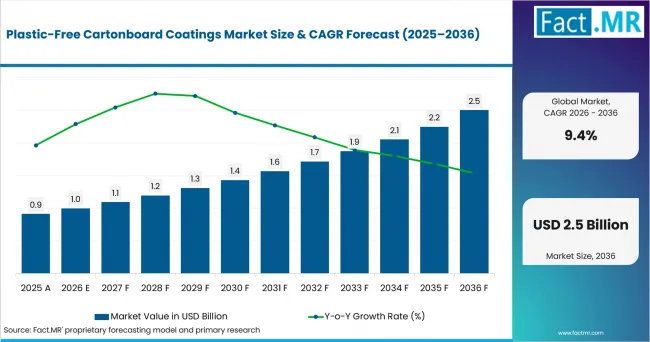
Plastic Free Cartonboard Coatings Market Value Analysis | Source: Fact.MR
What are the defining numbers behind Plastic-Free Cartonboard Coatings Market growth?
USD 1.5 billion absolute opportunity by 2036, led by PFAS-free and grease resistance across foodservice applications.
- Demand Drivers in the Market
- Board mills need coatings retaining barrier performance after drying and creasing under commercial converting conditions.
- Carton converters require formulations running on existing metering assets without separate extrusion or lamination equipment.
- Foodservice packaging teams require grease and moisture protection supported by food-contact records for hot products.
- Brand compliance teams require transparent layer composition and recovery evidence under PFAS controls and producer-fee assessments.
- Key Segments Analyzed
- By chemistry: Dispersion (bio) is expected to account for 34.0% share in 2026 due to aqueous flexibility.
- By barrier property: Grease & oil resistance is projected to garner 38.0% share in 2026 owing to leakage risk.
- By regulatory driver: PFAS-free is anticipated to capture 48.0% share in 2026 driven by food-contact screens.
- By end use: Foodservice is estimated to represent 40.0% share in 2026 attributable to hot oily applications.
- By substrate: Folding boxboard is forecast to hold 40.0% share in 2026 reinforced by controlled surfaces.
- Analyst Opinion at Fact.MR
- Shambhu Nath Jha, Principal Consultant at Fact.MR: “Coating selection depends on complete-package performance and converted-line evidence during qualification. Adoption is expected to favor systems preserving performance after printing and folding under production conditions. Providers should combine formulation control with local trials and food-contact records supporting approvals across jurisdictions.”
- Strategic Implications
- Board mills should compare coat weight and fiber yield during barrier-grade qualification across converted commercial structures.
- Carton converters should test drying speed and crease integrity on production assets while preparing performance claims for brands.
- Food brands should require complete layer composition and jurisdiction-specific classification during approval of national packaging claims.
- Coating formulators should establish local technical-service routes that shorten trials and reduce repeated regional sample shipments.
Multi-barrier coatings gain value by preserving sealing and folding performance on established commercial converting equipment. Michelman introduced Nuvita Life 4002 and Nuvita Life 4605 in April 2026 for fiber food packaging. The combined functions give converters a documented route from qualification trials into repeat commercial orders.
India is projected to record 11.9% CAGR under scrutiny across paper packaging materials. China is estimated to post 10.9% CAGR due to coated-board standards. United Kingdom demand is anticipated to advance at 9.9% CAGR by 2036 as recyclability ratings influence fees. Germany is forecast to expand at 9.1% CAGR over the assessment period owing to package recovery tests. Brazil is expected to register 8.9% CAGR through 2036 under cellulosic food-contact requirements and local qualification constraints.
How does the Plastic-Free Cartonboard Coatings Market break down by segment?
Dispersion (bio) 34.0%, grease & oil resistance 38.0%.
Which Chemistry dominates?
Dispersion (bio) is projected to account for 34.0% share in 2026
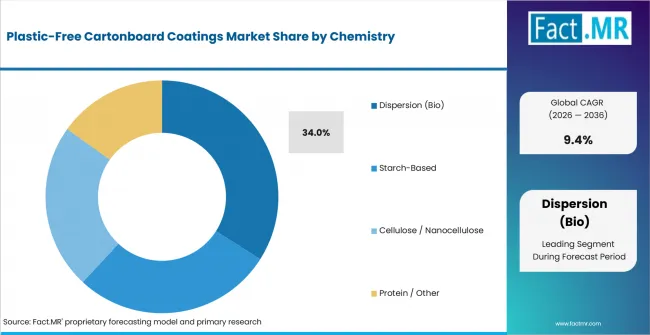
Plastic Free Cartonboard Coatings Market Analysis By Chemistry | Source: Fact.MR
By chemistry, dispersion (bio) is estimated to hold 34.0% share in 2026 owing to aqueous flexibility. Starch and cellulose systems serve narrower needs across paper coating materials, while Fedrigoni’s February 2025 Papkot investment supports scale-up.
What leads the Barrier Property segment?
Grease & oil resistance is estimated to garner 38.0% share in 2026
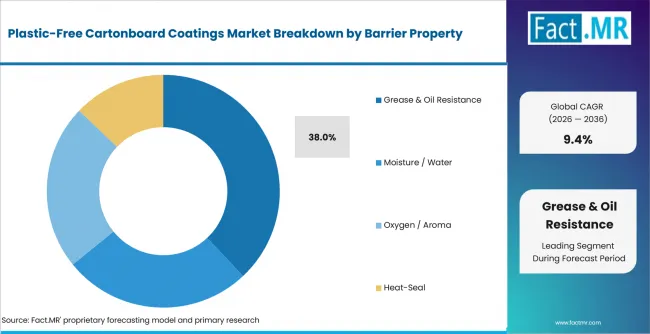
Plastic Free Cartonboard Coatings Market Analysis By Barrier Property | Source: Fact.MR
By barrier property, grease & oil resistance is forecast to represent 38.0% share in 2026 due to staining risk. Archroma’s March 2024 coating supports fold-resistant greaseproof paper and paper barrier coatings across narrower moisture and oxygen needs.
How does PFAS-Free shape the Regulatory Driver category?
PFAS-free is anticipated to capture 48.0% share in 2026
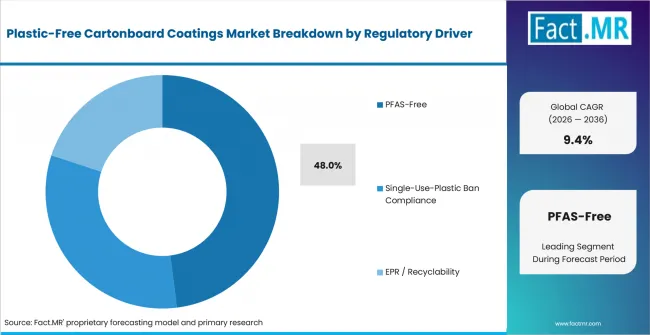
Plastic Free Cartonboard Coatings Market Analysis By Regulatory Driver | Source: Fact.MR
PFAS-free is projected to hold 48.0% share in 2026 owing to food-contact screening before broader cost comparison. Regulation (EU) 2025-40 directs trials toward documented fluorine-free barrier coatings from August 2026 under whole-package requirements.
What supports Foodservice within End Use?
Foodservice is estimated to represent 40.0% share in 2026
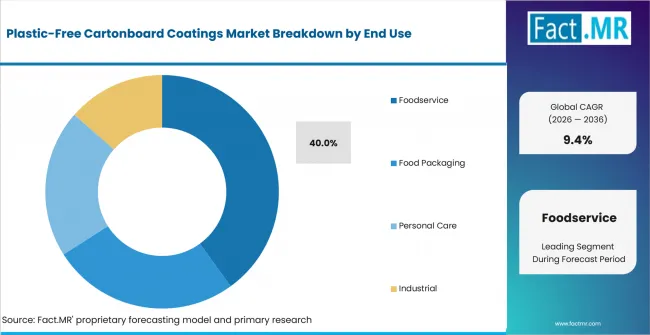
Plastic Free Cartonboard Coatings Market Analysis By End Use | Source: Fact.MR
Foodservice is expected to lead end use with 40.0% share in 2026 because hot foods expose weak barriers. Xampla’s March 2026 European expansion gives foodservice packaging converters a commercial reference for broader packaged-food qualification.
Why does Folding Boxboard lead the Substrate category?
Folding boxboard is forecast to hold 40.0% share in 2026
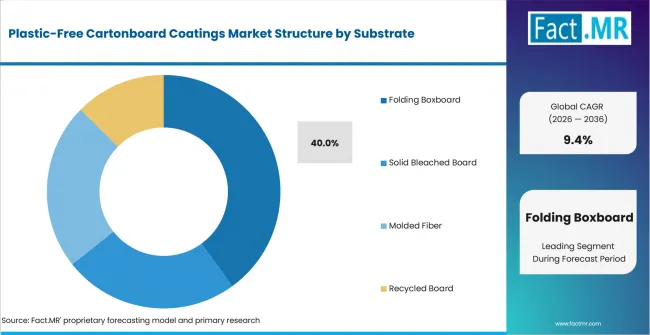
Plastic Free Cartonboard Coatings Market Analysis By Substrate | Source: Fact.MR
Based on substrate, folding boxboard is projected to account for 40.0% share in 2026 due to controlled holdout. AF&PA’s May 2025 standard gives folding carton packaging converters repeatable tests for coated-board repulpability across fiber-based packaging recycling streams.
What is accelerating Plastic-Free Cartonboard Coatings Market adoption, and what is holding it back?
PFAS withdrawal drives it, commercial-line qualification restrains it.
Drivers Impact Analysis
| DRIVER | (~) % IMPACT ON CAGR | GEOGRAPHIC RELEVANCE | IMPACT TIMELINE |
|---|---|---|---|
| PFAS withdrawal | +1.4% | Europe, USA | Short term (<= 2 years) |
| Recyclability-linked EPR | +1.1% | Europe, United Kingdom | Medium term (2-4 years) |
| Fiber conversion | +0.9% | Global brand programs | Medium term (2-4 years) |
| Foodservice barriers | +0.7% | Europe, Asia Pacific | Long term (>= 4 years) |
| Asset compatibility | +0.5% | Global converters | Long term (>= 4 years) |
Source: Fact.MR analysis. Updated Aug 1, 2026
- PFAS withdrawal: Regulatory deadlines shift food-contact cartons toward non-fluorinated barriers carrying composition records and commercial-line validation.
- Producer-responsibility assessment: Fee-linked recyclability ratings alter carton economics and favor complete-pack testing with qualified converters.
- Plastic-to-fiber conversion: Packaging redesign increases demand for fiber structures retaining barrier performance across established distribution workflows.
- Foodservice barrier needs: Hot takeaway foods expose coating failures quickly and reward systems passing multi-format stain-resistance trials.
- Existing-asset compatibility: Aqueous systems reduce equipment changes and gain approval through stable drying and coat-weight control.
Opportunity Impact Analysis
| OPPORTUNITY | (~) % IMPACT ON CAGR | GEOGRAPHIC RELEVANCE | IMPACT TIMELINE |
|---|---|---|---|
| Multi-barrier dispersions | +0.9% | Europe, USA | Medium term (2-4 years) |
| Print-applied routes | +0.7% | Global converters | Short term (<= 2 years) |
| Verified natural materials | +0.6% | Europe, Asia Pacific | Medium term (2-4 years) |
| Local qualification networks | +0.4% | India, China | Long term (>= 4 years) |
Source: Fact.MR analysis. Updated Aug 1, 2026
- Multi-barrier dispersions: Combined grease and moisture control reduces qualification interfaces without requiring additional converter equipment.
- Print-applied routes: Flexographic application places barriers inside familiar converting steps supported by repeatable press settings.
- Verified natural materials: Protein and cellulose routes differentiate through transparent classification and documented finished-carton performance.
- Local qualification networks: Regional laboratories shorten production trials through local stock and trained application teams.
Restraints Impact Analysis
| RESTRAINT | (~) % IMPACT ON CAGR | GEOGRAPHIC RELEVANCE | IMPACT TIMELINE |
|---|---|---|---|
| Commercial-line failure | -0.8% | Global converters | Short term (<= 2 years) |
| Coat weight and drying | -0.6% | Cost-sensitive markets | Medium term (2-4 years) |
| Plastic-free definitions | -0.5% | Europe, export markets | Medium term (2-4 years) |
| Service and supply gaps | -0.3% | Emerging markets | Long term (>= 4 years) |
Source: Fact.MR analysis. Updated Aug 1, 2026
- Qualification failure: Flat-sheet tests cannot prove converted performance without reproducible results from trials on customer equipment.
- Coat weight and drying: Higher material use or drying energy slows approvals under tight throughput economics.
- Definition mismatch: Bio-based layers receive different plastic classifications across jurisdictions and require repeated export review.
- Service and supply gaps: Specialized formulations lose commercial reach without stable materials and nearby application support.
Which countries are scaling Plastic-Free Cartonboard Coatings Market fastest?
United Kingdom 9.9%, Germany 9.1%, Brazil 8.9%.
Regional coverage includes North America and Europe alongside Asia Pacific, Latin America and the Middle East & Africa.
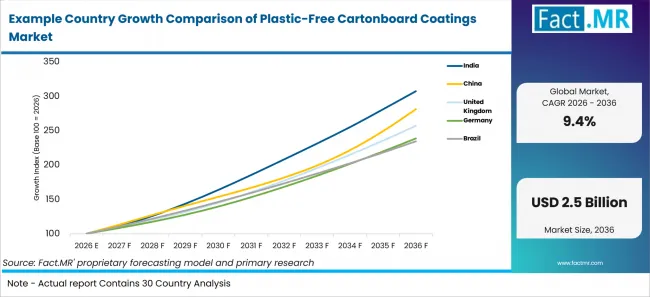
Example Country Growth Comparison Of Plastic Free Cartonboard Coatings Market | Source: Fact.MR
| COUNTRY | CAGR |
|---|---|
| United Kingdom | 9.9% |
| Germany | 9.1% |
| Brazil | 8.9% |
Source: Fact.MR analysis. Updated Aug 1, 2026
What supports the United Kingdom outlook?
9.9% CAGR by 2036, owing to recyclability ratings that influence producer fees.
The United Kingdom recyclability method assigns traffic-light ratings that influence producer-fee exposure across household packaging. Sales of plastic-free cartonboard coatings are anticipated to expand at a 9.9% CAGR by 2036. Complete-pack assessment creates local friction by evaluating coatings alongside every converted package component during fee classification.
What underpins Germany's growth?
9.1% CAGR over the assessment period, shaped by whole-package recovery tests and established converting systems.
German converters purchase against whole-package recovery tests that combine coating behavior with printing and gluing performance. The plastic-free cartonboard coatings market is forecast to record a 9.1% CAGR over the assessment period. The August 2025 minimum standard supports fiber recovery, but current converted-package evidence remains a material approval friction.
How is Brazil developing coating demand?
8.9% CAGR across the ten-year window, reinforced by plastic-packaging reverse logistics and food-processing demand.
Brazilian food-contact packaging rules separate cellulosic materials and require manufacturers to meet applicable technical regulations. The plastic-free cartonboard coatings market is expected to register an 8.9% CAGR by 2036. Long service distances and uneven converter capability raise qualification costs outside Brazil’s major packaging centers.
Who leads the Plastic-Free Cartonboard Coatings Market?
Solenis and Michelman lead direct coating breadth, while Kemira and Xampla strengthen natural-material and regional commercialization routes.
The competitive field remains distributed across broad formulators and material specialists because no chemistry covers every barrier function or legal definition. Broad platforms compete through multi-barrier performance while material specialists enter through protein or mineral routes. Converter partnerships lower entry barriers, but repeat line data and local support for heat-seal coatings determine conversion into recurring orders.
Solenis and Michelman provide broad barrier coverage while Kemira and Xampla strengthen bio-based routes across regional programs. Papkot adds mineral technology while Archroma supplies grease barriers and MM Kotkamills integrates coatings with cartonboard production.
Which companies are the key providers?
Some of the key players profiled include Solenis, Michelman, Kemira, Xampla, Papkot, Archroma, and MM Kotkamills.
- Solenis
- Michelman
- Kemira
- Xampla
- Papkot
- Archroma
- MM Kotkamills.
Bibliography
- American Forest & Paper Association. (2025, May 29). Industry Publishes Updated Voluntary Standard for Recycling Cardboard.
- Archroma. (2024, March 18). Archroma launches Cartaseal® OGB F10, a superior PFAS-free barrier coating for oil and grease applications.
- Central Agency Packaging Register. (2025, August 28). Minimum standard for determining the recyclability of packaging.
- Department for Environment, Food & Rural Affairs. (2024, December 23). Recyclability assessment methodology: How to assess your packaging waste.
- European Parliament and Council. (2025, January 22). Regulation (EU) 2025-40 of the European Parliament and of the Council of 19 December 2024 on packaging and packaging waste.
- Fedrigoni. (2025, February 27). Fedrigoni invests in Papkot, a pioneer in sustainable packaging solutions.
- Food Safety and Standards Authority of India. (2025, October 13). Draft Food Safety and Standards (Packaging) Amendment Regulations, 2025 regarding provisions related to Poly- and perfluoroalkyl substances (PFAs) and Bisphenol A (BPA) for food contact materials.
- Michelman. (2026, April 30). Michelman introduces Nuvita® Life 4002 and Nuvita® Life 4605: Bio-based barrier coatings for paper packaging applications.
- MM Group. (2025, November 21). Cartonboard barriers are getting better all the time.
- National Standardization Administration of China. (2025, June 30). GB-T 36392-2025: Coated paper and board for food packaging.
- Agência Nacional de Vigilância Sanitária. (2026, April 17). Embalagens.
- Xampla. (2026, March 12). Just Eat Takeaway expands plastic-free Morro Coating range across Europe.
This Report Addresses
- Report coverage tracks Chemistry choices and Barrier Property design requirements in Plastic-Free Cartonboard Coatings.
- The segment review evaluates Regulatory Driver applications alongside End Use demand patterns.
- The country outlook examines India, China, United Kingdom, Germany, and Brazil in comparable commercial settings.
- Provider comparison reviews manufacturing readiness and customer qualification expectations in Plastic-Free Cartonboard Coatings.
- Substrate demand signals inform the practical route to market.
- Published data and primary checks support the Plastic-Free Cartonboard Coatings forecast assumptions.
What does the Plastic-Free Cartonboard Coatings Market cover?
Plastic-free functional coatings that protect cartonboard without conventional plastic barrier layers.
The market covers finished commercial coatings sold for grease or moisture protection on fiber substrates.
Revenue excludes wider coated-paper sales without a separately attributable plastic-free functional coating layer in the finished structure.
What is included in the scope?
Commercial plastic-free coatings used on cartonboard and related fiber packaging.
Included chemistries cover dispersion and natural-material routes across foodservice applications while integrated board enters through attributable coating value.
What is excluded from the scope?
Conventional plastic laminates and finished-package revenue without an attributable plastic-free coating value.
The scope excludes polyethylene and wax barriers alongside uncoated board or coating machinery without commercial plastic-free formulations.
How Was the Analysis Built?
The analysis draws on 120+ sources, 35+ company portfolios, 25+ countries, and more than 20 industry interviews.
- Primary Research: Primary research includes discussions with manufacturers, service providers, technology developers, distributors, end users, procurement teams, and subject-matter experts. These conversations examine purchasing priorities, product adoption, operational challenges, approval requirements, competitive positioning, and the factors that influence wider market acceptance.
- Desk Research: Desk research covers government statistics, regulatory publications, company filings, trade data, technical studies, industry associations, standards, public policy, and other authoritative sources. Every source used in the analysis is documented in the bibliography.
- Market Sizing and Forecasting: Market estimates combine historical performance, demand indicators, pricing and volume trends, segment shares, company participation, country-level growth, adoption patterns, investment activity, and barriers to market expansion.
- Data Validation and Update Cycle: Findings are validated by comparing primary interviews with public data, company activity, regulatory changes, trade patterns, and industry developments. Regular updates review new product launches, capacity changes, partnerships, approvals, procurement trends, and shifts in commercial adoption.
Segmentation
What is the report’s scope and coverage?
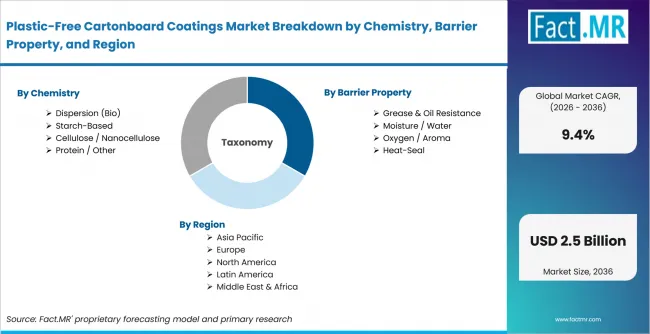
Plastic Free Cartonboard Coatings Market Breakdown By Chemistry, Barrier Property, And Region | Source: Fact.MR
| Coverage field | Report scope |
|---|---|
| Quantitative Units | USD Billion |
| Market Definition | Plastic-free functional coatings sold for cartonboard and related fiber substrates. |
| Chemistry | Dispersion (Bio), Starch-Based, Cellulose - Nanocellulose, Protein - Other |
| Barrier Property | Grease & Oil Resistance, Moisture - Water, Oxygen - Aroma, Heat-Seal |
| Regulatory Driver | PFAS-Free, Single-Use-Plastic Ban Compliance, EPR - Recyclability |
| End Use | Foodservice, Food Packaging, Personal Care, Industrial |
| Substrate | Folding Boxboard, Solid Bleached Board, Molded Fiber, Recycled Board |
| Regions Covered | North America, Europe, Asia Pacific, Latin America, Middle East & Africa |
| Countries Covered | United States, Canada, Germany, United Kingdom, France, Italy, Spain, Japan, South Korea, Australia, Brazil, Mexico, UAE, Saudi Arabia, South Africa |
| Key Companies Profiled | Solenis, Michelman, Kemira, Xampla, Papkot, Archroma, MM Kotkamills |
| Forecast Period | 2026 to 2036 |
| Approach | Hybrid top-down and bottom-up approach using coating demand, barrier mix, substrate use, country adoption, provider activity. |
Source: Fact.MR analysis. Updated Aug 1, 2026
How is the market segmented?
-
By Chemistry:
- Dispersion (Bio)
- Starch-Based
- Cellulose - Nanocellulose
- Protein - Other
-
By Barrier Property:
- Grease & Oil Resistance
- Moisture - Water
- Oxygen - Aroma
- Heat-Seal
-
By Regulatory Driver:
- PFAS-Free
- Single-Use-Plastic Ban Compliance
- EPR - Recyclability
-
By End Use:
- Foodservice
- Food Packaging
- Personal Care
- Industrial
-
By Substrate:
- Folding Boxboard
- Solid Bleached Board
- Molded Fiber
- Recycled Board
-
By Region:
- North America
- United States
- Canada
- Europe
- Germany
- United Kingdom
- France
- Italy
- Spain
- Asia Pacific
- India
- China
- Japan
- South Korea
- Australia
- Latin America
- Brazil
- Argentina
- Mexico
- Chile
- Middle East & Africa
- UAE
- Saudi Arabia
- South Africa
- North America
Frequently Asked Questions
Which chemistry accounts for the primary share?
Which barrier property records the primary share?
Which regulatory driver shapes the primary share?
How does India perform during the forecast?
How does China perform during the forecast?
What is the primary market driver?
What is the main market restraint?
Who worked on this report


Preview the report firsthand - request a free sample
Free SampleGet the brochure for pricing and purchase details
Download PDF