Microfluidic Chip Cooling Market Size, Share, Growth and Forecast (2026 - 2036)
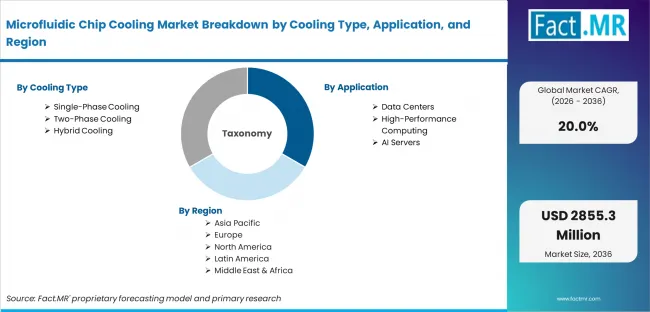
The global Microfluidic Chip Cooling Market is segmented by Product Type, by Material Type, by Coolant Type, by Application, by End User, by Distribution Channel, and by Region. Forecast for 2026 to 2036.
Microfluidic Chip Cooling Market Overview, Growth Outlook, and Forecast by Fact.MR
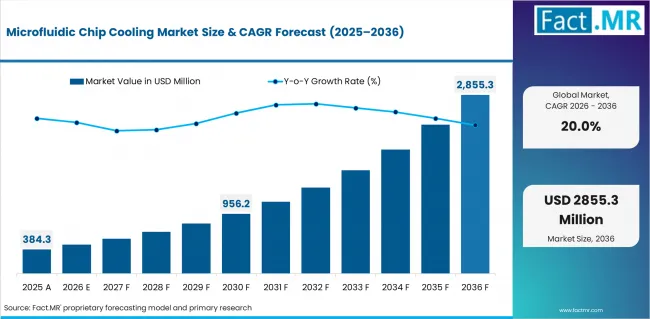
- Global microfluidic chip cooling market revenue stood at USD 384.3 million in 2025 and is forecast to reach USD 2,855.3 million by 2036.
- At a 20.0% CAGR from 2026 to 2036, this market is set to expand 6.2x in value, adding USD 2,394 million in absolute opportunity.
Summary of the Microfluidic Chip Cooling Market
- Market Snapshot
- In 2025, the global Microfluidic Chip Cooling Market was valued at approximately USD 384.3 million.
- The market is estimated to reach USD 461.1 million in 2026 and is projected to attain USD 2,855.3 million by 2036.
- The Microfluidic Chip Cooling Market is likely to expand at a CAGR of 20.0% during the forecast period.
- The market is anticipated to create an absolute dollar opportunity of USD 2,394 million between 2026 and 2036.
- Cold Plate / External Cooling accounts for 31.7% of market share in 2026 under the integration type segment.
- India (24.9%) and China (21.5%) are the key growth markets during the forecast period.
- Demand and Growth Drivers
- Increasing demand for AI chips, GPUs and high power processors is catalyzing the market growth.
- Hyperscale data center and HPC system expansion is driving the need for high-end chip cooling.
- Heat density in semiconductors is increasing, driving the uptake of microfluidic cooling.
- Rising utilization of chiplets and 3D packaging among the other factors is anticipated to fuel the demand for embedded thermal solutions.
- The use of liquid cooling in AI servers is an important market trend.
- Advances in two-phase cooling microchannels and dielectric fluids are making them more effective.
- Increasing focus on energy-efficient data centers is driving the demand.
- Semiconductor fab equipment spending is increasing, leading to new opportunities.
- The commercialization is being accelerated through partnerships between chipmakers, OEMs and cooling providers.
- Growing demand for miniaturized cooling solutions in telecom, automotive, and edge AI devices is creating new applications.
- Product and Segment View
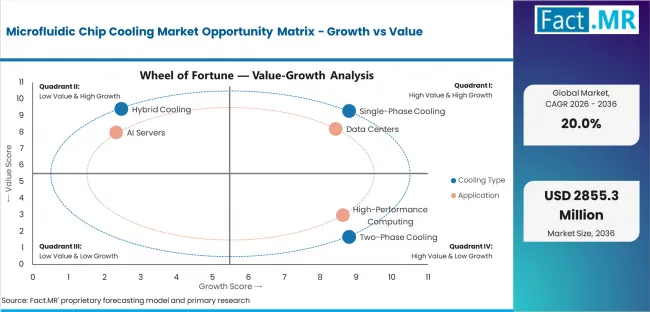
- Single-Phase Cooling dominates 60.8% of the cooling technology segment due to simpler implementation, reduced complexity, and efficient thermal management in AI servers and data center applications.
- Two-Phase Cooling holds 27.6% share, owing to better heat transfer rate, and escalating adoption in high-power GPU and HPC systems.
- Hybrid Cooling accounts 11.6% share for the cooling solution market and is anticipated to continue benefiting from a combination of air and liquid cooling technologies capable of addressing diversified cooling solutions requirements.
- Cold Plate / External Cooling holds 31.7% share of the integration type segment, it is popular for its easy installation and scalable implementation on the existing server hosts.
- On-Chip Cooling accounts for 26.4% share, supported by demand for direct hotspot cooling and high-end semiconductor package integration.
- In-Package Cooling has 22.8% share, due to Its increasing adoption in chiplet architectures and small form factor processor designs.
- Dielectric Fluids account for 29.6% share, supported by safe operation in direct-contact and immersion cooling systems.
- Geography and Competitive Outlook
- North America is considered as the best regional market due to existence of large hyperscale data center investments, AI chip leadership, leading semiconductor R&D and early liquid cooling adopters etc.
- East Asia: East Asia remains the fastest growing region, driven by strong semiconductor fabrication capacity, mature chip packaging ecosystems, huge electronics manufacturing capacity, and booming AI infrastructure.
- Western Europe: Western Europe has steady demand because of energy-efficient data center and industrial electronics innovation, automotive semiconductor applications, and sustainability related cooling solutions upgrades.
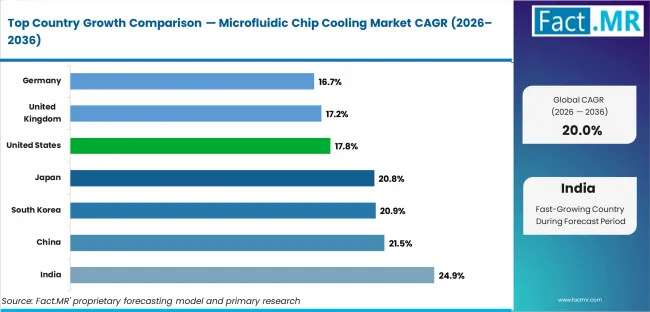
- China (21.5%), India (24.9%), and South Korea (20.9%) are the emerging markets with high growth potential, and United States (17.8%) and Germany (16.7%) are the mature markets with steady growth over the forecast duration.
- Vertiv, Schneider Electric, Microsoft, CoolIT Systems, LiquidStack, Corintis, TNO, and Frore Systems, among others, are the key players in the Microfluidic Chip Cooling Market..
- Analyst Opinion
- Shambhu Nath Jha, Principal Consultant at Fact.MR, says “The Microfluidic Chip Cooling Market is no longer defined only by conventional thermal management systems. Growth is more and more being propelled by AI processors, hyperscale data centers, and advanced semiconductor packaging especially as chip power densities increase and users are moving to liquid-based cooling solutions that provide better heat dissipation, higher energy efficiency and easier integration with next-generation computing infrastructure.
Microfluidic Chip Cooling Market— At a Glance
| Attribute | Details |
|---|---|
| Market Value 2025 | USD 384.3 million |
| Market Value 2026 | USD 461.1 million |
| Market Value 2036 | USD 2,855.3 million |
| Absolute Dollar Opportunity | USD 2,394 million |
| Total Growth | 519% |
| CAGR | 20.00% |
| Growth Multiple | 6.2x |
| Key Demand Theme | Rising demand for AI processors, GPUs, hyperscale data centers, and advanced semiconductor thermal management |
| Leading Application | Data Centers |
| Application Share | 30.80% |
| Leading Integration Type | Cold Plate / External Cooling |
| Integration Type Share | 31.70% |
| Leading Component Type | GPU |
| Component Share | 28.90% |
| Leading Coolant Type | Water-Based Coolants |
| Coolant Share | 34.80% |
| Key Growth Regions | East Asia, North America, South Asia & Pacific |
| Key Companies | Vertiv, Schneider Electric, Microsoft, CoolIT Systems, LiquidStack, Corintis |
| Segmentation by Cooling Technology | Single-Phase Cooling, Two-Phase Cooling, Hybrid Cooling |
| Segmentation by Integration Type | On-Chip Cooling, In-Package Cooling, Cold Plate / External Cooling, Rack-Level Cooling |
| Segmentation by Component Type | CPU, GPU, AI Accelerators / ASICs, Memory Chips, Power Electronics |
| Segmentation by Coolant Type | Water-Based Coolants, Dielectric Fluids, Engineered Fluids, Advanced Coolants |
| Segmentation by Application | Data Centers, High-Performance Computing, AI Servers, Telecom Equipment, Automotive Electronics, Consumer Electronics |
| Segmentation by Region | North America, Latin America, East Asia, South Asia & Pacific, Western Europe, Eastern Europe, Middle East & Africa |
Key Growth Drivers, Constraints, and Opportunities
Key Factors Driving Growth
- Demand for AI processors, GPUs and high-performance chips with thermal management needs that go beyond traditional air cooling is soaring.
- Increasing infiltration of hyperscale data centers, AI servers, and HPC clusters that are aiming at higher rack density with lower energy usage.
- Increasing utilization of microfluidic cooling techniques with high heat dissipation, hot-spot regulation, and higher chip efficiency.
Key Market Constraints
- High initial integration costs and complex redesign requirements can limit adoption, particularly in legacy server and semiconductor platforms.
- Reliability concerns related to fluid leakage, maintenance, and long-term operational stability may slow commercialization.
- Dependence on semiconductor investment cycles and enterprise capex spending can create uneven demand patterns.
Key Opportunity Areas
- Wider adoption in AI infrastructure, edge computing, telecom hardware, and autonomous electronics is expanding the addressable market.
- Advanced features such as two-phase cooling, smart sensors, real-time thermal monitoring, and modular cooling architectures create premium revenue opportunities.
- Demand for energy-efficient solutions that reduce power usage effectiveness (PUE) and operating costs supports long-term market growth.
| Growth Driver | Demand Impact | Time Horizon | Key Impact Area | Fact.MR Insight |
|---|---|---|---|---|
| Rising deployment of AI servers, GPUs, and high-power processors | High | Short-Mid Term | Adoption acceleration | Increasing processor heat density is directly driving demand for microfluidic chip cooling to maintain performance and reliability. |
| High energy cost of data centers + need for efficient thermal management | High | Short-Mid Term | Cost optimization & aftermarket expansion | Operators are adopting advanced chip cooling solutions to reduce power consumption, improve PUE, and lower cooling-related operating costs. |
| Shift toward chiplets, 3D packaging, and dense semiconductor architectures | High | Mid Term | Product innovation & OEM adoption | Demand is transitioning toward embedded cooling systems integrated into next-generation chip packages and server platforms. |
| Advancements in two-phase cooling, dielectric fluids, and smart thermal controls | Medium-High | Mid-Long Term | Product enhancement | Technology innovation is enabling superior heat transfer, lower maintenance, and premium cooling solutions for high-end computing systems. |
| Expansion of AI infrastructure in Asia and emerging data center regions | Medium | Short-Mid Term | Regional growth & accessibility | Semiconductor growth in Asia and rising digital infrastructure investments are improving commercialization opportunities and market penetration. |
Segment-wise Analysis of the Microfluidic Chip Cooling Market
- Cold Plate / External Cooling holds 31.7% of the integration type segment in 2026, supported by ease of deployment, compatibility with existing server infrastructure, and strong penetration across retrofit AI data center and HPC cooling environments.
- GPU accounts for 28.9% of the component type category in 2026, as market demand is heavily concentrated on cooling high-power graphics processors used in AI model training, inference workloads, and accelerated computing platforms.
- Water-Based Coolants represent 34.8% of the coolant type segment in 2026, driven by cost efficiency, high thermal conductivity, and widespread use in direct liquid cooling loops for servers and semiconductor systems.
Microfluidic chip cooling market is segmented on the basis of cooling technology, integration type, component type, coolant type, application, and region. By cooling technology, the market includes single-phase cooling, two-phase cooling and hybrid cooling. By integration type, it comprises on-chip cooling, in-package cooling, cold plate/external cooling and rack-level cooling. By component type, it caters to CPU, GPU, AI accelerators/ASICs, memory chips and power electronics. By Application, Data Centers dominate the segment with 30.8% share, however East Asia leads the regional demand due to semiconductor manufacturing aggregation and AI hardware deployment.
Cold plate systems and water-based coolant solutions are the most prevalent due to favorable trade-offs between cost, scalability and thermal capability, while on-chip cooling, two-phase systems, dielectric fluids, and AI accelerator-centric solutions are anticipated to spearhead new & future growth as chip power density and compute demand continue to soar.
Which Cooling Type Segment Dominates the Microfluidic Chip Cooling Market?
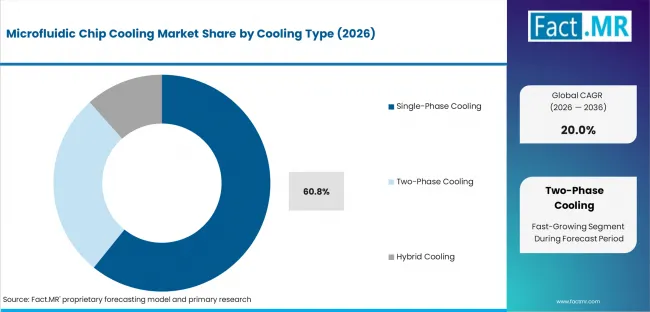
The cooling stage of the Microfluidic Chip Cooling Market is Cooling in a Single Phase, which captures the biggest market share and is estimated to hold around 60.8% of the overall market value in 2026. The pillars supporting this leadership are: simpler system, easier deployment, proven operational reliability and wide compatibility with existing liquid cooling infrastructure. Two-phase systems have yet to gain popularity in infrastructure hardware, as single-phase designs are still very dominant in AI servers, HPC systems, and enterprise data centers where they provide an efficient and cost-effective means of heat removal and scales well under increasing demand for compute.
Which Application Segment Dominates the Microfluidic Chip Cooling Market?
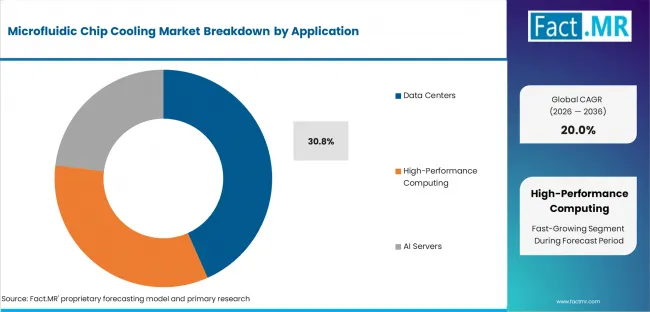
The Data Centers application is estimated to account for the largest market share of 30.8% in 2026 in the market. Increasing hyperscale cloud growth, increasing AI workload, and demand for high rack density are driving up adoption of advanced chip cooling solutions. Data centers are still focused on thermal efficiency, uptime, and reduced power usage effectiveness (PUE), and that is driving solid demand.
Which Integration Type Segment Dominates the Microfluidic Chip Cooling Market?
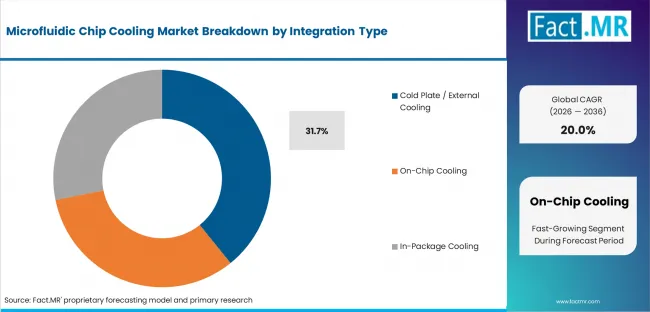
The Cold Plate/External Cooling is anticipated to account for 31.7% of the total market value by 2026. It is led by the fact that it can be retrofittable, has less barriers of integration, is easier to maintain and can be deployed in existing server and HPC environments. These designs provide a viable route for operators seeking to raise thermal performance levels without redesigning their chips or packages.
Which Component Type Segment Dominates the Microfluidic Chip Cooling Market?
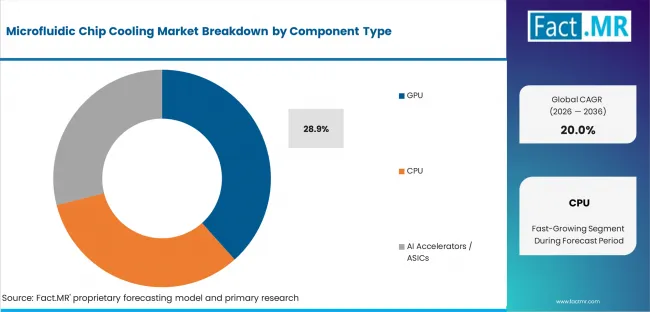
The GPU segment is expected to hold the largest share of the component category in 2026 with 28.9% of the market value. Growing utilization of GPUs for training and inference of AI models, graphics processing and accelerated computing results in high thermal load which necessitates sophisticated cooling technology. GPU-intense server clusters, for instance, continue to drive market growth.
Regional Outlook Across Key Markets
India leads with 24.9% CAGR, driven by data centers, AI adoption, semiconductor initiatives, and digital infrastructure. North America remains stable, with the United States at 17.8% supported by hyperscale cloud and AI chips, while Canada grows via HPC and data center upgrades. East Asia is highly attractive: China (21.5%) benefits from localization and manufacturing scale; Japan (20.8%) from advanced materials and thermal engineering; South Korea (20.9%) from memory and AI semiconductors. Europe shows steady demand, led by Germany (16.7%) and the United Kingdom (17.2%). South Asia & Pacific emerges strongly, driven by cloud expansion and electronics diversification.
.webp)
| Country | CAGR (2026 to 2036) (%) |
|---|---|
| India | 24.9% |
| China | 21.5% |
| Japan | 20.8% |
| South Korea | 20.9% |
| United States | 17.8% |
| United Kingdom | 17.2% |
| Germany | 16.7% |
Source: Fact.MR analysis, based on proprietary forecasting model and primary research.
North America – The AI Infrastructure Leadership Hub
North America is a mature, innovation-oriented market, with demand based on hyperscale data centers, AI processor deployment and energy-efficient thermal upgrades. Leaders including Vertiv, Schneider Electric, and Microsoft also have strong footing through their advanced cooling ecosystems and partnerships with servers. The area focuses on retrofit installations and second generation liquid cooling solutions.
- U.S.: The US leads with a 17.8% CAGR, driven by hyperscale data centers and AI chip leadership (NVIDIA). Strong demand from AI model training and early liquid cooling adoption creates a mature yet rapidly expanding market focused on high-performance computing and energy-efficient retrofits.
Western Europe – The Sustainability & Efficiency Driven Market
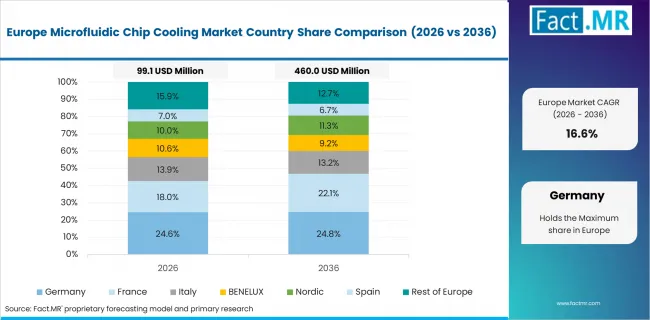
Western Europe is a technology-driven market where demand is shaped by carbon reduction targets, high-efficiency data centers, and innovation in industrial electronics. Industry leaders Schneider Electric, and Vertiv, are pioneers in integrated thermal solutions and sustainability-led infrastructure projects.
- Germany: Growing at 16.7% CAGR, Germany’s market is driven by sustainability targets, energy-efficient data centers, and industrial automotive electronics. Demand focuses on reducing Power Usage Effectiveness (PUE) and integrating advanced cooling into precision manufacturing and high-performance industrial systems.
East Asia – The Semiconductor Manufacturing Powerhouse
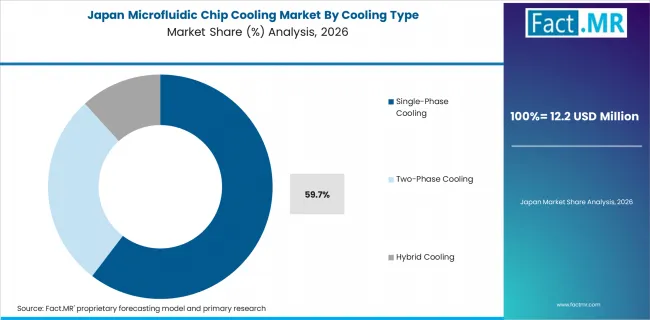
East Asia is the center of the global production, centered an advanced semiconductor fabs, packaging ecosystem, and electronics manufacturing mega factories. Major companies and ecosystems in China, Japan, South Korea and Taiwan dominate in chip production capacity and AI hardware supply chains.
- China: With a 21.5% CAGR, China is a high-growth market powered by massive semiconductor fabrication capacity, government AI infrastructure investments, and local electronics manufacturing. Rapid adoption is fueled by the need to cool domestic AI chips and hyperscale cloud expansion.
- Japan: Japan’s market grows at 20.8% CAGR, leveraging leadership in advanced materials, thermal engineering, and precision manufacturing. Demand is strong for innovative cooling solutions in robotics, high-performance computing, and next-generation consumer electronics, focusing on miniaturization and efficiency.
- South Korea: Achieving 20.9% CAGR, South Korea's market is propelled by memory semiconductor leadership (Samsung, SK Hynix) and AI chip development. High thermal density in advanced memory and logic chips drives urgent demand for embedded and two-phase microfluidic cooling solutions.
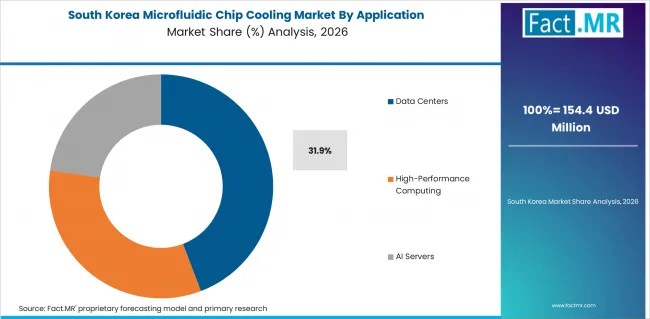
South Asia & Pacific – The High-Growth Digital Infrastructure Region
South Asia & Pacific is a high-growth emerging market benefiting from rapid cloud expansion, electronics manufacturing diversification, and increasing enterprise AI adoption. Regional players and global entrants are expanding data center footprints and thermal infrastructure investments.
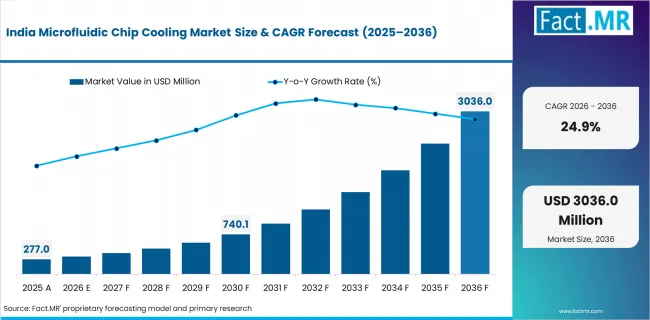
- India: The fastest-growing market at 24.9% CAGR, India’s growth is fueled by rapid cloud infrastructure expansion, new data center investments, and government semiconductor initiatives. Massive digitalization and rising AI adoption create strong demand for efficient, scalable chip cooling solutions.
Latin America – The Emerging Data Center Growth Market
Latin America represents an emerging demand center, supported by increasing colocation investments, enterprise digitization, and telecom modernization. Global cooling solution providers are strengthening presence through regional partnerships and distributor networks.
- Brazil: Growing at an 18.5% CAGR, Brazil represents an emerging market driven by increasing colocation data center investments, enterprise digitization, and telecom modernization. Growth is supported by regional partnerships and demand for reliable cooling in a warming climate.
Competitive Benchmarking and Company Positioning
Leading Companies Shaping the Microfluidic Chip Cooling Market
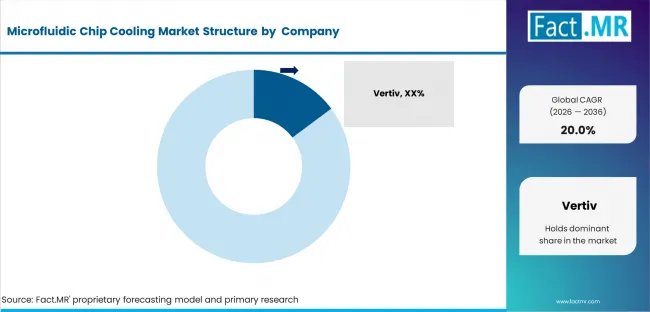
Microfluidic Chip Cooling Market is moderately fragmented with the major players like Vertiv, Schneider Electric, Microsoft, CoolIT Systems, LiquidStack included holding around 50–60% of the overall global market. Competition revolves around thermal efficiency, trade-off between scalability and integration capabilities, reliability, and the total cost of ownership.
Large infrastructure-focused players have established customer relationships, complete global service networks, and a strong footprint in hyperscale data centers, as well as enterprise cooling projects. Technology leaders including Microsoft, Corintis, TNO, and Frore Systems battle via proprietary chip-level cooling architectures, embedded microfluidics, and next generation thermal IP.
Recent Industry Developments
- CoolIT Systems launches three high-density Coolant Distribution Units for AI and HPC cooling applications (April 2025)
- CoolIT Systems introduced three high-density Coolant Distribution Units, expanding its liquid cooling portfolio with advanced thermal management solutions for AI servers, hyperscale data centers, and high-performance computing environments. [1]
- Ecolab to acquire CoolIT Systems to expand AI data center liquid cooling capabilities (March 2026)
- Ecolab announced a definitive agreement to acquire CoolIT Systems, strengthening its position in advanced liquid cooling technologies for next-generation AI data centers and high-density computing infrastructure. [5]
- CoolIT Systems achieves 4000W breakthrough for ultra-high wattage AI processors (December 2025)
- CoolIT Systems introduced a 4000W single-phase direct liquid cooling solution, redefining thermal management performance for ultra-high wattage AI processors and next-generation accelerated computing systems. [6]
Leading Companies Shaping the Microfluidic Chip Cooling Market
- Corintis
- Microsoft
- TNO
- Frore Systems
- CoolIT Systems
- LiquidStack
- Vertiv
- Schneider Electric
Sources and Research References
- [1] CoolIT Systems, “CoolIT Systems Launches Three High-Density Coolant Distribution Units,” July 2024
- [2] Vertiv, “Vertiv Expands Liquid Cooling Portfolio to Make North America AI Deployments Easier, Faster and More Cost Effective,” October 2024
- [3] Submer, “CleanSpark Selects Submer as Strategic Partner for AI Data Center Expansion,” October 2025
- [4] Vertiv, “Vertiv Announces Global Launch of Liquid Cooling Services Portfolio to Support Systems for AI and High-Density Compute Applications,” February 2025
- [5] Ecolab, “Ecolab to Acquire CoolIT Systems, a Global Leader in Advanced Liquid Cooling for Next-Gen AI Data Centers,” March 2026.
- [6] CoolIT Systems, “CoolIT Systems’ 4000W Breakthrough Redefining Single-Phase DLC for Ultra-High Wattage AI Processors,” March 2025.
Microfluidic Chip Cooling Market Definition
The microfluidic chip cooling market offers advanced thermal management products based on microchannel, liquid flow network (LFN), chip-level cooling (CLC) architectures and others, designed to dissipate heat from high-performance semiconductor devices where temperature control is key. It covers single-phase, two-phase, and hybrid cooling solutions at the on-chip, in-package, cold plate/external, and rack-level air flow, liquid flow, and air + liquid flow configurations for applications such as AI servers, datacenter, high performance computing systems, telecommunication equipment, automotive electronics, next-generation consumer devices.
Microfluidic Chip Cooling Market Inclusions
The global and regional market size of the microfluidic chip cooling market along with the market share analysis is provided in this report, and it is expected to expand at a CAGR of 20% from 2026 to 2036. It presents division by cooling technology, integration type, component type, coolant type, application, and region. The report also covers pricing analysis, growth trends, demand outlook across major regions, adoption rates in AI datacenters & semiconductors industries, and commercialization trends of advanced chip thermal management solutions.
Microfluidic Chip Cooling Market Exclusions
The scope does not include standard air cooling products, regular heat sinks, cooling fans, thermal interface materials or general rack HVAC solutions not specifically tailored for microfluidic chip cooling. It excludes data center facility cooling solutions, industrial liquid cooling systems, or unrelated refrigeration equipment. Over-the-counter protective coatings, passive thermal materials, and non-chip level thermal accessories are NOT included unless they have a direct application in microfluidic semiconductor cooling. This report is limited to dedicated microfluidic cooling products and systems and related applications in the semiconductor and high performance electronics markets.
Microfluidic Chip Cooling Market Research Methodology
- Primary Research
- In order to capture the live demand trends, technology adoption and pricing dynamics, interviews were taken with semiconductor cooling solution providers, microfluidic technology developers, data center operators, server OEMs, chip manufacturers, and thermal management experts for the AI, HPC and electronics industry.
- Desk Research
- The market size, trends and competitive environment were validated by secondary research including company annual reports, investor handbooks, patent analysis, semiconductor industry databases, government technology reports and trade publications.
- Market-Sizing and Forecasting
- To derive accurate estimates and forecasts, a mixed methodology of the bottom-up analysis (company revenues, installed cooling systems, deployments volumes) and top-down (semiconductor output, AI server shipments, DCC benchmarks, industry expenditure trends) was implemented.
- Data Validation and Update Cycle
- All market estimates were triangulated with industry stakeholders and domain experts, then periodically updated based on new product launches, AI infrastructure investments, semiconductor capacity additions, and macroeconomic indicators.
Scope of Analysis

Parameter |
Details |
|---|---|
| Quantitative Units | USD 461.1 million to USD 2,855.3 million, at a CAGR of 20.0% |
| Market Definition | The Microfluidic Chip Cooling Market covers advanced chip-level thermal management systems that use microchannels, liquid flow networks, and precision cooling architectures for heat dissipation across AI processors, GPUs, CPUs, ASICs, memory chips, and power electronics in data centers, HPC systems, telecom equipment, automotive electronics, and consumer devices. |
| Regions Covered | North America, Latin America, Western Europe, Eastern Europe, East Asia, South Asia & Pacific, Middle East & Africa |
| Countries Covered | USA, Canada, Mexico, UK, Germany, France, China, Japan, South Korea, Taiwan, India, Singapore, Brazil, Saudi Arabia, UAE, and 25+ countries |
| Key Companies | Vertiv, Schneider Electric, Microsoft, CoolIT Systems, LiquidStack, Corintis, TNO, Frore Systems |
| Forecast Period | 2026 to 2036 |
| Approach | Hybrid demand-side and top-down methodology built on country-level semiconductor output, AI server demand, data center expansion, pricing analysis, shipment validation, cooling deployment benchmarks, and primary interviews across OEMs, chipmakers, hyperscalers, cooling providers, and thermal engineering experts. |
Analysis by Cooling Technology, by Integration Type, by Component Type, by Coolant Type, by Application, and by Region
-
Microfluidic Chip Cooling Market By Cooling Technology
- Single-Phase Cooling
- Water Cooling
- Dielectric Liquid Cooling
- Two-Phase Cooling
- Boiling Microchannel Cooling
- Vapor Chamber Cooling
- Hybrid Cooling
- Air + Liquid Cooling
- Heat Pipe + Liquid Cooling
- Single-Phase Cooling
-
Microfluidic Chip Cooling Market By Integration Type
- On-Chip Cooling
- In-Package Cooling
- Cold Plate / External Cooling
- Rack-Level Cooling
-
Microfluidic Chip Cooling Market By Component Type
- CPU
- GPU
- AI Accelerators / ASICs
- Memory Chips
- Power Electronics
-
Microfluidic Chip Cooling Market By Coolant Type
- Water-Based Coolants
- Dielectric Fluids
- Engineered Fluids
- Advanced Coolants
-
Microfluidic Chip Cooling Market By Application
- Data Centers
- High-Performance Computing
- AI Servers
- Telecom Equipment
- Automotive Electronics
- Consumer Electronics
-
Microfluidic Chip Cooling Market By Region
- North America
- USA
- Canada
- Mexico
- Latin America
- Brazil
- Chile
- Rest of LATAM
- East Asia
- China
- Japan
- South Korea
- Taiwan
- South Asia & Pacific
- India
- Singapore
- Australia
- ASEAN
- Western Europe
- Germany
- France
- U.K.
- Italy
- Spain
- BENELUX
- Nordic
- Rest of W. Europe
- Eastern Europe
- Poland
- Hungary
- Czech Republic
- Balkan & Baltics
- Rest of E. Europe
- Middle East and Africa
- Kingdom of Saudi Arabia
- United Arab Emirates
- South Africa
- Rest of Middle East and Africa
- North America
- Frequently Asked Questions -
How large is the demand for Microfluidic Chip Cooling in the global market in 2025?
Demand for Microfluidic Chip Cooling in the global market is estimated to be valued at USD 384.3 million in 2025.
What will be the market size of Microfluidic Chip Cooling in the global market by 2036?
The market size for Microfluidic Chip Cooling is projected to reach USD 2,855.3 million by 2036.
What is the expected demand growth for Microfluidic Chip Cooling in the global market between 2026 and 2036?
Demand for Microfluidic Chip Cooling in the global market is expected to grow at a CAGR of 20.0% between 2026 and 2036, supported by rising AI infrastructure investments, growing chip power density, and increasing adoption of liquid cooling technologies.
Which cooling technology segment is expected to dominate the market?
Single-Phase Cooling is expected to dominate the market, accounting for 60.8% of the market share in 2026, driven by easier deployment, lower complexity, and broad compatibility with existing server cooling systems.
Which integration type segment is expected to lead the market?
Cold Plate / External Cooling is expected to lead the market, capturing 31.7% share in 2026, supported by retrofit compatibility and strong demand from data centers and HPC facilities.
Table of Content
- Microfluidic Chip Cooling Market - Executive Summary
- Market Overview
- Market Definition and Introduction
- Market Taxonomy/ Research Scope
- Global Microfluidic Chip Cooling Market Demand Analysis 2021-2025 and Forecast, 2026–2036
- Historical Market Volume Analysis, 2021-2025
- Current and Future Market Volume Forecast, 2026–2036
- Y-o-Y Growth Trend Analysis
- Global Microfluidic Chip Cooling Market - Pricing Analysis
- Product Category and Country-Level Pricing Analysis
- Global Average Pricing Analysis Benchmark
- Factors Influencing Pricing
- Cost Structure Analysis: Elementary Deep Dive
- Competitive Pricing Strategies
- Price Trends and Forecasts
- Historical price trends
- Future price forecasts
- Global Microfluidic Chip Cooling Market Demand Analysis 2021-2025 and Forecast, 2026–2036
- Historical Market Value Analysis, 2021-2025
- Current and Future Market Value Forecast, 2026–2036
- Y-o-Y Growth Trend Analysis
- Absolute $ Opportunity Analysis
- Market Background and Foundation Data
- Global Advanced Semiconductor Cooling Systems Market Outlook, 2024
- Market Size (US$ Mn)
- Growth Rate Analysis
- Key Demand Drivers
- Penetration of Microfluidic Chip Cooling in Global Advanced Semiconductor Cooling Systems Market
- Market Share (%)
- Adoption by Application
- Future Penetration Potential
- Recent Developments in Microfluidic Chip Cooling, by Market Players
- Product Launches
- Partnerships & Collaborations
- R&D Innovations
- Microfluidic Chip Cooling Production Analysis
- By Region
- By Key Companies
- Capacity Expansion Trends
- Investment Analysis, By Region
- North America
- Europe
- Asia-Pacific
- Venture Capital & Private Equity Trends
- Start-up Ecosystem Analysis, 2021–2025
- Total Number of Startups
- Emerging Start-ups
- Funding Trends
- Regional Presence
- Key Innovation Focus Areas
- Microfluidic Chip Cooling Market Opportunity Assessment
- Total Available Market (US$ Mn)
- Serviceable Addressable Market (US$ Mn)
- Serviceable Obtainable Market (US$ Mn)
- Porter’s Five Forces and PESTEL Analysis
- Investment Feasibility Analysis
- Macro-Economic Factors
- Forecast Factors - Relevance & Impact
- Industry Value and Supply Chain Analysis
- List of Key Channel Partners
- Profit Margin & Operating Margin at Each Node of Supply Chain.
- Notes on Value Added at Each Node in the Value Chain
- Factors Influencing Value Chain
- Market Dynamics
- Drivers
- Restraints
- Opportunity Analysis
- Key Regulations & Certifications
- Global Advanced Semiconductor Cooling Systems Market Outlook, 2024
- Global Microfluidic Chip Cooling Market Analysis 2021-2025 and Forecast 2026–2036, By Cooling Technology
- Introduction / Key Findings
- Market Size & Volume Analysis by Market Taxonomy, 2021–2036
- Single-Phase Cooling
- Water cooling
- Dielectric liquid cooling
- Two-Phase Cooling
- Boiling microchannel cooling
- Vapor chamber cooling
- Hybrid Cooling
- Air + liquid cooling
- Heat pipe + liquid cooling
- Single-Phase Cooling
- Market Attractiveness Analysis by Cooling Technology
- Global Microfluidic Chip Cooling Market Analysis 2021-2025 and Forecast 2026–2036, By Integration Type
- Introduction / Key Findings
- Market Size & Volume Analysis by Market Taxonomy, 2021–2036
- On-Chip Cooling
- In-Package Cooling
- Cold Plate / External Cooling
- Rack-Level Cooling
- Market Attractiveness Analysis by Integration Type
- Global Microfluidic Chip Cooling Market Analysis 2021-2025 and Forecast 2026–2036, By Component Type
- Introduction / Key Findings
- Market Size & Volume Analysis by Market Taxonomy, 2021–2036
- CPU
- GPU
- AI Accelerators / ASICs
- Memory Chips
- Power Electronics
- Market Attractiveness Analysis by Component Type
- Global Microfluidic Chip Cooling Market Analysis 2021-2025 and Forecast 2026–2036, By Coolant Type
- Introduction / Key Findings
- Market Size & Volume Analysis by Market Taxonomy, 2021–2036
- Water-Based Coolants
- Dielectric Fluids
- Engineered Fluids
- Advanced Coolants
- Market Attractiveness Analysis by Coolant Type
- Global Microfluidic Chip Cooling Market Analysis 2021-2025 and Forecast 2026–2036, By Application
- Introduction / Key Findings
- Market Size & Volume Analysis by Market Taxonomy, 2021–2036
- Data Centers
- High-Performance Computing
- AI Servers
- Telecom Equipment
- Automotive Electronics
- Consumer Electronics
- Market Attractiveness Analysis by Application
- Global Microfluidic Chip Cooling Market Analysis and Forecast, by Region
- Introduction / Key Findings
- Market Size & Volume Analysis by Market Taxonomy, 2021–2036
- North America
- Latin America
- Western Europe
- Eastern Europe
- East Asia
- South Asia & Pacific
- Middle East & Africa
- Market Attractiveness Analysis by Region
- North America Microfluidic Chip Cooling Market Analysis and Forecast
- Market Size & Volume Analysis by Market Taxonomy, 2021–2036
- By Country
- United States
- Canada
- Mexico
- By Taxonomy
- By Country
- Market Attractiveness Analysis By Country & Taxonomy
- Market Size & Volume Analysis by Market Taxonomy, 2021–2036
- Latin America Microfluidic Chip Cooling Market Analysis and Forecast
- Market Size & Volume Analysis by Market Taxonomy, 2021–2036
- By Country
- Brazil
- Chile
- Rest of LATAM
- By Taxonomy
- By Country
- Market Attractiveness Analysis By Country & Taxonomy
- Market Size & Volume Analysis by Market Taxonomy, 2021–2036
- Western Europe Microfluidic Chip Cooling Market Analysis and Forecast
- Market Size & Volume Analysis by Market Taxonomy, 2021–2036
- By Country
- Germany
- Italy
- France
- United kingdom
- Spain
- BENELUX
- Nordics
- Rest of Western Europe
- By Taxonomy
- By Country
- Market Attractiveness Analysis By Country & Taxonomy
- Market Size & Volume Analysis by Market Taxonomy, 2021–2036
- Eastern Europe Microfluidic Chip Cooling Market Analysis and Forecast
- Market Size & Volume Analysis by Market Taxonomy, 2021–2036
- By Country
- Russia
- Hungary
- Poland
- Balkan & Baltics
- Rest of Eastern Europe
- By Taxonomy
- By Country
- Market Attractiveness Analysis By Country & Taxonomy
- Market Size & Volume Analysis by Market Taxonomy, 2021–2036
- East Asia Microfluidic Chip Cooling Market Analysis and Forecast
- Market Size & Volume Analysis by Market Taxonomy, 2021–2036
- By Country
- China
- Japan
- South Korea
- By Taxonomy
- By Country
- Market Attractiveness Analysis By Country & Taxonomy
- Market Size & Volume Analysis by Market Taxonomy, 2021–2036
- South Asia & Pacific Microfluidic Chip Cooling Market Analysis and Forecast
- Market Size & Volume Analysis by Market Taxonomy, 2021–2036
- By Country
- India
- ASEAN
- Australia & New Zealand
- Rest of South Asia & Pacific
- By Taxonomy
- By Country
- Market Attractiveness Analysis By Country & Taxonomy
- Market Size & Volume Analysis by Market Taxonomy, 2021–2036
- Middle East & Africa Microfluidic Chip Cooling Market Analysis and Forecast
- Market Size & Volume Analysis by Market Taxonomy, 2021–2036
- By Country
- Kingdom of Saudi Arabia
- Other GCC Countries
- Turkiye
- South Africa
- Other African Union
- By Taxonomy
- By Country
- Market Attractiveness Analysis By Country & Taxonomy
- Market Size & Volume Analysis by Market Taxonomy, 2021–2036
- Country-level Microfluidic Chip Cooling Market Analysis and Forecast
- Introduction
- Market Value Proportion Analysis, By Key Countries
- Global Vs. Country Growth Comparison
- United States Microfluidic Chip Cooling Market Analysis
- Market Size & Volume Analysis by Market Taxonomy, 2021–2036
- By Cooling Technology
- By Integration Type
- By Component Type
- By Coolant Type
- By Application
- By GGG
- Market Size & Volume Analysis by Market Taxonomy, 2021–2036
-
- Canada Microfluidic Chip Cooling Market Analysis
- Mexico Microfluidic Chip Cooling Market Analysis
- Brazil Microfluidic Chip Cooling Market Analysis
- Chile Microfluidic Chip Cooling Market Analysis
- Germany Microfluidic Chip Cooling Market Analysis
- France Microfluidic Chip Cooling Market Analysis
- Italy Microfluidic Chip Cooling Market Analysis
- Spain Microfluidic Chip Cooling Market Analysis
- United Kingdom Microfluidic Chip Cooling Market Analysis
- BENELUX Microfluidic Chip Cooling Market Analysis
- Nordics Microfluidic Chip Cooling Market Analysis
- Poland Microfluidic Chip Cooling Market Analysis
- Russia Microfluidic Chip Cooling Market Analysis
- Hungary Microfluidic Chip Cooling Market Analysis
- Balkan & Baltics Microfluidic Chip Cooling Market Analysis
- China Microfluidic Chip Cooling Market Analysis
- Japan Microfluidic Chip Cooling Market Analysis
- South Korea Microfluidic Chip Cooling Market Analysis
- India Microfluidic Chip Cooling Market Analysis
- ASEAN Microfluidic Chip Cooling Market Analysis
- ANZ Microfluidic Chip Cooling Market Analysis
- KSA Microfluidic Chip Cooling Market Analysis
- Other GCC Countries Microfluidic Chip Cooling Market Analysis
- South Africa Microfluidic Chip Cooling Market Analysis
- Turkiye Microfluidic Chip Cooling Market Analysis
- Microfluidic Chip Cooling Market Structure Analysis
- Market Analysis by Tier of Companies
- Market Share Analysis of Top Players
- Market Space for New Brands and Dollar Opportunity
- Market Presence Analysis
- Regional Footprint of Players
- Product Footprint by Players
- Application Footprint by Players
- Microfluidic Chip Cooling Competition Analysis
- Competition Dashboard
- Pricing Analysis by Competition
- Competition Benchmarking
- Competition Deep Dive
- Corintis
- Overview
- Product Portfolio
- Sales Footprint
- Key Developments
- SWOT Analysis
- Strategy Overview
- Key Financials
- Microsoft
- TNO
- Frore Systems
- CoolIT Systems
- LiquidStack
- Vertiv
- Schneider Electric
- Other Prominent Players
- Corintis
- Primary Insights
- Assumption & Acronyms Used
- Research Methodology & Data Sources
- Introduction
List Of Table
- Table 1: Global Market Value (USD Mn) Forecast by Region, 2021 to 2036
- Table 2: Global Market Volume (Units) Forecast by Region, 2021 to 2036
- Table 3: Global Market Value (USD Mn) Forecast by Cooling Technology, 2021 to 2036
- Table 4: Global Market Volume (Units) Forecast by Cooling Technology, 2021 to 2036
- Table 5: Global Market Value (USD Mn) Forecast by Integration Type, 2021 to 2036
- Table 6: Global Market Volume (Units) Forecast by Integration Type, 2021 to 2036
- Table 7: Global Market Value (USD Mn) Forecast by Component Type, 2021 to 2036
- Table 8: Global Market Volume (Units) Forecast by Component Type, 2021 to 2036
- Table 9: Global Market Value (USD Mn) Forecast by Coolant Type, 2021 to 2036
- Table 10: Global Market Volume (Units) Forecast by Coolant Type, 2021 to 2036
- Table 11: Global Market Value (USD Mn) Forecast by Application, 2021 to 2036
- Table 12: Global Market Volume (Units) Forecast by Application, 2021 to 2036
- Table 13: North America Market Value (USD Mn) Forecast by Country, 2021 to 2036
- Table 14: North America Market Volume (Units) Forecast by Country, 2021 to 2036
- Table 15: North America Market Value (USD Mn) Forecast by Cooling Technology, 2021 to 2036
- Table 16: North America Market Volume (Units) Forecast by Cooling Technology, 2021 to 2036
- Table 17: North America Market Value (USD Mn) Forecast by Integration Type, 2021 to 2036
- Table 18: North America Market Volume (Units) Forecast by Integration Type, 2021 to 2036
- Table 19: North America Market Value (USD Mn) Forecast by Component Type, 2021 to 2036
- Table 20: North America Market Volume (Units) Forecast by Component Type, 2021 to 2036
- Table 21: North America Market Value (USD Mn) Forecast by Coolant Type, 2021 to 2036
- Table 22: North America Market Volume (Units) Forecast by Coolant Type, 2021 to 2036
- Table 23: North America Market Value (USD Mn) Forecast by Application, 2021 to 2036
- Table 24: North America Market Volume (Units) Forecast by Application, 2021 to 2036
- Table 25: Latin America Market Value (USD Mn) Forecast by Country, 2021 to 2036
- Table 26: Latin America Market Volume (Units) Forecast by Country, 2021 to 2036
- Table 27: Latin America Market Value (USD Mn) Forecast by Cooling Technology, 2021 to 2036
- Table 28: Latin America Market Volume (Units) Forecast by Cooling Technology, 2021 to 2036
- Table 29: Latin America Market Value (USD Mn) Forecast by Integration Type, 2021 to 2036
- Table 30: Latin America Market Volume (Units) Forecast by Integration Type, 2021 to 2036
- Table 31: Latin America Market Value (USD Mn) Forecast by Component Type, 2021 to 2036
- Table 32: Latin America Market Volume (Units) Forecast by Component Type, 2021 to 2036
- Table 33: Latin America Market Value (USD Mn) Forecast by Coolant Type, 2021 to 2036
- Table 34: Latin America Market Volume (Units) Forecast by Coolant Type, 2021 to 2036
- Table 35: Latin America Market Value (USD Mn) Forecast by Application, 2021 to 2036
- Table 36: Latin America Market Volume (Units) Forecast by Application, 2021 to 2036
- Table 37: Western Europe Market Value (USD Mn) Forecast by Country, 2021 to 2036
- Table 38: Western Europe Market Volume (Units) Forecast by Country, 2021 to 2036
- Table 39: Western Europe Market Value (USD Mn) Forecast by Cooling Technology, 2021 to 2036
- Table 40: Western Europe Market Volume (Units) Forecast by Cooling Technology, 2021 to 2036
- Table 41: Western Europe Market Value (USD Mn) Forecast by Integration Type, 2021 to 2036
- Table 42: Western Europe Market Volume (Units) Forecast by Integration Type, 2021 to 2036
- Table 43: Western Europe Market Value (USD Mn) Forecast by Component Type, 2021 to 2036
- Table 44: Western Europe Market Volume (Units) Forecast by Component Type, 2021 to 2036
- Table 45: Western Europe Market Value (USD Mn) Forecast by Coolant Type, 2021 to 2036
- Table 46: Western Europe Market Volume (Units) Forecast by Coolant Type, 2021 to 2036
- Table 47: Western Europe Market Value (USD Mn) Forecast by Application, 2021 to 2036
- Table 48: Western Europe Market Volume (Units) Forecast by Application, 2021 to 2036
- Table 49: Eastern Europe Market Value (USD Mn) Forecast by Country, 2021 to 2036
- Table 50: Eastern Europe Market Volume (Units) Forecast by Country, 2021 to 2036
- Table 51: Eastern Europe Market Value (USD Mn) Forecast by Cooling Technology, 2021 to 2036
- Table 52: Eastern Europe Market Volume (Units) Forecast by Cooling Technology, 2021 to 2036
- Table 53: Eastern Europe Market Value (USD Mn) Forecast by Integration Type, 2021 to 2036
- Table 54: Eastern Europe Market Volume (Units) Forecast by Integration Type, 2021 to 2036
- Table 55: Eastern Europe Market Value (USD Mn) Forecast by Component Type, 2021 to 2036
- Table 56: Eastern Europe Market Volume (Units) Forecast by Component Type, 2021 to 2036
- Table 57: Eastern Europe Market Value (USD Mn) Forecast by Coolant Type, 2021 to 2036
- Table 58: Eastern Europe Market Volume (Units) Forecast by Coolant Type, 2021 to 2036
- Table 59: Eastern Europe Market Value (USD Mn) Forecast by Application, 2021 to 2036
- Table 60: Eastern Europe Market Volume (Units) Forecast by Application, 2021 to 2036
- Table 61: East Asia Market Value (USD Mn) Forecast by Country, 2021 to 2036
- Table 62: East Asia Market Volume (Units) Forecast by Country, 2021 to 2036
- Table 63: East Asia Market Value (USD Mn) Forecast by Cooling Technology, 2021 to 2036
- Table 64: East Asia Market Volume (Units) Forecast by Cooling Technology, 2021 to 2036
- Table 65: East Asia Market Value (USD Mn) Forecast by Integration Type, 2021 to 2036
- Table 66: East Asia Market Volume (Units) Forecast by Integration Type, 2021 to 2036
- Table 67: East Asia Market Value (USD Mn) Forecast by Component Type, 2021 to 2036
- Table 68: East Asia Market Volume (Units) Forecast by Component Type, 2021 to 2036
- Table 69: East Asia Market Value (USD Mn) Forecast by Coolant Type, 2021 to 2036
- Table 70: East Asia Market Volume (Units) Forecast by Coolant Type, 2021 to 2036
- Table 71: East Asia Market Value (USD Mn) Forecast by Application, 2021 to 2036
- Table 72: East Asia Market Volume (Units) Forecast by Application, 2021 to 2036
- Table 73: South Asia and Pacific Market Value (USD Mn) Forecast by Country, 2021 to 2036
- Table 74: South Asia and Pacific Market Volume (Units) Forecast by Country, 2021 to 2036
- Table 75: South Asia and Pacific Market Value (USD Mn) Forecast by Cooling Technology, 2021 to 2036
- Table 76: South Asia and Pacific Market Volume (Units) Forecast by Cooling Technology, 2021 to 2036
- Table 77: South Asia and Pacific Market Value (USD Mn) Forecast by Integration Type, 2021 to 2036
- Table 78: South Asia and Pacific Market Volume (Units) Forecast by Integration Type, 2021 to 2036
- Table 79: South Asia and Pacific Market Value (USD Mn) Forecast by Component Type, 2021 to 2036
- Table 80: South Asia and Pacific Market Volume (Units) Forecast by Component Type, 2021 to 2036
- Table 81: South Asia and Pacific Market Value (USD Mn) Forecast by Coolant Type, 2021 to 2036
- Table 82: South Asia and Pacific Market Volume (Units) Forecast by Coolant Type, 2021 to 2036
- Table 83: South Asia and Pacific Market Value (USD Mn) Forecast by Application, 2021 to 2036
- Table 84: South Asia and Pacific Market Volume (Units) Forecast by Application, 2021 to 2036
- Table 85: Middle East & Africa Market Value (USD Mn) Forecast by Country, 2021 to 2036
- Table 86: Middle East & Africa Market Volume (Units) Forecast by Country, 2021 to 2036
- Table 87: Middle East & Africa Market Value (USD Mn) Forecast by Cooling Technology, 2021 to 2036
- Table 88: Middle East & Africa Market Volume (Units) Forecast by Cooling Technology, 2021 to 2036
- Table 89: Middle East & Africa Market Value (USD Mn) Forecast by Integration Type, 2021 to 2036
- Table 90: Middle East & Africa Market Volume (Units) Forecast by Integration Type, 2021 to 2036
- Table 91: Middle East & Africa Market Value (USD Mn) Forecast by Component Type, 2021 to 2036
- Table 92: Middle East & Africa Market Volume (Units) Forecast by Component Type, 2021 to 2036
- Table 93: Middle East & Africa Market Value (USD Mn) Forecast by Coolant Type, 2021 to 2036
- Table 94: Middle East & Africa Market Volume (Units) Forecast by Coolant Type, 2021 to 2036
- Table 95: Middle East & Africa Market Value (USD Mn) Forecast by Application, 2021 to 2036
- Table 96: Middle East & Africa Market Volume (Units) Forecast by Application, 2021 to 2036
List Of Figures
- Figure 1: Global Market Volume (Units) Forecast 2021–2036
- Figure 2: Global Market Pricing Analysis
- Figure 3: Global Market Value (USD Mn) Forecast 2021–2036
- Figure 4: Global Market Value Share and BPS Analysis by Cooling Technology, 2026 and 2036
- Figure 5: Global Market Y-o-Y Growth Comparison by Cooling Technology, 2026 to 2036
- Figure 6: Global Market Attractiveness Analysis by Cooling Technology
- Figure 7: Global Market Value Share and BPS Analysis by Integration Type, 2026 and 2036
- Figure 8: Global Market Y-o-Y Growth Comparison by Integration Type, 2026 to 2036
- Figure 9: Global Market Attractiveness Analysis by Integration Type
- Figure 10: Global Market Value Share and BPS Analysis by Component Type, 2026 and 2036
- Figure 11: Global Market Y-o-Y Growth Comparison by Component Type, 2026 to 2036
- Figure 12: Global Market Attractiveness Analysis by Component Type
- Figure 13: Global Market Value Share and BPS Analysis by Coolant Type, 2026 and 2036
- Figure 14: Global Market Y-o-Y Growth Comparison by Coolant Type, 2026 to 2036
- Figure 15: Global Market Attractiveness Analysis by Coolant Type
- Figure 16: Global Market Value Share and BPS Analysis by Application, 2026 and 2036
- Figure 17: Global Market Y-o-Y Growth Comparison by Application, 2026 to 2036
- Figure 18: Global Market Attractiveness Analysis by Application
- Figure 19: Global Market Value (USD Mn) Share and BPS Analysis by Region, 2026 and 2036
- Figure 20: Global Market Y-o-Y Growth Comparison by Region, 2026 to 2036
- Figure 21: Global Market Attractiveness Analysis by Region
- Figure 22: North America Market Incremental $ Opportunity, 2026 to 2036
- Figure 23: Latin America Market Incremental $ Opportunity, 2026 to 2036
- Figure 24: Western Europe Market Incremental $ Opportunity, 2026 to 2036
- Figure 25: Eastern Europe Market Incremental $ Opportunity, 2026 to 2036
- Figure 26: East Asia Market Incremental $ Opportunity, 2026 to 2036
- Figure 27: South Asia and Pacific Market Incremental $ Opportunity, 2026 to 2036
- Figure 28: Middle East & Africa Market Incremental $ Opportunity, 2026 to 2036
- Figure 29: North America Market Value Share and BPS Analysis by Country, 2026 and 2036
- Figure 30: North America Market Value Share and BPS Analysis by Cooling Technology, 2026 and 2036
- Figure 31: North America Market Y-o-Y Growth Comparison by Cooling Technology, 2026 to 2036
- Figure 32: North America Market Attractiveness Analysis by Cooling Technology
- Figure 33: North America Market Value Share and BPS Analysis by Integration Type, 2026 and 2036
- Figure 34: North America Market Y-o-Y Growth Comparison by Integration Type, 2026 to 2036
- Figure 35: North America Market Attractiveness Analysis by Integration Type
- Figure 36: North America Market Value Share and BPS Analysis by Component Type, 2026 and 2036
- Figure 37: North America Market Y-o-Y Growth Comparison by Component Type, 2026 to 2036
- Figure 38: North America Market Attractiveness Analysis by Component Type
- Figure 39: North America Market Value Share and BPS Analysis by Coolant Type, 2026 and 2036
- Figure 40: North America Market Y-o-Y Growth Comparison by Coolant Type, 2026 to 2036
- Figure 41: North America Market Attractiveness Analysis by Coolant Type
- Figure 42: North America Market Value Share and BPS Analysis by Application, 2026 and 2036
- Figure 43: North America Market Y-o-Y Growth Comparison by Application, 2026 to 2036
- Figure 44: North America Market Attractiveness Analysis by Application
- Figure 45: Latin America Market Value Share and BPS Analysis by Country, 2026 and 2036
- Figure 46: Latin America Market Value Share and BPS Analysis by Cooling Technology, 2026 and 2036
- Figure 47: Latin America Market Y-o-Y Growth Comparison by Cooling Technology, 2026 to 2036
- Figure 48: Latin America Market Attractiveness Analysis by Cooling Technology
- Figure 49: Latin America Market Value Share and BPS Analysis by Integration Type, 2026 and 2036
- Figure 50: Latin America Market Y-o-Y Growth Comparison by Integration Type, 2026 to 2036
- Figure 51: Latin America Market Attractiveness Analysis by Integration Type
- Figure 52: Latin America Market Value Share and BPS Analysis by Component Type, 2026 and 2036
- Figure 53: Latin America Market Y-o-Y Growth Comparison by Component Type, 2026 to 2036
- Figure 54: Latin America Market Attractiveness Analysis by Component Type
- Figure 55: Latin America Market Value Share and BPS Analysis by Coolant Type, 2026 and 2036
- Figure 56: Latin America Market Y-o-Y Growth Comparison by Coolant Type, 2026 to 2036
- Figure 57: Latin America Market Attractiveness Analysis by Coolant Type
- Figure 58: Latin America Market Value Share and BPS Analysis by Application, 2026 and 2036
- Figure 59: Latin America Market Y-o-Y Growth Comparison by Application, 2026 to 2036
- Figure 60: Latin America Market Attractiveness Analysis by Application
- Figure 61: Western Europe Market Value Share and BPS Analysis by Country, 2026 and 2036
- Figure 62: Western Europe Market Value Share and BPS Analysis by Cooling Technology, 2026 and 2036
- Figure 63: Western Europe Market Y-o-Y Growth Comparison by Cooling Technology, 2026 to 2036
- Figure 64: Western Europe Market Attractiveness Analysis by Cooling Technology
- Figure 65: Western Europe Market Value Share and BPS Analysis by Integration Type, 2026 and 2036
- Figure 66: Western Europe Market Y-o-Y Growth Comparison by Integration Type, 2026 to 2036
- Figure 67: Western Europe Market Attractiveness Analysis by Integration Type
- Figure 68: Western Europe Market Value Share and BPS Analysis by Component Type, 2026 and 2036
- Figure 69: Western Europe Market Y-o-Y Growth Comparison by Component Type, 2026 to 2036
- Figure 70: Western Europe Market Attractiveness Analysis by Component Type
- Figure 71: Western Europe Market Value Share and BPS Analysis by Coolant Type, 2026 and 2036
- Figure 72: Western Europe Market Y-o-Y Growth Comparison by Coolant Type, 2026 to 2036
- Figure 73: Western Europe Market Attractiveness Analysis by Coolant Type
- Figure 74: Western Europe Market Value Share and BPS Analysis by Application, 2026 and 2036
- Figure 75: Western Europe Market Y-o-Y Growth Comparison by Application, 2026 to 2036
- Figure 76: Western Europe Market Attractiveness Analysis by Application
- Figure 77: Eastern Europe Market Value Share and BPS Analysis by Country, 2026 and 2036
- Figure 78: Eastern Europe Market Value Share and BPS Analysis by Cooling Technology, 2026 and 2036
- Figure 79: Eastern Europe Market Y-o-Y Growth Comparison by Cooling Technology, 2026 to 2036
- Figure 80: Eastern Europe Market Attractiveness Analysis by Cooling Technology
- Figure 81: Eastern Europe Market Value Share and BPS Analysis by Integration Type, 2026 and 2036
- Figure 82: Eastern Europe Market Y-o-Y Growth Comparison by Integration Type, 2026 to 2036
- Figure 83: Eastern Europe Market Attractiveness Analysis by Integration Type
- Figure 84: Eastern Europe Market Value Share and BPS Analysis by Component Type, 2026 and 2036
- Figure 85: Eastern Europe Market Y-o-Y Growth Comparison by Component Type, 2026 to 2036
- Figure 86: Eastern Europe Market Attractiveness Analysis by Component Type
- Figure 87: Eastern Europe Market Value Share and BPS Analysis by Coolant Type, 2026 and 2036
- Figure 88: Eastern Europe Market Y-o-Y Growth Comparison by Coolant Type, 2026 to 2036
- Figure 89: Eastern Europe Market Attractiveness Analysis by Coolant Type
- Figure 90: Eastern Europe Market Value Share and BPS Analysis by Application, 2026 and 2036
- Figure 91: Eastern Europe Market Y-o-Y Growth Comparison by Application, 2026 to 2036
- Figure 92: Eastern Europe Market Attractiveness Analysis by Application
- Figure 93: East Asia Market Value Share and BPS Analysis by Country, 2026 and 2036
- Figure 94: East Asia Market Value Share and BPS Analysis by Cooling Technology, 2026 and 2036
- Figure 95: East Asia Market Y-o-Y Growth Comparison by Cooling Technology, 2026 to 2036
- Figure 96: East Asia Market Attractiveness Analysis by Cooling Technology
- Figure 97: East Asia Market Value Share and BPS Analysis by Integration Type, 2026 and 2036
- Figure 98: East Asia Market Y-o-Y Growth Comparison by Integration Type, 2026 to 2036
- Figure 99: East Asia Market Attractiveness Analysis by Integration Type
- Figure 100: East Asia Market Value Share and BPS Analysis by Component Type, 2026 and 2036
- Figure 101: East Asia Market Y-o-Y Growth Comparison by Component Type, 2026 to 2036
- Figure 102: East Asia Market Attractiveness Analysis by Component Type
- Figure 103: East Asia Market Value Share and BPS Analysis by Coolant Type, 2026 and 2036
- Figure 104: East Asia Market Y-o-Y Growth Comparison by Coolant Type, 2026 to 2036
- Figure 105: East Asia Market Attractiveness Analysis by Coolant Type
- Figure 106: East Asia Market Value Share and BPS Analysis by Application, 2026 and 2036
- Figure 107: East Asia Market Y-o-Y Growth Comparison by Application, 2026 to 2036
- Figure 108: East Asia Market Attractiveness Analysis by Application
- Figure 109: South Asia and Pacific Market Value Share and BPS Analysis by Country, 2026 and 2036
- Figure 110: South Asia and Pacific Market Value Share and BPS Analysis by Cooling Technology, 2026 and 2036
- Figure 111: South Asia and Pacific Market Y-o-Y Growth Comparison by Cooling Technology, 2026 to 2036
- Figure 112: South Asia and Pacific Market Attractiveness Analysis by Cooling Technology
- Figure 113: South Asia and Pacific Market Value Share and BPS Analysis by Integration Type, 2026 and 2036
- Figure 114: South Asia and Pacific Market Y-o-Y Growth Comparison by Integration Type, 2026 to 2036
- Figure 115: South Asia and Pacific Market Attractiveness Analysis by Integration Type
- Figure 116: South Asia and Pacific Market Value Share and BPS Analysis by Component Type, 2026 and 2036
- Figure 117: South Asia and Pacific Market Y-o-Y Growth Comparison by Component Type, 2026 to 2036
- Figure 118: South Asia and Pacific Market Attractiveness Analysis by Component Type
- Figure 119: South Asia and Pacific Market Value Share and BPS Analysis by Coolant Type, 2026 and 2036
- Figure 120: South Asia and Pacific Market Y-o-Y Growth Comparison by Coolant Type, 2026 to 2036
- Figure 121: South Asia and Pacific Market Attractiveness Analysis by Coolant Type
- Figure 122: South Asia and Pacific Market Value Share and BPS Analysis by Application, 2026 and 2036
- Figure 123: South Asia and Pacific Market Y-o-Y Growth Comparison by Application, 2026 to 2036
- Figure 124: South Asia and Pacific Market Attractiveness Analysis by Application
- Figure 125: Middle East & Africa Market Value Share and BPS Analysis by Country, 2026 and 2036
- Figure 126: Middle East & Africa Market Value Share and BPS Analysis by Cooling Technology, 2026 and 2036
- Figure 127: Middle East & Africa Market Y-o-Y Growth Comparison by Cooling Technology, 2026 to 2036
- Figure 128: Middle East & Africa Market Attractiveness Analysis by Cooling Technology
- Figure 129: Middle East & Africa Market Value Share and BPS Analysis by Integration Type, 2026 and 2036
- Figure 130: Middle East & Africa Market Y-o-Y Growth Comparison by Integration Type, 2026 to 2036
- Figure 131: Middle East & Africa Market Attractiveness Analysis by Integration Type
- Figure 132: Middle East & Africa Market Value Share and BPS Analysis by Component Type, 2026 and 2036
- Figure 133: Middle East & Africa Market Y-o-Y Growth Comparison by Component Type, 2026 to 2036
- Figure 134: Middle East & Africa Market Attractiveness Analysis by Component Type
- Figure 135: Middle East & Africa Market Value Share and BPS Analysis by Coolant Type, 2026 and 2036
- Figure 136: Middle East & Africa Market Y-o-Y Growth Comparison by Coolant Type, 2026 to 2036
- Figure 137: Middle East & Africa Market Attractiveness Analysis by Coolant Type
- Figure 138: Middle East & Africa Market Value Share and BPS Analysis by Application, 2026 and 2036
- Figure 139: Middle East & Africa Market Y-o-Y Growth Comparison by Application, 2026 to 2036
- Figure 140: Middle East & Africa Market Attractiveness Analysis by Application
- Figure 141: Global Market – Tier Structure Analysis
- Figure 142: Global Market – Company Share Analysis