Telecom Mounting Hardware Market (2026 - 2036)
Telecom Mounting Hardware Market is segmented by Component (Hardware, Software, and Services), Technology (5G, 4G/LTE, and 2G & 3G), Infrastructure (Wireless and Wired), End Use (Consumer Electronics, BFSI, Retail, and Media) and Region. Forecast for 2026 to 2036.
Core Findings
Telecom Mounting Hardware Market Forecast and Outlook 2026 to 2036
The telecom mounting hardware market reached an estimated USD 340.0 billion in 2025. According to Fact.MR, the market is projected to rise to USD 365.5 billion in 2026 and expand further to USD 753.3 billion by 2036, reflecting a steady CAGR of 7.5% over the forecast period.
Between 2026 and 2036, the sector is expected to create an absolute dollar opportunity of USD 413.3 billion. This growth is being fueled by two parallel infrastructure cycles. First, global 5G network densification is driving large-scale deployment of small cells, distributed antenna systems, and mid-band radios, all of which require new mounting frameworks. Second, many emerging markets are entering a 4G and LTE upgrade phase, replacing aging tower structures that are nearing the end of their operational lifespan. Together, these trends are reshaping long-term capital investment patterns across telecom infrastructure.
From the perspective of Steven Vondran, CEO of American Tower, "Leasing demand across our global tower portfolio and data center business remains robust, underpinned by sustained growth in mobile data consumption, continued 5G deployment, and increasing hybrid-cloud and AI-related workloads.’
Country growth rates reflect the maturity of 5G investment programmes and the scale of network densification pipelines. China leads at 10.5% CAGR, underpinned by the Ministry of Industry and Information Technology target of 38 5G base stations per 10,000 residents and a CNY 2.3 trillion infrastructure investment cycle. India follows at 9.8% as 469,000 base stations were installed during record-pace 5G rollout by Jio, Airtel, and Vi across 773 districts, demanding extensive new mounting structures. Germany posts 8.8% driven by Deutsche Telekom private network deployments and EU Connectivity Toolbox-compliant site rollout frameworks. France records 8.0% from ongoing multi-band rural densification under national broadband plan obligations. The United Kingdom grows at 7.5%, sustained by Shared Rural Network obligations and Ofcom spectrum licensing conditions that compel multi-operator mounting infrastructure investment.
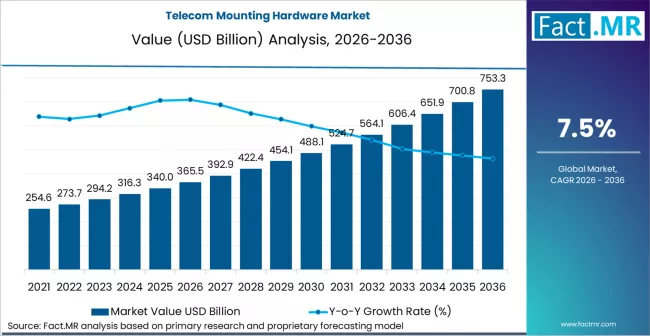
| Metric | Value |
|---|---|
| Estimated Value in 2026 | USD 365.5 billion |
| Forecast Value in 2036 | USD 753.3 billion |
| Forecast CAGR (2026 to 2036) | 7.5% |
Market Definition
The telecom mounting hardware market includes structural and mechanical products used to attach, support, and protect telecom equipment on towers, poles, rooftops, walls, and street infrastructure. It covers antenna mounts, pole concealments, enclosures, rack systems, cable management, grounding components, and load bearing structures.
Market Inclusions
The report analyzes global and regional revenues from 2026 to 2036 by component type, technology generation, infrastructure type, end use, and geography. It assesses 5G versus 4G pricing trends, small cell versus macrocell demand, and wireless versus wired infrastructure. Country forecasts include China, India, Germany, France, and the United Kingdom.
Market Exclusions
The study excludes antennas, radios, and base station electronics. Civil construction and tower foundation work are not included. Data centre racks outside telecom field deployments and pure software networking products are also excluded.
Research Methodology
- Primary Research: Interviews were conducted with tower procurement teams, carrier deployment managers, municipal officials, distributors, and structural engineers across key regions.
- Desk Research: Sources included Ericsson Mobility Reports, ITU policy documents, FCC auction data, MIIT 5G targets, Nokia and CommScope releases, and U.S. infrastructure programme records.
- Market Sizing and Forecasting: A hybrid model combined top down 5G deployment forecasts and capex disclosures with bottom up unit pricing and volume estimates by hardware category and infrastructure type.
- Data Validation and Update Cycle: Findings were verified against tower company reports, carrier earnings guidance, FCC and Ofcom data, and MIIT deployment updates. Forecasts are reviewed annually with quarterly capex monitoring.
Summary
- Market Definition
- Telecom mounting hardware includes structural and enclosure components used to install and protect telecom equipment across wireless and wired networks globally.
- Demand Drivers
- U.S. operators deploy 50,000 to 70,000 small cells annually, each requiring new pole mounts, enclosures, and cable systems.
- China’s MIIT set a target of 38 base stations per 10,000 residents in November 2024, driving sustained procurement by major carriers.
- Nokia’s USD 4 billion U.S. investment in 2025 and Ericsson’s global carrier presence signal long term scaling of mounting system supply chains.
- Key Segments Analyzed
- By Component: Hardware holds about 53.3% share in 2025, led by antenna mounts, enclosures, racks, and structural supports.
- By Technology: 5G represents roughly 48.2% of market value, driven by new small cell and macrocell mounting needs.
- By Infrastructure: Wireless infrastructure accounts for about 67% of value, supported by global network densification.
- By End Use: Consumer Electronics leads overall demand, while BFSI and Retail are fastest growing due to private 5G deployments.
- Analyst Opinion at FACT.MR
- Shambhu Nath Jha, Principal Consultant at Fact.MR, states that CXOs will find this report valuable for understanding how 5G small cell densification is creating new demand for pole mounted enclosures, multi band antenna mounts, and PIM mitigation accessories. He adds that the study identifies which suppliers are best positioned to capture the USD 413.3 billion absolute dollar opportunity through 2036.
- Strategic Implications / Executive Takeaways
- Mounting hardware manufacturers should expand RF transparent enclosure and concealment solutions for small cells, as municipalities increasingly require discreet pole mounted installations.
- Suppliers should design certified multi band antenna mounts that support both 4G LTE and 5G equipment, helping tower operators manage load requirements during technology overlap.
- Enterprise private networks offer the highest margin opportunity through 2036. Manufacturers should target BFSI, logistics, and manufacturing clients with customised indoor DAS and private 5G mounting systems aligned with building codes.
- Methodology
- Market sizing combined global base station forecasts with average hardware revenue per site, validated through tower capex disclosures and distributor interviews.
- Technology shares were benchmarked using spectrum data, carrier capex reports, and shipment volumes from tier one suppliers.
- Regional forecasts incorporated MIIT 5G targets, FCC permitting data, Ofcom rural deployment obligations, and India Department of Telecommunications milestones.
Segmental Analysis
Telecom Mounting Hardware Market Analysis by Component
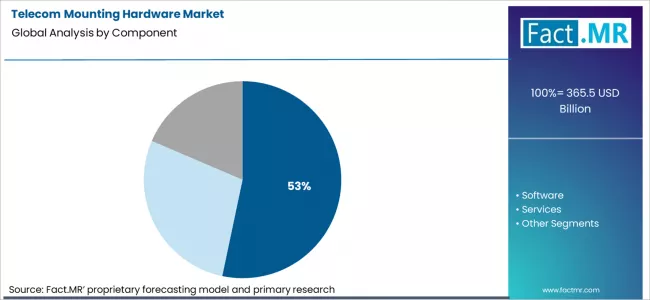
Hardware is projected to hold 53.3% share in 2025. Every deployment requires structural mounts, grounding systems, and cable management before services begin. This makes hardware the foundational revenue driver for each site.
- Valmont Telecom ConcealFab Side Enclosure Portfolio Launch: In December 2025, Valmont launched RF transparent pole mounted enclosures for 5G and fibre deployments. [2] The portfolio supports integrated radios, power, and backup systems, reflecting premium demand for concealment ready hardware.
- Valmont Site Pro 1 Heavy Duty Ring Mount Innovation: In November 2024, Valmont introduced reinforced ring mounts for heavier multi band 5G antennas. [6] These certified mounts address higher load requirements and command higher pricing than standard hardware.
- SOLiD Next Generation BTS Interface Unit for DAS Hardware: In December 2025, SOLiD unveiled its nBIU for multi operator DAS networks. [7] The unit increases fibre and RF capacity while reducing space needs, raising hardware value per venue.
Telecom Mounting Hardware Market Analysis by Technology
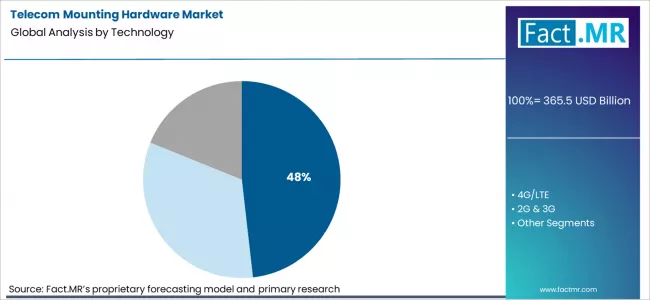
5G is expected to hold 48.2% share in 2025. Massive MIMO radios require stronger mounts and higher RF specification enclosures. As densification expands, 5G hardware revenue continues to outpace legacy systems.
- Ericsson 5G Factory and Mid Band Deployment Scale: Ericsson invested USD 50 million in its Texas 5G factory and reported 5G traffic rising from 34% in 2024 to 83% by 2031. [8][1] This growth supports long term demand for reinforced mounting systems.
- Nokia Massive MIMO Testing in Upper 6 GHz for 5G Advanced: In February 2025, Nokia tested upper 6 GHz massive MIMO radios for future deployments. Mid band spectrum remains dominant, sustaining structural demand for advanced antenna mounts.
- CommScope PowerShift LTE Hybrid 4G 5G Antenna Platform: In 2025, CommScope introduced hybrid antenna systems supporting co sited 4G and 5G equipment.
Drivers, Restraints, and Opportunities
Growth is now driven by 5G densification rather than traditional macrocell tower cycles. Earlier demand centered on standard steel tower mounts replaced over long intervals. The 5G phase requires hardware at street level, on poles, buildings, and indoor sites. Each location needs tailored, regulation compliant, and aesthetically integrated mounting solutions.
The defining challenge is speed versus structural precision. Operators are deploying tens of thousands of small cells every year, yet each site demands engineering validation, municipal approval, load certification, and RF compliant enclosure design. These requirements increase cost and extend timelines. However, they also create a competitive moat, enabling certified suppliers to command premium pricing while limiting participation from low cost commodity hardware providers.
- FCC Small Cell Order and Municipal Deployment Acceleration: The FCC Small Cell Order limits local barriers and caps permitting fees, supporting U.S. small cell growth. [3] Valmont Telecom launched its ConcealFab Side Enclosure line in December 2025 to meet municipal aesthetic rules. [2] With 50,000 to 70,000 annual U.S. deployments, mounting demand continues to compound.
- China MIIT 5G Density Mandate and Infrastructure Investment Scale: MIIT targets require 38 base stations per 10,000 residents and 75% 5G traffic share. [4] China’s USD 215 billion 5G investment drives large scale, multi operator mounting demand. Shared infrastructure models increase hardware volumes per site.
- Nokia USD 4 Billion U.S. Investment and Supply Chain Localisation: Nokia announced a USD 4 billion U.S. expansion in November 2025 to support domestic telecom infrastructure. [5] Combined with Ericsson and CommScope production, localisation strengthens supply security and favours regionally certified suppliers.
Regional Analysis
The telecom mounting hardware market is is segmented into North America, Latin America, Europe, East Asia, South Asia, Oceania and Middle East & Africa across 40+ countries. The full report also offers market attractiveness analysis based on regional trends.
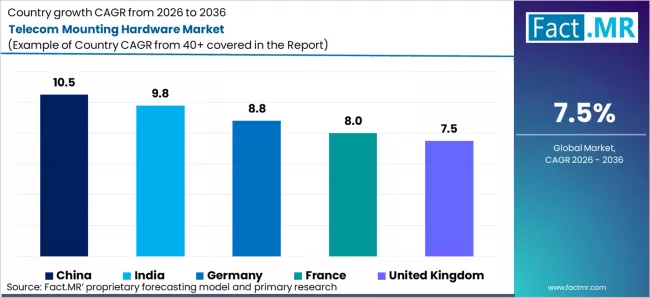
| Country | CAGR (2026 to 2036) |
|---|---|
| China | 10.5% |
| India | 9.8% |
| Germany | 8.8% |
| France | 8.0% |
| United Kingdom | 7.5% |
Source: Fact.MR (FACT.MR) analysis, based on proprietary forecasting model and primary research
Asia Pacific Telecom Mounting Hardware Market Analysis
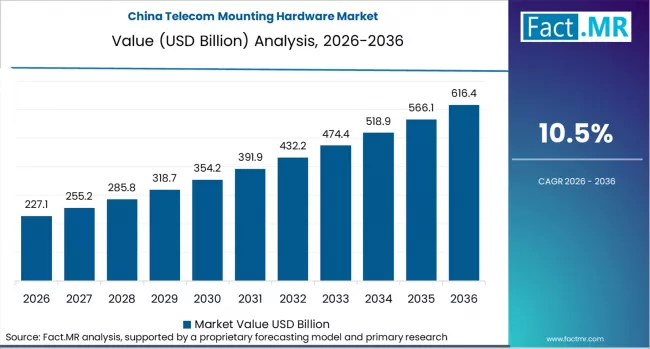
Asia Pacific leads global telecom mounting hardware volumes. Growth is driven by China’s mandated 5G densification and India’s rapid nationwide rollout. Huawei and ZTE support domestic deployments in China, while Ericsson and Nokia are strong across India, Japan, and South Korea.
- China: Demand in China is projected to grow at 10.5% CAGR through 2036. MIIT targets require 38 base stations per 10,000 residents and 75% 5G traffic penetration. [4] State owned carriers continue multi-billion-dollar infrastructure investment cycles. Shared tower models increase per site mounting complexity and revenue. China had invested about USD 215 billion in 5G by 2025, with 5G Advanced trials expanding in major cities.
- India: Demand in India is projected to rise at 9.8% CAGR through 2036. The country deployed 469,000 base stations across 773 districts at record pace. [4] Ericsson and Nokia support large scale RAN deployments for Airtel and Jio. Government reforms in 2025 accelerated spectrum processes and site approvals.
FACT.MR covers China, India, Japan, South Korea, Australia and New Zealand, ASEAN, and Rest of Asia Pacific. The report details density targets, carrier capex allocation, procurement trends, and infrastructure sharing regulations by country.
Europe Telecom Mounting Hardware Market Analysis
Europe sets structured standards for telecom infrastructure deployment. EU Connectivity Toolbox guidance and national regulations define permitting and aesthetic requirements. Ericsson and Nokia lead carrier grade mounting systems, while CommScope supplies DAS and cable management for enterprise clients. Demand is balanced between rural broadband expansion and urban 5G densification.
- Germany: Demand in Germany is projected to grow at 8.8% CAGR through 2036. Deutsche Telekom has expanded private 5G networks at industrial sites, requiring specialised indoor mounting hardware. [8] Regulatory updates in 2024 standardised site approvals, reducing deployment friction. Enterprise grade mounts and indoor DAS systems generate higher margins than traditional tower hardware.
- France: Demand in France is projected to rise at 8.0% CAGR through 2036. Rural coverage obligations under national broadband plans sustain macrocell tower demand. ARCEP regulations encourage shared site builds, increasing structural hardware volumes. Ericsson and Telia’s NorthStar collaboration in 2025 highlights private 5G integration trends.
- United Kingdom: Demand in the UK is projected to grow at 7.5% CAGR through 2036. The Shared Rural Network programme requires multi operator tower infrastructure, increasing per site hardware value. Ofcom mid band coverage obligations drive structural upgrades. Nokia’s global manufacturing expansion in 2025 supports supply continuity for UK operators.
FACT.MR covers Germany, France, United Kingdom, Italy, Spain, Netherlands, Nordics, and Rest of Europe. The report provides compliance timelines, broadband investment schedules, capex allocation insights, and enterprise network hardware adoption trends.
Competitive Aligners for Market Players
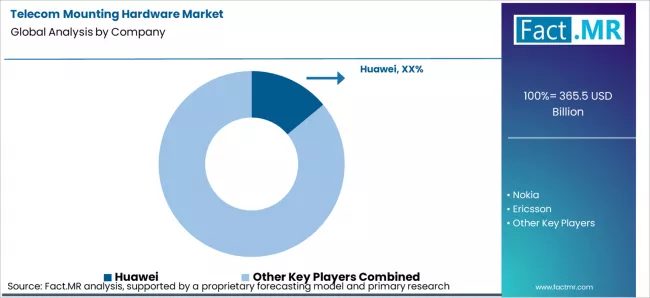
The global telecom mounting hardware market is moderately concentrated in the certified structural hardware tier and fragmented in basic brackets and fasteners. Valmont Industries, CommScope, and Amphenol lead in North America and Europe, where wind load ratings and municipal compliance are mandatory. In China, Huawei and ZTE dominate through tight integration with national carriers. Ericsson and Nokia bundle mounting systems with radio deployments across more than 100 countries. In this segment, certification and equipment compatibility matter more than price. Carriers prefer hardware engineered specifically for their deployed radio platforms.
Suppliers with strong structural engineering depth hold the greatest advantage. Valmont combines pole design, mount engineering, and concealment systems, giving it an edge in municipality approvals. Amphenol benefits from a broad connector, cable, and mounting portfolio that supports both wireless and wired deployments. CommScope leverages hybrid 4G and 5G platforms and DAS expertise to serve enterprise and stadium projects.
Buyer behaviour reflects structured procurement. Tower companies secure multi-year supply contracts, while carriers rely on approved vendor lists. Enterprise buyers make fewer but higher value purchases, requiring technical validation and certified load calculations before approval.
Recent Development
- In December 2025, Valmont Telecom introduced the ConcealFab Side Enclosure portfolio, featuring RF transparent pole mounted cabinets for 5G small cell and fibre deployments in North America, designed to meet municipal aesthetic standards and support large scale rollout.
- In November 2025, Nokia announced a USD 4 billion expansion of its U.S. R&D and manufacturing operations, strengthening support for BEAD funded broadband projects and domestic 5G infrastructure deployment.
Key Players
- Huawei
- Nokia
- Ericsson
- Cisco
- ZTE
- CommScope
- Amphenol
- Valmont Industries
- American Tower Corporation
- Ubicquia
- Ryse Energy
Scope of Report
| Items | Values |
|---|---|
| Quantitative Units | USD 365.5 billion (2026) to USD 753.3 billion (2036), at a CAGR of 7.5% |
| Market Definition | Telecom mounting hardware includes structural, mechanical, and enclosure products used to install and protect telecom equipment on towers, poles, rooftops, walls, and street infrastructure across wireless and wired networks. |
| Component Segmentation | Hardware, Software, Services |
| Technology Segmentation | 5G,4G/LTE, 2G & 3G |
| Infrastructure Segmentation | Wireless, Wired |
| End Use Segmentation | Consumer Electronics BFSI, Retail, Media |
| Application Coverage | 5G small cell pole attachment, macrocell tower mount and upgrade, distributed antenna system installation, private enterprise 5G indoor mounting, fibre-to-the-premises node enclosure, multi-operator shared tower hardware, municipal smart city infrastructure mounting |
| Regions Covered | Asia Pacific, Europe, North America, Latin America, Middle East and Africa |
| Countries Covered | China, India, Japan, South Korea, Australia and New Zealand, ASEAN, Rest of Asia Pacific, Germany, France, United Kingdom, Italy, Spain, Netherlands, Nordics, Rest of Europe, United States, Canada, Mexico, Brazil, Colombia, Argentina, Chile, Rest of Latin America, Kingdom of Saudi Arabia, United Arab Emirates, South Africa, Nigeria, Rest of Middle East and Africa |
| Key Companies Profiled | Huawei, Nokia, Ericsson, Cisco, ZTE, CommScope, Amphenol, Valmont Industries, American Tower Corporation, Ubicquia, Ryse Energy |
| Forecast Period | 2026 to 2036 |
| Approach | Hybrid top-down and bottom-up market modeling validated through primary interviews with resin producers and panel manufacturers, supported by trade data benchmarking and plant level capacity verification |
Telecom Mounting Hardware Market by Segment
-
By Component :
- Hardware
- Software
- Services
-
By Technology :
- 5G
- 4G/LTE
- 2G & 3G
-
By Infrastructure :
- Wireless
- Wired
-
By End Use :
- Consumer Electronics
- BFSI
- Retail
- Media
-
By Region :
- North America
- United States
- Canada
- Mexico
- Europe
- Germany
- France
- United Kingdom
- Italy
- Spain
- Netherlands
- Nordics
- Rest of Europe
- Asia Pacific
- China
- India
- Japan
- South Korea
- Australia and New Zealand
- ASEAN
- Rest of Asia Pacific
- Latin America
- Brazil
- Mexico
- Colombia
- Argentina
- Chile
- Rest of Latin America
- Middle East and Africa
- Kingdom of Saudi Arabia
- United Arab Emirates
- South Africa
- Nigeria
- Rest of Middle East and Africa
- North America
Bibliography
- [1] Ericsson AB. "Ericsson Mobility Report November 2024." Ericsson AB, November 2024.
- [2] Wireless Estimator. "Built for speed and performance: ConcealFab launches Side Enclosures for faster small cell rollouts." Wireless Estimator, December 17, 2025.
- [3] U.S. Federal Communications Commission. "Accelerating Wireless Broadband Deployment by Removing Barriers to Infrastructure Investment Small Cell Order (FCC 18-133)." FCC, September 2018 (reaffirmed through 2024 litigation).
- [4] Research Nester. "Global 5G Infrastructure Market: MIIT 5G Density Targets and China Deployment Data." Research Nester, November 2025.
- [5] Fierce Network. "Nokia ramps its U.S. operations with new $4B investment." Fierce Network, November 21, 2025.
- [6] Wireless Estimator. "New Valmont Site Pro 1 heavy duty ring mounts ensure antennas stay on the tower." Wireless Estimator, November 2024.
- [7] Globe Newswire. "In December 2025, SOLiD unveiled the next-generation BTS Interface Unit (nBIU) for its ALLIANCE 5G DAS platform." Globe Newswire, December 2025.
- [8] TeckNexus. "Ericsson TeckNexus 2024 Award for Private Network Excellence in Manufacturing USA 5G Smart Factory Lewisville Texas." TeckNexus, 2024.
This Report Addresses
- Market intelligence to enable structured strategic decision making across mature and emerging telecom infrastructure economies
- Market size estimation and 10-year revenue forecasts from 2026 to 2036, supported by validated tower count and capex benchmarks
- Growth opportunity mapping across macro towers, small cells, and smart poles with emphasis on 5G densification
- Segment and regional revenue forecasts covering wireless and wired infrastructure, hardware components, and installation services
- Competition strategy assessment including M&A consolidation models, cost survivability positioning, and smart city partnership benchmarking
- Product innovation tracking including wind-load engineered mounts, camouflaged concealment solutions, and renewable-integrated sites
- Regulatory impact analysis covering spectrum auction mandates, urban planning zoning laws, and infrastructure sharing policies
- Market report delivery in PDF, Excel, PPT, and interactive dashboard formats for executive and operational use
Table of Content
- Executive Summary
- Global Market Outlook
- Demand to side Trends
- Supply to side Trends
- Technology Roadmap Analysis
- Analysis and Recommendations
- Market Overview
- Market Coverage / Taxonomy
- Market Definition / Scope / Limitations
- Research Methodology
- Chapter Orientation
- Analytical Lens and Working Hypotheses
- Market Structure, Signals, and Trend Drivers
- Benchmarking and Cross-market Comparability
- Market Sizing, Forecasting, and Opportunity Mapping
- Research Design and Evidence Framework
- Desk Research Programme (Secondary Evidence)
- Company Annual and Sustainability Reports
- Peer-reviewed Journals and Academic Literature
- Corporate Websites, Product Literature, and Technical Notes
- Earnings Decks and Investor Briefings
- Statutory Filings and Regulatory Disclosures
- Technical White Papers and Standards Notes
- Trade Journals, Industry Magazines, and Analyst Briefs
- Conference Proceedings, Webinars, and Seminar Materials
- Government Statistics Portals and Public Data Releases
- Press Releases and Reputable Media Coverage
- Specialist Newsletters and Curated Briefings
- Sector Databases and Reference Repositories
- FMR Internal Proprietary Databases and Historical Market Datasets
- Subscription Datasets and Paid Sources
- Social Channels, Communities, and Digital Listening Inputs
- Additional Desk Sources
- Expert Input and Fieldwork (Primary Evidence)
- Primary Modes
- Qualitative Interviews and Expert Elicitation
- Quantitative Surveys and Structured Data Capture
- Blended Approach
- Why Primary Evidence is Used
- Field Techniques
- Interviews
- Surveys
- Focus Groups
- Observational and In-context Research
- Social and Community Interactions
- Stakeholder Universe Engaged
- C-suite Leaders
- Board Members
- Presidents and Vice Presidents
- R&D and Innovation Heads
- Technical Specialists
- Domain Subject-matter Experts
- Scientists
- Physicians and Other Healthcare Professionals
- Governance, Ethics, and Data Stewardship
- Research Ethics
- Data Integrity and Handling
- Primary Modes
- Tooling, Models, and Reference Databases
- Desk Research Programme (Secondary Evidence)
- Data Engineering and Model Build
- Data Acquisition and Ingestion
- Cleaning, Normalisation, and Verification
- Synthesis, Triangulation, and Analysis
- Quality Assurance and Audit Trail
- Market Background
- Market Dynamics
- Drivers
- Restraints
- Opportunity
- Trends
- Scenario Forecast
- Demand in Optimistic Scenario
- Demand in Likely Scenario
- Demand in Conservative Scenario
- Opportunity Map Analysis
- Product Life Cycle Analysis
- Supply Chain Analysis
- Investment Feasibility Matrix
- Value Chain Analysis
- PESTLE and Porter’s Analysis
- Regulatory Landscape
- Regional Parent Market Outlook
- Production and Consumption Statistics
- Import and Export Statistics
- Market Dynamics
- Global Market Analysis 2021 to 2025 and Forecast, 2026 to 2036
- Historical Market Size Value (USD Million) Analysis, 2021 to 2025
- Current and Future Market Size Value (USD Million) Projections, 2026 to 2036
- Y to o to Y Growth Trend Analysis
- Absolute $ Opportunity Analysis
- Global Market Pricing Analysis 2021 to 2025 and Forecast 2026 to 2036
- Global Market Analysis 2021 to 2025 and Forecast 2026 to 2036, By Component
- Introduction / Key Findings
- Historical Market Size Value (USD Million) Analysis By Component , 2021 to 2025
- Current and Future Market Size Value (USD Million) Analysis and Forecast By Component , 2026 to 2036
- Hardware
- Software
- Services
- Hardware
- Y to o to Y Growth Trend Analysis By Component , 2021 to 2025
- Absolute $ Opportunity Analysis By Component , 2026 to 2036
- Global Market Analysis 2021 to 2025 and Forecast 2026 to 2036, By Technology
- Introduction / Key Findings
- Historical Market Size Value (USD Million) Analysis By Technology, 2021 to 2025
- Current and Future Market Size Value (USD Million) Analysis and Forecast By Technology, 2026 to 2036
- 5G
- 4G/LTE
- 2G & 3G
- 5G
- Y to o to Y Growth Trend Analysis By Technology, 2021 to 2025
- Absolute $ Opportunity Analysis By Technology, 2026 to 2036
- Global Market Analysis 2021 to 2025 and Forecast 2026 to 2036, By Infrastructure
- Introduction / Key Findings
- Historical Market Size Value (USD Million) Analysis By Infrastructure, 2021 to 2025
- Current and Future Market Size Value (USD Million) Analysis and Forecast By Infrastructure, 2026 to 2036
- Wireless
- Wired
- Wireless
- Y to o to Y Growth Trend Analysis By Infrastructure, 2021 to 2025
- Absolute $ Opportunity Analysis By Infrastructure, 2026 to 2036
- Global Market Analysis 2021 to 2025 and Forecast 2026 to 2036, By Region
- Introduction
- Historical Market Size Value (USD Million) Analysis By Region, 2021 to 2025
- Current Market Size Value (USD Million) Analysis and Forecast By Region, 2026 to 2036
- North America
- Latin America
- Western Europe
- Eastern Europe
- East Asia
- South Asia and Pacific
- Middle East & Africa
- Market Attractiveness Analysis By Region
- North America Market Analysis 2021 to 2025 and Forecast 2026 to 2036, By Country
- Historical Market Size Value (USD Million) Trend Analysis By Market Taxonomy, 2021 to 2025
- Market Size Value (USD Million) Forecast By Market Taxonomy, 2026 to 2036
- By Country
- USA
- Canada
- Mexico
- By Component
- By Technology
- By Infrastructure
- By Country
- Market Attractiveness Analysis
- By Country
- By Component
- By Technology
- By Infrastructure
- Key Takeaways
- Latin America Market Analysis 2021 to 2025 and Forecast 2026 to 2036, By Country
- Historical Market Size Value (USD Million) Trend Analysis By Market Taxonomy, 2021 to 2025
- Market Size Value (USD Million) Forecast By Market Taxonomy, 2026 to 2036
- By Country
- Brazil
- Chile
- Rest of Latin America
- By Component
- By Technology
- By Infrastructure
- By Country
- Market Attractiveness Analysis
- By Country
- By Component
- By Technology
- By Infrastructure
- Key Takeaways
- Western Europe Market Analysis 2021 to 2025 and Forecast 2026 to 2036, By Country
- Historical Market Size Value (USD Million) Trend Analysis By Market Taxonomy, 2021 to 2025
- Market Size Value (USD Million) Forecast By Market Taxonomy, 2026 to 2036
- By Country
- Germany
- UK
- Italy
- Spain
- France
- Nordic
- BENELUX
- Rest of Western Europe
- By Component
- By Technology
- By Infrastructure
- By Country
- Market Attractiveness Analysis
- By Country
- By Component
- By Technology
- By Infrastructure
- Key Takeaways
- Eastern Europe Market Analysis 2021 to 2025 and Forecast 2026 to 2036, By Country
- Historical Market Size Value (USD Million) Trend Analysis By Market Taxonomy, 2021 to 2025
- Market Size Value (USD Million) Forecast By Market Taxonomy, 2026 to 2036
- By Country
- Russia
- Poland
- Hungary
- Balkan & Baltic
- Rest of Eastern Europe
- By Component
- By Technology
- By Infrastructure
- By Country
- Market Attractiveness Analysis
- By Country
- By Component
- By Technology
- By Infrastructure
- Key Takeaways
- East Asia Market Analysis 2021 to 2025 and Forecast 2026 to 2036, By Country
- Historical Market Size Value (USD Million) Trend Analysis By Market Taxonomy, 2021 to 2025
- Market Size Value (USD Million) Forecast By Market Taxonomy, 2026 to 2036
- By Country
- China
- Japan
- South Korea
- By Component
- By Technology
- By Infrastructure
- By Country
- Market Attractiveness Analysis
- By Country
- By Component
- By Technology
- By Infrastructure
- Key Takeaways
- South Asia and Pacific Market Analysis 2021 to 2025 and Forecast 2026 to 2036, By Country
- Historical Market Size Value (USD Million) Trend Analysis By Market Taxonomy, 2021 to 2025
- Market Size Value (USD Million) Forecast By Market Taxonomy, 2026 to 2036
- By Country
- India
- ASEAN
- Australia & New Zealand
- Rest of South Asia and Pacific
- By Component
- By Technology
- By Infrastructure
- By Country
- Market Attractiveness Analysis
- By Country
- By Component
- By Technology
- By Infrastructure
- Key Takeaways
- Middle East & Africa Market Analysis 2021 to 2025 and Forecast 2026 to 2036, By Country
- Historical Market Size Value (USD Million) Trend Analysis By Market Taxonomy, 2021 to 2025
- Market Size Value (USD Million) Forecast By Market Taxonomy, 2026 to 2036
- By Country
- Kingdom of Saudi Arabia
- Other GCC Countries
- Turkiye
- South Africa
- Other African Union
- Rest of Middle East & Africa
- By Component
- By Technology
- By Infrastructure
- By Country
- Market Attractiveness Analysis
- By Country
- By Component
- By Technology
- By Infrastructure
- Key Takeaways
- Key Countries Market Analysis
- USA
- Pricing Analysis
- Market Share Analysis, 2025
- By Component
- By Technology
- By Infrastructure
- Canada
- Pricing Analysis
- Market Share Analysis, 2025
- By Component
- By Technology
- By Infrastructure
- Mexico
- Pricing Analysis
- Market Share Analysis, 2025
- By Component
- By Technology
- By Infrastructure
- Brazil
- Pricing Analysis
- Market Share Analysis, 2025
- By Component
- By Technology
- By Infrastructure
- Chile
- Pricing Analysis
- Market Share Analysis, 2025
- By Component
- By Technology
- By Infrastructure
- Germany
- Pricing Analysis
- Market Share Analysis, 2025
- By Component
- By Technology
- By Infrastructure
- UK
- Pricing Analysis
- Market Share Analysis, 2025
- By Component
- By Technology
- By Infrastructure
- Italy
- Pricing Analysis
- Market Share Analysis, 2025
- By Component
- By Technology
- By Infrastructure
- Spain
- Pricing Analysis
- Market Share Analysis, 2025
- By Component
- By Technology
- By Infrastructure
- France
- Pricing Analysis
- Market Share Analysis, 2025
- By Component
- By Technology
- By Infrastructure
- India
- Pricing Analysis
- Market Share Analysis, 2025
- By Component
- By Technology
- By Infrastructure
- ASEAN
- Pricing Analysis
- Market Share Analysis, 2025
- By Component
- By Technology
- By Infrastructure
- Australia & New Zealand
- Pricing Analysis
- Market Share Analysis, 2025
- By Component
- By Technology
- By Infrastructure
- China
- Pricing Analysis
- Market Share Analysis, 2025
- By Component
- By Technology
- By Infrastructure
- Japan
- Pricing Analysis
- Market Share Analysis, 2025
- By Component
- By Technology
- By Infrastructure
- South Korea
- Pricing Analysis
- Market Share Analysis, 2025
- By Component
- By Technology
- By Infrastructure
- Russia
- Pricing Analysis
- Market Share Analysis, 2025
- By Component
- By Technology
- By Infrastructure
- Poland
- Pricing Analysis
- Market Share Analysis, 2025
- By Component
- By Technology
- By Infrastructure
- Hungary
- Pricing Analysis
- Market Share Analysis, 2025
- By Component
- By Technology
- By Infrastructure
- Kingdom of Saudi Arabia
- Pricing Analysis
- Market Share Analysis, 2025
- By Component
- By Technology
- By Infrastructure
- Turkiye
- Pricing Analysis
- Market Share Analysis, 2025
- By Component
- By Technology
- By Infrastructure
- South Africa
- Pricing Analysis
- Market Share Analysis, 2025
- By Component
- By Technology
- By Infrastructure
- USA
- Market Structure Analysis
- Competition Dashboard
- Competition Benchmarking
- Market Share Analysis of Top Players
- By Regional
- By Component
- By Technology
- By Infrastructure
- Competition Analysis
- Competition Deep Dive
- Huawei
- Overview
- Product Portfolio
- Profitability by Market Segments (Product/Age /Sales Channel/Region)
- Sales Footprint
- Strategy Overview
- Marketing Strategy
- Product Strategy
- Channel Strategy
- Nokia
- Ericsson
- Cisco
- ZTE
- CommScope
- Amphenol
- Huawei
- Competition Deep Dive
- Assumptions & Acronyms Used
List Of Table
- Table 1: Global Market Value (USD Million) Forecast by Region, 2021 to 2036
- Table 2: Global Market Value (USD Million) Forecast by Component , 2021 to 2036
- Table 3: Global Market Value (USD Million) Forecast by Technology, 2021 to 2036
- Table 4: Global Market Value (USD Million) Forecast by Infrastructure, 2021 to 2036
- Table 5: North America Market Value (USD Million) Forecast by Country, 2021 to 2036
- Table 6: North America Market Value (USD Million) Forecast by Component , 2021 to 2036
- Table 7: North America Market Value (USD Million) Forecast by Technology, 2021 to 2036
- Table 8: North America Market Value (USD Million) Forecast by Infrastructure, 2021 to 2036
- Table 9: Latin America Market Value (USD Million) Forecast by Country, 2021 to 2036
- Table 10: Latin America Market Value (USD Million) Forecast by Component , 2021 to 2036
- Table 11: Latin America Market Value (USD Million) Forecast by Technology, 2021 to 2036
- Table 12: Latin America Market Value (USD Million) Forecast by Infrastructure, 2021 to 2036
- Table 13: Western Europe Market Value (USD Million) Forecast by Country, 2021 to 2036
- Table 14: Western Europe Market Value (USD Million) Forecast by Component , 2021 to 2036
- Table 15: Western Europe Market Value (USD Million) Forecast by Technology, 2021 to 2036
- Table 16: Western Europe Market Value (USD Million) Forecast by Infrastructure, 2021 to 2036
- Table 17: Eastern Europe Market Value (USD Million) Forecast by Country, 2021 to 2036
- Table 18: Eastern Europe Market Value (USD Million) Forecast by Component , 2021 to 2036
- Table 19: Eastern Europe Market Value (USD Million) Forecast by Technology, 2021 to 2036
- Table 20: Eastern Europe Market Value (USD Million) Forecast by Infrastructure, 2021 to 2036
- Table 21: East Asia Market Value (USD Million) Forecast by Country, 2021 to 2036
- Table 22: East Asia Market Value (USD Million) Forecast by Component , 2021 to 2036
- Table 23: East Asia Market Value (USD Million) Forecast by Technology, 2021 to 2036
- Table 24: East Asia Market Value (USD Million) Forecast by Infrastructure, 2021 to 2036
- Table 25: South Asia and Pacific Market Value (USD Million) Forecast by Country, 2021 to 2036
- Table 26: South Asia and Pacific Market Value (USD Million) Forecast by Component , 2021 to 2036
- Table 27: South Asia and Pacific Market Value (USD Million) Forecast by Technology, 2021 to 2036
- Table 28: South Asia and Pacific Market Value (USD Million) Forecast by Infrastructure, 2021 to 2036
- Table 29: Middle East & Africa Market Value (USD Million) Forecast by Country, 2021 to 2036
- Table 30: Middle East & Africa Market Value (USD Million) Forecast by Component , 2021 to 2036
- Table 31: Middle East & Africa Market Value (USD Million) Forecast by Technology, 2021 to 2036
- Table 32: Middle East & Africa Market Value (USD Million) Forecast by Infrastructure, 2021 to 2036
List Of Figures
- Figure 1: Global Market Pricing Analysis
- Figure 2: Global Market Value (USD Million) Forecast 2021 to 2036
- Figure 3: Global Market Value Share and BPS Analysis by Component , 2026 and 2036
- Figure 4: Global Market Y to o to Y Growth Comparison by Component , 2026 to 2036
- Figure 5: Global Market Attractiveness Analysis by Component
- Figure 6: Global Market Value Share and BPS Analysis by Technology, 2026 and 2036
- Figure 7: Global Market Y to o to Y Growth Comparison by Technology, 2026 to 2036
- Figure 8: Global Market Attractiveness Analysis by Technology
- Figure 9: Global Market Value Share and BPS Analysis by Infrastructure, 2026 and 2036
- Figure 10: Global Market Y to o to Y Growth Comparison by Infrastructure, 2026 to 2036
- Figure 11: Global Market Attractiveness Analysis by Infrastructure
- Figure 12: Global Market Value (USD Million) Share and BPS Analysis by Region, 2026 and 2036
- Figure 13: Global Market Y to o to Y Growth Comparison by Region, 2026 to 2036
- Figure 14: Global Market Attractiveness Analysis by Region
- Figure 15: North America Market Incremental Dollar Opportunity, 2026 to 2036
- Figure 16: Latin America Market Incremental Dollar Opportunity, 2026 to 2036
- Figure 17: Western Europe Market Incremental Dollar Opportunity, 2026 to 2036
- Figure 18: Eastern Europe Market Incremental Dollar Opportunity, 2026 to 2036
- Figure 19: East Asia Market Incremental Dollar Opportunity, 2026 to 2036
- Figure 20: South Asia and Pacific Market Incremental Dollar Opportunity, 2026 to 2036
- Figure 21: Middle East & Africa Market Incremental Dollar Opportunity, 2026 to 2036
- Figure 22: North America Market Value Share and BPS Analysis by Country, 2026 and 2036
- Figure 23: North America Market Value Share and BPS Analysis by Component , 2026 and 2036
- Figure 24: North America Market Y to o to Y Growth Comparison by Component , 2026 to 2036
- Figure 25: North America Market Attractiveness Analysis by Component
- Figure 26: North America Market Value Share and BPS Analysis by Technology, 2026 and 2036
- Figure 27: North America Market Y to o to Y Growth Comparison by Technology, 2026 to 2036
- Figure 28: North America Market Attractiveness Analysis by Technology
- Figure 29: North America Market Value Share and BPS Analysis by Infrastructure, 2026 and 2036
- Figure 30: North America Market Y to o to Y Growth Comparison by Infrastructure, 2026 to 2036
- Figure 31: North America Market Attractiveness Analysis by Infrastructure
- Figure 32: Latin America Market Value Share and BPS Analysis by Country, 2026 and 2036
- Figure 33: Latin America Market Value Share and BPS Analysis by Component , 2026 and 2036
- Figure 34: Latin America Market Y to o to Y Growth Comparison by Component , 2026 to 2036
- Figure 35: Latin America Market Attractiveness Analysis by Component
- Figure 36: Latin America Market Value Share and BPS Analysis by Technology, 2026 and 2036
- Figure 37: Latin America Market Y to o to Y Growth Comparison by Technology, 2026 to 2036
- Figure 38: Latin America Market Attractiveness Analysis by Technology
- Figure 39: Latin America Market Value Share and BPS Analysis by Infrastructure, 2026 and 2036
- Figure 40: Latin America Market Y to o to Y Growth Comparison by Infrastructure, 2026 to 2036
- Figure 41: Latin America Market Attractiveness Analysis by Infrastructure
- Figure 42: Western Europe Market Value Share and BPS Analysis by Country, 2026 and 2036
- Figure 43: Western Europe Market Value Share and BPS Analysis by Component , 2026 and 2036
- Figure 44: Western Europe Market Y to o to Y Growth Comparison by Component , 2026 to 2036
- Figure 45: Western Europe Market Attractiveness Analysis by Component
- Figure 46: Western Europe Market Value Share and BPS Analysis by Technology, 2026 and 2036
- Figure 47: Western Europe Market Y to o to Y Growth Comparison by Technology, 2026 to 2036
- Figure 48: Western Europe Market Attractiveness Analysis by Technology
- Figure 49: Western Europe Market Value Share and BPS Analysis by Infrastructure, 2026 and 2036
- Figure 50: Western Europe Market Y to o to Y Growth Comparison by Infrastructure, 2026 to 2036
- Figure 51: Western Europe Market Attractiveness Analysis by Infrastructure
- Figure 52: Eastern Europe Market Value Share and BPS Analysis by Country, 2026 and 2036
- Figure 53: Eastern Europe Market Value Share and BPS Analysis by Component , 2026 and 2036
- Figure 54: Eastern Europe Market Y to o to Y Growth Comparison by Component , 2026 to 2036
- Figure 55: Eastern Europe Market Attractiveness Analysis by Component
- Figure 56: Eastern Europe Market Value Share and BPS Analysis by Technology, 2026 and 2036
- Figure 57: Eastern Europe Market Y to o to Y Growth Comparison by Technology, 2026 to 2036
- Figure 58: Eastern Europe Market Attractiveness Analysis by Technology
- Figure 59: Eastern Europe Market Value Share and BPS Analysis by Infrastructure, 2026 and 2036
- Figure 60: Eastern Europe Market Y to o to Y Growth Comparison by Infrastructure, 2026 to 2036
- Figure 61: Eastern Europe Market Attractiveness Analysis by Infrastructure
- Figure 62: East Asia Market Value Share and BPS Analysis by Country, 2026 and 2036
- Figure 63: East Asia Market Value Share and BPS Analysis by Component , 2026 and 2036
- Figure 64: East Asia Market Y to o to Y Growth Comparison by Component , 2026 to 2036
- Figure 65: East Asia Market Attractiveness Analysis by Component
- Figure 66: East Asia Market Value Share and BPS Analysis by Technology, 2026 and 2036
- Figure 67: East Asia Market Y to o to Y Growth Comparison by Technology, 2026 to 2036
- Figure 68: East Asia Market Attractiveness Analysis by Technology
- Figure 69: East Asia Market Value Share and BPS Analysis by Infrastructure, 2026 and 2036
- Figure 70: East Asia Market Y to o to Y Growth Comparison by Infrastructure, 2026 to 2036
- Figure 71: East Asia Market Attractiveness Analysis by Infrastructure
- Figure 72: South Asia and Pacific Market Value Share and BPS Analysis by Country, 2026 and 2036
- Figure 73: South Asia and Pacific Market Value Share and BPS Analysis by Component , 2026 and 2036
- Figure 74: South Asia and Pacific Market Y to o to Y Growth Comparison by Component , 2026 to 2036
- Figure 75: South Asia and Pacific Market Attractiveness Analysis by Component
- Figure 76: South Asia and Pacific Market Value Share and BPS Analysis by Technology, 2026 and 2036
- Figure 77: South Asia and Pacific Market Y to o to Y Growth Comparison by Technology, 2026 to 2036
- Figure 78: South Asia and Pacific Market Attractiveness Analysis by Technology
- Figure 79: South Asia and Pacific Market Value Share and BPS Analysis by Infrastructure, 2026 and 2036
- Figure 80: South Asia and Pacific Market Y to o to Y Growth Comparison by Infrastructure, 2026 to 2036
- Figure 81: South Asia and Pacific Market Attractiveness Analysis by Infrastructure
- Figure 82: Middle East & Africa Market Value Share and BPS Analysis by Country, 2026 and 2036
- Figure 83: Middle East & Africa Market Value Share and BPS Analysis by Component , 2026 and 2036
- Figure 84: Middle East & Africa Market Y to o to Y Growth Comparison by Component , 2026 to 2036
- Figure 85: Middle East & Africa Market Attractiveness Analysis by Component
- Figure 86: Middle East & Africa Market Value Share and BPS Analysis by Technology, 2026 and 2036
- Figure 87: Middle East & Africa Market Y to o to Y Growth Comparison by Technology, 2026 to 2036
- Figure 88: Middle East & Africa Market Attractiveness Analysis by Technology
- Figure 89: Middle East & Africa Market Value Share and BPS Analysis by Infrastructure, 2026 and 2036
- Figure 90: Middle East & Africa Market Y to o to Y Growth Comparison by Infrastructure, 2026 to 2036
- Figure 91: Middle East & Africa Market Attractiveness Analysis by Infrastructure
- Figure 92: Global Market - Tier Structure Analysis
- Figure 93: Global Market - Company Share Analysis
- FAQs -
How large is the telecom mounting hardware market in 2025?
The global telecom mounting hardware market reached USD 340.0 billion in 2025, driven by 5G densification and ongoing 4G LTE infrastructure upgrades worldwide.
What will the telecom mounting hardware market size be in 2026?
The market is estimated to grow to USD 365.5 billion in 2026, supported by small cell expansion in North America, China’s 5G mandates, and India’s rapid rollout.
What is the projected market size by 2036?
The market is projected to reach USD 753.3 billion by 2036, creating an absolute dollar opportunity of USD 413.3 billion between 2026 and 2036.
What is the expected CAGR from 2026 to 2036?
Fact.MR projects a 7.5% CAGR for the global telecom mounting hardware market during the 2026 to 2036 period.
What does Telecom Mounting Hardware Market mean in this report?
It refers to the global industry supplying structural and mechanical systems that physically connect telecom equipment to deployment sites.
What is included in the scope of this Telecom Mounting Hardware report?
The scope includes hardware components, installation services, and related planning software across wireless and wired infrastructure.
What is excluded from the scope of this report?
Active electronics such as radios and antennas are excluded unless integrated within a smart pole system.
What does market forecast mean on this page?
Market forecast refers to model based projections developed using defined assumptions for strategic planning.
Which component segment is poised to lead the telecom mounting hardware market?
Hardware leads with about 53.3% share, as structural mounting products are essential for every network site deployment.
Which technology segment holds the largest market share?
The 5G segment holds around 48.2% share in 2025 due to premium pricing of reinforced mounts and concealment systems for massive MIMO deployments.
Which country shows the fastest growth rate?
China is the fastest growing market at a projected 10.5% CAGR through 2036, supported by MIIT density targets and large scale 5G investment.