- Base Value(2025): 2.8 Bn
- Estimated Value(2026): 3.0 Bn
- Forecast Value (2036): 5.2 Bn
- CAGR (2026 - 2036): 5.7%
Mining Lubricants Market Analysis and Forecast by Fact.MR
- The global market for mining lubricants is estimated at USD 3.13 billion in 2026 and has been forecast to expand at a CAGR of 5.7% to reach USD 5.45 billion by 2036.
- The mining lubricants category includes hydraulic oils, gear oils, engine oils configurations across surface mining, underground mining, mineral processing specifications.
- Demand is shaped by end-use requirements spanning industrial, commercial, and institutional applications.
- Growth is supported by equipment modernization, regulatory compliance, and expanding capacity in emerging markets, with technology improvements continuing to influence specification requirements and replacement cycles across the installed base.
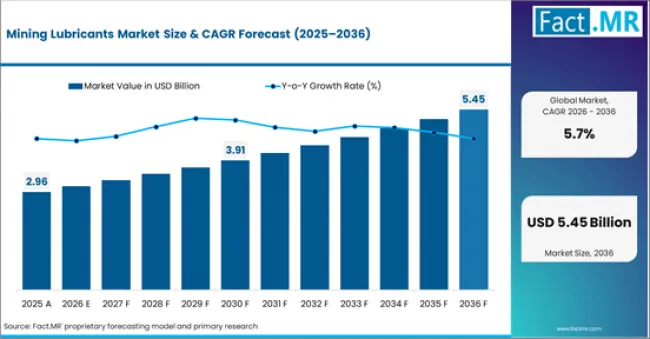
Mining Lubricants Market Value Analysis | Source: Fact.MR
Summary of the Mining Lubricants Market
- Market Snapshot
- In 2025, the global Mining Lubricants Market was valued at approximately USD 2.96 billion.
- The market is estimated to reach USD 3.13 billion in 2026 and is projected to attain USD 5.45 billion by 2036.
- The mining lubricants market is likely to expand at a CAGR of 5.7% during the forecast period.
- The market is anticipated to create an absolute dollar opportunity of USD 2.32 billion between 2026 and 2036.
- Hydraulic Oils accounts for 32% of lubricant type share in 2026.
- China (6.8%) and India (6.4%) are the key growth markets during the forecast period.
- Demand and Growth Drivers
- Increasing adoption of energy-efficient and low-maintenance alternatives is supporting equipment replacement cycles across industrial operations.
- Expansion of water, wastewater, and utility infrastructure in emerging markets is creating sustained procurement pipelines.
- Growing demand from food processing, chemical, and pharmaceutical sectors is broadening the installed base beyond traditional industrial buyers.
- Tightening environmental and noise regulations are accelerating the shift toward advanced technology platforms.
- Integration of remote monitoring, IoT-based controls, and predictive maintenance capabilities is influencing procurement specifications.
- Product and Segment View
- Hydraulic Oils accounts for 32% of the lubricant type segment in 2026, supported by sustained demand from established end-use applications and operational requirements.
- Surface Mining accounts for 38% of the application sector segment in 2026, supported by sustained demand from established end-use applications and operational requirements.
- Mineral Oil accounts for 44% of the base oil type segment in 2026, supported by sustained demand from established end-use applications and operational requirements.
- Key segmentation includes:
- Lubricant Type: Hydraulic Oils, Gear Oils, Engine Oils, Greases, Other Lubricant Configurations
- Application Sector: Surface Mining, Underground Mining, Mineral Processing, Equipment Maintenance, Others
- Base Oil Type: Mineral Oil, Synthetic Oil, Bio Based Oil, Semi Synthetic Oil, Other Base Platforms
- Mining Method: Open Pit Mining, Underground Mining, Placer Mining, Other Extraction Services
- These systems enable:
- Performance optimization across multiple operating conditions and load requirements.
- Remote monitoring and data-driven maintenance scheduling through connected platforms.
- Compliance with evolving regulatory and efficiency standards in target applications.
- Geography and Competitive Outlook
- North America remains a large demand base supported by mature industrial infrastructure, established distribution channels, and ongoing replacement and upgrade cycles across key end-use sectors.
- Europe shows stable demand supported by energy efficiency regulations, advanced manufacturing requirements, and growing adoption of high-specification products.
- Asia Pacific is the fastest-growing region, led by China (6.8%) and India (6.4%), supported by industrial expansion, infrastructure investment, and capacity additions.
- Key companies active in the market include Exxon Mobil Corporation, Shell plc, Chevron Corporation, TotalEnergies SE, BP plc, Castrol Limited, Valvoline Inc., Fuchs Petrolub SE.
- Analyst Opinion
- Shambhu Nath Jha, Principal Consultant at Fact.MR, says 'The mining lubricants market is moving beyond volume-driven growth toward value-led expansion. Buyers are increasingly specifying products based on lifecycle cost, energy efficiency, and integration capability rather than upfront price alone. This shift is favoring suppliers with stronger technical portfolios and aftermarket service networks. Demand in China and India reflects structural capacity additions rather than one-time procurement cycles, which supports sustained growth through the forecast period.'
Key Growth Drivers, Constraints, and Opportunities
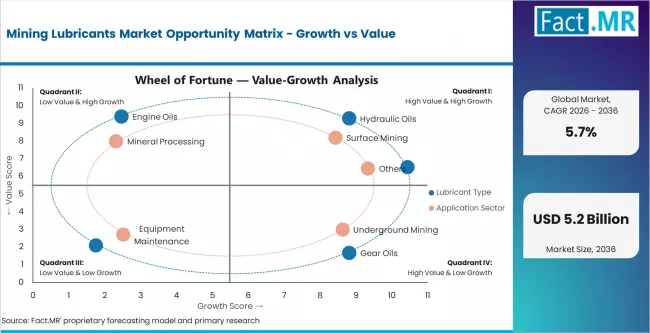
Mining Lubricants Market Opportunity Matrix Growth Vs Value | Source: Fact.MR
Key Factors Driving Growth
- Increasing adoption of energy-efficient and low-maintenance alternatives is supporting equipment replacement cycles across industrial operations.
- Expansion of water, wastewater, and utility infrastructure in emerging markets is creating sustained procurement pipelines.
- Growing demand from food processing, chemical, and pharmaceutical sectors is broadening the installed base beyond traditional industrial buyers.
Key Market Constraints
- High upfront capital costs for advanced models continue to limit adoption among smaller operators and price-sensitive buyers.
- Fragmented aftermarket and service infrastructure in emerging markets creates maintenance challenges and increases total cost of ownership.
- Supply chain constraints for specialty components and raw materials can extend lead times and affect production scheduling.
Key Opportunity Areas
- Expansion into adjacent applications beyond traditional use cases is widening the addressable market for existing product platforms.
- Subscription-based service models tied to monitoring, maintenance, and performance optimization are creating recurring revenue opportunities.
- Growing demand in Asia Pacific and Latin America is providing above-average growth rates relative to mature markets.
Segment-wise Analysis of the Mining Lubricants Market
- Hydraulic Oils holds 32% of the lubricant type segment in 2026, supported by its established demand base, operational relevance, and continued preference among core buyer groups.
- Surface Mining holds 38% of the application sector segment in 2026, supported by its established demand base, operational relevance, and continued preference among core buyer groups.
- Mineral Oil holds 44% of the base oil type segment in 2026, supported by its established demand base, operational relevance, and continued preference among core buyer groups.
The mining lubricants market is segmented by lubricant type, application sector, base oil type, mining method, equipment type, and region. Hydraulic Oils leads the lubricant type segment by value in the near term based on its installed base and broad applicability, while emerging specifications are expected to drive the next phase of growth as buyer requirements evolve.
Which Lubricant Type Segment Dominates the Mining Lubricants Market?
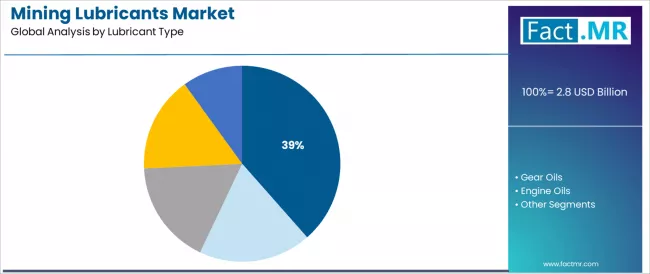
Mining Lubricants Market Analysis By Lubricant Type | Source: Fact.MR
Hydraulic Oils is estimated to account for 32% of the lubricant type segment in 2026. This leadership is supported by the established demand base across core applications, proven operational track record, and broad suitability for standard and high-volume requirements. The segment benefits from wide availability through established distribution channels and strong familiarity among procurement teams.
Gear Oils follows as the second-largest segment, with demand shaped by specific operational requirements and growing adoption in newer applications. Growth in this segment reflects shifting buyer preferences and expanding use cases that favor its technical characteristics over traditional alternatives.
Which Application Sector Segment Dominates the Mining Lubricants Market?
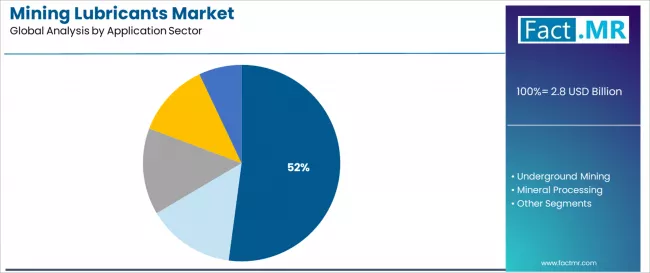
Mining Lubricants Market Analysis By Application Sector | Source: Fact.MR
Surface Mining is estimated to account for 38% of the application sector segment in 2026. This leadership is supported by the established demand base across core applications, proven operational track record, and broad suitability for standard and high-volume requirements. The segment benefits from wide availability through established distribution channels and strong familiarity among procurement teams.
Underground Mining follows as the second-largest segment, with demand shaped by specific operational requirements and growing adoption in newer applications. Growth in this segment reflects shifting buyer preferences and expanding use cases that favor its technical characteristics over traditional alternatives.
Which Base Oil Type Segment Dominates the Mining Lubricants Market?
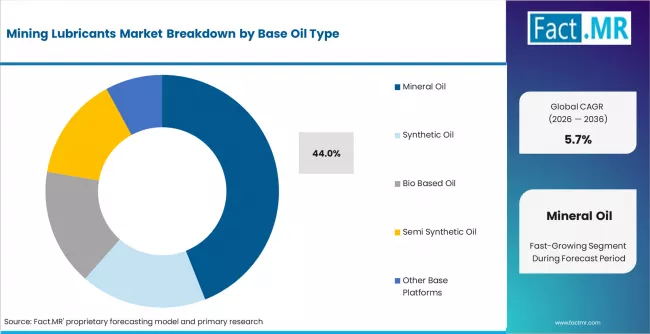
Mining Lubricants Market Analysis By Base Oil Type | Source: Fact.MR
Mineral Oil is estimated to account for 44% of the base oil type segment in 2026. This leadership is supported by the established demand base across core applications, proven operational track record, and broad suitability for standard and high-volume requirements. The segment benefits from wide availability through established distribution channels and strong familiarity among procurement teams.
Synthetic Oil follows as the second-largest segment, with demand shaped by specific operational requirements and growing adoption in newer applications. Growth in this segment reflects shifting buyer preferences and expanding use cases that favor its technical characteristics over traditional alternatives.
Which Product Trend is Shaping the Next Phase of Growth in the Mining Lubricants Market?
Gear Oils is not yet the largest lubricant type segment, but it is emerging as one of the faster-growing parts of the market. Its share is projected to rise as more buyers shift toward specifications that offer improved performance, lower lifecycle costs, and better integration with modern operational requirements. This trend is most visible in markets where new installations dominate over replacement demand.
The shift toward gear oils reflects a broader change in buyer expectations. End users increasingly prioritize total cost of ownership, operational flexibility, and compliance readiness over upfront cost. As a result, higher-specification products are moving from a premium niche into a more central growth driver for the category, particularly in markets where industrial capacity is expanding and procurement standards are tightening.
Regional Outlook Across Key Markets
.webp "Top Country Growth Comparison Mining Lubricants Market Cagr (2026 2036)")
Top Country Growth Comparison Mining Lubricants Market Cagr (2026 2036) | Source: Fact.MR
- China is projected to grow at 6.8% CAGR, supported by its position as the largest global demand source for hydraulic oils, domestic OEM cost advantages, and industrial upgrading investment across surface mining.
- India is projected to grow at 6.4% CAGR, supported by government infrastructure spending, growing surface mining capacity, and increasing domestic manufacturing of hydraulic oils.
- South Korea is projected to grow at 5.9% CAGR, driven by high-technology surface mining sector demand, quality and after-sales support priorities, and smart manufacturing investment.
- Brazil is projected to grow at 5.8% CAGR, supported by national infrastructure programs, growing surface mining activity, and improving local assembly capability for hydraulic oils.
CAGR Table
| Country | CAGR (%) |
|---|---|
| China | 6.8% |
| India | 6.4% |
| South Korea | 5.9% |
| Brazil | 5.8% |
| USA | 5.2% |
| Germany | 4.9% |
Source: Fact.MR analysis. Updated May 26, 2026
Source: Fact MR (FMR) analysis, based on proprietary forecasting model and primary research.
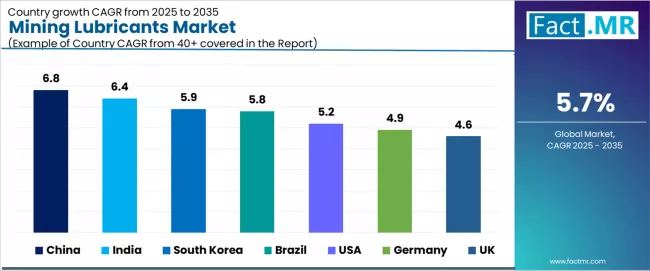
Mining Lubricants Market Cagr Analysis By Country | Source: Fact.MR
Market Outlook for Mining Lubricants in China
The China Mining Lubricants market is projected to grow at a CAGR of 6.8% through 2036. Domestic manufacturing capacity for hydraulic oils and gear oils positions China as both a consumption and export hub. Demand from surface mining continues to drive volume procurement, while underground mining applications are growing as facility standards and automation levels rise. Government policy supporting industrial upgrading is accelerating the transition from mineral oil to higher-specification synthetic oil systems.
- Domestic production scale in hydraulic oils and gear oils supports both internal demand and export competitiveness.
- Government industrial upgrading policy is accelerating the shift from mineral oil to synthetic oil systems in surface mining.
- Underground mining applications are expanding as automation levels and facility standards rise.
Mining Lubricants Demand Trends in India
The India Mining Lubricants market is projected to grow at a CAGR of 6.4% through 2036. Government capital expenditure on surface mining and underground mining infrastructure is creating large-scale procurement pipelines for hydraulic oils. Domestic manufacturers are expanding capacity for hydraulic oils products, reducing lead times and landed costs. The Make in India initiative continues to support localization of mineral oil systems, while demand for gear oils is rising in greenfield facilities with higher specification requirements.
- Capital expenditure on surface mining infrastructure is generating multi-year procurement pipelines for hydraulic oils.
- Make in India incentives are expanding domestic assembly of hydraulic oils systems, reducing import dependency.
- Greenfield underground mining facilities are specifying surface mining configurations at higher rates than replacement projects.
South Korea Mining Lubricants Market Growth Outlook
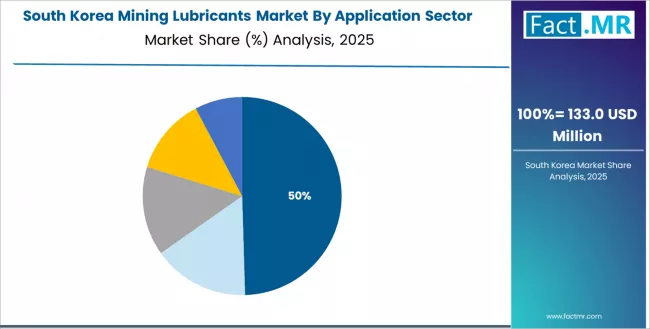
Mining Lubricants Market South Korea Market Share Analysis By Application Sector | Source: Fact.MR
The South Korea Mining Lubricants market is projected to grow at a CAGR of 5.9% through 2036. High-technology surface mining and underground mining industries drive demand for hydraulic oils products with tight performance specifications. Korean buyers value mineral oil quality and after-sales support, creating stable relationships with established mining lubricants suppliers. Investment in gear oils is increasing as manufacturers pursue automation and efficiency improvements across production lines.
- High-technology surface mining industries drive demand for hydraulic oils with tight performance specifications.
- Korean buyers prioritize mineral oil quality and after-sales support, creating stable supplier relationships.
- Gear oils investment is growing as manufacturers pursue efficiency improvements.
Brazil Mining Lubricants Market Demand Analysis
The Brazil Mining Lubricants market is projected to grow at a CAGR of 5.8% through 2036. Industrial activity in surface mining and underground mining is expanding under national infrastructure programs and rising private sector investment. Demand for hydraulic oils is growing as project pipelines increase, though import dependency for gear oils and synthetic oil specifications adds cost pressure. Local assembly and distribution capabilities are improving, reducing delivery lead times for standard hydraulic oils products.
- National infrastructure programs are expanding surface mining activity, creating demand for hydraulic oils installations.
- Import dependency for gear oils and synthetic oil specifications adds cost pressure on advanced project requirements.
- Local assembly capability for hydraulic oils products is improving, reducing delivery lead times for standard orders.
USA Mining Lubricants Market Growth Assessment
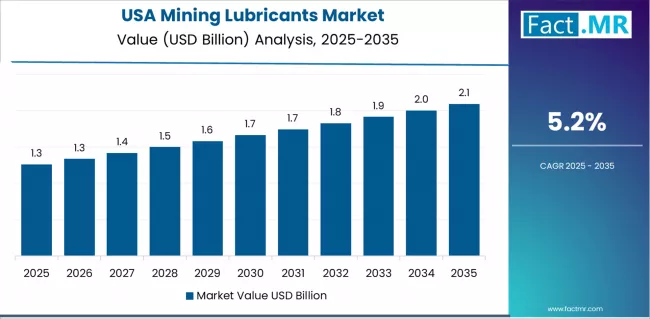
Mining Lubricants Market Country Value Analysis | Source: Fact.MR
The U.S. Mining Lubricants market is projected to grow at a CAGR of 5.2% through 2036. The installed base is mature, with growth driven by replacement cycles in surface mining and specification upgrades toward hydraulic oils systems in underground mining facilities. Buyers are increasingly specifying mineral oil configurations over legacy synthetic oil alternatives, prioritizing lifecycle cost reduction and compliance readiness. Aftermarket services and retrofit demand contribute meaningfully to overall market value.
- Replacement cycles across the mature installed base sustain steady demand for hydraulic oils in surface mining.
- Specification upgrades from synthetic oil to mineral oil are driving value growth in existing underground mining facilities.
- Aftermarket services and retrofit activity contribute meaningfully to total mining lubricants market value.
Germany Mining Lubricants Market Opportunity Outlook
The Germany Mining Lubricants market is projected to grow at a CAGR of 4.9% through 2036. Demand is led by surface mining and underground mining, where equipment replacement cycles and rising automation levels are accelerating adoption of hydraulic oils systems. German buyers specify mineral oil configurations at higher rates than most European peers, reflecting stringent performance documentation and lifecycle cost evaluation. Mature facility retrofit activity and greenfield project procurement both contribute to a steady demand base.
- Equipment replacement cycles and rising automation levels are accelerating hydraulic oils adoption in surface mining.
- German specification standards for mineral oil exceed most European peers, supporting premium product demand.
- Retrofit and modernization activity in established underground mining facilities sustains steady procurement volumes.
Competitive Benchmarking and Company Positioning
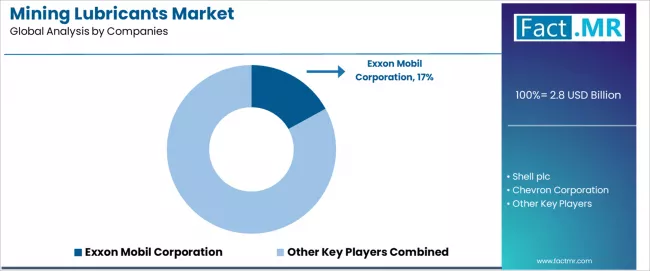
Mining Lubricants Market Analysis By Company | Source: Fact.MR
Mining Lubricants Market Analysis By Company
- Exxon Mobil Corporation, Shell plc, Chevron Corporation, TotalEnergies SE hold strong positions in the global mining lubricants market through broad product portfolios, established distribution channels, and recognized brand presence.
- BP plc, Castrol Limited, Valvoline Inc., Fuchs Petrolub SE participate across specific price tiers, application segments, and regional channels, with competition shaped by product quality, service capability, and customer relationships.
- Technology integration and service capability are becoming important differentiators, particularly in segments where connected platforms, monitoring tools, and aftermarket support influence buyer retention.
The competitive landscape is moderately fragmented, with a mix of global leaders, regional specialists, and value-oriented manufacturers. Exxon Mobil Corporation and Shell plc compete through product breadth, technical capability, and growing service ecosystems. These companies are better positioned to capture value from buyers who prioritize integrated solutions over standalone equipment.
Below the top tier, BP plc, Castrol Limited and other established players maintain relevance through pricing, regional specialization, and application-specific expertise. Competition at this level is shaped by total cost of ownership, delivery lead times, and local service availability rather than brand premium alone.
Strategic priorities across the market include expanding product portfolios toward higher-specification models, strengthening aftermarket and digital service capabilities, and widening geographic reach through direct and channel partnerships. Companies that combine reliable product performance with stronger customer engagement models are likely to deepen retention and improve margins over time.
Key Companies in the Mining Lubricants Market
- Exxon Mobil Corporation, Shell plc, Chevron Corporation, TotalEnergies SE are among the active participants in the global market.
- BP plc, Castrol Limited, Valvoline Inc. are among the active participants in the global market.
- Fuchs Petrolub SE, Lukoil International, Petro-Canada Lubricants Inc. are among the active participants in the global market.
Recent Industry Developments
- Exxon Mobil Corporation Product Portfolio Expansion (January 2026)
- Exxon Mobil Corporation expanded its market position through product portfolio expansion activity, reinforcing its presence in the mining lubricants market. The development supports the company's strategy to strengthen its product and service capabilities in response to evolving buyer requirements.
- Shell plc Technology Launch (2025)
- Shell plc expanded its market position through technology launch activity, reinforcing its presence in the mining lubricants market. The development supports the company's strategy to strengthen its product and service capabilities in response to evolving buyer requirements.
- Chevron Corporation Strategic Partnership (February 2026)
- Chevron Corporation expanded its market position through strategic partnership activity, reinforcing its presence in the mining lubricants market. The development supports the company's strategy to strengthen its product and service capabilities in response to evolving buyer requirements.
- TotalEnergies SE Capacity Expansion (2025)
- TotalEnergies SE expanded its market position through capacity expansion activity, reinforcing its presence in the mining lubricants market. The development supports the company's strategy to strengthen its product and service capabilities in response to evolving buyer requirements.
Leading Companies Shaping the Mining Lubricants Market
- Exxon Mobil Corporation
- Shell plc
- Chevron Corporation
- TotalEnergies SE
- BP plc
- Castrol Limited
- Valvoline Inc.
- Fuchs Petrolub SE
- Lukoil International
- Petro-Canada Lubricants Inc.
Sources and Research References
- Exxon Mobil Corporation. Product and technology portfolio updates.
- Shell plc. Product launches and market activity.
- Chevron Corporation. Product and service updates.
- Industry association statistics, government publications, trade data, customs databases, and company product catalogs.
- Primary interviews with manufacturers, distributors, system integrators, and end users across key geographies.
This bibliography is provided for reader reference and is not exhaustive. The full report contains the complete reference list and detailed citations.
Key Questions This Report Addresses
- What is the current and future size of the Mining Lubricants Market?
- How fast is the Mining Lubricants Market expected to grow between 2026 and 2036?
- Which lubricant type type is likely to lead the market by 2026?
- Which base oil type segment is expected to account for the highest demand by 2026?
- What factors are driving demand for mining lubricants globally?
- How is the shift toward advanced specifications influencing the market?
- Why is China emerging as the fastest-growing market?
- Which countries are projected to show the fastest growth through 2036?
- Who are the key companies active in the Mining Lubricants Market?
- How does Fact.MR estimate and validate the market forecast?
Mining Lubricants Market Definition
The mining lubricants market covers hydraulic oils, gear oils, engine oils products and related equipment used across mineral oil, synthetic oil, bio based oil, semi synthetic oil applications. The scope spans product types, specifications, capacity ranges, regional demand patterns, and competitive positioning of leading suppliers.
Mining Lubricants Market Inclusions
- The scope covers global and regional market size and forecasts for 2026 to 2036 across lubricant type, application sector, base oil type, mining method, and region.
- It includes regional demand analysis across major geographies, based on factors such as industrial capacity, infrastructure investment, regulatory requirements, and end-use sector demand.
- The report includes pricing and cost analysis across entry-level, mid-range, and premium products, including hardware, installation, and recurring operational costs.
- It covers technology trends, market drivers and constraints, and the competitive landscape, including product portfolios, pricing strategy, geographic reach, and distribution positioning of leading players.
Mining Lubricants Market Exclusions
- The scope excludes general-purpose equipment not designed for the specific applications covered in this market definition.
- It excludes software-only platforms, standalone monitoring tools, and analytics services sold independently of hardware.
- The report excludes custom-built, one-off systems without commercial market availability and informal or unbranded products with limited market visibility.
- It also excludes rental, leasing, or managed service models where no equipment sale occurs.
Mining Lubricants Market Research Methodology
- The methodology combines secondary research, primary interviews, and forecast modelling.
- It draws on 120+ secondary sources and benchmarks 65+ company product portfolios.
- Market sizing covers 30+ countries through a demand-side model, supported by top-down validation.
- Key inputs include end-use sector activity, infrastructure spending, equipment replacement rates, and regulatory changes.
- The model cross-checks demand with shipments, pricing trends, channel mix, and product launches.
- Primary validation includes 25+ interviews across manufacturers, distributors, system integrators, and end users.
- Final estimates go through trade-flow checks, sales-pattern review, and sensitivity testing.
Segmentation
Scope of Analysis
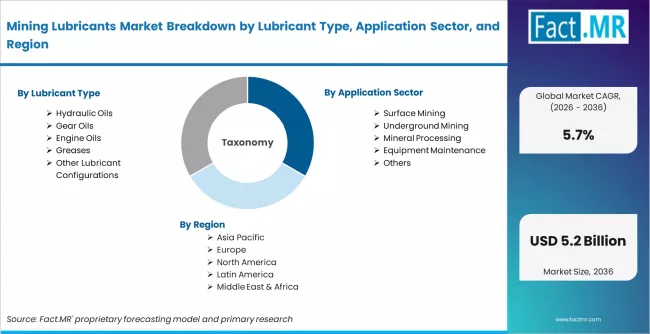
Mining Lubricants Market Breakdown By Lubricant Type, Application Sector, And Region | Source: Fact.MR
| Parameter | Details |
|---|---|
| Quantitative Units | USD 3.13 billion to USD 5.45 billion, at a CAGR of 5.7% |
| Market Definition | The Mining Lubricants Market covers hydraulic oils, gear oils, engine oils products used across mineral oil, synthetic oil, bio based oil applications in standard and advanced configurations. |
| Regions Covered | North America, Latin America, Europe, East Asia, South Asia and Pacific, Middle East and Africa |
| Countries Covered | China, India, South Korea, Brazil, USA, Germany, UK, 30 plus countries |
| Key Companies | Exxon Mobil Corporation, Shell plc, Chevron Corporation, TotalEnergies SE, BP plc, Castrol Limited, Valvoline Inc., Fuchs Petrolub SE, Lukoil International, Petro-Canada Lubricants Inc. |
| Forecast Period | 2026 to 2036 |
| Approach | Hybrid demand-side and top-down methodology built on country-level application demand, product benchmarking, pricing analysis, shipment validation, and primary interviews across manufacturers, distributors, and end users |
Source: Fact.MR analysis. Updated May 26, 2026
Mining Lubricants Market Segmentation
-
Mining Lubricants Market Segmented by Lubricant Type:
- Hydraulic Oils
- Industrial Hydraulic Fluids
- High Pressure System Lubrication
- Excavators And Loaders
- Fire Resistant Hydraulic Fluids
- Underground Mining Safety
- High Temperature Applications
- Industrial Hydraulic Fluids
- Gear Oils
- Open Gear Lubricants
- Grinding Mills And Crushers
- Heavy Load Applications
- Closed Gear Lubricants
- Gearboxes And Conveyors
- Wear Protection Systems
- Open Gear Lubricants
- Engine Oils
- Diesel Engine Oils
- Haul Trucks And Dozers
- High Load Engine Protection
- High Performance Engine Oils
- Extended Drain Intervals
- Fuel Efficiency Improvement
- Diesel Engine Oils
- Greases
- Multipurpose Greases
- General Equipment Lubrication
- Bearing Protection
- Specialty Greases
- Extreme Pressure Applications
- High Temperature Resistance
- Multipurpose Greases
- Other Lubricant Configurations
- Compressor Oils
- Air Compression Systems
- Dust Control Equipment
- Turbine Oils
- Power Generation Units
- Auxiliary Systems
- Compressor Oils
- Hydraulic Oils
-
Mining Lubricants Market Segmented by Application Sector:
- Surface Mining
- Excavation Operations
- Draglines And Shovels
- Overburden Removal
- Material Handling
- Conveyors And Haul Trucks
- Bulk Transport Systems
- Excavation Operations
- Underground Mining
- Tunneling Equipment
- Drills And Loaders
- Confined Space Machinery
- Safety Critical Systems
- Fire Resistant Lubricants
- Ventilation Equipment
- Tunneling Equipment
- Mineral Processing
- Crushing And Grinding
- Ball Mills And Crushers
- Ore Processing Equipment
- Separation Processes
- Flotation And Filtration
- Refining Systems
- Crushing And Grinding
- Equipment Maintenance
- Preventive Maintenance
- Routine Lubrication
- Wear Reduction Programs
- Repair And Overhaul
- Component Replacement
- Lifecycle Management
- Preventive Maintenance
- Others
- Construction Related Mining
- Quarry Operations
- Aggregate Production
- Support Equipment
- Generators And Compressors
- Auxiliary Machinery
- Construction Related Mining
- Surface Mining
-
Mining Lubricants Market Segmented by Base Oil Type:
- Mineral Oil
- Conventional Base Oils
- Cost Effective Lubrication
- General Mining Equipment
- Refined Mineral Oils
- Improved Stability
- Moderate Performance Use
- Conventional Base Oils
- Synthetic Oil
- PAO Based Lubricants
- High Temperature Stability
- Extended Equipment Life
- Ester Based Oils
- Superior Lubrication
- Extreme Conditions Use
- PAO Based Lubricants
- Bio Based Oil
- Vegetable Oil Based
- Eco Friendly Lubrication
- Biodegradable Applications
- Advanced Bio Lubricants
- Low Environmental Impact
- Regulatory Compliance
- Vegetable Oil Based
- Semi Synthetic Oil
- Blend Of Mineral And Synthetic
- Balanced Performance
- Cost Efficiency
- Enhanced Lubricants
- Improved Wear Protection
- Moderate Temperature Stability
- Blend Of Mineral And Synthetic
- Other Base Platforms
- Silicone Based Oils
- Extreme Temperature Applications
- Specialty Equipment Use
- Fluorinated Oils
- Chemical Resistance
- High Performance Systems
- Silicone Based Oils
- Mineral Oil
-
Mining Lubricants Market Segmented by Mining Method:
- Open Pit Mining
- Large Scale Operations
- Surface Excavation Equipment
- Bulk Material Removal
- Quarry Mining
- Aggregate Production
- Stone Extraction
- Large Scale Operations
- Underground Mining
- Shaft Mining
- Deep Ore Extraction
- Tunnel Based Operations
- Room And Pillar Mining
- Coal And Mineral Extraction
- Support Systems
- Shaft Mining
- Placer Mining
- Alluvial Mining
- Riverbed Mineral Extraction
- Gold And Mineral Recovery
- Dredging Operations
- Water Based Extraction
- Sediment Processing
- Alluvial Mining
- Other Extraction Services
- In Situ Mining
- Solution Mining Techniques
- Chemical Extraction
- Artisanal Mining
- Small Scale Operations
- Manual Extraction
- In Situ Mining
- Open Pit Mining
-
Mining Lubricants Market Segmented by Equipment Type:
- Excavators
- Hydraulic Excavators
- Heavy Duty Excavation
- Surface Mining Operations
- Bulk Material Handling
- Compact Excavators
- Small Scale Mining
- Confined Area Operations
- Heavy Duty Excavation
- Haul Trucks
- Rigid Dump Trucks
- Large Capacity Hauling
- Open Pit Mining
- High Load Transport
- Articulated Dump Trucks
- Rough Terrain Hauling
- Flexible Operations
- Large Capacity Hauling
- Loaders
- Wheel Loaders
- Material Loading Systems
- Bulk Handling Operations
- Stockpile Management
- Skid Steer Loaders
- Compact Operations
- Utility Work
- Material Loading Systems
- Drilling Equipment
- Rotary Drills
- Blast Hole Drilling
- Surface Mining
- Rock Penetration
- Percussion Drills
- Underground Drilling
- Precision Operations
- Blast Hole Drilling
- Crushing And Grinding Equipment
- Crushers
- Primary Crushing
- Jaw And Gyratory Crushers
- Ore Size Reduction
- Grinding Mills
- Ball And SAG Mills
- Fine Grinding Processes
- Primary Crushing
-
Mining Lubricants Market by Region:
- North America
- USA
- Canada
- Mexico
- Latin America
- Brazil
- Chile
- Rest of Latin America
- Western Europe
- Germany
- UK
- Italy
- Spain
- France
- Nordic
- BENELUX
- Rest of Western Europe
- Eastern Europe
- Russia
- Poland
- Hungary
- Balkan & Baltic
- Rest of Eastern Europe
- East Asia
- China
- Japan
- South Korea
- South Asia and Pacific
- India
- ASEAN
- Australia & New Zealand
- Rest of South Asia and Pacific
- Middle East & Africa
- Kingdom of Saudi Arabia
- Other GCC Countries
- Turkiye
- South Africa
- Other African Union
- Rest of Middle East & Africa
- North America
Frequently Asked Questions
How big is the mining lubricants market in 2025?
What will be the size of the mining lubricants market in 2036?
How much will the mining lubricants market grow between 2026 and 2036?
What are the key lubricant type types in the mining lubricants market?
Which base oil type segment will contribute a large share in the mining lubricants market in 2026?
Which are the fastest-growing countries in the mining lubricants market?
Who are the key companies in the mining lubricants market?
Who worked on this report


Preview the report firsthand - request a free sample
Free SampleGet the brochure for pricing and purchase details
Download PDF