- Base Value(2025): 90.8 Bn
- Forecast Value (2036): 184.9 Bn
- CAGR (2036): 6.5%
Nickel Mining Market Forecast and Outlook 2026 to 2036
In 2025, the nickel mining market was valued at approximately USD 90.8 billion. Based on Fact.MR analysis, demand for nickel mining operations is estimated to reach around USD 98.6 billion in 2026 and expand to nearly USD 184.9 billion by 2036, reflecting a CAGR of 6.5% during the forecast period.
As Stuart Harshaw, President and CEO of Nickel Creek Platinum, noted,“The challenge we have is to bring new sulfide projects into play that have this low-carbon footprint and can feed into the EV market” [1] Fact.MR analysis interprets this as indicative of a structural shift toward sulfide-based projects capable of supplying battery-grade Class 1 nickel required for electric vehicle production.
The market is expected to add close to USD 86.0 billion in incremental value over the forecast window, reflecting expansion driven by battery manufacturing demand alongside stainless steel consumption. Early-period growth is supported by laterite expansion in Asia and incremental sulfide capacity additions. Mid-period performance aligns with increasing demand for high-purity nickel in cathode precursor production. In later years, value realization is shaped by recycling integration, stricter environmental permitting, and capital allocation toward lower-emission mining operations.
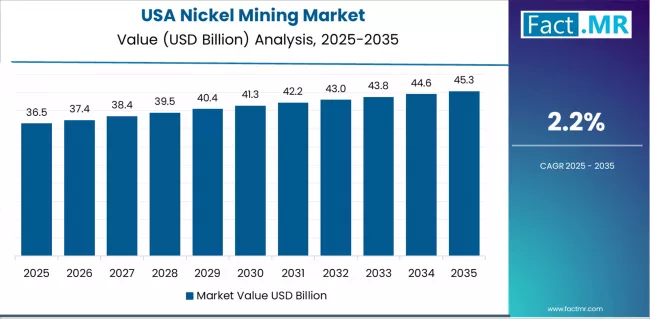
China leads growth at 7.8% CAGR, supported by stainless steel production and battery supply chain integration. India follows at 7.2%, driven by infrastructure development and alloy demand. The United States records 6.9%, reflecting domestic battery manufacturing and supply diversification efforts. Japan posts 6.4%, supported by specialty alloy and electronics demand, while the United Kingdom at 6.1% remains influenced by downstream processing and recycling-linked supply chains.
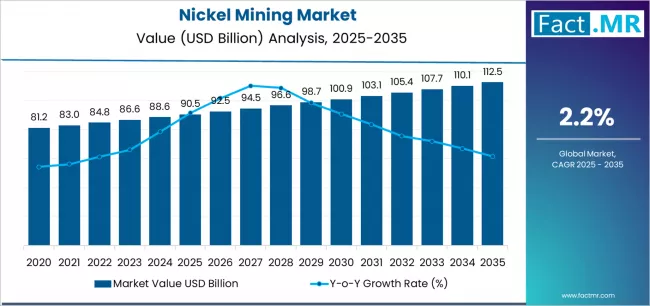
Nickel Mining Market Market Value Analysis | Source: Fact.MR
Summary of Nickel Mining Market
- Market Definition
- The nickel mining market covers extraction of nickel-bearing sulfide and laterite ores through underground and surface operations to supply primary feedstock for stainless steel, battery materials, alloys, and industrial applications.
- Demand Drivers
- Battery manufacturing expansion increases demand for Class 1 nickel suitable for high-nickel cathode chemistries used in electric vehicles and stationary energy storage.
- Sustained stainless steel production in construction, infrastructure, and industrial equipment supports baseline nickel ore demand across major consuming regions.
- Government focus on critical mineral security and supply diversification influences long-term mine development and capacity planning decisions.
- Key Segments Analyzed
- Mining Method: Underground mining leads due to access to higher-grade sulfide deposits that support consistent output and established processing routes.
- Product Type: Nickel sulfide dominates as it requires lower processing intensity and aligns with battery-grade material qualification requirements.
- Geography: Asia Pacific drives volume growth through downstream steel and battery supply chains, while North America and Europe emphasize supply security and recycling integration.
- Analyst Opinion at Fact.MR
- Shambhu Nath Jha, Principal Consultant at Fact.MR, opines, ‘CXOs will find this report useful for assessing how ore grade profiles, permitting timelines, and downstream battery qualification requirements influence capital allocation and long-term supply contracts in nickel mining.’
- Strategic Implications
- Mining firms should prioritize sulfide projects with clear pathways to battery-grade material qualification.
- Downstream users benefit from long-term offtake agreements to manage exposure to supply concentration risks.
- Investors should evaluate projects based on permitting clarity and alignment with critical mineral policies.
- Methodology
- Production and reserve benchmarks.
- Regulatory and land-use context reviewed.
| Metric | Value |
|---|---|
| Market Value (2026) | USD 98.6 billion |
| Forecast Value (2036) | USD 184.9 billion |
| Forecast CAGR (2026-2036) | 6.5% |
Source: Fact.MR analysis. Updated Feb 26, 2026
Nickel Mining Market Definition
The nickel mining market covers the extraction and primary processing of nickel bearing ores to produce nickel concentrates or refined nickel suitable for industrial use. Mining activities include laterite and sulfide ore extraction through surface and underground methods. Nickel is used mainly in stainless steel production, battery materials, alloys, and electroplating. Mining operations, environmental controls, and mineral reporting follow frameworks and oversight issued by the US Geological Survey and resource governance bodies. [2]
Nickel Mining Market Inclusions
The report covers global and regional market size estimates in volume and value with a forecast from 2026 to 2036. Coverage includes segmentation by ore type, laterite and sulfide, mining method, application across stainless steel and battery supply chains, and end use by industrial manufacturers. Regional production patterns, cost structures, and international trade flows for mined nickel are included.
Nickel Mining Market Exclusions
The scope excludes downstream nickel refining, smelting, alloy production, and finished metal products. Recycling of nickel from scrap and secondary sources is not included. Battery manufacturing, stainless steel production, and chemical processing of nickel compounds are excluded. Exploration services, drilling equipment, engineering services, and speculative mineral assets without active production are also outside the scope.
Nickel Mining Market Research Methodology
- Primary Research: Interviews were conducted with mining operators, geological consultants, commodity traders, and procurement teams in metal consuming industries.
- Desk Research: Desk research used mineral production statistics, reserve data, and regulatory documentation issued by the US Geological Survey and public mining authorities.
- Market Sizing and Forecasting: Estimates were developed using mine production data, capacity utilization, and demand indicators from stainless steel and battery material supply chains.
- Data Validation and Update Cycle: Data was cross checked against national mining statistics, export records, company disclosures, and government resource reports before updates were finalized.
Nickel Mining Market Segmental Analysis
Nickel Mining Market Analysis by Mining Method
Nickel Mining Market Analysis By Mining Method | Source: Fact.MR
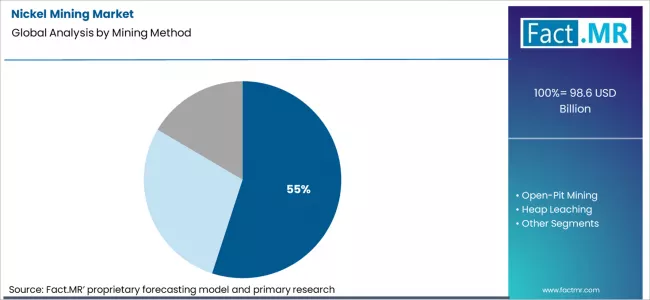
Based on Fact.MR analysis, consumption of underground mining methods is estimated to hold 55% share of the global nickel mining market. Fact.MR analysts note underground operations lead due to access to high-grade sulfide deposits located beneath surface layers. As per Fact.MR, this mining method addresses producer requirements for ore selectivity, reduced surface disturbance, and continuity of extraction in mature mining districts worldwide today supporting established processing infrastructure and long-term resource development strategies.
- Mining oversight: Mineral extraction activities are regulated under national mining safety and operational standards. [3]
- Ore grade focus: Fact.MR analysts note underground mining is common for higher-grade sulfide deposits.
- Infrastructure continuity: Established underground sites support extended production cycles.
Nickel Mining Market Analysis by Product Type
Nickel Mining Market Analysis By Product Type | Source: Fact.MR
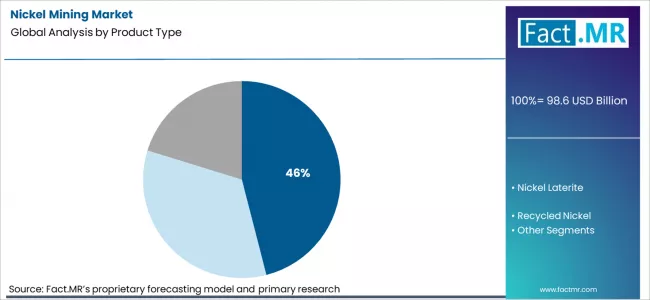
Based on Fact.MR analysis, consumption of nickel sulfide ore is estimated to hold 46% share of the global nickel mining market. Fact.MR analysts note nickel sulfide leads due to relatively lower processing energy requirements compared with laterite ores. As per Fact.MR, this product type addresses smelter compatibility, established refining routes, and suitability for battery-grade nickel production across global metallurgical supply chains today.
- Mineral data reporting: Nickel production and resource statistics are documented by national geological agencies. [4]
- Processing efficiency: Fact.MR analysts note sulfide ores are processed through established flotation and smelting routes.
- Battery linkage: Sulfide-derived nickel supports cathode material supply chains.
Nickel Mining Market Drivers, Restraints, and Opportunities
Fact.MR analysis indicates that the nickel mining market exists as a foundational raw materials segment within global metals and minerals supply chains, supplying primary feedstock for stainless steel production, battery materials for electric vehicles (EVs), and other industrial alloys. As per Fact.MR assessment, nickel extraction and processing operations are subject to environmental, land use, and mineral resource permitting frameworks such as those established by the U.S. Bureau of Land Management (BLM) mining and minerals policies, which govern exploration, lease management, and environmental compliance on federal lands in the United States [5]. Fact.MR analysts observe that current market scale and investment patterns are shaped by demand from stainless steel producers, shifting battery chemistry requirements, and regional mining capacities in key producing regions such as Indonesia, the Philippines, Russia, and Canada.
Fact.MR is of the opinion that current market dynamics reflect a transition in demand drivers as the electrification of transport and energy storage expands nickel use beyond traditional metallurgical applications. Based on Fact.MR assessment, conventional nickel use in stainless steel remains a dominant volume driver, but growth in nickel sulphate and other battery-grade intermediates is increasing as EV penetration rises. Nickel sulphate and precursor products generally command higher per-unit value because of processing steps and purity requirements for battery applications, meaning realised market value can rise even where total mined tonnage grows at a measured rate. Fact.MR analysis suggests that this interplay between volume demands for traditional applications and value uptake from EV and energy storage markets will shape near-term market progression.
- Regulated mining and resource management: Fact.MR analysts note that frameworks such as the U.S. Bureau of Land Management (BLM) mining and minerals policies influence exploration, permitting, and environmental compliance for nickel mining in regulated jurisdictions. [6]
- Shift toward battery-grade nickel demand: Based on Fact.MR assessment, rising adoption of nickel-rich cathode chemistries in EV batteries supports increased demand for high-purity nickel intermediates, influencing investment in upstream mining and refining.
- Asia Pacific production concentration: Fact.MR opines that Indonesia, the Philippines, and other Asia Pacific producers continue to shape regional supply dynamics because of favourable resource endowments, processing capacity expansions, and policy incentives aimed at downstream metal processing.
Regional Analysis
Based on regional assessment, the nickel mining sector is analyzed across North America, Europe, East Asia, South Asia, and other resource-intensive regions, spanning more than 40 countries. Regional performance varies according to electric vehicle battery demand, stainless steel production capacity, mining investment activity, and government policies related to critical mineral security.
Nickel Mining Market CAGR Analysis by Country (2026-2036)
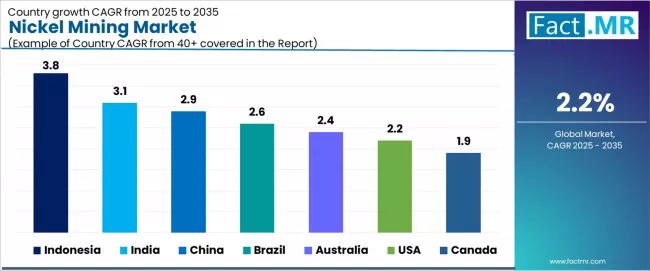
Nickel Mining Market Cagr Analysis By Country | Source: Fact.MR
| Country | CAGR |
|---|---|
| China | 7.8% |
| India | 7.2% |
| United States | 6.9% |
| Japan | 6.4% |
| United Kingdom | 6.1% |
Source: Fact.MR analysis. Updated Feb 26, 2026
Source: Fact.MR analysis, based on proprietary forecasting models and primary research.
Outlook On Nickel Mining Demand in Asia Pacific
Nickel Mining Market Country Value Analysis | Source: Fact.MR
Asia Pacific reflects strong nickel mining demand supported by stainless steel production battery material requirements and industrial growth. Sales momentum is driven by expansion of electric vehicle supply chains alloy manufacturing and domestic consumption. China and India anchor regional demand through downstream refining capacity and increasing nickel usage. Mining activity aligns with resource security strategies import substitution and long term supply planning. Market growth reflects capacity development processing integration and rising demand from energy storage and industrial manufacturing sectors across regional economies.
- China: Demand for nickel mining output in China is projected to rise at 7.8% CAGR through 2036. Growth reflects strong stainless steel production and increasing use of nickel in battery material supply chains, as per Fact.MR.
- India: Demand for nickel mining output in India is projected to rise at 7.2% CAGR through 2036. Usage reflects expanding industrial alloy demand and growing interest in battery raw material sourcing, according to Fact.MR.
Fact.MR’s analysis of the Nickel Mining Market in Asia Pacific consists of country-wise assessment that includes China and India. Readers can find downstream consumption and supply security references.
Demand for Nickel Mining in North America
North America shows steady demand for nickel mining supported by battery manufacturing defense applications and specialty alloys. Sales growth is shaped by electric vehicle adoption domestic supply considerations and strategic material sourcing. The United States anchors regional demand through refining activity and downstream manufacturing. Mining investment reflects supply diversification efforts and long term procurement strategies. Market expansion remains moderate reflecting regulatory oversight project development timelines and integration with established metal processing infrastructure across national industrial ecosystems.
- United States: Demand for nickel mining output in the United States is projected to rise at 6.9% CAGR through 2036. Usage is supported by battery material demand specialty alloy production and domestic supply chain development, as per Fact.MR.
Fact.MR’s analysis of the Nickel Mining Market in North America consists of country-wise assessment that includes the United States. Readers can find supply chain and industrial demand insights.
Analysis On Nickel Mining Sales in Europe
Europe reflects regulated demand for nickel mining output shaped by industrial usage sustainability standards and import reliance. Sales are driven by stainless steel manufacturing aerospace alloys and emerging battery supply chains. Germany and the United Kingdom contribute through downstream metal processing and consumption rather than large scale mining. Market activity reflects procurement contracts recycling integration and long term sourcing strategies. Growth remains steady reflecting environmental oversight limited domestic reserves and dependence on diversified global nickel supply networks.
- United Kingdom: Demand for nickel mining output in the United Kingdom is projected to rise at 6.1% CAGR through 2036. Usage reflects stainless steel consumption and alloy demand through industrial manufacturing supply chains, according to Fact.MR.
Fact.MR’s analysis of the Nickel Mining Market in Europe consists of country-wise assessment that includes the United Kingdom. Readers can find sourcing strategies and downstream demand references.
Outlook On Nickel Mining Demand in Japan
Japan reflects stable demand for nickel mining output driven by stainless steel production advanced alloys and battery material requirements. Consumption depends on imported ore and refined nickel supported by long term supply contracts. Market growth reflects downstream manufacturing rather than mining expansion.
- Japan: Demand for nickel mining output in Japan is projected to rise at 6.4% CAGR through 2036. Usage reflects stainless steel manufacturing and battery material sourcing through long term import arrangements, as per Fact.MR.
Fact.MR’s analysis of the Nickel Mining Market in Japan consists of country-wise assessment that includes Japan. Readers can find import dependency and industrial usage insights.
Competitive Landscape for Nickel Mining Market Players
Nickel Mining Market Analysis By Company | Source: Fact.MR
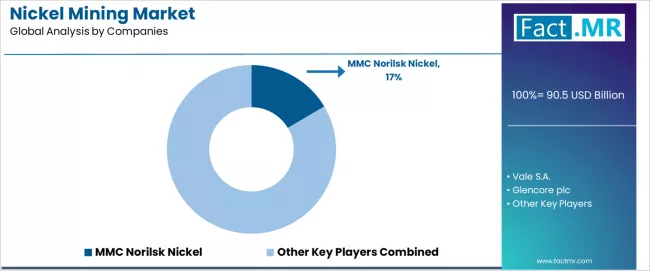
As per Fact.MR analysis, the 2026 nickel mining market is defined by validated ore quality, production efficiency, and regulatory compliance, which determine competitive advantage. Vale S.A. and Glencore plc lead with large-scale mining operations and verified nickel concentrate quality, which strengthens adoption in stainless steel, battery, and alloy applications. BHP Group Limited and Norilsk Nickel emphasize high-yield extraction and optimized smelting processes, which improves operational efficiency and reduces production costs. Sumitomo Metal Mining and First Quantum Minerals provide multi-region compliant operations with documented sustainability and environmental performance, which increases stakeholder confidence. PT Vale Indonesia and Nickel Asia Corporation focus on region-specific ore processing and supply chain reliability, which supports consistent market delivery. Eramet S.A. and Anglo American plc leverage integrated upstream and downstream capabilities with validated quality control, which enhances adoption among industrial users. Across the market, validated ore quality, production efficiency, and multi-region regulatory compliance form enduring competitive moats, reducing reliance on price or isolated mine output.
Recent Industry Developments
- Indonesia Slashes 2026 Mining Quotas: On February 10, 2026, Indonesia’s Ministry of Energy and Mineral Resources (ESDM) confirmed it would cut the 2026 nickel production quota (RKAB) to 260 million tons, a significant drop from the 379 million tons approved for 2025. This move aims to stabilize global prices and align supply with domestic smelting capacity. [7]
- Vale Divests Canadian Nickel Complex: On February 19, 2026, Vale announced the sale of its historic Thompson nickel mine complex in Manitoba to a consortium including Exiro Minerals and the Canada Growth Fund. The new entity, Exiro Nickel, plans to invest $200 million to double production over the next five years, focusing on North American supply security. [8]
Key Players in Nickel Mining Market
- Vale S.A.
- Glencore plc
- BHP Group Limited
- Norilsk Nickel
- Sumitomo Metal Mining
- First Quantum Minerals
- PT Vale Indonesia
- Nickel Asia Corporation
- Eramet S.A.
- Anglo American plc
Bibliography
- [1] Investing News Network. (2023). Low-carbon, high-grade nickel projects positioned to supply the EV market: Interview with Stuart Harshaw, CEO of Nickel Creek Platinum. Investing News Network.
- [2] U.S. Geological Survey. (2024). Nickel-Statistics and information. National Minerals Information Center, U.S. Department of the Interior; U.S. Department of the Interior. (2024). Mining laws and regulations. Office of Congressional and Legislative Affairs.
- [3] Mine Safety and Health Administration. (2024). Mine safety and health laws and regulations. U.S. Department of Labor.
- [4] U.S. Geological Survey. (2024). Nickel statistics and information. National Minerals Information Center, U.S. Department of the Interior.
- [5] U.S. Bureau of Land Management. (2024). Mining and minerals: Laws, permitting, and environmental compliance. U.S. Department of the Interior.
- [6] U.S. Bureau of Land Management. (2024). Mining and minerals program overview. U.S. Department of the Interior.
- [7] Ministry of Energy and Mineral Resources (ESDM), Republic of Indonesia. (2026). Indonesia to reduce nickel mining production quota for 2026 [Official government announcement].
- [8] Northern Miner. (2026). Vale to sell Manitoba nickel complex to investor group. The Northern Miner Group.
This Report Addresses
- Market intelligence to support structured strategic decision-making across primary nickel supply chains, where ore grade profiles, processing intensity, and supply security shape long-term value realization beyond short-term commodity price cycles
- Global market size assessment and 10-year revenue forecasts from 2026 to 2036, developed using mine production capacity, project development timelines, downstream demand indicators, and trade-linked supply dynamics
- Growth opportunity mapping across mining methods (underground, open-pit, heap leaching), highlighting how deposit type, operating cost structure, and permitting complexity influence capacity additions and output stability
- Product-type benchmarking across nickel sulfide, nickel laterite, and recycled nickel, with focus on processing requirements, emissions intensity, and suitability for Class 1 / battery-grade qualification pathways
- Application-level demand assessment across stainless steel, battery manufacturing, alloys, chemical processing, and other industrial uses, quantifying the shift in value contribution from EV-linked demand alongside baseline stainless consumption
- End-use analysis across automotive, electronics, construction, aerospace, and other sectors, connecting downstream material qualification requirements to upstream offtake structures and long-term supply contracts
- Competitive landscape assessment benchmarking leading miners on resource quality, cost position, sustainability performance, geographic diversification, and delivery reliability for industrial and battery-linked customers
- Technology and operational roadmap tracking covering processing route evolution (laterite processing intensity vs sulfide routes), recycling integration, and deployment of lower-emission mining and processing practices
- Regulatory and governance context review covering mineral reporting, land-use oversight, and permitting frameworks relevant to mine development and operational compliance in key jurisdictions
- Regional and country-level growth mapping highlighting differentiated trajectories across China, India, the United States, Japan, and the United Kingdom, alongside broader Asia-Pacific supply concentration dynamics
- Multi-format market report delivery in PDF, Excel datasets, PPT formats, and interactive dashboards for executives, strategy teams, procurement, trading, and investment stakeholders
Segmentation
Scope of the Report
| Metric | Value |
|---|---|
| Quantitative Units | USD 98.6 billion (2026) to USD 184.9 billion (2036), CAGR 6.5% |
| Market Definition | The nickel mining market covers extraction and primary processing of nickel-bearing ores to produce nickel concentrates or refined nickel suitable for industrial applications. Mining includes laterite and sulfide ores via underground, open-pit, and heap leaching methods. Nickel is used in stainless steel, batteries, alloys, and chemical processing. Mining operations and environmental compliance follow USGS and resource governance regulations. |
| Mining Method Segmentation | Underground Mining, Open-Pit Mining, Heap Leaching |
| Product Type Segmentation | Nickel Sulfide, Nickel Laterite, Recycled Nickel |
| Application Segmentation | Stainless Steel Production, Battery Manufacturing, Alloy Production, Chemical Processing, Others (catalysts, coinage applications) |
| End Use Segmentation | Automotive, Electronics, Construction, Aerospace, Others |
| Regions Covered | Asia Pacific, Europe, North America, Latin America, Middle East & Africa |
| Countries Covered | India, China, Japan, South Korea, Indonesia, Australia & New Zealand, Germany, Italy, France, United Kingdom, Spain, Benelux, Nordics, Central & Eastern Europe, United States, Canada, Mexico, Brazil, Argentina, Chile, Kingdom of Saudi Arabia, United Arab Emirates, South Africa, Turkey |
| Key Companies Profiled | Vale S.A., Glencore plc, BHP Group Limited, Norilsk Nickel, Sumitomo Metal Mining, First Quantum Minerals, PT Vale Indonesia, Nickel Asia Corporation, Eramet S.A., Anglo American plc |
| Forecast Period | 2026 to 2036 |
| Approach | Hybrid top-down and bottom-up modeling validated with primary interviews of mining operators, geological consultants, and metal procurement teams; cross-checked with national mining statistics, trade data, and resource governance reports. |
Source: Fact.MR analysis. Updated Feb 26, 2026
Nickel Mining Market Analysis by Segments
-
Mining Method :
- Underground Mining
- Open-Pit Mining
- Heap Leaching
-
Product Type :
- Nickel Sulfide
- Nickel Laterite
- Recycled Nickel
-
Application :
- Stainless Steel Production
- Battery Manufacturing
- Alloy Production
- Chemical Processing
- Others (catalysts, coinage applications)
-
End Use :
- Automotive
- Electronics
- Construction
- Aerospace
- Others
-
Region :
- Asia Pacific
- India
- China
- Japan
- South Korea
- Indonesia
- Australia & New Zealand
- ASEAN
- Rest of Asia Pacific
- Europe
- Germany
- Italy
- France
- United Kingdom
- Spain
- Benelux
- Nordics
- Central & Eastern Europe
- Rest of Europe
- North America
- United States
- Canada
- Mexico
- Latin America
- Brazil
- Argentina
- Chile
- Rest of Latin America
- Middle East & Africa
- Kingdom of Saudi Arabia
- United Arab Emirates
- South Africa
- Turkey
- Rest of Middle East & Africa
- Asia Pacific
Frequently Asked Questions
How large is the nickel mining market in 2026?
What will the nickel mining market size be by 2036?
What is the expected CAGR of the nickel mining market between 2026 and 2036?
How much incremental value will the nickel mining market add over the forecast period?
What factors structurally govern long-term value creation in nickel mining?
Which mining method currently leads the global nickel mining market?
Why does underground mining hold a higher share than open-pit mining?
Which product type dominates nickel mining output globally?
Why is nickel sulfide preferred for battery manufacturing supply chains?
How significant is battery manufacturing as a demand driver for nickel mining?
What role does stainless steel production play in overall nickel demand?
Which region drives the highest growth in nickel mining demand?
Which country records the fastest nickel mining market growth?
How strong is nickel mining demand growth in India?
What is the growth outlook for nickel mining in the United States?
How does Japan’s nickel mining demand outlook compare globally?
What growth rate is projected for the United Kingdom?
How does recycling integration affect long-term nickel mining value?
What challenges shape capital allocation decisions in nickel mining projects?
What is the long-term outlook for the nickel mining market?
Who worked on this report


Preview the report firsthand - request a free sample
Free SampleGet the brochure for pricing and purchase details
Download PDF