Autonomous Mining Equipment Market

Autonomous Mining Equipment Market Size and Share Forecast Outlook 2026 to 2036

Autonomous mining equipment market is projected to grow from USD 5.0 billion in 2026 to USD 15.0 billion by 2036, at a CAGR of 11.6%. Surface Mining Equipment will dominate with a 38.0% market share, while semi-autonomous will lead the autonomy level segment with a 46.0% share.

Autonomous Mining Equipment Market Forecast and Outlook 2026 to 2036

The global autonomous mining equipment market is projected to grow from USD 5.0 billion in 2026 to approximately USD 15.5 billion by 2036, recording an extraordinary absolute increase of USD 10.5 billion over the forecast period. This translates into a total growth of 210.0%, with the market forecast to expand at a CAGR of 11.6% between 2026 and 2036.

Key Takeaways from the Autonomous Mining Equipment Market

  • Autonomous Mining Equipment Market Value (2026): USD 5.0 billion
  • Autonomous Mining Equipment Market Forecast Value (2036): USD 15.5 billion
  • Autonomous Mining Equipment Market Forecast CAGR (2026 to 2036): 11.6%
  • Leading Equipment Type in Autonomous Mining Equipment Market: Surface Mining Equipment (38.0%)
  • Leading Autonomy Level in Autonomous Mining Equipment Market: Semi-Autonomous (46.0%)
  • Leading Application in Autonomous Mining Equipment Market: Metal Mining (41.0%)
  • Leading Component in Autonomous Mining Equipment Market: Hardware (52.0%)
  • Leading Power Source in Autonomous Mining Equipment Market: Diesel-powered Autonomous Systems (44.0%)
  • Key Growth Regions in Autonomous Mining Equipment Market: Asia Pacific, North America, and Oceania
  • Key Players in Autonomous Mining Equipment Market: Caterpillar Inc., Komatsu Ltd., Hitachi Construction Machinery, Sandvik AB, Epiroc AB, Liebherr Group, Volvo Construction Equipment, Autonomous Solutions Inc., Hexagon Mining, RPMGlobal
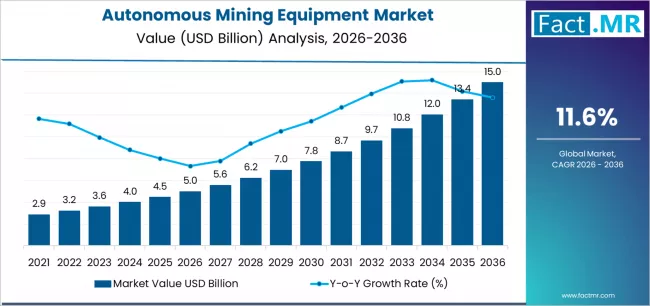
Autonomous Mining Equipment Market Market Value Analysis

The market will grow 3.0X during this period, supported by exponential demand for mining safety enhancement solutions, rising adoption of advanced automation technologies, and growing emphasis on operational efficiency innovation and productivity optimization across global mining operations.

The autonomous mining equipment market is positioned for substantial expansion, driven by increasing recognition of worker safety importance, growing need for operational cost reduction with enhanced productivity standards, and rising adoption of advanced autonomous vehicle technologies across surface and underground mining operations globally.

The market demonstrates robust fundamentals supported by expanding automated mining site networks, mining operators' focus on predictive maintenance and fleet optimization protocols, and rising recognition of autonomous equipment as critical operational components in achieving enhanced safety outcomes, productivity improvement capabilities, and cost reduction effectiveness within modern mining architectures across diverse mineral extraction applications.

Autonomous Mining Equipment Market

Metric Value
Estimated Value (2026E) USD 5.0 billion
Forecast Value (2036F) USD 15.5 billion
Forecast CAGR (2026 to 2036) 11.6%

Category

Category Segments
Equipment Type Surface Mining Equipment (Drills; Load-Haul-Dump; Trucks; Excavators); Underground Mining Equipment
Autonomy Level Semi-Autonomous Systems (Remote-operated; Tele-operated); Fully Autonomous Systems (AI-guided Systems)
Application Metal Mining (Haulage; Drilling; Loading; Material Transport); Coal Mining; Mineral Mining
Component Hardware (LiDAR; Radar; GNSS); Software (Autonomous Control Software)
Power Source Diesel-powered Autonomous Systems; Battery-electric Autonomous Systems; Hybrid Systems; Hydrogen-assisted Systems
Region Asia Pacific; North America; Europe; Latin America; Middle East & Africa; Oceania

Segmental Analysis

How does Surface Mining Equipment Drive Market Leadership in Autonomous Mining?
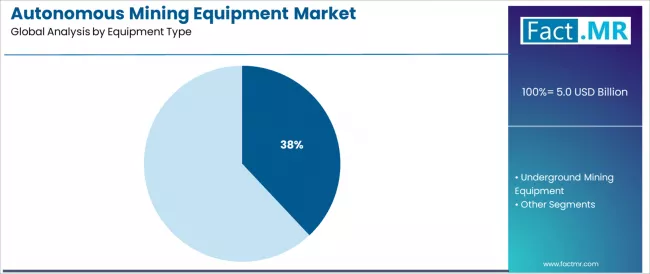
Autonomous Mining Equipment Market Analysis By Equipment Type

The surface mining equipment segment is projected to account for 38.0% of the autonomous mining equipment market in 2026, reaffirming its position as the category's dominant application specification.

Mining operators increasingly recognize the optimal balance of technology maturity and operational scale offered by autonomous surface mining equipment for open-pit operations, particularly in large-scale hauling applications and bulk material extraction environments.

This equipment category addresses both productivity maximization requirements and safety enhancement demands while providing proven autonomous capabilities across diverse surface mining operations.

Why Does Semi-Autonomous System Command Majority Market Share?
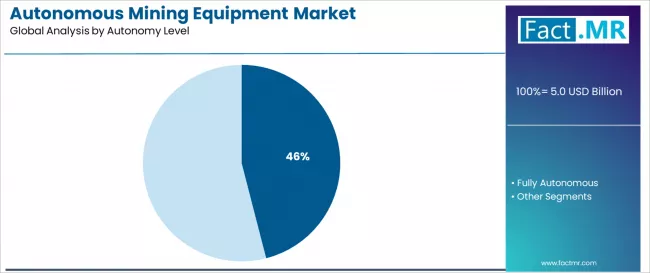
Autonomous Mining Equipment Market Analysis By Autonomy Level

Semi-autonomous system is projected to represent 46.0% of autonomous mining equipment demand in 2026, underscoring its role as the primary autonomy level driving current market adoption and fleet deployment.

Mining operators recognize that semi-autonomous systems, including remote-operated and tele-operated capabilities, provide the most pragmatic automation approach that fully autonomous systems cannot yet match in operational flexibility and site adaptability. Semi-autonomous equipment utilized in mining operations offers enhanced productivity improvement and proven safety benefits essential for serving progressive automation and risk mitigation requirements.

What Drives Metal Mining Application Segment Prominence?
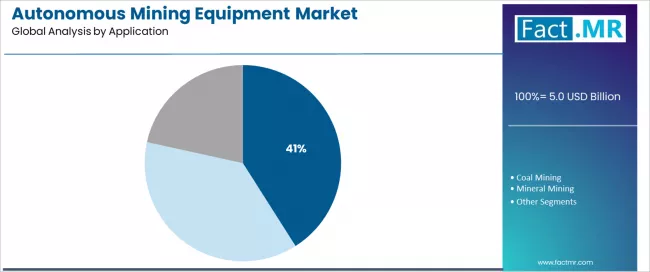
Autonomous Mining Equipment Market Analysis By Application

The metal mining application is projected to account for 41.0% of the autonomous mining equipment market in 2026, establishing its position as the leading commodity segment. Mining operators increasingly recognize that metal mining operations, encompassing copper, iron ore, gold, and other base and precious metals, represent the most economically significant and automation-receptive category requiring autonomous equipment due to operation scale and safety criticality.

How Does Hardware Component Command Market Leadership?
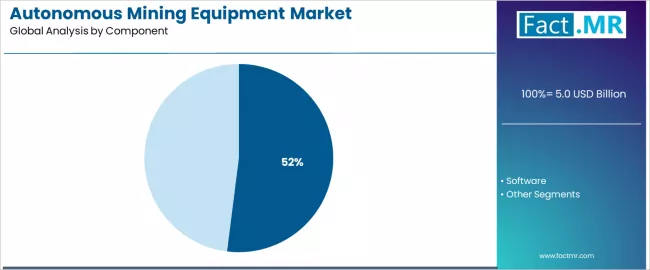
Autonomous Mining Equipment Market Analysis By Component

Hardware component is projected to represent 52.0% of autonomous mining equipment market value in 2026, underscoring its role as the primary technology category driving system capabilities and operational performance.

Equipment manufacturers recognize that hardware components, including LiDAR sensors, radar systems, GNSS positioning, and computing platforms, provide the fundamental sensing and control infrastructure that software alone cannot deliver in autonomous operation requirements. Hardware components utilized in autonomous mining offer essential perception capabilities and actuation control essential for serving safety-critical and precision navigation requirements.

What drives Diesel-Powered Autonomous Systems Dominance?
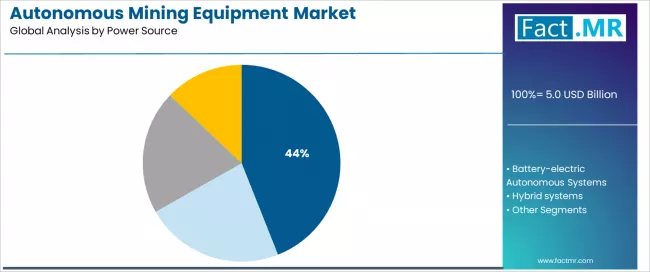
Autonomous Mining Equipment Market Analysis By Power Source

Diesel-powered autonomous systems are projected to account for 44.0% of the autonomous mining equipment market in 2026, establishing their position as the leading powertrain segment.

Mining operators increasingly recognize that diesel-powered platforms, leveraging established refueling infrastructure and proven power density characteristics, represent the most operationally practical and immediately deployable autonomous equipment option for existing mine operations. This power source addresses both autonomous technology adoption and operational continuity requirements while providing familiar maintenance protocols across global mining operations.

What are the Drivers, Restraints, and Key Trends of the Autonomous Mining Equipment Market?

The autonomous mining equipment market is expanding due to rising emphasis on worker safety and the need to improve productivity across global mining operations. Mining companies are increasingly adopting automation to reduce accident risks, improve operational consistency, and address skilled labor shortages. Technological progress in artificial intelligence, sensor systems, and data analytics is further supporting wider deployment of autonomous solutions.

Despite these drivers, market growth is constrained by high upfront capital investment requirements, particularly for fleet conversion and supporting digital infrastructure. Workforce transition challenges and resistance to automation also affect adoption, while regulatory approval processes vary across jurisdictions, adding implementation complexity and delays.

Key trends include the rapid integration of AI-guided navigation and machine learning algorithms, enabling real-time obstacle detection, adaptive route planning, and predictive maintenance. Another major trend is the adoption of battery-electric autonomous equipment, supported by on-site charging and renewable energy integration. These solutions reduce emissions, lower ventilation needs in underground mines, and improve long-term operating cost efficiency, aligning automation with broader mine decarbonization strategies.

Analysis of the Autonomous Mining Equipment Market by Key Countries
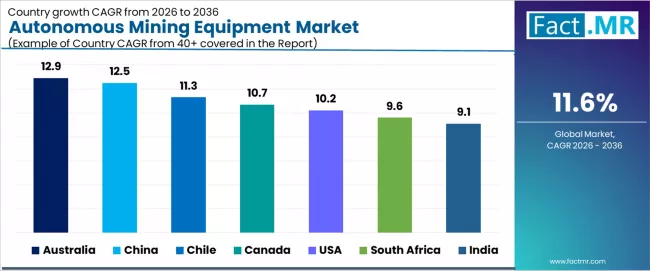
Autonomous Mining Equipment Market Cagr Analysis By Country

Country CAGR (2026-2036)
Australia 12.9%
China 12.5%
Chile 11.3%
Canada 10.7%
USA 10.2%
South Africa 9.6%
India 9.1%

How does Australia Demonstrate Exceptional Market Potential Through Automated Mining Expansion?

Australia leads global autonomous mining adoption, with revenue projected to grow at a 12.9% CAGR through 2036. Growth is driven by large-scale deployment of autonomous systems across iron ore, coal, and gold operations, particularly in the Pilbara, Queensland, and Western Australia. Remote mine locations, workforce constraints, and a strong zero-harm safety culture are accelerating investments in fully autonomous fleets.

Mining operators increasingly view automation as essential for continuous operations, productivity optimization, and risk reduction. Major equipment manufacturers have expanded local support and integration capabilities to meet rising demand. Proven productivity gains and successful lights-out mining models continue to strengthen Australia’s position as a global benchmark for autonomous mining deployment.

What Enables China’s Market Leadership Through Large-Scale Mining Automation?

China’s autonomous mining equipment market is expanding at a 12.5% CAGR, supported by vast mining output and accelerating automation across coal and metal mining operations. Strong domestic equipment manufacturing capabilities and growing collaboration between OEMs and mining operators underpin adoption. Government policies promoting mining modernization and stricter safety standards are driving investments in autonomous haulage and remote-operated systems.

Automation is increasingly used to address labor constraints while improving efficiency and compliance. As technology platforms mature, China continues to scale autonomous deployment across both surface and underground mining, reinforcing its leadership in volume-driven automation adoption.

Why Does Chile Maintain Leadership in Copper Mining Automation?

Chile’s autonomous mining equipment market grows at an 11.3% CAGR, anchored in its dominant global copper production base. Large-scale open-pit and underground copper operations are integrating automation to enhance productivity, control costs, and maintain international competitiveness.

Strong mining infrastructure and technical expertise support phased deployment from semi-autonomous to fully autonomous systems. Automation is also expanding into lithium extraction, reinforcing demand for advanced equipment solutions. Safety compliance and efficiency targets increasingly shape equipment specifications, positioning automation as a strategic necessity across Chile’s mining sector.

How does Canada Sustain Mining Innovation Through Advanced Autonomous Deployment?

Canada records a 10.7% CAGR through 2036, supported by strong mining innovation and autonomous technology integration in remote and harsh environments. Operations in northern regions and established mining districts showcase advanced systems linked to centralized control and safety platforms.

Mining operators prioritize reliability, cold-weather performance, and worker protection, driving demand for proven autonomous solutions. A mature mining technology ecosystem and close collaboration with equipment manufacturers support continuous advancement. Safety excellence and operational resilience remain central to Canada’s autonomous mining strategy.

What drives Market Growth in the USA through Advanced Mining Technology Adoption?
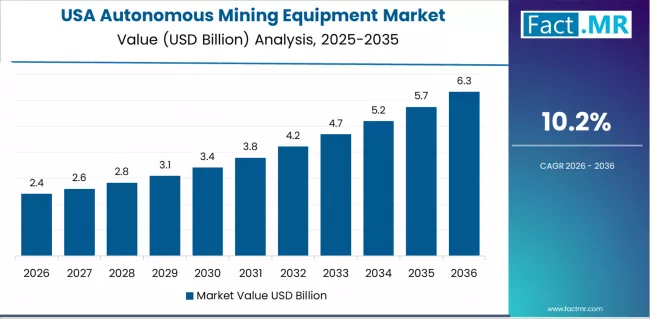
Autonomous Mining Equipment Market Country Value Analysis

The USA’s autonomous mining equipment market grows at a 10.2% CAGR, driven by strong equipment manufacturing capabilities and technology innovation. Adoption spans surface and underground operations, supported by advanced automation platforms integrating AI and data analytics.

Mining operators emphasize productivity gains while maintaining compliance with rigorous safety and regulatory standards. A robust technology development ecosystem accelerates deployment and validation of autonomous solutions. Proven performance and reliability remain key purchase criteria across US mining applications.

Why Is South Africa Expanding Autonomous Mining Adoption for Deep-Level Safety?

South Africa’s market grows at a 9.6% CAGR, shaped by deep-level mining conditions and safety imperatives. Gold and platinum operations increasingly deploy autonomous and remote-operated equipment to reduce worker exposure in hazardous underground environments.

Automation strategies prioritize hazard elimination, confined-space operation, and workforce protection. Mining expertise in complex underground settings supports technology adaptation and targeted deployment. Safety-driven automation remains central to South Africa’s mining modernization efforts.

How does India’s Mining Modernization Drive Autonomous Equipment Adoption?

India’s autonomous mining equipment market expands at a 9.1% CAGR, supported by coal and iron ore sector modernization. Government incentives and productivity improvement initiatives are encouraging automation adoption in opencast operations.

Mining operators focus on balancing technological advancement with cost considerations, emphasizing efficiency and safety gains. As mineral demand grows, automation is increasingly viewed as a tool for output stability and operational improvement. Early-stage deployment is creating a foundation for broader adoption across India’s mining sector.

Competitive Landscape of the Autonomous Mining Equipment Market
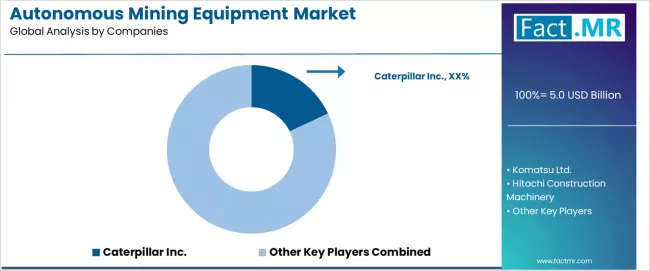
Autonomous Mining Equipment Market Analysis By Company

The autonomous mining equipment market is highly competitive, with participation from global equipment manufacturers, automation specialists, and integrated mining solution providers. Competition centers on system reliability, safety performance, fleet integration, and productivity optimization. Companies are investing in AI-driven control systems, advanced sensor technologies, mining-operator partnerships, and lifecycle technical support to meet stringent safety standards and demanding operational requirements.

Caterpillar Inc. leads the market, supported by established autonomous hauling systems and advanced fleet management platforms deployed across large-scale surface mining operations. Komatsu Ltd. competes through proven autonomous haulage solutions and deep integration with surface mining technologies. Hitachi Construction Machinery focuses on autonomous equipment systems serving multiple commodity segments, while Sandvik AB and Epiroc AB maintain strong positions in underground mining through drilling automation, battery-electric platforms, and integrated control systems.

Liebherr Group and Volvo Construction Equipment emphasize autonomous hauling, safety technologies, and coordinated fleet operations. Autonomous Solutions Inc. addresses retrofit automation needs for existing fleets. Hexagon Mining and RPMGlobal strengthen competition through mine management software and integrated automation platforms focused on operational optimization and data-driven decision-making.

Key Players in the Autonomous Mining Equipment Market

  • Caterpillar Inc.
  • Komatsu Ltd.
  • Hitachi Construction Machinery
  • Sandvik AB
  • Epiroc AB
  • Liebherr Group
  • Volvo Construction Equipment
  • Autonomous Solutions Inc.
  • Hexagon Mining
  • RPMGlobal

Scope of the Report

Items Values
Quantitative Units (2026) USD 5.0 Billion
Equipment Type Surface Mining Equipment (Drills, Load-Haul-Dump, Trucks, Excavators), Underground Mining Equipment
Autonomy Level Semi-Autonomous (Remote-operated, Tele-operated), Fully Autonomous (AI-guided systems)
Application Metal Mining (Haulage, Drilling, Loading, Material transport), Coal Mining, Mineral Mining
Component Hardware (LiDAR, Radar, GNSS), Software (Autonomous control software)
Power Source Diesel-powered Autonomous Systems, Battery-electric Autonomous Systems, Hybrid systems, Hydrogen-assisted systems
Regions Covered Asia Pacific, North America, Europe, Latin America, MEA, Oceania
Countries Covered USA, Australia, Canada, China, Chile, South Africa, India and 40+ countries
Key Companies Profiled Caterpillar Inc., Komatsu Ltd., Hitachi Construction Machinery, Sandvik AB, Epiroc AB, Liebherr Group, Volvo Construction Equipment, Autonomous Solutions Inc., Hexagon Mining, RPMGlobal
Additional Attributes Dollar sales by equipment type, autonomy level, application, component, power source, regional demand trends, competitive landscape, mining operator preferences for specific autonomous solutions, integration with comprehensive mine management systems, innovations in AI algorithm development, battery-electric technology advancement, and operational safety optimization capabilities

Autonomous Mining Equipment Market by Segments

  • Equipment Type :

    • Surface Mining Equipment
      • Drills
      • Load-Haul-Dump
      • Trucks
      • Excavators
    • Underground Mining Equipment
  • Autonomy Level :

    • Semi-Autonomous
      • Remote-operated
      • Tele-operated
    • Fully Autonomous
      • AI-guided systems
  • Application :

    • Metal Mining
      • Haulage
      • Drilling
      • Loading
      • Material transport
    • Coal Mining
    • Mineral Mining
  • Component :

    • Hardware
      • LiDAR
      • Radar
      • GNSS
    • Software
      • Autonomous control software
  • Power Source :

    • Diesel-powered Autonomous Systems
    • Battery-electric Autonomous Systems
    • Hybrid systems
    • Hydrogen-assisted systems
  • Region :

    • Asia Pacific

      • China
      • India
      • Japan
      • South Korea
      • ASEAN
      • Australia & New Zealand
      • Rest of Asia Pacific
    • North America

      • USA
      • Canada
      • Mexico
    • Europe

      • Germany
      • France
      • UK
      • Italy
      • Spain
      • Nordic
      • BENELUX
      • Rest of Europe
    • Latin America

      • Brazil
      • Argentina
      • Chile
      • Rest of Latin America
    • MEA

      • Saudi Arabia
      • Other GCC Countries
      • Turkey
      • South Africa
      • Other African Countries
      • Rest of MEA
    • Oceania

      • Australia
      • New Zealand
      • Other Pacific Islands

Table of Content

  1. Executive Summary
    • Global Market Outlook
    • Demand to side Trends
    • Supply to side Trends
    • Technology Roadmap Analysis
    • Analysis and Recommendations
  2. Market Overview
    • Market Coverage / Taxonomy
    • Market Definition / Scope / Limitations
  3. Market Background
    • Market Dynamics
      • Drivers
      • Restraints
      • Opportunity
      • Trends
    • Scenario Forecast
      • Demand in Optimistic Scenario
      • Demand in Likely Scenario
      • Demand in Conservative Scenario
    • Opportunity Map Analysis
    • Product Life Cycle Analysis
    • Supply Chain Analysis
    • Investment Feasibility Matrix
    • Value Chain Analysis
    • PESTLE and Porter’s Analysis
    • Regulatory Landscape
    • Regional Parent Market Outlook
    • Production and Consumption Statistics
    • Import and Export Statistics
  4. Global Market Analysis 2021 to 2025 and Forecast, 2026 to 2036
    • Historical Market Size Value (USD Million) Analysis, 2021 to 2025
    • Current and Future Market Size Value (USD Million) Projections, 2026 to 2036
      • Y to o to Y Growth Trend Analysis
      • Absolute $ Opportunity Analysis
  5. Global Market Pricing Analysis 2021 to 2025 and Forecast 2026 to 2036
  6. Global Market Analysis 2021 to 2025 and Forecast 2026 to 2036, By Equipment Type
    • Introduction / Key Findings
    • Historical Market Size Value (USD Million) Analysis By Equipment Type, 2021 to 2025
    • Current and Future Market Size Value (USD Million) Analysis and Forecast By Equipment Type, 2026 to 2036
      • Surface Mining Equipment
      • Underground Mining Equipment
    • Y to o to Y Growth Trend Analysis By Equipment Type, 2021 to 2025
    • Absolute $ Opportunity Analysis By Equipment Type, 2026 to 2036
  7. Global Market Analysis 2021 to 2025 and Forecast 2026 to 2036, By Autonomy Level
    • Introduction / Key Findings
    • Historical Market Size Value (USD Million) Analysis By Autonomy Level, 2021 to 2025
    • Current and Future Market Size Value (USD Million) Analysis and Forecast By Autonomy Level, 2026 to 2036
      • Semi-Autonomous
      • Fully Autonomous
    • Y to o to Y Growth Trend Analysis By Autonomy Level, 2021 to 2025
    • Absolute $ Opportunity Analysis By Autonomy Level, 2026 to 2036
  8. Global Market Analysis 2021 to 2025 and Forecast 2026 to 2036, By Application
    • Introduction / Key Findings
    • Historical Market Size Value (USD Million) Analysis By Application, 2021 to 2025
    • Current and Future Market Size Value (USD Million) Analysis and Forecast By Application, 2026 to 2036
      • Metal Mining
      • Coal Mining
      • Mineral Mining
    • Y to o to Y Growth Trend Analysis By Application, 2021 to 2025
    • Absolute $ Opportunity Analysis By Application, 2026 to 2036
  9. Global Market Analysis 2021 to 2025 and Forecast 2026 to 2036, By Power Source
    • Introduction / Key Findings
    • Historical Market Size Value (USD Million) Analysis By Power Source, 2021 to 2025
    • Current and Future Market Size Value (USD Million) Analysis and Forecast By Power Source, 2026 to 2036
      • Diesel-powered Autonomous Systems
      • Battery-electric Autonomous Systems
      • Hybrid systems
      • Hydrogen-assisted systems
    • Y to o to Y Growth Trend Analysis By Power Source, 2021 to 2025
    • Absolute $ Opportunity Analysis By Power Source, 2026 to 2036
  10. Global Market Analysis 2021 to 2025 and Forecast 2026 to 2036, By Component
    • Introduction / Key Findings
    • Historical Market Size Value (USD Million) Analysis By Component, 2021 to 2025
    • Current and Future Market Size Value (USD Million) Analysis and Forecast By Component, 2026 to 2036
      • Hardware
      • Software
    • Y to o to Y Growth Trend Analysis By Component, 2021 to 2025
    • Absolute $ Opportunity Analysis By Component, 2026 to 2036
  11. Global Market Analysis 2021 to 2025 and Forecast 2026 to 2036, By Region
    • Introduction
    • Historical Market Size Value (USD Million) Analysis By Region, 2021 to 2025
    • Current Market Size Value (USD Million) Analysis and Forecast By Region, 2026 to 2036
      • North America
      • Latin America
      • Western Europe
      • Eastern Europe
      • East Asia
      • South Asia and Pacific
      • Middle East & Africa
    • Market Attractiveness Analysis By Region
  12. North America Market Analysis 2021 to 2025 and Forecast 2026 to 2036, By Country
    • Historical Market Size Value (USD Million) Trend Analysis By Market Taxonomy, 2021 to 2025
    • Market Size Value (USD Million) Forecast By Market Taxonomy, 2026 to 2036
      • By Country
        • USA
        • Canada
        • Mexico
      • By Equipment Type
      • By Autonomy Level
      • By Application
      • By Power Source
      • By Component
    • Market Attractiveness Analysis
      • By Country
      • By Equipment Type
      • By Autonomy Level
      • By Application
      • By Power Source
      • By Component
    • Key Takeaways
  13. Latin America Market Analysis 2021 to 2025 and Forecast 2026 to 2036, By Country
    • Historical Market Size Value (USD Million) Trend Analysis By Market Taxonomy, 2021 to 2025
    • Market Size Value (USD Million) Forecast By Market Taxonomy, 2026 to 2036
      • By Country
        • Brazil
        • Chile
        • Rest of Latin America
      • By Equipment Type
      • By Autonomy Level
      • By Application
      • By Power Source
      • By Component
    • Market Attractiveness Analysis
      • By Country
      • By Equipment Type
      • By Autonomy Level
      • By Application
      • By Power Source
      • By Component
    • Key Takeaways
  14. Western Europe Market Analysis 2021 to 2025 and Forecast 2026 to 2036, By Country
    • Historical Market Size Value (USD Million) Trend Analysis By Market Taxonomy, 2021 to 2025
    • Market Size Value (USD Million) Forecast By Market Taxonomy, 2026 to 2036
      • By Country
        • Germany
        • UK
        • Italy
        • Spain
        • France
        • Nordic
        • BENELUX
        • Rest of Western Europe
      • By Equipment Type
      • By Autonomy Level
      • By Application
      • By Power Source
      • By Component
    • Market Attractiveness Analysis
      • By Country
      • By Equipment Type
      • By Autonomy Level
      • By Application
      • By Power Source
      • By Component
    • Key Takeaways
  15. Eastern Europe Market Analysis 2021 to 2025 and Forecast 2026 to 2036, By Country
    • Historical Market Size Value (USD Million) Trend Analysis By Market Taxonomy, 2021 to 2025
    • Market Size Value (USD Million) Forecast By Market Taxonomy, 2026 to 2036
      • By Country
        • Russia
        • Poland
        • Hungary
        • Balkan & Baltic
        • Rest of Eastern Europe
      • By Equipment Type
      • By Autonomy Level
      • By Application
      • By Power Source
      • By Component
    • Market Attractiveness Analysis
      • By Country
      • By Equipment Type
      • By Autonomy Level
      • By Application
      • By Power Source
      • By Component
    • Key Takeaways
  16. East Asia Market Analysis 2021 to 2025 and Forecast 2026 to 2036, By Country
    • Historical Market Size Value (USD Million) Trend Analysis By Market Taxonomy, 2021 to 2025
    • Market Size Value (USD Million) Forecast By Market Taxonomy, 2026 to 2036
      • By Country
        • China
        • Japan
        • South Korea
      • By Equipment Type
      • By Autonomy Level
      • By Application
      • By Power Source
      • By Component
    • Market Attractiveness Analysis
      • By Country
      • By Equipment Type
      • By Autonomy Level
      • By Application
      • By Power Source
      • By Component
    • Key Takeaways
  17. South Asia and Pacific Market Analysis 2021 to 2025 and Forecast 2026 to 2036, By Country
    • Historical Market Size Value (USD Million) Trend Analysis By Market Taxonomy, 2021 to 2025
    • Market Size Value (USD Million) Forecast By Market Taxonomy, 2026 to 2036
      • By Country
        • India
        • ASEAN
        • Australia & New Zealand
        • Rest of South Asia and Pacific
      • By Equipment Type
      • By Autonomy Level
      • By Application
      • By Power Source
      • By Component
    • Market Attractiveness Analysis
      • By Country
      • By Equipment Type
      • By Autonomy Level
      • By Application
      • By Power Source
      • By Component
    • Key Takeaways
  18. Middle East & Africa Market Analysis 2021 to 2025 and Forecast 2026 to 2036, By Country
    • Historical Market Size Value (USD Million) Trend Analysis By Market Taxonomy, 2021 to 2025
    • Market Size Value (USD Million) Forecast By Market Taxonomy, 2026 to 2036
      • By Country
        • Kingdom of Saudi Arabia
        • Other GCC Countries
        • Turkiye
        • South Africa
        • Other African Union
        • Rest of Middle East & Africa
      • By Equipment Type
      • By Autonomy Level
      • By Application
      • By Power Source
      • By Component
    • Market Attractiveness Analysis
      • By Country
      • By Equipment Type
      • By Autonomy Level
      • By Application
      • By Power Source
      • By Component
    • Key Takeaways
  19. Key Countries Market Analysis
    • USA
      • Pricing Analysis
      • Market Share Analysis, 2025
        • By Equipment Type
        • By Autonomy Level
        • By Application
        • By Power Source
        • By Component
    • Canada
      • Pricing Analysis
      • Market Share Analysis, 2025
        • By Equipment Type
        • By Autonomy Level
        • By Application
        • By Power Source
        • By Component
    • Mexico
      • Pricing Analysis
      • Market Share Analysis, 2025
        • By Equipment Type
        • By Autonomy Level
        • By Application
        • By Power Source
        • By Component
    • Brazil
      • Pricing Analysis
      • Market Share Analysis, 2025
        • By Equipment Type
        • By Autonomy Level
        • By Application
        • By Power Source
        • By Component
    • Chile
      • Pricing Analysis
      • Market Share Analysis, 2025
        • By Equipment Type
        • By Autonomy Level
        • By Application
        • By Power Source
        • By Component
    • Germany
      • Pricing Analysis
      • Market Share Analysis, 2025
        • By Equipment Type
        • By Autonomy Level
        • By Application
        • By Power Source
        • By Component
    • UK
      • Pricing Analysis
      • Market Share Analysis, 2025
        • By Equipment Type
        • By Autonomy Level
        • By Application
        • By Power Source
        • By Component
    • Italy
      • Pricing Analysis
      • Market Share Analysis, 2025
        • By Equipment Type
        • By Autonomy Level
        • By Application
        • By Power Source
        • By Component
    • Spain
      • Pricing Analysis
      • Market Share Analysis, 2025
        • By Equipment Type
        • By Autonomy Level
        • By Application
        • By Power Source
        • By Component
    • France
      • Pricing Analysis
      • Market Share Analysis, 2025
        • By Equipment Type
        • By Autonomy Level
        • By Application
        • By Power Source
        • By Component
    • India
      • Pricing Analysis
      • Market Share Analysis, 2025
        • By Equipment Type
        • By Autonomy Level
        • By Application
        • By Power Source
        • By Component
    • ASEAN
      • Pricing Analysis
      • Market Share Analysis, 2025
        • By Equipment Type
        • By Autonomy Level
        • By Application
        • By Power Source
        • By Component
    • Australia & New Zealand
      • Pricing Analysis
      • Market Share Analysis, 2025
        • By Equipment Type
        • By Autonomy Level
        • By Application
        • By Power Source
        • By Component
    • China
      • Pricing Analysis
      • Market Share Analysis, 2025
        • By Equipment Type
        • By Autonomy Level
        • By Application
        • By Power Source
        • By Component
    • Japan
      • Pricing Analysis
      • Market Share Analysis, 2025
        • By Equipment Type
        • By Autonomy Level
        • By Application
        • By Power Source
        • By Component
    • South Korea
      • Pricing Analysis
      • Market Share Analysis, 2025
        • By Equipment Type
        • By Autonomy Level
        • By Application
        • By Power Source
        • By Component
    • Russia
      • Pricing Analysis
      • Market Share Analysis, 2025
        • By Equipment Type
        • By Autonomy Level
        • By Application
        • By Power Source
        • By Component
    • Poland
      • Pricing Analysis
      • Market Share Analysis, 2025
        • By Equipment Type
        • By Autonomy Level
        • By Application
        • By Power Source
        • By Component
    • Hungary
      • Pricing Analysis
      • Market Share Analysis, 2025
        • By Equipment Type
        • By Autonomy Level
        • By Application
        • By Power Source
        • By Component
    • Kingdom of Saudi Arabia
      • Pricing Analysis
      • Market Share Analysis, 2025
        • By Equipment Type
        • By Autonomy Level
        • By Application
        • By Power Source
        • By Component
    • Turkiye
      • Pricing Analysis
      • Market Share Analysis, 2025
        • By Equipment Type
        • By Autonomy Level
        • By Application
        • By Power Source
        • By Component
    • South Africa
      • Pricing Analysis
      • Market Share Analysis, 2025
        • By Equipment Type
        • By Autonomy Level
        • By Application
        • By Power Source
        • By Component
  20. Market Structure Analysis
    • Competition Dashboard
    • Competition Benchmarking
    • Market Share Analysis of Top Players
      • By Regional
      • By Equipment Type
      • By Autonomy Level
      • By Application
      • By Power Source
      • By Component
  21. Competition Analysis
    • Competition Deep Dive
      • Caterpillar Inc.
        • Overview
        • Product Portfolio
        • Profitability by Market Segments (Product/Age /Sales Channel/Region)
        • Sales Footprint
        • Strategy Overview
          • Marketing Strategy
          • Product Strategy
          • Channel Strategy
      • Komatsu Ltd.
      • Hitachi Construction Machinery
      • Sandvik AB
      • Epiroc AB
      • Liebherr Group
      • Volvo Construction Equipment
      • Autonomous Solutions Inc.
      • Hexagon Mining
      • RPMGlobal
  22. Assumptions & Acronyms Used
  23. Research Methodology

List Of Table

  • Table 1: Global Market Value (USD Million) Forecast by Region, 2021 to 2036
  • Table 2: Global Market Value (USD Million) Forecast by Equipment Type, 2021 to 2036
  • Table 3: Global Market Value (USD Million) Forecast by Autonomy Level, 2021 to 2036
  • Table 4: Global Market Value (USD Million) Forecast by Application, 2021 to 2036
  • Table 5: Global Market Value (USD Million) Forecast by Power Source, 2021 to 2036
  • Table 6: Global Market Value (USD Million) Forecast by Component, 2021 to 2036
  • Table 7: North America Market Value (USD Million) Forecast by Country, 2021 to 2036
  • Table 8: North America Market Value (USD Million) Forecast by Equipment Type, 2021 to 2036
  • Table 9: North America Market Value (USD Million) Forecast by Autonomy Level, 2021 to 2036
  • Table 10: North America Market Value (USD Million) Forecast by Application, 2021 to 2036
  • Table 11: North America Market Value (USD Million) Forecast by Power Source, 2021 to 2036
  • Table 12: North America Market Value (USD Million) Forecast by Component, 2021 to 2036
  • Table 13: Latin America Market Value (USD Million) Forecast by Country, 2021 to 2036
  • Table 14: Latin America Market Value (USD Million) Forecast by Equipment Type, 2021 to 2036
  • Table 15: Latin America Market Value (USD Million) Forecast by Autonomy Level, 2021 to 2036
  • Table 16: Latin America Market Value (USD Million) Forecast by Application, 2021 to 2036
  • Table 17: Latin America Market Value (USD Million) Forecast by Power Source, 2021 to 2036
  • Table 18: Latin America Market Value (USD Million) Forecast by Component, 2021 to 2036
  • Table 19: Western Europe Market Value (USD Million) Forecast by Country, 2021 to 2036
  • Table 20: Western Europe Market Value (USD Million) Forecast by Equipment Type, 2021 to 2036
  • Table 21: Western Europe Market Value (USD Million) Forecast by Autonomy Level, 2021 to 2036
  • Table 22: Western Europe Market Value (USD Million) Forecast by Application, 2021 to 2036
  • Table 23: Western Europe Market Value (USD Million) Forecast by Power Source, 2021 to 2036
  • Table 24: Western Europe Market Value (USD Million) Forecast by Component, 2021 to 2036
  • Table 25: Eastern Europe Market Value (USD Million) Forecast by Country, 2021 to 2036
  • Table 26: Eastern Europe Market Value (USD Million) Forecast by Equipment Type, 2021 to 2036
  • Table 27: Eastern Europe Market Value (USD Million) Forecast by Autonomy Level, 2021 to 2036
  • Table 28: Eastern Europe Market Value (USD Million) Forecast by Application, 2021 to 2036
  • Table 29: Eastern Europe Market Value (USD Million) Forecast by Power Source, 2021 to 2036
  • Table 30: Eastern Europe Market Value (USD Million) Forecast by Component, 2021 to 2036
  • Table 31: East Asia Market Value (USD Million) Forecast by Country, 2021 to 2036
  • Table 32: East Asia Market Value (USD Million) Forecast by Equipment Type, 2021 to 2036
  • Table 33: East Asia Market Value (USD Million) Forecast by Autonomy Level, 2021 to 2036
  • Table 34: East Asia Market Value (USD Million) Forecast by Application, 2021 to 2036
  • Table 35: East Asia Market Value (USD Million) Forecast by Power Source, 2021 to 2036
  • Table 36: East Asia Market Value (USD Million) Forecast by Component, 2021 to 2036
  • Table 37: South Asia and Pacific Market Value (USD Million) Forecast by Country, 2021 to 2036
  • Table 38: South Asia and Pacific Market Value (USD Million) Forecast by Equipment Type, 2021 to 2036
  • Table 39: South Asia and Pacific Market Value (USD Million) Forecast by Autonomy Level, 2021 to 2036
  • Table 40: South Asia and Pacific Market Value (USD Million) Forecast by Application, 2021 to 2036
  • Table 41: South Asia and Pacific Market Value (USD Million) Forecast by Power Source, 2021 to 2036
  • Table 42: South Asia and Pacific Market Value (USD Million) Forecast by Component, 2021 to 2036
  • Table 43: Middle East & Africa Market Value (USD Million) Forecast by Country, 2021 to 2036
  • Table 44: Middle East & Africa Market Value (USD Million) Forecast by Equipment Type, 2021 to 2036
  • Table 45: Middle East & Africa Market Value (USD Million) Forecast by Autonomy Level, 2021 to 2036
  • Table 46: Middle East & Africa Market Value (USD Million) Forecast by Application, 2021 to 2036
  • Table 47: Middle East & Africa Market Value (USD Million) Forecast by Power Source, 2021 to 2036
  • Table 48: Middle East & Africa Market Value (USD Million) Forecast by Component, 2021 to 2036

List Of Figures

  • Figure 1: Global Market Pricing Analysis
  • Figure 2: Global Market Value (USD Million) Forecast 2021 to 2036
  • Figure 3: Global Market Value Share and BPS Analysis by Equipment Type, 2026 and 2036
  • Figure 4: Global Market Y to o to Y Growth Comparison by Equipment Type, 2026 to 2036
  • Figure 5: Global Market Attractiveness Analysis by Equipment Type
  • Figure 6: Global Market Value Share and BPS Analysis by Autonomy Level, 2026 and 2036
  • Figure 7: Global Market Y to o to Y Growth Comparison by Autonomy Level, 2026 to 2036
  • Figure 8: Global Market Attractiveness Analysis by Autonomy Level
  • Figure 9: Global Market Value Share and BPS Analysis by Application, 2026 and 2036
  • Figure 10: Global Market Y to o to Y Growth Comparison by Application, 2026 to 2036
  • Figure 11: Global Market Attractiveness Analysis by Application
  • Figure 12: Global Market Value Share and BPS Analysis by Power Source, 2026 and 2036
  • Figure 13: Global Market Y to o to Y Growth Comparison by Power Source, 2026 to 2036
  • Figure 14: Global Market Attractiveness Analysis by Power Source
  • Figure 15: Global Market Value Share and BPS Analysis by Component, 2026 and 2036
  • Figure 16: Global Market Y to o to Y Growth Comparison by Component, 2026 to 2036
  • Figure 17: Global Market Attractiveness Analysis by Component
  • Figure 18: Global Market Value (USD Million) Share and BPS Analysis by Region, 2026 and 2036
  • Figure 19: Global Market Y to o to Y Growth Comparison by Region, 2026 to 2036
  • Figure 20: Global Market Attractiveness Analysis by Region
  • Figure 21: North America Market Incremental Dollar Opportunity, 2026 to 2036
  • Figure 22: Latin America Market Incremental Dollar Opportunity, 2026 to 2036
  • Figure 23: Western Europe Market Incremental Dollar Opportunity, 2026 to 2036
  • Figure 24: Eastern Europe Market Incremental Dollar Opportunity, 2026 to 2036
  • Figure 25: East Asia Market Incremental Dollar Opportunity, 2026 to 2036
  • Figure 26: South Asia and Pacific Market Incremental Dollar Opportunity, 2026 to 2036
  • Figure 27: Middle East & Africa Market Incremental Dollar Opportunity, 2026 to 2036
  • Figure 28: North America Market Value Share and BPS Analysis by Country, 2026 and 2036
  • Figure 29: North America Market Value Share and BPS Analysis by Equipment Type, 2026 and 2036
  • Figure 30: North America Market Y to o to Y Growth Comparison by Equipment Type, 2026 to 2036
  • Figure 31: North America Market Attractiveness Analysis by Equipment Type
  • Figure 32: North America Market Value Share and BPS Analysis by Autonomy Level, 2026 and 2036
  • Figure 33: North America Market Y to o to Y Growth Comparison by Autonomy Level, 2026 to 2036
  • Figure 34: North America Market Attractiveness Analysis by Autonomy Level
  • Figure 35: North America Market Value Share and BPS Analysis by Application, 2026 and 2036
  • Figure 36: North America Market Y to o to Y Growth Comparison by Application, 2026 to 2036
  • Figure 37: North America Market Attractiveness Analysis by Application
  • Figure 38: North America Market Value Share and BPS Analysis by Power Source, 2026 and 2036
  • Figure 39: North America Market Y to o to Y Growth Comparison by Power Source, 2026 to 2036
  • Figure 40: North America Market Attractiveness Analysis by Power Source
  • Figure 41: North America Market Value Share and BPS Analysis by Component, 2026 and 2036
  • Figure 42: North America Market Y to o to Y Growth Comparison by Component, 2026 to 2036
  • Figure 43: North America Market Attractiveness Analysis by Component
  • Figure 44: Latin America Market Value Share and BPS Analysis by Country, 2026 and 2036
  • Figure 45: Latin America Market Value Share and BPS Analysis by Equipment Type, 2026 and 2036
  • Figure 46: Latin America Market Y to o to Y Growth Comparison by Equipment Type, 2026 to 2036
  • Figure 47: Latin America Market Attractiveness Analysis by Equipment Type
  • Figure 48: Latin America Market Value Share and BPS Analysis by Autonomy Level, 2026 and 2036
  • Figure 49: Latin America Market Y to o to Y Growth Comparison by Autonomy Level, 2026 to 2036
  • Figure 50: Latin America Market Attractiveness Analysis by Autonomy Level
  • Figure 51: Latin America Market Value Share and BPS Analysis by Application, 2026 and 2036
  • Figure 52: Latin America Market Y to o to Y Growth Comparison by Application, 2026 to 2036
  • Figure 53: Latin America Market Attractiveness Analysis by Application
  • Figure 54: Latin America Market Value Share and BPS Analysis by Power Source, 2026 and 2036
  • Figure 55: Latin America Market Y to o to Y Growth Comparison by Power Source, 2026 to 2036
  • Figure 56: Latin America Market Attractiveness Analysis by Power Source
  • Figure 57: Latin America Market Value Share and BPS Analysis by Component, 2026 and 2036
  • Figure 58: Latin America Market Y to o to Y Growth Comparison by Component, 2026 to 2036
  • Figure 59: Latin America Market Attractiveness Analysis by Component
  • Figure 60: Western Europe Market Value Share and BPS Analysis by Country, 2026 and 2036
  • Figure 61: Western Europe Market Value Share and BPS Analysis by Equipment Type, 2026 and 2036
  • Figure 62: Western Europe Market Y to o to Y Growth Comparison by Equipment Type, 2026 to 2036
  • Figure 63: Western Europe Market Attractiveness Analysis by Equipment Type
  • Figure 64: Western Europe Market Value Share and BPS Analysis by Autonomy Level, 2026 and 2036
  • Figure 65: Western Europe Market Y to o to Y Growth Comparison by Autonomy Level, 2026 to 2036
  • Figure 66: Western Europe Market Attractiveness Analysis by Autonomy Level
  • Figure 67: Western Europe Market Value Share and BPS Analysis by Application, 2026 and 2036
  • Figure 68: Western Europe Market Y to o to Y Growth Comparison by Application, 2026 to 2036
  • Figure 69: Western Europe Market Attractiveness Analysis by Application
  • Figure 70: Western Europe Market Value Share and BPS Analysis by Power Source, 2026 and 2036
  • Figure 71: Western Europe Market Y to o to Y Growth Comparison by Power Source, 2026 to 2036
  • Figure 72: Western Europe Market Attractiveness Analysis by Power Source
  • Figure 73: Western Europe Market Value Share and BPS Analysis by Component, 2026 and 2036
  • Figure 74: Western Europe Market Y to o to Y Growth Comparison by Component, 2026 to 2036
  • Figure 75: Western Europe Market Attractiveness Analysis by Component
  • Figure 76: Eastern Europe Market Value Share and BPS Analysis by Country, 2026 and 2036
  • Figure 77: Eastern Europe Market Value Share and BPS Analysis by Equipment Type, 2026 and 2036
  • Figure 78: Eastern Europe Market Y to o to Y Growth Comparison by Equipment Type, 2026 to 2036
  • Figure 79: Eastern Europe Market Attractiveness Analysis by Equipment Type
  • Figure 80: Eastern Europe Market Value Share and BPS Analysis by Autonomy Level, 2026 and 2036
  • Figure 81: Eastern Europe Market Y to o to Y Growth Comparison by Autonomy Level, 2026 to 2036
  • Figure 82: Eastern Europe Market Attractiveness Analysis by Autonomy Level
  • Figure 83: Eastern Europe Market Value Share and BPS Analysis by Application, 2026 and 2036
  • Figure 84: Eastern Europe Market Y to o to Y Growth Comparison by Application, 2026 to 2036
  • Figure 85: Eastern Europe Market Attractiveness Analysis by Application
  • Figure 86: Eastern Europe Market Value Share and BPS Analysis by Power Source, 2026 and 2036
  • Figure 87: Eastern Europe Market Y to o to Y Growth Comparison by Power Source, 2026 to 2036
  • Figure 88: Eastern Europe Market Attractiveness Analysis by Power Source
  • Figure 89: Eastern Europe Market Value Share and BPS Analysis by Component, 2026 and 2036
  • Figure 90: Eastern Europe Market Y to o to Y Growth Comparison by Component, 2026 to 2036
  • Figure 91: Eastern Europe Market Attractiveness Analysis by Component
  • Figure 92: East Asia Market Value Share and BPS Analysis by Country, 2026 and 2036
  • Figure 93: East Asia Market Value Share and BPS Analysis by Equipment Type, 2026 and 2036
  • Figure 94: East Asia Market Y to o to Y Growth Comparison by Equipment Type, 2026 to 2036
  • Figure 95: East Asia Market Attractiveness Analysis by Equipment Type
  • Figure 96: East Asia Market Value Share and BPS Analysis by Autonomy Level, 2026 and 2036
  • Figure 97: East Asia Market Y to o to Y Growth Comparison by Autonomy Level, 2026 to 2036
  • Figure 98: East Asia Market Attractiveness Analysis by Autonomy Level
  • Figure 99: East Asia Market Value Share and BPS Analysis by Application, 2026 and 2036
  • Figure 100: East Asia Market Y to o to Y Growth Comparison by Application, 2026 to 2036
  • Figure 101: East Asia Market Attractiveness Analysis by Application
  • Figure 102: East Asia Market Value Share and BPS Analysis by Power Source, 2026 and 2036
  • Figure 103: East Asia Market Y to o to Y Growth Comparison by Power Source, 2026 to 2036
  • Figure 104: East Asia Market Attractiveness Analysis by Power Source
  • Figure 105: East Asia Market Value Share and BPS Analysis by Component, 2026 and 2036
  • Figure 106: East Asia Market Y to o to Y Growth Comparison by Component, 2026 to 2036
  • Figure 107: East Asia Market Attractiveness Analysis by Component
  • Figure 108: South Asia and Pacific Market Value Share and BPS Analysis by Country, 2026 and 2036
  • Figure 109: South Asia and Pacific Market Value Share and BPS Analysis by Equipment Type, 2026 and 2036
  • Figure 110: South Asia and Pacific Market Y to o to Y Growth Comparison by Equipment Type, 2026 to 2036
  • Figure 111: South Asia and Pacific Market Attractiveness Analysis by Equipment Type
  • Figure 112: South Asia and Pacific Market Value Share and BPS Analysis by Autonomy Level, 2026 and 2036
  • Figure 113: South Asia and Pacific Market Y to o to Y Growth Comparison by Autonomy Level, 2026 to 2036
  • Figure 114: South Asia and Pacific Market Attractiveness Analysis by Autonomy Level
  • Figure 115: South Asia and Pacific Market Value Share and BPS Analysis by Application, 2026 and 2036
  • Figure 116: South Asia and Pacific Market Y to o to Y Growth Comparison by Application, 2026 to 2036
  • Figure 117: South Asia and Pacific Market Attractiveness Analysis by Application
  • Figure 118: South Asia and Pacific Market Value Share and BPS Analysis by Power Source, 2026 and 2036
  • Figure 119: South Asia and Pacific Market Y to o to Y Growth Comparison by Power Source, 2026 to 2036
  • Figure 120: South Asia and Pacific Market Attractiveness Analysis by Power Source
  • Figure 121: South Asia and Pacific Market Value Share and BPS Analysis by Component, 2026 and 2036
  • Figure 122: South Asia and Pacific Market Y to o to Y Growth Comparison by Component, 2026 to 2036
  • Figure 123: South Asia and Pacific Market Attractiveness Analysis by Component
  • Figure 124: Middle East & Africa Market Value Share and BPS Analysis by Country, 2026 and 2036
  • Figure 125: Middle East & Africa Market Value Share and BPS Analysis by Equipment Type, 2026 and 2036
  • Figure 126: Middle East & Africa Market Y to o to Y Growth Comparison by Equipment Type, 2026 to 2036
  • Figure 127: Middle East & Africa Market Attractiveness Analysis by Equipment Type
  • Figure 128: Middle East & Africa Market Value Share and BPS Analysis by Autonomy Level, 2026 and 2036
  • Figure 129: Middle East & Africa Market Y to o to Y Growth Comparison by Autonomy Level, 2026 to 2036
  • Figure 130: Middle East & Africa Market Attractiveness Analysis by Autonomy Level
  • Figure 131: Middle East & Africa Market Value Share and BPS Analysis by Application, 2026 and 2036
  • Figure 132: Middle East & Africa Market Y to o to Y Growth Comparison by Application, 2026 to 2036
  • Figure 133: Middle East & Africa Market Attractiveness Analysis by Application
  • Figure 134: Middle East & Africa Market Value Share and BPS Analysis by Power Source, 2026 and 2036
  • Figure 135: Middle East & Africa Market Y to o to Y Growth Comparison by Power Source, 2026 to 2036
  • Figure 136: Middle East & Africa Market Attractiveness Analysis by Power Source
  • Figure 137: Middle East & Africa Market Value Share and BPS Analysis by Component, 2026 and 2036
  • Figure 138: Middle East & Africa Market Y to o to Y Growth Comparison by Component, 2026 to 2036
  • Figure 139: Middle East & Africa Market Attractiveness Analysis by Component
  • Figure 140: Global Market - Tier Structure Analysis
  • Figure 141: Global Market - Company Share Analysis

- FAQs -

How big is the autonomous mining equipment market in 2026?

The global autonomous mining equipment market is estimated to be valued at USD 5.0 billion in 2026.

What will be the size of autonomous mining equipment market in 2036?

The market size for the autonomous mining equipment market is projected to reach USD 15.0 billion by 2036.

How much will be the autonomous mining equipment market growth between 2026 and 2036?

The autonomous mining equipment market is expected to grow at a 11.6% CAGR between 2026 and 2036.

What are the key product types in the autonomous mining equipment market?

The key product types in autonomous mining equipment market are surface mining equipment and underground mining equipment.

Which autonomy level segment to contribute significant share in the autonomous mining equipment market in 2026?

In terms of autonomy level, semi-autonomous segment to command 46.0% share in the autonomous mining equipment market in 2026.

Autonomous Mining Equipment Market