
- Market Value (2025): USD 280.4 Mn
- Estimated Value (2026): USD 300.0 Mn
- Forecast Value (2036): USD 590.1 Mn
- CAGR (2026-2036): 7.0%
Modular Extrusion Platforms Market Forecast and Outlook 2026 to 2036
As per the Fact.MR analysis, the modular extrusion platforms market crossed a valuation of USD 280.4 million in 2025 and is projected to grow from USD 300.0 million in 2026 to USD 590.1 million by 2036. Demand for modular extrusion platforms is likely to grow at a CAGR of 7.0% over the forecast period.
Demand for modular extrusion platforms is rising as food, feed and pet food makers want extruders whose screw, barrel and die sections can be reconfigured for new products without buying a new line. Modular platforms let one plant switch between puffed snacks, breakfast cereals, textured proteins and kibble. For example, high-moisture extrusion has become the main process for making whole-cut plant-based meat analogues. Similar product diversification is projected to drive sales of modular extrusion platforms through 2036.
Key Takeaways from the Modular Extrusion Platforms Market
- Modular Extrusion Platforms Market Value (2025): USD 280.4 million
- Modular Extrusion Platforms Market Value (2026): USD 300.0 million
- Modular Extrusion Platforms Market Forecast Value (2036): USD 590.1 million
- Modular Extrusion Platforms Market Forecast CAGR (2026-2036): 7.0%
- Leading Extruder architecture: Multi-stage modular (26.1%)
- Key Market Participants: GEA, JBT Marel, Heat and Control, Bühler, Baker Perkins, tna solutions
- Key Growth Regions: India, United States, China, Germany, France
Pet food has become one of the fastest-growing users of food extrusion, as dry kibble production expands with pet ownership in Asia and Latin America. Demand for modular extrusion platforms is growing as pet food makers add recipes for life stages and special diets. The key players such as Wenger, Clextral and Bühler offer extruders that switch between pet food and human food formats. Similar recipe variety is projected to drive sales of modular extrusion platforms worldwide.
Modular Extrusion Platforms Market
| Metric | Value |
|---|---|
| Estimated Value in (2026) | USD 300.0 million |
| Forecast Value in (2036) | USD 590.1 million |
| Forecast CAGR (2026 to 2036) | 7.0% |
Source: Fact.MR analysis.
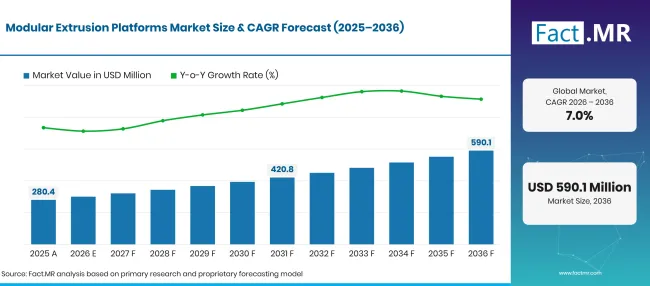
Modular Extrusion Platforms Forecast Global | Source: Fact.MR
Category
| Category | Segments |
|---|---|
| Extruder architecture | Single-screw modular, Co-rotating twin-screw, Counter-rotating twin-screw, Multi-stage modular, Hybrid extrusion |
| Processing scale | Pilot / lab, Small commercial, Mid-scale, High-throughput, Ultra-high-throughput |
| Operating configuration | Batch, Semi-continuous, Continuous, Modular skid, Integrated line |
| Food / process application | Bakery / wafers, Confectionery / cocoa, Snacks / seasoning, Brewing / grains, Other food / industrial |
| Region | India; United States; China; Germany; France |
Source: Fact.MR analysis.
Segmental Analysis
What is encouraging processors to invest in multi-stage modular extrusion platforms?
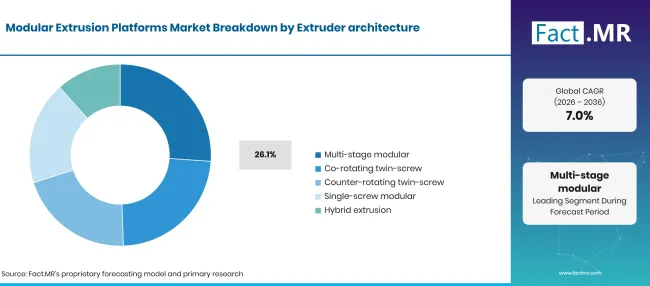
Modular Extrusion Platforms Breakdown Extruder Architecture | Source: Fact.MR
Demand for multi-stage modular designs account for 26.1% of market revenue in 2026, about USD 78.3 million, as food manufacturers seek greater control over ingredient conditioning, cooking, expansion and texturization. India's Ministry of Food Processing Industries reported in June 2026 that investments under the Production Linked Incentive Scheme had created 34 lakh metric tonnes per annum of additional food-processing capacity. Sales of PLI-supported products also increased to ₹1,08,854 crore in FY 2025–26. Expanding processing capacity is creating opportunities for modular extrusion platforms that allow manufacturers to configure individual processing stages around different product requirements.
Which production trends are supporting sales of ultra-high-throughput modular extrusion platforms?
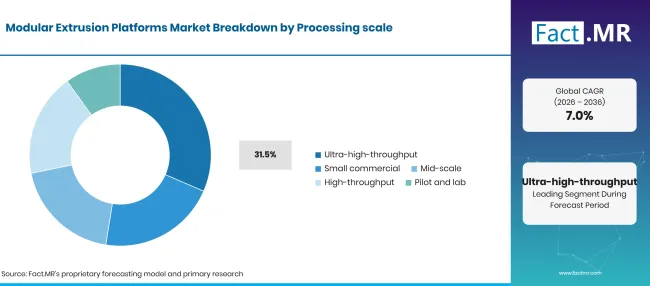
Modular Extrusion Platforms Breakdown Processing Scale | Source: Fact.MR
Sales of ultra-high-throughput systems capture 31.5% of market revenue in 2026, about USD 94.5 million, as large-scale cereal, snack and animal-feed processors require equipment capable of handling substantial ingredient volumes. The USDA's November 2026 Feed Outlook estimates U.S. feed-grain production at 414 million metric tonnes for 2026–27, including 403.7 million metric tonnes of corn. This substantial grain supply supports demand for industrial processing infrastructure, including high-capacity extrusion equipment used in cereal production, feed preparation and expanded snack manufacturing.
How is food-processing infrastructure expansion influencing semi-continuous extrusion demand?
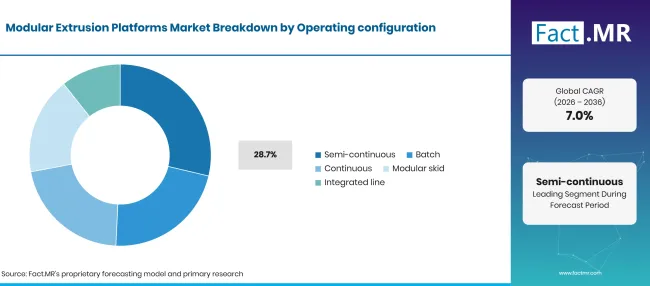
Modular Extrusion Platforms Breakdown Operating Configuration | Source: Fact.MR
Demand for semi-continuous operation represents 28.7% of market revenue in 2026, reaching USD 86.1 million, as processors coordinate extrusion with upstream ingredient preparation and downstream drying, cooling and packaging. India's Ministry of Food Processing Industries reported that 1,256 projects under the Pradhan Mantri Kisan Sampada Yojana had been completed or become operational by June 2026. These projects created 294.21 lakh metric tonnes per annum of processing and preservation capacity. Expansion of integrated processing facilities is strengthening opportunities for extrusion platforms that can operate alongside batch-based preparation and downstream continuous production systems.
What is expanding application demand for modular extrusion platforms beyond conventional snack production?
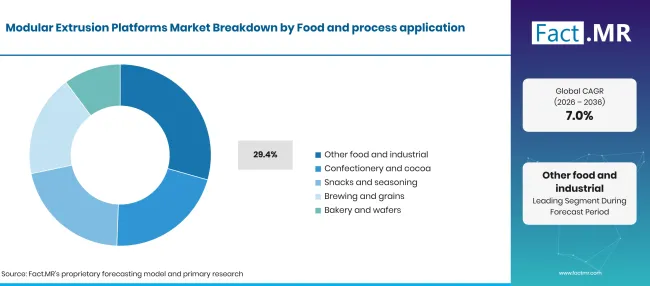
Modular Extrusion Platforms Breakdown Food And Process Application | Source: Fact.MR
Other food and industrial applications account for 29.4% of market revenue in 2026, about USD 88.2 million, reflecting demand from pet food, aquafeed, textured plant proteins and industrial starch processing. According to the FAO's June 2026 State of World Fisheries and Aquaculture report, global aquaculture production of aquatic animals reached 103 million tonnes in 2024, exceeding 100 million tonnes for the first time. Additionally, India's 2026 Bioeconomy Report recorded animal nutrition industry growth from USD 20.50 billion in 2024 to USD 23.04 billion in 2025, with aquaculture increasing from USD 6.89 billion to USD 8.61 billion. These developments support opportunities for modular extrusion platforms serving specialized feed and food applications.
Modular Extrusion Platforms Market-Drivers, Restraints & Trends
Drivers: Demand for High-Protein and High-Fiber Food Products
Demand for modular extrusion platforms is supported by the expansion of food processing and investment in manufacturing capacity. According to India's Ministry of Food Processing Industries, the food processing sector recorded a gross value added (GVA) of ₹2.24 lakh crore in 2023–24, compared with ₹1.34 lakh crore in 2014–15. The sector attracted USD 7.33 billion in foreign direct investment between 2014–15 and 2024–25. Furthermore, processed food exports accounted for 20.4% of India's agricultural exports in 2024–25, compared with 13.7% in 2014–15. These figures, published by the government in February 2026, demonstrate the expanding industrial base for processed foods. This supports investment opportunities for flexible extrusion systems used in cereal, snack and protein-based food production
Restraints: High Equipment Costs and Cautious Investment in Plant-Based Meat
Sales of modular extrusion platforms can be constrained by high initial equipment costs, particularly when manufacturers need specialized screw configurations, interchangeable barrels and downstream processing systems. India's Ministry of Statistics and Programme Implementation reported in September 2026 that fixed capital investment in registered manufacturing increased by 10.54% in 2024–25, indicating continued capital expenditure across the industrial sector. High equipment costs and uncertainty in individual product categories can nevertheless encourage processors to prioritize modular systems that accommodate multiple formulations and applications.
Opportunity: Pet Food and Aquafeed Extrusion
Demand for extrusion equipment used in animal feed and aquafeed production is supported by expanding fisheries and animal-feed manufacturing infrastructure. India's Ministry of Fisheries reported in September 2026 that national fish production reached a record 198 lakh tonnes in 2024–25, compared with 95.79 lakh tonnes in 2013–14. Inland fisheries and aquaculture production increased to 151.60 lakh tonnes during the same period. Separately, the Department of Animal Husbandry and Dairying reported in its 2025–26 Annual Report that 150 projects supported under the Animal Husbandry Infrastructure Development Fund had established approximately 109.33 lakh metric tonnes of annual animal-feed manufacturing capacity as of December 31, 2025. These developments support opportunities for modular extrusion platforms used in feed processing, particularly fish-feed and formulated animal-feed production.
Trend: Digital Extrusion Control and Automated Processing
Demand for digitally controlled modular extrusion platforms is increasing as food and feed manufacturers seek greater consistency in moisture levels, temperature, pressure and screw speed. Automated recipe management and integrated sensors allow operators to adjust processing parameters across different formulations and production batches. India's Ministry of Food Processing Industries reported that beneficiary companies under the Production Linked Incentive Scheme for Food Processing Industry had recorded cumulative investments of ₹9,207 crore and cumulative production and sales of ₹5,13,104 crore as of June 30, 2026. The scheme also covered 165 approved applications across food-processing categories. These figures indicate continued investment in food-processing capacity and industrial modernization.
Modular Extrusion Platforms Market by Analysis by Key Country
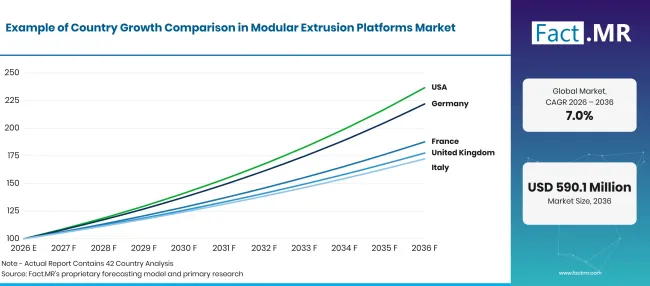
Modular Extrusion Platforms Growth Index | Source: Fact.MR
| Country | CAGR (2026-2036) |
|---|---|
| India | 9.3% |
| United States | 9.0% |
| China | 8.6% |
| Germany | 8.3% |
| France | 6.5% |
Source: Fact.MR analysis.
Why is India the fastest-growing market for modular extrusion platforms?
Demand in India is projected to grow at a 9.3% CAGR, the fastest among the five key countries, as extruded snacks, breakfast cereals and pet food expand and the PLI scheme supports food processing investment.
The Ministry of Food Processing Industries reported in July 2026 that investments under the Production Linked Incentive Scheme had created 34 lakh metric tonnes per annum of additional processing capacity. Sales of PLI-supported products also reached ₹1,08,854 crore in FY 2025–26, compared with ₹58,758 crore in FY 2019–20. This expansion is creating opportunities for extrusion equipment suppliers serving large food-processing facilities.
Which manufacturing developments are creating sales opportunities for modular extrusion platforms in the United States?
Sales in the United States are estimated to record a 9.0% CAGR as pet food makers expand plants and cereal makers refresh lines.
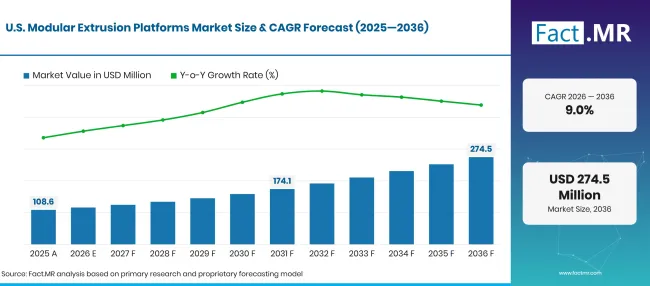
Modular Extrusion Platforms Forecast Usa | Source: Fact.MR
Wenger, based in Kansas, serves US plants. The U.S. Census Bureau reported in September 2026 that food manufacturing generated approximately USD 1,054.3 billion in shipments and employed 1.70 million people, based on its 2024 Annual Integrated Economic Survey. Separately, Federal Reserve data showed manufacturing output increasing 0.3% in September 2026. These industrial activities support replacement and capacity-expansion opportunities for suppliers such as Wenger, particularly in high-volume pet-food and cereal processing.
What is driving modular extrusion platform demand in China?
Sales in China are projected to increase at an 8.6% CAGR as urban pet ownership grows and aquafeed output rises with the country's large aquaculture sector.
Domestic extruder maker Famsun competes with Bühler, Andritz and Wenger on modular lines. The Ministry of Agriculture and Rural Affairs reported that aquatic product output across 20 provinces reached 43.05 million tonnes between January and August 2026, increasing 3.93% year over year. Marine aquaculture production grew 5.16% during this period. Rising aquaculture output is strengthening requirements for specialized feed manufacturing and processing capacity. Domestic equipment suppliers such as Famsun can address these requirements alongside international extrusion technology providers.
What is shaping modular extrusion platform demand in Germany?
Demand in Germany is anticipated to grow at an 8.3% CAGR as cereal, snack and alternative-protein makers develop high-moisture and texturized products, and Rügenwalder Mühle currently sells more plant-based than meat products.
Coperion in Stuttgart and Leistritz in Nuremberg build twin-screw extruders. Destatis reported in May 2026 that Germany produced 124,900 tonnes of vegetarian and vegan meat alternatives in 2025, representing a 1.2% annual decline. However, production remained 107% higher than in 2019, demonstrating substantial longer-term industry development. Manufacturers developing textured proteins and specialized food ingredients require precise extrusion control. This creates opportunities for domestic technology providers such as Coperion and Leistritz to serve food-processing equipment modernization.
Why is modular extrusion platform growth slower in France?
Adoption of modular extrusion platforms in France is projected to represent a 6.5% CAGR, the slowest among the five key countries, as domestic cereal and snack markets are mature, although Clextral exports widely from Firminy.
The French Ministry of Agriculture's October 2026 food-industry overview reported that the country has more than 23,000 food-processing companies employing approximately 480,000 people. These businesses transform around 70% of domestic agricultural production. This substantial manufacturing base sustains demand for extrusion equipment, although incremental purchases increasingly depend on modernization, specialized product development and export-oriented production rather than widespread first-time industrial capacity creation.
Competitive Landscape for Modular Extrusion Platforms Market
The modular extrusion platforms market is characterized by competition between integrated food-processing equipment manufacturers and specialized extrusion technology suppliers. GEA, Bühler and JBT Marel compete through integrated extrusion lines for snacks, cereals, pet food and aquafeed. Coperion, including its Baker Perkins business, and Clextral strengthen competition through configurable twin-screw extruders, modular barrel designs and specialized screw configurations. These manufacturers differentiate their offerings through processing flexibility, throughput, energy consumption and product consistency.
Competition is increasingly influenced by demand for equipment that accommodates different formulations without extensive machinery replacement. Bühler's Nutrex 7 Series emphasizes scalable modularity and automated operation, while GEA's xTru Twin supports sectional screw configurations and recipe monitoring. Coperion focuses on improved feeding efficiency and reduced operating costs, while Clextral offers streamlined twin-screw platforms. Growing applications in pet food, aquafeed, textured vegetable proteins and high-protein snacks are creating opportunities for suppliers offering quick-change components, digital process control and adaptable production capacities.
Recent Developments
- On June 16, 2025, GEA introduced its new high-speed Bake Extruder at IBA 2025 in Düsseldorf, Germany. The modular extrusion system is designed for medium- to large-scale biscuit manufacturers and supports wire-cut, co-extruded, filled and continuous-extruded products. Its design features interchangeable dies and cutting mechanisms, customizable filler blocks and optional lobe pumps. The system uses brushless motors and servo-driven axes for precise extrusion-speed and cutting control. Its wire-cut system can operate at up to 350 strokes per minute across a maximum working width of 1,700 mm. The launch strengthens GEA's modular extrusion portfolio for bakery applications.
- On May 6, 2026, Bühler launched Nutrex 7 Series, a next-generation twin-screw extrusion platform for food and feed manufacturers. The modular system supports scalable configurations, flexible left- and right-hand layouts and adaptation to changing product requirements. Its updated design incorporates hygienic construction, an integrated digital control system, browser-based monitoring and automated production-startup functions. The company also introduced its patented Cleaning Lance for improved internal cleaning. According to Bühler, the platform can reduce cleaning and audit-readiness times by up to 50%, while its StepFlow functionality can reduce production waste by up to 30% per run. The platform was developed for cereals, snacks, pet food, meat alternatives and food ingredients.
- On April 15, 2026, JBT Marel announced that Wenger and Extru-Tech would present their extrusion technologies together at Petfood Forum 2026. The announcement highlighted the recently launched Minimally Processed Pet Food Line, which supports gently cooked, air-dried, fresh and baked pet-food applications. A key technology featured was Wenger's PetFlex twin-screw extruder. PetFlex allows processors to switch between conventional formulations and recipes containing higher fresh-meat inclusions using the same equipment, reducing the need for extensive hardware changes. The development expands JBT Marel's extrusion capabilities for premium pet food, specialized nutrition and flexible production requirements.
- In March 2026, Coperion announced a new feeding platform for its small ZSK twin-screw extruders, extending its availability from the ZSK 18 MEGAlab to the ZSK 26 Mc¹⁸ and ZSK 27 Mv¹⁴ models. The platform allows up to four feeders to be positioned flexibly along the extrusion process section and attached to different barrel positions or side feeders. It can also be mounted on either side of the extruder. Two configurations are available, including a high-end version with adjustable feeder positioning and a more economical version with predefined positions. Coperion states that the design improves process flexibility, efficiency and user-friendliness.
Key Players in Modular Extrusion Platforms Market
Key companies operating in the market include GEA, Bühler, JBT Marel, Baker Perkins, Coperion, and Clextral.
- GEA
- Bühler
- JBT Marel
- Baker Perkins
- Coperion
- Clextral
Modular Extrusion Platforms Market by Segments
-
Extruder architecture
- Single-screw modular
- Co-rotating twin-screw
- Counter-rotating twin-screw
- Multi-stage modular
- Hybrid extrusion
-
Processing scale
- Pilot / lab
- Small commercial
- Mid-scale
- High-throughput
- Ultra-high-throughput
-
Operating configuration
- Batch
- Semi-continuous
- Continuous
- Modular skid
- Integrated line
-
Food / process application
- Bakery / wafers
- Confectionery / cocoa
- Snacks / seasoning
- Brewing / grains
- Other food / industrial
-
Region:
- North America
- United States
- Canada
- Mexico
- Europe
- Germany
- United Kingdom
- France
- Italy
- Spain
- Rest of Europe
- Asia Pacific
- China
- India
- Japan
- South Korea
- Australia
- Rest of Asia Pacific
- Latin America
- Brazil
- Mexico
- Argentina
- Rest of Latin America
- Middle East & Africa
- GCC Countries
- South Africa
- Rest of Middle East & Africa
- North America
Bibliography
- Association of Biotechnology Led Enterprises. (2026). India bioeconomy report 2026. Biotechnology Industry Research Assistance Council (BIRAC), Government of India.
- Bühler Group. (2025). Annual report 2024.
- Board of Governors of the Federal Reserve System. (2026, September 18). Industrial production and capacity utilization – G.17.
- Food and Agriculture Organization of the United Nations. (2026, June 16). SOFIA 2026: Global fisheries and aquaculture production reaches new highs.
- Good Food Institute. (2026). State of the industry report: Plant-based meat, seafood, eggs, dairy, and ingredients.
- Ministry of Fisheries, Animal Husbandry and Dairying. (2026, September 7). Growth of aquaculture sector in India through modern technologies. Press Information Bureau, Government of India.
- Ministry of Food Processing Industries. (2026, April 21). Strengthening India’s food processing ecosystem. Press Information Bureau, Government of India.
- Ministry of Statistics and Programme Implementation. (2026, September 30). Release of the Annual Survey of Industries (2024–25) results. Press Information Bureau, Government of India.
- Ministry of Agriculture and Rural Affairs of the People's Republic of China. (2026, September 20). 1—8月水产品产量4305.09万吨 [Aquatic product production reached 43.0509 million tonnes from January to August 2026].
- Ministère de l'Agriculture, de l'Agro-alimentaire et de la Souveraineté alimentaire. (2026, October 16). Le panorama des industries agroalimentaires 2026
- Statistisches Bundesamt (Destatis). (2026, May 18). Nach jahrelangem Anstieg: Fleischersatz-Produktion sinkt 2025 um 1,2 % gegenüber dem Vorjahr
- Ministry of Food Processing Industries. (2026, April 21). Strengthening India's food processing ecosystem. Press Information Bureau, Government of India.
- Ministry of Food Processing Industries. (2026, September). Annual report 2025–26. Government of India.
- Press Information Bureau. (2026). Food processing reforms and enhanced financial support under the Production Linked Incentive Scheme for the Food Processing Industry. Government of India.
- Press Information Bureau. (2026, November 13). The manufacturing transformation powered by PLI: From policy to production. Government of India.
- United States Department of Agriculture, Economic Research Service. (2026, November 16). Corn and other feed grains: Market outlook.
- United States Department of Agriculture, Economic Research Service. (2026, November 13). Feed outlook: November 2026 (Report No. FDS-26k).
- U.S. Census Bureau. (2026, September 2). Manufacturers' shipments, inventories, and orders: July 2026.
Segmentation
Scope of Report
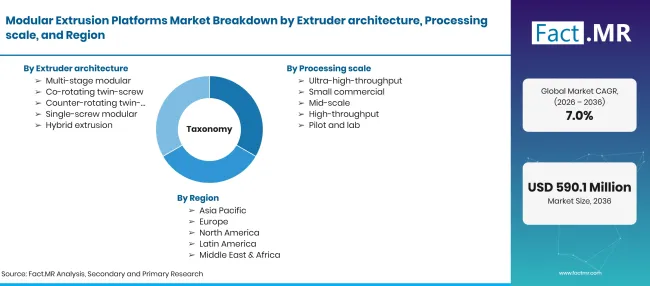
Modular Extrusion Platforms Taxonomy | Source: Fact.MR
| Items | Values |
|---|---|
| Quantitative Units (2026) | USD 300.0 Million |
| Extruder architecture | Single-screw modular, Co-rotating twin-screw, Counter-rotating twin-screw, Multi-stage modular, Hybrid extrusion |
| Processing scale | Pilot / lab, Small commercial, Mid-scale, High-throughput, Ultra-high-throughput |
| Operating configuration | Batch, Semi-continuous, Continuous, Modular skid, Integrated line |
| Food / process application | Bakery / wafers, Confectionery / cocoa, Snacks / seasoning, Brewing / grains, Other food / industrial |
| Regions Covered | North America, Latin America, Europe, East Asia, South Asia and Pacific, Middle East & Africa |
| Countries Covered | India, United States, China, Germany, France, and other countries |
| Key Companies Profiled |
|
| Additional Attributes | Dollar revenue in the Modular Extrusion Platforms Market is segmented by extruder architecture (single-screw modular, co-rotating twin-screw, counter-rotating twin-screw, multi-stage modular, hybrid extrusion); processing scale (pilot / lab, small commercial, mid-scale, high-throughput, ultra-high-throughput); operating configuration (batch, semi-continuous, continuous, modular skid, integrated line); food / process application (bakery / wafers, confectionery / cocoa, snacks / seasoning, brewing / grains, other food / industrial) and region. |
Source: Fact.MR analysis.
Table of Contents
Key Takeaways
- Market Size and CAGR
- Top Growth Driver
- Fastest Growing Segment
- Leading Region
- Key Companies
- Emerging Opportunities

