- Market Value (2025): USD 439.4 Mn
- Estimated Value (2026): USD 465.1 Mn
- Forecast Value (2036): USD 822.0 Mn
- CAGR (2026-2036): 5.9%
Marine Alarm Systems Market Forecast and Outlook 2026 to 2036
Fact.MR studies the marine alarm systems market was valued at USD 439.4 million in 2025 and is projected to grow from USD 465.1 million in 2026 to USD 822.0 million by 2036. Demand for marine alarm systems is likely to grow at a CAGR of 5.9% over the forecast period.
Demand for marine alarm systems is rising as lithium-ion batteries, electric vehicles and alternative marine fuels introduce new fire-safety challenges aboard vessels. These hazards can cause rapid heat build-up, toxic gas release and fire re-ignition, increasing the need for early detection and continuous monitoring. Manufacturers are offering addressable fire alarm panels, intelligent smoke and heat detectors, flame sensors and gas-detection systems to help crews identify abnormal conditions and respond promptly. In June 2025, the vehicle carrier Morning Midas caught fire in the Pacific Ocean while transporting approximately 3,000 vehicles, including electric and hybrid models, before sinking. In December 2025, the U.S. National Transportation Safety Board reported that improperly secured lithium-ion battery energy storage units caused two fires aboard the cargo vessel Genius Star XI. A June 2025 container fire aboard Interasia Tenacity in India also highlighted battery-related cargo risks. Such incidents are strengthening demand for reliable onboard detection and alarm solutions, supporting market growth through 2036.
Key Takeaways from the Marine Alarm Systems Market
- Marine Alarm Systems Market Value (2025): USD 439.4 million
- Marine Alarm Systems Market Value (2026): USD 465.1 million
- Marine Alarm Systems Market Forecast Value (2036): USD 822.0 million
- Marine Alarm Systems Market Forecast CAGR (2026-2036): 5.9%
- Leading Product Type: Fire Alarm Systems (38.2%)
- Key Market Participants: Johnson Controls International plc, Honeywell International Inc., Kongsberg Gruppen ASA, ABB Ltd., Consilium Safety Group, Autronica Fire and Security AS, Emerson Electric Co., Siemens AG
- Key Growth Regions: United States, Germany, Japan, Brazil, United Kingdom
In March 2026, the IMO's Sub-Committee on Ship Systems and Equipment (SSE 12) progressed measures to strengthen fire detection and control in containerships and advanced work on fire safety guidelines for vehicle carriers transporting new-energy vehicles. It also considered interim guidelines for video monitoring and detection systems. These developments are expected to encourage further investment in advanced onboard alarm and fire detection technologies. Demand for marine alarm systems is gaining momentum as IMO amendments to SOLAS Chapter II-2 and the Fire Safety Systems (FSS) Code took effect on January 1, 2026. New requirements strengthen individually addressable fire detection, smoke and heat monitoring, and video surveillance across vehicle, special-category and ro-ro spaces. Existing ro-ro passenger ships must meet specified additional detection and video-monitoring requirements by their first survey on or after January 1, 2028. These regulatory changes are creating opportunities for suppliers of integrated fire alarm, heat detection and video-monitoring systems.
Marine Alarm Systems Market
| Metric | Value |
|---|---|
| Estimated Value in (2026) | USD 465.1 million |
| Forecast Value in (2036) | USD 822.0 million |
| Forecast CAGR (2026 to 2036) | 5.9% |
Source: Fact.MR analysis. Updated Nov 23, 2026
Source: Fact.MR analysis.
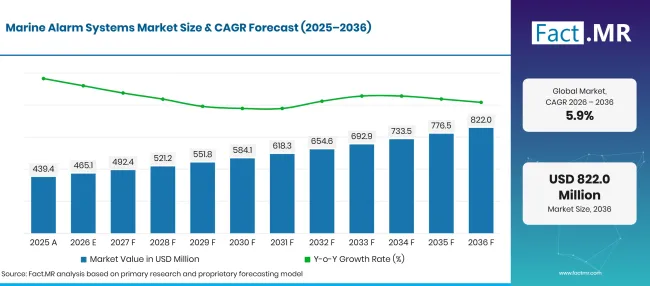
Marine Alarm Systems Market Forecast Global | Source: Fact.MR
Category
| Category | Segments |
|---|---|
| Product Type | Fire Alarm Systems, Intrusion Alarm Systems, Gas Detection Systems, Others |
| Application | Commercial Vessels, Military Vessels, Recreational Boats, Others |
| Component | Sensors, Control Panels, Alarms, Others |
| End-User | Fleet Operators, Shipyards, Individual Boat Owners, Others |
| Region | United States; Germany; Japan; Brazil; United Kingdom |
Source: Fact.MR analysis. Updated Nov 23, 2026
Source: Fact.MR analysis.
Segmental Analysis
Why do fire alarm systems lead product demand in the Marine Alarm Systems Market?
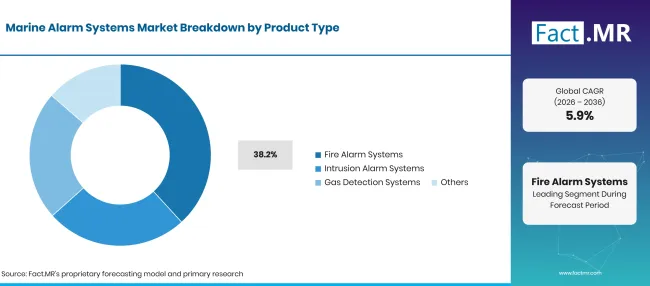
Marine Alarm Systems Market Breakdown Product Type | Source: Fact.MR
Demand for Fire alarm systems account for 38.2% of revenue in 2026, about USD 180 million, as SOLAS requires fixed fire detection in machinery spaces, accommodation and cargo areas. Gas detection and intrusion alarms follow. Manufacturers are offering addressable detectors. Similar rules are projected to keep fire alarms in the lead. The IMO's 2026 SOLAS amendments specifically strengthen smoke and heat detection coverage in vehicle, special-category and ro-ro spaces. These requirements are creating procurement opportunities for addressable detectors, alarm control panels and integrated fire monitoring equipment. Manufacturers offering systems that combine rapid fire identification with reliable alarm transmission are positioned to benefit from vessel compliance upgrades and new installations.
Why do commercial vessels lead application demand in the Marine Alarm Systems Market?
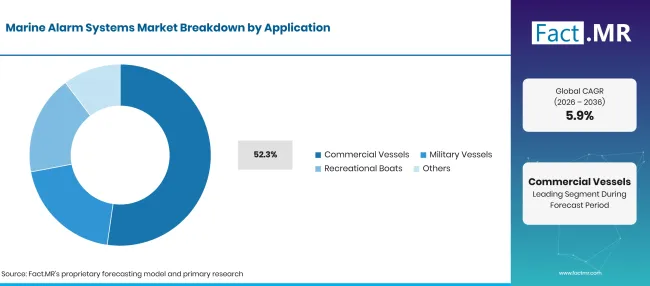
Marine Alarm Systems Market Breakdown Application | Source: Fact.MR
Commercial vessels segment leads with 52.3% of revenue in 2026, about USD 245 million, as cargo, passenger and tanker fleets must meet SOLAS. Military and recreational follow. Manufacturers serve owners and yards. Similar rules are projected to keep commercial vessels in the lead. The U.S. Coast Guard reported 8,999 SOLAS safety examinations in its May 2026 publication of the 2025 Port State Control Annual Report. This inspection activity reinforces the importance of maintaining compliant onboard safety equipment and supports demand for fire alarms, gas detectors and integrated vessel monitoring systems.
Why do sensors lead component demand in the Marine Alarm Systems Market?
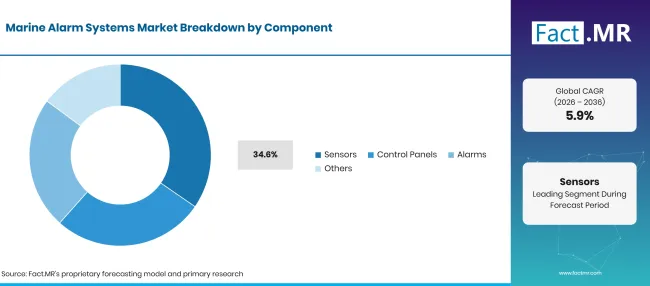
Marine Alarm Systems Market Breakdown Component | Source: Fact.MR
Sensors segment to capture 34.6% of revenue in 2026, about USD 160 million, as each ship needs many detectors. Control panels and alarms follow. Manufacturers are offering multi-sensor detectors. Similar coverage needs are projected to keep sensors in the lead. The European Maritime Safety Agency's October 2026 casualty overview reported that system or equipment failures accounted for 51.3% of recorded fire and explosion accident events in its analysis. This evidence highlights the importance of dependable detection and monitoring equipment. Manufacturers are therefore targeting vessel operators with multi-sensor detectors, improved response capabilities and systems designed for demanding marine environments.
Why do fleet operators lead end-user demand in the Marine Alarm Systems Market?
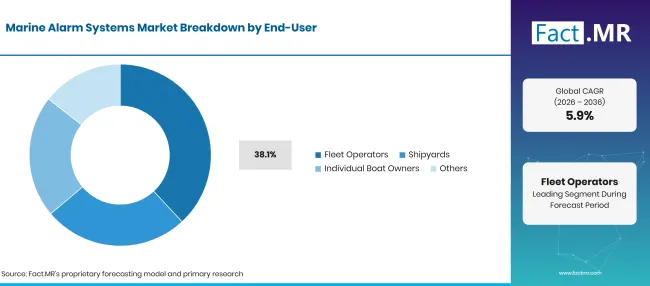
Marine Alarm Systems Market Breakdown End User | Source: Fact.MR
Fleet operators segment holds 38.1% of revenue in 2026, about USD 175 million, as they buy upgrades and maintenance. Shipyards and boat owners follow. Manufacturers offer service contracts. Similar fleet needs are projected to keep operators in the lead. The U.S. Coast Guard's 2026 publication of its 2025 inspection results recorded 8,999 SOLAS safety examinations. This continued regulatory oversight supports recurring demand for alarm maintenance, replacement components and integrated monitoring services across commercial fleets.
Marine Alarm Systems Market-Drivers, Restraints & Trends
Drivers: Stricter Fire Safety Requirements for Vehicle-Carrying Ships
Demand for marine alarm systems is increasing as shipping companies strengthen fire protection on vehicle carriers, ro-ro vessels and containerships transporting electric vehicles. The IMO's January 2026 SOLAS amendments require fixed fire detection and alarm systems in specified vehicle and ro-ro spaces, alongside video monitoring arrangements. Further, the IMO's SSE 12 meeting in March 2026 progressed work on portable infrared thermal imagers and water-mist equipment for containership fire protection. These regulatory developments are encouraging shipowners to purchase addressable fire detectors, heat-monitoring equipment and integrated alarm panels. Similar safety requirements are projected to drive marine alarm system sales through 2036.
Restraints: Retrofit Costs and Detector Reliability Challenges
Sales of marine alarm systems can be constrained by the cost and complexity of installing modern detection equipment on older vessels. Retrofitting addressable fire panels, additional sensors, video monitoring and integrated control systems can require electrical modifications, equipment replacement and vessel downtime. The European Maritime Safety Agency's 2026 casualty assessment found that system or equipment failures accounted for 51.3% of recorded fire and explosion accident events. This highlights the importance of equipment reliability and maintenance in marine environments. Manufacturers must improve detector durability, reduce false alarms and offer retrofit-compatible products to limit installation difficulties and support replacement purchases.
Opportunity: Video and Thermal Fire Detection
Demand for video-based and thermal fire detection is gaining momentum as vessel operators seek faster identification of fires in vehicle decks and cargo spaces. Under the SOLAS amendments effective from January 2026, specified vehicle, special-category and ro-ro spaces require video monitoring arrangements that allow crews to identify fire locations more quickly. In March 2026, the IMO's SSE 12 also advanced draft amendments covering portable infrared thermal imagers for containerships. These developments are encouraging suppliers to combine conventional smoke and heat detectors with thermal imaging, video monitoring and centralized alarm displays. Similar technology adoption is projected to support sales of advanced marine fire detection systems.
Trend: Gas Detection for Alternative Marine Fuels
Demand for marine gas detection systems is gaining attention as shipping companies evaluate ammonia, hydrogen, methanol and other alternative fuels. In May 2026, the IMO's Maritime Safety Committee approved interim safety guidelines for ships using hydrogen and ammonia as fuel, alongside training guidelines for seafarers working with alternative-fuel technologies. The IMO also updated its maritime alternative-fuel regulatory mapping in March 2026 to cover conventional fuels, methanol, ammonia, hydrogen and other emerging options. These developments are encouraging equipment suppliers to strengthen gas-leak monitoring capabilities and develop detection solutions suited to alternative-fuel installations. Similar fuel diversification is projected to support demand for marine gas detection systems.
Marine Alarm Systems Market by Analysis by Key Country
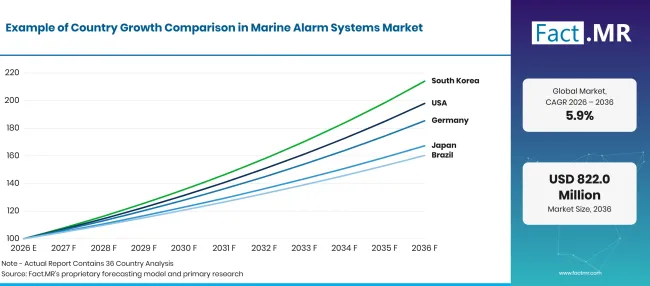
Marine Alarm Systems Market Growth Index | Source: Fact.MR
| Country | CAGR (2026-2036) |
|---|---|
| United States | 7.1% |
| Germany | 6.4% |
| Japan | 5.3% |
| Brazil | 4.8% |
| United Kingdom | 4.2% |
Source: Fact.MR analysis. Updated Nov 23, 2026
Source: Fact.MR analysis.
Why is the United States the fastest-growing market for marine alarm systems?
Sales of marine alarm systems in the United States are projected to increase at a 7.1% CAGR, the fastest among the five key countries, as naval and Coast Guard shipbuilding expands and owners upgrade fire detection.
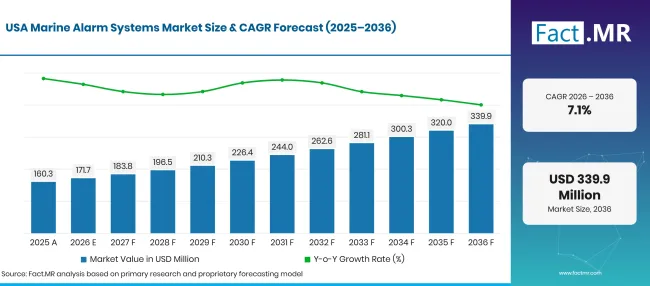
Marine Alarm Systems Market Forecast Usa | Source: Fact.MR
Honeywell, Emerson and Johnson Controls serve US yards. Similar programs are projected to drive sales. A September 2026 U.S. Government Accountability Office report identified 886 nearshore marine fires recorded by the Coast Guard between 2015 and 2025, of which 206 resulted in fatalities, injuries, damage exceeding USD 200,000 or total vessel loss. These findings are strengthening the case for early-warning smoke detectors, thermal monitoring and integrated alarm systems across commercial and specialized vessels.
Which maritime developments are creating opportunities in Germany?
Demand in Germany is estimated to grow at a 6.4% CAGR as cruise and naval ships built at German yards carry large detection networks.
Siemens supplies marine automation. Similar activity is projected to drive sales. In January 2026, Germany's Federal Maritime and Hydrographic Agency expanded its merchant fleet statistical classification to include additional ship types and began publishing updated monthly vessel data under the international Statcode 5 classification. The improved fleet coverage provides a more comprehensive basis for monitoring German maritime activity. Together with the 2026 SOLAS fire-safety requirements, these developments support demand for compliant fire detection, alarm panels and onboard monitoring equipment.
What is shaping marine alarm demand in Japan?
Japan's Ministry of Land, Infrastructure, Transport and Tourism reported that domestic coastal shipping transported 26.514 million tonnes of cargo in July 2026, representing a 7.2% increase year over year.
Cargo transportation growth supports vessel utilization and creates opportunities for suppliers providing reliable alarm systems, replacement sensors and maintenance services to commercial operators. Commercial cargo transportation and continued vessel operations support procurement of fire detection, machinery alarms and onboard monitoring equipment. Demand in Japan is anticipated to record a 5.3% CAGR as Japanese car-carrier operators add fire detection on vehicle decks. Similar risks are projected to drive sales.
What is supporting marine alarm demand in Brazil?
Sales in Brazil are estimated to grow at a 4.8% CAGR as offshore vessels need gas detection. Similar activity is projected to support sales.
Offshore vessel construction and investment in domestic shipbuilding are creating opportunities for fire detection, gas monitoring and machinery alarm installations. In March 2026, Brazil's Ministry of Ports and Airports announced a R$41.7 billion investment portfolio under the Merchant Marine Fund, covering 890 projects. These included 612 vessel construction projects, 115 repair and docking services and 141 modernization projects. This investment pipeline is creating potential procurement opportunities for marine alarm suppliers serving shipyards, offshore vessel operators and commercial fleets.
Why is marine alarm growth slower in the United Kingdom?
Demand in the United Kingdom is projected to grow at a 4.2% CAGR, the slowest among the five key countries, as commercial shipbuilding is limited.
Similar conditions are projected to keep growth slower. Demand is supported by replacement installations, regulatory upgrades and maintenance across the registered merchant fleet. The Maritime and Coastguard Agency's 2025–26 annual report recorded 1,041 commercial vessels above 100 gross tonnes on the UK Ship Register at March 31, 2026, with a combined gross tonnage of 8.79 million. The same report recorded 4,486 registered fishing vessels and 13,901 pleasure vessels. These fleet figures provide a basis for replacement and modernization demand, while the established market limits the contribution from new vessel installations.
Competitive Landscape for Marine Alarm Systems Market
Competition in the marine alarm systems market is divided between fire safety technology providers, industrial automation companies and specialized marine safety suppliers. Johnson Controls, Honeywell, Siemens and Emerson compete through fire detection, gas monitoring and integrated alarm technologies, while Kongsberg and ABB focus on vessel automation, monitoring and control systems. Consilium Safety Group and Autronica Fire and Security specialize in marine fire detection, alarm panels and integrated safety solutions. Buyers select suppliers based on marine certifications, detection accuracy, system reliability, integration capabilities and lifecycle support.
From 2024 onward, competition increasingly shifted toward advanced fire detection, battery-related hazard monitoring and integrated safety technologies. The growing use of lithium-ion batteries in electric vehicles, energy storage systems and onboard applications is increasing the need for early thermal runaway detection, smoke monitoring and gas sensing. Regulatory attention toward ro-ro vessels and vehicle carriers is also encouraging shipowners to upgrade existing fire detection infrastructure. Manufacturers offering addressable alarm systems, video-based fire detection, intelligent sensors and retrofit-compatible solutions are better positioned to strengthen their market presence. Partnerships between marine equipment manufacturers and automation providers are also important for delivering integrated vessel safety systems.
Recent Developments
- In April 2026, Johnson Controls announced changes to the Marine Equipment Directive (MED) certification status of its ZETTLER T1200 fire detection panel platform. The company discontinued renewal of MED approval for the older T1200 platform but confirmed continued availability of alternative T1200.xM variants carrying other existing marine type approvals, including DNV, ABS, BV, KRS, LRS and CCS. This portfolio change reflects the company's efforts to maintain its marine fire detection offering while addressing updated certification requirements.
- In November 2026, Honeywell Technologies introduced new fire and life safety capabilities on November 10, 2026, including AI-enabled System Sensor Distinguish technology, enhanced carbon monoxide monitoring and Incident Command software. The innovations are designed to improve early hazard identification, reduce nuisance alarms and strengthen emergency response. Although the announcement primarily targets building safety rather than marine applications, the developments demonstrate continued investment in intelligent fire detection and monitoring technologies.
- In August 2026, Kongsberg launched its Aegir SSA sonar product family on August 24, 2026, to improve maritime security, navigation and underwater situational awareness. The platform combines acoustic sensing with AI-powered virtual sonar operator capabilities and supports monitoring around ports, offshore assets and critical maritime infrastructure.
- In September 2026, ABB completed its acquisition of Norwegian marine automation specialist Høglund AS on September 1, 2026. The acquisition added 85 employees and expanded ABB's marine automation portfolio with Høglund's Integrated Automation System, which is installed on more than 600 vessels. The system combines onboard data from engines, generators and cargo systems for vessel monitoring, automation and control. This acquisition strengthens ABB's integrated marine alarm monitoring and automation capabilities.
- In June 2026, Consilium Safety Group partnered with Samsung Heavy Industries and S Wave to develop a wireless smoke and heat detection solution that received Approval in Principle from the American Bureau of Shipping in June 2026. The technology uses surface-wave communication through a ship's metal structure, reducing the need for conventional cabling. Its battery-powered detectors communicate with Consilium safety panels and can be integrated into existing systems, making the solution suitable for newbuild vessels and retrofit projects.
- In June 2026, Consilium acquired its long-standing Turkish partner Integmar Marine Technologies on June 26, 2026. The acquisition expands its regional installation, maintenance and aftermarket service capabilities for marine fire, gas and flame detection systems. The move strengthens customer support and lifecycle services for shipowners and operators.
- In February 2026, Autronica introduced AutroMaster Mobile on February 25, 2026, to improve remote monitoring and maintenance of its AutroSafe and AutroPrime fire detection systems. The platform provides mobile, tablet and browser-based access to real-time system information, alarm notifications, fault messages, historical records and automated reports. The solution is designed to simplify maintenance activities and enable technical personnel to monitor multiple installations remotely.
Key Players in Marine Alarm Systems Market
Key companies operating in the market include Johnson Controls International plc, Honeywell International Inc., Kongsberg Gruppen ASA, ABB Ltd., Consilium Safety Group, Autronica Fire and Security AS, Emerson Electric Co., and Siemens AG.
- Johnson Controls International plc
- Honeywell International Inc.
- Kongsberg Gruppen ASA
- ABB Ltd.
- Consilium Safety Group
- Autronica Fire and Security AS
- Emerson Electric Co.
- Siemens AG
Bibliography
- ABB Ltd. (2026, September 2). ABB completes acquisition of Høglund to expand marine automation offering.
- Autronica Fire and Security AS. (2026, February 25). Introducing AutroMaster Mobile – real-time control and efficient operations for technical personnel.
- Consilium Safety Group. (2026, June 4). Consilium tackles maritime cabling costs with wireless smoke and heat detection.
- Consilium Safety Group. (2026, June 26). Consilium Safety Group further expands its presence in Türkiye by acquiring Integmar Marine Technologies Inc.
- European Maritime Safety Agency. (2026). Annual overview of marine casualties and incidents – 2026 edition. Publications Office of the European Union.
- Government Accountability Office. (2026, September 29). Coast Guard: Additional action needed to address marine firefighting challenges (GAO-26-108533).
- Honeywell Technologies. (2026, November 10). Honeywell Technologies unveils new portfolio of intelligent fire and life safety innovations to improve detection, monitoring and incident response.
- International Maritime Organization. (2026, March 13). Sub-Committee on Ship Systems and Equipment, 12th session (SSE 12), 9 to 13 March 2026.
- International Maritime Organization. (2026, May 22). Maritime Safety Committee – 111th session (MSC 111), 13–22 May 2026.
- International Maritime Organization. (n.d.). Raft of shipping rules in force from 1 January 2026.
- Japan Ministry of Land, Infrastructure, Transport and Tourism. (2026, October 28). 内航船舶輸送統計月報の概要(令和8年7月分) [Summary of the monthly coastal vessel transportation statistics, July 2026].
- Johnson Controls International plc. (2026, April 1). Non-MED approved T1200 marine panels (Product Information Bulletin No. FD_MKB-1265).
- KONGSBERG Gruppen ASA. (2026, August 24). KONGSBERG launches Aegir SSA – a new family of sonars for subsea situational awareness.
- Maritime and Coastguard Agency. (2026, July 15). MCA annual report and accounts 2025 to 2026. GOV.UK.
- Ministry of Ports and Airports, Brazil. (2026, March 24). Modais de transportes terão investimentos de R$ 41,7 bilhões do Fundo da Marinha Mercante [Transport sectors to receive R$41.7 billion in investments from the Merchant Marine Fund]. GOV.BR.
- Onderzoeksraad voor Veiligheid (Dutch Safety Board). (2025, May 22). Emergency assistance Fremantle Highway.
- United States Coast Guard. (2026, May 19). 2025 Port State Control Annual Report posted.
- Federal Maritime and Hydrographic Agency (BSH). (n.d.). Statistics: Reliable German merchant fleet statistics.
Segmentation
Scope of Report
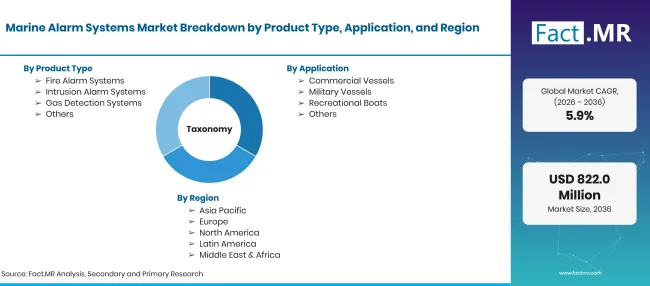
Marine Alarm Systems Market Taxonomy | Source: Fact.MR
| Items | Values |
|---|---|
| Quantitative Units (2026) | USD 465.1 Million |
| Product Type | Fire Alarm Systems, Intrusion Alarm Systems, Gas Detection Systems, Others |
| Application | Commercial Vessels, Military Vessels, Recreational Boats, Others |
| Component | Sensors, Control Panels, Alarms, Others |
| End-User | Fleet Operators, Shipyards, Individual Boat Owners, Others |
| Regions Covered | North America, Latin America, Europe, Asia Pacific, Middle East & Africa |
| Countries Covered | United States, Germany, Japan, United Kingdom, Brazil, and other countries |
| Key Companies Profiled | Johnson Controls International plc Honeywell International Inc. Kongsberg Gruppen ASA ABB Ltd. Consilium Safety Group Autronica Fire and Security AS Emerson Electric Co. Siemens AG |
| Additional Attributes | Dollar revenue in the Marine Alarm Systems Market is segmented by product type (fire alarm systems, intrusion alarm systems, gas detection systems); application (commercial vessels, military vessels, recreational boats); component (sensors, control panels, alarms); end-user (fleet operators, shipyards, individual boat owners) and region. |
Source: Fact.MR analysis. Updated Nov 23, 2026
Source: Fact.MR analysis.
Marine Alarm Systems Market by Segments
-
Product Type
- Fire Alarm Systems
- Intrusion Alarm Systems
- Gas Detection Systems
- Others
-
Application
- Commercial Vessels
- Military Vessels
- Recreational Boats
- Others
-
Component
- Sensors
- Control Panels
- Alarms
- Others
-
End-User
- Fleet Operators
- Shipyards
- Individual Boat Owners
- Others
-
Region:
- North America
- United States
- Canada
- Mexico
- Europe
- Germany
- United Kingdom
- France
- Italy
- Spain
- Rest of Europe
- Asia Pacific
- China
- India
- Japan
- South Korea
- Australia
- Rest of Asia Pacific
- Latin America
- Brazil
- Argentina
- Rest of Latin America
- Middle East & Africa
- GCC Countries
- South Africa
- Rest of Middle East & Africa
- North America
Frequently Asked Questions
How big is the global Marine Alarm Systems Market in 2026?
What will be the size of the Marine Alarm Systems Market by 2036?
How fast will the Marine Alarm Systems Market grow during the forecast period?
Which product type segment holds the largest share of the Marine Alarm Systems Market?
Who worked on this report


Preview the report firsthand - request a free sample
Free SampleGet the brochure for pricing and purchase details
Download PDF