- Market Value (2025): USD 1.66 Bn
- Estimated Value (2026): USD 1.75 Bn
- Forecast Value (2036): USD 2.93 Bn
- CAGR (2026-2036): 5.3%
Marine Water Removal Equipment Market Forecast and Outlook 2026 to 2036
As per the Fact.MR analysis, the marine water removal equipment market was valued at USD 1.66 billion in 2025 and is projected to grow from USD 1.75 billion in 2026 to USD 2.93 billion by 2036. Demand for marine water removal equipment is likely to grow at a CAGR of 5.3% over the forecast period.
Demand for marine water removal equipment is rising as ships must pump bilges, separate oily water and remove wastewater under MARPOL rules. Manufacturing company are offering pumps, oily water separators and vacuum systems. For example, MARPOL Annex I limits oil content in discharged bilge water to 15 parts per million. Similar rules are projected to drive sales through 2036.
Key Takeaways from the Marine Water Removal Equipment Market
- Marine Water Removal Equipment Market Value (2025): USD 1.66 billion
- Marine Water Removal Equipment Market Value (2026): USD 1.75 billion
- Marine Water Removal Equipment Market Forecast Value (2036): USD 2.93 billion
- Marine Water Removal Equipment Market Forecast CAGR (2026-2036): 5.3%
- Leading Product Type: Pumps (38.2%)
- Key Market Participants: Xylem Inc., Alfa Laval AB, Wärtsilä Corporation, Pentair plc, Parker Hannifin Corporation
- Key Growth Regions: Germany, Brazil, United States, United Kingdom, Japan
Sales of marine water removal equipment is increasing as shipowners and shipyards install reliable bilge pumps, oily-water separators and drainage systems to manage machinery-space water and prevent marine pollution. IMO's MARPOL Annex I requirements regulate oil discharge from ships and establish equipment and operational requirements for controlling oily bilge water. These requirements support demand for compliant water-removal and treatment equipment across commercial vessels. Manufacturing company such as Alfa Laval, Wärtsilä and DESMI offer marine pumping and separation solutions to shipbuilders and vessel operators. Continued investment in pollution-control systems and vessel maintenance is expected to support equipment sales.
Marine Water Removal Equipment Market
| Metric | Value |
|---|---|
| Estimated Value in (2026) | USD 1.75 billion |
| Forecast Value in (2036) | USD 2.93 billion |
| Forecast CAGR (2026 to 2036) | 5.3% |
Source: Fact.MR analysis. Updated Nov 23, 2026
Source: Fact.MR analysis.
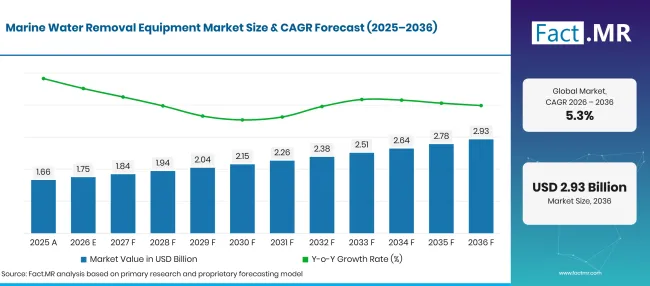
Marine Water Removal Equipment Market Forecast Global | Source: Fact.MR
Category
| Category | Segments |
|---|---|
| Product Type | Pumps, Water Separators, Vacuum Systems, Others |
| Application | Commercial Vessels, Military Vessels, Recreational Boats, Others |
| Distribution Channel | Direct Sales, Distributors, Online Sales, Others |
| End-User | Shipbuilding, Offshore Oil and Gas, Marine Transportation, Others |
| Region | Germany; Brazil; United States; United Kingdom; Japan |
Source: Fact.MR analysis. Updated Nov 23, 2026
Source: Fact.MR analysis.
Segmental Analysis
What is driving pump sales in the Marine Water Removal Equipment Market?
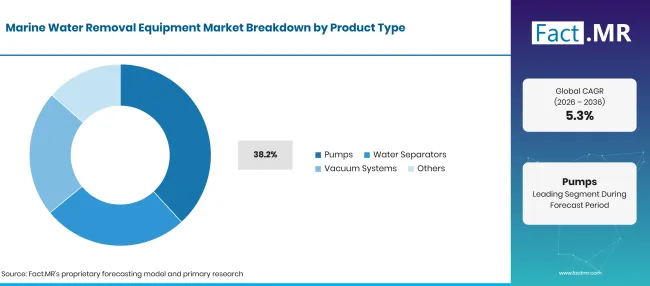
Marine Water Removal Equipment Market Breakdown Product Type | Source: Fact.MR
Demand for Pumps account for 38.2% of revenue in 2026, about USD 670 million, as every vessel needs bilge, ballast and fire pumps. Separators and vacuum systems follow. Manufacturing company such as Xylem and DESMI offer marine pumps. Similar needs are projected to keep pumps in the lead. UN Trade and Development (UNCTAD) reported that the global merchant fleet comprised approximately 116,000 vessels of at least 100 gross tons at the beginning of 2026, providing a substantial installed base for marine pumping equipment. Shipowners are prioritizing reliable pumps for machinery-space drainage, bilge-water handling and vessel maintenance, supporting replacement and new-installation sales.
Which vessel category is generating the strongest demand for marine water removal systems?
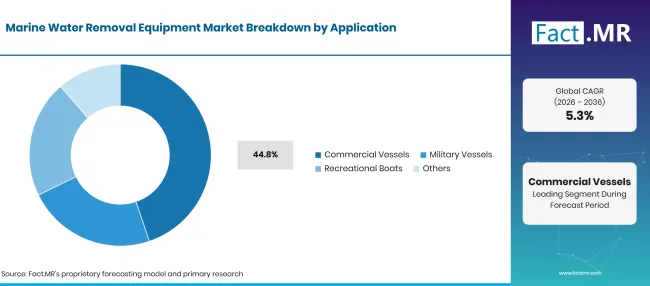
Marine Water Removal Equipment Market Breakdown Application | Source: Fact.MR
Sales of commercial vessels segment holds 44.8% of revenue in 2026, about USD 785 million, as cargo and passenger ships carry large systems. Military and recreational follow. Manufacturing company serve yards. Similar fleets are projected to keep commercial vessels in the lead. UNCTAD reported that global commercial fleet carrying capacity reached approximately 2.5 billion deadweight tons on January 1, 2026, increasing by 85 million deadweight tons over the previous year. Oil tankers and bulk carriers represented 69% of this capacity. This extensive commercial shipping base supports demand for marine pumps, oily-water separators and associated water-treatment equipment.
How are shipyard procurement practices supporting direct equipment sales?
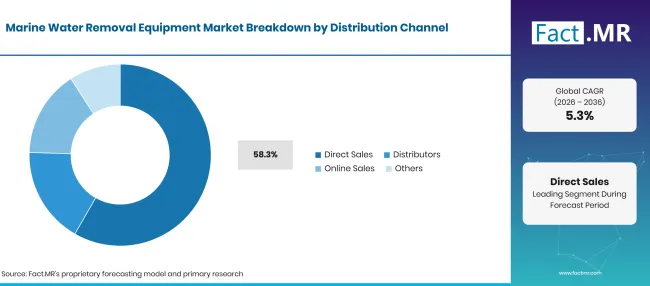
Marine Water Removal Equipment Market Breakdown Distribution Channel | Source: Fact.MR
Direct sales to represent 58.3% of revenue in 2026, about USD 1.0 billion, as yards buy engineered systems. Distributors serve spares. Manufacturing company sell direct. Similar buying is projected to keep direct sales in the lead. India's Ministry of Ports, Shipping and Waterways reported that the Indian-registered fleet reached 1,609 vessels with 14.33 million gross tonnage as of May 31, 2026. The ministry also reported that Cochin Shipyard secured contracts for four 70-tonne bollard-pull tugs during May 2026. Such shipbuilding contracts create procurement opportunities for integrated marine equipment suppliers, while distributors continue to serve replacement parts and maintenance requirements.
What is making shipbuilding an important end-user market for marine water removal equipment?
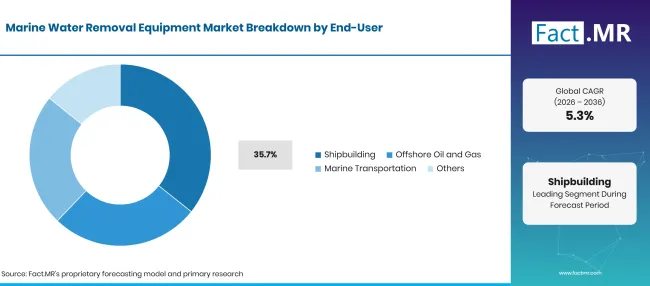
Marine Water Removal Equipment Market Breakdown End User | Source: Fact.MR
Shipbuilding segment to capture 35.7% of revenue in 2026, about USD 625 million, as newbuilds need complete systems. Offshore and transport follow. Manufacturing company serve yards. Similar orders are projected to keep shipbuilding in the lead. The Japan Ship Exporters' Association's 2026 industry report recorded 7,468 vessels in the global newbuilding order backlog at the end of December 2025, representing 313.4 million gross tons. China, South Korea and Japan together accounted for 91% of completed ship tonnage in 2025. This substantial construction pipeline provides opportunities for marine equipment manufacturers supplying shipyards with integrated water-removal systems.
Marine Water Removal Equipment Market-Drivers, Restraints & Trends
Drivers: Stronger Enforcement of Marine Pollution Prevention Requirements
Demand for marine water removal equipment is supported by stricter enforcement of oily bilge-water discharge requirements and greater scrutiny of onboard pollution-control systems. In February 2026, the International Maritime Organization's Sub-Committee on Pollution Prevention and Response agreed on draft amendments to MARPOL Annex I, including new Regulation 12B for ships fitted with integrated bilge water treatment systems. The proposed provisions also introduce standardized operational and recording requirements. Separately, the U.S. Coast Guard's August 2026 regulatory filing estimated an annual paperwork burden of 19,858 hours for maintaining Oil Record Books, up from 15,741 hours previously, reflecting the administrative requirements associated with monitoring shipboard oil operations. These developments are strengthening the importance of reliable oily water separators, bilge pumps and wastewater treatment systems.
Restraints: Price Competition from Asian Shipbuilding Centres
Sales of marine water removal equipment from Western suppliers faces pricing pressure because China, South Korea and Japan account for a substantial share of global shipbuilding output. The OECD's 2026 review of the UK shipbuilding industry reported that China, South Korea and Japan together accounted for approximately 90% of global shipbuilding orderbook capacity in 2024, with China holding 50.0%, South Korea 29.3% and Japan 10.4%. This concentration strengthens the competitive position of suppliers operating close to major Asian shipyards. Local pump, separator and sewage-system manufacturers can compete through lower production costs, established shipyard relationships and regional service networks. Western manufacturers therefore need to strengthen local distribution, technical support and after-sales service to compete for newbuilding contracts.
Opportunity: Growing Adoption of Vacuum Sewage Systems
Demand for vacuum sewage systems is gaining importance as cruise operators and passenger-vessel owners expand onboard sanitation capacity. India's Ministry of Ports, Shipping and Waterways reported in 2026 that the country recorded 462,661 ocean cruise passengers and 212 cruise vessel calls during FY 2025–26. Passenger traffic increased 5.5-fold and vessel calls increased 2.1-fold compared with FY 2013–14. The government also reported that the Cruise Bharat Mission targets 1 million sea cruise passengers by March 2029. Growing cruise activity is creating opportunities for compact vacuum toilets, sewage collection systems and onboard wastewater treatment equipment.
Trend: Increasing Adoption of Monitored Oily Water Separators
Demand for monitored oily water separators is increasing as maritime regulators emphasize continuous oil-content monitoring, automatic discharge controls and accurate operational records. In February 2026, the IMO agreed on draft amendments to MARPOL Annex I that include updated guidance for integrated bilge water treatment systems and revised Oil Record Book procedures. Australia's Maritime Safety Authority also specifies that approved oil-filtering equipment must incorporate a 15-ppm bilge alarm, with a maximum five-second response for displaying changes in oil content and a maximum 20-second response for automatic discharge stopping. These technical requirements are encouraging equipment suppliers to offer integrated oil-content monitors, automatic stopping devices, fail-safe controls and improved monitoring arrangements.
Marine Water Removal Equipment Market by Analysis by Key Country
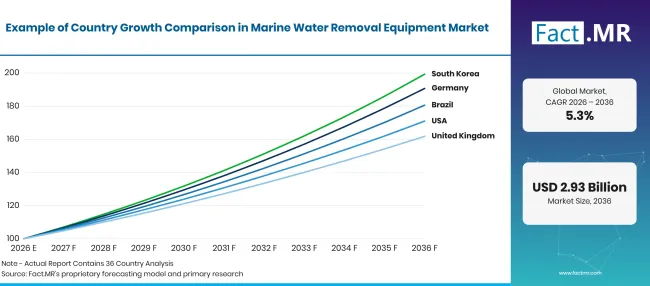
Marine Water Removal Equipment Market Growth Index | Source: Fact.MR
| Country | CAGR (2026-2036) |
|---|---|
| Germany | 6.7% |
| Brazil | 6.1% |
| United States | 5.5% |
| United Kingdom | 4.9% |
| Japan | 4.3% |
Source: Fact.MR analysis. Updated Nov 23, 2026
Source: Fact.MR analysis.
Why is Germany the fastest-growing market for marine water removal equipment?
Demand in Germany is projected to grow at a 6.7% CAGR, the fastest among the five key countries, as cruise ships at Meyer Werft and naval frigates need complex bilge, ballast and wastewater systems.
Similar work is projected to drive sales. Germany's Federal Ministry of Defence announced in June 2026 that it would discontinue the delayed F126 frigate programme and initiate procurement of eight MEKO A-200 frigates. Separately, the German Navy Command's 2026 annual report recorded 41 ongoing shipbuilding orders in 2025, valued at EUR 14.3 billion. These programmes provide opportunities for marine equipment suppliers serving German shipyards and naval contractors.
What is supporting marine water removal demand in Brazil?
Sales in Brazil are estimated to capture a 6.1% CAGR as Petrobras adds FPSOs and support vessels that need bilge, ballast and produced-water pumping.
Similar investment is projected to drive sales. Brazil's National Agency of Petroleum, Natural Gas and Biofuels (ANP) reported that offshore fields accounted for 98.1% of Brazilian oil production in August 2026. Additionally, Petrobras signed contracts in May 2026 for two FPSO production units under the Sergipe Águas Profundas project, involving investments exceeding BRL 60 billion. The combination of offshore production infrastructure and supporting marine operations creates opportunities for equipment manufacturers.
What is shaping marine water removal sales in the United States?
Sales in the United States are anticipated to hold a 5.5% CAGR as naval shipbuilding and Coast Guard cutter programs expand. Xylem and Parker supply US yards.
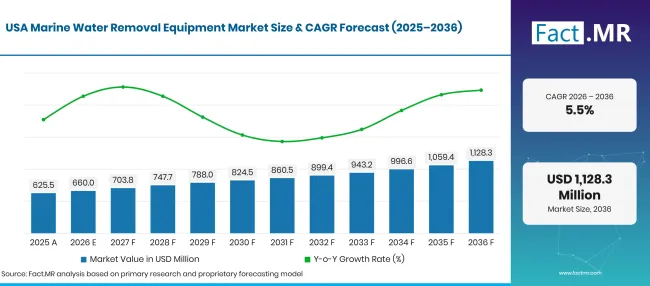
Marine Water Removal Equipment Market Forecast Usa | Source: Fact.MR
Similar programs are projected to drive sales. The U.S. Navy's FY2026 Shipbuilding and Conversion budget allocated approximately USD 20.84 billion for vessel construction, conversion and related shipbuilding activities. In September 2026, the Navy also awarded three prototype agreements worth approximately USD 280.5 million for the construction of LCU 1700 landing craft. These procurement activities provide opportunities for marine equipment suppliers serving naval shipyards and vessel manufacturers.
What is shaping marine water removal demand in the United Kingdom?
Demand in the United Kingdom is estimated to grow at a 4.9% CAGR as frigate and support ship programs continue at UK yards. Similar programs are projected to support sales.
The Ministry of Defence's 2026 armed forces equipment statistics recorded 52 Royal Navy surface vessels and 12 Royal Fleet Auxiliary vessels as of April 1, 2026. In September 2026, the government also announced a keel-laying milestone for the first of three Fleet Solid Support ships, with the programme expected to generate around 1,200 shipyard jobs. These developments create procurement opportunities for marine equipment manufacturers supplying naval construction and maintenance projects.
Why is marine water removal growth slower in Japan?
Demand in Japan is projected to represent a 4.3% CAGR, the slowest among the five key countries, as domestic pump makers dominate supply to Japanese yards.
Similar conditions are projected to keep growth slower. Japan's Ministry of Land, Infrastructure, Transport and Tourism published its 2026 shipbuilding and ship-machinery statistics, covering monthly vessel orders, construction starts, completions, repair activity and quarterly production of ship machinery. The July 2026 shipbuilding statistics and second-quarter machinery production releases provide official indicators for monitoring domestic vessel construction and equipment manufacturing.
Competitive Landscape for Marine Water Removal Equipment Market
Competition in the marine water removal equipment market is divided between oily-water separation system manufacturers and marine pump specialists. Alfa Laval, GEA Group, Veolia Water Technologies (RWO), Wärtsilä and Parker Hannifin (Village Marine) compete in bilge-water treatment and oily-water separation systems. Xylem (Rule), Pentair (SHURFLO), SPX FLOW (Johnson Pump) and DESMI focus on marine bilge pumps, centrifugal pumps and water-transfer equipment.
Manufacturers are incorporating oil-content monitoring, automatic discharge controls and digital process management to help vessel operators maintain compliance. For example, GEA's bilge Separator integrates SafetyMaster monitoring and automatically records processing data for up to 18 months. Alfa Laval's PureBilge combines automated centrifugal separation with secure discharge controls. Competition is increasingly shaped by stricter marine discharge requirements, automated monitoring and operational reliability.
Product differentiation also depends on compact equipment designs, lower maintenance requirements, energy efficiency and suitability for new vessels and retrofits. Manufacturers offering integrated treatment systems, continuous monitoring and documented discharge performance are positioned to address increasingly demanding vessel-owner requirements.
Recent Developments
- On September 3, 2026, Alfa Laval introduced the PureBallast 3 Ultra Skid, a skid-mounted version of its ballast water management system. The prefabricated design reduces installation time and equipment footprint while retaining biological treatment performance. The launch expands its marine water treatment portfolio.
- At SMM 2026, GEA showcased GEA X Control, a new automation platform for marine separators. The platform offers cloud connectivity, remote diagnostics, integration with vessel automation systems and cybersecurity-compliant operation. It supports more efficient monitoring and maintenance of marine separation equipment.
- On February 5, 2026, Wärtsilä announced an agreement to divest its Water & Waste business to Sweden-based Solix Group AB. The business includes marine ballast water treatment and wastewater management technologies. The transaction represents a portfolio restructuring that affects Wärtsilä's marine water treatment operations.
Key Players in Marine Water Removal Equipment Market
Key companies operating in the market include Alfa Laval, GEA Group, Veolia Water Technologies (RWO), Wärtsilä, Parker Hannifin (Village Marine), Xylem (Rule), Pentair (SHURFLO), SPX FLOW (Johnson Pump), and DESMI.
- Alfa Laval
- GEA Group
- Veolia Water Technologies (RWO)
- Wärtsilä
- Parker Hannifin (Village Marine)
- Xylem (Rule)
- Pentair (SHURFLO)
- SPX FLOW (Johnson Pump)
- DESMI
Bibliography
- Alfa Laval. (2026, September 3). Alfa Laval expands PureBallast 3 Ultra portfolio with new skid solution for faster, simpler installation.
- Australian Maritime Safety Authority. (2025). Testing and inspection of oil filtering equipment (MEPC.107(49)).
- Agência Nacional do Petróleo, Gás Natural e Biocombustíveis. (2026, October 1). ANP divulga dados consolidados da produção de petróleo e gás em agosto de 2026 [ANP releases consolidated oil and gas production data for August 2026].
- Agência Nacional do Petróleo, Gás Natural e Biocombustíveis. (2026, November 3). Produção de petróleo e gás natural bate novo recorde em setembro [Oil and natural gas production reaches a new record in September].
- Bundeswehr. (2026, June 24). Verteidigungsministerium beendet das Rüstungsprojekt Fregatte F126 [Ministry of Defence terminates the F126 frigate procurement project].
- Department of the Navy. (2025). Department of Defense appropriations act, 2026: Shipbuilding and conversion, Navy. U.S. Department of Defense.
- GEA Group. (2026). SMM 2026: Next-generation automation for smarter marine separation.
- Government of India, Ministry of Ports, Shipping and Waterways. (2026). Monthly summary for the month of May 2026.
- International Maritime Organization. (2004). Revised guidelines and specifications for pollution prevention equipment for machinery space bilges of ships (MEPC.107(49)).
- International Maritime Organization. (2026, February 13). Sub-Committee on Pollution Prevention and Response (PPR 13), 9–13 February 2026.
- Japan Ship Exporters' Association. (2026). Current status of Japan shipbuilding industry 2026.
- Organisation for Economic Co-operation and Development. (2026). Peer review of the United Kingdom shipbuilding industry.
- Petrobras. (2026, May 29). Petrobras assina contratos para dois FPSOs do projeto Sergipe Águas Profundas [Petrobras signs contracts for two FPSOs for the Sergipe Águas Profundas project].
- U.S. Coast Guard. (2026, August 10). Collection of information under review by Office of Management and Budget; OMB Control Number: 1625-0009. Federal Register.
- U.S. Navy. (2026, September 15). U.S. Navy awards three prototype agreements to accelerate LCU 1700 production and strengthen maritime industrial base.
- UK Ministry of Defence. (2026, August 20). UK armed forces equipment and formations 2026. GOV.UK.
- UK Ministry of Defence. (2026, September 3). Key milestone reached for future Navy support ship as names of sister ships announced. GOV.UK.
- UN Trade and Development. (2026, June 18). Data insights: Maritime transport and the global merchant fleet. UNCTAD Data Hub.
- UN Trade and Development. (2026). Review of maritime transport 2026.
- Veolia. (2026). Water technologies and solutions.
- Wärtsilä Corporation. (2026, February 5). Wärtsilä to divest its Water & Waste business to Solix Group AB.
Segmentation
Scope of Report
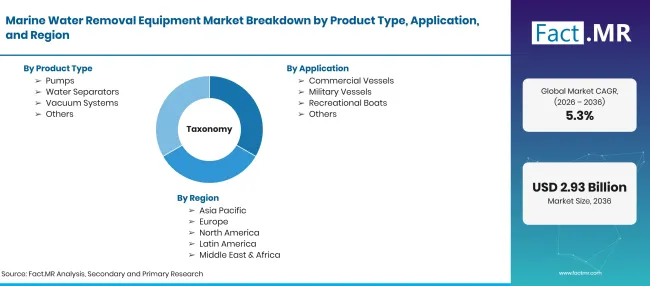
Marine Water Removal Equipment Market Taxonomy | Source: Fact.MR
| Items | Values |
|---|---|
| Quantitative Units (2026) | USD 1.75 Billion |
| Product Type | Pumps, Water Separators, Vacuum Systems, Others |
| Application | Commercial Vessels, Military Vessels, Recreational Boats, Others |
| Distribution Channel | Direct Sales, Distributors, Online Sales, Others |
| End-User | Shipbuilding, Offshore Oil and Gas, Marine Transportation, Others |
| Regions Covered | North America, Latin America, Europe, Asia Pacific, Middle East & Africa |
| Countries Covered | United States, Germany, Japan, United Kingdom, Brazil, and other countries |
| Key Companies Profiled |
|
| Additional Attributes | Dollar revenue in the Marine Water Removal Equipment Market is segmented by product type (pumps, water separators, vacuum systems); application (commercial vessels, military vessels, recreational boats); distribution channel (direct sales, distributors, online sales); end-user (shipbuilding, offshore oil and gas, marine transportation) and region. |
Source: Fact.MR analysis. Updated Nov 23, 2026
Source: Fact.MR analysis.
Marine Water Removal Equipment Market by Segments
-
Product Type
- Pumps
- Water Separators
- Vacuum Systems
- Others
-
Application
- Commercial Vessels
- Military Vessels
- Recreational Boats
- Others
-
Distribution Channel
- Direct Sales
- Distributors
- Online Sales
- Others
-
End-User
- Shipbuilding
- Offshore Oil and Gas
- Marine Transportation
- Others
-
Region:
- North America
- United States
- Canada
- Mexico
- Europe
- Germany
- United Kingdom
- France
- Italy
- Spain
- Rest of Europe
- Asia Pacific
- China
- India
- Japan
- South Korea
- Australia
- Rest of Asia Pacific
- Latin America
- Brazil
- Argentina
- Rest of Latin America
- Middle East & Africa
- GCC Countries
- South Africa
- Rest of Middle East & Africa
- North America
Frequently Asked Questions
How big is the global Marine Water Removal Equipment Market in 2026?
What will be the size of the Marine Water Removal Equipment Market by 2036?
How fast will the Marine Water Removal Equipment Market grow during the forecast period?
Which product type segment holds the largest share of the Marine Water Removal Equipment Market?
Who worked on this report


Preview the report firsthand - request a free sample
Free SampleGet the brochure for pricing and purchase details
Download PDF