- Base Value(2025): 6.2 Bn
- Estimated Value(2026): 6.8 Bn
- Forecast Value (2036): 15.7 Bn
- CAGR (2026 - 2036): 8.7%
Multi-Brand Vehicle Diagnostic Tester Platforms Market Forecast and Outlook By Fact.MR
- The multi-brand vehicle diagnostic tester platforms market was valued at USD 6.2 billion in 2025.
- According to Fact.MR, demand is estimated to reach USD 6.8 billion in 2026 and further expand to USD 15.7 billion by 2036, reflecting a CAGR of 8.7% during the assessment period.
- The growth trajectory remains steady, supported by ongoing changes in vehicle architecture and servicing requirements.
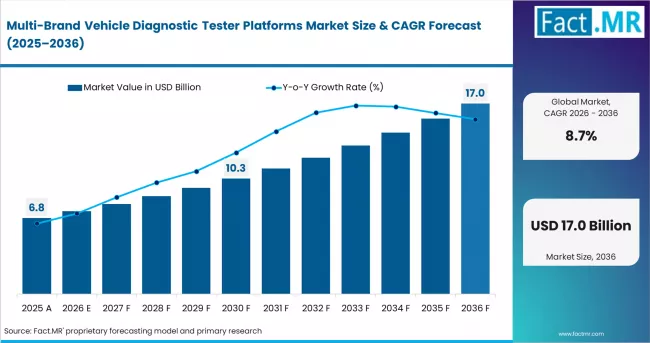
Multi Brand Vehicle Diagnostic Tester Platforms Market Market Value Analysis | Source: Fact.MR
| Metric | Details |
|---|---|
| Industry Size (2026) | USD 6.8 billion |
| Industry Value (2036) | USD 15.7 billion |
| CAGR (2026 to 2036) | 8.7% |
Source: Fact.MR analysis. Updated May 11, 2026
Summary of Multi-Brand Vehicle Diagnostic Tester Platforms Market
- Market Definition
- The market includes professional tester platforms that let independent and mixed-brand workshops diagnose, service, and support repair procedures across multiple vehicle makes from one diagnostic ecosystem.
- Demand Drivers
- Vehicle systems are becoming harder to service with generic scan functions alone, which raises demand for guided and manufacturer-specific multi-brand diagnostics.
- Secure gateway and locked-function access are pushing workshops toward platforms that can maintain authorized access across brands. [3]
- Workshops want fewer tool handoffs between brands because repair speed and technician productivity now matter as much as coverage breadth.
- Key Segments Analyzed
- By Component, Diagnostic Software is expected to hold 41.9% share in 2026, supported by recurring update value, guided repair logic, and protocol support.
- By Vehicle Type, Passenger Cars are projected to account for 52.6% share in 2026 because of the size of the service parc and the breadth of mixed-brand workshop demand.
- By Workshop Type, Independent Workshops are likely to capture 46.8% share in 2026 due to their stronger need for one platform that covers many brands.
- By Geography, China is expected to be the fastest-growing country in this study at 9.8% CAGR through 2036, supported by service-parc growth and expanding electronic-system complexity.
- Analyst Opinion at Fact.MR
- Shambhu Nath Jha, Senior Analyst at Fact.MR, states that this market is no longer defined by who can read the most fault codes. It is defined by who can keep the workshop inside one repair workflow for the longest time. The strongest platforms reduce escalation to OEM tools, shorten diagnosis time, and keep technicians productive even as vehicle access rules and software-dependent repair procedures become more fragmented across brands.
- Strategic Implications
- Platform vendors should deepen update cadence, secure-access support, and guided diagnostics instead of competing on hardware specification alone.
- Workshops need to prioritize platforms that improve repair completion and not just vehicle-brand count.
- Providers that combine tester hardware, software subscriptions, remote support, and unlock workflows are better positioned than vendors selling a scan device without an evolving ecosystem. [4]
- Methodology
- Focus on decision-makers responsible for diagnostics throughput and tool investment.
- Uses official standards, vehicle production data, and current vendor platform disclosures.
- Connects vehicle complexity, workshop coverage needs, and recurring software value.
- Cross-checks claims against current protocol support, brand coverage, and secure-access frameworks. [5]
The market is expected to generate an absolute opportunity of USD 8.9 billion between 2026 and 2036. Demand is anchored in the increasing complexity of vehicle systems across both internal combustion engine (ICE) and electric vehicle (EV) platforms. Modern vehicles integrate advanced electronics, software-driven diagnostics, and connected components, requiring more capable and adaptable diagnostic tools. Workshops continue to rely on multi-brand platforms to manage a diverse vehicle parc that includes both legacy and newly introduced models. This need for broad compatibility supports consistent demand across independent service providers and authorized repair networks. At the same time, the transition toward electrification is not replacing existing service requirements but adding new layers of diagnostic complexity.
China leads with a projected CAGR of 9.8% through 2036, driven by a large and expanding vehicle parc along with rising demand for advanced multi-brand diagnostic capabilities in workshops. India follows at 9.4%, supported by growing aftermarket modernization and increasing need for mixed-brand diagnostic coverage. South Korea grows at 8.9%, underpinned by high electronic-system complexity in vehicles and strong service requirements. Germany records 8.5%, with growth anchored in a mature aftermarket ecosystem and continued demand for software-driven diagnostics. The United States grows at 8.2%, driven by the need for secure gateway access and higher diagnostic depth in independent repair environments.
Segmental Analysis
Multi-Brand Vehicle Diagnostic Tester Platforms Market Analysis by Component
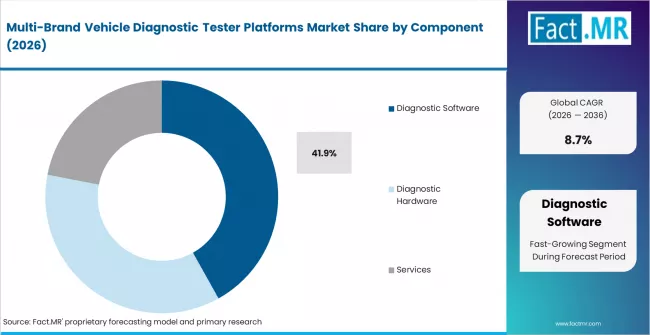
Multi Brand Vehicle Diagnostic Tester Platforms Market Analysis By Component | Source: Fact.MR
Diagnostic software is expected to account for 41.9% share in 2026. Its lead position reflects the shift in value from physical tester devices to continuously updated digital capabilities. Core functions such as guided troubleshooting, expanded vehicle coverage, repair databases, and compatibility with evolving communication protocols are now delivered through software layers rather than hardware alone.Workshops depend on regular updates to remain aligned with new vehicle models, electronic architectures, and access requirements. As vehicles become more software-defined, the ability to diagnose faults accurately depends on current data and structured diagnostic workflows. This makes software the primary driver of usability and long-term platform relevance.
- Update value: Software leads because workshops need constant coverage refreshes rather than a fixed-function tool that ages quickly.
- Repair depth: Guided diagnostics and service information make the difference between identifying a fault and completing a repair.
- Protocol support: New access methods and communication standards are added through the software layer, not through hardware alone. [6]
Multi-Brand Vehicle Diagnostic Tester Platforms Market Analysis by Vehicle Type
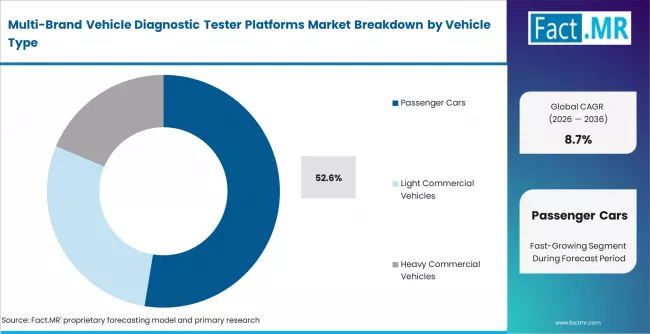
Multi Brand Vehicle Diagnostic Tester Platforms Market Analysis By Vehicle Type | Source: Fact.MR
Passenger cars continue to dominate demand within multi-brand vehicle diagnostic tester platforms due to the significantly larger global vehicle parc compared to heavy-duty segments. Independent workshops rely heavily on multi-brand tools to service a wide mix of passenger vehicles, driving consistent diagnostic usage. Production data from OICA reinforces the scale of this segment across global markets. Passenger cars are projected to account for 52.6% share in 2026. Platform providers such as Bosch, Autel, and TEXA align their offerings with broad passenger-vehicle coverage to support workshop needs.
- Parc breadth: Passenger cars create the largest mixed-brand service pool for independent workshops.
- Brand diversity: Workshops handling cars face more manufacturer variation, which strengthens demand for one multi-brand platform.
- Service frequency: Routine maintenance and repair events occur often enough to keep passenger-vehicle diagnostics central to workshop economics.
Multi-Brand Vehicle Diagnostic Tester Platforms Market Analysis by Workshop Type
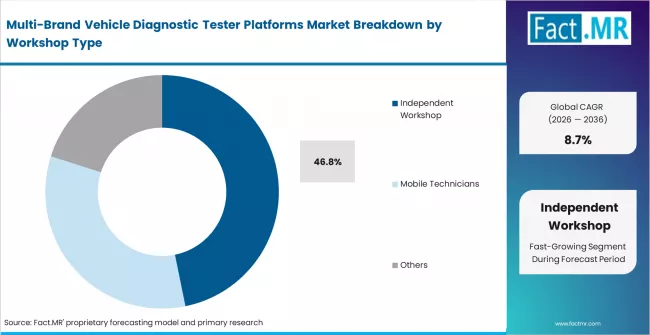
Multi Brand Vehicle Diagnostic Tester Platforms Market Analysis By Workshop Type | Source: Fact.MR
Independent Workshops are expected to account for 46.8% share in 2026, as independent operators need broad diagnostic autonomy without maintaining a separate OEM tool stack for every vehicle line they service. Bosch explicitly positions ESI[tronic] and KTS tools for everyday workshop cross-brand diagnosis, while TEXA states that its software gives independent operators advanced functions that would otherwise require original tools in some cases. AutoAuth’s role in secure function access also reinforces how independents now depend on approved multi-brand ecosystems to stay competitive on newer vehicles.
- Coverage pressure: Independent workshops need to service many makes without maintaining dealer-only tool structures.
- Margin discipline: One effective multi-brand platform reduces training and tool-switching costs inside the bay.
- Access continuity: As secure gateways spread, independents place greater value on platforms that preserve authorized diagnostic reach.
Multi-Brand Vehicle Diagnostic Tester Platforms Market Drivers, Restraints, and Opportunities
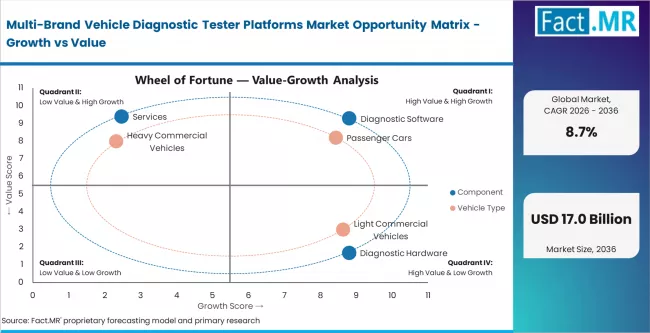
Multi Brand Vehicle Diagnostic Tester Platforms Market Opportunity Matrix Growth Vs Value | Source: Fact.MR
A key growth driver comes from the rising complexity of vehicle systems across the global service base. Modern vehicles integrate advanced electronics, software-driven functions, and interconnected control units, increasing the difficulty of accurate diagnosis and repair. Bosch identifies system complexity as a primary challenge for workshops, particularly as service tasks become more software-dependent. At the same time, SAE International continues to support diagnostic interface frameworks such as J2534 and broader vehicle E/E standards. These developments reinforce demand for diagnostic platforms that can adapt to evolving architectures, manage cross-brand protocol variation, and support increasingly software-linked repair processes.
Access fragmentation remains a key restraint. Even platforms with broad vehicle coverage face limitations when OEM-controlled security layers restrict deeper diagnostic functions. Gateway modules, encrypted communication channels, and proprietary service workflows can limit the effectiveness of multi-brand tools. AutoAuth highlights that certain secured functions remain inaccessible without certified authorization, even when advanced diagnostic systems are in use. Right-to-repair discussions continue to shape this landscape, as access to vehicle data and service functions remains uneven across manufacturers. This fragmentation reduces operational efficiency for workshops, which may need to rely on multiple tools or access pathways to complete repairs. As a result, the market favors platforms that can navigate security requirements while maintaining broad compatibility and usability.
Opportunities in the Multi-Brand Vehicle Diagnostic Tester Platforms Market
- Secure access integration: Platforms that simplify approved gateway access can capture more value as locked functions spread across newer vehicles.
- Remote diagnostics: TEXA’s remote diagnosis offering shows room for platforms that blend in-bay tools with expert back-end support when the local technician reaches a workflow limit.
Commercial-vehicle expansion: Autel’s current heavy-duty and mixed-duty diagnostic positioning supports growth in platforms that extend beyond passenger-car service into fleet and CV workshops.
Regional Analysis
Based on the regional analysis, the Multi-Brand Vehicle Diagnostic Tester Platforms Market is segmented into Asia Pacific, Europe, North America, Latin America, and Middle East & Africa across 40 plus countries.
.webp "Top Country Growth Comparison Multi Brand Vehicle Diagnostic Tester Platforms Market Cagr (2026 2036)")
Top Country Growth Comparison Multi Brand Vehicle Diagnostic Tester Platforms Market Cagr (2026 2036) | Source: Fact.MR
| Country | CAGR (2026 to 2036) |
|---|---|
| China | 9.8% |
| India | 9.4% |
| South Korea | 8.9% |
| Germany | 8.5% |
| United States | 8.2% |
Source: Fact.MR analysis. Updated May 11, 2026
Source: Fact.MR analysis, based on proprietary forecasting model and primary research.
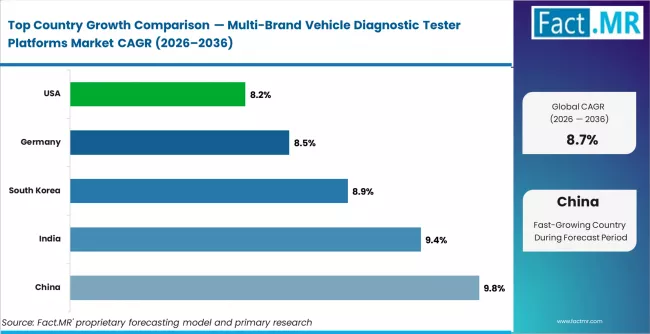
Multi Brand Vehicle Diagnostic Tester Platforms Market Cagr Analysis By Country | Source: Fact.MR
Asia Pacific Multi-Brand Vehicle Diagnostic Tester Platforms Market Analysis
Asia Pacific is the fastest-growing region, supported by high vehicle production, expanding service parc, and increasing complexity in automotive electronics. The region combines strong manufacturing output with rising aftermarket demand, creating sustained need for advanced diagnostic platforms. Countries such as China, India, and South Korea contribute through scale, modernization, and technological depth.
- China: The China market continues to expand as workshops adapt to more complex vehicle architectures and mixed-brand servicing requirements. Growth is projected at a 9.8% CAGR, supported by large vehicle volumes and increasing demand for advanced diagnostic capabilities. As electronic systems become more integrated, workshops rely on multi-brand platforms to maintain service efficiency.
- India: India reflects a growing shift toward organized aftermarket services and workshop modernization. Demand for diagnostic tester platforms is rising as repair centers handle a wider mix of vehicle brands and technologies. With a projected CAGR of 9.4%, the market is benefiting from increasing adoption of digital diagnostic tools and expanding service infrastructure.
- South Korea: South Korea’s market is driven by advanced vehicle systems and high electronic content in the vehicle parc. The country is expected to record steady growth, with demand supported by newer architectures requiring deeper diagnostic access. A CAGR of 8.9% reflects this trend, as workshops invest in tools that support complex repair and maintenance requirements.
Fact.MR’s Asia Pacific analysis also includes Japan and Southeast Asia, where diagnostic demand is influenced by vehicle technology levels and the need for cross-brand servicing capabilities.
Europe Multi-Brand Vehicle Diagnostic Tester Platforms Market Analysis
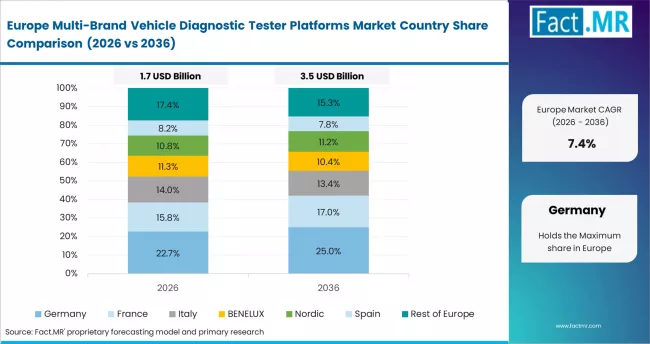
Multi Brand Vehicle Diagnostic Tester Platforms Market Europe Country Market Share Analysis, 2026 & 2036 | Source: Fact.MR
Europe represents a standards-intensive and workshop-mature environment, where diagnostic tools are essential for maintaining access to modern vehicle systems. The region’s strong emphasis on independent repair capability and regulatory frameworks supports ongoing demand for advanced multi-brand platforms.
- Germany: Germany remains the leading market, supported by its large service base and complex vehicle mix. Workshops require diagnostic platforms that provide continuous software updates and access to newer vehicle functions. Demand remains steady as repair processes become increasingly software-driven. The market is expected to grow at an 8.5% CAGR, reflecting sustained need for high-performance diagnostic tools.
Across Europe, growth is less about first-time adoption and more about upgrading existing platforms to maintain compatibility with evolving vehicle technologies and secure access requirements.
North America Multi-Brand Vehicle Diagnostic Tester Platforms Market Analysis
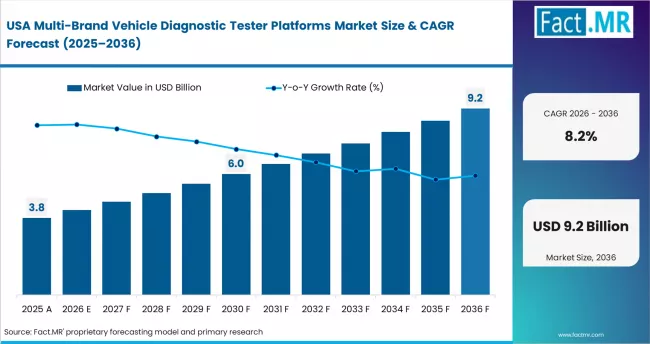
Multi Brand Vehicle Diagnostic Tester Platforms Market Country Value Analysis | Source: Fact.MR
North America remains commercially important due to its well-established independent repair ecosystem and large mixed-brand vehicle parc. Workshops in the region depend heavily on advanced diagnostic tools to remain competitive, particularly as secure gateway access becomes more critical for servicing newer vehicles.
- United States: The United States anchors regional demand, supported by high service activity and increasing complexity in vehicle diagnostics. Growth remains steady as workshops invest in tools that improve productivity and enable access to restricted vehicle systems. The market is projected to expand at an 8.2% CAGR, reflecting the importance of secure access frameworks and advanced diagnostic depth.
Demand is further reinforced by the need for continuous software updates and compatibility across multiple vehicle brands, ensuring that independent workshops can service modern vehicles effectively.
Competitive Aligners for Market Players
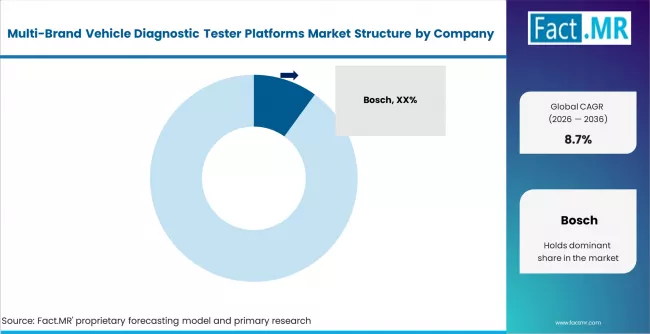
Multi Brand Vehicle Diagnostic Tester Platforms Market Analysis By Company | Source: Fact.MR
The market is moderately fragmented, though a smaller set of brands shapes the higher-function professional tier. Bosch, Autel, TEXA, Launch Tech, Snap-on, and selected specialist providers compete across overlapping parts of this category, but they do not compete on identical terms. Bosch emphasizes deep workshop software and guided diagnostics, TEXA stresses multi-brand diagnosis plus remote support and secure unlocking, while Autel and Launch continue to push broader OE-level service functions, ECU programming, and newer protocol support across professional handheld platforms.
Competitive advantage is defined less by the tablet itself and more by ecosystem strength. Buyers increasingly distinguish between a tester that can connect and one that can complete the job. That difference rests on software updates, brand coverage depth, gateway support, guided repair logic, and the ability to keep the workshop productive when access or protocol complexity rises. TEXA’s secure unlocking announcement and Bosch’s current workshop positioning both reinforce that this market is moving toward service ecosystems rather than static diagnostic devices.
Key Players in Multi-Brand Vehicle Diagnostic Tester Platforms Market
- Bosch
- Autel
- TEXA
- Launch Tech
- Snap-on
- Hella Gutmann
- TOPDON
Bibliography
- [1] Bosch Aftermarket. ESI [tronic] Software for Automotive Workshops.
- [2] OICA. World motor vehicle production by country/region and type, 2024.
- [3] AutoAuth. Homepage.
- [4] TEXA. IDC6 Diagnostic Software brochure
- [5] OICA. World motor vehicle production by country/region and type, 2024.
- [6] SAE. J2534 Pass-Thru Programming Task Force.
This Report Addresses
- Strategic outlook for multi-brand vehicle diagnostic tester platform demand.
- Forecast trajectory from USD 6.8 billion in 2026 to USD 15.7 billion by 2036.
- Why software updates, secure access, and guided repair are becoming more important than base scan functionality.
- Segment analysis by component, vehicle type, workshop type, connectivity, and functionality.
- Regional demand patterns across Asia Pacific, Europe, North America, and Latin America.
- Competitive positioning of major workshop diagnostic-platform vendors.
- The role of secure gateways, J2534, DoIP, and PassThru in platform value.
- Why the category is moving from scan devices toward recurring diagnostic ecosystems.
Multi-Brand Vehicle Diagnostic Tester Platforms Market Definition
The market covers professional multi-brand diagnostic tester platforms used by workshops and service providers to identify faults, access control units, perform service resets, run active tests, execute guided diagnostics, and support software-linked repair tasks across multiple vehicle manufacturers. These platforms typically combine handheld or tablet-based hardware, diagnostic interfaces, software subscriptions, and increasingly cloud-linked or remote support functions. [1]
Multi-Brand Vehicle Diagnostic Tester Platforms Market Inclusions
Market scope includes scan tools, diagnostic tablets, VCI interfaces, pass-thru-capable diagnostic platforms, workshop software subscriptions, diagnostic databases, secure gateway access support, remote diagnostic assistance, and integrated functions such as ECU coding, service routines, and calibration support where these are offered inside a multi-brand platform. It covers passenger car, commercial vehicle, and selected off-highway applications used by independent and mixed-brand service environments.
Multi-Brand Vehicle Diagnostic Tester Platforms Market Exclusions
The scope excludes single-brand OEM dealer tools sold only for one manufacturer, consumer-grade OBD dongles without workshop-grade functions, and general workshop management software that does not provide diagnostic tester capability. It also excludes standalone emissions inspection equipment unless the platform is marketed as a broader multi-brand diagnostic system.
Multi-Brand Vehicle Diagnostic Tester Platforms Market Research Methodology
- Primary Research:Interviews with workshop owners, master technicians, diagnostics specialists, fleet maintenance managers, and aftermarket tool distributors.
- Desk Research
- Review of OICA vehicle production data, SAE diagnostic standards committees, official vendor platform pages, and current secure-access and diagnostic protocol material.
- Market-Sizing and Forecasting
- Hybrid model based on workshop diagnostic-tool demand, software subscription penetration, vehicle-system complexity, and the share of advanced repair workflows requiring multi-brand diagnostic access.
- Data Validation and Update Cycle
- Validation against current platform capabilities from Bosch, TEXA, Autel, and related providers, plus official standards and access-framework sources such as SAE and AutoAuth. [2]
Segmentation
Scope of the Report
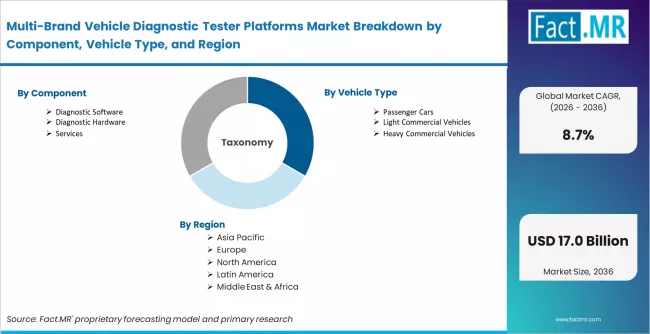
Multi Brand Vehicle Diagnostic Tester Platforms Market Breakdown By Component, Vehicle Type, And Region | Source: Fact.MR
| Attribute | Details |
|---|---|
| Quantitative Units | USD 6.8 billion (2026) to USD 15.7 billion (2036), at a CAGR of 8.7% |
| Market Definition | Professional multi-brand vehicle diagnostic tester platforms used for fault diagnosis, service procedures, active tests, coding, and guided repair support across multiple vehicle manufacturers |
| Component Segmentation | Diagnostic Hardware, Diagnostic Software, Services |
| Vehicle Type Segmentation | Passenger Cars, Light Commercial Vehicles, Heavy Commercial Vehicles, Off-Highway Vehicles |
| Connectivity Segmentation | Wired, Wireless, Cloud-Connected |
| Workshop Type Segmentation | Independent Workshops, Dealer-Linked Multi-Brand Networks, Fleet Service Centers, Mobile Technicians |
| Functionality Segmentation | Code Reading, Bi-Directional Diagnostics, ECU Coding & Programming, ADAS Calibration Support, Remote Diagnostics |
| Regions Covered | Asia Pacific, Europe, North America, Latin America, Middle East & Africa |
| Countries Covered | China, India, South Korea, Germany, United States, Japan, Brazil, and 40+ countries |
| Key Companies Profiled | Bosch, Autel, TEXA, Launch Tech, Snap-on, Hella Gutmann, TOPDON |
| Forecast Period | 2026 to 2036 |
| Approach | Hybrid sizing based on workshop demand, software subscription penetration, vehicle complexity, and multi-brand diagnostic workflow value |
Source: Fact.MR analysis. Updated May 11, 2026
Multi-Brand Vehicle Diagnostic Tester Platforms Market by Segments
-
By Compnent:
- Diagnstic Hardware
- Diagnstic Sftware
- Services
- By Vehicle Type:
-
Passenger Cars
- Light Cmmercial Vehicles
- Heavy Cmmercial Vehicles
- off-Highway Vehicles
-
By Connectivity:
- Wired
- Wireless
- Clud-Connected
-
By Region:
- North America
- United States
- Canada
- Mexic
- Latin America
- Brazil
- Argentina
- Chile
- Rest f Latin America
- Western Eurpe
- Germany
- France
- United Kingdm
- Italy
- Spain
- Nrdic Cuntries
- BENELUX
- Rest f Western Eurpe
- Eastern Eurpe
- Russia
- Pland
- Hungary
- Balkan and Baltic
- Rest f Eastern Eurpe
- East Asia
- China
- Japan
- Suth Krea
- Suth Asia and Pacific
- India
- ASEAN
- Australia and New Zealand
- Rest f Suth Asia and Pacific
- Middle East and Africa
- Kingdm f Saudi Arabia
- ther GCC Cuntries
- Turkey
- Suth Africa
- Rest f Middle East and Africa
- North America
Frequently Asked Questions
How large is the Multi-Brand Vehicle Diagnostic Tester Platforms Market in 2025?
What will the market size be in 2026?
What is the projected market size by 2036?
What is the expected CAGR from 2026 to 2036?
Which component segment is poised to lead the market?
Which vehicle type holds the largest share?
Which workshop type dominates the market?
Which functionality segment leads the market?
Which country shows the fastest growth?
What is driving demand in this market?
What is the key challenge in this market?
Who worked on this report


Preview the report firsthand - request a free sample
Free SampleGet the brochure for pricing and purchase details
Download PDF