- Market Value (2025): USD 2.5 Bn
- Estimated Value (2026): USD 2.7 Bn
- Forecast Value (2036): USD 7.2 Bn
- CAGR (2026-2036): 10.2%
What is the Multi-Chamber Biobased Detergents Market forecast to be worth by 2036?
USD 2.7 billion in 2026 to USD 7.2 billion by 2036 at a 10.2% CAGR.
- The Multi-Chamber Biobased Detergents Market was valued at USD 2.5 billion in 2025.
- Demand is projected to increase from USD 2.7 billion in 2026 to USD 7.2 billion by 2036.
- The market is forecast to grow at a 10.2% CAGR from 2026 to 2036.
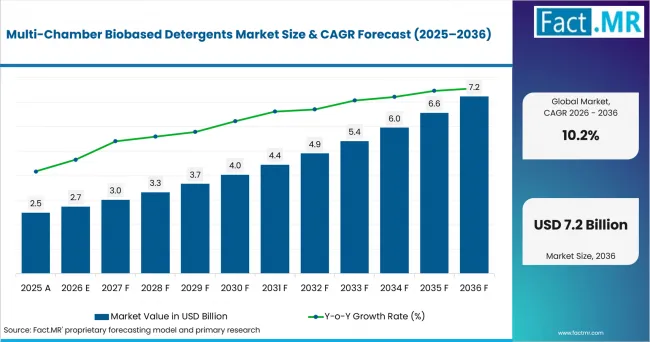
Multi Chamber Biobased Detergents Market Value Analysis | Source: Fact.MR
What are the defining numbers behind Multi-Chamber Biobased Detergents Market growth?
USD 4.5 billion absolute opportunity between 2026 and 2036.
- Demand Drivers in the Market
- Laundry brands need set doses that limit overuse and keep sensitive ingredients stable before washing. Separate chambers reduce contact between surfactants and enzymes during storage. They also keep selected boosters apart until water releases the full dose.
- Cold-wash users need formulas that release cleaning agents quickly in cooler water. The U.S. Energy Information Administration reported in February 2026 that the 2025 residential power price averaged 17.30 cents per kWh.
- Dish-care brands need compact doses that keep incompatible ingredients apart until use. Split chambers can place several cleaning steps in one pre-set unit. The design is useful when a wash cycle needs quick film opening and controlled release of strong chemistry.
- Product teams need biobased ingredients that meet cleaning goals in a measured dose. Plant surfactants and biobased solvents must work with pod films and enzyme systems. Stable storage is as important as biobased content when the formula moves into a chambered pod.
- Retail and large-site users need unit doses that make handling simple and reduce dosing differences. Premeasured chambers help many users follow the same wash routine. Clear dose counts and compact storage can also support stock control.
- Key Segments Analyzed
- By Chamber Configuration: 2-chamber liquid is forecast to hold 32.0% share in 2026.
- By Biobased Chemistry: Plant surfactants are forecast to account for 31.0% share in 2026.
- By Wash Need: Cold wash is forecast to capture 35.0% share in 2026.
- By Dose Format: Laundry pod is forecast to represent 31.0% share in 2026.
- Analyst Opinion at Fact.MR
- Shambhu Nath Jha, Principal Consultant at Fact.MR, states, “The commercial value of multi-chamber detergent design comes from separating actives that perform best when they are stored apart. Demand is forecast to favor systems that release cleanly in cold water while carrying more biobased chemistry. Firms should pair film fit with enzyme shelf life and clear per-wash results evidence.”
- Strategic Implications
- Brand owners should test each chamber across the planned shelf life. Tests should cover enzymes, surfactants, chelants, and odor-control ingredients before scale-up. A stable design lowers the chance that strong ingredients interact before the pod reaches wash water.
- Film suppliers should show how the film opens in cooler cycles and across common water-hardness levels. Brands need steady release on fabrics and inside machines. Tests across normal wash programs can guide formula choices when strong chemistry uses thinner film.
- Product teams should favor plant surfactants and biobased solvents that work with strong pod formulas. Tests should cover shelf life and quick release after the film opens. This helps teams balance biobased content with the cleaning results expected from concentrated detergents.
- Pack teams should manage outer-pack weight around moisture-sensitive unit doses. PackUK published a plastic packaging EPR base fee of GBP 423 per tonne in June 2025 for the 2025 to 2026 scheme year.
Japan is forecast to record a 10.6% CAGR through 2036 as compact detergent formats fit household routines. The USA is projected at 10.3% as cold-wash costs and safer-chemistry screening shape formulas. Germany is forecast at 10.0% with broad washing-machine use. France is estimated at 9.7% as household upkeep supports home-care demand. The UK is forecast at 7.4% as power and pack costs shape product economics.
How does the Multi-Chamber Biobased Detergents Market break down by segment?
Cold wash leads Wash Need at 35.0%; 2-chamber liquid leads Chamber Configuration at 32.0%.
Which Chamber Configuration leads?
2-chamber liquid is expected to hold 32.0% share in 2026.
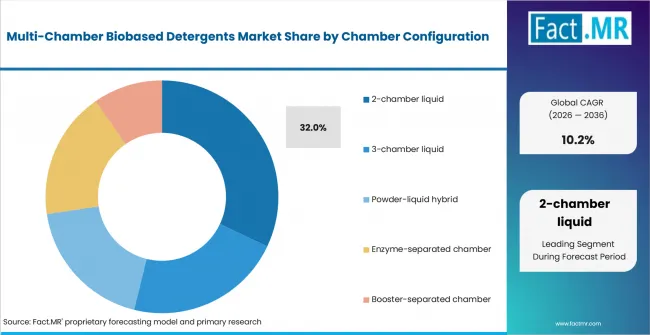
Multi Chamber Biobased Detergents Market Analysis By Chamber Configuration | Source: Fact.MR
Two-chamber liquid formats keep strong liquids apart during storage. One zone can hold the main surfactant blend. The second can protect enzymes or boosters until release. The 32.0% share reflects this balance between formula control and practical production. Related automatic dish-care formats appear in the dishwasher detergent category.
What leads the Biobased Chemistry segment?
Plant surfactants are projected to account for 31.0% share in 2026.
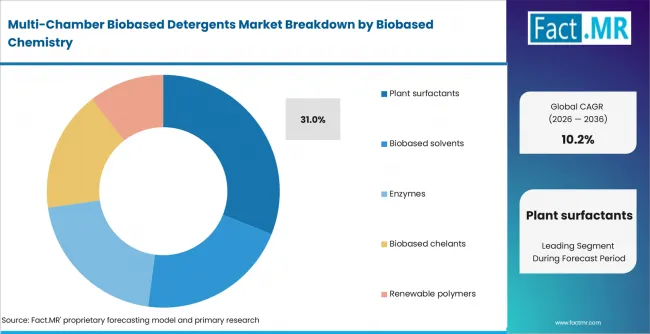
Multi Chamber Biobased Detergents Market Analysis By Biobased Chemistry | Source: Fact.MR
Plant surfactants provide the main wetting and soil-removal role in biobased detergent design. Their 31.0% share reflects this direct cleaning use. Ingredient context also links with bio-based surfactants for detergents and other renewable cleaning inputs.
How does Wash Need shape demand?
Cold wash is anticipated to lead with 35.0% share in 2026.
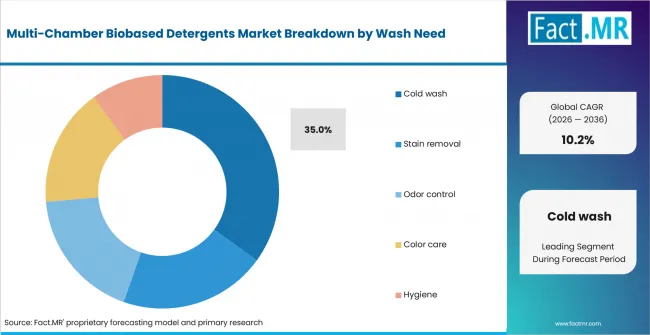
Multi Chamber Biobased Detergents Market Analysis By Wash Need | Source: Fact.MR
Cold wash accounts for 35.0% of Wash Need. Split chambers can protect enzymes and strong ingredients before film release. Lower-temperature results also depend on enzyme systems used across detergent enzyme applications.
What supports Laundry Pod within Dose Format?
Laundry pod is estimated to represent 31.0% share in 2026.
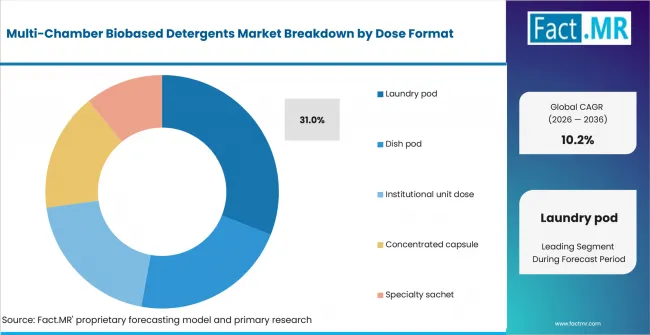
Multi Chamber Biobased Detergents Market Analysis By Dose Format | Source: Fact.MR
Laundry pods combine set dosing with a format that can hold split liquid zones. Their 31.0% share reflects broad household use and formula separation before washing. Institutional unit doses and specialty sachets extend measured dosing into managed cleaning settings. Related household context appears across laundry cleaning products.
What is accelerating Multi-Chamber Biobased Detergents Market adoption, and what is holding it back?
Cold-wash results and dose control support adoption, while film fit and safety rules can slow rollout.
Drivers Impact Analysis
| DRIVER | (~) % IMPACT ON CAGR | GEOGRAPHIC RELEVANCE | IMPACT TIMELINE |
|---|---|---|---|
| Cold-wash results from split actives | +1.5% | North America, Europe, East Asia | Short term (<= 2 years) |
| Easy premeasured dosing | +1.2% | Global | Short term (<= 2 years) |
| Plant-based surfactant reformula | +1.0% | Europe, North America, Japan | Medium term (2-4 years) |
| Concentrated packs and logistics gains | +0.8% | Europe, North America | Medium term (2-4 years) |
| Large-site unit-dose control | +0.6% | North America, Europe | Long term (>= 4 years) |
Opportunity Impact Analysis
| OPPORTUNITY | (~) % IMPACT ON CAGR | GEOGRAPHIC RELEVANCE | IMPACT TIMELINE |
|---|---|---|---|
| Three-chamber stain and odor doses | +1.1% | North America, Europe | Medium term (2-4 years) |
| Biobased chelant and solvent blends | +0.9% | Europe, Japan | Medium term (2-4 years) |
| Cold-water film improvement | +0.8% | Global | Short term (<= 2 years) |
| Professional unit-dose growth | +0.5% | North America, Europe | Long term (>= 4 years) |
Restraints Impact Analysis
| RESTRAINT | (~) % IMPACT ON CAGR | GEOGRAPHIC RELEVANCE | IMPACT TIMELINE |
|---|---|---|---|
| Film-formula fit limits | -0.8% | Global | Short term (<= 2 years) |
| Child-safety and handling needs | -0.6% | North America, Europe | Short term (<= 2 years) |
| Higher fill and chamber complexity | -0.5% | Global | Medium term (2-4 years) |
| Pack and recycling pressure | -0.4% | Europe, Japan | Medium term (2-4 years) |
Which countries are scaling the Multi-Chamber Biobased Detergents Market through 2036?
- Japan remains at the top of the displayed range with a 10.6% CAGR. Compact household formats support measured dosing.
- The USA follows at 10.3% CAGR as established unit-dose use supports multi-chamber laundry formats.
- Germany records a 10.0% CAGR as broad machine ownership supports measured, concentrated wash doses.
- France posts a 9.7% CAGR as energy costs and household upkeep shape concentrated cleaning choices.
- The UK reaches a 7.4% CAGR as power prices and pack fees affect detergent format costs.
Similar CAGRs can still lead to different market conditions because machine use and power prices vary by country. Pack rules and product-safety expectations also shape unit-dose design. Full report coverage includes North America, Latin America, Western Europe, Eastern Europe, East Asia, South Asia & Pacific, and Middle East & Africa.
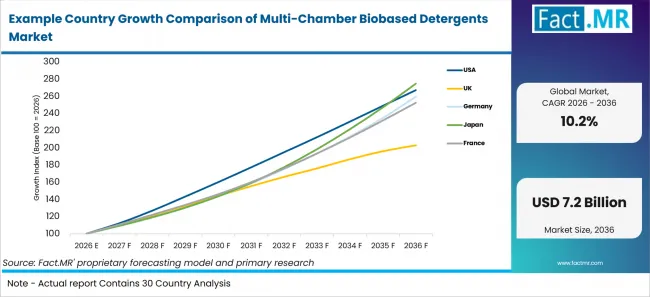
Example Country Growth Comparison Of Multi Chamber Biobased Detergents Market | Source: Fact.MR
| Country | CAGR (2026-2036) |
|---|---|
| Japan | 10.6% |
| United States | 10.3% |
| Germany | 10.0% |
| France | 9.7% |
| United Kingdom | 7.4% |
What supports USA adoption?
10.3% CAGR, supported by established unit-dose use and a strong focus on cold-wash formulas.
U.S. detergent brands already sell unit-dose products at scale, which reduces the need to teach the format. The 10.3% CAGR is forecast to support split chemistry for cold wash and stain care. Firms are likely to compete on film reliability and shelf life across common machine programs.
How is the United Kingdom developing demand?
7.4% CAGR, shaped by cooler-wash economics and packaging cost pressure.
Energy prices keep cooler washing relevant in the United Kingdom. Ofgem reported in May 2026 that the Direct Debit power rate for July to September 2026 was 26.11 pence per kWh. Multi-chamber products can pair cold-wash chemistry with set dosing. Brand fit will depend on cleaning results and efficient packs at a clear per-wash cost.
What is supporting Germany’s adoption?
10.0% CAGR, supported by broad appliance use and concentrated detergent formats.
Germany combines a mature machine base with close attention to household power costs. The Bundesnetzagentur reported in November 2025 that household power costs averaged 40.05 cents per kWh on April 1 for annual use of 2,500 to 5,000 kWh. The 10.0% CAGR is forecast to support concentrated doses that work well in routine machine washing. Firms also need pod films and formulas that stay stable in storage and dissolve during the chosen cycle.
How does Japan perform?
10.6% CAGR, led by concentrated household formats and domestic detergent production.
Japan supports compact detergent formats through a strong domestic maker base and space-saving household routines. METI reported that synthetic detergent production reached 110,377 tonnes in March 2025. The 10.6% CAGR is forecast to support chambered doses for odor and stain care. Product design must keep the dose compact while allowing each chamber to release cleanly.
What supports France?
9.7% CAGR, backed by household power costs and concentrated cleaning formats.
French household power costs keep efficient washing relevant to detergent choice. In July 2026, France’s Statistical Data and Studies Department reported that the average electricity price for French households was EUR 254.6 per MWh in 2025, including all taxes. The 9.7% CAGR is forecast to support measured, concentrated doses with cold-wash results. Firms can also limit outer-pack material while keeping the moisture barrier needed for soluble pod film.
Who leads the Multi-Chamber Biobased Detergents Market?
Procter & Gamble, Henkel, and Unilever form the large consumer-detergent group within the profiled competitive set. Their relevance comes from participation in household laundry and cleaning categories where concentrated, premeasured formats can combine cleaning chemistry with convenient dosing. Multi-chamber systems add value by keeping selected actives apart until the wash begins.
Henkel is also represented through its active laundry-formulation portfolio. Its recent work on concentrated laundry products aligns with a market where brands must balance strong cleaning performance, compact dosing, film compatibility, and stability during storage. Split chambers provide another formulation route when enzymes, surfactants, or boosters perform better when separated before use.
Dropps, Itaconix, and Senzora broaden the competitive landscape beyond the largest household-care groups. The report includes them as current profiled participants in a market spanning plant surfactants, biobased solvents, enzymes, biobased chelants, renewable polymers, and multiple unit-dose configurations.
Which companies are the key providers?
Companies profiled include Procter & Gamble; Henkel; Unilever; Dropps; Itaconix; and Senzora.
- Procter & Gamble
- Henkel
- Unilever
- Dropps
- Itaconix
- Senzora
Bibliography
- Department for Environment, Food & Rural Affairs. (2025, June 30). Extended Producer Responsibility for Packaging: 2025 base fees.
- Statistisches Bundesamt (Destatis). (2025, December 9). Equipment with consumer durables.
- Ofgem. (2026, May 27). Changes to energy price cap between 1 July and 30 September 2026.
- Bundesnetzagentur, & Bundeskartellamt. (2025, November 26). Monitoring Report 2025: Developments in the electricity and gas market.
- Ministry of Economy, Trade and Industry. (2025, May 16). Indices of industrial production: Revised report for March 2025.
- Service des données et études statistiques. (2026, July 23). Prix de l’électricité en France et dans l’Union européenne en 2025.
- Henkel. (2025, April 2). Henkel debuts new concentrated formulas for all®, Persil® and Snuggle® liquid laundry products.
This Report Answers
- The report explains use by chamber design and biobased chemistry. It also covers wash need and dose format across the listed regions.
- Segment analysis identifies the leading subsegments and explains how split chemistry shapes each product. It also reviews cold-water results and biobased ingredients in concentrated dose formats.
- Country analysis compares the listed CAGRs with machine use and power prices. It also reviews safety rules and pack costs that can shape unit-dose products.
- Competitive analysis reviews the profiled companies and focuses on current market activity and product fit.
- Application analysis covers laundry pods, dish pods, and institutional unit doses. It also includes concentrated capsules and specialty sachets that use split compartments.
What does the Multi-Chamber Biobased Detergents Market cover?
The market covers pre-set detergent doses with two or more chambers. These chambers keep selected ingredients apart until use. Laundry and automatic dishwashing formats are included when split chambers support dosing and formula control. Professional products also overlap with commercial laundry detergents when controlled dosing is part of the wash system.
The assessment includes plant surfactants, biobased solvents, enzymes, biobased chelants, and renewable polymers. It covers cold wash, stain removal, odor control, color care, and hygiene needs. Detergent polymers provide added context for soil control and fabric-care functions.
What is included in the scope?
The scope includes two-chamber and three-chamber liquid pods. Powder-liquid hybrids and separated enzyme or booster chambers are also included.
Dose formats cover laundry pods, dish pods, institutional unit doses, concentrated capsules, and specialty sachets. Renewable surface-active chemistry also overlaps with biosurfactants used in household cleaning.
What is excluded from the scope?
Single-compartment detergents are excluded unless they form part of a multi-chamber system.
Bottled liquids, powders, bars, sheets, and tablets without split compartments sit outside the measured market. Broader ingredient coverage remains available across detergent chemicals.
How Was the Analysis Built?
The analysis draws on 120+ sources, 35+ company portfolios, 25+ countries, and more than 20 industry interviews.
- Primary Research: Primary research includes discussions with manufacturers, service providers, technology developers, distributors, end users, and subject-matter experts. These conversations examine purchasing priorities, product adoption, operational challenges, approval requirements, competitive positioning, and the factors that influence wider market acceptance.
- Desk Research: Desk research covers government statistics, regulatory publications, company filings, trade data, technical studies, industry associations, standards, public policy, and other authoritative sources. Every source used in the analysis is documented in the bibliography.
- Market Sizing and Forecasting: Market estimates combine historical performance, demand indicators, pricing and volume trends, segment shares, company participation, country-level growth, adoption patterns, investment activity, and barriers to market expansion.
- Data Validation and Update Cycle: Findings are validated by comparing primary interviews with public data, company activity, regulatory changes, trade patterns, and industry developments. Regular updates review new product launches, capacity changes, partnerships, approvals, and shifts in commercial adoption.
What is the report’s scope and coverage?
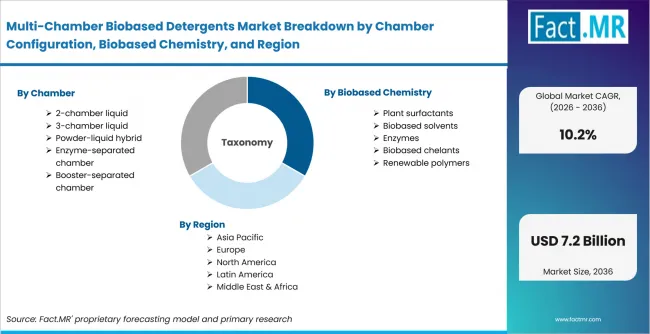
Multi Chamber Biobased Detergents Market Breakdown By Chamber Configuration, Biobased Chemistry, And Region | Source: Fact.MR
| Attribute | Details |
|---|---|
| Quantitative Units | USD billion |
| Market Definition | Multi-chamber unit-dose laundry, dishwashing, and selected institutional detergents that use two or more separated chambers and incorporate biobased chemistry such as plant surfactants, biobased solvents, enzymes, biobased chelants, or renewable polymers. |
| Chamber Configuration | 2-chamber liquid; 3-chamber liquid; Powder-liquid hybrid; Enzyme-separated chamber; Booster-separated chamber |
| Biobased Chemistry | Plant surfactants; Biobased solvents; Enzymes; Biobased chelants; Renewable polymers |
| Wash Need | Cold wash; Stain removal; Odor control; Color care; Hygiene |
| Dose Format | Laundry pod; Dish pod; Institutional unit dose; Concentrated capsule; Specialty sachet |
| Regions Covered | North America; Latin America; Western Europe; Eastern Europe; East Asia; South Asia & Pacific; Middle East & Africa |
| Countries Covered | United States; United Kingdom; Germany; Japan; France |
| Key Companies Profiled | Procter & Gamble; Henkel; Unilever; Dropps; Itaconix; Senzora |
| Forecast Period | 2026 to 2036 |
| Approach | Hybrid top-down and bottom-up review using product-format adoption, detergent formula trends, unit-dose fit, country household indicators, packaging regulation, and verified provider portfolios. |
How is the market segmented?
-
By Chamber Configuration:
- 2-chamber liquid
- 3-chamber liquid
- Powder-liquid hybrid
- Enzyme-separated chamber
- Booster-separated chamber
-
By Biobased Chemistry:
- Plant surfactants
- Biobased solvents
- Enzymes
- Biobased chelants
- Renewable polymers
-
By Wash Need:
- Cold wash
- Stain removal
- Odor control
- Color care
- Hygiene
-
By Dose Format:
- Laundry pod
- Dish pod
- Institutional unit dose
- Concentrated capsule
- Specialty sachet
-
By Region:
- North America
- Latin America
- Western Europe
- Eastern Europe
- East Asia
- South Asia & Pacific
- Middle East & Africa