- Market Value (2025): USD 417.8 Bn
- Estimated Value (2026): USD 445.0 Bn
- Forecast Value (2036): USD 1,150 Bn
- CAGR (2026-2036): 10.0%
What is the Biobased Laundry Pod Systems Market forecast to be worth by 2036?
USD 3.9 Billion in 2026 to USD 10.0 Billion by 2036 at a 9.9% CAGR.
- The Biobased Laundry Pod Systems Market crossed a valuation of USD 3.6 Billion in 2025.
- Demand is projected to increase from USD 3.9 Billion in 2026 to USD 10.0 Billion by 2036.
- The market is forecast to record a 9.9% CAGR from 2026 to 2036 as detergent brands and film converters shift unit-dose packs toward bio-attributed soluble formats.
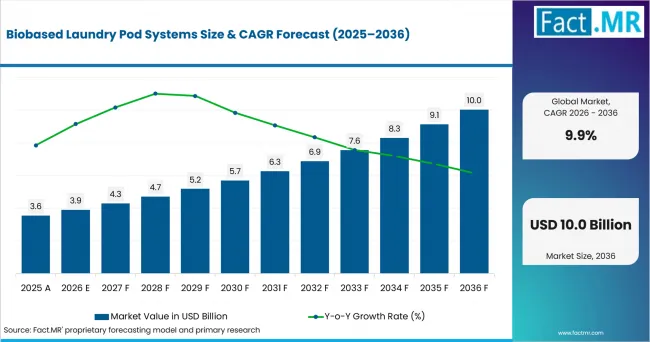
Biobased Laundry Pod Systems Value Analysis | Source: Fact.MR
What are the defining numbers behind Biobased Laundry Pod Systems Market growth?
USD 6.1 Billion absolute opportunity by 2036, led by bio-attributed PVA, liquid single chamber systems and laundry wash applications.
- Demand Drivers in the Market
- Household shoppers need pre-measured pods that reduce dosing mistakes and fit short weekly laundry routines.
- Laundry brands need soluble films that maintain pack strength during handling and dissolve cleanly in cold water.
- Retail chains need compact detergent formats because smaller packs improve shelf density and reduce leakage handling.
- Certification teams need clearer safer-chemistry routes after the U.S. Environmental Protection Agency updated its performance measures in January 2026 and listed 1,656 Safer Choice-certified products for FY 2025.
- Institutional laundry operators need low-temperature systems that support consistent cleaning in shorter wash programs.
- Key Segments Analyzed
- By Pod Film: Bio-attributed PVA is expected to hold 36.0% share in 2026, supported by established water-soluble film handling and easier line conversion.
- By Detergent System: Liquid single chamber is projected to account for 31.0% share in 2026 due to simpler filling and familiar wash dosing.
- By Claim: Bio-based content is anticipated to capture 29.0% share in 2026 owing to clear shelf communication around ingredient origin.
- By Application: Laundry wash is estimated to represent 33.0% share in 2026, led by repeat household use across machine washing.
- Analyst Opinion at Fact.MR
- Shambhu Nath Jha, Principal Consultant at Fact.MR, states, "The commercial test for biobased laundry pod systems is the full pack experience. Film origin gets attention, but dissolution, storage stability and cleaning performance decide repeat use. Suppliers are expected to gain when they pair claim documentation with capsule engineering that survives humid shelves and short cold cycles."
- Strategic Implications
- Film converters should validate cold-water dissolution and storage stability across humid retail channels before scale-up.
- Detergent brands should connect bio-based claims to named test methods and clear on-pack explanations.
- Retailers should review pod packs for leakage control, shelf density and safe household storage instructions.
- Laundry formulators should balance enzymes, fragrance release and film compatibility before shifting into bio-attributed film.
- Ecommerce teams should build pack counts that travel well and keep product weight low for repeat household orders.
China is expected to record 11.2% CAGR through 2036, supported by ecommerce scale and appliance replacement. The USA is projected to post 10.7% CAGR through premium single-dose formats and safer-chemistry labels. Germany is anticipated to advance at 10.5% CAGR through efficient washing habits and detergent manufacturing depth. Japan is estimated to reach 9.6% CAGR as compact homes favor measured laundry formats. France is forecast to register 9.2% CAGR through structured household-care retail and close scrutiny of environmental claims.
How does the Biobased Laundry Pod Systems Market break down by segment?
Bio-attributed PVA leads at 36.0%; laundry wash leads at 33.0%.
Which Pod Film dominates?
Bio-attributed PVA holds 36.0% share in 2026.
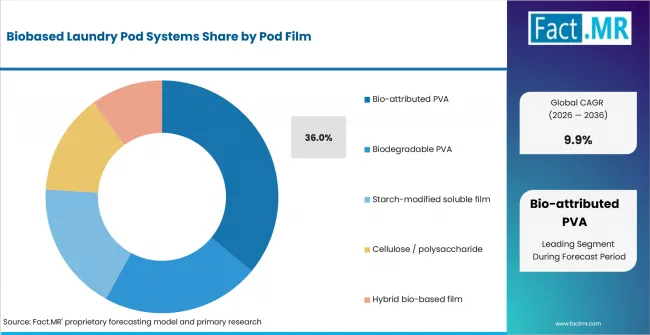
Biobased Laundry Pod Systems Analysis By Pod Film | Source: Fact.MR
Bio-attributed PVA leads because pod producers can adapt existing PVA film handling while changing part of the raw-material claim. The film still needs storage strength and clean dissolution. That balance makes bio-attributed PVA easier to scale than newer cellulose or starch-modified films that require deeper line qualification.
PVA film buyers evaluate seal strength, water solubility and humidity resistance together. A film that dissolves quickly but softens too early creates leakage risk. A stronger film that dissolves slowly creates residue complaints. Bio-attributed PVA is therefore expected to hold the first position while converters improve plant-based or polysaccharide options.
What leads the Detergent System segment?
Liquid single chamber accounts for 31.0% share in 2026.
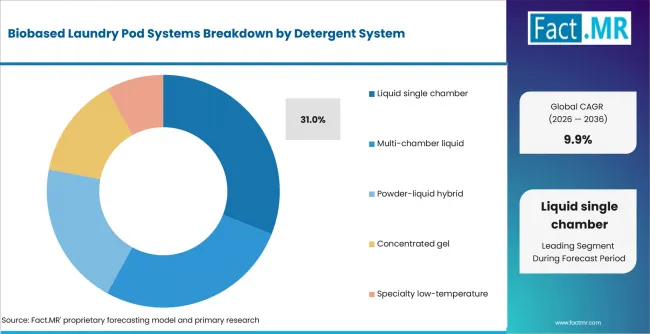
Biobased Laundry Pod Systems Analysis By Detergent System | Source: Fact.MR
Liquid single chamber pods lead because they keep the product familiar for shoppers and simpler for filling lines. Multi-chamber formats improve benefit separation, but they raise sealing and leakage-control requirements. Powder-liquid hybrid systems remain useful for targeted performance claims, yet their line change requirements slow broad adoption.
Henkel launched Persil Gigant Discs on August 1, 2025 for large wash loads and stated that one Gigant Disc has the washing power of two Persil 4in1 Discs. The launch supports the segment view that larger pre-measured liquid formats can answer load-size changes while preserving simple dosing.
How does Claim shape demand?
Bio-based content captures 29.0% share in 2026.
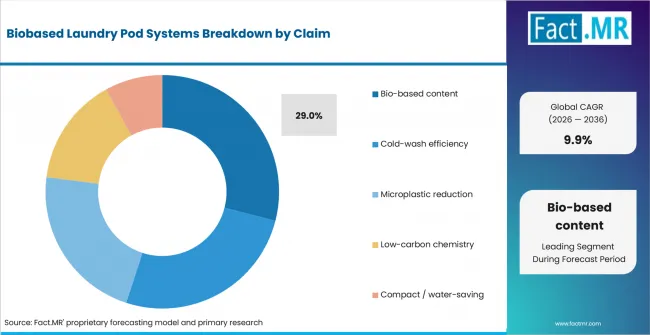
Biobased Laundry Pod Systems Analysis By Claim | Source: Fact.MR
Bio-based content leads the claim segment because it is easier for shoppers to understand at the shelf. The claim separates biobased pods from standard unit-dose packs while staying linked to measurable input choices. Cold-wash efficiency and microplastic reduction claims still require clearer evidence for many retail programs.
Claim strength depends on documentation. Brands have to show what part of the pod system is bio-attributed and how the claim is measured. This favors suppliers that can provide chain-of-custody records for film inputs and testing support for finished packs.
What supports Laundry wash within Application?
Laundry wash represents 33.0% share in 2026.
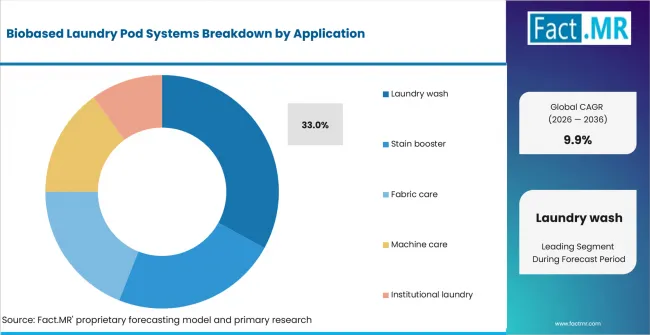
Biobased Laundry Pod Systems Analysis By Application | Source: Fact.MR
Laundry wash leads because weekly machine washing creates the broadest repeat-use base. Household detergent replacement begins in the core wash step before moving into stain booster, fabric care or machine care pods. Brands therefore treat laundry wash as the main route for bio-attributed pod system adoption.
Stain booster and fabric care applications are expected to build from the same dosing habit. Institutional laundry may add volume where operators prefer fixed dose control. The main application base remains household laundry wash because consumers already understand capsules and expect them to clean in standard machine cycles.
What is accelerating Biobased Laundry Pod Systems Market adoption, and what is holding it back?
Demand is expected to rise through compact dosing, bio-attributed films and cold-wash positioning. Adoption is constrained by child-safety handling, input cost and residue risk.
Drivers Impact Analysis
| DRIVER | (~) % IMPACT ON CAGR | GEOGRAPHIC RELEVANCE | IMPACT TIMELINE |
|---|---|---|---|
| Shift toward compact single-dose laundry formats | +1.5% | North America, Western Europe, East Asia | Short term (<= 2 years) |
| Bio-attributed soluble film adoption | +1.3% | Global | Medium term (2-4 years) |
| Cold-wash and quick-cycle detergent positioning | +1.1% | North America, Europe, Japan | Medium term (2-4 years) |
| Retail interest in smaller and lighter packs | +0.8% | Global | Long term (>= 4 years) |
Source: Fact.MR analysis. Updated Sep 17, 2026
Opportunity Impact Analysis
| OPPORTUNITY | (~) % IMPACT ON CAGR | GEOGRAPHIC RELEVANCE | IMPACT TIMELINE |
|---|---|---|---|
| Certified bio-based and safer-chemistry claims | +1.2% | USA, Europe | Short term (<= 2 years) |
| Institutional laundry pods for controlled dosing | +0.9% | North America, Europe, Japan | Medium term (2-4 years) |
| Hybrid film blends with better cold-water solubility | +0.7% | Global | Long term (>= 4 years) |
Source: Fact.MR analysis. Updated Sep 17, 2026
Restraints Impact Analysis
| RESTRAINT | (~) % IMPACT ON CAGR | GEOGRAPHIC RELEVANCE | IMPACT TIMELINE |
|---|---|---|---|
| Child-safety concerns around colorful concentrated pods | -0.7% | USA, Europe, Japan | Short term (<= 2 years) |
| Higher cost of bio-attributed inputs | -0.5% | Global | Medium term (2-4 years) |
| Residue risk in short and cold cycles | -0.4% | Global | Medium term (2-4 years) |
Source: Fact.MR analysis. Updated Sep 17, 2026
Which countries are scaling the Biobased Laundry Pod Systems Market through 2036?
- The country comparison spans 2.0 percentage points across the five listed markets.
- China remains 0.5 percentage point above the USA as ecommerce scale supports compact detergent formats.
- The USA remains 0.2 percentage point above Germany through premium single-dose formats and safer-chemistry labels.
- Germany remains 0.9 percentage point above Japan through efficient laundry habits and detergent manufacturing depth.
- Japan remains 0.4 percentage point above France as compact homes favor measured laundry formats.
- France completes the displayed range through structured retail and careful review of environmental claims.
Comparable CAGRs create different entry conditions because each country uses pods through a different channel mix. Full report coverage includes North America, Latin America, Western Europe, Eastern Europe, East Asia, South Asia & Pacific, Middle East & Africa.
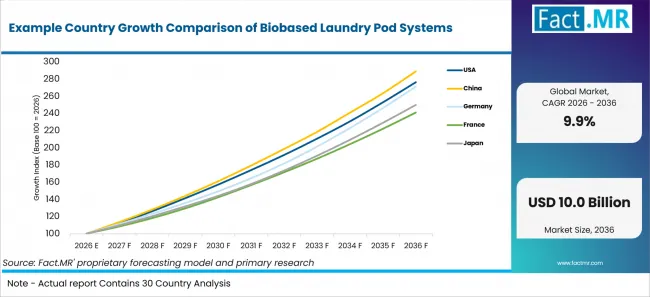
Example Country Growth Comparison Of Biobased Laundry Pod Systems | Source: Fact.MR
| Country | CAGR (2026-2036) |
|---|---|
| China | 11.2% |
| USA | 10.7% |
| Germany | 10.5% |
| Japan | 9.6% |
| France | 9.2% |
Source: Fact.MR analysis. Updated Sep 17, 2026
What supports China adoption?
11.2% CAGR, shaped by ecommerce scale and appliance replacement.
China has a large online channel for compact household products, which suits lightweight detergent pods and refill-friendly pack counts. The National Bureau of Statistics of China reported in January 2026 that online retail sales reached RMB 15,972.2 billion in 2025. Bio-attributed PVA systems are expected to benefit when local brands pair convenient dosing with reliable film dissolution in machine-wash households.
What supports USA adoption?
10.7% CAGR, supported by safer-chemistry labels and premium single-dose formats.
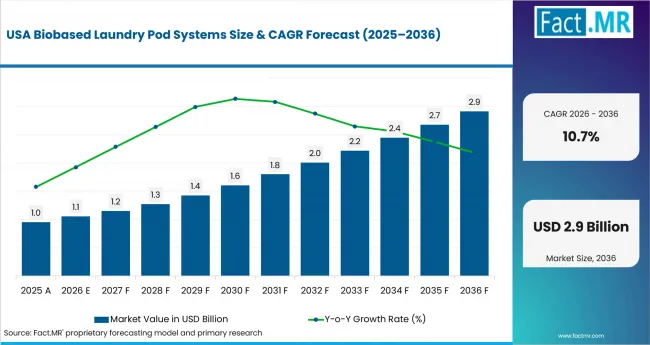
Biobased Laundry Pod Systems Country Value Analysis | Source: Fact.MR
The USA has an established base for unit-dose detergent and a clear route for safer-chemistry positioning. The Federal Reserve Bank of St. Louis carried U.S. Census Bureau AIES data updated in September 2026 showing 2024 soap and other detergent manufacturing shipments of USD 26.16 billion. Biobased pod systems are expected to gain when brands connect familiar capsule use with clear film-origin documentation.
What supports Germany adoption?
10.5% CAGR, led by efficient laundry habits and detergent manufacturing depth.
Germany combines mature household-care retail with consumer attention to efficient washing. Destatis reported in January 2026 that private household consumption expenditure reached EUR 2,251.31 billion in 2025. Biobased pods are expected to fit German laundry routines when larger-load formats maintain clean dosing and strong performance in lower-temperature cycles.
How does Japan perform?
9.6% CAGR, supported by compact homes and measured laundry routines.
Japan favors space-saving household formats and precise dosing. The Statistics Bureau of Japan released its 2025 yearly average in February 2026 and reported monthly consumption expenditure of JPY 314,001 per two-or-more-person household. Biobased pod systems are expected to appeal where small storage space and fast-dissolving formats reduce friction for routine machine washing.
How does France perform?
9.2% CAGR, shaped by household-care retail and environmental claim review.
France is a structured market for premium laundry formats and careful product claims. INSEE reported in June 2026 that household final consumption expenditure slowed to 0.4% volume growth in 2025. Brands are expected to position biobased pods around convenient dosing and documented ingredient origin while keeping price-value messages simple for mainstream retailers.
Who leads the Biobased Laundry Pod Systems Market?
Unilever participates through its global Dirt Is Good laundry platform and short-cycle detergent innovation. Its Wonder Wash formulation is designed specifically for short, cold wash cycles and can perform in as little as 15 minutes.
Competition centers on film compatibility, fill stability and claim documentation. Pod brands must prove dissolution in cold water and maintain capsule strength during storage. Suppliers that connect soluble-film know-how with detergent chemistry are expected to hold an advantage in launches that move from standard PVA toward bio-attributed systems.
Which companies are the key providers?
Companies covered include Dropps; Henkel; Unilever; SC Johnson (Ecover); AspenClean; and ECOS.
- Dropps
- Henkel
- Unilever
- SC Johnson (Ecover)
- AspenClean
- ECOS
Bibliography
- Tide. (2026, February 17). Tide unveils world-first laundry breakthrough: Introducing Tide evo, the fiber-detergent tile.
- Henkel AG & Co. KGaA. (2025, August 1). Persil Gigant Discs: Perfekt dosiert für große Waschladungen.
- National Bureau of Statistics of China. (2026, January 20). Total retail sales of consumer goods in December 2025.
- Statistisches Bundesamt. (2026, January 15). Private consumption expenditure.
- Statistics Bureau of Japan. (2026, February 6). 2025 yearly average [Family Income and Expenditure Survey].
- Beretti, P.-A., & Pereira, É. (2026, June 16). Household consumption in 2025: Household consumption slowed despite a sharp deceleration in prices (Insee Première No. 2110). Institut national de la statistique et des études économiques.
- U.S. Environmental Protection Agency. (2026, February 2). Safer Choice performance measures.
This Report Answers
- The report explains where biobased laundry pod systems are used across pod film and detergent system choices. It also covers claim positioning and application use.
- Segment analysis identifies the leading subsegments and the commercial reasons detergent brands prioritize them.
- Country analysis examines the listed markets and the retail or household mechanisms supporting pod adoption.
- Competitive analysis reviews current providers across laundry pod systems, fabric cleaning brands and soluble-film packaging capabilities.
- Application analysis assesses how cold-water dissolution, capsule strength and dosing convenience influence purchase decisions.
What does the Biobased Laundry Pod Systems Market cover?
The Biobased Laundry Pod Systems Market covers pre-measured laundry detergent formats that combine soluble film with concentrated detergent chemistry. Related coverage on water-soluble packaging helps frame the wider pod and pouch boundary around dissolvable delivery formats.
The assessment includes systems where film origin, dissolution behavior and detergent compatibility form the value proposition. Adjacent analysis of water-soluble pouches supports the packaging link between single-dose detergent and soluble-film formats.
What is included in the scope?
The scope includes consumer and institutional laundry pods that use bio-attributed or biobased soluble-film systems. Related coverage of detergent polymers helps connect pod formulation to antiredeposition and soil-release chemistry.
Included systems cover liquid single chamber pods, multi-chamber pods, powder-liquid hybrids and concentrated gel capsules. Analysis of detergent chemicals supports the detergent-ingredient boundary across surfactants, enzymes and builders.
What is excluded from the scope?
The scope excludes conventional bottled liquid detergent, loose powder detergent and fabric softener sheets sold without soluble pod film. Coverage of low-temperature laundry chemicals remains adjacent where cold-wash chemistry is sold outside pod systems.
The scope excludes fragrance-only boosters when they are sold as beads or crystals outside a biobased pod system. Analysis of fragrance boosters is used only as an adjacent fabric-care reference.
How Was the Analysis Built?
The analysis draws on 120+ sources, 35+ company portfolios, 25+ countries, and more than 20 industry interviews.
- Primary Research: Primary research includes discussions with brand managers, film converters, detergent formulators, retailers, institutional laundry operators and subject-matter experts. These conversations examine performance requirements, product adoption, storage concerns, claim review and factors that influence wider market acceptance.
- Desk Research: Desk research covers government statistics, regulatory publications, company filings, official product launches, technical studies, standards, public policy and other authoritative sources. Every source used in the analysis is documented in the bibliography.
- Market Sizing and Forecasting: Market estimates combine historical performance, detergent format adoption, segment shares, company participation, country-level growth, film conversion activity and barriers to market expansion.
- Data Validation and Update Cycle: Findings are validated by comparing primary interviews with public data, company activity, regulatory changes and industry developments. Regular updates review new product launches, capacity changes, partnerships, approvals and shifts in commercial adoption.
Segmentation
What is the report's scope and coverage?
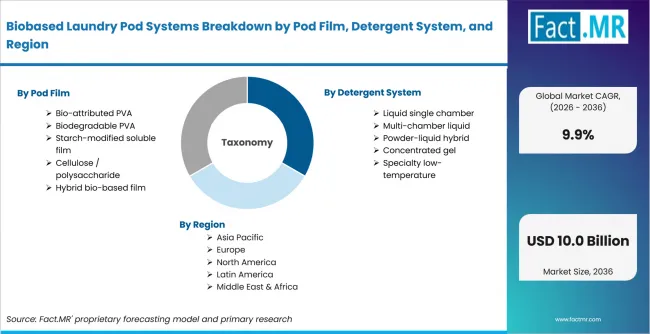
Biobased Laundry Pod Systems Breakdown By Pod Film, Detergent System, And Region | Source: Fact.MR
| Attribute | Details |
|---|---|
| Quantitative Units | USD Billion |
| Market Definition | Biobased laundry pod systems cover pre-measured detergent capsules or pod formats that use bio-attributed soluble film, biodegradable PVA, starch-modified film, cellulose or polysaccharide materials, and hybrid bio-based film systems. |
| Pod Film | Bio-attributed PVA; Biodegradable PVA; Starch-modified soluble film; Cellulose or polysaccharide; Hybrid bio-based film |
| Detergent System | Liquid single chamber; Multi-chamber liquid; Powder-liquid hybrid; Concentrated gel; Specialty low-temperature |
| Claim | Bio-based content; Cold-wash efficiency; Microplastic reduction; Low-carbon chemistry; Compact or water-saving |
| Application | Laundry wash; Stain booster; Fabric care; Machine care; Institutional laundry |
| Regions Covered | North America; Latin America; Western Europe; Eastern Europe; East Asia; South Asia & Pacific; Middle East & Africa |
| Countries Covered | USA; China; Germany; France; Japan |
| Key Companies Profiled | Dropps; Henkel; Unilever; SC Johnson (Ecover); AspenClean; ECOS |
| Forecast Period | 2026 to 2036 |
| Approach | Hybrid top-down and bottom-up approach using detergent format adoption, film conversion activity, claim documentation, country retail indicators and company portfolio review. |
Source: Fact.MR analysis. Updated Sep 17, 2026
How is the market segmented?
-
By Pod Film
- Bio-attributed PVA
- Biodegradable PVA
- Starch-modified soluble film
- Cellulose or polysaccharide
- Hybrid bio-based film
-
By Detergent System
- Liquid single chamber
- Multi-chamber liquid
- Powder-liquid hybrid
- Concentrated gel
- Specialty low-temperature
-
By Claim
- Bio-based content
- Cold-wash efficiency
- Microplastic reduction
- Low-carbon chemistry
- Compact or water-saving
-
By Application
- Laundry wash
- Stain booster
- Fabric care
- Machine care
- Institutional laundry
-
By Region
- North America
- Latin America
- Western Europe
- Eastern Europe
- East Asia
- South Asia & Pacific
- Middle East & Africa
Frequently Asked Questions
Biobased Laundry Pod How big is the biobased laundry pod systems market in 2026?
What is the CAGR of the biobased laundry pod systems market from 2026 to 2036?
Which pod film leads the biobased laundry pod systems market?
Which application leads the biobased laundry pod systems market?
Who are the leading companies in the biobased laundry pod systems market?
Who worked on this report


Preview the report firsthand - request a free sample
Free SampleGet the brochure for pricing and purchase details
Download PDF