- Market Value (2025): USD 6.4 Bn
- Estimated Value (2026): USD 7.0 Bn
- Forecast Value (2036): USD 17.2 Bn
- CAGR (2026-2036): 9.5%
What is the Open-Innovation Ingredient Platforms Market forecast to be worth by 2036?
USD 7.0 billion in 2026 to USD 17.2 billion by 2036 at a 9.5% CAGR.
- The Open-Innovation Ingredient Platforms Market reached USD 6.4 billion in 2025.
- Demand is expected to increase from USD 7.0 billion in 2026 to USD 17.2 billion by 2036.
- The market is expected to record a 9.5% CAGR from 2026 to 2036 as ingredient firms and consumer brands use outside search networks to widen the pool of tech considered before product choices are locked.
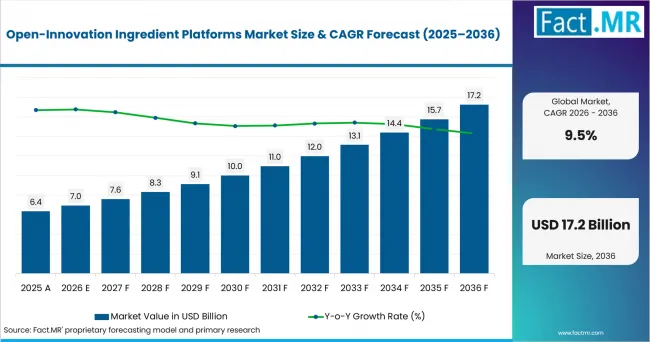
Open Innovation Ingredient Platforms Market Value Analysis | Source: Fact.MR
What are the defining numbers behind Open-Innovation Ingredient Platforms Market growth?
USD 10.3 billion absolute opportunity by 2036, led by startup scouting, food uses, search steps, and ingredient firms.
- Demand Drivers in the Market
- Ingredient firms need wider search routes because useful enzymes, proteins and cultures can come from outside their own labs. A clear scouting process helps teams find options early. It also lets them compare product fit before they commit more time and money.
- CPG brands need faster access to outside product options when a product brief has several goals. The USDA Economic Research Service reported in June 2026 that inflation-adjusted U.S. food spending reached USD 2.51 trillion in 2025.
- Universities and biotech partners need a clear route from research to ingredient use. License steps and shared tests can link lab ideas with firms that have product labs, plant scale and market access. The network helps each side see the next task before a project moves forward.
- Retailers and nutrition firms need ingredient ideas that fit changing product needs while keeping development cycles manageable. Open networks let users search across firms and experts first. Lab work can then focus on the smaller set of options that best match the brief.
- Key Segments Analyzed
- By Platform Model: Startup scouting is expected to hold 36.0% share in 2026 because it gives corporate ingredient teams a focused route to search outside ventures, tech, and IP before formal joint work begins.
- By Ingredient Domain: Food is expected to account for 32.0% share in 2026 as product work spans taste, texture, nutrition, preservation, and process results across many product categories.
- By Workflow: Discovery is expected to capture 31.0% share in 2026 since open R&D creates the most value when outside options are found and screened before expensive trial or scale-up work starts.
- By User: Ingredient suppliers are expected to hold 35.0% share in 2026 owing to their need to connect internal use skill with startups, research institutes, buyers, and expert tech partners.
- Analyst Opinion at Fact.MR
- Shambhu Nath Jha, Principal Consultant at Fact.MR, states, “Open-innovation networks create value when search leads move into product proof. Ingredient teams need clear proof, ownership and test steps. Networks that link search, screening, testing and launch are expected to draw more use than simple partner lists.”
- Strategic Implications
- Ingredient firms should define tech scouting themes around specific product gaps. This helps outside searches return tech that can enter a product program quickly.
- CPG brands should use clear challenge briefs that state results targets, processing constraints, and proof needs before inviting outside proposals.
- Platform operators should make stage gates visible so users can distinguish early search leads from options that have completed screening or trial work. Clear stages keep product teams focused on the next proof need and shorten internal handoffs.
The UK is expected to record a 10.0% CAGR through 2036. Japan follows at 9.7%, the USA at 9.4%. Germany at 9.1% and France at 8.7%. Research depth, startup work and ingredient work scale shape the varied country paths.
How does the Open-Innovation Ingredient Platforms Market break down by segment?
Startup scouting leads Platform Model at 36.0%. Food leads Ingredient Domain at 32.0%. Discovery leads Workflow at 31.0%. Ingredient firms lead User at 35.0%.
Which Platform Model leads?
Startup scouting is expected to hold 36.0% share in 2026.
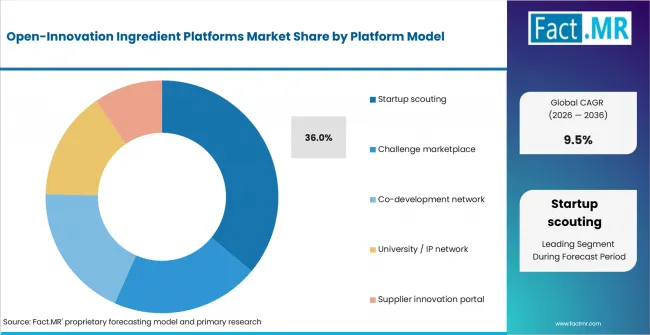
Open Innovation Ingredient Platforms Market Analysis By Platform Model | Source: Fact.MR
Startup scouting leads because ingredient firms often search beyond strong supplier lists for a new function or product design route. A clear platform organizes options around a product brief. Challenge marketplaces widen the search. At the same time, joint work and university networks become more useful after a promising candidate is identified.
What leads the Ingredient Domain segment?
Food is expected to account for 32.0% share in 2026.
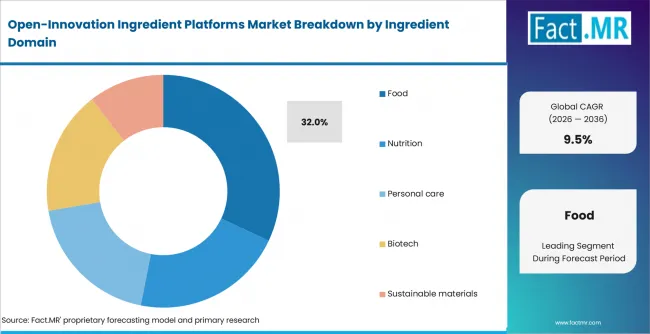
Open Innovation Ingredient Platforms Market Analysis By Ingredient Domain | Source: Fact.MR
Food leads because teams often need several product roles within one product brief. Outside search expands the ingredient options considered before product work begins. Nutrition, personal care, biotech, and sustainable-material programs widen the search into functional ingredients, sensorial materials, enzymes, fermentation, and adjacent tech.
How does Workflow shape demand?
Discovery is expected to capture 31.0% share in 2026.
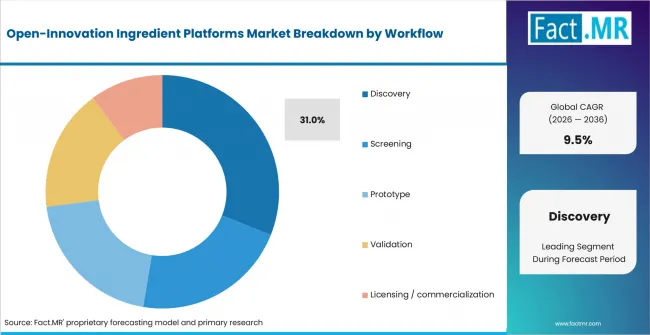
Open Innovation Ingredient Platforms Market Analysis By Workflow | Source: Fact.MR
Discovery is expected to hold the largest workflow share because open innovation starts with search. Screening then narrows options by product fit and proof before trial work begins. Cargill reopened its upgraded Singapore Innovation Center in April 2025. The center supports food science, culinary innovation, consumer work and co-creation with customers.
What supports Ingredient suppliers within User?
Ingredient suppliers are expected to hold 35.0% share in 2026.
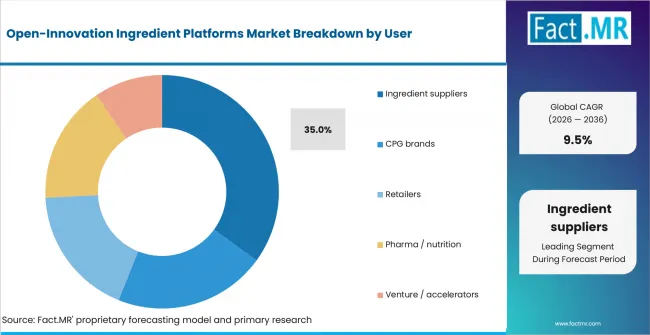
Open Innovation Ingredient Platforms Market Analysis By User | Source: Fact.MR
Ingredient firms combine test labs, rules skill, plant know-how, and buyer briefs with outside science. CPG brands use the same networks for product challenges. Retailers shape private-label needs. At the same time, pharma, nutrition, venture, and accelerator users bring varied proof and launch needs.
What is accelerating Open-Innovation Ingredient Platforms Market adoption, and what is holding it back?
Outside search and joint work accelerate adoption. proof quality, IP alignment, and rules review restrain conversion.
Drivers Impact Analysis
| DRIVER | (~) % IMPACT ON CAGR | GEOGRAPHIC RELEVANCE | IMPACT TIMELINE |
|---|---|---|---|
| Startup and university scouting | +1.8% | North America, Europe, East Asia | Short term (<= 2 years) |
| Buyer joint-work networks | +1.4% | Global | Short term (<= 2 years) |
| Biotech ingredient search | +1.1% | USA, Europe, Japan | Medium term (2-4 years) |
| Digital screening tools | +0.9% | Global | Medium term (2-4 years) |
| Licensing routes for outside IP | +0.6% | North America, Europe, East Asia | Long term (>= 4 years) |
Source: Fact.MR analysis. Updated Sep 24, 2026
Opportunity Impact Analysis
| OPPORTUNITY | (~) % IMPACT ON CAGR | GEOGRAPHIC RELEVANCE | IMPACT TIMELINE |
|---|---|---|---|
| AI-assisted ingredient search | +1.2% | North America, Europe | Medium term (2-4 years) |
| Shared pilot and test networks | +1.0% | Global | Medium term (2-4 years) |
| Food and nutrition search | +0.8% | Global | Short term (<= 2 years) |
| University IP licensing | +0.6% | Europe, Japan, USA | Long term (>= 4 years) |
Source: Fact.MR analysis. Updated Sep 24, 2026
Restraints Impact Analysis
| RESTRAINT | (~) % IMPACT ON CAGR | GEOGRAPHIC RELEVANCE | IMPACT TIMELINE |
|---|---|---|---|
| Uneven proof quality | -0.7% | Global | Short term (<= 2 years) |
| IP and confidentiality terms | -0.6% | Global | Short term (<= 2 years) |
| Rules review for novel ingredients | -0.5% | USA, UK, Europe, Japan | Medium term (2-4 years) |
| Scale-up gap after search | -0.4% | Global | Medium term (2-4 years) |
Source: Fact.MR analysis. Updated Sep 24, 2026
Which countries are scaling the Open-Innovation Ingredient Platforms Market through 2036?
- The country comparison spans 1.3 percentage points between the UK at 10.0% and France at 8.7% across the forecast period.
- The UK remains 0.3 percentage point above Japan as business research spending supports clear outside joint work.
- Japan remains 0.3 percentage point above the USA as university ventures expand the pool of tech available for scouting.
- The USA remains 0.3 percentage point above Germany through broad corporate R&D and a large ingredient work base.
- Germany remains 0.4 percentage point above France as business research work supports licensing and joint work.
Comparable CAGRs can create varied entry conditions due to research depth and partner access. Launch routes and test skills also shape local market entry. Full report coverage includes North America, Latin America, Western Europe, Eastern Europe, East Asia, South Asia & Pacific, Middle East & Africa.
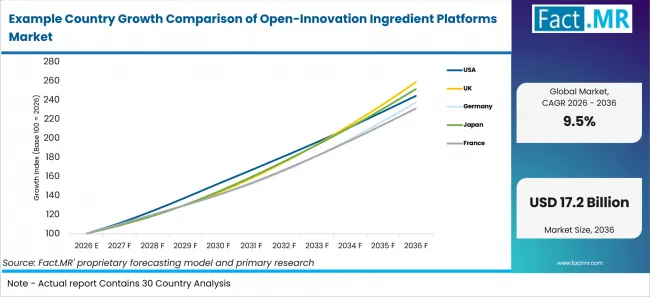
Example Country Growth Comparison Of Open Innovation Ingredient Platforms Market | Source: Fact.MR
| Country | CAGR (2026-2036) |
|---|---|
| United Kingdom | 10.0% |
| Japan | 9.7% |
| United States | 9.4% |
| Germany | 9.1% |
| France | 8.7% |
Source: Fact.MR analysis. Updated Sep 24, 2026
What supports USA adoption?
9.4% CAGR, supported by corporate research depth and ingredient work networks.
U.S. ingredient teams are expected to use outside search networks to widen access to science and cross-border R&D. The U.S. Bureau of Economic Analysis reported in July 2026 that R&D by U.S. affiliates of foreign multinationals reached USD 95.5 billion in 2024, up 5.3%. That research base gives ingredient firms and brands a broad pool of partners for search, testing and joint work.
How is the United Kingdom scaling demand?
10.0% CAGR, supported by research-intensive firms and clear joint work.
The United Kingdom is expected to benefit from a dense research base that supports outside tech searches and joint work. The Office for National Statistics reported in November 2025 that UK firms performed GBP 55.6 billion of R&D in 2024, up 4.5% from 2023. That spending gives ingredient teams a wide pool of research groups for search, screening and product work.
What supports Germany’s adoption?
9.1% CAGR, supported by business R&D and biotech joint work.
Germany is expected to attract open-R&D ingredient programs through its business research base and applied-science networks. Destatis reported in March 2026 that German R&D spending reached EUR 137.1 billion in 2024, up 3.8% from the previous year. This research depth gives ingredient firms and brand teams more routes to identify outside science and move selected tech into product testing and licensing discussions.
How does Japan develop demand?
9.7% CAGR, supported by university ventures and outside tech scouting.
Japan’s ingredient firms are expected to gain a wider scouting pool as university ventures bring research into business use. The Ministry of Economy, Trade and Industry reported in June 2026 that it had identified 6,220 university startups as of the end of October 2025, up from 5,074 in the prior survey. That larger pool gives platform users more partners for search and product review.
What is supporting France’s adoption?
8.7% CAGR, supported by research scale and market work networks.
France is expected to support open-R&D ingredient programs through a large product workforce and strong research clusters. The Ministry of Higher Education and Research reported in April 2026 that firms employed 321,500 full-time-equivalent R&D staff in 2024, up 3.1% from 2023. That scale supports partner searches and joint testing across food, nutrition and biotech-related ingredient programs.
Who leads the Open-Innovation Ingredient Platforms Market?
Kerry links biotechnology research with ingredient and product development for food, beverage, and pharmaceutical applications. In September 2025, the company opened its Biotechnology Centre in Leipzig. Kerry said the facility draws on the work of more than 100 scientists and technical experts and supports enzyme and strain identification and engineering, fermentation, bioprocess development and scale-up, and production.
Ingredion uses its global Idea Labs® network and co-creation programs to connect customer product-development needs with consumer insights, applied research, formulation expertise, prototyping, testing, and scale-up support. Its ingredient portfolio and technical resources support development across food, beverage, health, and nutrition applications.
IFF combines food ingredients, bioscience, and health expertise with innovation centers, laboratories, pilot facilities, and customer co-creation resources. Cargill operates a global network of food R&D and innovation centers where scientists work with customers on formulation, sensory evaluation, ingredient functionality, process development, and new-product creation. Both companies therefore provide collaborative pathways from product concepts toward testing and commercial development.
Tate & Lyle combines ingredient science with Customer Innovation and Collaboration Centres and technology-enabled testing resources such as its ALFIE automated laboratory. dsm-firmenich combines taste, texture, nutrition, health science, application expertise, and customer co-creation capabilities. Competitive differentiation is expected to depend on scientific breadth, customer collaboration, testing capability, quality of supporting evidence, and the ability to move concepts from development toward commercially viable ingredient and product solutions.
Which companies are the key providers?
Key firms include Kerry Group, Ingredion, IFF, Cargill, Tate & Lyle, and dsm-firmenich.
- Kerry Group
- Ingredion
- IFF
- Cargill
- Tate & Lyle
- dsm-firmenich
Bibliography
- Zeballos, E., & Sinclair, W. (2026, June 11). Total U.S. food spending reached $2.51 trillion in 2025. U.S. Department of Agriculture, Economic Research Service.
- U.S. Bureau of Economic Analysis. (2026, July 10). Activities of U.S. affiliates of foreign multinational enterprises, 2024.
- Office for National Statistics. (2025, November 28). Business enterprise research and development, UK: 2024.
- Statistisches Bundesamt (Destatis). (2026, March 27). 3,8 % mehr Ausgaben für Forschung und Entwicklung im Jahr 2024 [3.8% more expenditure on research and development in 2024].
- Ministère de l’Enseignement supérieur, de la Recherche et de l’Espace. (2026, April). Les dépenses de R&D des entreprises en 2024 (données provisoires).
- Tate & Lyle. (2025, October 24). Celebrating ALFIE: Driving smarter, faster innovation for our customers.
- Cargill. (2025, April 10). Cargill unveils transformed Innovation Center in Singapore to advance food innovation, for Asia from Asia.
- Kerry Group plc. (2025, September 24). Kerry establishes new biotechnology centre in Leipzig.
This Report Answers
- The report covers startup scouting, challenge marketplaces, joint networks, university and IP networks and supplier portals.
- Segment analysis shows the main platform model, ingredient domain, workflow and user group. It also explains each 2026 share.
- Country analysis compares the USA, UK. Germany. Japan and France with the stated CAGRs and one current official fact for each market.
- Competitive analysis reviews Kerry Group, Ingredion, IFF, Cargill, Tate & Lyle and dsm-firmenich. Company profiles focus on capabilities and market role.
What does the Open-Innovation Ingredient Platforms Market cover?
The market covers clear systems that help firms find and test outside ingredient ideas. It includes startup scouting, challenge marketplaces and joint networks. Search briefs can cover food ingredients, food additives and natural food colors when teams need new science or lab proof.
The workflow starts with search and screening. It then moves to trials, testing and license or launch steps. It can cover functional foods, fermented ingredients, personalized nutrition and plant protein ingredients when outside science helps solve a product need.
What is included in the scope?
The scope includes networks run by ingredient firms, brands and expert partners. These networks organize search around a clear product need. Briefs can cover enzymes, flavors and fragrances and protein ingredients when a platform links search to screening and lab work.
The scope includes university and IP networks when projects cover ingredient tests, licenses or joint work. Venture and accelerator programs are included when they have a clear link to ingredient search or launch.
What is excluded from the scope?
The scope centers on R&D software tied directly to ingredient development. Seller portals and company networks are included when they provide a defined search and evaluation process. Direct ingredient sales enter the scope when a platform links search with screening, testing or joint work.
How Was the Analysis Built?
The analysis draws on 120+ sources, 35+ company portfolios, 25+ countries, and more than 20 industry interviews.
- Primary Research: Primary research includes discussions with manufacturers, service providers, technology developers, distributors, end users, and subject-matter experts. These conversations examine purchasing priorities, product adoption, operational challenges, approval requirements, competitive positioning, and the factors that influence wider market acceptance.
- Desk Research: Desk research covers government statistics, regulatory publications, company filings, trade data, technical studies, industry associations, standards, public policy, and other authoritative sources. Every source used in the analysis is documented in the bibliography.
- Market Sizing and Forecasting: Market estimates combine historical performance, demand indicators, pricing and volume trends, segment shares, company participation, country-level growth, adoption patterns, investment activity, and barriers to market expansion.
- Data Validation and Update Cycle: Findings are validated by comparing primary interviews with public data, company activity, regulatory changes, trade patterns, and industry developments. Regular updates review new product launches, capacity changes, partnerships, approvals, and shifts in commercial adoption.
Segmentation
What is the report’s scope and coverage?
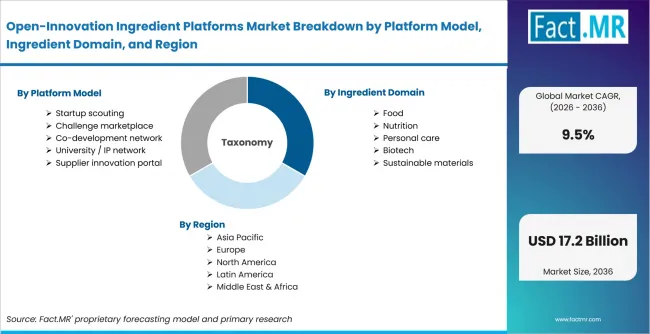
Open Innovation Ingredient Platforms Market Breakdown By Platform Model, Ingredient Domain, And Region | Source: Fact.MR
| Attribute | Details |
|---|---|
| Quantitative Units | USD billion |
| Market Definition | Platforms and clear R&D networks used to find, screen, test, license or launch outside ingredient ideas across food, nutrition, personal care, biotech and related material uses. |
| Platform Model | Startup scouting; Challenge marketplace; Co-development network; University / IP network; Supplier innovation portal |
| Ingredient Domain | Food; Nutrition; Personal care; Biotech; Sustainable materials |
| Workflow | Discovery; Screening; Prototype; Validation; Licensing / commercialization |
| User | Ingredient suppliers; CPG brands; Retailers; Pharma / nutrition; Venture / accelerators |
| Regions Covered | North America; Latin America; Western Europe; Eastern Europe; East Asia; South Asia & Pacific; Middle East & Africa |
| Countries Covered | United States; United Kingdom; Germany; Japan; France |
| Key Companies Profiled | Kerry Group; Ingredion; IFF; Cargill; Tate & Lyle; dsm-firmenich |
| Forecast Period | 2026 to 2036 |
| Approach | Hybrid top-down and bottom-up approach using ingredient R&D activity, partner-network depth, search steps, test-lab skills, country R&D indicators and verified provider portfolios. |
Source: Fact.MR analysis. Updated Sep 24, 2026
How is the market segmented?
-
By Platform Model:
- Startup scouting
- Challenge marketplace
- Co-development network
- University / IP network
- Supplier innovation portal
-
By Ingredient Domain:
- Food
- Nutrition
- Personal care
- Biotech
- Sustainable materials
-
By Workflow:
- Discovery
- Screening
- Prototype
- Validation
- Licensing / market launch
-
By User:
- Ingredient suppliers
- CPG brands
- Retailers
- Pharma / nutrition
- Venture / accelerators
-
By Region:
- North America
- Latin America
- Western Europe
- Eastern Europe
- East Asia
- South Asia & Pacific
- Middle East & Africa
Frequently Asked Questions
How big is the Open-Innovation Ingredient Platforms Market in 2026?
What is the CAGR of the Open-Innovation Ingredient Platforms Market from 2026 to 2036?
Which platform model leads the Open-Innovation Ingredient Platforms Market?
Which user group leads the Open-Innovation Ingredient Platforms Market?
Who are the leading companies in the Open-Innovation Ingredient Platforms Market?
Who worked on this report


Preview the report firsthand - request a free sample
Free SampleGet the brochure for pricing and purchase details
Download PDF