- Base Value(2026): 4.3 Bn
- Estimated Value(2026): 4.3 Bn
- Forecast Value (2036): 7.3 Bn
- CAGR (2026 - 2036): 5.5%
Multi-Surface Disinfectant Cleaners Market Forecast and Outlook 2026 to 2036
Multi-surface disinfectant cleaners are becoming a standard part of daily hygiene routines across homes and commercial spaces. The market is expected to grow from about USD 4.3 billion in 2026 to nearly USD 7.3 billion by 2036, reflecting a CAGR of 5.5%. This steady rise comes from lasting changes in hygiene behavior after recent global health crises. Businesses, hospitals, hotels, and even households now expect higher and more consistent disinfection standards.
Summary of Multi-Surface Disinfectant Cleaners Market - Key Takeaways
- The market includes ready-to-use sprays, concentrates, wipes, and other disinfectant formats designed for use across multiple surfaces such as stainless steel, glass, plastics, sealed wood, and countertops in residential, commercial, healthcare, and hospitality settings.
- The defined scope covers revenue generated by active chemistry, end-use setting, format, contact time positioning, and regional demand across North America, Europe, Asia Pacific, Latin America, and the Middle East & Africa, excluding single-surface specialty cleaners and non-disinfectant household detergents.
- The multi-surface disinfectant cleaners market is projected to grow at a CAGR of 5.5% from 2026 to 2036, expanding from USD 4.3 billion in 2026 to approximately USD 7.3 billion by 2036, based on Fact.MR forecasting driven by sustained hygiene awareness, regulatory compliance requirements, and institutional infection control programs.
- Quaternary ammonium compounds lead the active chemistry segment with a 34% share in 2026, supported by broad-spectrum antimicrobial efficacy, surface compatibility, and established regulatory approvals across major markets.
- Standard contact time formulations account for 44% of total demand, as most institutional and residential users balance proven pathogen kill performance with operational practicality.
- China records the fastest growth at 6.5% CAGR, supported by national hygiene standardization programs and large-scale urban infrastructure expansion, while Brazil and the United States also demonstrate strong momentum through healthcare investments and evolving consumer safety preferences.
- Competition is led by major players such as Clorox, Reckitt, Procter & Gamble, SC Johnson Professional, Ecolab, Diversey, Unilever, 3M, Zep, and Betco, with differentiation increasingly centered on gentle-kill chemistries, sustainability credentials, smart dispensing systems, and regulatory compliance expertise.
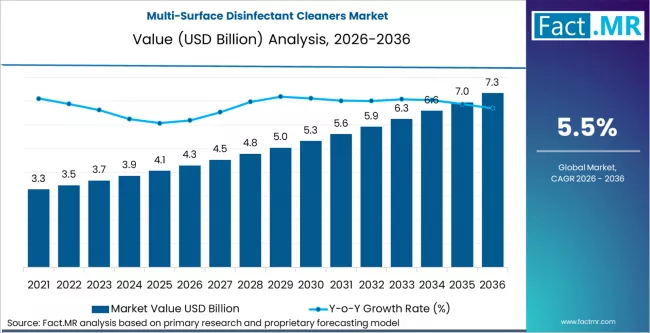
Multi Surface Disinfectant Cleaners Market Market Value Analysis | Source: Fact.MR
One of the biggest advantages of multi-surface disinfectants is convenience. Facility managers prefer products that work across countertops, stainless steel, glass, plastics, and sealed wood without damaging surfaces. Using one product instead of many simplifies inventory and training. At the same time, buyers want strong pathogen kill claims backed by scientific testing, but without harsh odors or surface damage.
Regulations are also shaping the market. In Europe, strict biocidal product rules require extensive safety and efficacy testing. In the UK, tighter limits on respiratory irritants are pushing companies toward low-odor formulas. China is standardizing disinfection practices across public buildings, creating large-volume procurement demand. Germany’s green procurement policies are encouraging biodegradable hydrogen peroxide solutions over chlorine-based products.
Marc Bitzer, Chairman and CEO of Whirlpool Corporation, captures the shift well. He notes that hygiene expectations have permanently increased. Consumers now want hospital-level disinfection that is safe for everyday use around children and pets. This mindset is encouraging companies to develop gentler yet highly effective chemistries that remove the harsh bleach smell while still delivering broad-spectrum protection.
Multi-Surface Disinfectant Cleaners Market
| Metric | Value |
|---|---|
| Estimated Value in (2026) | USD 4.3 billion |
| Forecast Value in (2036) | USD 7.3 billion |
| Forecast CAGR (2026 to 2036) | 5.5% |
Source: Fact.MR analysis. Updated Feb 13, 2026
Category
| Category | Segments |
|---|---|
| Active Chemistry | Quaternary Ammonium, Hydrogen Peroxide/Peracetic Systems, Alcohol Blends, Chlorine/Hypochlorite & Other Oxidizers |
| End-Use Setting | Commercial Buildings, Healthcare & Institutions, Hospitality & Foodservice, Residential |
| Format | RTU Sprays, Concentrates, Wipes, Other Formats |
| Contact Time Positioning | Fast Contact Time (≤1 min), Standard Contact Time (2-5 min), Extended Contact Time (>5 min) |
| Region | North America; Europe; Asia Pacific; Latin America; Middle East & Africa |
Source: Fact.MR analysis. Updated Feb 13, 2026
Segmental Analysis
What drives RTU sprays to hold a 42% market share?
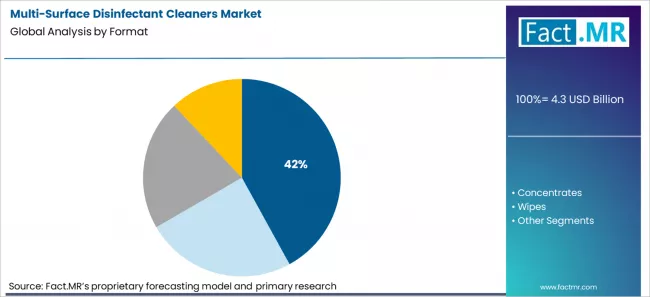
Multi Surface Disinfectant Cleaners Market Analysis By Format | Source: Fact.MR
Ready-to-use sprays lead the market because they are simple and reliable. They remove the need for dilution, which helps prevent mixing errors that can weaken disinfection or create unsafe concentrations. Trigger sprays make application easy and controlled. Users can cover surfaces evenly without wasting product. At home, consumers prefer RTU formats because they are convenient and safe to store. Most households do not want to measure or mix chemicals. In commercial buildings, RTU sprays are ideal for quick touch-ups on high-touch areas like door handles and counters between deep cleaning cycles. They help maintain hygiene standards without relying fully on centralized dilution systems.
What establishes quaternary ammonium compounds at 34% market share?
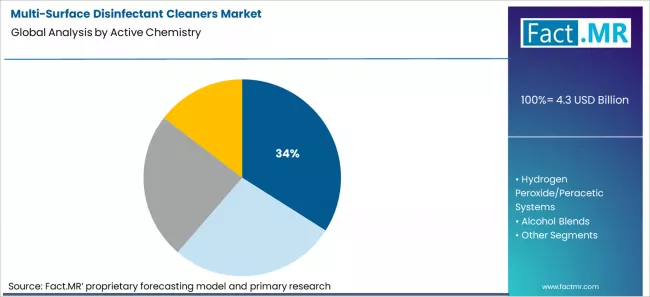
Multi Surface Disinfectant Cleaners Market Analysis By Active Chemistry | Source: Fact.MR
Quaternary ammonium compounds, often called “quats,” remain popular because they are effective and versatile. They kill a wide range of bacteria, viruses, and fungi. They are also gentle on many surfaces, including stainless steel, plastic, sealed wood, and electronics housings. Unlike bleach, quats are less corrosive and do not damage most fixtures. They also provide some residual antimicrobial activity between cleanings. Healthcare and foodservice operators value this added layer of protection. Years of regulatory approvals and strong performance data also make quats a trusted choice.
Market Dynamics
- Drivers: Hygiene standards have permanently increased. Businesses now follow documented cleaning programs backed by lab-tested pathogen claims. Hospitals use hospital-grade disinfectants to reduce infection risk. Restaurants must comply with strict health inspections. Consumers are more aware of germs and resistant bacteria. They want products that work against emerging pathogens. Touchless dispensers in offices and public buildings help control dosage and reduce waste. Green building certifications now encourage safer, more sustainable disinfectants such as hydrogen peroxide-based systems.
- Restraints: Regulatory approval is complex and expensive. In the U.S., EPA registration requires detailed safety and efficacy testing. In Europe, similar approval is required under biocidal regulations. These processes take time and money. Raw material supply issues, especially for certain quat ingredients, can affect pricing and availability. Many users also misunderstand required contact times. If products are wiped too soon, they may not deliver full disinfection. Environmental concerns about quat persistence in wastewater are also increasing regulatory pressure.
- Trend 1: Pet- and child-safe gentle-kill formulations There is growing demand for disinfectants that are strong but gentle. Families want hospital-level protection without harsh fumes. Brands are responding with low-odor, bleach-free formulas. These use milder acids or plant-based actives to achieve proven kill claims. Safety messaging now highlights pediatric and pet-friendly testing. Consumers are willing to pay more for peace of mind.
- Trend 2: Zero-residue, non-slip surface solutions Commercial buyers are focusing on safety beyond germ control. Some disinfectants leave films that can make floors slippery. This creates liability risks. New zero-residue formulas avoid buildup while still delivering strong pathogen control. Japan has led this trend due to strict slip-resistance standards and an aging population. Other developed markets are following as fall prevention becomes a larger concern.
Multi-Surface Disinfectant Cleaners Market Analysis by Country
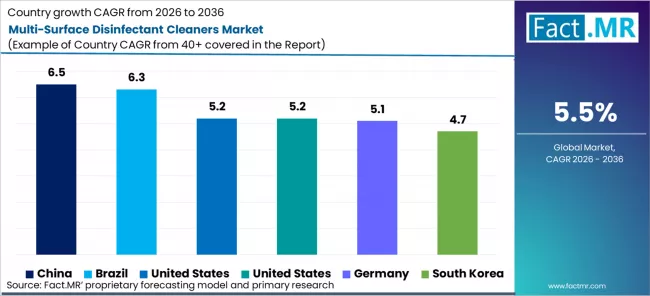
Multi Surface Disinfectant Cleaners Market Cagr Analysis By Country | Source: Fact.MR
| Country | CAGR (2026 to 2036) |
|---|---|
| China | 6.5% |
| Brazil | 6.3% |
| United States | 5.2% |
| United Kingdom | 5.2% |
| Germany | 5.1% |
| South Korea | 4.7% |
Source: Fact.MR analysis. Updated Feb 13, 2026
What is accelerating China’s multi-surface disinfectant market?
China is expanding at a 6.5% CAGR, driven by rapid urbanization and stricter public hygiene standards. National guidelines now require documented disinfection programs in offices, malls, and transit hubs. This creates consistent demand for commercial-grade formulations, especially quaternary ammonium systems. Strong local supply chains, supported by Sinopec partnerships, reduce reliance on imports. High population density in major cities also increases cleaning frequency. Government procurement policies favor compliant domestic brands, helping local manufacturers grow quickly.
Why is Brazil seeing steady market growth?
Brazil is growing at a 6.3% CAGR as tropical heat and humidity increase the need for frequent disinfection. Expanding healthcare infrastructure and recovering hospitality activity are adding to demand. Hotels, hospitals, and shopping centers are strengthening hygiene protocols. International suppliers are investing in local production, which improves availability and lowers distribution costs across regional markets.
What supports the United States market expansion?
The U.S. market is progressing at a 5.2% CAGR. Consumers want strong disinfection without harsh bleach odors, especially in homes with children and pets. Commercial buildings continue enhanced hygiene practices introduced during the pandemic. Healthcare facilities prefer fast-contact-time products that improve operational efficiency. State-level environmental regulations also push demand for low-VOC formulations.
How is the United Kingdom performing?
The UK market is expanding at a 5.2% CAGR, supported by stricter Health and Safety Executive rules limiting respiratory irritants in enclosed commercial spaces. Hospitals and NHS facilities increasingly prefer low-odor, low-VOC disinfectants that protect staff and patients. Large property managers in London and other major cities maintain premium hygiene standards to attract multinational tenants. Hospitality and transport operators also follow documented disinfection programs. Post-Brexit regulatory flexibility allows suppliers to fine-tune formulations for UK preferences, including faster contact times and milder fragrance profiles. ESG reporting requirements further encourage adoption of certified sustainable disinfectant products.
What is driving Germany’s development?
Germany is growing at a 5.1% CAGR, largely due to strong environmental and procurement laws. Public buildings and healthcare facilities must prioritize biodegradable and certified disinfectants. Green Public Procurement frameworks give preference to products meeting strict environmental criteria. Technical testing standards set by German authorities ensure high efficacy and surface compatibility. Demand is particularly strong in healthcare, manufacturing, and public transport infrastructure. Commercial tenants also value sustainable cleaning programs that align with DGNB and other green building certifications.
Why is South Korea advancing steadily?
South Korea is expanding at a 4.7% CAGR, driven by Circular Economy initiatives and consumer preference for eco-labeled household chemicals. High-density urban living increases reliance on multi-surface disinfectants for small apartments and shared facilities. The government promotes safer, plant-based antimicrobial systems. Smart buildings integrate automated dispensing and monitoring systems, boosting demand for compatible formulations. Corporate offices and tech campuses also maintain elevated hygiene standards.
What explains Japan’s market growth?
Japan is progressing at a 4.1% CAGR, shaped by an aging population and strict safety priorities. Zero-residue disinfectants are preferred to reduce slip risks in hospitals, transit stations, and shopping centers. The country’s strong hygiene culture sustains demand for premium, well-tested formulations. Disaster preparedness planning supports steady consumption of versatile disinfectants for emergency shelters. Compact living spaces also favor multi-purpose, low-odor products that balance performance with safety.
Competitive Landscape for Multi-Surface Disinfectant Cleaners Market
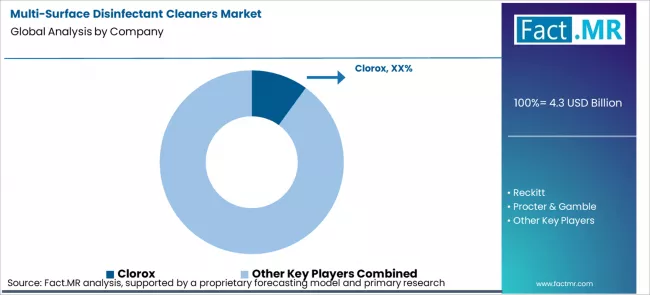
Multi Surface Disinfectant Cleaners Market Analysis By Company | Source: Fact.MR
The multi-surface disinfectant cleaners market operates through segmented competitive dynamics where consumer packaged goods companies leverage brand recognition and retail distribution networks. In 2024, competition in the multi-surface disinfectant cleaners market was still heavily shaped by post-pandemic demand spikes. Large consumer brands such as Clorox, Reckitt (Lysol and Dettol), and Procter & Gamble relied strongly on brand trust and retail shelf dominance. Bleach-based and quaternary ammonium products led sales, especially in households that prioritized strong “kill claims.” Professional suppliers like Ecolab and Diversey focused on hospitals, foodservice chains, and large facilities, offering not just chemicals but service contracts, training, and compliance documentation. Speed to market and supply reliability were major competitive advantages at that time.
By 2026, the landscape has shifted. Growth is steadier, and competition centers more on formulation safety, sustainability, and system integration. Gentler, low-odor, pet- and child-safe products are gaining traction, pressuring traditional bleach-heavy portfolios. Companies are investing more in hydrogen peroxide, plant-based actives, and extended-protection technologies such as Microban 24.
In professional channels, integrated solutions now include smart dispensing systems, usage monitoring, and regulatory support. Regional manufacturers have strengthened their position in Asia and Latin America by offering cost-effective, locally compliant formulas. Overall, the market in 2026 is less about emergency demand and more about long-term hygiene programs, environmental performance, and total cost of ownership.
Recent Development
- In April 2025, Unilever introduced a new probiotic-based surface cleaning spray under its Cif brand designed to keep killing dirt and microbes for days after application. The pet- and child-friendly formulation reflects broader consumer demand for gentler, longer-lasting disinfectant products.
- In 2025, SC Johnson launched FamilyGuard Multi-Surface disinfectant expansion across North American retail channels, introducing gentle-kill formulations delivering EPA-registered pathogen efficacy across 100-plus surface types while eliminating harsh bleach odors and addressing consumer demand for pet and child safe household disinfection solutions.
Key Market Players in Multi-Surface Disinfectant Cleaners Market
- Clorox
- Reckitt
- Procter & Gamble
- SC Johnson Professional
- Ecolab
- Diversey
- Unilever
- 3M
- Zep
- Betco
Bibliography
- SC Johnson Professional. 2025-2026. FamilyGuard Multi-Surface disinfectant expansion and gentle-kill formulation technologies for pet and child safe household applications. Official company publications and product documentation.
- Reckitt Benckiser Group. 2025. Dettol Pro Solutions expansion for hospital-grade commercial and hospitality applications. Corporate technology briefs and technical white papers.
- Henkel AG (BODE Chemie). 2025-2026. Bio-based surface disinfectant formulations meeting EU Biocidal Product Regulation and German Green Public Procurement requirements. Company press releases and sustainability reports.
- Kao Corporation. 2026. Zero-residue non-slip surface disinfection technologies for aging demographic applications. Technical application guides and product documentation.
- European Union. 2023. Biocidal Product Regulation implementation guidelines for disinfectant efficacy testing and environmental safety assessment. Official EU regulatory publications.
- UK Health and Safety Executive. 2025. Post-Brexit respiratory irritant threshold standards for cleaning chemicals in occupied commercial spaces. Official HSE regulatory guidance.
Segmentation
Scope of Report
| Items | Values |
|---|---|
| Quantitative Units (2026) | USD 4.3 Billion |
| Active Chemistry | Quaternary Ammonium, Hydrogen Peroxide/Peracetic Systems, Alcohol Blends, Chlorine/Hypochlorite & Other Oxidizers |
| End-Use Setting | Commercial Buildings, Healthcare & Institutions, Hospitality & Foodservice, Residential |
| Format | RTU Sprays, Concentrates, Wipes, Other Formats |
| Contact Time Positioning | Fast Contact Time (≤1 min), Standard Contact Time (2-5 min), Extended Contact Time (>5 min) |
| Regions Covered | North America, Europe, Asia Pacific, Latin America, Middle East & Africa |
| Countries Covered | U.S., Canada, Germany, Italy, UK, France, Japan, China, Brazil, South Korea, Australia, and other countries |
| Key Companies Profiled | Clorox, Reckitt, Procter & Gamble, SC Johnson Professional, Ecolab, Diversey, Unilever, 3M, Zep, Betco |
| Additional Attributes | Dollar revenue in the multi-surface disinfectant cleaners market is segmented by active chemistry (quaternary ammonium, hydrogen peroxide/peracetic systems, alcohol blends, chlorine/hypochlorite & other oxidizers), end-use setting (commercial buildings, healthcare & institutions, hospitality & foodservice, residential), format (RTU sprays, concentrates, wipes, other formats), contact time positioning (fast contact time, standard contact time, extended contact time), and region. |
Source: Fact.MR analysis. Updated Feb 13, 2026
Multi-Surface Disinfectant Cleaners Market by Segments
-
Active Chemistry :
- Quaternary Ammonium
- Hydrogen Peroxide/Peracetic Systems
- Alcohol Blends
- Chlorine/Hypochlorite & Other Oxidizers
-
End-Use Setting :
- Commercial Buildings
- Healthcare & Institutions
- Hospitality & Foodservice
- Residential
-
Format :
- RTU Sprays
- Concentrates
- Wipes
- Other Formats
-
Contact Time Positioning :
- Fast Contact Time (≤1 min)
- Standard Contact Time (2-5 min)
- Extended Contact Time (>5 min)
-
Region :
- Asia Pacific
- China
- India
- Japan
- South Korea
- Australia
- Rest of Asia Pacific
- North America
- United States
- Canada
- Mexico
- Europe
- Germany
- France
- UK
- Italy
- Spain
- Rest of Europe
- Latin America
- Brazil
- Argentina
- Chile
- Asia Pacific
Frequently Asked Questions
How big is the multi-surface disinfectant cleaners market in 2026?
What will be the size of multi-surface disinfectant cleaners market in 2036?
How much will be the multi-surface disinfectant cleaners market growth between 2026 and 2036?
What are the key product types in the multi-surface disinfectant cleaners market?
Which format segment to contribute significant share in the multi-surface disinfectant cleaners market in 2026?
Who worked on this report


Preview the report firsthand - request a free sample
Free SampleGet the brochure for pricing and purchase details
Download PDF