- Base Value(2026): 305.1 Mn
- Forecast Value (2036): 611.5 Mn
- CAGR (2036): 7.2%
What is the seed kits market forecast to be worth by 2036?
- Global Seed Kits Market revenue stood at USD 284.6 Mn in 2025 and is forecast to reach USD 611.5 Mn by 2036.
- At a 7.2% CAGR from 2026 to 2036.
- This market is set to expand ~ 2.0x in value, adding USD 306 Mn in absolute opportunity.
- The rising consumer interest in home gardening, indoor cultivation, and sustainable living is emerging as a primary growth driver for the Seed Kits Market.
- Seed kits are increasingly being adopted for their convenience, accessibility, and ability to support vegetable, herb, flower, and specialty plant cultivation across homes, educational settings, and wellness applications.
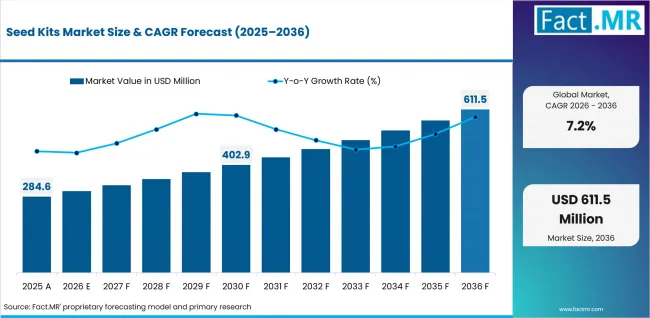
Seed Kits Market Value Analysis | Source: Fact.MR
Summary of the Seed Kits Market
- Market Snapshot
- Global seed kits market revenue stood at USD 284.6 Mn in 2025 and is forecast to reach USD 611.5 Mn by 2036.
- At a 7.2% CAGR from 2026 to 2036, this market is set to expand ~2.0x in value, adding USD 306 Mn in absolute opportunity.
- Growth is being driven by increasing consumer interest in home gardening, self-sufficiency, and indoor cultivation solutions.
- Rising adoption of hobby gardening, educational growing programs, and wellness-focused planting activities is reinforcing demand for seed kits.
- Expansion of e-commerce distribution and customizable gardening kits is supporting broader market penetration.
- Demand and Growth Drivers
- Growing popularity of home gardening and urban farming lifestyles
- Rising interest in sustainable food cultivation and DIY planting activities
- Increasing use of seed kits for education, therapy, and recreational gardening
- Expansion of digital retail platforms and subscription-based gardening models
- Need for solutions that provide:
- Easy-to-use gardening starter systems
- Convenient indoor and outdoor cultivation experiences
- Personalized and customizable growing options
- Accessible gardening tools for beginners and hobbyists
- Product and Segment View
- Vegetable seed kits hold 34% of seed type share in 2026, emerging as the leading segment.
- Herb seed kits account for 22% share, while flower seed kits represent 19% share.
- Fruit seed kits contribute 11%, and specialty seed kits account for 14% of market share.
- Starter grow kits account for 31% of kit composition share in 2026, positioning them as the dominant composition segment.
- Seed-only kits represent 28% share, followed by complete gardening kits at 27% and DIY/customizable kits at 14%.
- Outdoor seed kits hold 42% share by growing environment, supported by rising backyard gardening and outdoor cultivation activities.
- Indoor seed kits account for 38% share, while hybrid/adaptable kits represent 20% share.
- Home gardening leads application share with 62%, reflecting strong consumer preference for household cultivation and gardening engagement.
- Geography and Competitive Outlook
- Growth is supported across North America, Europe, and Asia Pacific.
- Key growth markets and CAGR: U.S. 6.4%, Germany 6.6%, U.K. 6.8%, Japan 7.0%, Canada 7.3%, China 8.1%, India 9.0%.
- Market expansion is closely tied to:
- Rising consumer engagement in gardening and plant-based lifestyles
- Expansion of online gardening retail ecosystems
- Growing awareness of sustainable cultivation and wellness gardening practices
- Key companies active in this market include: Burpee, Ferry-Morse, Seed Needs, Park Seed, Botanical Interests, The Old Farmer’s Almanac, and Urban Leaf.
- Analyst Opinion
- Shambhu Nath Jha, Principal Consultant at Fact.MR, says, “The Seed Kits Market is no longer defined solely by conventional seed packaging and basic home gardening products. Growth is increasingly driven by expanding consumer participation in home gardening, indoor cultivation, and urban farming, rising demand for sustainable and DIY growing solutions, advancements in smart gardening, customization, and subscription-based offerings, and increasing adoption of convenient, all-in-one seed kits for food cultivation, educational learning, wellness applications, and hobby gardening across residential, institutional, and commercial end-use environments.
Seed Kits Market— At a Glance
| Attribute | Details |
|---|---|
| Market Value 2025 | USD 284.6 Mn |
| Market Value 2036 | USD 611.5 Mn |
| Absolute Dollar Opportunity 2026–2036 | USD 306 Mn |
| Total Growth 2026–2036 | 114.9% |
| CAGR 2026–2036 | 7.2% |
| Growth Multiple | ~2.0x |
| Key Demand Theme | Growing adoption of home gardening and DIY cultivation kits |
| Leading Segment by Seed Type (2026) | Vegetable Seed Kits |
| Segment Share (2026) | 34% |
| Leading Segment by Kit Composition (2026) | Starter Grow Kits |
| Segment Share (2026) | 31% |
| Leading Segment by Growing Environment (2026) | Outdoor Seed Kits |
| Segment Share (2026) | 42% |
| Leading Segment by Application (2026) | Home Gardening |
| Segment Share (2026) | 62% |
| Leading Segment by Distribution Channel (2026) | Online Retail |
| Segment Share (2026) | 45% |
| Key Growth Regions | North America, Europe, Asia Pacific |
| Country CAGRs | U.S. 6.4%, Germany 6.6%, U.K. 6.8%, Japan 7.0%, Canada 7.3%, China 8.1%, India 9.0% |
| Top Companies | Burpee, Ferry-Morse, Seed Needs, Park Seed, Botanical Interests, Urban Leaf |
| Segmentation by Seed Type | Vegetable Seed Kits, Herb Seed Kits, Flower Seed Kits, Fruit Seed Kits, Specialty Seed Kits |
| Segmentation by Kit Composition | Seed-Only Kits, Starter Grow Kits, Complete Gardening Kits, DIY/Customizable Kits |
| Segmentation by Growing Environment | Indoor Seed Kits, Outdoor Seed Kits, Hybrid/Adaptable Kits |
| Segmentation by Application | Home Gardening, Educational Use, Commercial & Institutional Use, Therapeutic & Wellness Use |
| Segmentation by Distribution Channel | Online Retail, Online Retail, Direct & Subscription Sales |
| Segmentation by Region | North America, Latin America, Europe, Asia Pacific, Middle East & Africa |
Source: Fact.MR analysis. Updated Jun 1, 2026
Demand is being reinforced by expanding participation in DIY gardening, urban farming, and self-sufficiency trends, particularly among urban households, hobby gardeners, and environmentally conscious consumers. The market is further benefiting from increasing availability of customizable kits, smart gardening solutions, subscription-based offerings, and e-commerce-enabled distribution models designed to improve user experience, simplify cultivation processes, and support diverse growing environments across indoor and outdoor gardening ecosystems.
What is accelerating seed kits adoption, and what is holding it back?
Key Factors Driving Growth
- Global demand for Seed Kits is anticipated to increase due to the rise in interest in sustainable living, DIY gardening, and easy solutions for growing plants.
- Increased consumer demand for user-friendly, multi-functional gardening kits suitable for indoor planting, customization, and simplicity is estimated to increase the adoption rate of seed kits.
- The growing usage of seed kits in home food gardening, educational activities, therapy, indoor farming, and gift-giving purposes will ensure market growth.
| Growth Driver | Demand Impact | Time Horizon | Key Impact Area | Fact.MR Insight |
|---|---|---|---|---|
| Rising demand for home gardening and sustainable lifestyles | High | Short-Mid Term | Consumer gardening adoption and self-cultivation | Growing interest in food security, wellness, and eco-conscious living is accelerating seed kit demand |
| Expansion of indoor gardening and urban farming practices | High | Short-Mid Term | Indoor cultivation and compact growing solutions | Urban consumers are increasingly adopting convenient seed kits for space-efficient gardening |
| Growth of educational, wellness, and therapeutic gardening applications | High | Mid-Long Term | Learning, engagement, and wellness gardening | Seed kits are gaining traction across schools, community programs, and therapeutic settings |
| Advancements in smart gardening, customization, and subscription-based kits | Medium-High | Mid-Long Term | Product innovation and customer experience | Technology-enabled and personalized seed kits are improving convenience, engagement, and recurring sales |
| Increasing investments in e-commerce, D2C channels, and gardening product innovation | Medium | Short-Mid Term | Market accessibility and product availability | Digital retail expansion and new product launches are broadening market reach and consumer access |
Source: Fact.MR analysis. Updated Jun 1, 2026
Key Market Constraints
- High expenses on raw materials, packaging, transportation, and development of products, together with increased price sensitivity, can limit the possibilities of market expansion and sales of more premium products.
- Competing products such as seeds themselves, gardening equipment, cheap substitutes, seasonality, and less experienced consumers can hamper market growth and penetration.
- Market penetration may also suffer from variable climate, fewer gardeners, difficulties with distribution, and a lack of knowledge about seed kits among target groups.
Key Opportunity Areas
- Increased demand in home gardening, indoor farming, educational gardening, wellness applications, and urban farming creates excellent opportunities for seed kit providers.
- Development of smart grow kits, customizable seed packs, subscription services for home gardening, organic products, and cultivation solutions for beginners can be some of the ways of leveraging the current opportunities.
The Seed Kits Market offers huge opportunities for innovation and value creation in connected gardening products, ecological packaging, AI-assisted plant care, virtual gardening communities, and more sustainable urban gardening ecosystems.
How does the seed kits market break down by segment?
- By 2026, Vegetable Seed Kits account for a 34% market share of the seed type segment due to increasing consumer demand for home food cultivation, rising interest in self-grown vegetables, expanding participation in urban and indoor gardening, and growing preference for easy-to-grow edible plant solutions among households, hobby gardeners, and sustainability-focused consumers globally.
- Starter Grow Kits represent a 31% market share of the kit composition segment by 2026, driven by their beginner-friendly format, inclusion of essential growing components, strong suitability for indoor and home gardening applications, and rising consumer preference for convenient, all-in-one cultivation solutions across residential, educational, and wellness gardening environments worldwide.
The segmentation of the Seed Kits Market includes seed type, kit composition, growing environment, application, distribution channel, and region.
Which Seed Type Dominates the Seed Kits Market?
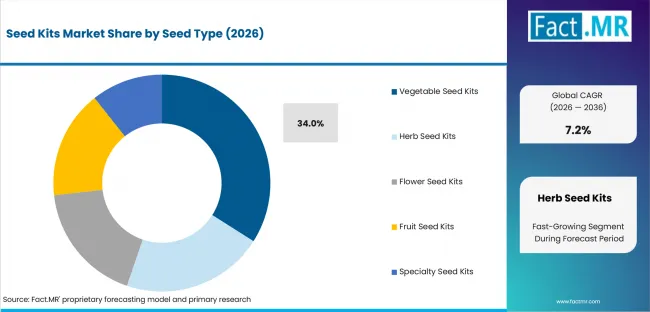
Seed Kits Market Analysis By Seed Type | Source: Fact.MR
Vegetable Seed Kits holds a market share of 34% in the market in 2026. The reason for that is the increased use of vegetable seed kits for cultivating fresh produce at homes in the process of urban food gardening. Along with rising consumer demand for healthful living practices, increased interest in self-sufficient activities, sustainable gardening, and home-grown food production, demand for easy-growing edible plants and gardening is increasing.
Which Kit Composition Dominates the Seed Kits Market?
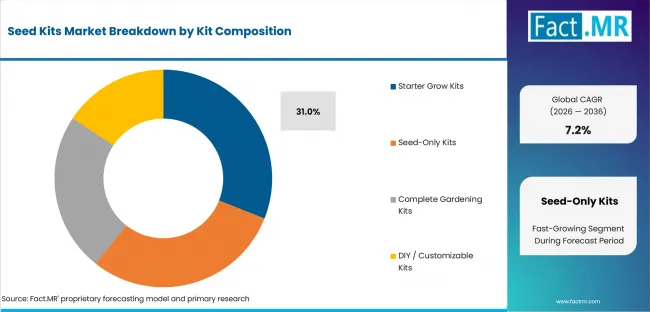
Seed Kits Market Analysis By Kit Composition | Source: Fact.MR
Starter Grow Kits hold a market share of 31% in 2026 in the market. This is due to the popularity of such products as all-in-one gardening solutions that contain seeds along with necessary materials for growing them. The factors that contribute to their demand are increased consumer interest in easy cultivation processes and availability of suitable products both for indoor and outdoor growing.
Which Growing Environment Dominates the Seed Kits Market?
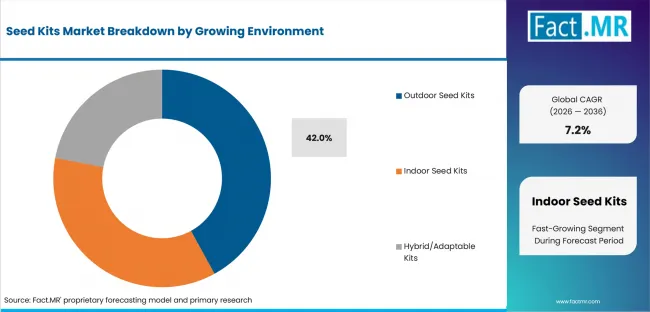
Seed Kits Market Analysis By Growing Environment | Source: Fact.MR
Outdoor Seed Kits hold a market share of 42% in the market in 2026. Outdoor seed kits have wide application in the areas of outdoor gardening, including backyard and patio cultivation, along with traditional home gardening. Increased consumer interest in outdoor gardening, homegrown vegetables, herbs, and flowers, as well as larger-scale cultivation environment needs, contributes to segment development.
Which Application Dominates the Seed Kits Market?
Home Gardening accounts for 62% of market shares of the market in 2026. Home gardening is on the rise, which can be explained by DIY gardening and indoor cultivation activities among global consumers. Growing interest in sustainable lifestyles and wellness hobbies contributes to rising demands. Increased interest in urban gardening contributes to market expansion as well.
Which Distribution Channel Dominates the Seed Kits Market?
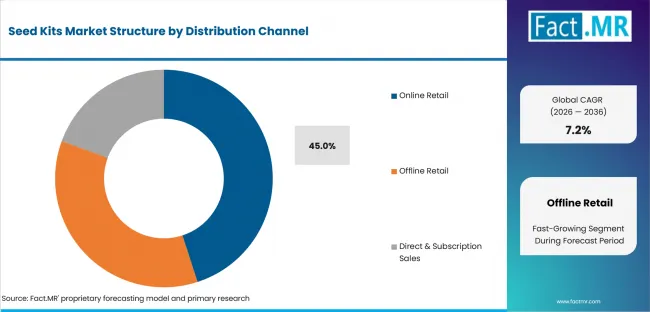
Seed Kits Market Analysis By Distribution Channel | Source: Fact.MR
Online Retail holds a market share of 45% in the market in 2026. One of the factors that contributes to such high share of online retail sales is an increased role of online purchases and digital commerce in gardening. Apart from convenient buying options, online retail allows people to compare and choose subscriptions and join digital gardening communities.
Which countries are scaling seed kits demand fastest?
The market analysis covers key global regions, including South Asia and Pacific, Middle East & Africa, North America, Latin America, Western Europe, and Eastern Europe. It is segmented geographically, with specific market dynamics for each region. The full report provides a detailed market attractiveness analysis.
CAGR Table
| Country | CAGR (%) |
|---|---|
| U.S. | 6.4% |
| Germany | 6.6% |
| U.K. | 6.8% |
| Japan | 7.0% |
| Canada | 7.3% |
| China | 8.1% |
| India | 9.0% |
Source: Fact.MR analysis. Updated Jun 1, 2026
Source: Fact.MR (FMR) analysis, based on proprietary forecasting model and primary research.
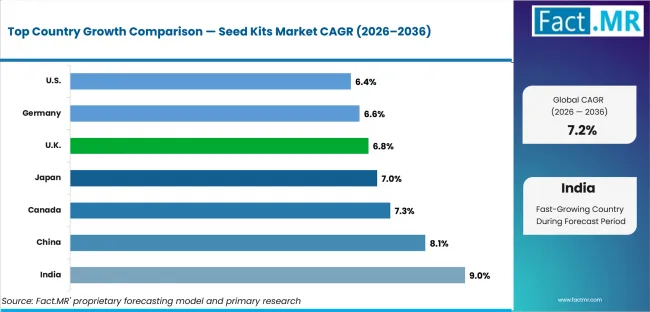
Seed Kits Market Cagr Analysis By Country | Source: Fact.MR
North America
North America serves as the high-throughput precision agriculture laboratory, where seed kit adoption is driven by data-enabled farming and corporate sustainability pledges. Key regional players include Bayer Crop Science (leading with its Preceon Smart Corn System, holding a dominant share in trait-integrated kits) and Corteva Agriscience (strong in soybean and sunflower seed kits via the Pioneer brand).
- United States: Demand for Seed Kits in the U.S. is projected to rise at 6.4% CAGR through forecast period. Growth is fueled by the USDA’s Natural Resources Conservation Service (NRCS) EQIP program, which in March 2025 increased cost-share coverage for cover crop seed kits to $50 per acre for climate-smart practices [1].
Western Europe
Western Europe functions as the regulatory and ecological transition driver, where seed kit formulation is dictated by pesticide reduction laws and carbon farming incentives. Key players include Limagrain (dominant in vegetable and cover crop kits for French cooperatives) and RAGT Semences (strong in hybrid wheat kits tailored to low-input systems).
- Germany: Demand for Seed Kits in Germany is projected to rise at 6.6% CAGR through forecast period. The Federal Ministry of Food and Agriculture (BMEL) introduced the “Farm Future” ecological tender (March 2025) mandating that 40% of subsidized seed kits contain at least three flowering species for insect habitat [2]. Simultaneously, Lower Saxony’s water protection regulation (January 2025) required all seed kits planted in nitrate-vulnerable zones to include catch crop species with documented nitrification inhibition traits [3].
East Asia
East Asia acts as the high-density, high-precision vegetable and rice seed kit innovation hub, where government-led intensification and commercial greenhouse expansion drive standardized kit adoption. Key regional players include Syngenta Group (dominant in China for high-germination vegetable seed kits) and Kitamura Seeds (leader in Japan for hybrid leafy green kits for plant factories).
- Japan: Demand for Seed Kits in Japan is projected to rise at 7.0% CAGR through forecast period. The Ministry of Agriculture, Forestry and Fisheries (MAFF) revised the “Smart Agriculture” subsidy guidelines (March 2025) to cover 70% of the cost of pre-germinated, tape-seed kits for robotic transplanters [4]. Furthermore, the Tokyo Metropolitan Government’s “Next-Gen Plant Factory” tender (February 2025) exclusively listed 14 types of hydroponic seed kits with certified low-bacterial loads for urban vertical farms [5].
- China: Demand for Seed Kits in China is projected to rise at 8.1% CAGR through forecast period. The Ministry of Agriculture and Rural Affairs (MARA) released its 2025 catalog of major-promotion green seed kits (January 2025), mandating that any provincial subsidy for protected agriculture requires kits from that list [6].
South Asia & Pacific
South Asia & Pacific is the climate-adaptive, decentralized seed kit volume market, where smallholder digital agronomy and government distribution networks shape rapid growth. Key regional players include Nuziveedu Seeds (dominant in India for cotton and vegetable seed kits via state tenders) and Advanta Seeds (strong in tropical hybrid corn kits for ASEAN climate zones).
- India: Demand for Seed Kits in India is projected to rise at 9.0% CAGR through forecast period. India: Rising urban gardening adoption, DIY home cultivation trends, expanding e-commerce access, and growing consumer preference for sustainable, chemical-free food production are driving India’s Seed Kits Market, supported by balcony gardening, wellness lifestyles, and educational gardening initiatives.
Fact.MR's analysis of the Seed Kits market delivers a complete regional breakdown across North America, Western Europe, East Asia, and South Asia & Pacific. Readers can evaluate country-level CAGR projections, compare subsidy-driven adoption in the U.S. and Canada, assess regulatory impacts in Germany and the U.K., and examine government procurement mandates driving growth in Japan, China, and India.
Who leads the seed kits market landscape?
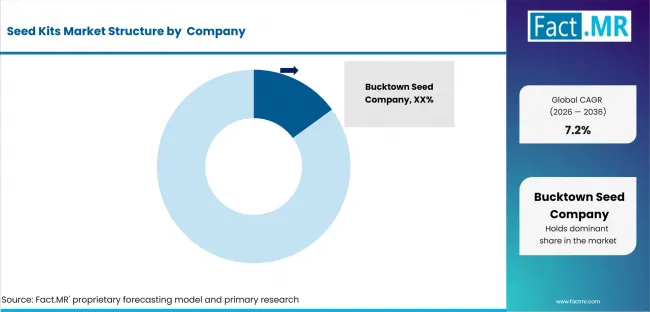
Seed Kits Market Analysis By Company | Source: Fact.MR
Leading Companies Shaping the Seed Kits Market
In the seed kits market, there is a high level of fragmentation among companies including Bucktown Seed Company, Buzzy Seeds, Plantgem, Garden Republic, and Back to the Roots. Structure advantages include good e-commerce capabilities, efficient retailing, unique sourcing abilities, and diverse garden products. In terms of buyer power, switching costs are low, as buyers compare brands based on ease of growing, effectiveness, and value for money. Price competition is strong in the Seed Kits Market; as a result, sellers are encouraged to adopt superior positioning, subscriptions, and refills.
Which companies are the key players?
- Bucktown Seed Company
- SurvivalGardenSeeds
- Bentley Seeds
- Buzzy Seeds
- Plantgem
- Sow Right Seeds
- Garden Republic
- Urban Leaf
- Back to the Roots
- Seed Needs
- NatureZ Edge
- Sereniseed
- Grow Buddha
What recent moves are shaping the seed kits market?
- Buzzy Seeds expands all-in-one grow kit portfolio for indoor gardening, gifting, and beginner cultivation applications (2025): Buzzy Seeds strengthened its seed-kit product lineup through expanded offerings across herb, flower, culinary, kids, and pollinator grow kits, reinforcing its positioning in easy-to-use gardening kits and lifestyle cultivation products. (Buzzy Seeds Official Product Release) [7]
- Slow Food USA launches “Plant a Seed 2025” initiative with seed-company collaborations supporting school gardening and biodiversity cultivation (2025): The Plant a Seed 2025 program expanded collaboration with participating seed companies to distribute cultivation-focused seed offerings and educational growing resources for school and community gardening ecosystems. (Slow Food USA Official Program Release) [8]
- International Seed Federation launches 2025 World Seed Congress agenda focused on seed innovation, resilience, and sustainable seed ecosystems (May 2025): The ISF World Seed Congress 2025 highlighted investment, innovation, seed resilience, sustainable food systems, and commercialization themes influencing global seed and packaged cultivation product markets. (International Seed Federation Press Kit) [9]
Sources and Research References
- [1] United States Department of Agriculture (USDA) – Natural Resources Conservation Service (NRCS), Environmental Quality Incentives Program (EQIP), March 2025.
- [2] Federal Ministry of Food and Agriculture (BMEL), Germany, Farm Future Ecological Agriculture Initiative / Sustainable Farming Programs, March 2025.
- [3] Lower Saxony Ministry for Environment, Energy and Climate Protection, Water Protection and Agricultural Nitrate Management Measures, January 2025.
- [4] Ministry of Agriculture, Forestry and Fisheries (MAFF), Japan, Smart Agriculture Program and Subsidy Guidelines, March 2025.
- [5] Tokyo Metropolitan Government, Next-Generation Plant Factory and Urban Agriculture Programs, February 2025.
- [6] Ministry of Agriculture and Rural Affairs (MARA), China, 2025 Major Promotion Agricultural Seed Catalog, January 2025.
- [7] Buzzy Seeds, All-in-One Grow Kits for Every Occasion – Official Product Portfolio, 2025.
- [8] Slow Food USA, Plant a Seed 2025 Program, 2025.
- [9] International Seed Federation (ISF), 2025 World Seed Congress Press Kit, May 2025.
What does the seed kits market cover?
Seed Kits Market consists of garden packs, that provide packaged gardening solutions using seeds accompanied by other items like soil pellets, pots, planting material, tags, nutrients, and instructions on how to grow the plants. The main purpose of seed kits is to make it easy to grow plants regardless of the consumer's gardening experience level. The primary use of seed kits is for making it easy to cultivate plants indoors or outdoors for vegetables, herbs, fruits, flowers, and any specialty plant.
Seed Kits Market Inclusions
The report presents a global and regional market analysis of the Seed Kits Market for the forecast period of 2026-2036. Market analysis involves segmentation by type of seed, type of kit, growth medium, application, and distribution channels used. It also features market share analysis, market price trends, competitive environment assessment, consumer demand trends, regional analysis, and selected trade, supply chain, and distribution dynamics impacting the Seed Kits Market performance.
Seed Kits Market Exclusions
The report does not include agricultural seeds that are packaged for use in agriculture but includes those that can be sold through garden kits. It also excludes gardening materials, pesticides, fertilizers, and irrigation materials that are sold without being packaged within seed kits. In addition, the scope of the report excludes hydroponics systems and other farming technologies and machinery and ornamental plants.
Seed Kits Market Research Methodology
- Primary Research
- Interviews have been taken from seed kit producers, gardening products suppliers, distributors, online shopping sites, institutional buyers, and market experts operating in different regional markets for evaluation of demand trend, pricing trend, and potential growth of the market.
- Desk Research
- Sources such as company annual reports, industry publications, gardening industry database, government data on agriculture industry, consumer expenditure data, retail sales data, and other public information available regarding home gardening, seeds, and gardening products have been utilized in the report.
- Market-Sizing and Forecasting
- An integrated approach based on bottom-up and top-down approach to calculate market size in terms of revenues of the companies involved. The forecasting approach is based on demand indicators, consumer acceptance trends, price trend, and regional market penetration.
- Data Validation and Update Cycle
- Validation of data takes place using an integrated triangulation technique based on primary interview data, secondary data sets, and internal modeling techniques.
Segmentation
What is the report’s scope and coverage?
| Parameter | Details |
|---|---|
| Quantitative Units | USD 284.6 million in 2025 to USD 611.5 million in 2036, at a CAGR of 7.2% |
| Market Definition | The Seed Kits Market comprises packaged gardening products containing seeds and optional growing components such as soil, pots, and instructions, designed for convenient plant cultivation across home gardening, educational, and wellness applications. |
| Regions Covered | North America, Latin America, Europe, East Asia, South Asia and Pacific, MiddleEastand Africa |
| Countries Covered | USA, Canada, UK, Germany, China, India, 30 plus countries |
| Key Companies | Tenova, SMS group GmbH, Metso, RAUCH Furnace Technology, Mettop, Metalcess, Hatch Ltd., Glencore, ANDRITZ, Aurubis Richmond LLC, Boliden, Materials Processing Institute, Kintek Furnace |
| Forecast Period | 2026 to 2036 |
| Approach | Hybrid demand-side and top-downmethodologybuilt on country-level application demand, product benchmarking, pricing analysis, shipment validation, and primary interviews across manufacturers, distributors, retailers, and end users |
Source: Fact.MR analysis. Updated Jun 1, 2026
How is the market segmented?
-
Seed Kits Market by Seed Type
- Vegetable Seed Kits
- Leafy Greens Kits
- Root Vegetable Kits
- Fruiting Vegetable Kits
- Culinary Vegetable Assortment Kits
- Herb Seed Kits
- Culinary Herb Kits
- Medicinal Herb Kits
- Aromatic Herb Kits
- Mixed Herb Garden Kits
- Flower Seed Kits
- Ornamental Flower Kits
- Wildflower Kits
- Pollinator-Friendly Flower Kits
- Cut Flower Garden Kits
- Fruit Seed Kits
- Berry Seed Kits
- Melon & Vine Fruit Kits
- Dwarf Fruit Plant Kits
- Mixed Fruit Garden Kits
- Specialty Seed Kits
- Organic Seed Kits
- Heirloom Seed Kits
- Exotic/Rare Seed Kits
- Native Plant Seed Kits
- Vegetable Seed Kits
-
Seed Kits Market by Kit Composition
- Seed-Only Kits
- Single Variety Seed Packs
- Multi-Variety Seed Collections
- Seasonal Seed Assortments
- Thematic Seed Bundles
- Starter Grow Kits
- Seeds + Soil Kits
- Seeds + Pots/Containers Kits
- Seeds + Growing Medium Kits
- Seeds + Fertilizer/Nutrient Kits
- Complete Gardening Kits
- All-in-One Indoor Grow Kits
- All-in-One Outdoor Grow Kits
- Hydroponic Seed Kits
- Smart Gardening Kits
- DIY / Customizable Kits
- Build-Your-Own Garden Kits
- Personalized Seed Selection Kits
- Subscription Refill Kits
- Expansion/Accessory Kits
- Seed-Only Kits
-
Seed Kits Market by Growing Environment
- Indoor Seed Kits
- Windowsill Gardening Kits
- Countertop Gardening Kits
- LED Grow Light Kits
- Controlled Environment Kits
- Outdoor Seed Kits
- Garden Bed Kits
- Patio & Terrace Kits
- Raised Bed Kits
- Urban Outdoor Gardening Kits
- Hybrid/Adaptable Kits
- Indoor-Outdoor Convertible Kits
- Seasonal Transfer Kits
- Portable Gardening Kits
- Multi-Environment Kits
- Indoor Seed Kits
-
Seed Kits Market by Application
- Home Gardening
- Indoor Gardening
- Outdoor Gardening
- Balcony/Container Gardening
- Backyard Gardening
- Educational Use
- School Learning Kits
- STEM/Science Experiment Kits
- University/Academic Projects
- Environmental Awareness Programs
- Commercial & Institutional Use
- Restaurants & Culinary Gardens
- Hotels & Hospitality Landscaping
- Corporate Wellness Programs
- Community Garden Projects
- Therapeutic & Wellness Use
- Horticultural Therapy Programs
- Mental Wellness Gardening Kits
- Senior Care Gardening Programs
- Rehabilitation Center Gardening Kits
- Home Gardening
-
Seed Kits Market by Distribution Channel
- Offline Retail
- Garden Centers & Nurseries
- Home Improvement Stores
- Supermarkets & Hypermarkets
- Specialty Hobby Stores
- Online Retail
- Brand-Owned Websites
- E-commerce Marketplaces
- Gardening E-Retailers
- Social Commerce Platforms
- Direct & Subscription Sales
- Monthly Subscription Kits
- Seasonal Subscription Boxes
- Direct-to-Consumer Sales
- Institutional Bulk Supply
- Offline Retail
-
Seed Kits Market by Region
- North America
- USA
- Canada
- Mexico
- Latin America
- Brazil
- Chile
- Rest of LATAM
- East Asia
- China
- Japan
- South Korea
- Western Europe
- Germany
- Italy
- France
- U.K.
- Spain
- BENELUX
- Nordic
- Rest of W. Europe
- Eastern Europe
- Russia
- Hungary
- Poland
- Balkan & Baltics
- Rest of E. Europe
- South Asia & Pacific
- India
- ASEAN
- ANZ
- Rest of SAP
- Middle East and Africa
- Kingdom of Saudi Arabia
- United Arab Emirates
- South Africa
- Rest of Middle East and Africa
- North America
Frequently Asked Questions
How large is the demand for Seed Kits in the global market in 2026?
What will be the market size of Seed Kits in the global market by 2036?
What is the expected demand growth for Seed Kits in the global market between 2026 and 2036?
Which seed type is expected to dominate the market?
Which region is expected to show the highest growth rate for Seed Kits?
How significant is the growth outlook for China in this market?
What is the growth outlook for Japan in this market?
Which European market is highlighted in this analysis?
What is the growth outlook for the United States in the Seed Kits market?
Which company is identified as a leading player in the Seed Kits market?
Who worked on this report


Preview the report firsthand - request a free sample
Free SampleGet the brochure for pricing and purchase details
Download PDF