- Base Value(2026): 8.3 Bn
- Estimated Value(2026): 8.3 Bn
- Forecast Value (2036): 11.2 Bn
- CAGR (2026 - 2036): 3.0%
Multi-Tool Combo Kits Market Forecast and Outlook 2026 to 2036
The multi-tool combo kits market is likely to be valued at USD 8.3 billion in 2026, and reach USD 11.2 billion by 2036, at 3.0% CAGR.
Multi-Tool Combo Kits Market Key Takeaways
- Multi-Tool Combo Kits Market Value (2026): USD 8.3 billion
- Multi-Tool Combo Kits Market Forecast Value (2036): USD 11.2 billion
- Multi-Tool Combo Kits Market Forecast CAGR 2026 to 2036: 3.0%
- Leading Kit Size in Multi-Tool Combo Kits Market: 3-4 Tool Kits (35.0%)
- Key Growth Region in Multi-Tool Combo Kits Market: Asia Pacific
- Key Players in Multi-Tool Combo Kits Market: DEWALT, Milwaukee, Makita, Bosch, Ryobi, Black+Decker, Craftsman, Kobalt, Metabo HPT, Hilti
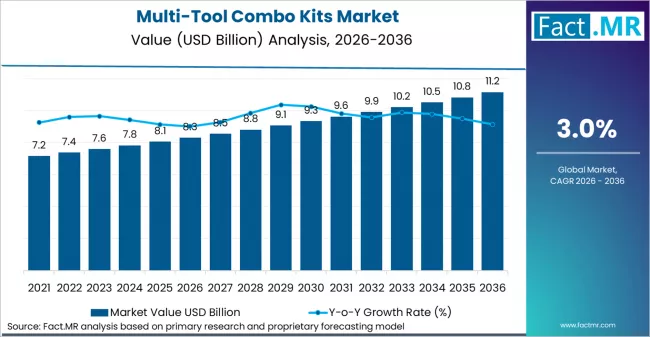
Multi Tool Combo Kits Market Market Value Analysis | Source: Fact.MR
Demand formation reflects procurement behavior centered on task coverage efficiency rather than single-tool performance optimization. Combo kits serve users seeking standardized cordless platforms that support drilling, fastening, cutting, and finishing activities within constrained budgets and storage limits.
Adoption is closely linked to replacement cycles, renovation activity, and fleet standardization among contractors, maintenance teams, and institutional buyers. Battery interchangeability, charger commonality, and platform continuity influence purchasing decisions more strongly than incremental power gains. Retail and professional distribution channels position combo kits as entry points into long-term tool ecosystems, reinforcing repeat purchases aligned with voltage platform commitment and accessory compatibility.
Market scalability remains shaped by price sensitivity, utilization balance across bundled tools, and perceived trade-offs versus specialized equipment. Oversized kits face underutilization risks that weaken value justification for professional users with defined task profiles. Platform fragmentation across brands creates switching friction for buyers with existing tool inventories. Battery lifecycle costs, storage constraints, and uneven wear across tools affect replacement timing. Demand progression follows renovation, maintenance, and small-scale contracting activity rather than large construction cycles or industrial expansion.
Multi-Tool Combo Kits Market
| Metric | Value |
|---|---|
| Estimated Value in (2026E) | USD 8.3 billion |
| Forecast Value in (2036F) | USD 11.2 billion |
| Forecast CAGR 2026 to 2036 | 3.0% |
Source: Fact.MR analysis. Updated Jan 29, 2026
Category
| Category | Segments |
|---|---|
| Kit Size | 3-4 Tool; 2-Tool; 5-7 Tool; 8+ Tool |
| Voltage Class | 18 / 20V; 36 / 40V; 12V; 60V+ |
| User Segment | Professional; DIY; Prosumer; Institutional |
| Sales Channel | Retail / Big-Box; Online; Pro Distributors; Direct Fleet |
| Region | North America; Europe; Asia Pacific; Latin America; Middle East & Africa |
Source: Fact.MR analysis. Updated Jan 29, 2026
Segmental Analysis
What Is the Impact of Kit Size on the Multi-Tool Combo Kits Market?
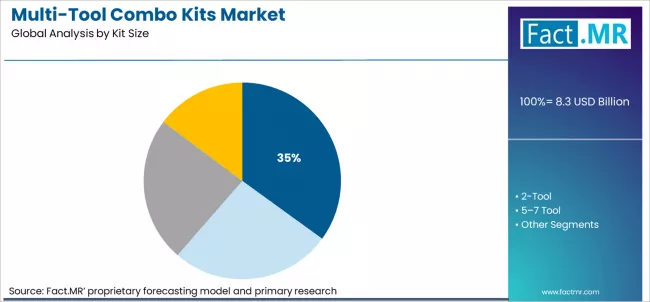
Multi Tool Combo Kits Market Analysis By Kit Size | Source: Fact.MR
In the multi-tool combo kits market, kit size directly shapes purchasing behavior by balancing versatility, cost efficiency, and intended use scenarios. Kits containing three to four tools lead demand with a 35.0% share, reflecting strong alignment with professional and prosumer requirements. These kits typically bundle core tools such as drills, drivers, and impact wrenches that address the majority of daily tasks without excess redundancy. Buyers favor this size range for its manageable price point, reduced storage burden, and flexibility across construction, maintenance, and installation workflows where tool utilization remains consistently high.
How Does Voltage Class Influence Demand in the Multi-Tool Combo Kits Market?
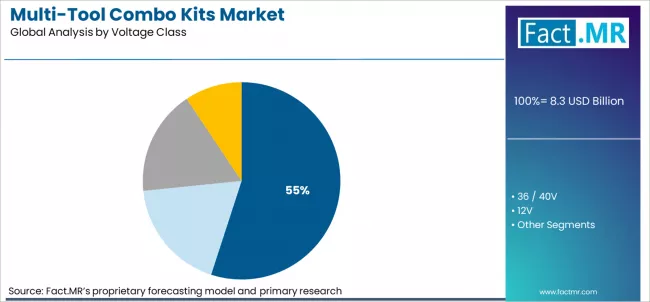
Multi Tool Combo Kits Market Analysis By Voltage Class | Source: Fact.MR
Voltage class plays a critical role in determining power capability, runtime, and platform compatibility within combo kit selection. The 18 or 20V class accounts for a 55.0% share, driven by its balance between performance and portability. This voltage range supports demanding applications while remaining suitable for handheld operation across extended work periods. Broad ecosystem availability, battery interchangeability, and compatibility with professional-grade tools reinforce adoption, particularly among users seeking scalable cordless platforms that support expansion without committing to higher voltage systems.
What are the Drivers, Restraints, and Key Trends in the Multi-Tool Combo Kits Market?
- Drivers: Demand for multi-tool combo kits is shaped by growth in DIY home improvement, professional contracting, and small-business maintenance work where versatility and space efficiency are priorities. Users value tool assortments that combine drills, drivers, saws, grinders and accessories in interoperable platforms that reduce the need for separate purchases. Retailers and distributors support adoption by bundling battery platforms, chargers and complementary heads to simplify procurement and encourage loyalty to specific power tool ecosystems.
- Restraints: Price sensitivity in value-oriented segments can limit uptake, as comprehensive kits command higher upfront spending than individual tools. Perception of performance trade-offs, where combo kit components are seen as less robust than specialised standalone tools, can deter professional users focused on heavy-duty operations. Variability in battery compatibility across brands creates uncertainty for buyers who already own tools, complicating decisions about platform consolidation and increasing perceived switching cost.
- Trend 1: Expansion of platform interoperability initiatives that allow multi-tool kits to share batteries and chargers across a broader range of devices, reducing total system cost for end users.
- Trend 2: Growth in ergonomic and modular accessory systems that enable rapid conversion between tool functions, improving field flexibility for technicians and hobbyists alike.
Analysis of the Multi-Tool Combo Kits Market by Key Country
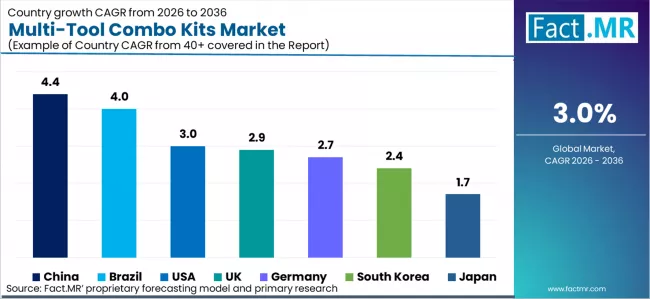
Multi Tool Combo Kits Market Cagr Analysis By Country | Source: Fact.MR
| Country | CAGR (%) |
|---|---|
| China | 4.4% |
| Brazil | 4.0% |
| USA | 3.0% |
| UK | 2.9% |
| Germany | 2.7% |
| South Korea | 2.4% |
| Japan | 1.7% |
Source: Fact.MR analysis. Updated Jan 29, 2026
The report covers an in-depth analysis of 40+ countries; top-performing countries are highlighted below.
What is driving growth of multi-tool combo kits demand in China?
Demand for multi-tool combo kits in China is rising as construction activity and home improvement projects sustain steady tool usage. Growth at 4.4% CAGR reflects strong demand from contractors and small workshops seeking bundled solutions reducing upfront costs. Rapid urban development increases need for compact tool sets supporting varied tasks. Domestic manufacturers supply competitively priced kits aligned with high-volume distribution. Battery interoperability across tools supports operational efficiency. Demand remains concentrated within construction trades, light manufacturing maintenance, and urban residential renovation markets.
- Expansion of urban construction activity
- Preference for cost-efficient bundled tools
- Growth of domestic tool manufacturing
- Demand for battery-compatible tool platforms
Why is Brazil seeing expansion in multi-tool combo kits adoption?
Multi-tool combo kits demand in Brazil is increasing as professional users seek value-driven tool purchases. Growth at 4.0% CAGR reflects demand from construction, carpentry, and repair services supporting residential and commercial projects. Economic considerations encourage bundled purchases rather than single-tool upgrades. Informal and small-scale contractors favor kits supporting multiple applications. Distribution through regional hardware networks strengthens market reach. Demand remains driven by domestic construction and maintenance requirements rather than industrial-scale projects.
- Growth of residential construction activity
- Cost sensitivity among small contractors
- Preference for versatile tool combinations
- Strong regional hardware distribution
What factors are shaping multi-tool combo kits sales in the USA?
Sales of multi-tool combo kits in the USA are increasing as consumers and professionals prioritize convenience and platform compatibility. Growth at 3.0% CAGR reflects demand from DIY users, maintenance crews, and renovation contractors. Battery ecosystem alignment influences purchase decisions. Space efficiency and storage convenience shape household demand. Professional users favor kits supporting standardized tool platforms. Demand centers on replacement purchases and incremental upgrades rather than expansion of tool ownership.
- Growth of DIY and home renovation activity
- Emphasis on battery platform standardization
- Demand for storage-efficient tool solutions
- Replacement-driven purchasing behavior
How is the UK supporting growth of multi-tool combo kits demand?
Multi-tool combo kits demand in the UK is advancing as renovation and maintenance activities remain steady. Growth at 2.9% CAGR reflects demand from tradespeople and homeowners seeking flexible tool solutions. Limited storage space increases appeal of compact bundled kits. Energy efficiency and cordless operation influence selection. Demand remains concentrated within residential refurbishment and light commercial maintenance rather than large construction projects.
- Demand from renovation and refurbishment work
- Preference for compact tool storage
- Focus on cordless tool operation
- Use within light commercial maintenance
What is driving expansion of multi-tool combo kits demand in Germany?
Demand for multi-tool combo kits in Germany is rising as users prioritize precision, reliability, and organized tool systems. Growth at 2.7% CAGR reflects adoption among skilled trades and technical maintenance professionals. Standardized tool quality and durability influence purchasing behavior. Structured workflows favor bundled kits supporting defined tasks. Demand remains driven by professional applications rather than casual consumer use.
- Demand from skilled trade professionals
- Emphasis on tool durability and precision
- Preference for organized tool systems
- Use in technical maintenance applications
How is South Korea shaping demand for multi-tool combo kits?
Multi-tool combo kits demand in South Korea is growing as compact living spaces and urban maintenance drive efficient tool usage. Growth at 2.4% CAGR reflects adoption across residential repair and light industrial maintenance. Compact design and portability influence kit selection. Export-oriented brands emphasize consistent quality and ergonomic design. Demand focuses on productivity within limited workspace environments.
- Compact living and workspace constraints
- Demand for portable tool solutions
- Focus on ergonomic tool design
- Use in residential and light industrial repair
What factors are influencing multi-tool combo kits demand in Japan?
Demand for multi-tool combo kits in Japan is expanding gradually as users emphasize precision and long-term reliability. Growth at 1.7% CAGR reflects conservative purchasing patterns and focus on essential tool ownership. Space limitations encourage compact, multifunctional kits. Quality assurance and tool longevity remain key considerations. Demand remains concentrated within specialized maintenance and household repair activities.
- Conservative tool purchasing behavior
- Emphasis on precision and reliability
- Demand for compact multifunctional kits
- Focus on long service life
What Defines the Competitive Landscape for the Multi-Tool Combo Kits Market?
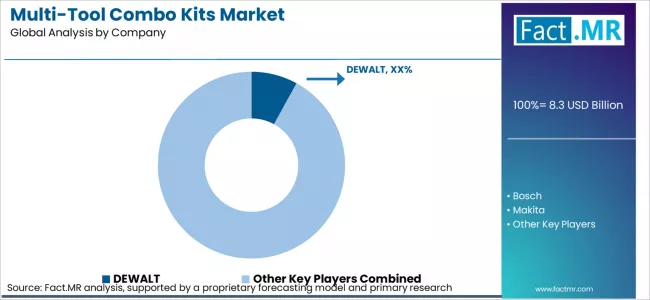
Multi Tool Combo Kits Market Analysis By Company | Source: Fact.MR
Demand for multi-tool combo kits is driven by workforce mobility, project-based contracting, and preference for standardized cordless platforms. Buyers compare kit breadth, battery interchangeability, power-to-weight balance, runtime consistency, and durability across drilling, fastening, cutting, and grinding tasks. Evaluation also considers charger speed, ecosystem expansion paths, warranty coverage, and availability through professional and DIY channels. Procurement behavior favors brands offering scalable kits aligned to a single voltage platform, predictable lifecycle support, and regional service networks. Industry direction reflects consolidation around platform-led ecosystems and growing emphasis on brushless motors and compact form factors.
DEWALT holds leading positioning through broad professional-grade combo kits anchored by widely adopted cordless platforms. Milwaukee competes by emphasizing high-output tools and ecosystem depth tailored to trade professionals. Makita maintains relevance with balanced performance, reliability, and extensive global distribution. Bosch supports demand via precision-oriented kits appealing to installers and maintenance users. Ryobi participates strongly in value-driven segments with accessible kits for homeowners and light contractors. Competitive differentiation centers on platform maturity, battery technology, kit configurability, and channel reach.
Key Players in the Multi-Tool Combo Kits Market
- DEWALT
- Bosch
- Makita
- Milwaukee
- Ryobi
- Black+Decker
- Craftsman
- Kobalt
- Metabo HPT
- Hilti
Bibliographies
- International Electrotechnical Commission. (2023). IEC 62841 series: Electric motor-operated hand-held tools, transportable tools and lawn and garden machinery-Safety. IEC.
- International Organization for Standardization. (2024). ISO 9001: Quality management systems-Requirements. ISO.
- Occupational Safety and Health Administration. (2024). Hand and power tool safety requirements in professional work environments. U.S. Department of Labor.
- European Commission. (2023). Energy efficiency and battery sustainability considerations for cordless power tools. Publications Office of the European Union.
Segmentation
Scope of the Report
| Items | Values |
|---|---|
| Quantitative Units | USD billion |
| Kit Size | 3-4 Tool; 2-Tool; 5-7 Tool; 8+ Tool |
| Voltage Class | 18 / 20V; 36 / 40V; 12V; 60V+ |
| User Segment | Professional; DIY; Prosumer; Institutional |
| Sales Channel | Retail / Big-Box; Online; Pro Distributors; Direct Fleet |
| Regions Covered | Asia Pacific, Europe, North America, Latin America, Middle East & Africa |
| Countries Covered | China, Brazil, USA, UK, Germany, South Korea, Japan, and 40+ countries |
| Key Companies Profiled | DEWALT; Bosch; Makita; Milwaukee; Ryobi; Black+Decker; Craftsman; Kobalt; Metabo HPT; Hilti |
| Additional Attributes | Dollar sales by kit size, voltage class, user segment, and sales channel; demand led by professional and prosumer adoption of cordless platforms; platform lock-in strategies driving repeat purchases of 18/20V ecosystems; growth in e-commerce and pro distribution networks; bundling strategies improving price competitiveness; fleet and institutional procurement favoring durability, battery compatibility, and service coverage. |
Source: Fact.MR analysis. Updated Jan 29, 2026
Multi-Tool Combo Kits Market Key Segment
-
Kit Size :
- 3-4 Tool
- 2-Tool
- 5-7 Tool
- 8+ Tool
-
Voltage Class :
- 18 / 20V
- 36 / 40V
- 12V
- 60V+
-
User Segment :
- Professional
- DIY
- Prosumer
- Institutional
-
Sales Channel :
- Retail / Big-Box
- Online
- Pro Distributors
- Direct Fleet
-
Region :
- North America
- USA
- Canada
- Mexico
- Europe
- Germany
- UK
- France
- Italy
- Spain
- Nordic Countries
- BENELUX
- Rest of Europe
- Asia Pacific
- China
- Japan
- South Korea
- India
- Australia
- Rest of Asia Pacific
- Latin America
- Brazil
- Argentina
- Rest of Latin America
- Middle East and Africa
- Kingdom of Saudi Arabia
- United Arab Emirates
- South Africa
- Rest of Middle East and Africa
- Other Regions
- Oceania
- Central Asia
- Other Markets
- North America
Frequently Asked Questions
How big is the multi-tool combo kits market in 2026?
What will be the size of multi-tool combo kits market in 2036?
How much will be the multi-tool combo kits market growth between 2026 and 2036?
What are the key product types in the multi-tool combo kits market?
Which voltage class segment to contribute significant share in the multi-tool combo kits market in 2026?
Who worked on this report


Preview the report firsthand - request a free sample
Free SampleGet the brochure for pricing and purchase details
Download PDF