- Market Value (2025): USD 313.3 Mn
- Estimated Value (2026): USD 332.4 Mn
- Forecast Value (2036): USD 599.8 Mn
- CAGR (2026-2036): 6.1%
What is the Multi Window Processor Market forecast to be worth by 2036?
USD 332.4 million in 2026 to USD 599.8 million by 2036, at a 6.1% CAGR.
- Fact.MR analysis estimates that the multi-window processor market stood at USD 313.3 million in 2025, before the next cycle of control-room and premium-display upgrades.
- Market value is projected to rise from USD 332.4 million in 2026 to USD 599.8 million by 2036 as higher-resolution feeds and more simultaneous layouts increase processing demand.
- The resulting 6.1% CAGR reflects a steady expansion in visual workload per endpoint. Surveillance rooms, vehicle cockpits, broadcast environments, and collaborative displays are moving from simple screen splitting toward real-time composition of multiple high-definition sources.
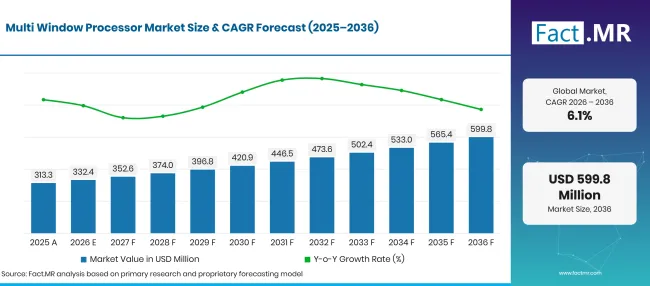
Factmr Multi Window Processor Market Forecast Global | Source: Fact.MR
| Year | Basis | Market Value (USD million) |
|---|---|---|
| 2025 | Actual | 313.3 |
| 2026 | Estimate | 332.4 |
| 2036 | Forecast | 599.8 |
| CAGR 2026 to 2036 | Forecast period | 6.1% |
Source: Fact.MR analysis. Updated Oct 19, 2026
What are the defining numbers behind Multi Window Processor Market growth?
The market is expected to create USD 71.05 million in additional annual revenue between 2026 and 2036. Hardware processors capture the performance-sensitive installations, while software and hybrid approaches extend adoption into cost-managed enterprise settings.
- Demand Drivers in the Market
- Advanced graphics processing architectures and parallel computing cores enable seamless compositing of multiple ultra-high-definition video windows without dropping frames. Advanced Micro Devices reported full-year 2024 revenue of USD 25.8 billion, driven by surging customer demand for high-performance graphics engines and parallel data processing silicon [1]. Broadcast production suites and virtual production studios procure multi window processors capable of compositing uncompressed 4K and 8K visual streams simultaneously.
- Automotive cockpit electronics increasingly incorporate multi-display processors to drive synchronized digital instrument clusters, central infotainment panels, and passenger entertainment screens from a single silicon module. Qualcomm Incorporated highlighted expanding automotive platform adoption, reporting full-year fiscal 2024 revenues of USD 38.96 billion with record automotive platform revenues [2]. Automotive engineers select centralized multi-window processors to eliminate redundant electronic control units and streamline in-cabin harness routing.
- Commercial enterprise collaboration rooms and hybrid workforce facilities deploy multi-window presentation hubs to display split-screen videoconference participants, interactive digital whiteboards, and shared presentation decks. Facility managers require processors that automatically adjust window layouts and pixel aspect ratios without requiring manual console configuration. Seamless compatibility across varied operating platforms accelerates commercial hardware rollouts.
- Emergency dispatch operations and utility security operation centers rely on hardware-based multi-window video wall processors to monitor hundreds of live surveillance feeds and telemetry channels. Intel Corporation reported full-year 2024 revenue of USD 53.1 billion, continuing extensive engineering investments in multi-threaded computing architectures and embedded graphics processing units [3]. Operators mandate hardware-isolated processing channels to ensure that signal loss on one camera stream does not disrupt critical operational dashboards.
- Key Segments Analyzed
- Hardware maintains the larger revenue position because control rooms and broadcast systems require deterministic switching, low latency, and continuous operation. Software solutions gain ground where standard compute platforms can manage the layout without creating unacceptable delay or reliability risk.
- Consumer electronics is forecast to hold 40.0% of 2026 demand, supported by gaming displays, premium televisions, and creator workstations. The more specialized upside comes from command centers, medical viewing, and automotive cockpits, where the processor must preserve image quality while handling several live inputs.
- Individual purchasing represents 57.3% of 2026 demand because multi-view monitors and high-end personal workstations are sold in larger unit volumes. Commercial buyers purchase fewer systems, but generally specify richer input configurations, longer duty cycles, and integration with control software.
- North America leads near-term adoption through broadcast infrastructure, security operations, digital signage networks, and a large installed base of premium computing equipment. Asia Pacific offers the broader manufacturing and unit-volume opportunity as display assembly, gaming hardware, and automotive electronics production expands.
- Analyst Opinion at Fact.MR
- Shambhu Nath Jha, Lead Consultant at Fact.MR, states, “Multi window processor design is moving beyond simple fixed grid division toward dynamic hardware-accelerated canvas management. Commercial operations and control centers now require continuous fluid transitions, arbitrary picture-in-picture scaling, and multi-source color matching in ultra-low-latency environments. Processor developers that integrate dedicated hardware scaling engines with modular IP-based streaming inputs will maintain a distinct competitive advantage over software-only emulation solutions.”
- Strategic Implications
- Processor manufacturers are incorporating dedicated hardware-accelerated image reconstruction engines to handle multi-stream camera feeds and automated visual scaling with minimal processing overhead. NIST computational studies highlighted how GPU-accelerated parallel reconstruction algorithms achieve thousands-fold efficiency gains during complex multi-stream image processing sequences [4].
- Semiconductor designers are transitioning multi-window display engines toward advanced multi-die packaging frameworks to integrate high-bandwidth memory directly alongside video processing logic. The U.S. Department of Commerce and NIST awarded USD 1.4 billion in CHIPS funding to validate high-density packaging and heterogeneous multi-die processor architectures [5].
- Display controller vendors are integrating secure hardware-level encryption protocols across physical HDMI and DisplayPort inputs to prevent unauthorized signal interception in government command centers. Verified cryptographic hardware separation enables secure visual isolation between classified intelligence feeds and public network data streams.
- System integrators are packaging multi-window processor hardware with intuitive drag-and-drop web graphical user interfaces to simplify layout customization for non-technical facility operators. Pre-programmed emergency display profiles allow command center supervisors to instantly switch visual layouts during critical incident responses.
Germany leads forecast expansion with a 7.7% CAGR, while Japan posts 7.2%, driven by broadcast video innovations, precision engineering workstations, and automotive cockpit integration. Brazil advances at 5.6%, supported by expanding digital surveillance networks and retail digital signage. The United States records a 4.8% CAGR, underpinned by military command operations, healthcare monitoring facilities, and broadcast production suites. The United Kingdom grows at 4.4%, spurred by corporate conferencing infrastructure and financial trading floor display modernization.
How does the Multi Window Processor Market break down by segment?
Hardware 62.3%; Consumer Electronics 40.0%; Individual 57.3% in 2026.
Which Component dominates?
Hardware holds 62.3% share in 2026.
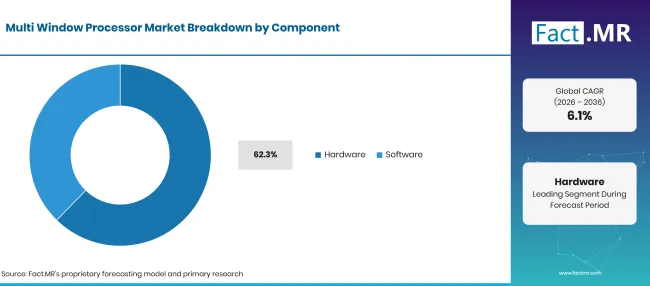
Factmr Multi Window Processor Market Breakdown Component | Source: Fact.MR
| Component | Share (2026) |
|---|---|
| Hardware (Leading segment) | 62.3% |
| Other segments combined | 37.7%* |
| Total | 100.0% |
Source: Fact.MR analysis. Updated Oct 19, 2026
Dedicated hardware processing units dominate market value because commercial video walls, broadcast switchers, and surveillance centers require zero-frame latency and deterministic pixel clock performance. Hardware-based processors utilize dedicated FPGAs and custom ASIC chips that process visual inputs directly in silicon without depending on an underlying host operating system. Software solutions capture growing market presence in desktop virtualization and collaborative web applications where cost efficiency outweighs absolute hardware latency constraints. Fact.MR reports assessing the display processor market and video wall processor market confirm that dedicated processing hardware remains essential for mission-critical video distribution. Technical overviews across the multi-display controller market and the global GPU market further illustrate ongoing hardware convergence between graphics engines and video compositing processors.
What leads the Application segment?
Consumer Electronics accounts for 40.0% share in 2026.
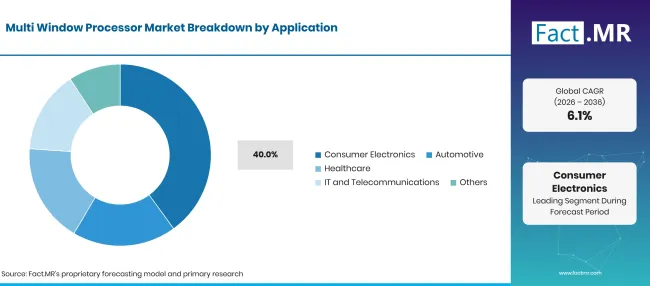
Factmr Multi Window Processor Market Breakdown Application | Source: Fact.MR
| Application | Share (2026) |
|---|---|
| Consumer Electronics (Leading segment) | 40.0% |
| Other segments combined | 60.0%* |
| Total | 100.0% |
Source: Fact.MR analysis. Updated Oct 19, 2026
Consumer electronics accounts for the largest share of multi window processor consumption as power users, financial analysts, and digital creators adopt ultra-wide monitors featuring integrated picture-in-picture and picture-by-picture processing. Automotive applications represent the fastest growing commercial segment, where multi-window processors control consolidated dashboard displays and rear-seat infotainment. Healthcare facilities deploy multi-window processors inside operating theaters to view endoscopic video feeds, patient vitals, and surgical checklists on a single high-resolution medical monitor. IT and telecommunications operators utilize multi-window platforms in network operations centers to oversee distributed server health metrics. Industry assessments detailing the digital signage media player market and the embedded vision processor market highlight the accelerating adoption of multi-window visual technology across varied end markets.
How does End-User purchasing shape sales?
Individual represents 57.3% share in 2026.
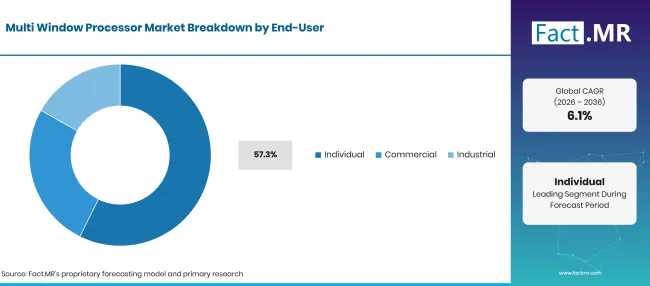
Factmr Multi Window Processor Market Breakdown End User | Source: Fact.MR
| End-User | Share (2026) |
|---|---|
| Individual (Leading segment) | 57.3% |
| Other segments combined | 42.7%* |
| Total | 100.0% |
Source: Fact.MR analysis. Updated Oct 19, 2026
Individual consumers represent the primary purchasing segment by volume and value, acquiring smart desktop displays, advanced gaming monitors, and personal content creation workstations equipped with native multi-window hardware processors. Commercial buyers procure rack-mounted multi-window matrix switchers to support corporate boardrooms, public security desks, and retail video walls. Industrial purchasers select ruggedized fanless processors to manage factory floor visualization terminals and supervisory control interfaces. Medical display processor market analysis demonstrates distinct procurement patterns across commercial and consumer channels.
What is accelerating Multi Window Processor Market adoption, and what is holding it back?
Proliferation of ultra-high-definition multi-camera security feeds, automotive cockpit display consolidation, and remote collaboration platforms accelerate market growth. Complex high-bandwidth video routing configurations, thermal dissipation constraints in fanless chassis, and elevated procurement costs for high-density FPGA silicon restrict broader adoption.
Drivers Impact Analysis
| DRIVER | (~) % IMPACT ON CAGR | GEOGRAPHIC RELEVANCE | IMPACT TIMELINE |
|---|---|---|---|
| Multi-display automotive cockpit integration | +1.3% | Europe, East Asia, USA | Short term (<= 2 years) |
| Emergency response command center upgrades | +1.1% | North America, Europe | Medium term (2–4 years) |
| Ultra-wide desktop monitor multi-source adoption | +0.9% | Global | Medium term (2–4 years) |
| IP-based AV-over-IP network migration | +0.8% | Global | Medium term (2–4 years) |
| 4K/8K broadcast multi-view monitoring expansion | +0.6% | North America, East Asia | Long term (>= 4 years) |
Source: Fact.MR analysis. Updated Oct 19, 2026
Opportunity Impact Analysis
| OPPORTUNITY | (~) % IMPACT ON CAGR | GEOGRAPHIC RELEVANCE | IMPACT TIMELINE |
|---|---|---|---|
| AI-assisted automated window layout arrangement | +1.0% | Global | Short term (<= 2 years) |
| Integrated AV-over-IP multi-window edge decoders | +0.8% | USA, Europe | Medium term (2–4 years) |
| Medical operating room multi-modality consoles | +0.6% | Europe, Japan, USA | Medium term (2–4 years) |
| Low-power automotive visual compositing modules | +0.5% | Asia Pacific, Global | Long term (>= 4 years) |
Source: Fact.MR analysis. Updated Oct 19, 2026
Restraints Impact Analysis
| RESTRAINT | (~) % IMPACT ON CAGR | GEOGRAPHIC RELEVANCE | IMPACT TIMELINE |
|---|---|---|---|
| Elevated cost of high-density FPGA components | -0.9% | Global | Short term (<= 2 years) |
| High-bandwidth video network latency bottlenecks | -0.7% | Global | Medium term (2–4 years) |
| Interoperability friction across legacy video standards | -0.5% | Europe, North America | Medium term (2–4 years) |
| Thermal management limits in compact enclosures | -0.4% | Global | Long term (>= 4 years) |
Source: Fact.MR analysis. Updated Oct 19, 2026
Which countries are scaling the Multi Window Processor Market through 2036?
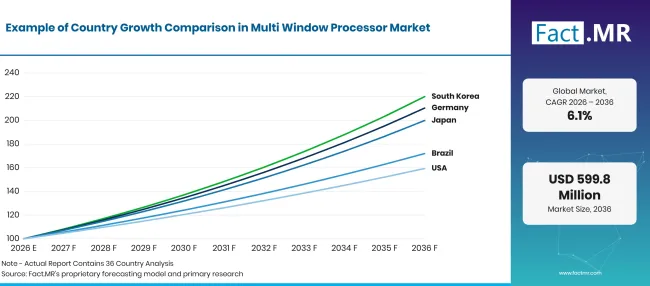
Factmr Multi Window Processor Market Growth Index | Source: Fact.MR
| Country | CAGR (2026–2036) |
|---|---|
| Germany | 7.7% |
| Japan | 7.2% |
| Brazil | 5.6% |
| United States | 4.8% |
| United Kingdom | 4.4% |
Source: Fact.MR analysis. Updated Oct 19, 2026
Why is Germany leading multi window processor expansion?
7.7% CAGR, fueled by industrial automation control rooms, premium automotive cockpit integration, and professional broadcast technology upgrades.
German luxury vehicle manufacturers and industrial machinery developers heavily integrate multi-window visual processors to drive consolidated cockpit dashboards and factory supervisory terminals. Engineering organizations across Munich and Stuttgart mandate robust hardware processing architectures capable of operating continuously without thermal throttling or frame degradation. System integrators report sustained procurement of modular rack-mounted processors for industrial monitoring facilities and traffic management centers.
How is Japan advancing multi window processor technology?
7.2% CAGR, propelled by 8K broadcast infrastructure investments, advanced consumer display innovations, and urban rail command centers.
Japanese public transit authorities and broadcast networks deploy high-density multi-window processors to manage complex transport surveillance grids and multi-camera live event coverage. Domestic electronics manufacturers lead consumer display engineering, integrating dedicated multi-window processing chips directly into ultra-wide gaming monitors and commercial digital signage panels. Government investments in disaster monitoring facilities also generate recurring orders for multi-channel video wall processors.
What is driving adoption in Brazil?
5.6% CAGR, supported by public safety command center modernizations and expanding retail digital signage installations.
Brazilian municipal public safety departments in São Paulo and Rio de Janeiro are upgrading metropolitan surveillance command centers with multi-window video wall processors to coordinate traffic management and police dispatch. Commercial shopping centers and financial institutions increasingly procure multi-display controllers to drive high-impact advertising video walls. Expanding broadband infrastructure supports wider deployment of IP-based multi-window streaming hardware across corporate offices.
What supports multi window processor sales in the United States?
4.8% CAGR, sustained by defense command operations, corporate video collaboration facilities, and enterprise security operations.
United States federal security agencies, financial trading houses, and defense installations maintain the world's highest density of multi-window video wall processors. Commercial enterprises continuously upgrade hybrid meeting spaces with intelligent multi-window presentation processors that automatically balance remote video participant windows and shared presentations. Broadcast production networks in New York and Los Angeles regularly procure specialized real-time multi-viewers to manage live sports and news broadcasts.
Why is the United Kingdom maintaining commercial demand?
4.4% CAGR, driven by financial trading floor visual infrastructure, public transport monitoring, and corporate boardroom automation.
London financial institutions and commodities trading desks rely extensively on multi-window display processors to organize real-time market data feeds, charting windows, and algorithmic trading dashboards across multiple monitors. Transport for London and municipal emergency operations utilize hardware-based video wall processors to maintain situational awareness across transit networks. Commercial AV integrators report steady demand for compact conference room processors designed for seamless web collaboration.
Who leads the Multi Window Processor Market?
Samsung Electronics Co., Ltd. leads global supply, capturing substantial volume through its integrated display controllers and commercial SMART signage hardware platforms. Qualcomm Technologies, Inc. and Intel Corporation provide high-performance system-on-chip architectures and multi-threaded embedded processors that power automotive cockpits and enterprise visualization platforms. NVIDIA Corporation and Advanced Micro Devices, Inc. (AMD) deliver industry-leading graphics processing units and video compositing engines engineered for parallel visual compute workloads.
Texas Instruments Incorporated and Broadcom Inc. supply specialized video switching silicon, interface transceivers, and high-speed multi-channel routing chips. MediaTek Inc. commands extensive presence across consumer smart displays and multi-window television processing boards. Apple Inc. and ARM Holdings plc define power-efficient processor architectures that enable sophisticated multi-window multitasking on personal computing devices and professional workstation monitors.
Which companies are the key providers?
Key companies include Samsung Electronics Co., Ltd.; Qualcomm Technologies, Inc.; Intel Corporation; NVIDIA Corporation; Advanced Micro Devices, Inc.; Texas Instruments; Broadcom Inc.; MediaTek Inc.; Apple Inc.; and ARM Holdings plc.
- Samsung Electronics Co., Ltd.
- Qualcomm Technologies, Inc.
- Intel Corporation
- NVIDIA Corporation
- Advanced Micro Devices, Inc.
- Texas Instruments
- Broadcom Inc.
- MediaTek Inc.
- Apple Inc.
- ARM Holdings plc
Bibliography
- [1] Advanced Micro Devices, Inc. (2025, February 4). AMD reports fourth quarter and full year 2024 financial results.
- [2] Qualcomm Incorporated. (2024, November 6). Qualcomm announces fourth quarter and fiscal 2024 results.
- [3] Intel Corporation. (2025, January 30). Intel reports fourth-quarter and full-year 2024 financial results.
- [4] National Institute of Standards and Technology. (2024, June 18). GPU-accelerated parallel image reconstruction strategies for magnetic particle imaging.
- [5] National Institute of Standards and Technology. (2025, January 16). U.S. Department of Commerce announces $1.4 billion in final awards to support next generation of U.S. semiconductor advanced packaging.
This Report Answers
- The report assesses technical capabilities across dedicated hardware processors, FPGA modules, and software compositing engines.
- Application analysis details why consumer electronics and automotive cockpits generate the fastest expanding shipment volumes.
- Country-level evaluations explore why Germany and Japan lead market growth across broadcast, automotive, and industrial applications.
- End-user purchasing reviews illustrate why individual desktop users and commercial control rooms require distinct processor architectures.
- Competitive profiling benchmarks video processing pipelines, input latency ratings, and strategic silicon partnerships across leading vendors.
What does the Multi Window Processor Market cover?
The market encompasses specialized electronic hardware and software engines capable of capturing, scaling, positioning, and displaying multiple video signals simultaneously on a shared visual surface. It covers video wall processors, desktop multi-viewers, automotive cockpit display controllers, and broadcast multiviewer systems. The analysis incorporates related Fact.MR evaluations of video wall displays and commercial audiovisual controllers.
What is included in the scope?
The scope includes standalone video wall processor units, modular chassis cards, embedded display processing chips, and integrated software management licenses sold to commercial integrators and end consumers.
Revenues reflect manufacturer invoice values for processing hardware and dedicated firmware suites. Custom multi-channel input/output interface boards designed specifically for multi-window routing are included in hardware totals.
What is excluded from the scope?
The scope excludes standard consumer television receivers lacking multi-source processing capabilities, commodity video cables, passive mounting brackets, and generic display panels sold without integrated multi-window processing silicon.
General-purpose office personal computer graphics cards that lack dedicated hardware multi-window pipelining are excluded from market sizing. On-site installation labor charges and audiovisual staging service fees are outside the report boundary.
How Was the Analysis Built?
The analysis draws on 120+ sources, 35+ company portfolios, 25+ countries, and more than 20 industry interviews.
- Primary Research: Primary research includes discussions with manufacturers, service providers, technology developers, distributors, end users, and subject-matter experts. These conversations examine purchasing priorities, product adoption, operational challenges, approval requirements, competitive positioning, and the factors that influence wider market acceptance.
- Desk Research: Desk research covers government statistics, regulatory publications, company filings, trade data, technical studies, industry associations, standards, public policy, and other authoritative sources. Every source used in the analysis is documented in the bibliography.
- Market Sizing and Forecasting: Market estimates combine historical performance, demand indicators, pricing and volume trends, segment shares, company participation, country-level growth, adoption patterns, investment activity, and barriers to market expansion.
- Data Validation and Update Cycle: Findings are validated by comparing primary interviews with public data, company activity, regulatory changes, trade patterns, and industry developments. Regular updates review new product launches, capacity changes, partnerships, approvals, and shifts in commercial adoption.
Segmentation
What is the report’s scope and coverage?
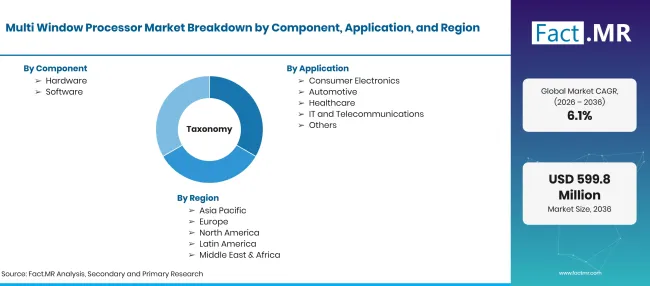
Factmr Multi Window Processor Market Taxonomy | Source: Fact.MR
| Attribute | Details |
|---|---|
| Quantitative Units | USD million in 2026 to USD million by 2036 at 6.1% CAGR |
| Market Definition | Hardware processors and integrated software solutions designed to composite, scale, and render multiple independent video streams onto single or multiple displays. |
| Component | Hardware; Software |
| Application | Consumer Electronics; Automotive; Healthcare; IT and Telecommunications; Others |
| End-User | Individual; Commercial; Industrial |
| Regions Covered | North America; Latin America; Western Europe; Eastern Europe; East Asia; South Asia & Pacific; Middle East & Africa |
| Countries Covered | Germany; Japan; Brazil; United States; United Kingdom |
| Companies Profiled | Samsung Electronics; Qualcomm; Intel; NVIDIA; AMD; Texas Instruments; Broadcom; MediaTek; Apple; ARM Holdings |
| Forecast Period | 2026 to 2036 |
| Approach | Analysis of commercial AV shipment registers, display processor design wins, corporate earnings releases, and interviews with control room integrators |
Source: Fact.MR analysis. Updated Oct 19, 2026
How is the market segmented?
-
By Component
- Hardware
- Software
-
By Application
- Consumer Electronics
- Automotive
- Healthcare
- IT and Telecommunications
- Others
-
By End-User
- Individual
- Commercial
- Industrial
-
By Region
- North America
- Latin America
- Western Europe
- Eastern Europe
- East Asia
- South Asia & Pacific
- Middle East & Africa
Frequently Asked Questions
How big is the multi window processor market in 2026?
What is the CAGR from 2026 to 2036?
Which component leads?
Which application leads?
Which companies participate in multi window processors?
Who worked on this report


Preview the report firsthand - request a free sample
Free SampleGet the brochure for pricing and purchase details
Download PDF