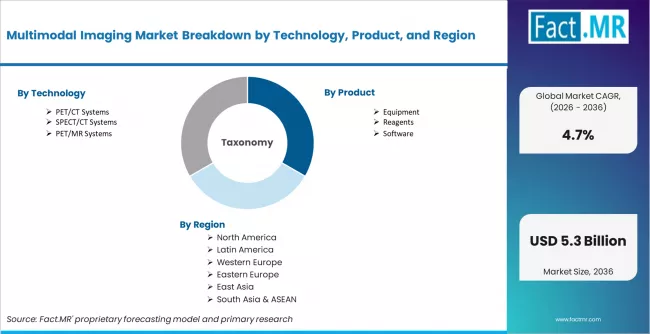
Multimodal Imaging Market Size, Share, Growth and Forecast (2026 - 2036)

The Multimodal Imaging Market is segmented by Technology (PET/CT Systems, SPECT/CT Systems, PET/MR Systems, OCT/Fundus Imaging Systems, Other Hybrid Imaging Systems), Product (Equipment, Reagents, Software), Application (Brain and Neurology, Cardiology, Oncology, Ophthalmology, Other Applications), End User (Hospitals, Diagnostic Imaging Centers, Academic and Research Institutes, Specialty Clinics), Sales Channel (Direct Institutional Sales, Medical Device Distributors, Tender-based Sales, Integrated Imaging Solution Providers), and Region. Forecast for 2026 to 2036.

Fact.MR analysis indicates that multimodal imaging demand is shifting from standalone anatomical imaging toward integrated functional and structural diagnosis. PET/CT systems are projected to lead by technology. Equipment is expected to dominate by product during the forecast period.

Multimodal Imaging Market Size, Market Forecast and Outlook by Fact.MR

  • The multimodal imaging market was valued at USD 3.1 billion in 2025.
  • Demand is set to reach USD 3.2 billion in 2026 at a CAGR of 4.7% during the forecast period.
  • Sustained clinical and research adoption takes the valuation to USD 5.1 billion through 2036 as hospitals and diagnostic centers invest in hybrid systems for oncology, neurology, cardiology, and ophthalmology.
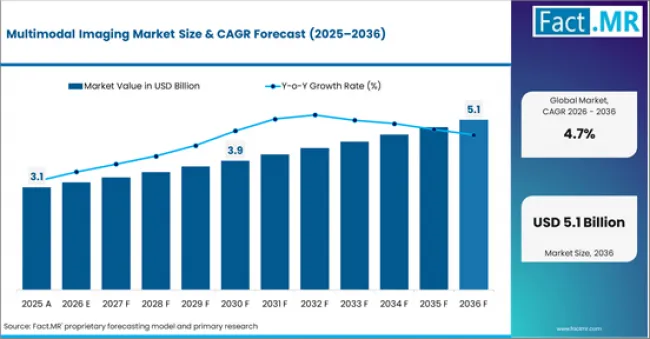
Multimodal Imaging Market Market Value Analysis 1

Metric Details
Industry Size (2026) USD 3.2 billion
Industry Value (2036) USD 5.1 billion
CAGR (2026 to 2036) 4.7%

Summary of Multimodal Imaging Market

  • Market Definition
    • Multimodal imaging combines two or more imaging methods to improve disease visualization, staging, diagnosis, and treatment monitoring. Scope is defined by hybrid hardware, imaging software, contrast or tracer use, clinical application, and the ability to combine functional and anatomical information.
  • Demand Drivers in the Market
    • Nuclear medicine physicians need imaging for metabolic and anatomical assessment.
    • Oncology imaging heads require accurate tumor staging and treatment response monitoring.
    • Diagnostic centers need faster workflows and clearer image interpretation support.
  • Key Segments Analyzed
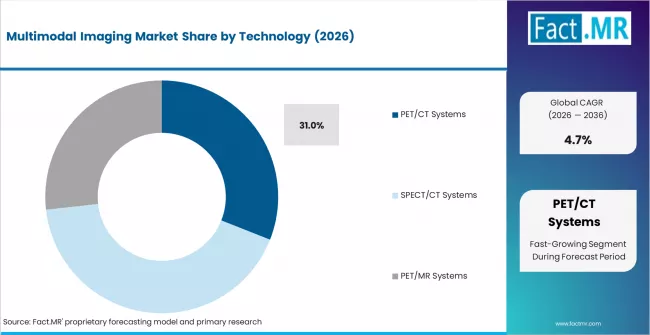
    • PET/CT Systems: PET/CT systems are expected to account for 31.0% share in 2026 because oncology and cardiology rely on combined metabolic and anatomical imaging.
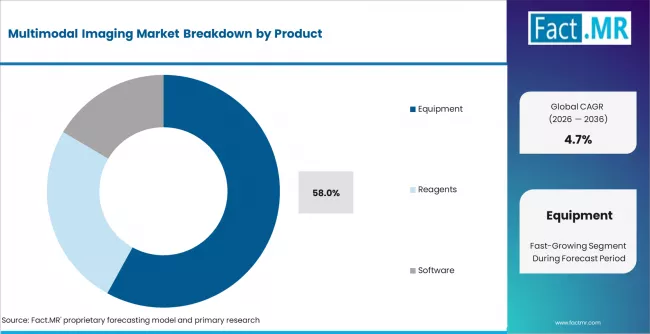
    • Equipment: Equipment is projected to hold 58.0% share in 2026 as scanners and hybrid systems carry the highest capital value.
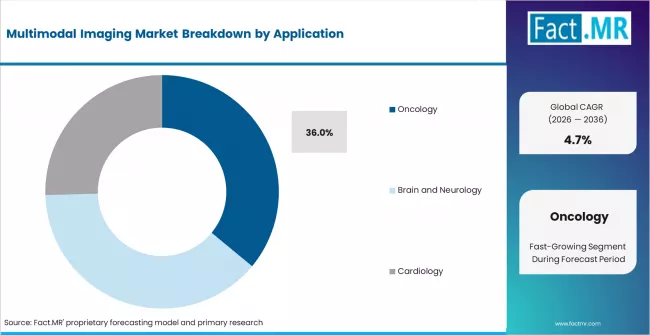
    • Oncology: Oncology is estimated to capture 36.0% share in 2026 due to tumor staging, recurrence detection, and treatment monitoring.
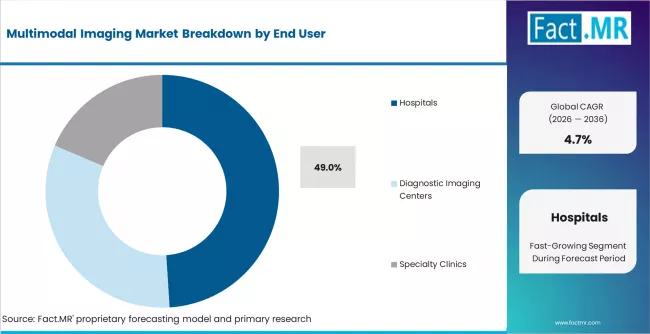
    • Hospitals: Hospitals are likely to hold 49.0% share in 2026 because hybrid imaging requires infrastructure, specialists, and patient referral volume.
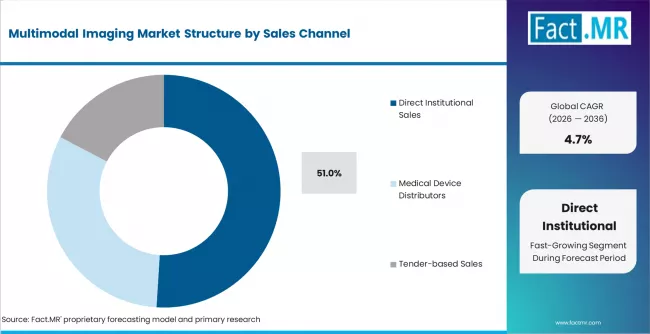
    • Direct Institutional Sales: Direct institutional sales are projected to account for 51.0% share in 2026 because buyers need installation, training, and service support.
    • Geography: China is forecast to grow at 5.8% CAGR through 2036, supported by hospital modernization and domestic imaging system development.
  • Analyst Opinion at Fact.MR
    • Shambhu Nath Jha, Senior Analyst at Fact.MR, opines, “Multimodal imaging growth will depend on clinical integration. Hospitals are not buying hybrid scanners only for image quality. They want systems that improve staging, guide therapy planning, and support faster interpretation. Suppliers will gain where they combine hardware performance, software depth, radiology workflow support, and service reliability.”
  • Strategic Implications
    • Hospitals must evaluate multimodal imaging through clinical pathway value and not scanner specifications alone.
    • Imaging companies should strengthen software and AI interpretation tools to protect system differentiation.
    • Diagnostic centers need utilization planning because hybrid imaging systems require high procedure volume.
  • Methodology
    • Fact.MR interviews radiology department heads, nuclear medicine physicians, diagnostic imaging center operators, imaging equipment distributors, and hospital buyers.
    • Research reviews device approvals, company disclosures, product portfolios, clinical imaging guidance, and hospital infrastructure signals.
    • Estimates use scanner installations, replacement demand, hybrid imaging adoption, procedure volume, software use, and regional capital investment.
    • Forecasts are validated through supplier checks, buyer interviews, procedure-flow review, regulatory database checks, and regional imaging infrastructure analysis.

Radiology leaders are being pushed to decide between single-modality imaging and hybrid platforms that combine anatomical and functional information. This shift is visible in PET/CT, SPECT/CT, PET/MR, and OCT/fundus systems. FDA documentation for Siemens Biograph systems describes them as combined X-ray CT and PET scanners, supporting the clinical role of hybrid PET/CT systems. [1] A practical point often missed is that multimodal imaging value depends on interpretation workflow, not only scanner quality. Hospitals need trained readers, image fusion software, and reporting integration.

The main inflection point arrives when multimodal imaging becomes part of disease pathway planning rather than a premium scan option. Hospitals trigger this shift by linking hybrid imaging with tumor staging, cardiac assessment, neuroimaging, and treatment monitoring. Once this happens, multimodal imaging moves from isolated capital equipment to a diagnostic decision platform.

China is projected to record 5.8% CAGR through 2036 as healthcare infrastructure and domestic imaging production expand. The United States is likely to grow at 4.9% CAGR through advanced imaging adoption and AI-supported interpretation. India is forecast to post 4.8% CAGR as diagnostic imaging access and oncology care expand. Germany is projected to grow at 4.5% CAGR, Japan at 4.2% CAGR, the UK at 4.0% CAGR, and Brazil at 3.8% CAGR. Country variation depends on imaging reimbursement, specialist availability, hospital capital budgets, and radiotracer access.

Segmental Analysis

Multimodal Imaging Market Analysis by Technology
Multimodal Imaging Market Analysis By Technology

PET/CT systems are projected to hold 31.0% share in 2026 as oncology, cardiology, and neurology use metabolic and anatomical data together. These systems help clinicians localize abnormal tracer uptake and link it with CT-based anatomy. SPECT/CT systems remain important in cardiac and bone imaging workflows. PET/MR systems are gaining demand where soft tissue contrast and reduced radiation exposure matter. OCT/fundus systems support ophthalmology by combining retinal structure and fundus views. Other hybrid systems serve research and specialized imaging needs. Siemens states that Biograph Vision Quadra PET/CT has an extended axial field of view and time-of-flight performance for advanced PET/CT imaging. [2]

  • Clinical Fusion: PET/CT combines metabolic activity with anatomical localization.
  • Cardiac Support: SPECT/CT remains important for cardiovascular and bone assessment.
  • Soft Tissue Need: PET/MR supports oncology and neurology where MRI contrast adds value.

Multimodal Imaging Market Analysis by Product
Multimodal Imaging Market Analysis By Product

Equipment is projected to account for 58.0% share in 2026 because hybrid scanners, imaging towers, detectors, and gantry systems form the largest purchase value. Hospitals and imaging centers need capital equipment before software and reagents can generate recurring workflow value. Reagents remain important in PET and SPECT imaging because tracer access determines scan availability. Software is gaining faster adoption as AI, image fusion, and workflow automation improve interpretation speed. Fact.MR analysis suggests that equipment leads because multimodal imaging still depends on installed system capacity. GE HealthCare’s Omni Legend is described as a PET/CT system intended for qualified healthcare professionals for imaging positron-emitting radiopharmaceutical distribution and localization. [3]

  • Capital Base: Equipment carries the highest value in multimodal imaging installations.
  • Tracer Dependence: Reagents support PET and SPECT scan availability.
  • Workflow Value: Software improves image fusion, interpretation, and reporting efficiency.

Multimodal Imaging Market Analysis by Application
Multimodal Imaging Market Analysis By Application

Oncology is predicted to reach 36.0% share in over the assessment period because cancer care depends on accurate staging, recurrence detection, therapy planning, and treatment response assessment. PET/CT and PET/MR help clinicians combine anatomical findings with molecular or metabolic activity. Brain and neurology applications are expanding through PET/MR and advanced hybrid imaging in neurodegenerative diseases and brain tumors. Cardiology uses SPECT/CT and PET/CT for perfusion and functional assessment. Ophthalmology uses OCT/fundus systems for retinal diseases. Other applications include infection, inflammation, and preclinical research. Siemens Healthineers introduced Biograph One PET/MR as a system designed to visualize organ location, function, and cellular metabolism together. [4]

  • Tumor Staging: Oncology uses hybrid imaging to connect lesion location with metabolic activity.
  • Neurology Use: PET/MR supports brain imaging where soft tissue contrast matters.
  • Cardiac Assessment: SPECT/CT and PET/CT support perfusion and functional evaluation.

Multimodal Imaging Market Analysis by End User
Multimodal Imaging Market Analysis By End User

Hospitals are likely to hold 49.0% share in 2026 because multimodal imaging requires infrastructure, specialist staffing, radiotracer logistics, and integrated patient referral systems. Large hospitals use hybrid imaging for oncology, cardiology, neurology, and complex diagnostic cases. Diagnostic imaging centers are gaining share because outpatient imaging demand continues to rise. Academic and research institutes use multimodal systems for preclinical and translational studies. Specialty clinics use OCT/fundus and selected hybrid platforms where procedure volume supports investment. End-user adoption depends on procedure throughput, reimbursement, and trained imaging staff. Philips’ annual reporting reflects its Diagnosis & Treatment business exposure, which includes imaging and image-guided therapy activities. [5]

  • Hospital Depth: Hospitals have the infrastructure needed for hybrid imaging systems.
  • Outpatient Growth: Diagnostic imaging centers use multimodal systems for referral-based procedures.
  • Research Role: Academic institutes use hybrid imaging for translational and preclinical work.

Multimodal Imaging Market Analysis by Sales Channel
Multimodal Imaging Market Analysis By Sales Channel

Direct institutional sales are projected to account for 51.0% share in 2026 because multimodal imaging systems require planning, installation, training, service, and software integration. Large hospitals and imaging networks often buy directly from equipment manufacturers. Medical device distributors remain important in emerging markets and smaller diagnostic centers. Tender-based sales serve public hospitals and government-backed imaging programs. Integrated imaging solution providers support buyers that need scanners, software, maintenance, and workflow tools bundled together. Channel choice affects installation quality and long-term service uptime. Siemens Healthineers’ reporting highlights imaging as a core business area, reinforcing the role of direct supplier relationships in large imaging purchases. [6]

  • Installation Support: Direct sales help buyers manage system planning and service needs.
  • Regional Access: Distributors support smaller imaging centers and developing markets.
  • Tender Buying: Public hospitals often purchase imaging systems through formal procurement.

Multimodal Imaging Market Drivers, Restraints, and Opportunities
Multimodal Imaging Market Opportunity Matrix Growth Vs Value

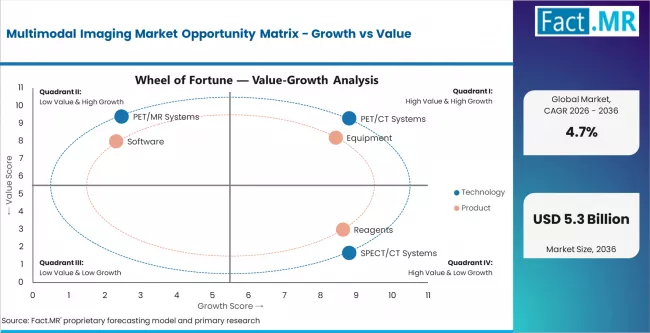
Cancer, cardiovascular disease, and neurological disorders are the main demand anchors for multimodal imaging. Hybrid systems help clinicians combine anatomy, physiology, and metabolic activity in one diagnostic pathway. FDA 510(k) documentation for PET/CT systems reinforces how these systems are positioned for whole-body and organ-specific imaging use. AI-supported analysis and cloud-based imaging workflows are creating new value in interpretation and reporting. These factors support demand for hardware and software that improve diagnostic confidence.

High equipment cost remains the main restraint. PET/MR and advanced PET/CT systems require large capital budgets, shielding, site planning, tracer access, trained staff, and maintenance contracts. Reimbursement gaps can slow adoption in emerging markets. Radiotracer availability can limit PET procedure growth even where scanners are installed. The IAEA notes that nuclear medicine uses radioactive materials to diagnose and treat disease, which makes infrastructure and safety practices important for adoption. [7] Suppliers that cannot support installation, training, and uptime may struggle to convert interested buyers.

Opportunities in the Multimodal Imaging Market

  • AI Imaging Software: Suppliers can expand through image fusion, reconstruction, and interpretation support.
  • PET/MR Adoption: Hospitals can use PET/MR where soft tissue contrast and functional imaging both matter.
  • Outpatient Imaging: Diagnostic centers can grow through high-throughput multimodal imaging services.

Regional Analysis

Based on the regional analysis, the multimodal imaging market is segmented into North America, Latin America, Western Europe, Eastern Europe, East Asia, South Asia and Pacific, and Middle East and Africa across 40 plus countries.

Top Country Growth Comparison Multimodal Imaging Market Cagr (2026 2036)

Country CAGR (2026 to 2036)
China 5.8%
United States 4.9%
India 4.8%
Germany 4.5%
Japan 4.2%
UK 4.0%
Brazil 3.8%

Source: Fact.MR analysis, based on proprietary forecasting model and primary research
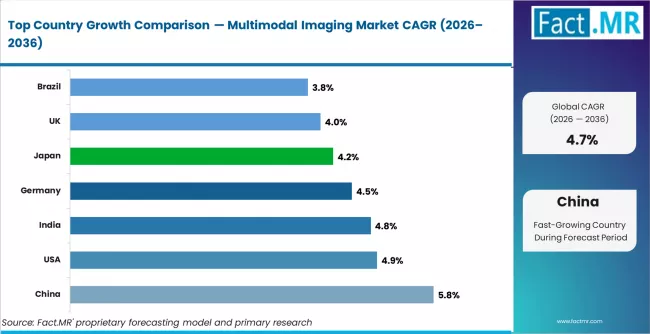
Multimodal Imaging Market Cagr Analysis By Country

East Asia Multimodal Imaging Market Analysis

East Asia shows steady growth because hospitals are investing in advanced diagnosis, oncology imaging, and domestic imaging technology. China creates the strongest regional growth opportunity through hospital modernization and rising local production. Japan has a mature imaging base where replacement and advanced clinical applications support demand. Fact.MR analysis indicates that buyers in this region evaluate systems through image quality, service uptime, and software support. Radiotracer access and specialist training remain important adoption factors.

  • China: China is projected to record 5.8% CAGR from 2026 to 2036 as healthcare infrastructure and domestic imaging production expand. Large hospitals need PET/CT, SPECT/CT, and AI-supported imaging tools for oncology and neurology. Domestic manufacturers are improving availability, but premium systems still depend on clinical proof and service quality. Suppliers with strong installation and software support can improve adoption.
  • Japan: Japan is projected to grow at 4.2% CAGR through 2036. Advanced hospitals use multimodal imaging for oncology, neurology, cardiology, and research workflows. Aging demographics support demand for accurate diagnostic imaging. Buyers value precision, service continuity, and proven image quality. Suppliers gain where they support integrated workflows and trained reader adoption.

North America Multimodal Imaging Market Analysis
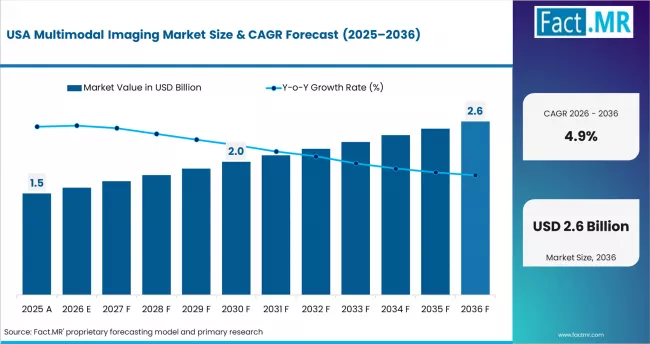
Multimodal Imaging Market Country Value Analysis

North America remains a major demand base because hospitals and imaging networks use advanced hybrid systems across oncology, cardiology, and neurology. The United States leads regional demand through established imaging infrastructure and strong adoption of AI-supported interpretation tools. FDA clearance pathways support regulated product introduction. Fact.MR analysis suggests that buyers in this region value clinical evidence, uptime, software integration, and service contracts. PET/CT and SPECT/CT remain central to multimodal imaging adoption.

  • United States: The United States is likely to grow at 4.9% CAGR through 2036 as advanced imaging adoption and AI-supported interpretation expand. Hospitals use PET/CT and SPECT/CT for oncology, cardiology, and neurology workflows. Imaging centers invest where scan volume supports capital equipment cost. FDA-cleared systems and strong service contracts influence buyer confidence. Suppliers with software depth can defend premium accounts.

South Asia and Pacific Multimodal Imaging Market Analysis

South Asia and Pacific is gaining momentum as healthcare infrastructure and oncology diagnosis capacity expand. India is the key growth country because large hospitals and diagnostic chains are investing in advanced imaging. Fact.MR analysis suggests that adoption in this region depends on capital budgets, radiotracer access, and trained specialists. Diagnostic imaging centers can grow faster where urban referral networks create scan volume. Cost remains a constraint for PET/MR and advanced hybrid systems.

  • India: India is forecast to post 4.8% CAGR through 2036 as diagnostic imaging access and oncology care expand. Private hospitals and diagnostic chains are increasing investment in PET/CT and advanced imaging workflows. Public-sector installations can improve access in selected cities. Skilled readers and radiotracer supply remain central to adoption. Suppliers with financing support and service coverage can improve market penetration.

Western Europe Multimodal Imaging Market Analysis
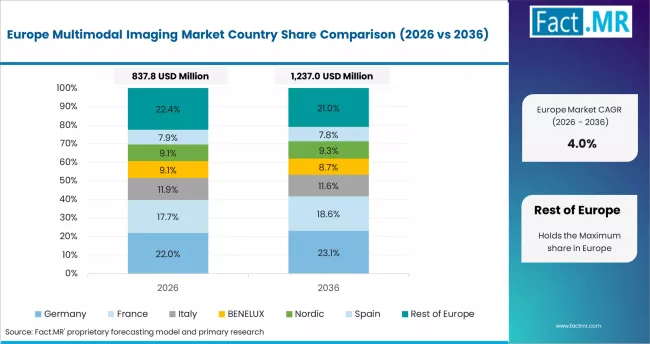
Multimodal Imaging Market Europe Country Market Share Analysis, 2026 & 2036

Western Europe demand is shaped by hospital renewal, cancer diagnosis programs, and strong research use. Germany and the UK are key countries in this regional spread. Buyers often evaluate imaging systems through clinical evidence, reimbursement, radiation management, and service reliability. Fact.MR analysis indicates that PET/MR and AI-supported software can grow where hospitals have specialist pathways and research programs. Growth is moderate because imaging infrastructure is already well developed.

  • Germany: Germany is projected to grow at 4.5% CAGR during 2026 to 2036. Hospitals use multimodal imaging across oncology, neurology, and cardiology. Strong research centers support adoption of advanced PET/MR and software tools. Buyers value clinical proof and technical service support. Replacement demand remains important because many facilities already use advanced imaging systems.
  • U.K.: The UK market is supported by oncology diagnostics demand and ongoing hospital imaging upgrades, which drive system adoption across diagnostic imaging centers and hospital networks. These facilities require solutions that improve throughput and reporting accuracy while aligning with clinical workflow needs. The UK is expected to expand at 4.0% CAGR over the study period. Public-sector budgeting can influence replacement cycles, making service support and integrated workflow software important differentiators for suppliers seeking preference.

Latin America Multimodal Imaging Market Analysis

Latin America demand is supported by oncology imaging needs, private hospital investment, and gradual expansion of diagnostic infrastructure. Brazil leads regional demand because it has the largest healthcare and imaging base. Fact.MR analysis indicates that adoption remains concentrated in private hospitals and major diagnostic centers. Cost, service access, and radiotracer availability limit wider diffusion. Suppliers need strong distributor partnerships and local service teams.

  • Brazil: Brazil is projected to record 3.8% CAGR from 2026 to 2036. Oncology imaging and private diagnostic centers support multimodal imaging demand. PET/CT adoption is stronger in major cities with specialist capacity. Equipment cost and service availability affect expansion outside large urban markets. Suppliers with local partners and financing support can build repeat demand.

Competitive Aligners for Market Players
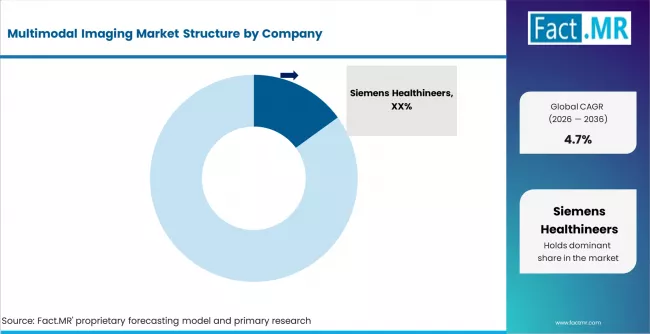
Multimodal Imaging Market Analysis By Company

The multimodal imaging market is concentrated around global imaging companies, nuclear medicine system suppliers, ophthalmic imaging firms, and specialized preclinical imaging providers. Siemens Healthineers, GE HealthCare, Philips, Canon, United Imaging, Bruker, Mediso, Topcon, and Carl Zeiss compete through system performance, software integration, service reach, and application depth. Large suppliers benefit from installed base and hospital relationships.

Competitive advantage depends on hybrid hardware and software workflow. Siemens Healthineers’ Biograph Vision Quadra PET/CT clearance and Biograph One PET/MR announcement show continued investment in hybrid imaging platforms. GE HealthCare’s Omni Legend PET/CT documentation supports its role in PET/CT system development. These systems show why PET/CT and PET/MR remain central to competitive positioning.

Software and AI support are becoming stronger differentiators. Philips’ annual reporting and Siemens Healthineers’ imaging focus show how large suppliers connect imaging systems with digital workflows. Bruker’s preclinical imaging portfolio and annual reporting support its role in research-focused multimodal imaging systems. Companies that combine hardware, software, service uptime, and clinical training are better placed through 2036.

Key Players in Multimodal Imaging Market

  • Siemens Healthineers
  • GE HealthCare
  • Koninklijke Philips N.V.
  • Canon Inc.
  • Shanghai United Imaging Healthcare Co. Ltd.
  • Bruker Corporation
  • Spectrum Dynamics Medical Inc.
  • Nipro Corporation
  • PerkinElmer Inc.
  • Mediso Ltd.
  • Carl Zeiss AG
  • MILabs B.V.
  • MR Solutions Ltd.
  • Neusoft Medical Systems Co. Ltd.
  • Topcon Corporation
  • TriFoil Imaging

Bibliography

  • [1]. U.S. Food and Drug Administration. (2025, July 3). K251671: Biograph Vision PET/CT systems. U.S. Food and Drug Administration.
  • [2]. Siemens Healthineers. (2021, March 8). Siemens Healthineers announces FDA clearance of Biograph Vision Quadra. Siemens Healthineers.
  • [3]. U.S. Food and Drug Administration. (2024, August 8). K241665: GE Omni Legend PET/CT system. U.S. Food and Drug Administration.
  • [4]. Siemens Healthineers. (2024, December 1). Siemens Healthineers plans to support new paths for personalized cancer care with Biograph One. Siemens Healthineers.
  • [5]. Philips. (2025, February 21). Annual Report 2024. Philips.
  • [6]. Siemens Healthineers. (2024, November 26). Annual Report 2024. Siemens Healthineers.
  • [7]. International Atomic Energy Agency. (2026). Nuclear medicine and diagnostic imaging resources. International Atomic Energy Agency.

This Report Addresses

  • Strategic intelligence on multimodal imaging demand across PET/CT, SPECT/CT, PET/MR, OCT/fundus systems, software, and reagents globally.
  • Market forecast from USD 3.2 billion in 2026 to USD 5.1 billion by 2036 at a CAGR of 4.7%.
  • Growth opportunity mapping across China healthcare modernization, United States advanced imaging adoption, India diagnostic infrastructure, Germany research hospitals, and Japan replacement demand.
  • Segment analysis by technology, product, application, end user, and sales channel.
  • Regional outlook covering East Asia imaging investment, North America advanced hybrid systems, South Asia diagnostic expansion, Western Europe research-linked adoption, and Latin America private imaging demand.
  • Competitive analysis of Siemens Healthineers, GE HealthCare, Philips, Canon, United Imaging, Bruker, Mediso, Carl Zeiss, Topcon, and MILabs.
  • Product assessment covering PET/CT systems, SPECT/CT systems, PET/MR systems, OCT/fundus systems, AI imaging software, and image fusion tools.
  • Report delivered through PDF, Excel datasets, and presentation formats, supported by primary interviews, regulatory review, supplier portfolio checks, procedure-volume analysis, and hospital buyer validation.

Multimodal Imaging Market Definition

The multimodal imaging market covers systems, software, reagents, and related solutions that combine two or more imaging methods to generate complementary diagnostic information. The market includes PET/CT, SPECT/CT, PET/MR, OCT/fundus imaging, optical hybrid systems, and software used to fuse or analyze images from multiple modalities. It differs from single-modality imaging because it combines structural, functional, metabolic, or molecular data in one diagnostic workflow.

Multimodal Imaging Market Inclusions

The scope includes PET/CT systems, SPECT/CT systems, PET/MR systems, OCT/fundus systems, hybrid optical imaging platforms, image fusion software, AI-supported image analysis tools, radiopharmaceutical-linked imaging workflows, contrast agents, research imaging platforms, and related accessories. Products used in hospitals, diagnostic imaging centers, academic research, oncology, neurology, cardiology, and ophthalmology are included when the workflow combines multiple imaging modalities.

Multimodal Imaging Market Exclusions

The scope excludes standalone MRI, standalone CT, standalone ultrasound, standalone X-ray, pure PACS software without multimodal analysis, general radiology equipment without hybrid imaging capability, and non-medical imaging systems. Radiotherapy equipment is excluded unless used with integrated multimodal imaging for diagnosis or treatment planning. General laboratory imaging systems are excluded unless they support multimodal biomedical imaging.

Multimodal Imaging Market Research Methodology

  • Primary Research:Interviews with radiologists, nuclear medicine physicians, hospital imaging heads, diagnostic center owners, oncology imaging specialists, and medical imaging distributors.
  • Desk Research:Review of FDA device clearances, company annual reports, imaging system product pages, nuclear medicine guidance, hospital imaging investment signals, and clinical imaging documentation.
  • Market-Sizing and Forecasting:Forecasting uses installed imaging base, hybrid system adoption, replacement cycles, radiotracer availability, hospital capital spending, and diagnostic procedure growth.
  • Data Validation and Update Cycle:Forecasts are validated through device supplier checks, imaging center interviews, hospital buyer inputs, regulatory review, and regional diagnostic infrastructure analysis.

Scope of the Report

Multimodal Imaging Market Breakdown By Technology, Product, And Region

Attribute Details
Quantitative Units USD 3.2 billion in 2026 to USD 5.1 billion by 2036, at a CAGR of 4.7%
Market Definition Hybrid imaging systems, reagents, and software used to combine anatomical, functional, metabolic, molecular, or optical imaging data in clinical and research workflows.
Technology PET/CT Systems, SPECT/CT Systems, PET/MR Systems, OCT/Fundus Imaging Systems, Other Hybrid Imaging Systems
Product Equipment, Reagents, Software
Application Brain and Neurology, Cardiology, Oncology, Ophthalmology, Other Applications
End User Hospitals, Diagnostic Imaging Centers, Academic and Research Institutes, Specialty Clinics
Sales Channel Direct Institutional Sales, Medical Device Distributors, Tender-based Sales, Integrated Imaging Solution Providers
Regions Covered North America, Latin America, Western Europe, Eastern Europe, East Asia, South Asia and Pacific, Middle East and Africa
Countries Covered China, United States, India, Germany, Japan, UK, Brazil, and 40 plus countries
Key Companies Profiled Siemens Healthineers, GE HealthCare, Philips, Canon, United Imaging, Bruker, Spectrum Dynamics Medical, Nipro, PerkinElmer, Mediso, Carl Zeiss, MILabs, MR Solutions, Neusoft Medical Systems, Topcon, TriFoil Imaging
Forecast Period 2026 to 2036
Approach Hybrid top-down and bottom-up model using installed imaging base, hybrid system adoption, replacement cycles, procedure volume, software adoption, and primary interviews with imaging buyers.

Multimodal Imaging Market Analysis by Segments

  • By Technology:

    • PET/CT Systems
    • SPECT/CT Systems
    • PET/MR Systems
    • OCT/Fundus Imaging Systems
    • Other Hybrid Imaging Systems
  • By Product:

    • Equipment
    • Reagents
    • Software
  • By Application:

    • Brain and Neurology
    • Cardiology
    • Oncology
    • Ophthalmology
    • Other Applications
  • By End User:

    • Hospitals
    • Diagnostic Imaging Centers
    • Academic and Research Institutes
    • Specialty Clinics
  • By Sales Channel:

    • Direct Institutional Sales
    • Medical Device Distributors
    • Tender-based Sales
    • Integrated Imaging Solution Providers
  • By Region:

    • North America
      • United States
      • Canada
      • Latin America
      • Brazil
      • Mexico
    • Western Europe
      • Germany
      • UK
      • France
    • Eastern Europe
      • Poland
      • Russia
      • East Asia
      • China
      • Japan
    • South Korea
      • South Asia and Pacific
      • India
      • ASEAN
      • Australia and

- Frequently Asked Questions -

How large is the multimodal imaging market in 2025?

The multimodal imaging market was valued at USD 3.10 billion in 2025.

What is the expected value in 2026?

Demand is estimated to reach USD 3.23 billion in 2026.

What is the forecast value by 2036?

The market is forecast to reach USD 5.11 billion by 2036.

What CAGR is projected for 2026 to 2036?

Fact.MR projects a CAGR of 4.70% for the 2026 to 2036 forecast period.

Which technology leads demand?

PET/CT systems lead with 31.0% share in 2026.

Which product accounts for the highest share?

Equipment leads with 58.0% share in 2026.

Which application drives the largest demand?

Oncology leads with 36.0% share in 2026.

Which end user accounts for the highest share?

Hospitals lead with 49.0% share in 2026.

Which sales channel leads the market?

Direct institutional sales lead with 51.0% share in 2026.

Which country shows the fastest growth?

China is projected to grow at 5.8% CAGR through 2036.

Why do PET/CT systems lead demand?

PET/CT systems lead because they combine metabolic activity with anatomical localization.

Why is PET/MR gaining demand?

PET/MR is gaining demand where soft tissue contrast and functional imaging both matter.

Why does oncology lead application demand?

Oncology leads because multimodal imaging supports tumor staging and treatment response monitoring.

What is the main restraint in this market?

High equipment cost and specialist staffing needs remain the main restraints.

How does AI affect multimodal imaging demand?

AI supports image fusion, reconstruction, interpretation, and reporting workflow efficiency.

Why are diagnostic imaging centers important?

Diagnostic imaging centers expand access when scan volume supports system investment.

What supports demand in China?

Healthcare infrastructure and domestic imaging production support demand in China.

What supports demand in the United States?

Advanced imaging adoption and AI-supported interpretation support demand in the United States.

What supports demand in Germany?

Research hospitals and oncology imaging programs support demand in Germany.

Why is service uptime important?

Service uptime protects scan schedules and helps buyers justify high capital equipment costs.

What defines competition in this market?

Competition depends on image quality, software integration, service support, and clinical workflow fit.

Who are the leading companies?

Leading companies include Siemens Healthineers, GE HealthCare, Philips, Canon, United Imaging, Bruker, Mediso, Carl Zeiss, Topcon, and MILabs.

Table of Content

  1. Executive Summary
    • Global Market Outlook
    • Demand to side Trends
    • Supply to side Trends
    • Technology Roadmap Analysis
    • Analysis and Recommendations
  2. Market Overview
    • Market Coverage / Taxonomy
    • Market Definition / Scope / Limitations
  3. Research Methodology
    • Chapter Orientation
    • Analytical Lens and Working Hypotheses
      • Market Structure, Signals, and Trend Drivers
      • Benchmarking and Cross-market Comparability
      • Market Sizing, Forecasting, and Opportunity Mapping
    • Research Design and Evidence Framework
      • Desk Research Programme (Secondary Evidence)
        • Company Annual and Sustainability Reports
        • Peer-reviewed Journals and Academic Literature
        • Corporate Websites, Product Literature, and Technical Notes
        • Earnings Decks and Investor Briefings
        • Statutory Filings and Regulatory Disclosures
        • Technical White Papers and Standards Notes
        • Trade Journals, Industry Magazines, and Analyst Briefs
        • Conference Proceedings, Webinars, and Seminar Materials
        • Government Statistics Portals and Public Data Releases
        • Press Releases and Reputable Media Coverage
        • Specialist Newsletters and Curated Briefings
        • Sector Databases and Reference Repositories
        • Fact.MR Internal Proprietary Databases and Historical Market Datasets
        • Subscription Datasets and Paid Sources
        • Social Channels, Communities, and Digital Listening Inputs
        • Additional Desk Sources
      • Expert Input and Fieldwork (Primary Evidence)
        • Primary Modes
          • Qualitative Interviews and Expert Elicitation
          • Quantitative Surveys and Structured Data Capture
          • Blended Approach
        • Why Primary Evidence is Used
        • Field Techniques
          • Interviews
          • Surveys
          • Focus Groups
          • Observational and In-context Research
          • Social and Community Interactions
        • Stakeholder Universe Engaged
          • C-suite Leaders
          • Board Members
          • Presidents and Vice Presidents
          • R&D and Innovation Heads
          • Technical Specialists
          • Domain Subject-matter Experts
          • Scientists
          • Physicians and Other Healthcare Professionals
        • Governance, Ethics, and Data Stewardship
          • Research Ethics
          • Data Integrity and Handling
      • Tooling, Models, and Reference Databases
    • Data Engineering and Model Build
      • Data Acquisition and Ingestion
      • Cleaning, Normalisation, and Verification
      • Synthesis, Triangulation, and Analysis
    • Quality Assurance and Audit Trail
  4. Market Background
    • Market Dynamics
      • Drivers
      • Restraints
      • Opportunity
      • Trends
    • Scenario Forecast
      • Demand in Optimistic Scenario
      • Demand in Likely Scenario
      • Demand in Conservative Scenario
    • Opportunity Map Analysis
    • Product Life Cycle Analysis
    • Supply Chain Analysis
    • Investment Feasibility Matrix
    • Value Chain Analysis
    • PESTLE and Porter’s Analysis
    • Regulatory Landscape
    • Regional Parent Market Outlook
    • Production and Consumption Statistics
    • Import and Export Statistics
  5. Global Market Analysis 2021 to 2025 and Forecast, 2026 to 2036
    • Historical Market Size Value (USD Million) Analysis, 2021 to 2025
    • Current and Future Market Size Value (USD Million) Projections, 2026 to 2036
      • Y to o to Y Growth Trend Analysis
      • Absolute $ Opportunity Analysis
  6. Global Market Pricing Analysis 2021 to 2025 and Forecast 2026 to 2036
  7. Global Market Analysis 2021 to 2025 and Forecast 2026 to 2036, By Product Type
    • Introduction / Key Findings
    • Historical Market Size Value (USD Million) Analysis By Product Type , 2021 to 2025
    • Current and Future Market Size Value (USD Million) Analysis and Forecast By Product Type , 2026 to 2036
      • Kits
      • Reagents
      • Antibodies
    • Y to o to Y Growth Trend Analysis By Product Type , 2021 to 2025
    • Absolute $ Opportunity Analysis By Product Type , 2026 to 2036
  8. Global Market Analysis 2021 to 2025 and Forecast 2026 to 2036, By Technique
    • Introduction / Key Findings
    • Historical Market Size Value (USD Million) Analysis By Technique, 2021 to 2025
    • Current and Future Market Size Value (USD Million) Analysis and Forecast By Technique, 2026 to 2036
      • Co-immunoprecipitation
      • Individual Immunoprecipitation
      • RNA Immunoprecipitation
    • Y to o to Y Growth Trend Analysis By Technique, 2021 to 2025
    • Absolute $ Opportunity Analysis By Technique, 2026 to 2036
  9. Global Market Analysis 2021 to 2025 and Forecast 2026 to 2036, By Application
    • Introduction / Key Findings
    • Historical Market Size Value (USD Million) Analysis By Application, 2021 to 2025
    • Current and Future Market Size Value (USD Million) Analysis and Forecast By Application, 2026 to 2036
      • Drug Discovery
      • Biomarker Discovery
      • Protein Interaction Studies
    • Y to o to Y Growth Trend Analysis By Application, 2021 to 2025
    • Absolute $ Opportunity Analysis By Application, 2026 to 2036
  10. Global Market Analysis 2021 to 2025 and Forecast 2026 to 2036, By End User
    • Introduction / Key Findings
    • Historical Market Size Value (USD Million) Analysis By End User, 2021 to 2025
    • Current and Future Market Size Value (USD Million) Analysis and Forecast By End User, 2026 to 2036
      • Pharmaceutical and Biotechnology Companies
      • Academic and Research Institutes
      • Contract Research Organizations
    • Y to o to Y Growth Trend Analysis By End User, 2021 to 2025
    • Absolute $ Opportunity Analysis By End User, 2026 to 2036
  11. Global Market Analysis 2021 to 2025 and Forecast 2026 to 2036, By Distribution Channel
    • Introduction / Key Findings
    • Historical Market Size Value (USD Million) Analysis By Distribution Channel, 2021 to 2025
    • Current and Future Market Size Value (USD Million) Analysis and Forecast By Distribution Channel, 2026 to 2036
      • Direct Institutional Sales
      • Laboratory Distributors
      • Online Scientific Supply Channels
    • Y to o to Y Growth Trend Analysis By Distribution Channel, 2021 to 2025
    • Absolute $ Opportunity Analysis By Distribution Channel, 2026 to 2036
  12. Global Market Analysis 2021 to 2025 and Forecast 2026 to 2036, By Region
    • Introduction
    • Historical Market Size Value (USD Million) Analysis By Region, 2021 to 2025
    • Current Market Size Value (USD Million) Analysis and Forecast By Region, 2026 to 2036
      • North America
      • Latin America
      • Western Europe
      • Eastern Europe
      • East Asia
      • South Asia and Pacific
      • Middle East & Africa
    • Market Attractiveness Analysis By Region
  13. North America Market Analysis 2021 to 2025 and Forecast 2026 to 2036, By Country
    • Historical Market Size Value (USD Million) Trend Analysis By Market Taxonomy, 2021 to 2025
    • Market Size Value (USD Million) Forecast By Market Taxonomy, 2026 to 2036
      • By Country
        • USA
        • Canada
        • Mexico
      • By Product Type
      • By Technique
      • By Application
      • By End User
      • By Distribution Channel
    • Market Attractiveness Analysis
      • By Country
      • By Product Type
      • By Technique
      • By Application
      • By End User
      • By Distribution Channel
    • Key Takeaways
  14. Latin America Market Analysis 2021 to 2025 and Forecast 2026 to 2036, By Country
    • Historical Market Size Value (USD Million) Trend Analysis By Market Taxonomy, 2021 to 2025
    • Market Size Value (USD Million) Forecast By Market Taxonomy, 2026 to 2036
      • By Country
        • Brazil
        • Chile
        • Rest of Latin America
      • By Product Type
      • By Technique
      • By Application
      • By End User
      • By Distribution Channel
    • Market Attractiveness Analysis
      • By Country
      • By Product Type
      • By Technique
      • By Application
      • By End User
      • By Distribution Channel
    • Key Takeaways
  15. Western Europe Market Analysis 2021 to 2025 and Forecast 2026 to 2036, By Country
    • Historical Market Size Value (USD Million) Trend Analysis By Market Taxonomy, 2021 to 2025
    • Market Size Value (USD Million) Forecast By Market Taxonomy, 2026 to 2036
      • By Country
        • Germany
        • UK
        • Italy
        • Spain
        • France
        • Nordic
        • BENELUX
        • Rest of Western Europe
      • By Product Type
      • By Technique
      • By Application
      • By End User
      • By Distribution Channel
    • Market Attractiveness Analysis
      • By Country
      • By Product Type
      • By Technique
      • By Application
      • By End User
      • By Distribution Channel
    • Key Takeaways
  16. Eastern Europe Market Analysis 2021 to 2025 and Forecast 2026 to 2036, By Country
    • Historical Market Size Value (USD Million) Trend Analysis By Market Taxonomy, 2021 to 2025
    • Market Size Value (USD Million) Forecast By Market Taxonomy, 2026 to 2036
      • By Country
        • Russia
        • Poland
        • Hungary
        • Balkan & Baltic
        • Rest of Eastern Europe
      • By Product Type
      • By Technique
      • By Application
      • By End User
      • By Distribution Channel
    • Market Attractiveness Analysis
      • By Country
      • By Product Type
      • By Technique
      • By Application
      • By End User
      • By Distribution Channel
    • Key Takeaways
  17. East Asia Market Analysis 2021 to 2025 and Forecast 2026 to 2036, By Country
    • Historical Market Size Value (USD Million) Trend Analysis By Market Taxonomy, 2021 to 2025
    • Market Size Value (USD Million) Forecast By Market Taxonomy, 2026 to 2036
      • By Country
        • China
        • Japan
        • South Korea
      • By Product Type
      • By Technique
      • By Application
      • By End User
      • By Distribution Channel
    • Market Attractiveness Analysis
      • By Country
      • By Product Type
      • By Technique
      • By Application
      • By End User
      • By Distribution Channel
    • Key Takeaways
  18. South Asia and Pacific Market Analysis 2021 to 2025 and Forecast 2026 to 2036, By Country
    • Historical Market Size Value (USD Million) Trend Analysis By Market Taxonomy, 2021 to 2025
    • Market Size Value (USD Million) Forecast By Market Taxonomy, 2026 to 2036
      • By Country
        • India
        • ASEAN
        • Australia & New Zealand
        • Rest of South Asia and Pacific
      • By Product Type
      • By Technique
      • By Application
      • By End User
      • By Distribution Channel
    • Market Attractiveness Analysis
      • By Country
      • By Product Type
      • By Technique
      • By Application
      • By End User
      • By Distribution Channel
    • Key Takeaways
  19. Middle East & Africa Market Analysis 2021 to 2025 and Forecast 2026 to 2036, By Country
    • Historical Market Size Value (USD Million) Trend Analysis By Market Taxonomy, 2021 to 2025
    • Market Size Value (USD Million) Forecast By Market Taxonomy, 2026 to 2036
      • By Country
        • Kingdom of Saudi Arabia
        • Other GCC Countries
        • Turkiye
        • South Africa
        • Other African Union
        • Rest of Middle East & Africa
      • By Product Type
      • By Technique
      • By Application
      • By End User
      • By Distribution Channel
    • Market Attractiveness Analysis
      • By Country
      • By Product Type
      • By Technique
      • By Application
      • By End User
      • By Distribution Channel
    • Key Takeaways
  20. Key Countries Market Analysis
    • USA
      • Pricing Analysis
      • Market Share Analysis, 2025
        • By Product Type
        • By Technique
        • By Application
        • By End User
        • By Distribution Channel
    • Canada
      • Pricing Analysis
      • Market Share Analysis, 2025
        • By Product Type
        • By Technique
        • By Application
        • By End User
        • By Distribution Channel
    • Mexico
      • Pricing Analysis
      • Market Share Analysis, 2025
        • By Product Type
        • By Technique
        • By Application
        • By End User
        • By Distribution Channel
    • Brazil
      • Pricing Analysis
      • Market Share Analysis, 2025
        • By Product Type
        • By Technique
        • By Application
        • By End User
        • By Distribution Channel
    • Chile
      • Pricing Analysis
      • Market Share Analysis, 2025
        • By Product Type
        • By Technique
        • By Application
        • By End User
        • By Distribution Channel
    • Germany
      • Pricing Analysis
      • Market Share Analysis, 2025
        • By Product Type
        • By Technique
        • By Application
        • By End User
        • By Distribution Channel
    • UK
      • Pricing Analysis
      • Market Share Analysis, 2025
        • By Product Type
        • By Technique
        • By Application
        • By End User
        • By Distribution Channel
    • Italy
      • Pricing Analysis
      • Market Share Analysis, 2025
        • By Product Type
        • By Technique
        • By Application
        • By End User
        • By Distribution Channel
    • Spain
      • Pricing Analysis
      • Market Share Analysis, 2025
        • By Product Type
        • By Technique
        • By Application
        • By End User
        • By Distribution Channel
    • France
      • Pricing Analysis
      • Market Share Analysis, 2025
        • By Product Type
        • By Technique
        • By Application
        • By End User
        • By Distribution Channel
    • India
      • Pricing Analysis
      • Market Share Analysis, 2025
        • By Product Type
        • By Technique
        • By Application
        • By End User
        • By Distribution Channel
    • ASEAN
      • Pricing Analysis
      • Market Share Analysis, 2025
        • By Product Type
        • By Technique
        • By Application
        • By End User
        • By Distribution Channel
    • Australia & New Zealand
      • Pricing Analysis
      • Market Share Analysis, 2025
        • By Product Type
        • By Technique
        • By Application
        • By End User
        • By Distribution Channel
    • China
      • Pricing Analysis
      • Market Share Analysis, 2025
        • By Product Type
        • By Technique
        • By Application
        • By End User
        • By Distribution Channel
    • Japan
      • Pricing Analysis
      • Market Share Analysis, 2025
        • By Product Type
        • By Technique
        • By Application
        • By End User
        • By Distribution Channel
    • South Korea
      • Pricing Analysis
      • Market Share Analysis, 2025
        • By Product Type
        • By Technique
        • By Application
        • By End User
        • By Distribution Channel
    • Russia
      • Pricing Analysis
      • Market Share Analysis, 2025
        • By Product Type
        • By Technique
        • By Application
        • By End User
        • By Distribution Channel
    • Poland
      • Pricing Analysis
      • Market Share Analysis, 2025
        • By Product Type
        • By Technique
        • By Application
        • By End User
        • By Distribution Channel
    • Hungary
      • Pricing Analysis
      • Market Share Analysis, 2025
        • By Product Type
        • By Technique
        • By Application
        • By End User
        • By Distribution Channel
    • Kingdom of Saudi Arabia
      • Pricing Analysis
      • Market Share Analysis, 2025
        • By Product Type
        • By Technique
        • By Application
        • By End User
        • By Distribution Channel
    • Turkiye
      • Pricing Analysis
      • Market Share Analysis, 2025
        • By Product Type
        • By Technique
        • By Application
        • By End User
        • By Distribution Channel
    • South Africa
      • Pricing Analysis
      • Market Share Analysis, 2025
        • By Product Type
        • By Technique
        • By Application
        • By End User
        • By Distribution Channel
  21. Market Structure Analysis
    • Competition Dashboard
    • Competition Benchmarking
    • Market Share Analysis of Top Players
      • By Regional
      • By Product Type
      • By Technique
      • By Application
      • By End User
      • By Distribution Channel
  22. Competition Analysis
    • Competition Deep Dive
      • Thermo Fisher Scientific Inc.
        • Overview
        • Product Portfolio
        • Profitability by Market Segments (Product/Age /Sales Channel/Region)
        • Sales Footprint
        • Strategy Overview
          • Marketing Strategy
          • Product Strategy
          • Channel Strategy
      • Merck KGaA
      • Bio-Rad Laboratories, Inc.
      • Abcam plc
      • Cell Signaling Technology, Inc.
      • GenScript Biotech Corporation
      • BioLegend, Inc.
  23. Assumptions & Acronyms Used

List Of Table

  • Table 1: Global Market Value (USD Million) Forecast by Region, 2021 to 2036
  • Table 2: Global Market Value (USD Million) Forecast by Product Type, 2021 to 2036
  • Table 3: Global Market Value (USD Million) Forecast by Technique, 2021 to 2036
  • Table 4: Global Market Value (USD Million) Forecast by Application, 2021 to 2036
  • Table 5: Global Market Value (USD Million) Forecast by End User, 2021 to 2036
  • Table 6: Global Market Value (USD Million) Forecast by Distribution Channel, 2021 to 2036
  • Table 7: North America Market Value (USD Million) Forecast by Country, 2021 to 2036
  • Table 8: North America Market Value (USD Million) Forecast by Product Type, 2021 to 2036
  • Table 9: North America Market Value (USD Million) Forecast by Technique, 2021 to 2036
  • Table 10: North America Market Value (USD Million) Forecast by Application, 2021 to 2036
  • Table 11: North America Market Value (USD Million) Forecast by End User, 2021 to 2036
  • Table 12: North America Market Value (USD Million) Forecast by Distribution Channel, 2021 to 2036
  • Table 13: Latin America Market Value (USD Million) Forecast by Country, 2021 to 2036
  • Table 14: Latin America Market Value (USD Million) Forecast by Product Type, 2021 to 2036
  • Table 15: Latin America Market Value (USD Million) Forecast by Technique, 2021 to 2036
  • Table 16: Latin America Market Value (USD Million) Forecast by Application, 2021 to 2036
  • Table 17: Latin America Market Value (USD Million) Forecast by End User, 2021 to 2036
  • Table 18: Latin America Market Value (USD Million) Forecast by Distribution Channel, 2021 to 2036
  • Table 19: Western Europe Market Value (USD Million) Forecast by Country, 2021 to 2036
  • Table 20: Western Europe Market Value (USD Million) Forecast by Product Type, 2021 to 2036
  • Table 21: Western Europe Market Value (USD Million) Forecast by Technique, 2021 to 2036
  • Table 22: Western Europe Market Value (USD Million) Forecast by Application, 2021 to 2036
  • Table 23: Western Europe Market Value (USD Million) Forecast by End User, 2021 to 2036
  • Table 24: Western Europe Market Value (USD Million) Forecast by Distribution Channel, 2021 to 2036
  • Table 25: Eastern Europe Market Value (USD Million) Forecast by Country, 2021 to 2036
  • Table 26: Eastern Europe Market Value (USD Million) Forecast by Product Type, 2021 to 2036
  • Table 27: Eastern Europe Market Value (USD Million) Forecast by Technique, 2021 to 2036
  • Table 28: Eastern Europe Market Value (USD Million) Forecast by Application, 2021 to 2036
  • Table 29: Eastern Europe Market Value (USD Million) Forecast by End User, 2021 to 2036
  • Table 30: Eastern Europe Market Value (USD Million) Forecast by Distribution Channel, 2021 to 2036
  • Table 31: East Asia Market Value (USD Million) Forecast by Country, 2021 to 2036
  • Table 32: East Asia Market Value (USD Million) Forecast by Product Type, 2021 to 2036
  • Table 33: East Asia Market Value (USD Million) Forecast by Technique, 2021 to 2036
  • Table 34: East Asia Market Value (USD Million) Forecast by Application, 2021 to 2036
  • Table 35: East Asia Market Value (USD Million) Forecast by End User, 2021 to 2036
  • Table 36: East Asia Market Value (USD Million) Forecast by Distribution Channel, 2021 to 2036
  • Table 37: South Asia and Pacific Market Value (USD Million) Forecast by Country, 2021 to 2036
  • Table 38: South Asia and Pacific Market Value (USD Million) Forecast by Product Type, 2021 to 2036
  • Table 39: South Asia and Pacific Market Value (USD Million) Forecast by Technique, 2021 to 2036
  • Table 40: South Asia and Pacific Market Value (USD Million) Forecast by Application, 2021 to 2036
  • Table 41: South Asia and Pacific Market Value (USD Million) Forecast by End User, 2021 to 2036
  • Table 42: South Asia and Pacific Market Value (USD Million) Forecast by Distribution Channel, 2021 to 2036
  • Table 43: Middle East & Africa Market Value (USD Million) Forecast by Country, 2021 to 2036
  • Table 44: Middle East & Africa Market Value (USD Million) Forecast by Product Type, 2021 to 2036
  • Table 45: Middle East & Africa Market Value (USD Million) Forecast by Technique, 2021 to 2036
  • Table 46: Middle East & Africa Market Value (USD Million) Forecast by Application, 2021 to 2036
  • Table 47: Middle East & Africa Market Value (USD Million) Forecast by End User, 2021 to 2036
  • Table 48: Middle East & Africa Market Value (USD Million) Forecast by Distribution Channel, 2021 to 2036

List Of Figures

  • Figure 1: Global Market Pricing Analysis
  • Figure 2: Global Market Value (USD Million) Forecast 2021-2036
  • Figure 3: Global Market Value Share and BPS Analysis by Product Type, 2026 and 2036
  • Figure 4: Global Market Y-o-Y Growth Comparison by Product Type, 2026 to 2036
  • Figure 5: Global Market Attractiveness Analysis by Product Type
  • Figure 6: Global Market Value Share and BPS Analysis by Technique, 2026 and 2036
  • Figure 7: Global Market Y-o-Y Growth Comparison by Technique, 2026 to 2036
  • Figure 8: Global Market Attractiveness Analysis by Technique
  • Figure 9: Global Market Value Share and BPS Analysis by Application, 2026 and 2036
  • Figure 10: Global Market Y-o-Y Growth Comparison by Application, 2026 to 2036
  • Figure 11: Global Market Attractiveness Analysis by Application
  • Figure 12: Global Market Value Share and BPS Analysis by End User, 2026 and 2036
  • Figure 13: Global Market Y-o-Y Growth Comparison by End User, 2026 to 2036
  • Figure 14: Global Market Attractiveness Analysis by End User
  • Figure 15: Global Market Value Share and BPS Analysis by Distribution Channel, 2026 and 2036
  • Figure 16: Global Market Y-o-Y Growth Comparison by Distribution Channel, 2026 to 2036
  • Figure 17: Global Market Attractiveness Analysis by Distribution Channel
  • Figure 18: Global Market Value (USD Million) Share and BPS Analysis by Region, 2026 and 2036
  • Figure 19: Global Market Y-o-Y Growth Comparison by Region, 2026 to 2036
  • Figure 20: Global Market Attractiveness Analysis by Region
  • Figure 21: North America Market Incremental Dollar Opportunity, 2026 to 2036
  • Figure 22: Latin America Market Incremental Dollar Opportunity, 2026 to 2036
  • Figure 23: Western Europe Market Incremental Dollar Opportunity, 2026 to 2036
  • Figure 24: Eastern Europe Market Incremental Dollar Opportunity, 2026 to 2036
  • Figure 25: East Asia Market Incremental Dollar Opportunity, 2026 to 2036
  • Figure 26: South Asia and Pacific Market Incremental Dollar Opportunity, 2026 to 2036
  • Figure 27: Middle East & Africa Market Incremental Dollar Opportunity, 2026 to 2036
  • Figure 28: North America Market Value Share and BPS Analysis by Country, 2026 and 2036
  • Figure 29: North America Market Value Share and BPS Analysis by Product Type, 2026 and 2036
  • Figure 30: North America Market Y-o-Y Growth Comparison by Product Type, 2026 to 2036
  • Figure 31: North America Market Attractiveness Analysis by Product Type
  • Figure 32: North America Market Value Share and BPS Analysis by Technique, 2026 and 2036
  • Figure 33: North America Market Y-o-Y Growth Comparison by Technique, 2026 to 2036
  • Figure 34: North America Market Attractiveness Analysis by Technique
  • Figure 35: North America Market Value Share and BPS Analysis by Application, 2026 and 2036
  • Figure 36: North America Market Y-o-Y Growth Comparison by Application, 2026 to 2036
  • Figure 37: North America Market Attractiveness Analysis by Application
  • Figure 38: North America Market Value Share and BPS Analysis by End User, 2026 and 2036
  • Figure 39: North America Market Y-o-Y Growth Comparison by End User, 2026 to 2036
  • Figure 40: North America Market Attractiveness Analysis by End User
  • Figure 41: North America Market Value Share and BPS Analysis by Distribution Channel, 2026 and 2036
  • Figure 42: North America Market Y-o-Y Growth Comparison by Distribution Channel, 2026 to 2036
  • Figure 43: North America Market Attractiveness Analysis by Distribution Channel
  • Figure 44: Latin America Market Value Share and BPS Analysis by Country, 2026 and 2036
  • Figure 45: Latin America Market Value Share and BPS Analysis by Product Type, 2026 and 2036
  • Figure 46: Latin America Market Y-o-Y Growth Comparison by Product Type, 2026 to 2036
  • Figure 47: Latin America Market Attractiveness Analysis by Product Type
  • Figure 48: Latin America Market Value Share and BPS Analysis by Technique, 2026 and 2036
  • Figure 49: Latin America Market Y-o-Y Growth Comparison by Technique, 2026 to 2036
  • Figure 50: Latin America Market Attractiveness Analysis by Technique
  • Figure 51: Latin America Market Value Share and BPS Analysis by Application, 2026 and 2036
  • Figure 52: Latin America Market Y-o-Y Growth Comparison by Application, 2026 to 2036
  • Figure 53: Latin America Market Attractiveness Analysis by Application
  • Figure 54: Latin America Market Value Share and BPS Analysis by End User, 2026 and 2036
  • Figure 55: Latin America Market Y-o-Y Growth Comparison by End User, 2026 to 2036
  • Figure 56: Latin America Market Attractiveness Analysis by End User
  • Figure 57: Latin America Market Value Share and BPS Analysis by Distribution Channel, 2026 and 2036
  • Figure 58: Latin America Market Y-o-Y Growth Comparison by Distribution Channel, 2026 to 2036
  • Figure 59: Latin America Market Attractiveness Analysis by Distribution Channel
  • Figure 60: Western Europe Market Value Share and BPS Analysis by Country, 2026 and 2036
  • Figure 61: Western Europe Market Value Share and BPS Analysis by Product Type, 2026 and 2036
  • Figure 62: Western Europe Market Y-o-Y Growth Comparison by Product Type, 2026 to 2036
  • Figure 63: Western Europe Market Attractiveness Analysis by Product Type
  • Figure 64: Western Europe Market Value Share and BPS Analysis by Technique, 2026 and 2036
  • Figure 65: Western Europe Market Y-o-Y Growth Comparison by Technique, 2026 to 2036
  • Figure 66: Western Europe Market Attractiveness Analysis by Technique
  • Figure 67: Western Europe Market Value Share and BPS Analysis by Application, 2026 and 2036
  • Figure 68: Western Europe Market Y-o-Y Growth Comparison by Application, 2026 to 2036
  • Figure 69: Western Europe Market Attractiveness Analysis by Application
  • Figure 70: Western Europe Market Value Share and BPS Analysis by End User, 2026 and 2036
  • Figure 71: Western Europe Market Y-o-Y Growth Comparison by End User, 2026 to 2036
  • Figure 72: Western Europe Market Attractiveness Analysis by End User
  • Figure 73: Western Europe Market Value Share and BPS Analysis by Distribution Channel, 2026 and 2036
  • Figure 74: Western Europe Market Y-o-Y Growth Comparison by Distribution Channel, 2026 to 2036
  • Figure 75: Western Europe Market Attractiveness Analysis by Distribution Channel
  • Figure 76: Eastern Europe Market Value Share and BPS Analysis by Country, 2026 and 2036
  • Figure 77: Eastern Europe Market Value Share and BPS Analysis by Product Type, 2026 and 2036
  • Figure 78: Eastern Europe Market Y-o-Y Growth Comparison by Product Type, 2026 to 2036
  • Figure 79: Eastern Europe Market Attractiveness Analysis by Product Type
  • Figure 80: Eastern Europe Market Value Share and BPS Analysis by Technique, 2026 and 2036
  • Figure 81: Eastern Europe Market Y-o-Y Growth Comparison by Technique, 2026 to 2036
  • Figure 82: Eastern Europe Market Attractiveness Analysis by Technique
  • Figure 83: Eastern Europe Market Value Share and BPS Analysis by Application, 2026 and 2036
  • Figure 84: Eastern Europe Market Y-o-Y Growth Comparison by Application, 2026 to 2036
  • Figure 85: Eastern Europe Market Attractiveness Analysis by Application
  • Figure 86: Eastern Europe Market Value Share and BPS Analysis by End User, 2026 and 2036
  • Figure 87: Eastern Europe Market Y-o-Y Growth Comparison by End User, 2026 to 2036
  • Figure 88: Eastern Europe Market Attractiveness Analysis by End User
  • Figure 89: Eastern Europe Market Value Share and BPS Analysis by Distribution Channel, 2026 and 2036
  • Figure 90: Eastern Europe Market Y-o-Y Growth Comparison by Distribution Channel, 2026 to 2036
  • Figure 91: Eastern Europe Market Attractiveness Analysis by Distribution Channel
  • Figure 92: East Asia Market Value Share and BPS Analysis by Country, 2026 and 2036
  • Figure 93: East Asia Market Value Share and BPS Analysis by Product Type, 2026 and 2036
  • Figure 94: East Asia Market Y-o-Y Growth Comparison by Product Type, 2026 to 2036
  • Figure 95: East Asia Market Attractiveness Analysis by Product Type
  • Figure 96: East Asia Market Value Share and BPS Analysis by Technique, 2026 and 2036
  • Figure 97: East Asia Market Y-o-Y Growth Comparison by Technique, 2026 to 2036
  • Figure 98: East Asia Market Attractiveness Analysis by Technique
  • Figure 99: East Asia Market Value Share and BPS Analysis by Application, 2026 and 2036
  • Figure 100: East Asia Market Y-o-Y Growth Comparison by Application, 2026 to 2036
  • Figure 101: East Asia Market Attractiveness Analysis by Application
  • Figure 102: East Asia Market Value Share and BPS Analysis by End User, 2026 and 2036
  • Figure 103: East Asia Market Y-o-Y Growth Comparison by End User, 2026 to 2036
  • Figure 104: East Asia Market Attractiveness Analysis by End User
  • Figure 105: East Asia Market Value Share and BPS Analysis by Distribution Channel, 2026 and 2036
  • Figure 106: East Asia Market Y-o-Y Growth Comparison by Distribution Channel, 2026 to 2036
  • Figure 107: East Asia Market Attractiveness Analysis by Distribution Channel
  • Figure 108: South Asia and Pacific Market Value Share and BPS Analysis by Country, 2026 and 2036
  • Figure 109: South Asia and Pacific Market Value Share and BPS Analysis by Product Type, 2026 and 2036
  • Figure 110: South Asia and Pacific Market Y-o-Y Growth Comparison by Product Type, 2026 to 2036
  • Figure 111: South Asia and Pacific Market Attractiveness Analysis by Product Type
  • Figure 112: South Asia and Pacific Market Value Share and BPS Analysis by Technique, 2026 and 2036
  • Figure 113: South Asia and Pacific Market Y-o-Y Growth Comparison by Technique, 2026 to 2036
  • Figure 114: South Asia and Pacific Market Attractiveness Analysis by Technique
  • Figure 115: South Asia and Pacific Market Value Share and BPS Analysis by Application, 2026 and 2036
  • Figure 116: South Asia and Pacific Market Y-o-Y Growth Comparison by Application, 2026 to 2036
  • Figure 117: South Asia and Pacific Market Attractiveness Analysis by Application
  • Figure 118: South Asia and Pacific Market Value Share and BPS Analysis by End User, 2026 and 2036
  • Figure 119: South Asia and Pacific Market Y-o-Y Growth Comparison by End User, 2026 to 2036
  • Figure 120: South Asia and Pacific Market Attractiveness Analysis by End User
  • Figure 121: South Asia and Pacific Market Value Share and BPS Analysis by Distribution Channel, 2026 and 2036
  • Figure 122: South Asia and Pacific Market Y-o-Y Growth Comparison by Distribution Channel, 2026 to 2036
  • Figure 123: South Asia and Pacific Market Attractiveness Analysis by Distribution Channel
  • Figure 124: Middle East & Africa Market Value Share and BPS Analysis by Country, 2026 and 2036
  • Figure 125: Middle East & Africa Market Value Share and BPS Analysis by Product Type, 2026 and 2036
  • Figure 126: Middle East & Africa Market Y-o-Y Growth Comparison by Product Type, 2026 to 2036
  • Figure 127: Middle East & Africa Market Attractiveness Analysis by Product Type
  • Figure 128: Middle East & Africa Market Value Share and BPS Analysis by Technique, 2026 and 2036
  • Figure 129: Middle East & Africa Market Y-o-Y Growth Comparison by Technique, 2026 to 2036
  • Figure 130: Middle East & Africa Market Attractiveness Analysis by Technique
  • Figure 131: Middle East & Africa Market Value Share and BPS Analysis by Application, 2026 and 2036
  • Figure 132: Middle East & Africa Market Y-o-Y Growth Comparison by Application, 2026 to 2036
  • Figure 133: Middle East & Africa Market Attractiveness Analysis by Application
  • Figure 134: Middle East & Africa Market Value Share and BPS Analysis by End User, 2026 and 2036
  • Figure 135: Middle East & Africa Market Y-o-Y Growth Comparison by End User, 2026 to 2036
  • Figure 136: Middle East & Africa Market Attractiveness Analysis by End User
  • Figure 137: Middle East & Africa Market Value Share and BPS Analysis by Distribution Channel, 2026 and 2036
  • Figure 138: Middle East & Africa Market Y-o-Y Growth Comparison by Distribution Channel, 2026 to 2036
  • Figure 139: Middle East & Africa Market Attractiveness Analysis by Distribution Channel
  • Figure 140: Global Market - Tier Structure Analysis
  • Figure 141: Global Market - Company Share Analysis

Multimodal Imaging Market