- Market Value (2025): USD 3.3 Bn
- Estimated Value (2026): USD 3.6 Bn
- Forecast Value (2036): USD 7.0 Bn
- CAGR (2026-2036): 7.0%
What is the Odor-Blasting Laundry Additives Market forecast to be worth by 2036?
USD 3.6 Billion in 2026 to USD 7.0 Billion by 2036, at 7.0% CAGR.
- The Odor-Blasting Laundry Additives Market crossed a valuation of USD 3.3 Billion in 2025.
- Demand is projected to increase from USD 3.6 Billion in 2026 to USD 7.0 Billion by 2036.
- The market is forecast to record a 7.0% CAGR from 2026 to 2036 as households, pet owners and sportswear users choose targeted odor-control formats.
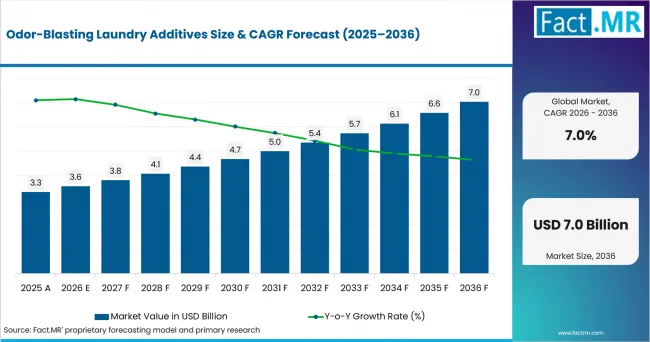
Odor Blasting Laundry Additives Value Analysis | Source: Fact.MR
What are the defining numbers behind Odor-Blasting Laundry Additives Market growth?
USD 3.4 Billion absolute opportunity by 2036, led by odor neutralizers, wash additives and liquid formats.
- Demand Drivers in the Market
- Households need odor neutralizers that work on body and sweat residues because synthetic fabrics often retain smell after a regular wash.
- Pet-owning consumers need pre-treat and wash-stage boosters because bedding, towels and washable covers create repeated odor-removal cycles.
- Online shoppers need clear format choices. The U.S. Census Bureau reported in August 2026 that seasonally adjusted retail e-commerce sales reached USD 340.2 billion in the second quarter of 2026.
- Formulators need safer chemistry claims. The U.S. EPA updated its Safer Choice performance measures in January 2026 and reported 1,656 total products certified by the program for fiscal 2025.
- Key Segments Analyzed
- By Additive Type: Odor neutralizer is expected to hold 36.0% share in 2026 because shoppers want a direct answer to fabric malodor.
- By Use Stage: Wash additive is projected to account for 31.0% share in 2026 as consumers prefer products that fit the normal machine cycle.
- By Odor Target: Body / sweat is anticipated to capture 29.0% share in 2026 due to activewear, school uniforms and work clothing.
- By Format: Liquid is estimated to represent 33.0% share in 2026 owing to easy dosing and fast mixing across common washing machines.
- Analyst Opinion at Fact.MR
- Shambhu Nath Jha, Principal Consultant at Fact.MR, states, "Odor control has become a separate laundry problem that goes beyond detergent fragrance. The market is expected to reward brands that show how an additive works on sweat, pet and mildew odors in a normal wash cycle. Suppliers should combine clear dosage guidance, safer ingredient documentation and credible fabric-care claims."
- Strategic Implications
- Brand owners should separate odor-neutralizing claims from fragrance claims so shoppers understand whether the product removes smell or mainly adds scent.
- Retail teams should group liquids, powders and beads by use stage because consumers search by laundry habit before chemistry type.
- Ingredient suppliers should document enzyme, oxygen and polymer performance on repeated-wear fabrics through plain tests that shoppers can understand.
- Manufacturers should prepare formulation files for allergen labeling, biodegradability review and low-temperature washing claims in regulated markets.
China is projected to record 7.8% CAGR through online daily-necessity sales and larger urban laundry routines. France is anticipated to post 7.7% CAGR as large-retail pricing supports recurring home-care replenishment. The USA is forecast to reach 7.3% CAGR through e-commerce access and certified home-care claims. Germany is estimated to advance at 7.1% CAGR due to laundry-care spending and EU detergent rules. Japan is expected to record 6.2% CAGR as compact formats suit dense homes and drugstore-led replenishment.
How does the Odor-Blasting Laundry Additives Market break down by segment?
Odor neutralizer leads at 36.0%; liquid leads at 33.0%.
Which Additive Type dominates?
Odor neutralizer holds 36.0% share in 2026.
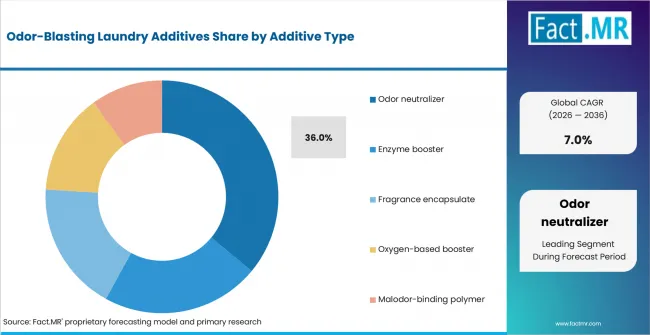
Odor Blasting Laundry Additives Analysis By Additive Type | Source: Fact.MR
Odor neutralizers lead because they give the clearest promise in this market: reduce smell on fabric after washing. They fit sportswear, towels, bedding and pet textiles where shoppers often find regular detergent insufficient for residual odor.
The segment connects functional chemistry with everyday laundry care. Church & Dwight ingredient disclosures list Arm & Hammer Odor Blasters products under laundry/fabric care, showing direct participation in odor-labeled laundry formats.
What leads the Use Stage segment?
Wash additive accounts for 31.0% share in 2026.
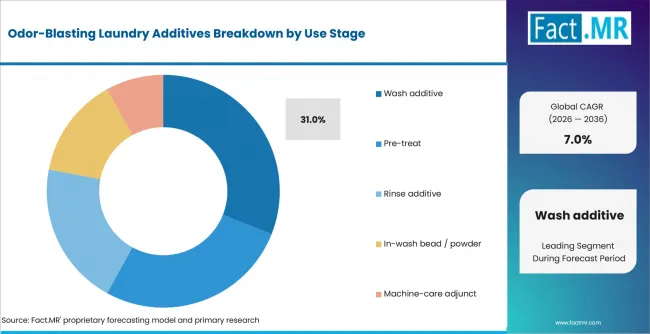
Odor Blasting Laundry Additives Analysis By Use Stage | Source: Fact.MR
Wash additives lead because they keep the laundry process familiar. The product goes into the same washing cycle and addresses smells while detergent handles visible soil.
This stage is commercially practical for liquid boosters, powders and beads. It lets brands explain dosage by load size, fabric type and odor severity through simple on-pack directions.
How does Odor Target shape demand?
Body / sweat captures 29.0% share in 2026.
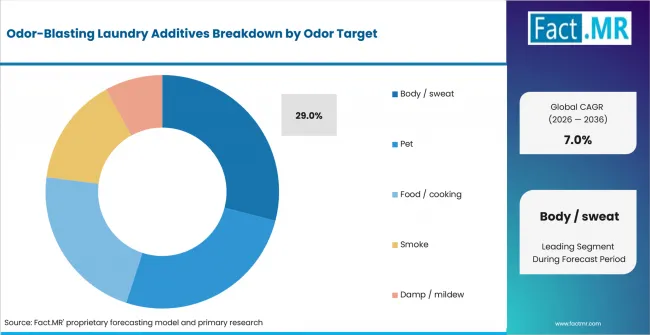
Odor Blasting Laundry Additives Analysis By Odor Target | Source: Fact.MR
Body and sweat odors lead because they repeat across many households after each wear. Sportswear, school clothes, work uniforms and inner layers create frequent treatment occasions.
The U.S. Bureau of Labor Statistics reported in September 2026 that household cleaning product prices rose 2.1% year over year in August 2026. Price visibility makes repeat-use additives more dependent on clear performance claims.
What supports Liquid within Format?
Liquid represents 33.0% share in 2026.
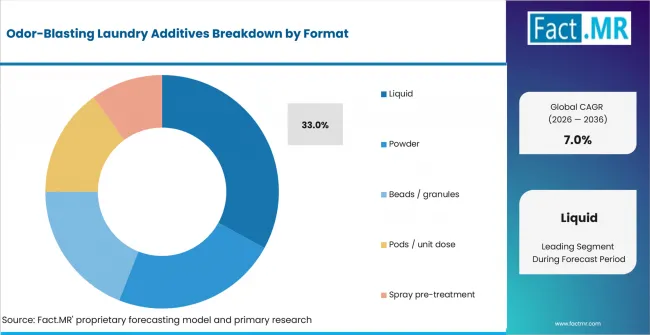
Odor Blasting Laundry Additives Analysis By Format | Source: Fact.MR
Liquid formats lead because consumers already understand liquid detergent dosing. Liquids disperse quickly and support pre-measured caps, refill packs and spray pre-treatment without asking households to learn a new wash habit.
P&G lists laundry additives within Fabric Care on its investor information page. That placement supports the market boundary for products sold beside detergents, fabric enhancers and home-care products.
What is accelerating Odor-Blasting Laundry Additives Market adoption, and what is holding it back?
Demand is expected to rise through odor-specific fabric care and easier retail formats. Adoption is shaped by price pressure, ingredient labeling and formulation proof.
Drivers Impact Analysis
| DRIVERS | (~) % IMPACT ON CAGR | GEOGRAPHIC RELEVANCE | IMPACT TIMELINE |
|---|---|---|---|
| Odor-specific laundry occasions | +1.4% | Global | Short term (<= 2 years) |
| Online retail discovery for boosters | +1.0% | North America, East Asia | Short term (<= 2 years) |
| Liquid and bead format familiarity | +0.8% | Global | Medium term (2-4 years) |
| Safer formulation documentation | +0.6% | USA, Europe, Japan | Medium term (2-4 years) |
Opportunity Impact Analysis
| OPPORTUNITY | (~) % IMPACT ON CAGR | GEOGRAPHIC RELEVANCE | IMPACT TIMELINE |
|---|---|---|---|
| Low-temperature odor removal claims | +0.9% | Europe, Japan | Medium term (2-4 years) |
| Pet and sportswear bundles | +0.8% | North America, Western Europe | Short term (<= 2 years) |
| Concentrated refill and compact formats | +0.7% | Global | Long term (>= 4 years) |
Restraints Impact Analysis
| RESTRAINTS | (~) % IMPACT ON CAGR | GEOGRAPHIC RELEVANCE | IMPACT TIMELINE |
|---|---|---|---|
| Household cleaning price sensitivity | -0.6% | USA, Europe | Short term (<= 2 years) |
| EU detergent and allergen labeling rules | -0.5% | Western Europe | Medium term (2-4 years) |
| Unit-dose and soluble-film review | -0.4% | Europe, Japan | Long term (>= 4 years) |
Which countries are scaling the Odor-Blasting Laundry Additives Market through 2036?
- The country comparison spans 1.6 percentage points and forms three practical growth bands across the forecast period.
- China remains 0.1 percentage point above France through online daily-necessity sales and large retail scale.
- France remains 0.4 percentage point above the USA as large-retail pricing supports recurring household purchases.
- The USA remains 0.2 percentage point above Germany through broad e-commerce access and established additive portfolios.
- Germany remains 0.9 percentage point above Japan through a larger household consumption base and EU detergent rules.
- Japan closes the displayed range through disciplined detergent baskets and compact product formats.
Comparable CAGRs can create different entry conditions due to detergent regulation, retail channels and laundry habits. Full report coverage includes North America, Latin America, Western Europe, Eastern Europe, East Asia, South Asia & Pacific, Middle East & Africa.
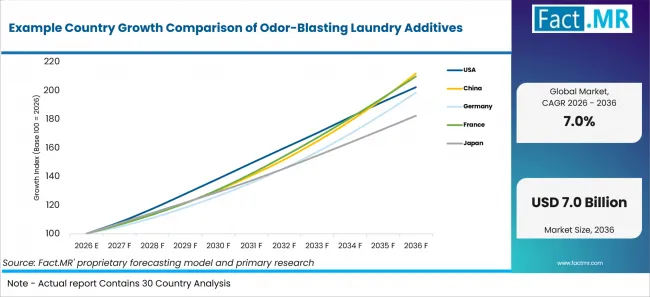
Example Country Growth Comparison Of Odor Blasting Laundry Additives | Source: Fact.MR
| Country | CAGR (2026-2036) |
|---|---|
| China | 7.8% |
| France | 7.7% |
| USA | 7.3% |
| Germany | 7.1% |
| Japan | 6.2% |
How is China scaling demand?
7.8% CAGR, supported by online daily-necessity sales and large retail scale.
China gives odor-control laundry additives a broad digital route to households that search by format and use case. The National Bureau of Statistics reported in January 2026 that online retail sales of physical goods reached 13,092.3 billion yuan in 2025. That channel supports liquids, beads and sprays where shoppers compare sweat, pet and cooking-odor claims before repeat purchase.
What supports France’s growth?
7.7% CAGR, backed by large-retail pricing and fabric-care routines.
France combines frequent grocery-led replenishment with a regulatory setting that favors clear detergent labeling. INSEE reported that, in mainland France’s large-scale retail sector, the combined index for processed food, household cleaning and personal-care products was 0.2% lower year over year in August 2026; cleaning, health and beauty products alone were down 0.4%. That pricing backdrop supports price comparison across recurring home-care purchases.
What supports USA adoption?
7.3% CAGR, driven by e-commerce access and certified home-care claims.
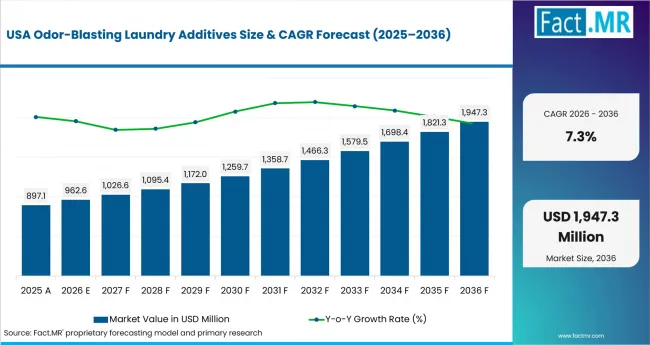
Odor Blasting Laundry Additives Country Value Analysis | Source: Fact.MR
The USA has a broad online channel for repeat laundry-care purchases and strong brand visibility in additives. The U.S. Census Bureau reported in August 2026 that seasonally adjusted retail e-commerce sales reached USD 340.2 billion in the second quarter of 2026. That channel helps households compare odor neutralizers, scent boosters and spray pre-treatments by review, format and odor target.
What is supporting Germany’s adoption?
7.1% CAGR, supported by household consumption scale and detergent documentation needs.
Germany’s detergent culture favors performance claims that explain wash results clearly. Destatis reports private consumption expenditure of domestic households at EUR 2,251.31 billion in 2025. This is an economy-wide household-consumption measure and is used here as broad consumer-spending context rather than a laundry-care spending figure.
How does Japan perform?
6.2% CAGR, led by compact laundry formats and dense-home routines.
Japan’s compact homes and frequent indoor drying make damp and residual fabric smells commercially relevant. The Statistics Bureau of Japan reported in February 2026 that average monthly consumption expenditure per two-or-more-person household was JPY 314,001 in 2025.
Who leads the Odor-Blasting Laundry Additives Market?
Procter & Gamble participates through its Fabric Care portfolio, which includes laundry detergents and fabric enhancers under brands such as Tide, Ariel, Gain and Downy. Henkel participates through Persil®, all® and Snuggle® laundry brands. In 2025, Henkel introduced more concentrated formulas and packaging across these liquid laundry products, including concentrated detergent and fabric-conditioning formats.
Unilever participates through Fabric Cleaning and Fabric Enhancers within its Home Care business, including fragrance-focused fabric-enhancer formats. Reckitt participates directly through Lysol® Laundry Sanitizer, a laundry additive positioned to kill odor-causing bacteria that detergents may leave behind.
Church & Dwight participates through ARM & HAMMER™ and OxiClean™ laundry products, including Odor Blasters™ variants. Kao adds Japan-focused laundry-detergent coverage through brands including Attack ZERO and EMAL. In February 2026, Kao reported that Attack ZERO and EMAL received design certification under a system established pursuant to Japan’s Plastic Resource Circulation Act.
Across these portfolios, suppliers differentiate products through cleaning and odor-control claims, fragrance delivery, product format, concentration and use-stage positioning.
Which companies are the key providers?
Companies covered include Henkel; Procter & Gamble; Unilever; Reckitt; Church & Dwight; and Kao.
- Henkel
- Procter & Gamble
- Unilever
- Reckitt
- Church & Dwight
- Kao
Bibliography
- U.S. Census Bureau. (2026, August 18). Quarterly retail e-commerce sales: 2nd quarter 2026 (Release No. CB26-133).
- U.S. Environmental Protection Agency. (2026, January). Safer Choice performance measures.
- U.S. Bureau of Labor Statistics. (2026, September 11). Consumer Price Index – August 2026 [News release].
- National Bureau of Statistics of China. (2026, January 20). Total retail sales of consumer goods in December 2025.
- Institut national de la statistique et des études économiques. (2026, September 15). In August 2026, consumer prices rose by 2.4% year on year: Consumer price index – final results – August 2026 (Informations rapides No. 218).
- Statistisches Bundesamt. (2026, January 15). Private consumption expenditure.
- Statistics Bureau of Japan. (2026, February 6). 2025 yearly average [Family Income and Expenditure Survey].
- European Parliament, & Council of the European Union. (2026, March 2). Regulation (EU) 2026/405 of the European Parliament and of the Council of 11 February 2026 on detergents and surfactants, and repealing Regulation (EC) No 648/2004. Official Journal of the European Union.
- Henkel. (2025, April 2). Henkel debuts new concentrated formulas for all®, Persil® and Snuggle® liquid laundry products.
- Kao Corporation. (2026, February 27). Kao becomes one of the first companies to receive certification under the “Guideline for Design of Plastic-Containing Products” design certification system based on the Plastic Resource Circulation Act for three of its products including Attack ZERO.
- Church & Dwight Co., Inc. (2026, February 1). Ingredient disclosure [Product ingredient disclosure for Arm & Hammer™ plus OxiClean™ Liquid Laundry Detergent – Odor Blasters™ Fresh Burst].
- Reckitt. (2025, March 27). Lysol continues celebrating unsung sports heroes.
- Unilever PLC. (2026). Annual report and accounts 2025 [Annual report].
This Report Answers
- The report explains where odor-blasting laundry additives are used across additive type, use stage, odor target and format.
- Segment analysis identifies the leading subsegments and the practical reasons consumers select them.
- Country analysis examines the listed markets and the retail, pricing or regulatory mechanisms supporting adoption.
- Competitive analysis reviews current providers across detergent, fabric-care, stain-removal and odor-control additive portfolios.
- Application analysis assesses how sweat, pet, food, smoke and damp-mildew odors influence purchase decisions.
What does the Odor-Blasting Laundry Additives Market cover?
The Odor-Blasting Laundry Additives Market covers products used alongside laundry detergent to reduce or manage fabric malodor. It is adjacent to laundry cleaning products, where detergents, softeners and boosters share retail shelf space.
The assessment includes odor neutralizers and boosters positioned around sweat, pet and damp-fabric smells. Related coverage on odor-neutralizing fabric agents helps define the chemistry boundary for fabric-care odor control.
What is included in the scope?
The scope includes consumer laundry additives sold in liquid, powder, bead, granule, pod and spray forms. The format review links to fragrance encapsulation agents where microcapsule release systems support longer-lasting scent effects.
Soil-suspension and wash-performance additives are included when odor management is part of the product role. Coverage of detergent CMC helps frame anti-redeposition and fabric-care additive functions.
What is excluded from the scope?
Standard detergents, fabric softeners and dryer sheets fall outside the scope when they carry no odor-blasting additive role. Separate coverage of commercial laundry detergents is used only as an adjacent laundering reference.
Room sprays, carpet deodorizers and surface cleaners are outside the fabric-laundry boundary. Related coverage of household cleaners is used only to separate home cleaning from washable-fabric additives.
How Was the Analysis Built?
The analysis draws on 120+ sources, 35+ company portfolios, 25+ countries, and more than 20 industry interviews.
- Primary Research: Primary research includes discussions with manufacturers, service providers, technology developers, distributors, end users, and subject-matter experts. These conversations examine purchasing priorities, product adoption, operational challenges, approval requirements, competitive positioning, and the factors that influence wider market acceptance.
- Desk Research: Desk research covers government statistics, regulatory publications, company filings, trade data, technical studies, industry associations, standards, public policy, and other authoritative sources. Every source used in the analysis is documented in the bibliography.
- Market Sizing and Forecasting: Market estimates combine historical performance, demand indicators, pricing and volume trends, segment shares, company participation, country-level growth, adoption patterns, investment activity, and barriers to market expansion.
- Data Validation and Update Cycle: Findings are validated by comparing primary interviews with public data, company activity, regulatory changes, trade patterns, and industry developments. Regular updates review new product launches, capacity changes, partnerships, approvals, and shifts in commercial adoption.
What is the report's scope and coverage?
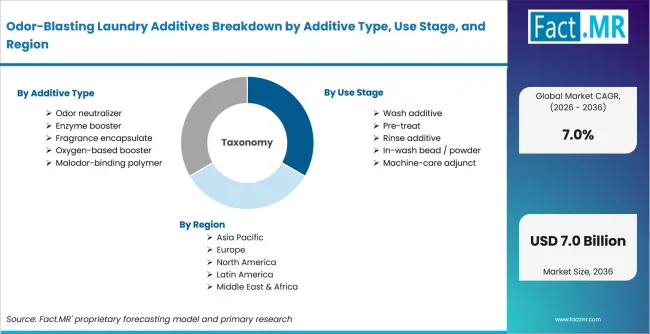
Odor Blasting Laundry Additives Breakdown By Additive Type, Use Stage, And Region | Source: Fact.MR
| Attribute | Details |
|---|---|
| Quantitative Units | USD Billion |
| Market Definition | Consumer laundry additive products used with or around detergent to reduce fabric malodor from sweat, pets, food, smoke and damp storage. |
| Additive Type | Odor neutralizer; Enzyme booster; Fragrance encapsulate; Oxygen-based booster; Malodor-binding polymer |
| Use Stage | Wash additive; Pre-treat; Rinse additive; In-wash bead / powder; Machine-care adjunct |
| Odor Target | Body / sweat; Pet; Food / cooking; Smoke; Damp / mildew |
| Format | Liquid; Powder; Beads / granules; Pods / unit dose; Spray pre-treatment |
| Regions Covered | North America; Latin America; Western Europe; Eastern Europe; East Asia; South Asia & Pacific; Middle East & Africa |
| Countries Covered | China; France; USA; Germany; Japan |
| Companies Profiled | Henkel; Procter & Gamble; Unilever; Reckitt; Church & Dwight; Kao |
| Forecast Period | 2026 to 2036 |
| Approach | Hybrid top-down and bottom-up approach using laundry-care spending indicators; retail channel activity; odor-target use cases; format mix; company portfolio review; and country-level adoption factors. |
How is the market segmented?
-
By Additive Type
- Odor neutralizer
- Enzyme booster
- Fragrance encapsulate
- Oxygen-based booster
- Malodor-binding polymer
-
By Use Stage
- Wash additive
- Pre-treat
- Rinse additive
- In-wash bead / powder
- Machine-care adjunct
-
By Odor Target
- Body / sweat
- Pet
- Food / cooking
- Smoke
- Damp / mildew
-
By Format
- Liquid
- Powder
- Beads / granules
- Pods / unit dose
- Spray pre-treatment
-
By Region
- North America
- Latin America
- Western Europe
- Eastern Europe
- East Asia
- South Asia & Pacific
- Middle East & Africa