- Market Value (2025): USD 3.3 Bn
- Estimated Value (2026): USD 3.5 Bn
- Forecast Value (2036): USD 6.3 Bn
- CAGR (2026-2036): 5.9%
What is the OEM High-Runner Lines Market forecast to be worth by 2036?
USD 3.5 billion in 2026 to USD 6.3 billion by 2036 at a 5.9% CAGR.
- The OEM High-Runner Lines Market was valued at USD 3.3 billion in 2025.
- Demand is projected to increase from USD 3.5 billion in 2026 to USD 6.3 billion by 2036.
- The market is forecast to record a 5.9% CAGR from 2026 to 2036 as paint-shop planners and component plants standardize repeatable finishing lines.
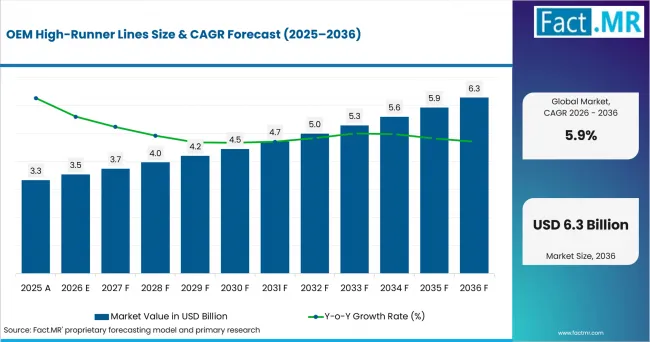
Oem High Runner Lines Value Analysis | Source: Fact.MR
What are the defining numbers behind OEM High-Runner Lines Market growth?
USD 2.8 billion absolute opportunity by 2036, led by automotive body paint lines, robotic application and 41-60 JPH throughput.
- Demand Drivers in the Market
- Automotive paint-shop engineers need repeatable body handling and coating control as model programs move through high-volume coating windows.
- Plant managers need energy-aware drying and booth systems where curing load, airflow control and oven sequencing shape operating cost.
- The Department for Business and Trade launched DRIVE35 with a £2.5 billion commitment in July 2025. Government guidance updated in August 2026 states that DRIVE35 is now a £4 billion capital and R&D programme to 2035 supporting the transition to zero-emission vehicle manufacturing.
- Automation teams need robot paths, spray controls and inspection data to reduce rework when high-runner programs operate across several shifts.
- Key Segments Analyzed
- By Line Segment: Automotive body paint lines are expected to hold 39.0% share in 2026 due to high capital intensity and direct use in vehicle OEM finishing plants.
- By Process: E-coat + primer + topcoat is projected to account for 34.0% share in 2026, supported by corrosion protection needs and complete body appearance specifications.
- By Automation: Robotic application is anticipated to capture 43.0% share in 2026 owing to its repeatability across body panels and high-volume components.
- By Throughput: 41-60 JPH is estimated to represent 31.0% share in 2026 as mixed-model OEM lines balance volume, downtime risk and product changeover.
- Analyst Opinion at Fact.MR
- Shambhu Nath Jha, Principal Consultant at Fact.MR, states, “OEM high-runner lines are purchased around uptime and cost per finished unit. The market is expected to favor suppliers that connect robot motion, curing control and plant data. Paint-shop owners should look for systems that protect throughput and support easier model changeovers.”
- Strategic Implications
- Paint-shop equipment vendors should document line availability, transfer efficiency and rework reduction by process stage.
- Automotive OEMs should compare total paint-shop energy use before approving new body-line or brownfield upgrade projects.
- Taikisha launched a dedicated Paint Finishing System Business website in February 2026. The company said the site presents its paint-finishing technologies and services in a globally consistent, systematic format.
- Automation integrators should link MES data with vision inspection so production teams trace defects back to process conditions.
The UK is forecast to post 7.4% CAGR through 2036, reinforced by zero-emission vehicle manufacturing support. The USA is projected to record 7.0% as vehicle output and robotic painting demand remain visible. Japan is anticipated to advance at 6.6% due to automation density. Germany is estimated to reach 6.3% through electric-car production. South Korea is expected to record 5.4% as export-oriented OEMs invest in flexible lines.
How does the OEM High-Runner Lines Market break down by segment?
Automotive body paint lines lead at 39.0%; robotic application leads at 43.0%.
Which Line Segment dominates?
Automotive body paint lines are expected to hold 39.0% share in 2026.
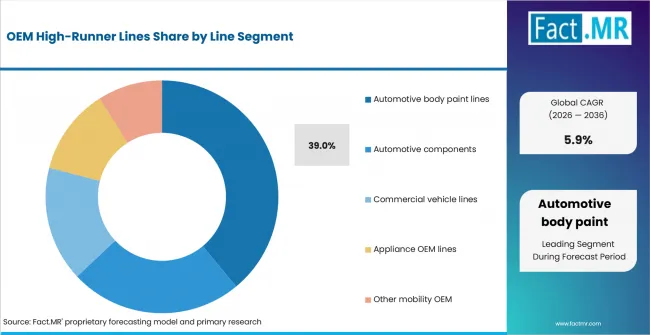
Oem High Runner Lines Analysis By Line Segment | Source: Fact.MR
Automotive body paint lines lead because the full vehicle body passes through pretreatment, coating, drying and inspection before final assembly. A defect at this stage affects the full vehicle, so OEMs require stable conveyors, robot paths and environmental control.
Complete body lines also receive larger budgets than component cells because every platform change can affect hangers, booth layout and cure timing. That position keeps body paint lines at the center of high-runner investment.
What leads the Process segment?
E-coat + primer + topcoat is projected to account for 34.0% share in 2026.
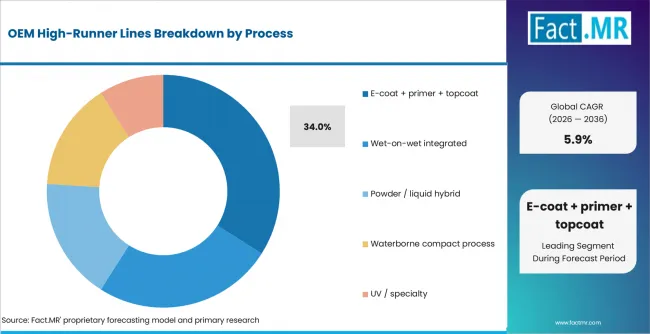
Oem High Runner Lines Analysis By Process | Source: Fact.MR
E-coat + primer + topcoat leads because it protects the body shell before the appearance layer is applied. The process links corrosion resistance with visible finish quality for vehicle OEMs and commercial vehicle plants.
Wet-on-wet and compact waterborne processes gain attention when plants seek shorter ovens or lower booth space. E-coat + primer + topcoat remains the reference route for full-body programs because validation routines are familiar to engineering teams.
How does Automation shape demand?
Robotic application is anticipated to capture 43.0% share in 2026.
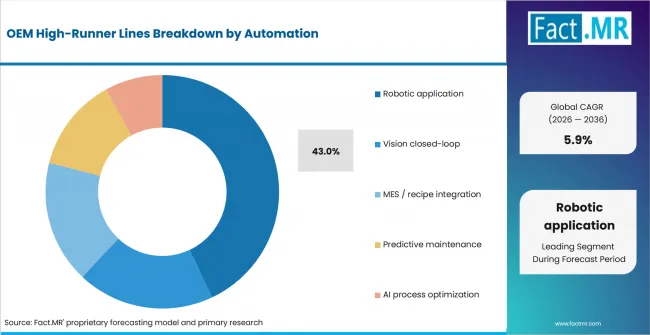
Oem High Runner Lines Analysis By Automation | Source: Fact.MR
Robotic application leads because spray path repeatability affects coating thickness, overspray and visible finish. Robots also help plants maintain speed when body variants and exterior colors change.
The International Federation of Robotics reported in May 2025 that U.S. automotive robot installations reached 13,700 units in 2024, up 10.7%. This provides recent evidence of the scale of automotive automation in the United States.
What supports demand within Throughput?
41-60 JPH is estimated to represent 31.0% share in 2026.
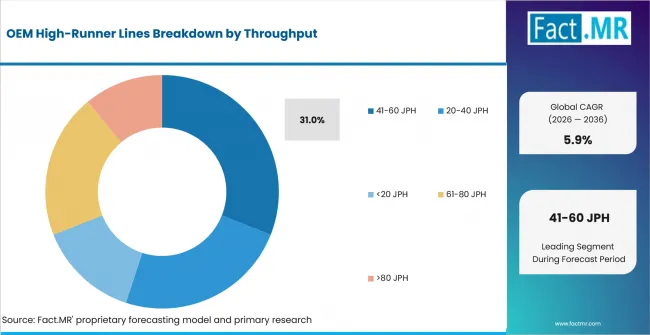
Oem High Runner Lines Analysis By Throughput | Source: Fact.MR
The 41-60 JPH band leads because it fits plants that need volume while retaining room for mixed-model scheduling. It suits facilities handling more than one body style or component family.
Higher bands require greater buffer capacity and stronger coordination between coating, drying and inspection. Lower bands remain useful for specialized products, but high-runner economics favor the middle band where uptime and flexibility align.
What is accelerating OEM High-Runner Lines Market adoption, and what is holding it back?
Demand is expected to rise through EV paint-shop renewal and robotic application. Adoption is constrained by capex and model-mix complexity.
Drivers Impact Analysis
| DRIVER | (~) % IMPACT ON CAGR | GEOGRAPHIC RELEVANCE | IMPACT TIMELINE |
|---|---|---|---|
| EV body and component paint-shop renewal | +1.3% | Europe, North America, East Asia | Medium term (2-4 years) |
| Energy-aware drying and booth control | +1.0% | Germany, Japan, UK | Medium term (2-4 years) |
| Robotic repeatability in high-volume coating | +0.9% | Global | Short term (<= 2 years) |
| Standardized component and appliance lines | +0.6% | North America, Europe, East Asia | Long term (>= 4 years) |
Opportunity Impact Analysis
| OPPORTUNITY | (~) % IMPACT ON CAGR | GEOGRAPHIC RELEVANCE | IMPACT TIMELINE |
|---|---|---|---|
| Brownfield modular paint-shop upgrades | +0.9% | USA, UK, Germany | Short term (<= 2 years) |
| Vision closed-loop defect control | +0.7% | Japan, South Korea, Germany | Medium term (2-4 years) |
| Powder and liquid hybrid cells | +0.5% | Global | Long term (>= 4 years) |
Restraints Impact Analysis
| RESTRAINT | (~) % IMPACT ON CAGR | GEOGRAPHIC RELEVANCE | IMPACT TIMELINE |
|---|---|---|---|
| High capital cost and production downtime | -0.7% | Global | Short term (<= 2 years) |
| Model-mix complexity in paint-shop layout | -0.5% | Europe, East Asia | Medium term (2-4 years) |
| Shortage of experienced commissioning teams | -0.3% | North America, Europe | Long term (>= 4 years) |
Which countries are scaling the OEM High-Runner Lines Market through 2036?
- The country comparison spans 2.0 percentage points and forms two practical growth bands across the forecast period.
- The UK remains 0.4 percentage point above the USA through zero-emission vehicle manufacturing support.
- The USA remains 0.4 percentage point above Japan as motor vehicle output sustains automated finishing demand.
- Japan remains 0.3 percentage point above Germany through automation density and precision finishing demand.
- Germany remains 0.9 percentage point above South Korea as electric-car production supports paint-shop renewal.
- South Korea closes the displayed range through export-led OEM manufacturing and eco-friendly vehicle sales.
Comparable CAGRs create different entry conditions due to energy costs, vehicle platforms, automation maturity and shutdown risk. Full report coverage includes North America, Latin America, Western Europe, Eastern Europe, East Asia, South Asia & Pacific, Middle East & Africa.
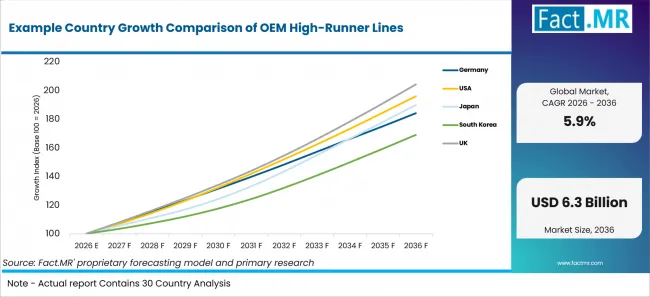
Example Country Growth Comparison Of Oem High Runner Lines | Source: Fact.MR
| Country | CAGR (2026-2036) |
|---|---|
| United Kingdom | 7.4% |
| USA | 7.0% |
| Japan | 6.6% |
| Germany | 6.3% |
| South Korea | 5.4% |
What supports UK adoption?
7.4% CAGR, reinforced by zero-emission vehicle manufacturing and model renewal.
UK paint-shop investment is expected to focus on EV-ready body handling, flexible color sequencing and compact component finishing. The Department for Transport reported in April 2026 that 473,000 zero-emission cars were registered for the first time in 2025. This provides current context for the UK's transition toward zero-emission passenger cars.
What supports USA adoption?
7.0% CAGR, supported by motor vehicle output and robotic paint-shop automation.
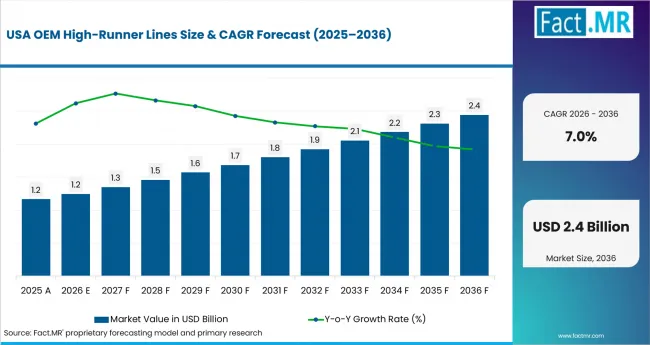
Oem High Runner Lines Country Value Analysis | Source: Fact.MR
U.S. demand is expected to come from brownfield upgrades at established assembly plants and automated coating cells for high-volume components. The Board of Governors of the Federal Reserve System's motor vehicles and parts production index, available via FRED, shows a 2025 annual level of 105.6176. This provides a recent indicator of U.S. motor-vehicle manufacturing activity.
How is Japan developing demand?
6.6% CAGR, driven by automation density and precision body finishing.
Japan is anticipated to favor high-runner lines that protect takt time, film-build control and export finish consistency. The International Federation of Robotics reported in July 2025 that Japanese automotive plants installed about 13,000 industrial robots in 2024. This provides recent evidence of the scale of automation in Japan's automotive manufacturing base.
What is supporting Germany’s adoption?
6.3% CAGR, supported by electric-car output and energy-aware paint-shop upgrades.
Germany is expected to remain centered on energy-aware paint shops, emission control and platform renewal for electric vehicles. VDA reported in February 2026 that Germany produced 1.67 million electric passenger cars in 2025. This provides current context for the scale of electric passenger-car production in Germany.
How does South Korea perform?
5.4% CAGR, led by export programs and eco-friendly vehicle production needs.
South Korea is forecast to support high-runner line demand through export plants that require consistent appearance quality and fast model changeover. The Ministry of Trade, Industry and Resources reported in January 2026 that automobile exports reached USD 72.0 billion in 2025. This provides current context for the scale of South Korea's automotive export activity.
Who leads the OEM High-Runner Lines Market?
Dürr supplies turnkey automotive paint shops, application technology and software-based energy and process-management solutions. Its 2025 Volkswagen Puebla project demonstrates high-throughput body painting, electric drying and automated material transport, with the facility designed to paint 90 vehicle bodies per hour using systems including EcoInCure electric ovens, a high-bay warehouse and EcoProFleet driverless transport.
Taikisha provides automotive paint-finishing systems supported by airflow-control and exhaust-treatment technologies. EISENMANN GmbH, which became a wholly owned Daifuku subsidiary in July 2026, provides industrial painting and surface-treatment systems together with material-handling and conveyor technologies for paint-shop and industrial applications.
Geico S.p.A. provides customizable turnkey automotive paint shops and Smart Paintshop technologies for digitalized plant operation. Cefla Finishing supplies industrial finishing and coating lines for sectors including automotive and durable consumer goods, with applications covering vehicle components and whiteware. Nordson supports automotive manufacturing through powder-coating, liquid-painting and paint-shop application equipment.
Across these suppliers, portfolios emphasize turnkey project execution, automated paint application, material handling, energy and process management, digital monitoring, maintenance support and solutions for both new installations and existing production environments.
Which companies are the key providers?
Key companies include Dürr; Taikisha Ltd.; Eisenmann GmbH; Geico S.p.A.; Cefla Finishing; and Nordson Corporation.
- Dürr
- Taikisha Ltd.
- Eisenmann GmbH
- Geico S.p.A.
- Cefla Finishing
- Nordson Corporation
Bibliography
- Board of Governors of the Federal Reserve System (US). (2026, June 15). Industrial production: Manufacturing: Durable goods: Motor vehicles and parts (NAICS = 3361–3) [Data series]. FRED, Federal Reserve Bank of St. Louis.
- Daifuku Co., Ltd. (2026, July 2). [Progress of disclosed matter] Notice regarding the completion of the acquisition of shares in EISENMANN GmbH (Germany).
- Department for Business and Trade. (2025, July 13). Backing British industry: Government launches £2.5bn DRIVE35 programme to power UK auto investment and jobs. GOV.UK.
- Department for Business, Innovation, Science and Trade, & Department for Business and Trade. (2026, August 10). Apply for automotive funding via the DRIVE35 programme. GOV.UK.
- Department for Transport. (2026, April 29). Vehicle licensing statistics, United Kingdom: 2025. GOV.UK.
- Dürr Systems AG. (2025, September 1). Dürr building a CO2-efficient paint shop as a turnkey project for Volkswagen.
- International Federation of Robotics. (2025, July 15). Japan’s car industry has highest robot installations in five years.
- International Federation of Robotics. (2025, May 8). Robot installed in US auto industry up by double digits.
- Ministry of Trade, Industry and Resources. (2026, January 15). Automobile exports hit record high of $72 billion in 2025.
- Taikisha Ltd. (2026, February 12). Notice of launch of the Paint Finishing System Business website.
- Verband der Automobilindustrie e.V. (VDA). (2026, February 3). New record: 40% electric share of passenger car production in 2025.
This Report Answers
- The report explains where OEM high-runner lines are used across body paint, component, commercial vehicle and appliance OEM environments.
- Segment analysis identifies the line segment, process, automation and throughput combinations that shape equipment selection.
- Country analysis examines Germany, the USA, Japan, South Korea and the UK through automotive output, EV transition and automation evidence.
- Competitive analysis reviews current providers across turnkey paint shops, robotic application, smart paint-shop software and industrial finishing lines.
- Application analysis assesses how takt time, energy use, rework control and line availability influence plant-level investment.
What does the OEM High-Runner Lines Market cover?
The OEM High-Runner Lines Market covers complete and modular production lines that apply coatings or surface finishes to repeat products at OEM plants. It includes vehicle body paint lines, component coating systems and appliance finishing lines.
Coverage includes line equipment connected with coating, curing, handling, inspection and recipe control. It also connects coverage of automotive OEM coatings, industrial paint booths, powder coating equipment, factory robot systems and robot vision systems where those categories overlap with high-volume OEM finishing.
What is included in the scope?
The scope includes turnkey paint shops, automated coating cells, booth systems, curing lines, application robots, paint delivery equipment and production software.
The included technology base connects with industrial automation control systems, robot arms, robotic end-of-arm tooling, industrial robot components and dispensing robot systems when these technologies are deployed inside OEM finishing lines.
What is excluded from the scope?
The scope excludes standalone coatings and consumables when sold apart from line equipment. It also excludes factory buildings, unrelated material handling systems, manual paint tools and raw robots sold apart from coating integration.
General manufacturing automation is excluded when it covers tasks outside OEM coating, curing, surface finishing or paint-shop process control. Vehicle assembly and body welding equipment enter the scope only when packaged with the finishing line.
How Was the Analysis Built?
The analysis draws on 120+ sources, 35+ company portfolios, 25+ countries, and more than 20 industry interviews.
- Primary Research: Primary research includes discussions with manufacturers, service providers, technology developers, distributors, end users, and subject-matter experts. These conversations examine purchasing priorities, product adoption, operational challenges, approval requirements, competitive positioning, and the factors that influence wider market acceptance.
- Desk Research: Desk research covers government statistics, regulatory publications, company filings, trade data, technical studies, industry associations, standards, public policy, and other authoritative sources. Every source used in the analysis is documented in the bibliography.
- Market Sizing and Forecasting: Market estimates combine historical performance, demand indicators, pricing and volume trends, segment shares, company participation, country-level growth, adoption patterns, investment activity, and barriers to market expansion.
- Data Validation and Update Cycle: Findings are validated by comparing primary interviews with public data, company activity, regulatory changes, trade patterns, and industry developments. Regular updates review new product launches, capacity changes, partnerships, approvals, and shifts in commercial adoption.
What is the report’s scope and coverage?
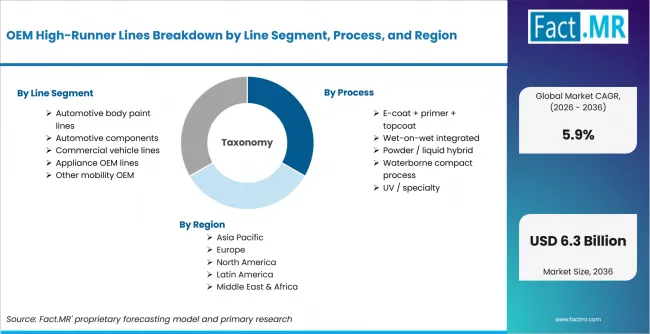
Oem High Runner Lines Breakdown By Line Segment, Process, And Region | Source: Fact.MR
| Attribute | Details |
|---|---|
| Quantitative Units | USD billion in 2026 to USD billion by 2036 at a CAGR |
| Market Definition | Integrated production lines used by OEM plants and high-volume component manufacturers for repeatable coating, curing, handling, inspection and recipe-controlled finishing. |
| Line Segment | Automotive body paint lines; Automotive components; Commercial vehicle lines; Appliance OEM lines; Other mobility OEM |
| Process | E-coat + primer + topcoat; Wet-on-wet integrated; Powder / liquid hybrid; Waterborne compact process; UV / specialty |
| Automation | Robotic application; Vision closed-loop; MES / recipe integration; Predictive maintenance; AI process optimization |
| Throughput | <20 JPH; 20-40 JPH; 41-60 JPH; 61-80 JPH; >80 JPH |
| Regions Covered | North America; Latin America; Western Europe; Eastern Europe; East Asia; South Asia & Pacific; Middle East & Africa |
| Countries Covered | Germany; USA; Japan; South Korea; UK |
| Key Companies Profiled | Dürr; Taikisha Ltd.; Eisenmann GmbH; Geico S.p.A.; Cefla Finishing; Nordson Corporation |
| Forecast Period | 2026 to 2036 |
| Approach | Hybrid top-down and bottom-up approach using OEM finishing investment, vehicle production indicators, automation evidence, throughput bands, country adoption and provider portfolio review. |
How is the market segmented?
-
By Line Segment
- Automotive body paint lines
- Automotive components
- Commercial vehicle lines
- Appliance OEM lines
- Other mobility OEM
-
By Process
- E-coat + primer + topcoat
- Wet-on-wet integrated
- Powder / liquid hybrid
- Waterborne compact process
- UV / specialty
-
By Automation
- Robotic application
- Vision closed-loop
- MES / recipe integration
- Predictive maintenance
- AI process optimization
-
By Throughput
- <20 JPH
- 20-40 JPH
- 41-60 JPH
- 61-80 JPH
- >80 JPH
-
By Region
- North America
- Latin America
- Western Europe
- Eastern Europe
- East Asia
- South Asia & Pacific
- Middle East & Africa