- Estimated Value(2026): 1.8 Bn
- Forecast Value (2036): 3.4 Bn
- CAGR (2026 - 2036): 6.7%
Toilet Roll Converting Lines Market Forecast and Outlook 2026 to 2036
In 2025, the toilet roll converting lines market surpassed a valuation of USD 1.7 billion. Based on Fact.MR analysis, demand for toilet roll converting lines is estimated to grow to USD 1.8 billion in 2026 and USD 3.4 billion by 2036. Fact.MR projects a CAGR of 6.7% during the forecast period.
The global toilet roll converting lines market is expected to generate an absolute dollar opportunity of around USD 1.6 billion during the 2026 to 2036 period. Growth is supported by rising private label tissue production capacity investment, replacement demand driven by energy efficiency mandates, and the accelerating shift to high-speed automatic lines in Asia Pacific and Latin America as converter margins tighten under retail pricing pressure.
Dino Bianco, CEO of KP Tissue/Kruger Products said, "Our Adjusted EBITDA was highlighted by robust sales volume in our Consumer segment and improved productivity from our network assets. ... We also benefited from a seasonally strong quarter, lower pulp and other input costs, as well as 2022 pricing carry over. As a result, we outperformed expectations despite an uncertain economic environment."
Country growth reflects tissue production capacity investment intensity, private label retail expansion, and energy compliance obligations. China leads at 7.0% CAGR, driven by domestic tissue brand expansion and large-scale converting line upgrades by national producers such as Vinda and C&S Paper. India follows at 6.4%, supported by rising organized retail penetration and greenfield tissue manufacturing investment by ITC and Godrej Consumer Products. Germany posts 7.2% as Tier 1 European OEMs integrate energy-efficient and Industry 4.0-compatible converting platforms ahead of EU industrial efficiency requirements. The United States posts 7.8%, anchored by private label tissue capacity expansion and Procter and Gamble and Kimberly-Clark fleet modernisation programmes. Japan records 6.7% supported by automated line upgrades by Oji Holdings and Nippon Paper Industries for export-grade tissue production.
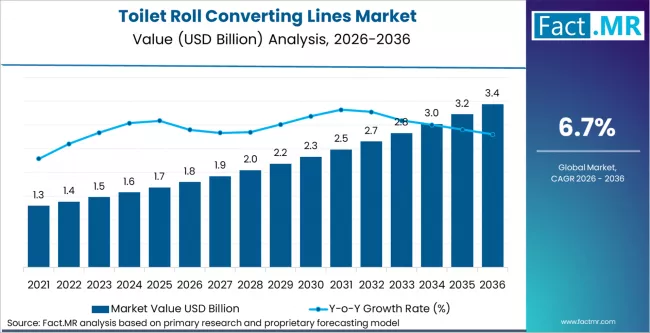
Toilet Roll Converting Lines Market Market Value Analysis | Source: Fact.MR
| Metric | Value |
|---|---|
| Estimated Value in 2026 | USD 1.8 billion |
| Forecast Value in 2036 | USD 3.4 billion |
| Forecast CAGR (2026 to 2036) | 6.7% |
Source: Fact.MR analysis. Updated Mar 9, 2026
Market Definition
The toilet roll converting lines market includes machinery systems that convert parent tissue reels into finished toilet rolls through unwinding, perforating, embossing, log cutting, wrapping, and packaging processes.
Market Inclusions
The report provides global and regional forecasts from 2026 to 2036 across automatic, semi-automatic, and manual converting lines by production capacity and end use. Coverage includes tissue manufacturers, contract converters, and private label producers across the United States, Germany, China, Japan, and India with analysis of pricing, automation adoption, and energy compliance costs.
Market Exclusions
Standalone tissue paper machines, parent reel production equipment, and napkin or facial tissue converting lines are excluded unless integrated into toilet roll converting systems. Spare parts, maintenance services, retrofitting kits for legacy equipment, finished toilet roll products, and packaging materials are not included.
Research Methodology
- Primary Research: Interviews were conducted with converting line OEM sales directors, tissue manufacturer procurement managers, contract converter operations head, private label retail buyers, and equipment leasing executives.
- Desk Research: Sources include OEM investor reports, tissue industry association publications, retail sustainability guidelines, energy efficiency regulations, and converting line technology patent filings.
- Market Sizing and Forecasting: A hybrid top down and bottom up model used tissue production volumes, converting line installations, equipment prices by capacity tier, replacement cycles, and regional automation adoption rates.
- Data Validation and Update Cycle: Results were validated using OEM shipment data, tissue industry capacity statistics, and procurement manager interviews, with forecasts updated annually based on regulation changes and market trends.
Summary of Toilet Roll Converting Lines Market
- Market Definition
- Toilet roll converting lines are machinery systems that convert parent tissue reels into finished toilet rolls through unwinding, perforating, embossing, log cutting, wrapping, and packaging.
- Demand Drivers
- Expansion of private label tissue production by retailers such as Walmart, Lidl, and Carrefour is increasing demand for high speed automatic converting lines.
- Rising labour costs in Asia Pacific and Latin America are pushing converters to shift from semi-automatic to fully automatic production lines.
- Energy efficiency regulations in Europe and North America are encouraging replacement of older converting equipment with servo driven automatic systems.
- Key Segments Analyzed
- By Machine Type: Automatic converting lines hold about 67% share in 2026 due to higher speed, lower labour dependence, and suitability for large scale production.
- By Production Capacity: High capacity lines above 1,000 rolls per minute account for about 71% of market value in 2026 due to strong demand from large tissue manufacturers.
- By Geography: The United States leads growth with a 7.8% CAGR through 2036, supported by private label expansion and fleet modernisation by major producers.
- Analyst Opinion at FACT.MR
- Shambhu Nath Jha, Principal Consultant at Fact.MR, opines, “CXOs will find that the toilet roll converting lines market growth through 2036 is driven by automation upgrades, private label production expansion, and energy compliance investment across major tissue producing regions.”
- Strategic Implications
- OEMs should offer modular automatic converting lines that allow converters to upgrade gradually from semi-automatic systems.
- Equipment suppliers in Asia Pacific should build strong service and spare parts networks in China and India.
- Manufacturers should integrate digital monitoring and predictive maintenance features into new converting line systems.
- Methodology
- Market sizing combined converting line shipment volumes by machine type with average unit prices validated using dealer sales data and manufacturer disclosures.
- Private label tissue production trends, energy regulations, and labour cost benchmarks were verified using industry reports and government data.
- Regional forecasts used tissue production activity, equipment installations, regulation timelines, and interviews with procurement managers and OEM executives.
Segmental Analysis
Toilet Roll Converting Lines Market Analysis by Machine Type
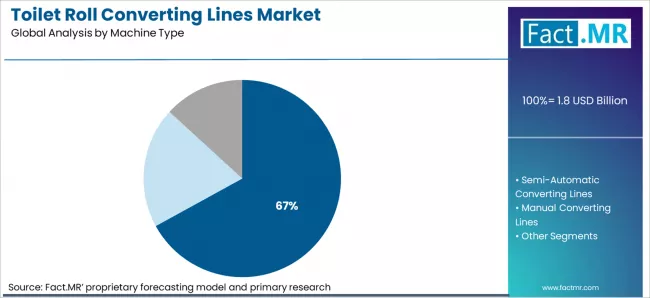
Toilet Roll Converting Lines Market Analysis By Machine Type | Source: Fact.MR
According to FACT.MR analysis, automatic converting lines are expected to hold about 67% share in 2026 due to higher output, lower labour requirements, and compatibility with large scale production.
- In 2024 Körber Tissue launched the TITAN HS converting line capable of producing over 1,200 rolls per minute with integrated quality inspection and digital monitoring features. [5]
- Fabio Perini introduced modular automatic converting line systems in 2025 allowing converters to scale capacity from 400 to 900 rolls per minute with lower capital investment. [6]
- Semi-automatic converting lines continue to see demand in India and Vietnam where small converters supply domestic retail markets at lower investment costs. [7]
Toilet Roll Converting Lines Market Analysis by Production Capacity
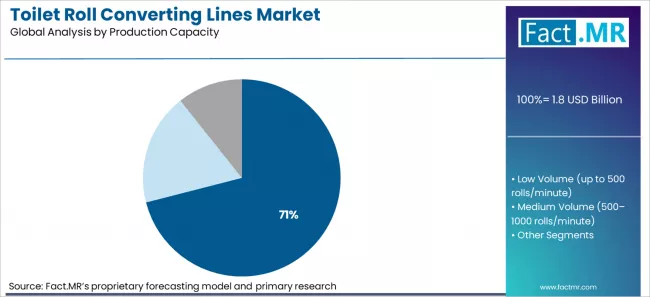
Toilet Roll Converting Lines Market Analysis By Production Capacity | Source: Fact.MR
High capacity converting lines above 1,000 rolls per minute account for around 71% of market value in 2026 due to strong adoption by large tissue producers and contract converters.
- In 2025 Futura installed high capacity converting lines in the United States operating above 1,100 rolls per minute with integrated automation systems. [8]
- Gambini introduced upgraded medium capacity converting lines in 2024 ranging from 500 to 1,000 rolls per minute with improved embossing and faster changeover features. [9]
- Demand for low capacity converting lines below 500 rolls per minute is rising in emerging markets such as Nigeria, Kenya, and Indonesia from new tissue converter entrants. [10]
Key Dynamics
Drivers, Restraints, and Opportunities
FACT.MR analysts note that the toilet roll converting lines market closely follows global tissue production expansion and retail private label growth. Rising tissue consumption and periodic equipment replacement cycles support steady demand for converting lines.
The market shows a split trend. Large tissue producers are investing in automated high speed lines, while small converters in cost sensitive markets continue using semi-automatic systems. Automation drives value growth, while semi-automatic installations support shipment volumes.
- Private label retail expansion is increasing converting line investment. Retailers such as Walmart, Lidl, Aldi, and Carrefour are requiring contract converters to adopt high speed automatic lines to meet volume and quality standards. [2]
- EU Energy Efficiency Directive 2023 is accelerating equipment replacement in Europe. Tissue producers are upgrading to servo driven automatic converting lines that reduce energy consumption and meet regulatory compliance requirements. [3]
- New tissue production facilities in China, India, and Southeast Asia are creating demand for new converting line installations beyond replacement cycles. [4]
Regional Analysis
The toilet roll converting lines market is analysed across Asia Pacific, Europe, North America, Latin America, and Middle East and Africa, covering 40+ countries with distinct demand profiles shaped by tissue production capacity investment, private label retail expansion, energy compliance requirements, and converting line automation adoption. The full report offers market attractiveness analysis by region based on capacity investment pipelines, regulatory mandate timelines, and OEM competitive positioning.
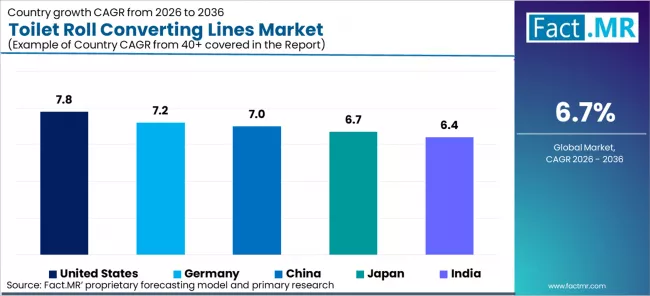
Toilet Roll Converting Lines Market Cagr Analysis By Country | Source: Fact.MR
| Country | CAGR (2026-2036) |
|---|---|
| United States | 7.8% |
| Germany | 7.2% |
| China | 7.0% |
| Japan | 6.7% |
| India | 6.4% |
Source: Fact.MR analysis. Updated Mar 9, 2026
Source: Fact.MR (FACT.MR) analysis, based on proprietary forecasting model and primary research
Asia Pacific Toilet Roll Converting Lines Market Analysis
Asia Pacific is the fastest growing region for toilet roll converting lines due to rising tissue production capacity in China and India and increasing tissue consumption across Southeast Asia. Chinese OEMs such as BaoSuo Paper Machinery and Dechangyu Paper Machinery compete strongly in mid-range systems, while Körber Tissue and Fabio Perini lead in high specification automatic lines.
- China: China’s toilet roll converting lines market is expected to grow at a 7.0% CAGR through 2036. Large producers including Vinda International, C&S Paper, and Hengan International are expanding converting capacity. Vinda confirmed new high speed converting line installations in Guangdong in 2024. Government energy efficiency guidelines are also encouraging replacement of older converting equipment with servo driven automatic systems.
- India: India is projected to register around 6.4% CAGR in toilet roll converting line demand through 2036. ITC Limited commissioned new converting capacity at its Bhadrachalam plant in 2025. Godrej Consumer Products also expanded hygiene product manufacturing infrastructure in 2024. Updated BIS tissue paper standards are creating demand for advanced converting equipment that meets new quality requirements.
FACT.MR's Asia Pacific analysis covers China, Japan, South Korea, India, Australia and New Zealand, ASEAN, and Rest of Asia Pacific. The report includes tissue production expansion trends, automation adoption data, and OEM competition by machine type and capacity.
Europe Toilet Roll Converting Lines Market Analysis
Europe represents the main technology and regulatory benchmark market for converting equipment. EU energy efficiency regulations and sustainability standards are encouraging adoption of servo electric automatic converting lines. Germany remains the largest regional demand centre.
- Germany: Germany’s market is forecast to expand at a 7.2% CAGR through 2036. EU Energy Efficiency Directive compliance is accelerating replacement of older converting lines with energy efficient automatic systems. Körber Tissue expanded its PERINI converting line range in 2024 targeting this demand. WEPA Group also announced converting capacity expansion across multiple European sites in 2025.
FACT.MR's European analysis covers Germany, France, the United Kingdom, Italy, Spain, the Netherlands, the Nordics, and Rest of Europe. The report includes regulatory compliance demand, OEM market share trends, and private label production investment data.
North America Toilet Roll Converting Lines Market Analysis
North America is the highest value market for toilet roll converting lines due to large scale tissue producers and strong private label manufacturing demand. Premium automatic converting lines dominate large facilities across the region.
- United States: The United States is projected to grow at a 7.8% CAGR through 2036. Kimberly Clark announced a multi-year converting equipment modernisation programme in 2025. Associated Hygienic Products installed new automatic converting lines in Ohio and Georgia during 2024. Georgia Pacific also continued upgrading converting equipment across its tissue production facilities.
FACT.MR's North American analysis covers the United States, Canada, and Mexico. The report includes private label demand trends, equipment replacement cycles, and regional growth forecasts by machine type and end use.
Competitive Aligners for Market Players
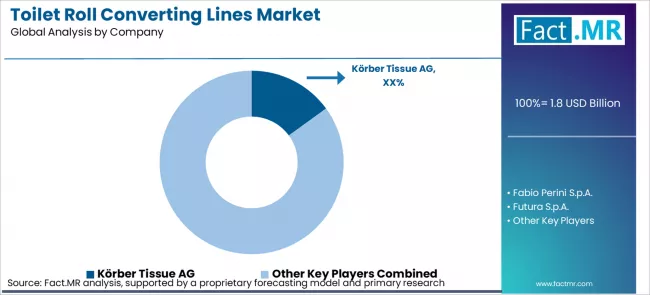
Toilet Roll Converting Lines Market Analysis By Company | Source: Fact.MR
The global toilet roll converting lines market shows moderate concentration in high speed automatic systems while remaining highly fragmented in semi-automatic and manual equipment. Premium automatic converting line supply is largely dominated by Körber Tissue and Fabio Perini. Their leadership is supported by strong global service networks, advanced automation technology, and long standing relationships with major tissue manufacturers across North America, Europe, and Asia Pacific. Companies such as Futura S.p.A., Gambini S.p.A., and OMET S.r.l. compete in mid-range automatic and semi-automatic lines with specialised solutions and regional focus.
Chinese equipment suppliers including BaoSuo Paper Machinery, Dechangyu Paper Machinery, and Jiuhyan Precision Machinery are expanding globally by offering cost competitive systems and improving service networks in Asia, Africa, and Latin America.
Large tissue producers such as Kimberly-Clark, Procter & Gamble, and Essity often source equipment from multiple OEMs to maintain bargaining power during fleet modernisation. In contrast, contract converters and private label producers usually rely on one or two suppliers to simplify spare parts management and service support, which strengthens long term OEM relationships.
Recent Developments
- In January 2025 Körber Tissue AG announced commercial availability of its TITAN HS high-speed converting line series for the North American and European markets, targeting above 1,200 rolls per minute throughput with integrated servo-electric drives and IoT production monitoring as standard specification for large tissue manufacturer customers.
- In November 2024 Fabio Perini S.p.A. disclosed at the Tissue World trade fair in Milan the launch of its modular automatic converting line architecture, enabling converters to configure capacity from 400 to 900 rolls per minute in standardised increments to reduce upfront capital requirements for mid-tier producers transitioning from semi-automatic systems.
Key Players
- Körber Tissue AG
- Fabio Perini S.p.A.
- Futura S.p.A.
- Omet S.r.l.
- Gambini S.p.A.
- BaoSuo Paper Machinery
- Dechangyu Paper Machinery
- Jiuhyan Precision Machinery
- Birla Hi Tech Machines
- Alpha Napkin Machines
Bibliography
- [2] Carrefour Group. (2024). Supplier Quality and Sustainability Requirements for Private Label Tissue Products: Converting Equipment and Production Standard Guidelines. Carrefour Corporate Affairs. September 2024. carrefour.com
- [3] European Parliament and Council. (2023). Directive 2023/1791 of the European Parliament and of the Council on Energy Efficiency: Industrial Energy Audit and Efficiency Implementation Requirements. Official Journal of the European Union. September 2023. eur-lex.europa.eu
- [4] ITC Limited. (2025). Q3 FY2025 Earnings Call Transcript: Personal Care Division Capacity Expansion and Tissue Converting Line Commissioning at Bhadrachalam. January 2025. itcportal.com
- [5] Körber Tissue AG. (2024). Product Press Release: TITAN HS High-Speed Converting Line Series Launch for North American and European Tissue Producers. Körber AG Investor Relations. October 2024. koerber.com
- [6] Fabio Perini S.p.A. (2025). Tissue World Milan 2025 Press Release: Modular Automatic Converting Line Architecture Launch for Mid-Tier Tissue Converters. February 2025. fabioperini.com
- [7] Tissue India Industry Association. (2024). Semi-Automatic Converting Line Demand Report: Small and Medium Converter Growth in South and Southeast Asia. October 2024. tissueindia.org
- [8] Futura S.p.A. (2025). Customer Case Study: High-Volume Automatic Converting Line Installation at Major U.S. Tissue Producer. Futura Corporate Press. January 2025. futuraconverting.com
- [9] Gambini S.p.A. (2024). Product Update: Medium-Volume Converting Line Platform with Enhanced Embossing Technology and Quick-Change Tooling. Gambini Corporate Communications. June 2024. gambini.com
- [10] AFSIA African Tissue and Hygiene Industry Association. (2024). Emerging Market Converting Equipment Demand Report: First-Time Converter Installations in Nigeria, Kenya, and Indonesia. November 2024. afsia.org
This Report Addresses
- Strategic intelligence on tissue converting automation demand, EU energy efficiency mandate compliance, private label retail capacity expansion, Chinese OEM competitive expansion, and Industry 4.0 integration trends in converting line technology.
- Market forecast from USD 1.8 billion in 2026 to USD 3.4 billion by 2036 at 6.7% CAGR, segmented by machine type, production capacity, end use, and region.
- Growth opportunities across automatic line upgrades in North America and Europe, greenfield converting capacity in China and India, and semi-automatic line demand from emerging market first-time converters in Africa and Southeast Asia.
- Country CAGR outlook for United States 7.8%, Germany 7.2%, China 7.0%, Japan 6.7%, and India 6.4%, with key demand drivers by country.
- Competitive analysis of Körber Tissue AG, Fabio Perini, Futura, Gambini, BaoSuo, and Dechangyu covering product range, technology capabilities, service networks, and regional market positioning.
- Technology tracking including servo-electric drive converting lines, IoT production monitoring integration, modular capacity configuration systems, and high-speed log-saw and wrapping automation.
- Regulatory analysis covering EU Energy Efficiency Directive 2023/1791, U.S. EPA manufacturing efficiency guidelines, India BIS IS 1397 tissue standards, and China MIIT industrial equipment energy efficiency guidelines.
- Report delivered in PDF, Excel datasets, PowerPoint summary, and dashboard formats supported by OEM disclosures, tissue industry records, and primary research.
Segmentation
Toilet Roll Converting Lines Market by Segment
-
By Machine Type :
- Automatic Converting Lines
- Semi-Automatic Converting Lines
- Manual Converting Lines
-
By Production Capacity :
- Low Volume (up to 500 rolls/minute)
- Medium Volume (500-1000 rolls/minute)
- High Volume (above 1000 rolls/minute)
-
By End Use :
- Tissue Paper Manufacturers
- Contract Converters
- Private Label Producers
- Others
-
By Region :
- North America
- United States
- Canada
- Mexico
- Europe
- Germany
- United Kingdom
- France
- Italy
- Spain
- Netherlands
- Nordics
- Rest of Europe
- Asia Pacific
- China
- Japan
- South Korea
- India
- Australia and New Zealand
- ASEAN
- Rest of Asia Pacific
- Latin America
- Brazil
- Mexico
- Colombia
- Rest of Latin America
- Middle East and Africa
- Kingdom of Saudi Arabia
- United Arab Emirates
- South Africa
- Turkey
- Rest of Middle East and Africa
- North America
Scope of Report
| Metric | Value |
|---|---|
| Quantitative Units | USD 1.8 billion (2026) to USD 3.4 billion (2036), at a CAGR of 6.7% |
| Market Definition | Toilet roll converting lines are machinery systems that convert parent tissue reels into finished toilet rolls through unwinding, perforating, embossing, log cutting, wrapping, and packaging, ranging from manual setups to fully automatic high speed systems above 1,000 rolls per minute. |
| Machine Type Segmentation | Automatic Converting Lines, Semi-Automatic Converting Lines, Manual Converting Lines |
| Production Capacity Segmentation | Low Volume (up to 500 rolls/minute), Medium Volume (500-1000 rolls/minute), High Volume (above 1000 rolls/minute) |
| End Use Segmentation | Tissue Paper Manufacturers, Contract Converters, Private Label Producers, Others |
| Application Coverage | Consumer toilet roll production, institutional away-from-home tissue supply, private label retail tissue, export-grade tissue manufacturing, and contract converting for branded tissue producers. |
| Regions Covered | Asia Pacific, Europe, North America, Latin America, Middle East and Africa |
| Countries Covered | China, Japan, South Korea, India, Australia and New Zealand, ASEAN, Rest of Asia Pacific, Germany, United Kingdom, France, Italy, Spain, Netherlands, Nordics, Rest of Europe, United States, Canada, Mexico, Brazil, Mexico, Colombia, Rest of Latin America, Kingdom of Saudi Arabia, United Arab Emirates, South Africa, Turkey, Rest of Middle East and Africa |
| Key Companies Profiled | Körber Tissue AG, Fabio Perini S.p.A., Futura S.p.A., Omet S.r.l., Gambini S.p.A., BaoSuo Paper Machinery, Dechangyu Paper Machinery, Jiuhyan Precision Machinery, Birla Hi Tech Machines, Alpha Napkin Machines |
| Forecast Period | 2026 to 2036 |
| Approach | A hybrid top down and bottom up model was used. Top down inputs included tissue production volumes, converting line installation base, and infrastructure investment data. Bottom up inputs covered machine prices by type and capacity, replacement cycles, energy compliance costs, and automation insights from OEM and tissue producer interviews. |
Source: Fact.MR analysis. Updated Mar 9, 2026
Frequently Asked Questions
How large is the toilet roll converting lines market in 2025?
What will the market size be in 2026?
What is the projected market size by 2036?
What is the expected CAGR for the forecast period 2026 to 2036?
Which machine type segment holds the leading share?
Which production capacity tier commands the largest market value?
Which country is projected to grow the fastest?
What is the expected growth rate for Germany's market?
Which end use segment commands the largest share?
How is the toilet roll converting lines market in China expected to grow?
Who worked on this report


Preview the report firsthand - request a free sample
Free SampleGet the brochure for pricing and purchase details
Download PDF