- Market Value (2025): USD 773.4 Mn
- Estimated Value (2026): USD 860.0 Mn
- Forecast Value (2036): USD 2486.3 Mn
- CAGR (2026-2036): 11.2%
What is the Off-the-Shelf Thruster Valves Market forecast to be worth by 2036?
The Off-the-Shelf Thruster Valves Market is projected to reach USD 2486.3 million by 2036, from USD 860.0 million in 2026, at an 11.2% CAGR.
- The market is valued at USD 773.4 million in 2025.
- Demand is valued at USD 860.0 million in 2026 and is forecast to reach USD 2486.3 million by 2036.
- The market is projected to expand at 11.2% CAGR from 2026 to 2036 as satellite programs increase the use of qualified propulsion hardware that can be integrated across repeat spacecraft builds.
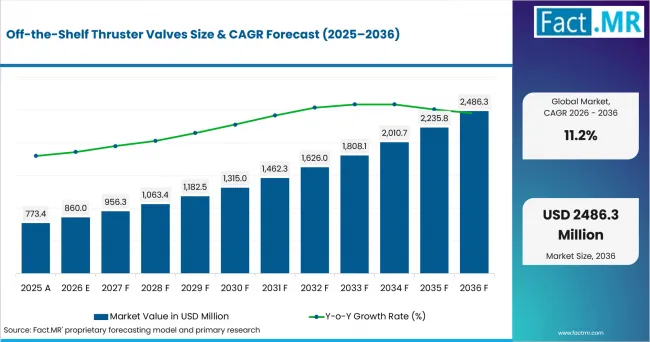
Off The Shelf Thruster Valves Value Analysis | Source: Fact.MR
What are the defining numbers behind Off-the-Shelf Thruster Valves Market growth?
The absolute dollar opportunity between 2026 and 2036 is USD 1,626.3 million. Growth depends on whether suppliers can combine catalogue-style availability with the documentation, testing, pressure integrity, and propellant compatibility expected for flight hardware. Small satellite integrators form the largest customer group, while latch valves and moderate-pressure classes hold the leading shares within the current market structure.
- Demand Drivers in the Market
- NASA's 2026 State-of-the-Art of Small Spacecraft Technology report includes in-space propulsion as a dedicated technology area, reflecting continued development of propulsion subsystems for compact spacecraft. This supports recurring demand for components that can move from qualification into repeat small-satellite builds. [1]
- ESA's electric-propulsion technology framework explicitly includes flow-control units, valves, pressure regulators, and pressure sensors within the propulsion component set. This makes valve qualification part of the propulsion architecture rather than a peripheral hardware decision. [2]
- The 2025 ECSS standard for pressurized hardware covers valves among pressure components and requires structural verification, qualification, and acceptance activity. Standardized component procurement can reduce redesign effort, but it does not remove mission-specific verification. [3]
- The UK Space Strategy and 2026 funding for domestic space technologies reinforce national investment in satellite communications, space services, and sovereign capability. That funding environment supports the supplier base that integrates propulsion hardware into spacecraft and launch systems. [4] [5]
- Key Segments Analyzed
- By Valve Type, Latch valve leads with 31.0% share in 2026. Its position reflects the importance of reliable isolation and repeatable flow-control functions within spacecraft propulsion assemblies.
- By Propellant Compatibility, Xenon / krypton leads with 28.0% share in 2026. Electric-propulsion systems use stored propellant alongside flow-control hardware, creating a direct requirement for compatible valves and regulators.
- By Pressure Class, 10-50 bar leads with 31.0% share in 2026. This range captures a broad set of propulsion flow-control duties where pressure integrity and leakage verification remain central to qualification.
- By Customer, SmallSat integrators lead with 31.0% share in 2026. Repeat small-spacecraft programs create demand for components that can be integrated with shorter redesign cycles while retaining flight qualification evidence.
- Analyst Opinion at Fact.MR
- Shambhu Nath Jha, Senior Consultant, Fact.MR.
- Strategic Implications
- Valve suppliers should treat qualification evidence as part of the product because a nominally standard component still has to fit the mission pressure envelope, cleanliness plan, and propellant choice.
- SmallSat-focused suppliers need product families that can be reused across recurring spacecraft designs without forcing customers into a fresh valve architecture for each mission.
- Electric-propulsion demand favors suppliers that can support xenon or krypton flow-control requirements while documenting leakage performance and material compatibility.
- Customers should compare valves on integration burden and verification history alongside unit price because qualification work can outweigh the purchase-price difference between components.
How does the Off-the-Shelf Thruster Valves Market break down by segment?
The market is organized around four purchasing decisions: valve architecture, propellant compatibility, pressure class, and customer type. Each category captures a different constraint in propulsion-system integration, from physical flow control to mission qualification.
Why does Latch valve lead Valve Type?
Latch valves account for 31.0% share in 2026.
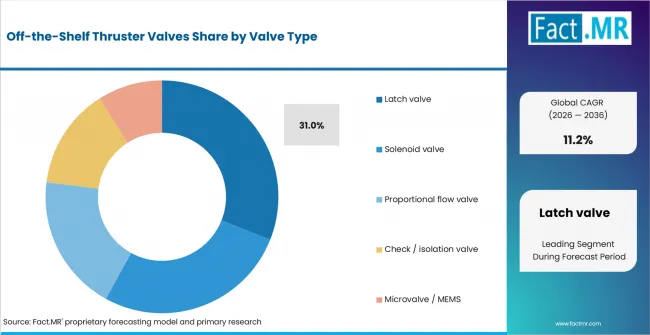
Off The Shelf Thruster Valves Analysis By Valve Type | Source: Fact.MR
ESA lists latching valves within the component set used in chemical propulsion systems, alongside isolation valves and check valves. Their leading share is consistent with procurement demand for discrete valve functions that can be specified as separate propulsion components rather than embedded in a fully custom assembly. [6]
The segment also benefits from the broader move toward repeatable spacecraft architectures seen across all-electric satellites, where propulsion hardware must fit a stable bus design across multiple spacecraft.
Why does Xenon / krypton lead Propellant Compatibility?
Xenon / krypton accounts for 28.0% share in 2026.
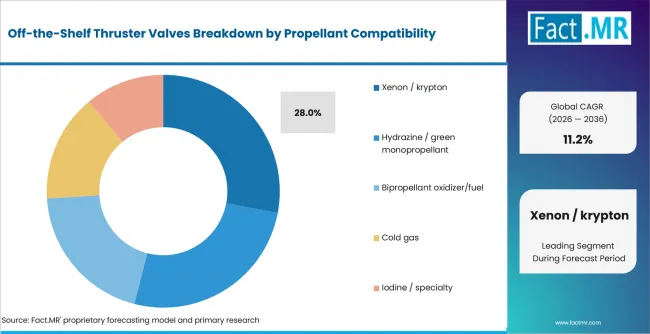
Off The Shelf Thruster Valves Analysis By Propellant Compatibility | Source: Fact.MR
ESA includes flow-control units and valves in its electric-propulsion technology map, while CNES describes xenon as a standard inert-gas propellant in Hall-effect satellite propulsion. The combination links propellant storage directly to precision flow-control hardware. [2] [7]
The segment also sits beside demand for green propellants, which broadens the material-compatibility requirements that valve suppliers may need to address across separate propulsion families.
Why does the 10-50 bar band lead Pressure Class?
The 10-50 bar band accounts for 21.0% share in 2026.
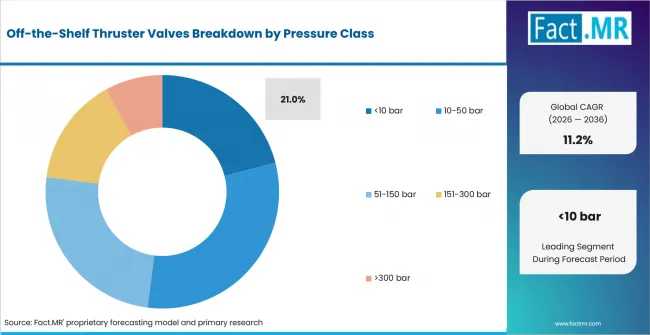
Off The Shelf Thruster Valves Analysis By Pressure Class | Source: Fact.MR
ECSS treats valves as pressurized hardware that must demonstrate design qualification and acceptable flight hardware. The leading position of this band reflects the concentration of current component demand in pressure duties where commercial availability can be combined with formal verification. [3]
Qualification requirements also connect this market with small satellite environmental testing, because propulsion components must be verified within the wider spacecraft test plan before flight acceptance.
Why do SmallSat integrators lead Customer?
SmallSat integrators account for 31.0% share in 2026.
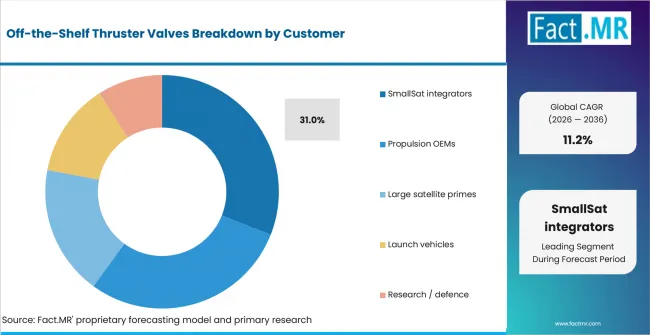
Off The Shelf Thruster Valves Analysis By Customer | Source: Fact.MR
NASA's small-spacecraft program emphasizes rapid development and technology demonstration for small spacecraft, while its 2026 launch schedule includes dedicated propulsion demonstrations. A recurring small-spacecraft pipeline increases the value of components that can be qualified once and reused with controlled changes across later builds. [1] [8]
The customer base also overlaps with 3D printed satellites, where compact spacecraft programs place a premium on parts that fit constrained mass and integration envelopes.
What is accelerating Off-the-Shelf Thruster Valves Market adoption, and what is holding it back?
Adoption improves when component reuse shortens propulsion-system integration without weakening flight assurance. It slows when valve qualification, contamination control, propellant compatibility, or pressure verification has to be repeated for each mission. The effects below are directional and are evaluated independently rather than added together.
Drivers Impact Analysis
| Factor | (~) % Impact on CAGR | Geographic Relevance | Impact Timeline |
|---|---|---|---|
| SmallSat propulsion integration | +1.4% | USA, Europe, Japan | 2026 to 2034 |
| Standardized component qualification | +1.1% | Europe, USA | 2026 to 2035 |
| Electric-propulsion deployment | +0.9% | France, USA, Japan | 2027 to 2036 |
SmallSat programs support repeat purchases where propulsion architectures are reused across multiple spacecraft. Common qualification frameworks reduce ambiguity in component selection, while electric propulsion adds a sustained requirement for controlled propellant delivery through valves and associated flow hardware.
Opportunity Impact Analysis
| Factor | (~) % Impact on CAGR | Geographic Relevance | Impact Timeline |
|---|---|---|---|
| Xenon / krypton flow-control hardware | +1.2% | Global | 2027 to 2036 |
| Modular propulsion hardware for repeat builds | +1.0% | USA, UK, Europe | 2027 to 2036 |
| Green monopropellant compatibility | +0.7% | USA, Europe, Japan | 2028 to 2036 |
Electric-propulsion programs create room for standardized flow-control hardware that supports xenon or krypton. Repeat spacecraft production favors modular components with stable interfaces. Suppliers can also widen their addressable market by qualifying materials and seals for newer propellant families. The last opportunity links to wider activity in reusable space modules, where repeat missions increase the value of reliable, serviceable propulsion hardware.
Restraints Impact Analysis
| Factor | (~) % Impact on CAGR | Geographic Relevance | Impact Timeline |
|---|---|---|---|
| Space qualification and contamination control | -1.1% | Global | 2026 to 2036 |
| Leakage and pressure-cycle verification | -0.9% | Global | 2026 to 2036 |
| Propellant-specific material compatibility | -0.7% | Global | 2026 to 2035 |
ECSS standards require qualification and acceptance work for pressurized hardware and define contamination-control requirements across space products. These requirements protect mission reliability, but they also limit how far an off-the-shelf valve can be treated as a simple catalogue purchase. [3] [9] he-shelf-thruster-valves-market
Which countries are scaling the Off-the-Shelf Thruster Valves Market through 2036?
- USA: Small-spacecraft technology programs and propulsion demonstrations create a recurring path from component testing to flight use.
- France: National satellite programs and long-standing electric-propulsion work support demand for propellant-control hardware across spacecraft platforms.
- Japan: Launch-vehicle and spacecraft programs maintain domestic demand for flight-qualified propulsion components and system integration.
- Germany: Research infrastructure and component-verification activity support qualification work for European spacecraft hardware.
- UK: Public funding for domestic space technologies supports spacecraft supply-chain development and propulsion-system procurement.
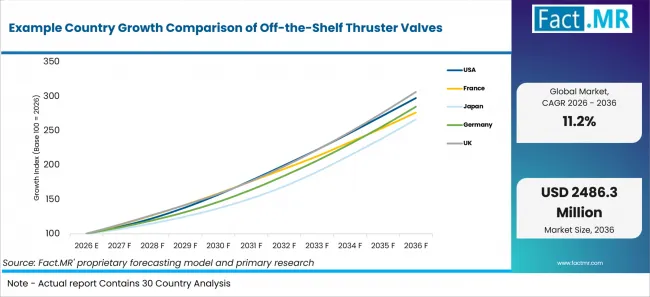
Example Country Growth Comparison Of Off The Shelf Thruster Valves | Source: Fact.MR
Country CAGR (2026-2036)
| Country | CAGR (2026-2036) |
|---|---|
| USA | 11.5% |
| France | 10.7% |
| Japan | 10.3% |
| Germany | 11.0% |
| UK | 11.8% |
What is driving USA's growth through 2036?
USA is projected to grow at 11.5% CAGR from 2026 to 2036.
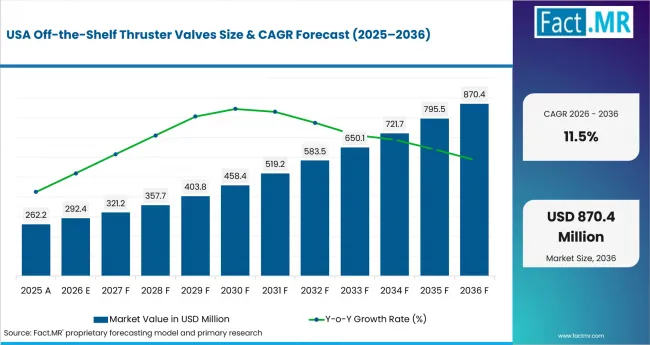
Off The Shelf Thruster Valves Country Value Analysis | Source: Fact.MR
NASA's 2026 small-spacecraft technology program covers in-space propulsion and continues to use flight demonstrations as a route for maturing hardware. That environment supports demand for valves that arrive with a documented qualification path and can be integrated into recurring spacecraft designs. [1] [8]
Procurement remains sensitive to mission assurance. A supplier can benefit from higher unit volumes only when pressure integrity, cleanliness, and propellant compatibility remain controlled across repeat builds.
What is driving France's growth through 2036?
France is forecast to grow at 10.7% CAGR.
CNES describes electric propulsion as an established satellite technology and identifies xenon as a typical propellant for Hall-effect thrusters. France also maintains current launch and spacecraft programs that keep propulsion qualification within the national space supply chain. [7] [10]
For valve suppliers, the opportunity is tied to compatibility with electric and chemical propulsion architectures rather than a single valve format. Qualification evidence that can transfer between related spacecraft programs can reduce integration work for French primes and subsystem suppliers.
What is driving Japan's growth through 2036?
Japan is forecast to grow at 10.3% CAGR.
JAXA's HTV-X program and other national spacecraft programs sustain engineering demand for propulsion, control, and flight-qualified components. The market mechanism is a continuing requirement for hardware that can pass mission-specific verification within established spacecraft-development programs. [11]
Off-the-shelf suppliers still need to fit Japanese program requirements on interfaces, documentation, and qualification. Commercial availability becomes valuable when it shortens integration without shifting additional verification burden to the spacecraft integrator.
What is driving Germany's growth through 2036?
Germany is projected to grow at 11.0% CAGR.
DLR co-organises ECSSMET 2026 with ESA and CNES, bringing together spacecraft structures, materials, environmental testing, assembly, integration, and verification disciplines. This reflects the qualification environment in which propulsion components are assessed before flight use. [12]
German demand is therefore linked to engineering verification as much as to component availability. Suppliers that provide traceable test evidence can reduce the effort required to qualify a valve within European spacecraft programs.
What is driving UK's growth through 2036?
UK is projected to grow at 11.8% CAGR.
The 2026 UK Space Strategy combines space-sector growth with national security priorities, while the government has announced more than GBP 62 million for homegrown satellite communications and space technologies. These programs strengthen the domestic customer base that procures spacecraft subsystems and qualified components. [4] [5]
Valve demand will depend on the propulsion architectures selected by UK spacecraft developers and the extent to which domestic programs move from prototypes into repeat production. The clearest opportunity is for components that can support multiple missions without a fresh design cycle.
Who Leads the Off-the-Shelf Thruster Valves Market?
Key players in the Off-the-Shelf Thruster Valves Market include VACCO Industries, Moog, Marotta Controls, ArianeGroup, Valcor Engineering, and IHI Aerospace. Competition centres on qualification history, propellant compatibility, pressure capability, leakage control, interface consistency, and the ability to supply repeat units for multi-spacecraft programs.
The market remains qualification-led. A valve with a strong catalogue position can still lose a program if the customer must repeat extensive verification or redesign surrounding hardware. Suppliers that combine stable product families with traceable test documentation are better placed to serve integrators seeking shorter procurement cycles without weakening mission assurance.
Which companies are the key providers?
The key providers identified in the market coverage are:
- VACCO Industries
- Moog
- Marotta Controls
- ArianeGroup
- Valcor Engineering
- IHI Aerospace
Bibliography
- [1] National Aeronautics and Space Administration. (2026). State-of-the-Art of Small Spacecraft Technology.
- [2] European Space Agency. (2026). Electric Propulsion Technologies Harmonisation.
- [3] European Cooperation for Space Standardization. (2025). ECSS-E-ST-32-02C Rev.2: Structural design and verification of pressurized hardware.
- [4] UK Space Agency, Department for Business and Trade, and Ministry of Defence. (2026). UK Space Strategy.
- [5] UK Space Agency. (2026). UK invests in homegrown space tech to boost national resilience.
- [6] European Space Agency. (2026). Chemical Propulsion - Components technology harmonisation.
- [7] Centre National d'Etudes Spatiales. (2026). Electric satellites programme overview.
- [8] National Aeronautics and Space Administration. (2026). Small Spacecraft and Distributed Systems launch schedule.
- [9] European Cooperation for Space Standardization. (2025). ECSS-Q-ST-70-01C Rev.1: Cleanliness and contamination control.
- [10] Centre National d'Etudes Spatiales. (2026). CNES at a glance and current space programmes.
- [11] Japan Aerospace Exploration Agency. (2026). HTV-X mission updates and programme information.
- [12] German Aerospace Center. (2026). ECSSMET 2026: European Conference on Spacecraft Structures, Materials and Environmental Testing.
This Report Answers
- How does the Off-the-Shelf Thruster Valves Market develop through 2036?
- Why do latch valves, xenon / krypton compatibility, the 10-50 bar band, and SmallSat integrators lead their categories?
- How do qualification and contamination-control requirements affect off-the-shelf component adoption?
- What supports demand in USA, France, Japan, Germany, and UK?
- Which supplier capabilities matter most when propulsion integrators compare valve providers?
What does the Off-the-Shelf Thruster Valves Market cover?
The market covers valves supplied for spacecraft and launch-vehicle thruster systems where the component is available as a standardized, catalogue-based, or pre-engineered product that can be qualified for a defined mission. Coverage includes latch valves, solenoid valves, proportional flow valves, check or isolation valves, and microvalve or MEMS formats across the stated propellant and pressure categories.
What is included in the scope?
Revenue from covered thruster valves is included when the valve is sold as an identifiable propulsion component to SmallSat integrators, propulsion OEMs, large satellite primes, launch-vehicle programs, or research and defence customers. Coverage includes valves configured for xenon or krypton, hydrazine or green monopropellant, bipropellant oxidizer or fuel, cold gas, and iodine or other specialty propellants within the stated pressure classes.
What is excluded from the scope?
Complete thrusters, propulsion systems, tanks, pumps, filters, pressure regulators, and sensors are excluded when they are sold independently of the covered valve. One-off custom valve engineering that cannot be treated as an off-the-shelf product is outside the core market definition. Terrestrial industrial valves and components used outside spacecraft or launch-vehicle propulsion are also excluded.
How Was the Analysis Built?
Desk Research: Official space agencies and standards bodies are used to establish current spacecraft programs, propulsion technology activity, component qualification requirements, and pressurized-hardware controls.
Market Sizing and Forecasting: The assessment is structured across Valve Type, Propellant Compatibility, Pressure Class, Customer, and country growth. Market values are presented for 2025, 2026, and 2036 with a consistent 2026-2036 forecast period.
Data Validation and Update Cycle: Segment shares are reconciled within each category and country growth rates are checked for consistent public representation. Current qualification and propulsion developments are reviewed against the market definition before publication updates.
What is the report's scope and coverage?
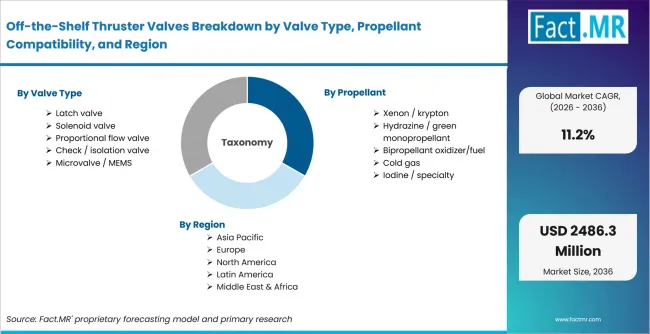
Off The Shelf Thruster Valves Breakdown By Valve Type, Propellant Compatibility, And Region | Source: Fact.MR
| Attribute | Details |
|---|---|
| Quantitative Units | USD million; CAGR and revenue shares in percent |
| Market Definition | Off-the-shelf valves supplied as standardized or pre-engineered flow-control components for spacecraft and launch-vehicle thruster systems. |
| Segments Covered | Valve Type; Propellant Compatibility; Pressure Class; Customer; Region |
| Regions Covered | Global |
| Countries Covered | USA; France; Japan; Germany; UK |
| Key Companies | VACCO Industries; Moog; Marotta Controls; ArianeGroup; Valcor Engineering; IHI Aerospace |
| Base Year | 2025 |
| Forecast Period | 2026 to 2036 |
| Market Value, 2025 | USD 773.4 million |
| Market Value, 2026 | USD 860.0 million |
| Market Value, 2036 | USD 2,486.3 million |
| CAGR, 2026-2036 | 11.2% |
| Absolute Opportunity | USD 1,626.3 million |
| Approach | Valve architecture, propellant compatibility, pressure class, customer mix, and country-growth assessment supported by official space-program and qualification evidence. |
How is the market segmented?
-
By Valve Type
- Latch valve - 31.0%
- Solenoid valve - 27.0%
- Proportional flow valve - 19.0%
- Check / isolation valve - 14.0%
- Microvalve / MEMS - 9.0%
-
By Propellant Compatibility
- Xenon / krypton - 28.0%
- Hydrazine / green monopropellant - 26.0%
- Bipropellant oxidizer/fuel - 20.0%
- Cold gas - 15.0%
- Iodine / specialty - 11.0%
-
By Pressure Class
- <10 bar - 21.0%
- 10-50 bar - 31.0%
- 51-150 bar - 25.0%
- 151-300 bar - 15.0%
- >300 bar - 8.0%
-
By Customer
- SmallSat integrators - 31.0%
- Propulsion OEMs - 29.0%
- Large satellite primes - 18.0%
- Launch vehicles - 13.0%
- Research / defence - 9.0%
-
By Region
- North America
- Latin America
- Western Europe
- Eastern Europe
- East Asia
- South Asia & Pacific
- Middle East & Africa