- Base Value(2025): 8.7 Bn
- Estimated Value(2026): 9.2 Bn
- Forecast Value (2036): 16.9 Bn
- CAGR (2026 - 2036): 6.2%
Motorized Valves Analysis and Forecast by Fact.MR
- The Motorized Valves Market is expected to grow from USD 9.2 billion in 2026 to USD 16.9 billion by 2036, at a 6.2% CAGR.
- driven by oil and gas facility operation sustaining the largest motorized valve demand, water infrastructure automation driving electric valve procurement, and IoT-connected smart valves raising connected process management value, with Electric Motorized Valves accounting 63.9% share and Oil & Gas Flow Control contributing 44.8% share as operators prioritize process reliability, flow-control accuracy, operational efficiency, and predictive maintenance across industrial facilities.
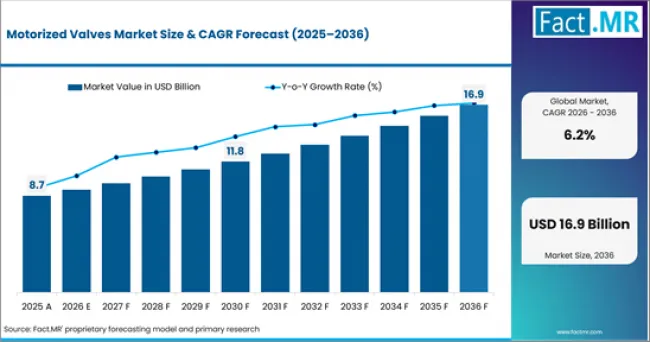
Motorized Valves Market Value Analysis | Source: Fact.MR
Summary of Motorized Valves Market
- Market Snapshot
- In 2025, the global Motorized Valves Market was valued at approximately USD 8.7 billion.
- The market is estimated to reach USD 9.2 billion in 2026 and is projected to attain USD 16.9 billion by 2036.
- The market is likely to expand at a CAGR of 6.2% during the forecast period.
- The market is anticipated to create an absolute dollar opportunity of USD 7.7 billion between 2026 and 2036.
- Electric Motorized Valves accounts for 63.9% of product share in 2026.
- China (8.4%) and India (7.8%) are the key growth markets during the forecast period.
- Demand and Growth Drivers
- Oil and gas facility operation and investment sustain the largest demand pool for motorized valves controlling flow, pressure, and isolation across upstream, midstream, and downstream operations.
- Water and wastewater infrastructure investment drives demand for electric motorized valves in treatment plants and distribution networks where automated flow control improves operational efficiency.
- IoT-connected smart valves with embedded diagnostics and positioner feedback are raising the value of motorized valve systems that support predictive maintenance and process optimization.
- Smart IoT-connected valves with digital positioners and embedded diagnostics create recurring value through predictive maintenance.
- Water network automation investment creates connected motorized valve demand for municipal and industrial distribution systems.
- Product and Segment View
- Electric Motorized Valves accounts for 63.9% of the product segment in 2026, emerging as the leading category.
- Oil & Gas Flow Control accounts for 44.8% of the application segment in 2026, making it the dominant use setting.
- Key segmentation includes:
- Product: Electric Motorized Valves, Pneumatic Motorized Valves, Hydraulic Motorized Valves, Smart IoT Enabled Valves
- Application: Oil & Gas Flow Control, Water & Wastewater Systems, Power Generation Systems, Chemical Processing Plants
- End Use: Industrial Manufacturing, Utilities Sector, Oil & Gas Industry, Building & Infrastructure
- Technology: Electro Mechanical Actuation, Smart Control Systems, Pneumatic Control Technology, Hydraulic Control Technology
- Formulation: Modular Valve Systems, Integrated Valve Systems, Custom Engineered Valves, Smart Adaptive Systems
- Distribution Channel: Direct OEM Sales, Authorized Distributors, System Integrators, Online Industrial Platforms
- These systems enable:
- Automated industrial flow control and isolation
- Precise electric valve positioning
- Smart diagnostic and predictive valve maintenance
- Geography and Competitive Outlook
- North America leads on oil and gas facility density, water infrastructure investment, and early adoption of smart motorized valve platforms.
- Europe demand reflects water network automation, chemical processing activity, and strong valve manufacturing heritage.
- Asia Pacific posts the steepest growth, as oil and gas investment and water infrastructure expansion in China and India widen motorized valve demand.
- China (8.4%) and India (7.8%) lead country growth, with other major markets showing steady demand.
- Key companies include Emerson Electric Co., Flowserve Corporation, IMI plc, Rotork plc, AUMA Riester GmbH & Co. KG, Belimo Holding AG.
- Analyst Opinion
- Shambhu Nath Jha, Principal Consultant at Fact.MR, says "Motorized valve demand is anchored in oil and gas facility operation and water infrastructure, and the defining shift is smart IoT connectivity transforming passive flow-control hardware into connected process-management components. Electric valves lead at 64% share on digital integration advantage. Water network automation is the broadest growth driver beyond oil and gas. Emerson, Flowserve, and IMI lead. China and India scale fastest on infrastructure expansion. Suppliers combining process-control heritage with smart positioner and digital-twin integration capture premium specification as operators invest in connected plant management."
Key Growth Drivers, Constraints, and Opportunities
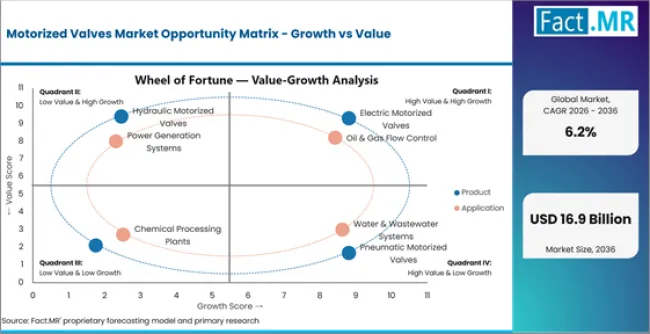
Motorized Valves Market Opportunity Matrix Growth Vs Value | Source: Fact.MR
Key Factors Driving Growth
- Oil and gas facility operation and investment sustain the largest demand pool for motorized valves controlling flow, pressure, and isolation across upstream, midstream, and downstream operations.
- Water and wastewater infrastructure investment drives demand for electric motorized valves in treatment plants and distribution networks where automated flow control improves operational efficiency.
- IoT-connected smart valves with embedded diagnostics and positioner feedback are raising the value of motorized valve systems that support predictive maintenance and process optimization.
Key Market Constraints
- Long valve lifetimes and low failure rates in established installations moderate replacement-cycle demand.
- High initial cost for smart IoT-enabled motorized valves limits adoption in cost-sensitive utility applications.
- Interoperability challenges between legacy DCS/PLC systems and new smart valve platforms slow digital upgrade.
Key Opportunity Areas
- Smart IoT-connected valves with digital positioners and embedded diagnostics create recurring value through predictive maintenance.
- Water network automation investment creates connected motorized valve demand for municipal and industrial distribution systems.
- Hydrogen and carbon capture infrastructure opens new specification requirements for motorized valves rated for clean-energy service.
Segment-wise Analysis of the Motorized Valves
- Electric Motorized Valves hold 63.9% of the product segment in 2026, supported by digital integration capability, lower maintenance requirements, and growing automation demand.
- Oil & Gas Flow Control represents 44.8% of the application segment in 2026, supported by extensive deployment across upstream, midstream, and downstream facilities.
The Motorized Valves Market is segmented by product, application, end use, technology, formulation, distribution channel. Demand is shaped by industrial automation investments, infrastructure development, energy-sector activity, and process-control requirements.
Which Product Segment Dominates the Motorized Valves?
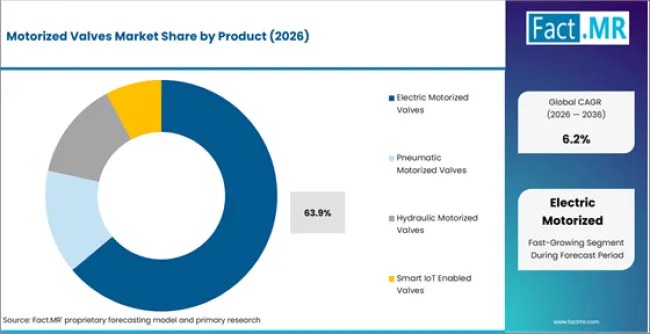
Motorized Valves Market Analysis By Product | Source: Fact.MR
Electric Motorized Valves lead the product segment with 63.9% share in 2026, reflecting the migration from pneumatic toward electric actuation where precise positioning, lower energy consumption, and easier digital integration favor electric configurations.
The segment is expected to retain leadership as smart valve adoption accelerates the electric actuation shift. Pneumatic and hydraulic configurations sustain positions in specific high-force and legacy applications, but electric valves anchor the largest share through their digital advantage.
Which Application Segment Dominates the Motorized Valves?
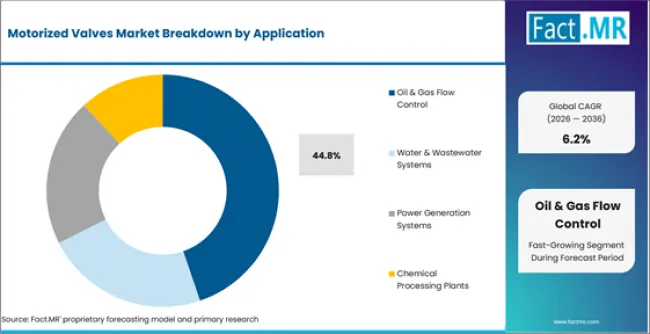
Motorized Valves Market Analysis By Application | Source: Fact.MR
Oil and Gas Flow Control leads the application segment with 44.8% share in 2026, driven by the concentration of motorized valve demand in upstream, midstream, and downstream facility operation where automated flow, pressure, and isolation control are standard requirements.
The application is likely to hold its lead as oil and gas facility operation continues globally. Water, power, and chemical applications grow alongside, but oil and gas anchors the largest demand channel through its facility density and specification stringency.
Which Product Trend is Shaping the Next Phase of Growth in the Motorized Valves?
Electric Motorized Valves lead the product segment at 63.9%, and the defining dynamic is the migration from pneumatic toward electric actuation where precise positioning, lower energy consumption, and easier digital integration favor electric-actuated configurations. Oil and gas flow control anchors the largest application share, where facility operation across upstream, midstream, and downstream sustains broad motorized valve demand.
Smart IoT-connected valves are the most consequential growth direction. Embedded diagnostics, digital positioners, and cloud connectivity transform motorized valves from passive flow-control hardware into connected process-management components. Smart valve platforms support predictive maintenance and digital-twin integration, creating recurring value for plant operators.
Regional Outlook Across Key Markets
- North America leads on oil and gas facility density, water infrastructure investment, and early adoption of smart motorized valve platforms.
- Europe demand reflects water network automation, chemical processing activity, and strong valve manufacturing heritage.
- Asia Pacific posts the steepest growth, as oil and gas investment and water infrastructure expansion in China and India widen motorized valve demand.
- The Middle East sustains demand anchored in oil and gas facility operation and desalination infrastructure.
.webp "Top Country Growth Comparison Motorized Valves Market Cagr (2026 2036)")
Top Country Growth Comparison Motorized Valves Market Cagr (2026 2036) | Source: Fact.MR
CAGR Table
| Country | CAGR (%) |
|---|---|
| China | 8.4% |
| India | 7.8% |
| Germany | 7.1% |
| Brazil | 6.5% |
| U.S. | 5.9% |
| UK | 5.3% |
| Japan | 4.7% |
Source: Fact.MR analysis. Updated Jun 12, 2026
Source: Fact.MR analysis, based on proprietary forecasting model and primary research.
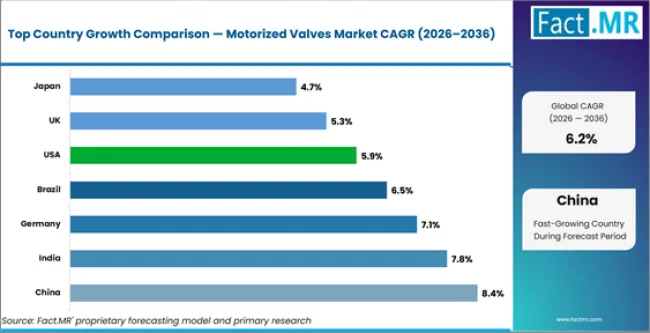
Motorized Valves Market Cagr Analysis By Country | Source: Fact.MR
Market Outlook for Motorized Valves in China
The China Motorized Valves market is projected to grow at a CAGR of 8.4% through 2036. Oil and gas facility operation and water infrastructure investment are widening motorized valve demand at scale. Domestic valve manufacturing provides competitive pricing for standard electric and pneumatic configurations, while process automation investment supports smart valve adoption in newer facilities.
- Water infrastructure investment widens motorized valve demand at scale.
- Process automation investment supports smart motorized valve adoption.
India Motorized Valves Demand Trends
The India Motorized Valves market is projected to grow at a CAGR of 7.8% through 2036. Demand is shaped by national water infrastructure programs and expanding oil refinery and chemical processing capacity. Cost-effectiveness favors standard electric motorized valves, while municipal water automation and industrial process control drive connected valve procurement in organized facilities.
- National water programs drive motorized valve demand in utility infrastructure.
- Oil refinery and chemical expansion widen industrial motorized valve procurement.
Motorized Valves Growth Assessment in Germany
The Germany Motorized Valves market is projected to grow at a CAGR of 7.1% through 2036. EU environmental regulation and German process engineering precision govern motorized valve specification across chemical, water, and power applications. Strong domestic valve manufacturing, including AUMA and Samson, sustains supply of high-specification electric and smart valve systems with lifecycle service.
- EU regulation governs motorized valve specification in process applications.
- Domestic manufacturing sustains high-specification electric and smart valve supply.
United States Motorized Valves Market Opportunity Outlook
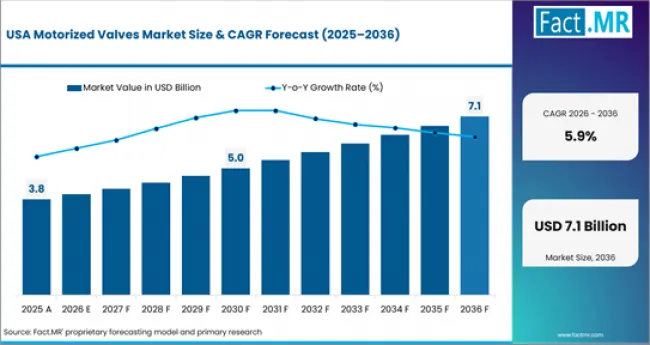
Motorized Valves Market Country Value Analysis | Source: Fact.MR
The United States Motorized Valves market is projected to grow at a CAGR of 5.9% through 2036. The oil and gas motorized valve installed base is mature, so growth tracks smart-valve upgrade and water infrastructure automation rather than first-time facility investment alone. API standards and SIL rating requirements shape specification, while IRA-linked clean energy infrastructure opens hydrogen and carbon capture valve demand.
- Smart-valve upgrade drives motorized valve replacement demand.
- Clean energy infrastructure opens hydrogen-rated valve specification demand.
Motorized Valves Demand Analysis in Japan
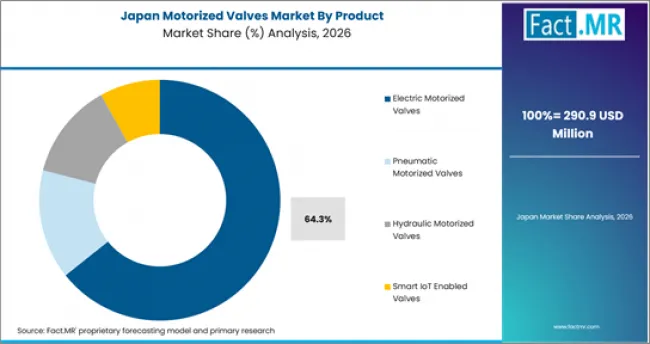
Motorized Valves Market Japan Market Share Analysis By Product | Source: Fact.MR
The Japan Motorized Valves market is projected to grow at a CAGR of 4.7% through 2036. Domestic valve manufacturing and precision process control standards sustain motorized valve demand. Preference for quality-compliant, domestically manufactured actuated valves shapes procurement, while chemical and power facility maintenance cycles drive replacement demand.
- Domestic manufacturing sustains quality-compliant motorized valve supply.
- Chemical and power facility cycles drive actuated valve replacement demand.
Competitive Benchmarking and Company Positioning
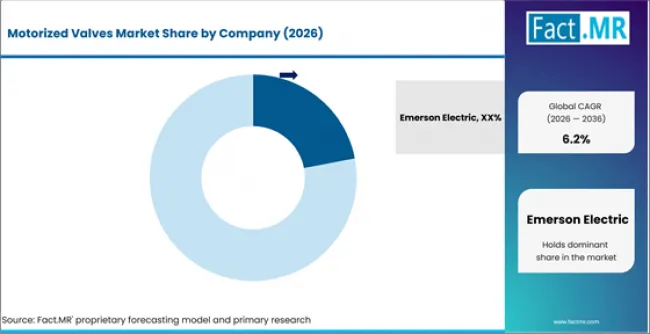
Motorized Valves Market Analysis By Company | Source: Fact.MR
Motorized Valves Analysis By Company
- Emerson, Flowserve, and IMI hold leading positions through comprehensive motorized valve and actuator portfolios spanning electric, pneumatic, and smart configurations, supported by global manufacturing and process industry relationships.
- Rotork and AUMA compete through dedicated electric actuator and smart positioner capability, where actuation technology depth and installed-base service shape competitive standing.
- IoT-connected smart valves with embedded diagnostics and digital-twin integration increasingly differentiate suppliers as plant operators shift purchasing from hardware to connected process management.
The competitive landscape is moderately concentrated among global valve and actuator manufacturers, with differentiation driven by actuation technology, smart positioner capability, and process industry expertise. Emerson, Flowserve, and IMI lead through portfolio breadth, global manufacturing, and the ability to serve oil and gas, water, power, and chemical applications from integrated platforms.
Below the leaders, Rotork, AUMA, Belimo, Samson, Metso, Crane, and Neles maintain strong positions through specific actuation technologies, regional manufacturing, and application expertise. Competition turns on positioning accuracy, diagnostic capability, and lifecycle service rather than price alone.
Smart valve connectivity is the competitive frontier. IoT-enabled motorized valves with embedded diagnostics, digital positioners, and cloud integration create recurring value through predictive maintenance and process optimization. Suppliers combining validated process-control heritage with smart connectivity and installed-base service are positioned to capture premium specification demand.
Key Companies in the Motorized Valves
- Leading companies in the motorized valves market include Emerson Electric Co., Flowserve Corporation, IMI plc, Rotork plc, which hold strong positions through portfolio breadth, engineering expertise, installed base, and global distribution.
- AUMA Riester GmbH & Co. KG, Belimo Holding AG, Samson AG, Metso Corporation maintain established positions across specific segments and channels, competing on valve performance, actuator technology, lifecycle service, and regional reach.
- Crane Co., Neles (Valmet) and other specialists compete through focused offerings and niche strength, reinforcing relevance in a competitive but evolving market.
Recent Industry Developments
- Emerson Electric Co. - Continued Smart Valve and Digital Automation Expansion (2025)
- Emerson continued enhancing its smart valve and digital automation portfolio, supporting process-control applications across oil & gas, water, power, and chemical industries.
- Rotork plc - Intelligent Electric Actuator Development (2025)
- Rotork continued developing intelligent electric actuation technologies with enhanced diagnostics, connectivity, and asset-management capabilities for industrial process-control applications.
- Industry Trend - Water Network Motorized Valve Automation (2025)
- Through 2025, utilities and municipal water authorities continued investing in automated valve-control systems for water distribution, treatment facilities, and pressure-management networks.
Leading Companies Shaping the Motorized Valves
- Emerson Electric Co.
- Flowserve Corporation
- IMI plc
- Rotork plc
- AUMA Riester GmbH & Co. KG
- Belimo Holding AG
- Samson AG
- Metso Corporation
- Crane Co.
Sources and Research References
- Emerson Electric Co. (2025). Automation solutions and smart valve technologies for process industries.
- International Water Association. (2025). Digital water and smart water network automation initiatives.
- Rotork plc. (2025). Electric actuators, intelligent valve automation, and flow control solutions.
This bibliography is provided for reader reference and is not exhaustive. The full report contains the complete reference list and detailed citations.
Key Questions This Report Addresses
- What is the current and future size of the Motorized Valves Market?
- How fast is the Motorized Valves Market expected to grow between 2026 and 2036?
- Which product segment is likely to lead the market by 2026?
- Which application segment is expected to account for the highest demand by 2026?
- What factors are driving demand in the motorized valves market globally?
- Which countries are projected to show the fastest growth through 2036?
- What is driving market expansion in China and India?
- Who are the key companies active in the motorized valves market?
- How is smart valve connectivity shifting purchasing from hardware to process management?
- What role does water network automation play in electric motorized valve demand?
- How does Fact.MR estimate and validate the motorized valves market forecast?
Motorized Valves Market Definition
The motorized valves market covers electric, pneumatic, hydraulic, and smart IoT-enabled motorized valves used in oil and gas flow control, water and wastewater systems, power generation, and chemical processing. It spans ball, butterfly, gate, and globe valve types with electric actuator, pneumatic actuator, and smart positioner technologies across oil and gas operators, utilities, power plants, and chemical facilities.
Motorized Valves Market Inclusions
- The scope covers global and regional market size and forecasts for 2026 to 2036 across product type, application, end use, technology, formulation, and distribution channel.
- It includes demand tied to oil and gas facility operation, water infrastructure, power plant control, and chemical process automation.
- Pricing analysis spans standard and smart motorized valves across OEM, distributor, and system integrator channels.
- Coverage includes IoT-connected smart valves with embedded diagnostics and digital-twin integration.
Motorized Valves Market Exclusions
- The scope excludes manual valves without motorized actuation.
- It excludes pressure relief valves and safety valves outside the flow-control definition.
- Residential and consumer plumbing valves are excluded.
- Hydraulic power unit components sold separately without valve integration are excluded.
Motorized Valves Market Research Methodology
- The methodology combines secondary research, primary interviews, and demand-side modeling.
- It draws on 110 plus secondary sources and benchmarks 50 plus valve and actuator portfolios.
- Market sizing covers 30 plus countries through a facility-operation and process-automation model with top-down validation.
- Key inputs include oil and gas facility investment, water infrastructure programs, power plant operation, and chemical capacity.
- The model cross-checks demand with valve shipments, actuator installations, and service revenue.
- Primary validation includes 20 plus interviews across process engineers, plant operators, valve manufacturers, and system integrators.
- Final estimates pass through installed-base review and sensitivity testing.
Segmentation
Scope of Analysis
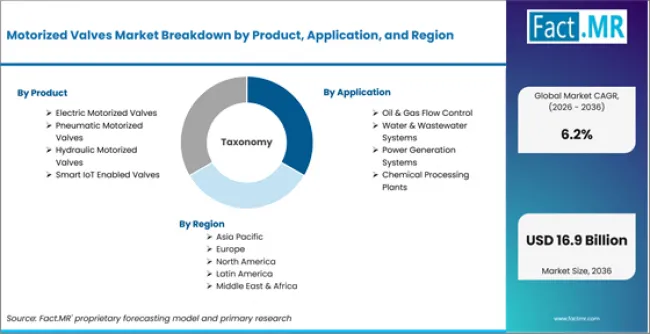
Motorized Valves Market Breakdown By Product, Application, And Region | Source: Fact.MR
| Parameter | Details |
|---|---|
| Quantitative Units | USD 9.2 billion to USD 16.9 billion, at a CAGR of 6.2% |
| Market Definition | The motorized valves market covers electric, pneumatic, hydraulic, and smart IoT-enabled actuated valves used in oil and gas, water, power, and chemical process applications. |
| Regions Covered | North America, Latin America, Europe, East Asia, South Asia and Pacific, Middle East and Africa |
| Countries Covered | China, India, Germany, Brazil, U.S., UK, Japan, 30 plus countries |
| Key Companies | Emerson Electric Co., Flowserve Corporation, IMI plc, Rotork plc, AUMA Riester GmbH & Co. KG, Belimo Holding AG, Samson AG, Metso Corporation, Crane Co., Neles (Valmet) |
| Forecast Period | 2026 to 2036 |
| Approach | Hybrid demand-side and top-down methodology built on country-level demand, product and valve-technology benchmarking, pricing analysis, shipment validation, and primary interviews across providers, laboratories, distributors, and end users |
Source: Fact.MR analysis. Updated Jun 12, 2026
Motorized Valves Segmentation
-
Motorized Valves Market Segmented by Product:
- Electric Motorized Valves
- Rotary Electric Valves
- Ball Motorized Valves
- Butterfly Motorized Valves
- Linear Electric Valves
- Globe Motorized Valves
- Gate Motorized Valves
- Rotary Electric Valves
- Pneumatic Motorized Valves
- Air Actuated Control Valves
- Spring Return Pneumatic Valves
- Double Acting Pneumatic Valves
- Hybrid Pneumatic Systems
- Electro Pneumatic Valves
- Smart Pneumatic Actuators
- Air Actuated Control Valves
- Hydraulic Motorized Valves
- High Pressure Hydraulic Valves
- Oil Driven Control Valves
- Industrial Hydraulic Regulators
- Precision Hydraulic Systems
- Servo Hydraulic Valves
- Closed Loop Hydraulic Controls
- High Pressure Hydraulic Valves
- Smart IoT Enabled Valves
- Connected Valve Systems
- Wireless Control Valves
- Cloud Integrated Valve Systems
- AI Assisted Valve Systems
- Predictive Maintenance Valves
- Self Diagnosing Valve Units
- Connected Valve Systems
- Electric Motorized Valves
-
Motorized Valves Market Segmented by Application:
- Oil & Gas Flow Control
- Upstream Operations
- Wellhead Pressure Control
- Drilling Fluid Regulation
- Midstream Operations
- Pipeline Flow Regulation
- Compressor Station Control
- Upstream Operations
- Water & Wastewater Systems
- Municipal Water Distribution
- Urban Water Flow Management
- Industrial Water Supply Systems
- Wastewater Treatment Plants
- Effluent Regulation Systems
- Sludge Flow Control Systems
- Municipal Water Distribution
- Power Generation Systems
- Thermal Power Plants
- Boiler Feed Control Systems
- Steam Flow Regulation Systems
- Renewable Energy Systems
- Hydrogen Flow Control Systems
- Bioenergy Process Control
- Thermal Power Plants
- Chemical Processing Plants
- Bulk Chemical Processing
- Reactor Flow Control Systems
- Mixing Process Regulation
- Specialty Chemical Handling
- Corrosive Fluid Control Systems
- High Purity Chemical Flow Systems
- Bulk Chemical Processing
- Oil & Gas Flow Control
-
Motorized Valves Market Segmented by End Use:
- Industrial Manufacturing
- Process Industries
- Chemical Manufacturing Plants
- Petrochemical Refineries
- Discrete Manufacturing
- Machinery Production Units
- Heavy Equipment Manufacturing
- Process Industries
- Utilities Sector
- Water Utilities
- Municipal Water Authorities
- Regional Distribution Networks
- Energy Utilities
- Power Grid Operators
- Renewable Energy Plants
- Water Utilities
- Oil & Gas Industry
- Exploration Companies
- Offshore Drilling Operators
- Onshore Extraction Facilities
- Refining Companies
- Crude Oil Refineries
- Gas Processing Plants
- Exploration Companies
- Building & Infrastructure
- Commercial Buildings
- HVAC System Integrators
- Smart Building Operators
- Infrastructure Projects
- Water Infrastructure Developers
- Urban Development Authorities
- Commercial Buildings
- Industrial Manufacturing
-
Motorized Valves Market Segmented by Technology:
- Electro Mechanical Actuation
- Rotary Actuation Systems
- High Torque Electric Actuators
- Precision Positioning Actuators
- Linear Actuation Systems
- Rod Driven Linear Actuators
- Direct Stroke Actuators
- Rotary Actuation Systems
- Smart Control Systems
- Digital Valve Controllers
- Microprocessor Based Controllers
- Embedded Control Modules
- IoT Connected Systems
- Wireless Communication Modules
- Cloud Based Control Platforms
- Digital Valve Controllers
- Pneumatic Control Technology
- Compressed Air Systems
- Air Flow Regulation Modules
- Pressure Control Units
- Smart Pneumatic Systems
- Sensor Integrated Pneumatics
- Automated Air Control Systems
- Compressed Air Systems
- Hydraulic Control Technology
- Fluid Power Systems
- High Pressure Actuation Systems
- Servo Controlled Hydraulic Units
- Advanced Hydraulic Electronics
- Electro Hydraulic Integration Systems
- Closed Loop Hydraulic Controls
- Fluid Power Systems
- Electro Mechanical Actuation
-
Motorized Valves Market Segmented by Formulation:
- Modular Valve Systems
- Interchangeable Valve Assemblies
- Plug and Play Actuator Systems
- Standardized Valve Modules
- Scalable Valve Platforms
- Expandable Flow Control Systems
- Multi Size Valve Architectures
- Interchangeable Valve Assemblies
- Integrated Valve Systems
- Fully Integrated Control Valves
- Sensor Embedded Valve Units
- Smart Feedback Valve Systems
- System Level Integration
- Plant Wide Flow Control Systems
- Networked Valve Ecosystems
- Fully Integrated Control Valves
- Custom Engineered Valves
- Application Specific Designs
- High Pressure Custom Valves
- Corrosion Resistant Custom Valves
- Industry Specific Configurations
- Oil & Gas Tailored Valves
- Chemical Industry Valve Designs
- Application Specific Designs
- Smart Adaptive Systems
- Self Regulating Valves
- AI Based Flow Adjustment Systems
- Predictive Response Valve Systems
- Learning Based Control Systems
- Adaptive Flow Optimization Valves
- Dynamic Pressure Response Valves
- Self Regulating Valves
- Modular Valve Systems
-
Motorized Valves Market Segmented by Distribution Channel:
- Direct OEM Sales
- Industrial Contracts
- Large Scale EPC Contracts
- Infrastructure Project Sales
- Enterprise Supply Agreements
- Multi Plant Procurement Deals
- Long Term Supply Contracts
- Industrial Contracts
- Authorized Distributors
- Regional Industrial Distributors
- Valve Equipment Suppliers
- Automation Component Distributors
- Specialized Technical Dealers
- Flow Control Specialists
- Process Automation Dealers
- Regional Industrial Distributors
- System Integrators
- Automation Integration Firms
- Industrial Control Integrators
- Smart Factory Solution Providers
- Engineering Contractors
- Plant Design Engineering Firms
- Process Optimization Consultants
- Automation Integration Firms
- Online Industrial Platforms
- B2B Procurement Portals
- Digital Industrial Marketplaces
- Cloud Procurement Systems
- Manufacturer Digital Channels
- OEM Web Ordering Systems
- Direct Configuration Platforms
- B2B Procurement Portals
- Direct OEM Sales
-
Motorized Valves Market by Region:
- North America
- USA
- Canada
- Mexico
- Latin America
- Brazil
- Chile
- Rest of Latin America
- Western Europe
- Germany
- UK
- Italy
- Spain
- France
- Nordic
- BENELUX
- Rest of Western Europe
- Eastern Europe
- Russia
- Poland
- Hungary
- Balkan & Baltic
- Rest of Eastern Europe
- East Asia
- China
- Japan
- South Korea
- South Asia and Pacific
- India
- ASEAN
- Australia & New Zealand
- Rest of South Asia and Pacific
- Middle East & Africa
- Kingdom of Saudi Arabia
- Other GCC Countries
- Turkiye
- South Africa
- Other African Union
- Rest of Middle East & Africa
- North America
Frequently Asked Questions
How big is the motorized valves market in 2026?
What will be the size of the motorized valves market in 2036?
How much will be the motorized valves market growth between 2026 and 2036?
What are the key products in the motorized valves market?
Which application segment is expected to contribute significant share in the motorized valves market in 2026?
Who worked on this report


Preview the report firsthand - request a free sample
Free SampleGet the brochure for pricing and purchase details
Download PDF