- Market Value (2025): USD 2.4 Bn
- Estimated Value (2026): USD 2.8 Bn
- Forecast Value (2036): USD 13.0 Bn
- CAGR (2026-2036): 16.4%
What is the Reusable Space Modules Market forecast to be worth by 2036?
USD 2.8 billion in 2026 to USD 13.0 billion by 2036 at a 16.4% CAGR.
- The Reusable Space Modules Market reached USD 2.4 billion in 2025.
- Demand is projected to increase from USD 2.8 billion in 2026 to USD 13.0 billion by 2036.
- The market is forecast to record a 16.4% CAGR from 2026 to 2036, supported by reusable capsules and commercial LEO stations.
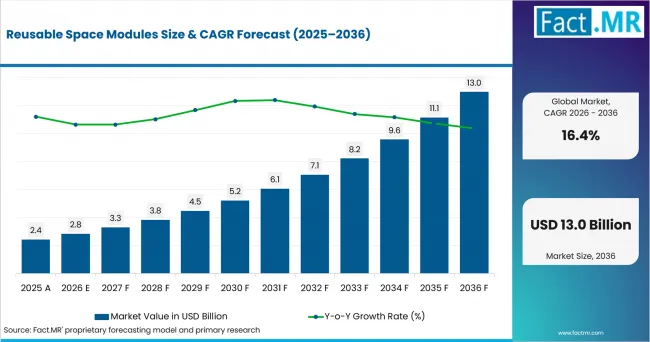
Reusable Space Modules Value Analysis | Source: Fact.MR
What are the defining numbers behind Reusable Space Modules Market growth?
USD 10.1 billion absolute opportunity by 2036, led by reusable crew and cargo capsules, LEO logistics and government space agencies.
- Demand Drivers in the Market
- NASA anticipated two crew missions annually for future commercial LEO destinations in March 2026. That schedule gives reusable crew capsules a recurring service reference point.
- ESA confirmed two LEO cargo-return demonstration missions at CM25 in November 2025. The decision gives Europe a clear path for dockable return systems.
- Thales Alenia Space reported in February 2025 that HALO’s pressurized primary structure was ready to be packaged for shipment to the United States. Pressurized structures remain central to reusable habitat readiness.
- Key Segments Analyzed
- By Module Type: Reusable crew and cargo capsules are expected to hold 34.0% share in 2026, supported by return cargo needs and crew-access continuity.
- By Mission Role: LEO logistics is projected to account for 32.0% share in 2026, owing to station resupply and post-ISS transition planning.
- By Reuse Cycle: 2-5 missions are anticipated to capture 31.0% share in 2026, driven by early reuse economics and realistic inspection cycles.
- By Customer Type: Government space agencies are estimated to represent 41.0% share in 2026, reflecting public mission funding and crew-safety review.
- Analyst Opinion at Fact.MR
- Shambhu Nath Jha, Principal Consultant at Fact.MR, states, “Reusable modules are drawing attention because mission planners want hardware that survives launch and docking. Return and refurbishment must fit the same service cycle. Demand is expected to move first where public programs create repeat mission schedules. Suppliers should combine pressure-vessel proof with interface evidence and post-flight inspection records.”
- Strategic Implications
- Capsule developers should publish mission-cycle evidence covering inspections, part replacement and thermal-protection checks after each return.
- Habitat builders should align docking ports and pressure systems with NASA and ESA safety-review expectations before station integration.
- Station operators should model cargo-return volumes early so module interfaces support crew logistics and commercial research use.
- Agencies should keep buying pathways open for core modules and attached logistics services during the ISS transition.
The USA is projected to record 19.1% CAGR through 2036, led by commercial LEO transition planning and licensed mission activity. Germany is forecast to post 18.6% CAGR, supported by ESA funding weight and human-exploration investment. The UK is expected to advance at 18.1% CAGR, reflecting ESA commitments and national space capability funding. Japan is anticipated to hold 16.5% CAGR, owing to HTV-X logistics experience and public space funding. France is estimated to reach 14.7% CAGR, reinforced by CNES programs and Europe’s spaceport investment.
How does the Reusable Space Modules Market break down by segment?
Reusable crew and cargo capsules lead Module Type at 34.0%; LEO logistics leads Mission Role at 32.0%.
Which Module Type dominates?
Reusable crew and cargo capsules hold 34.0% share in 2026.
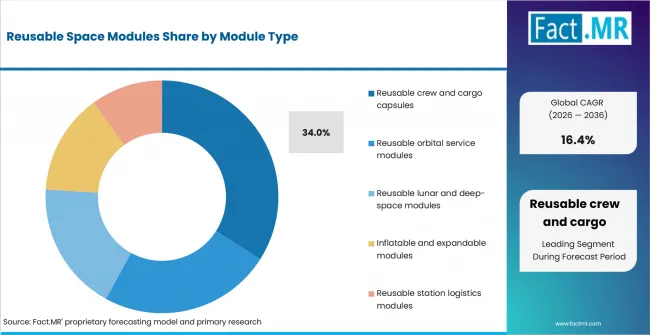
Reusable Space Modules Analysis By Module Type | Source: Fact.MR
Crew and cargo capsules lead because they carry payloads to orbital platforms and return selected cargo to Earth. NASA reported in August 2025 that CRS-33 carried more than 5,000 pounds of scientific investigations and cargo to the International Space Station. Return capability keeps capsules central to early reuse planning.
What leads the Mission Role segment?
LEO logistics accounts for 32.0% share in 2026.
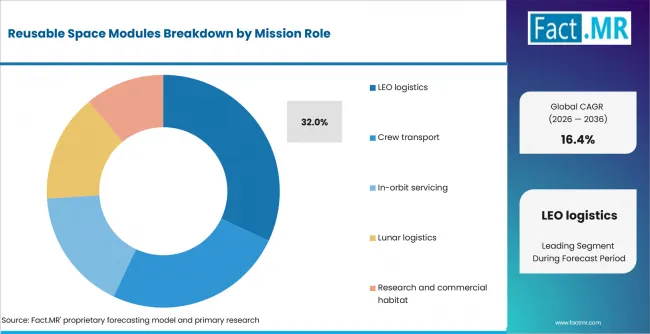
Reusable Space Modules Analysis By Mission Role | Source: Fact.MR
LEO logistics leads as public agencies prepare for station continuity after ISS retirement. GAO reported in June 2026 that NASA was working with six U.S. companies to develop commercial space stations. Reusable modules gain value where station access and cargo return are planned together.
How does Reuse Cycle shape demand?
2-5 missions capture 31.0% share in 2026.
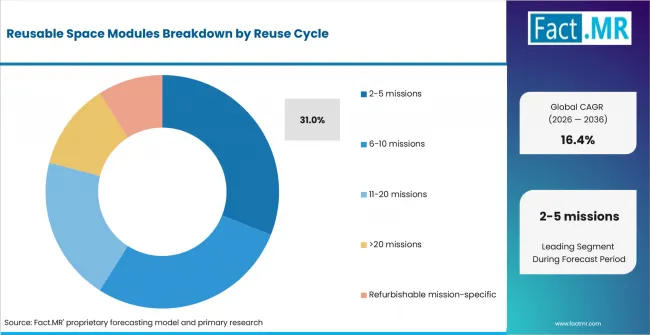
Reusable Space Modules Analysis By Reuse Cycle | Source: Fact.MR
The 2-5 mission band leads because early reusable modules need enough repeated use to justify qualification. JAXA confirmed in October 2025 that HTV-X1 separated about 14 minutes and 4 seconds after liftoff. Short reuse cycles fit a phase where operators still build flight evidence.
What supports Government space agencies within Customer Type?
Government space agencies represent 41.0% share in 2026.
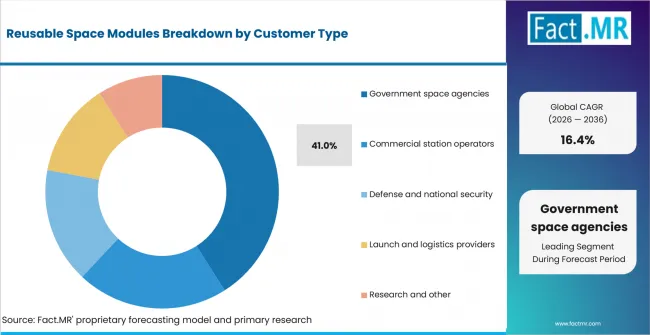
Reusable Space Modules Analysis By Customer Type | Source: Fact.MR
Government space agencies lead because reusable modules still rely on public exploration budgets and crew-safety oversight. The UK Space Agency made GBP 580.8 million of funding available to the sector in 2024-25. Public programs provide anchor demand before commercial station traffic reaches scale.
What is accelerating Reusable Space Modules Market adoption, and what is holding it back?
Demand is expected to rise through LEO transition needs and lunar logistics. Growth is constrained by safety review, licensing and refurbishment proof.
Drivers Impact Analysis
| DRIVER | (~) % IMPACT ON CAGR | GEOGRAPHIC RELEVANCE | IMPACT TIMELINE |
|---|---|---|---|
| Commercial LEO transition and station logistics | +1.9% | USA, Europe, Japan | Short term (<= 2 years) |
| Commercially procured reusable lunar hardware | +1.5% | USA, Germany, France | Medium term (2-4 years) |
| Cargo-return demonstrations and reentry learning | +1.2% | Europe, Japan, USA | Medium term (2-4 years) |
| Commercial habitat pressure-structure testing | +0.9% | USA, UK, Europe | Long term (>= 4 years) |
Source: Fact.MR analysis. Updated Sep 5, 2026
- Commercial LEO transition and station logistics: Future commercial low-Earth-orbit destinations are creating demand for reusable space modules that can support recurring cargo movement, station logistics, and repeated mission operations. Modular spacecraft systems can help operators manage resupply, payload transfer, and infrastructure expansion more efficiently.
- Commercially procured reusable lunar hardware: Lunar exploration programs are creating opportunities for commercially supplied reusable hardware that can support repeated crewed surface missions. Reusable module concepts can reduce dependence on single-use systems and strengthen the role of private suppliers in future lunar infrastructure.
- Cargo-return demonstrations and reentry learning: Cargo-return missions provide valuable operating experience in spacecraft power management, payload handling, reentry, recovery, and reusable capsule design. Successful demonstrations can help suppliers refine module architectures for repeated logistics missions and commercial return services.
- Commercial habitat pressure-structure testing: Commercial station developers need validated pressure structures before habitat interiors and integrated systems move toward launch readiness. Testing for structural integrity, sealing, environmental control compatibility, and repeated mission use is therefore central to reusable space-module qualification.
Opportunity Impact Analysis
| OPPORTUNITY | (~) % IMPACT ON CAGR | GEOGRAPHIC RELEVANCE | IMPACT TIMELINE |
|---|---|---|---|
| Commercial station operators adding dockable modules | +1.3% | USA, UK, Europe | Medium term (2-4 years) |
| Reusable lunar logistics and support hardware | +1.1% | USA, Germany, France, Japan | Long term (>= 4 years) |
| Inspection services tied to short reuse cycles | +0.7% | Global | Medium term (2-4 years) |
Source: Fact.MR analysis. Updated Sep 5, 2026
- Commercial station operators adding dockable modules: Private space-station programs create opportunities for reusable, dockable modules that support crew access, cargo transfer, and station expansion through standardized interfaces. Suppliers that demonstrate reliable docking, pressure integrity, and repeat-use capability can strengthen their position in commercial orbital infrastructure.
- Reusable lunar logistics and support hardware: Lunar exploration programs are increasing interest in commercially supplied reusable hardware for cargo movement, surface logistics, and sustained mission support. Modular systems that can be serviced, redeployed, or integrated with broader lunar infrastructure can support longer-duration operations.
- Inspection services tied to short reuse cycles: Returned capsules and modules require structured inspection, maintenance, and recertification before subsequent missions. Suppliers that provide repeatable inspection protocols, component-health assessment, and rapid turnaround support can help operators shorten reuse cycles while maintaining mission readiness.
Restraints Impact Analysis
| RESTRAINT | (~) % IMPACT ON CAGR | GEOGRAPHIC RELEVANCE | IMPACT TIMELINE |
|---|---|---|---|
| Human-rating and mission-safety documentation | -0.8% | Global | Long term (>= 4 years) |
| Launch and reentry licensing workload | -0.6% | USA, Europe | Short term (<= 2 years) |
| Refurbishment uncertainty after return exposure | -0.5% | USA, Europe, Japan | Medium term (2-4 years) |
Source: Fact.MR analysis. Updated Sep 5, 2026
- Human-rating and mission-safety documentation: Reusable modules intended for crew-facing missions require extensive hazard closure, interface verification, and safety documentation before approval. These requirements can lengthen qualification timelines and increase engineering effort across each mission configuration.
- Launch and reentry licensing workload: Launch and reentry operations require detailed regulatory review, licensing documentation, and coordination before missions proceed. The associated approval workload can slow deployment schedules, particularly for reusable systems operating across multiple launch sites or mission profiles.
- Refurbishment uncertainty after return exposure: Reusable pressure modules need repeated flight and recovery data before operators can establish predictable inspection and refurbishment intervals. Uncertainty around structural wear, thermal exposure, seals, and component life can increase turnaround time between missions.
Which countries are scaling the Reusable Space Modules Market through 2036?
- The country comparison spans 4.46 percentage points and forms three practical growth bands across the forecast period.
- The USA remains 0.57 percentage point above Germany through commercial LEO transition planning and licensed mission activity.
- Germany remains 0.50 percentage point above the UK through ESA funding weight and human-exploration investment.
- The UK remains 1.58 percentage points above Japan through ESA commitments and national space capability funding.
- Japan remains 1.81 percentage points above France through HTV-X logistics experience and public space funding.
- France closes the displayed range through CNES programs and Europe’s spaceport investment in French Guiana.
Comparable CAGRs create different entry conditions because reusable modules depend on funding cycles, launch access, safety review and industrial depth. Full report coverage includes North America, Latin America, Western Europe, Eastern Europe, East Asia, South Asia & Pacific, Middle East & Africa.
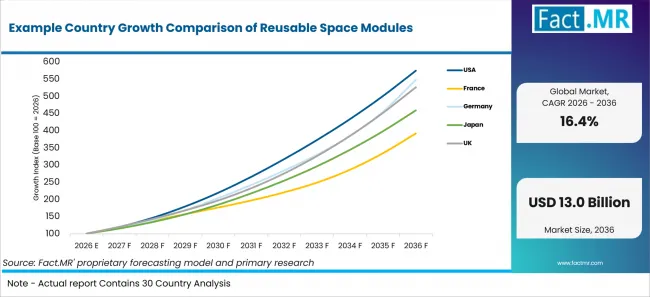
Example Country Growth Comparison Of Reusable Space Modules | Source: Fact.MR
| Country | CAGR (2026-2036) |
|---|---|
| USA | 19.1% |
| Germany | 18.6% |
| UK | 18.1% |
| Japan | 16.5% |
| France | 14.7% |
Source: Fact.MR analysis. Updated Sep 5, 2026
What supports USA adoption?
19.1% CAGR, supported by commercial LEO transition planning and licensed mission frequency.
The USA has a direct route from public station planning into reusable module demand. The FAA marked its 1,000th licensed or permitted commercial space-vehicle operation in August 2025. GAO reported in June 2026 that NASA was working with six U.S. companies on commercial-station development. These signals support capsules and dockable modules built for mission-level review.
What supports Germany’s adoption?
18.6% CAGR, supported by ESA funding weight and human-exploration investment.
Germany’s growth is tied to European program funding and module engineering depth. DLR reported on November 28, 2025 that Germany was contributing approximately EUR 5.4 billion to ESA programmes at current economic conditions. ESA subsequently confirmed a final CM25 contribution total of EUR 22.3 billion from Member States, Associate Members and Cooperating States. Human and robotic exploration funding gives German suppliers a path into pressure modules and service hardware.
How is the UK scaling demand?
18.1% CAGR, backed by ESA investment and a broad space-sector base.
The UK combines ESA funding with a broad domestic space base. GOV.UK announced a GBP 1.7 billion ESA investment package in November 2025. The UK Space Agency reported 55,550 people employed in the space sector in its 2025-26 annual report. That industrial base supports module design, test services and mission integration work.
How does Japan perform?
16.5% CAGR, led by public space funding and HTV-X mission experience.
Japan’s demand path is shaped by public funding and station-logistics experience. The Cabinet Office said in July 2025 that the combined annual space budget across ministries reached about JPY 1 trillion. JAXA launched HTV-X1 at 9:00:15 a.m. Japan time on October 26, 2025. Station-cargo experience gives Japan a practical base for reusable logistics modules.
What supports France adoption?
14.7% CAGR, reinforced by CNES capability and Europe’s spaceport investment.
France benefits from NewSpace funding and the Kourou launch base. The Direction générale des Entreprises reported in June 2025 that France 2030 had awarded EUR 1.052 billion to 99 NewSpace projects. ESA and CNES announced in May 2026 a renewed funding agreement for Europe’s Spaceport, representing total investment of over EUR 1 billion. These programs support module-adjacent qualification and launch-readiness services.
Who leads the Reusable Space Modules Market?
SpaceX is active through Dragon crew and cargo spacecraft used for crew transportation, station resupply and cargo-return operations. Its established Dragon flight activity gives the company substantial operational experience in reusable capsule-based transportation.
Sierra Space continues Dream Chaser development under a modified NASA Commercial Resupply Services-2 contract, with a free-flight demonstration targeted for late 2026. The reusable Dream Chaser spaceplane is designed to return cargo to Earth, while its companion Shooting Star module supports cargo delivery and disposal before re-entry.
Which companies are the key providers?
Key companies include SpaceX; Sierra Space; Thales Alenia Space; The Exploration Company.
- SpaceX
- Sierra Space
- Thales Alenia Space
- The Exploration Company
Bibliography
- Centre Spatial Guyanais. (2026, May 13). ESA and the French space agency: New funding agreement signed.
- Direction générale des Entreprises. (2025, June 20). L’État désigne 30 nouveaux lauréats pour des projets sur le New Space.
- DLR. (2025, November 28). Germany invests 5.4 billion euros in the future of European space.
- European Space Agency. (2025, November 27). ESA Member States commit to largest contributions at Ministerial.
- Federal Aviation Administration. (2025, August 14). 1,000 commercial space operations.
- Federal Aviation Administration. (2025, September 9). The facts about FAA commercial space oversight.
- Japan Aerospace Exploration Agency. (2025, October 26). Launch result of new unmanned cargo transfer spacecraft1 (HTV-X1) aboard the 7th H3 Launch Vehicle (H3 F7).
- Japan Aerospace Exploration Agency. (2025, October 30). Successful berthing of the HTV-X1 to the International Space Station (ISS).
- Cabinet Office, Government of Japan. (2025, July 9). Space partnership opportunity delegation.
- Zamora, B. R. (2025, April 4). NASA welcomes Gateway lunar space station’s HALO module to US. NASA.
- Garcia, M. A. (2025, August 25). SpaceX Dragon docks to station delivering new science, supplies. NASA.
- Jones, S., & Russell, J. (2025, September 25). NASA, Sierra Space modify commercial resupply services contract. NASA.
- Sierra Space. (2025, January 29). Sierra Space’s Dream Chaser® spaceplane successfully passes NASA testing milestone in preparation for launch.
- Thales Alenia Space. (2025, February 20). Lunar Gateway’s HALO pressurized module in preparation for shipment to the United States.
- The Exploration Company. (2025, June 30). Mission Possible: Re-entry milestone achieved for Europe’s reusable spaceflight.
- U.S. Government Accountability Office. (2026, June 17). Low-Earth orbit: NASA faces impending decisions for replacing International Space Station with commercial stations (GAO-26-107805).
This Report Answers
- The report explains where reusable space modules are used across module type, mission role, reuse cycle and customer type.
- Segment analysis identifies leading subsegments and the reasons agencies and station teams prioritize them.
- Country analysis examines listed markets and program mechanisms supporting module deployment.
- Competitive analysis reviews providers across capsules, station modules, cargo return and commercial habitats.
- Application analysis assesses safety review, docking compatibility and refurbishment planning.
What does the Reusable Space Modules Market cover?
The Reusable Space Modules Market covers spacecraft modules and capsule systems designed for repeat use or refurbishable mission cycles. It includes crew and cargo capsules, orbital service modules, expandable habitats and logistics modules.
The assessment covers LEO logistics and crew transport. It also covers in-orbit servicing, lunar logistics and research or commercial habitat roles.
What is included in the scope?
The scope includes reusable or refurbishable spacecraft modules, crew capsules, cargo capsules and attached station modules. Related materials decisions overlap with aerospace composites when weight and pressure integrity shape module design.
Payload packaging and structural design link to 3D printed satellites where low-volume space hardware requires qualified production methods. Orbital service modules connect with space debris reusable orbital vehicles when servicing missions use reusable vehicle approaches.
What is excluded from the scope?
The scope excludes expendable satellites, standalone launch vehicles, ground test equipment and general consulting. Raw materials and electronics are outside scope when sold separately.
How Was the Analysis Built?
The analysis draws on 120+ sources, 35+ company portfolios, 25+ countries, and more than 20 industry interviews.
- Primary Research: Primary research includes discussions with manufacturers, service providers, technology developers, distributors, end users, and subject-matter experts. These conversations examine purchasing priorities, product adoption, operational challenges, approval requirements, competitive positioning, and the factors that influence wider market acceptance.
- Desk Research: Desk research covers government statistics, regulatory publications, company filings, trade data, technical studies, industry associations, standards, public policy, and other authoritative sources. Every source used in the analysis is documented in the bibliography.
- Market Sizing and Forecasting: Market estimates combine historical performance, demand indicators, pricing and volume trends, segment shares, company participation, country-level growth, adoption patterns, investment activity, and barriers to market expansion.
- Data Validation and Update Cycle: Findings are validated by comparing primary interviews with public data, company activity, regulatory changes, trade patterns, and industry developments. Regular updates review new product launches, capacity changes, partnerships, approvals, and shifts in commercial adoption.
Segmentation
What is the report’s scope and coverage?
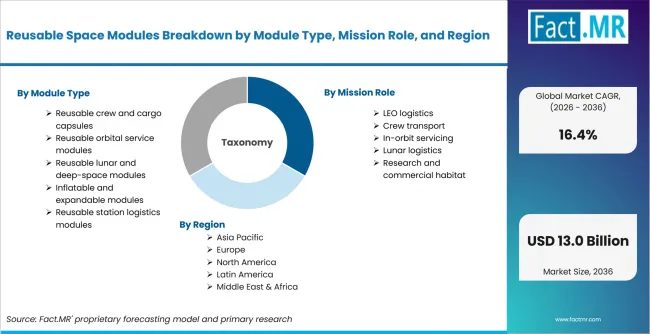
Reusable Space Modules Breakdown By Module Type, Mission Role, And Region | Source: Fact.MR
| Attribute | Details |
|---|---|
| Quantitative Units | USD billion |
| Market Definition | Reusable spacecraft modules, station modules and related service modules designed for repeat missions or refurbishable mission-specific reuse. |
| Module Type | Reusable crew and cargo capsules; Reusable orbital service modules; Reusable lunar and deep-space modules; Inflatable and expandable modules; Reusable station logistics modules |
| Mission Role | LEO logistics; Crew transport; In-orbit servicing; Lunar logistics; Research and commercial habitat |
| Reuse Cycle | 2-5 missions; 6-10 missions; 11-20 missions; >20 missions; Refurbishable mission-specific |
| Customer Type | Government space agencies; Commercial station operators; Defense and national security; Launch and logistics providers; Research and other |
| Regions Covered | North America; Latin America; Western Europe; Eastern Europe; East Asia; South Asia & Pacific; Middle East & Africa |
| Countries Covered | USA; France; Germany; Japan; UK |
| Key Companies Profiled | SpaceX; Sierra Space; Thales Alenia Space; The Exploration Company |
| Forecast Period | 2026 to 2036 |
| Approach | Hybrid top-down and bottom-up approach using station program activity, mission roles, reuse cycles, customer demand and provider portfolio review. |
Source: Fact.MR analysis. Updated Sep 5, 2026
How is the market segmented?
-
By Module Type
- Reusable crew and cargo capsules
- Reusable orbital service modules
- Reusable lunar and deep-space modules
- Inflatable and expandable modules
- Reusable station logistics modules
-
By Mission Role
- LEO logistics
- Crew transport
- In-orbit servicing
- Lunar logistics
- Research and commercial habitat
-
By Reuse Cycle
- 2-5 missions
- 6-10 missions
- 11-20 missions
- >20 missions
- Refurbishable mission-specific
-
By Customer Type
- Government space agencies
- Commercial station operators
- Defense and national security
- Launch and logistics providers
- Research and other
-
By Region
- North America
- Latin America
- Western Europe
- Eastern Europe
- East Asia
- South Asia & Pacific
- Middle East & Africa
Frequently Asked Questions
How big is the reusable space modules market in 2026?
What is the CAGR of the reusable space modules market from 2026 to 2036?
Which module type leads the reusable space modules market?
Which mission role leads the reusable space modules market?
Who are the leading companies in the reusable space modules market?
Who worked on this report


Preview the report firsthand - request a free sample
Free SampleGet the brochure for pricing and purchase details
Download PDF