Oil & Gas Flow Control Equipment Market (2026 - 2036)

Oil & Gas Flow Control Equipment Market Size and Share Forecast Outlook 2026 to 2036

Core Findings

    Oil & Gas Flow Control Equipment Market Forecast and Outlook 2026 to 2036

    The oil & gas flow control equipment market is projected to grow at a CAGR of 3.2% from 2026 to 2036, expanding from USD 32.7 billion in 2026 to USD 44.81 billion by 2036. Across offshore platforms, specialized valves and actuators are essential for maintaining precise flow control under extreme pressure, temperature, and corrosive marine conditions. In refineries and petrochemical complexes, advanced control systems integrate with distributed control architectures to enable real-time optimization and rapid response to fluctuating feedstock conditions.

    Summary of Oil & Gas Flow Control Equipment Market - Key Takeaways

    • The market includes control valves, actuators, chokes, and manifold assemblies designed for harsh oil and gas operating environments.
    • The defined scope covers revenue generated by equipment type, application segment, material specifications, and lifecycle positioning across global markets.
    • The oil and gas flow control equipment market is projected to grow at a CAGR of 3.2% from 2026 to 2036, expanding from USD 32.7 billion to USD 44.8 billion based on Fact.MR forecasting.
    • Control valves lead the equipment segment with a 35% share in 2026, supported by upstream production requirements and refinery process control applications.
    • Project EPC installations account for 45% of total demand, as greenfield developments and capacity expansions drive new equipment procurement.
    • China records the fastest growth at 5.0% CAGR, supported by pipeline network expansion targeting 240,000 km infrastructure and energy security priorities.
    • Competition is led by major players such as Emerson (Fisher), SLB Cameron, Baker Hughes, SAMSON, Flowserve, IMI, Velan, Metso Neles, CIRCOR, and KOSO.
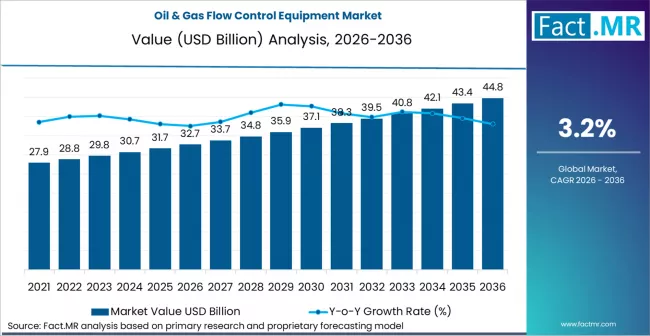
    Oil & Gas Flow Control Equipment Market Market Value Analysis

    A key transformation shaping the market is the shift toward software-defined and intelligent flow control systems. Operators increasingly prefer integrated platforms that combine valves, actuators, positioners, and analytics software into unified solutions. As Lal Karsanbhai, Executive President of Emerson Electric, emphasizes, oil and gas operators are moving toward integrated systems that enable data-driven decision-making and proactive maintenance strategies previously not possible with conventional mechanical equipment.

    Regulatory pressures are further influencing investment decisions. European methane reduction initiatives are accelerating demand for low-emission and zero-venting valve technologies. In the United Kingdom, post-Brexit compliance frameworks require enhanced telemetry and automated leak detection across North Sea operations. Meanwhile, China’s pipeline network expansion and energy security initiatives are driving significant infrastructure investment, increasing demand for high-pressure, digitally enabled flow control solutions that meet both domestic and international standards.

    Oil & Gas Flow Control Equipment Market

    Metric Value
    Estimated Value in (2026) USD 32.7 billion
    Forecast Value in (2036) USD 44.8 billion
    Forecast CAGR 2026 to 2036 3.2%

    Category 

    Category Segments
    Equipment Type Control Valves, Actuators, Chokes, Manifolds/Wellhead Assemblies
    Application Upstream, Midstream, Downstream
    Material/Pressure Class Carbon Steel, Alloy Steel, Stainless/Exotic
    Lifecycle Project EPC, MRO/Aftermarket, Brownfield Upgrades
    Region North America; Europe; Asia Pacific; Latin America; Middle East & Africa

    Segmental Analysis

    What drives control valves to hold a 35% market share?
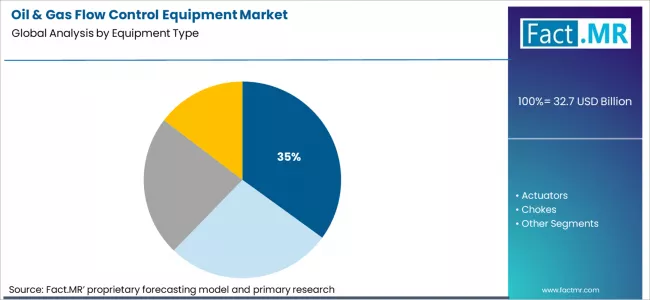
    Oil & Gas Flow Control Equipment Market Analysis By Equipment Type

    Control valves lead the market because they regulate flow, pressure, and temperature across every process stage from wellhead to refinery product tanks. These devices must operate reliably under extreme conditions including high pressures exceeding 10,000 psi, corrosive fluids containing hydrogen sulfide and carbon dioxide, and temperature swings from cryogenic LNG applications to hot crude processing. Advanced designs incorporate noise attenuation for gas letdown services, cavitation resistance for liquid throttling, and tight shutoff preventing leakage when closed. Digital valve controllers enable remote diagnostics, predictive maintenance, and performance optimization through continuous monitoring. Material selection becomes critical matching valve internals to specific service conditions preventing premature failure.

    What establishes upstream applications at 40% market share?
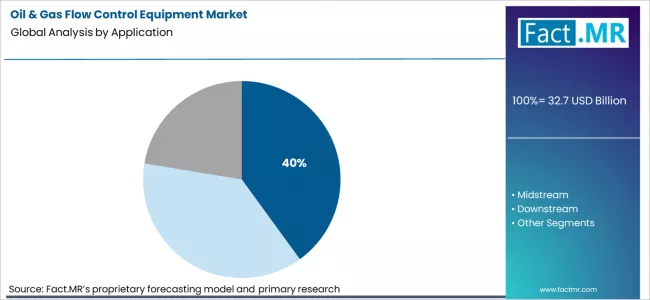
    Oil & Gas Flow Control Equipment Market Analysis By Application

    Upstream operations capture market share because exploration and production activities require extensive flow control infrastructure across drilling, completion, and production phases. Offshore platforms demand specialized equipment certified for subsea installation, withstanding saltwater corrosion and extreme water depths approaching 3,000 meters. Wellhead assemblies incorporate multiple valves and chokes controlling production rates while maintaining reservoir pressure management. Enhanced oil recovery techniques including water flooding and gas injection require precise injection control preventing formation damage. Shale production involves hydraulic fracturing operations demanding high-pressure pumping equipment and surface flow control managing volatile production profiles.

    Market Dynamics

    • Drivers: The oil and gas flow control equipment market is supported by several long-term structural drivers. A significant portion of global infrastructure was installed during the construction boom of the 1970s and 1980s and is now approaching the end of its service life. This is creating steady replacement demand as operators implement phased renewal programs to maintain safety and reliability. Digital transformation is another major catalyst. Companies are upgrading from legacy pneumatic and analog systems to intelligent electronic devices that support advanced process control, predictive maintenance, and remote monitoring. Environmental regulations, particularly methane emission reduction mandates, are accelerating the adoption of low-emission valve technologies, automated leak detection systems, and continuous monitoring platforms. Energy security priorities are also fueling investment.
    • Restraints: Despite steady demand fundamentals, the market remains sensitive to oil price volatility. During price downturns, operators often delay capital-intensive upstream projects, directly affecting new equipment orders. The broader energy transition also introduces uncertainty, as companies reassess long-term investment strategies between fossil fuels and renewable energy assets. Supply chain challenges continue to impact availability of specialty alloys, castings, and long-lead components, increasing project timelines and costs. Skilled labor shortages in manufacturing and field service sectors further constrain capacity. In addition, geopolitical tensions and trade restrictions can disrupt cross-border equipment sourcing.
    • Trend 1: Software-Defined Flow Control Platforms A major industry shift is the move toward software-defined flow control systems. Instead of replacing hardware to upgrade performance, operators can now update functionality through firmware and software enhancements, extending asset life and lowering total ownership costs. Initiatives such as Project Beyond from Emerson Electric highlight this transition, integrating artificial intelligence, machine learning, and zero-trust cybersecurity into operational technology platforms. Edge computing capabilities allow sensor data to be processed locally, enabling faster control adjustments without reliance on cloud connectivity. Digital twin technology is also gaining traction, creating virtual models of physical assets to support maintenance planning, operator training, and scenario simulation. facilities.
    • Trend 2: Green Hydrogen and Carbon Capture Infrastructure The global energy transition is opening new application areas for flow control equipment. Hydrogen production, compression, and distribution systems require specialized valves and materials designed to withstand hydrogen embrittlement. Companies such as KITZ Corporation are investing in ultra-high purity valve technologies to serve hydrogen and semiconductor markets. Carbon capture, utilization, and storage projects are also creating demand for equipment capable of handling supercritical carbon dioxide during compression, transport, and injection. These emerging sectors require extensive testing, material validation, and standards development before full commercial deployment.

    Oil & Gas Flow Control Equipment Market Analysis by Key Country
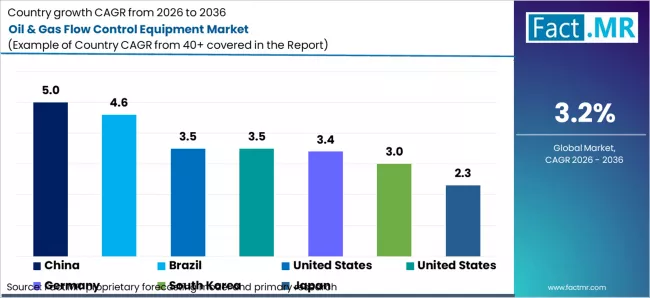
    Oil & Gas Flow Control Equipment Market Cagr Analysis By Country

    Country CAGR 2026 to 2036
    China 5.0%
    Brazil 4.6%
    United States 3.5%
    United Kingdom 3.5%
    Germany 3.4%
    South Korea 3.0%
    Japan 2.3%

    Why is China emerging as the fastest-growing market?

    China leads global growth at a 5.0% CAGR, driven by large-scale pipeline network expansion targeting 240,000 kilometers to strengthen energy security and meet Dual Carbon objectives. Major operators such as Sinopec are procuring high-pressure valves, actuators, and safety systems for both domestic production and LNG-linked infrastructure. Expanding natural gas consumption requires new midstream transportation capacity connecting supply with urban demand centers. Domestic content requirements encourage local manufacturing while fostering technology partnerships with international suppliers. Refinery upgrades, offshore South China Sea developments, and stricter environmental standards are accelerating adoption of advanced emission control and digital monitoring systems.

    Why is Brazil considered a high-growth opportunity?

    Brazil is expanding at 4.6% CAGR, supported by pre-salt offshore developments that require deepwater flow control equipment capable of withstanding extreme pressure and corrosive conditions. Investment programs by Petrobras are driving infrastructure expansion and refinery modernization. Domestic content requirements are encouraging local manufacturing partnerships, while natural gas pipeline expansion and biofuel integration create additional equipment demand. Brazil’s technical expertise in challenging offshore environments positions it as both a strong domestic market and a growing international supplier.

    What is shaping growth in the United States oil and gas flow control equipment market?

    The United States market is expanding at a steady 3.5% CAGR, supported by modernization and digital transformation initiatives. The launch of Project Beyond by Emerson Electric in 2025-2026 reflects growing operator demand for software-defined platforms that replace legacy proprietary systems with AI-enabled, cybersecurity-focused solutions. Gulf Coast refinery upgrades are incorporating intelligent control systems for predictive maintenance and real-time optimization. Shale basin maintenance activity continues to support strong aftermarket demand, while LNG export terminal expansions require advanced cryogenic service valves and actuators. Offshore developments in the Gulf of Mexico and pipeline infrastructure projects further sustain equipment investment, alongside regulatory pressure to reduce emissions through automated monitoring and low-leak technologies.

    What is driving momentum in the United Kingdom?

    The United Kingdom is advancing at 3.5% CAGR, influenced by post-Brexit regulatory frameworks and North Sea methane reduction initiatives. Rotork plc expanded intelligent actuation services in 2026 to support zero-venting requirements and real-time remote telemetry. Electric actuators are increasingly replacing pneumatic systems on offshore platforms to reduce emissions. Aging infrastructure replacement, decommissioning projects, and LNG-related investments are contributing to sustained demand for advanced flow control equipment.

    How is Germany reinforcing its market position?

    Germany is growing at 3.4% CAGR, supported by industrial modernization and hydrogen infrastructure development. Strategic shifts, including product portfolio upgrades by companies such as SAMSON AG, are accelerating adoption of Ethernet-APL-enabled digital positioners and fully electronic control systems. The country’s strong chemical and gas processing industries are systematically replacing pneumatic equipment with intelligent devices. Germany’s engineering expertise and export orientation continue to strengthen its leadership in precision flow control technologies across global markets.

    What is supporting South Korea’s expansion?

    South Korea is progressing at 3.0% CAGR, driven largely by its leadership in LNG carrier shipbuilding and advanced maritime applications. Companies like Hanmi Hydraulic Machinery are scaling eco-friendly high-pressure hydraulic systems tailored for LNG transport vessels. Strong petrochemical and refinery sectors also support demand for specialized control equipment. The country’s technology development capabilities and export orientation continue to strengthen its global competitive position.

    How is Japan repositioning its strategy?

    Japan’s market is growing at 2.3% CAGR as domestic fossil fuel demand plateaus. Companies such as KITZ Corporation are pivoting toward ultra-high purity and hydrogen-compatible valve systems under long-term strategic initiatives. While refinery expansion is limited, maintenance and LNG import terminal operations sustain steady demand for cryogenic and precision equipment. Japan’s strength in high-specification manufacturing and global exports helps offset slower domestic growth.

    Competitive Landscape for Oil & Gas Flow Control Equipment Market
    Oil & Gas Flow Control Equipment Market Analysis By Company

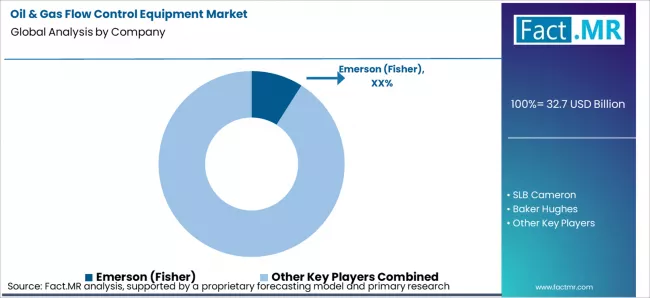
    The oil and gas flow control equipment market is relatively consolidated, led by a mix of global industrial conglomerates, specialized valve manufacturers, and oilfield service providers. Competition is no longer based solely on supplying mechanical components. Instead, companies differentiate themselves through digital capabilities, lifecycle services, and deep application expertise.

    Emerson Electric, through its Fisher brand heritage, offers a broad portfolio of valves, actuators, and automation systems integrated with advanced software platforms. Its strategy centers on delivering end-to-end automation solutions that combine hardware, analytics, and long-term service agreements. Specialized manufacturers including SAMSON AG focus on precision control valves and intelligent positioners for process industries, while Flowserve and IMI plc maintain diversified industrial valve portfolios across oil and gas and adjacent sectors.

    Companies such as Velan Inc. and Metso (Neles brand) concentrate on severe service applications requiring advanced metallurgy and corrosion-resistant materials. Meanwhile, CIRCOR International and KOSO Kent Introl target niche segments including instrumentation valves and specialized actuation systems. Innovation priorities across the competitive landscape increasingly include software-defined control platforms, predictive maintenance solutions, emission-reduction technologies, and modular equipment designs that simplify installation and servicing. Strategic partnerships between equipment suppliers, engineering contractors, and end-user operators are becoming more common, enabling collaborative problem-solving for technically complex and capital-intensive energy projects.

    Key Market Players in Oil and Gas Flow Control Equipment Market

    • Emerson (Fisher)
    • SLB Cameron
    • Baker Hughes
    • SAMSON
    • Flowserve
    • IMI
    • Velan
    • Metso Neles
    • CIRCOR
    • KOSO

    Scope of Report

    Items Values
    Quantitative Units (2026) USD 0.6 Billion
    Core Material Carbon/Graphite Core, Stainless Steel Core, Other Conductive Cores
    Sheath Polymer Polyester, Polyamide, Other Polymers
    Application ESD Garments & Cleanroom Textiles, Industrial/Conveyor & Filtration, Carpets/Upholstery & Others
    End Market Electronics & Semiconductor, Pharma & Healthcare, Industrial & Other
    Regions Covered North America, Europe, Asia Pacific, Latin America, Middle East & Africa
    Countries Covered U.S., Canada, Germany, Italy, UK, France, Japan, China, Brazil, South Korea, Australia, and other countries
    Key Companies Profiled Coats Group, Madeira Garnfabrik, Yantai Tayho, Toray Industries, Teijin Frontier, Monofil Technik, FilSpec, Sinterama, Unitika, Huvis
    Additional Attributes Dollar revenue in the anti-static carbon core filament yarns market is segmented by core material (carbon/graphite core, stainless steel core, other conductive cores), sheath polymer (polyester, polyamide, other polymers), application (ESD garments & cleanroom textiles, industrial/conveyor & filtration, carpets/upholstery & others), end market (electronics & semiconductor, pharma & healthcare, industrial & other), and region.

    Oil and Gas Flow Control Equipment Market by Segments

    • Equipment Type :

      • Control Valves
      • Actuators
      • Chokes
      • Manifolds/Wellhead Assemblies
    • Application :

      • Upstream
      • Midstream
      • Downstream
    • Material :

      • Carbon Steel
      • Alloy Steel
      • Stainless/Exotic
    • Life cycle :

      • Project EPC
      • MRO/Aftermarket
      • Brownfield Upgrades
    • Region :

      • Asia Pacific
        • China
        • Japan
        • South Korea
        • Rest of Asia Pacific
      • North America
        • United States
        • Canada
        • Mexico
      • Europe
        • Germany
        • France
        • UK
        • Spain
        • Rest of Europe
      • Latin America
        • Brazil
        • Mexico
        • Rest of Latin America

    Bibliography

    • Baker Hughes. 2026. Digital solutions and emission monitoring technologies for oil and gas operations. Houston (TX): Baker Hughes Company.
    • Emerson Electric Co. 2026. Project Beyond: Software-defined automation and operational technology platform overview. St. Louis (MO): Emerson Automation Solutions.
    • European Commission. 2023. Regulation (EU) 2023/956 and methane emission reduction initiatives for the energy sector. Brussels (BE): European Commission.
    • Flowserve Corporation. 2025. Severe service valve technologies for upstream and downstream applications. Irving (TX): Flowserve Corp.
    • International Energy Agency (IEA). 2024. World energy outlook 2024: Oil and gas infrastructure investment trends. Paris (FR): IEA.
    • KITZ Corporation. 2026. SHIN GLOBAL 2027 strategic initiative: Hydrogen and ultra-high purity valve systems. Chiba (JP): KITZ Corp.

    Table of Content

    1. Executive Summary
      • Global Market Outlook
      • Demand to side Trends
      • Supply to side Trends
      • Technology Roadmap Analysis
      • Analysis and Recommendations
    2. Market Overview
      • Market Coverage / Taxonomy
      • Market Definition / Scope / Limitations
    3. Research Methodology
      • Chapter Orientation
      • Analytical Lens and Working Hypotheses
        • Market Structure, Signals, and Trend Drivers
        • Benchmarking and Cross-market Comparability
        • Market Sizing, Forecasting, and Opportunity Mapping
      • Research Design and Evidence Framework
        • Desk Research Programme (Secondary Evidence)
          • Company Annual and Sustainability Reports
          • Peer-reviewed Journals and Academic Literature
          • Corporate Websites, Product Literature, and Technical Notes
          • Earnings Decks and Investor Briefings
          • Statutory Filings and Regulatory Disclosures
          • Technical White Papers and Standards Notes
          • Trade Journals, Industry Magazines, and Analyst Briefs
          • Conference Proceedings, Webinars, and Seminar Materials
          • Government Statistics Portals and Public Data Releases
          • Press Releases and Reputable Media Coverage
          • Specialist Newsletters and Curated Briefings
          • Sector Databases and Reference Repositories
          • FMR Internal Proprietary Databases and Historical Market Datasets
          • Subscription Datasets and Paid Sources
          • Social Channels, Communities, and Digital Listening Inputs
          • Additional Desk Sources
        • Expert Input and Fieldwork (Primary Evidence)
          • Primary Modes
            • Qualitative Interviews and Expert Elicitation
            • Quantitative Surveys and Structured Data Capture
            • Blended Approach
          • Why Primary Evidence is Used
          • Field Techniques
            • Interviews
            • Surveys
            • Focus Groups
            • Observational and In-context Research
            • Social and Community Interactions
          • Stakeholder Universe Engaged
            • C-suite Leaders
            • Board Members
            • Presidents and Vice Presidents
            • R&D and Innovation Heads
            • Technical Specialists
            • Domain Subject-matter Experts
            • Scientists
            • Physicians and Other Healthcare Professionals
          • Governance, Ethics, and Data Stewardship
            • Research Ethics
            • Data Integrity and Handling
        • Tooling, Models, and Reference Databases
      • Data Engineering and Model Build
        • Data Acquisition and Ingestion
        • Cleaning, Normalisation, and Verification
        • Synthesis, Triangulation, and Analysis
      • Quality Assurance and Audit Trail
    4. Market Background
      • Market Dynamics
        • Drivers
        • Restraints
        • Opportunity
        • Trends
      • Scenario Forecast
        • Demand in Optimistic Scenario
        • Demand in Likely Scenario
        • Demand in Conservative Scenario
      • Opportunity Map Analysis
      • Product Life Cycle Analysis
      • Supply Chain Analysis
      • Investment Feasibility Matrix
      • Value Chain Analysis
      • PESTLE and Porter’s Analysis
      • Regulatory Landscape
      • Regional Parent Market Outlook
      • Production and Consumption Statistics
      • Import and Export Statistics
    5. Global Market Analysis 2021 to 2025 and Forecast, 2026 to 2036
      • Historical Market Size Value (USD Million) Analysis, 2021 to 2025
      • Current and Future Market Size Value (USD Million) Projections, 2026 to 2036
        • Y to o to Y Growth Trend Analysis
        • Absolute $ Opportunity Analysis
    6. Global Market Pricing Analysis 2021 to 2025 and Forecast 2026 to 2036
    7. Global Market Analysis 2021 to 2025 and Forecast 2026 to 2036, By Equipment Type
      • Introduction / Key Findings
      • Historical Market Size Value (USD Million) Analysis By Equipment Type, 2021 to 2025
      • Current and Future Market Size Value (USD Million) Analysis and Forecast By Equipment Type, 2026 to 2036
        • Control Valves
        • Actuators
        • Chokes
        • Manifolds/Wellhead Assemblies
      • Y to o to Y Growth Trend Analysis By Equipment Type, 2021 to 2025
      • Absolute $ Opportunity Analysis By Equipment Type, 2026 to 2036
    8. Global Market Analysis 2021 to 2025 and Forecast 2026 to 2036, By Application
      • Introduction / Key Findings
      • Historical Market Size Value (USD Million) Analysis By Application, 2021 to 2025
      • Current and Future Market Size Value (USD Million) Analysis and Forecast By Application, 2026 to 2036
        • Upstream
        • Midstream
        • Downstream
      • Y to o to Y Growth Trend Analysis By Application, 2021 to 2025
      • Absolute $ Opportunity Analysis By Application, 2026 to 2036
    9. Global Market Analysis 2021 to 2025 and Forecast 2026 to 2036, By Region
      • Introduction
      • Historical Market Size Value (USD Million) Analysis By Region, 2021 to 2025
      • Current Market Size Value (USD Million) Analysis and Forecast By Region, 2026 to 2036
        • North America
        • Latin America
        • Western Europe
        • Eastern Europe
        • East Asia
        • South Asia and Pacific
        • Middle East & Africa
      • Market Attractiveness Analysis By Region
    10. North America Market Analysis 2021 to 2025 and Forecast 2026 to 2036, By Country
      • Historical Market Size Value (USD Million) Trend Analysis By Market Taxonomy, 2021 to 2025
      • Market Size Value (USD Million) Forecast By Market Taxonomy, 2026 to 2036
        • By Country
          • USA
          • Canada
          • Mexico
        • By Equipment Type
        • By Application
      • Market Attractiveness Analysis
        • By Country
        • By Equipment Type
        • By Application
      • Key Takeaways
    11. Latin America Market Analysis 2021 to 2025 and Forecast 2026 to 2036, By Country
      • Historical Market Size Value (USD Million) Trend Analysis By Market Taxonomy, 2021 to 2025
      • Market Size Value (USD Million) Forecast By Market Taxonomy, 2026 to 2036
        • By Country
          • Brazil
          • Chile
          • Rest of Latin America
        • By Equipment Type
        • By Application
      • Market Attractiveness Analysis
        • By Country
        • By Equipment Type
        • By Application
      • Key Takeaways
    12. Western Europe Market Analysis 2021 to 2025 and Forecast 2026 to 2036, By Country
      • Historical Market Size Value (USD Million) Trend Analysis By Market Taxonomy, 2021 to 2025
      • Market Size Value (USD Million) Forecast By Market Taxonomy, 2026 to 2036
        • By Country
          • Germany
          • UK
          • Italy
          • Spain
          • France
          • Nordic
          • BENELUX
          • Rest of Western Europe
        • By Equipment Type
        • By Application
      • Market Attractiveness Analysis
        • By Country
        • By Equipment Type
        • By Application
      • Key Takeaways
    13. Eastern Europe Market Analysis 2021 to 2025 and Forecast 2026 to 2036, By Country
      • Historical Market Size Value (USD Million) Trend Analysis By Market Taxonomy, 2021 to 2025
      • Market Size Value (USD Million) Forecast By Market Taxonomy, 2026 to 2036
        • By Country
          • Russia
          • Poland
          • Hungary
          • Balkan & Baltic
          • Rest of Eastern Europe
        • By Equipment Type
        • By Application
      • Market Attractiveness Analysis
        • By Country
        • By Equipment Type
        • By Application
      • Key Takeaways
    14. East Asia Market Analysis 2021 to 2025 and Forecast 2026 to 2036, By Country
      • Historical Market Size Value (USD Million) Trend Analysis By Market Taxonomy, 2021 to 2025
      • Market Size Value (USD Million) Forecast By Market Taxonomy, 2026 to 2036
        • By Country
          • China
          • Japan
          • South Korea
        • By Equipment Type
        • By Application
      • Market Attractiveness Analysis
        • By Country
        • By Equipment Type
        • By Application
      • Key Takeaways
    15. South Asia and Pacific Market Analysis 2021 to 2025 and Forecast 2026 to 2036, By Country
      • Historical Market Size Value (USD Million) Trend Analysis By Market Taxonomy, 2021 to 2025
      • Market Size Value (USD Million) Forecast By Market Taxonomy, 2026 to 2036
        • By Country
          • India
          • ASEAN
          • Australia & New Zealand
          • Rest of South Asia and Pacific
        • By Equipment Type
        • By Application
      • Market Attractiveness Analysis
        • By Country
        • By Equipment Type
        • By Application
      • Key Takeaways
    16. Middle East & Africa Market Analysis 2021 to 2025 and Forecast 2026 to 2036, By Country
      • Historical Market Size Value (USD Million) Trend Analysis By Market Taxonomy, 2021 to 2025
      • Market Size Value (USD Million) Forecast By Market Taxonomy, 2026 to 2036
        • By Country
          • Kingdom of Saudi Arabia
          • Other GCC Countries
          • Turkiye
          • South Africa
          • Other African Union
          • Rest of Middle East & Africa
        • By Equipment Type
        • By Application
      • Market Attractiveness Analysis
        • By Country
        • By Equipment Type
        • By Application
      • Key Takeaways
    17. Key Countries Market Analysis
      • USA
        • Pricing Analysis
        • Market Share Analysis, 2025
          • By Equipment Type
          • By Application
      • Canada
        • Pricing Analysis
        • Market Share Analysis, 2025
          • By Equipment Type
          • By Application
      • Mexico
        • Pricing Analysis
        • Market Share Analysis, 2025
          • By Equipment Type
          • By Application
      • Brazil
        • Pricing Analysis
        • Market Share Analysis, 2025
          • By Equipment Type
          • By Application
      • Chile
        • Pricing Analysis
        • Market Share Analysis, 2025
          • By Equipment Type
          • By Application
      • Germany
        • Pricing Analysis
        • Market Share Analysis, 2025
          • By Equipment Type
          • By Application
      • UK
        • Pricing Analysis
        • Market Share Analysis, 2025
          • By Equipment Type
          • By Application
      • Italy
        • Pricing Analysis
        • Market Share Analysis, 2025
          • By Equipment Type
          • By Application
      • Spain
        • Pricing Analysis
        • Market Share Analysis, 2025
          • By Equipment Type
          • By Application
      • France
        • Pricing Analysis
        • Market Share Analysis, 2025
          • By Equipment Type
          • By Application
      • India
        • Pricing Analysis
        • Market Share Analysis, 2025
          • By Equipment Type
          • By Application
      • ASEAN
        • Pricing Analysis
        • Market Share Analysis, 2025
          • By Equipment Type
          • By Application
      • Australia & New Zealand
        • Pricing Analysis
        • Market Share Analysis, 2025
          • By Equipment Type
          • By Application
      • China
        • Pricing Analysis
        • Market Share Analysis, 2025
          • By Equipment Type
          • By Application
      • Japan
        • Pricing Analysis
        • Market Share Analysis, 2025
          • By Equipment Type
          • By Application
      • South Korea
        • Pricing Analysis
        • Market Share Analysis, 2025
          • By Equipment Type
          • By Application
      • Russia
        • Pricing Analysis
        • Market Share Analysis, 2025
          • By Equipment Type
          • By Application
      • Poland
        • Pricing Analysis
        • Market Share Analysis, 2025
          • By Equipment Type
          • By Application
      • Hungary
        • Pricing Analysis
        • Market Share Analysis, 2025
          • By Equipment Type
          • By Application
      • Kingdom of Saudi Arabia
        • Pricing Analysis
        • Market Share Analysis, 2025
          • By Equipment Type
          • By Application
      • Turkiye
        • Pricing Analysis
        • Market Share Analysis, 2025
          • By Equipment Type
          • By Application
      • South Africa
        • Pricing Analysis
        • Market Share Analysis, 2025
          • By Equipment Type
          • By Application
    18. Market Structure Analysis
      • Competition Dashboard
      • Competition Benchmarking
      • Market Share Analysis of Top Players
        • By Regional
        • By Equipment Type
        • By Application
    19. Competition Analysis
      • Competition Deep Dive
        • Emerson (Fisher)
          • Overview
          • Product Portfolio
          • Profitability by Market Segments (Product/Age /Sales Channel/Region)
          • Sales Footprint
          • Strategy Overview
            • Marketing Strategy
            • Product Strategy
            • Channel Strategy
        • SLB Cameron
        • Baker Hughes
        • SAMSON
        • Flowserve
        • IMI
        • Velan
        • Metso Neles
        • CIRCOR
        • KOSO
    20. Assumptions & Acronyms Used

    List Of Table

    • Table 1: Global Market Value (USD Million) Forecast by Region, 2021 to 2036
    • Table 2: Global Market Value (USD Million) Forecast by Equipment Type, 2021 to 2036
    • Table 3: Global Market Value (USD Million) Forecast by Application, 2021 to 2036
    • Table 4: North America Market Value (USD Million) Forecast by Country, 2021 to 2036
    • Table 5: North America Market Value (USD Million) Forecast by Equipment Type, 2021 to 2036
    • Table 6: North America Market Value (USD Million) Forecast by Application, 2021 to 2036
    • Table 7: Latin America Market Value (USD Million) Forecast by Country, 2021 to 2036
    • Table 8: Latin America Market Value (USD Million) Forecast by Equipment Type, 2021 to 2036
    • Table 9: Latin America Market Value (USD Million) Forecast by Application, 2021 to 2036
    • Table 10: Western Europe Market Value (USD Million) Forecast by Country, 2021 to 2036
    • Table 11: Western Europe Market Value (USD Million) Forecast by Equipment Type, 2021 to 2036
    • Table 12: Western Europe Market Value (USD Million) Forecast by Application, 2021 to 2036
    • Table 13: Eastern Europe Market Value (USD Million) Forecast by Country, 2021 to 2036
    • Table 14: Eastern Europe Market Value (USD Million) Forecast by Equipment Type, 2021 to 2036
    • Table 15: Eastern Europe Market Value (USD Million) Forecast by Application, 2021 to 2036
    • Table 16: East Asia Market Value (USD Million) Forecast by Country, 2021 to 2036
    • Table 17: East Asia Market Value (USD Million) Forecast by Equipment Type, 2021 to 2036
    • Table 18: East Asia Market Value (USD Million) Forecast by Application, 2021 to 2036
    • Table 19: South Asia and Pacific Market Value (USD Million) Forecast by Country, 2021 to 2036
    • Table 20: South Asia and Pacific Market Value (USD Million) Forecast by Equipment Type, 2021 to 2036
    • Table 21: South Asia and Pacific Market Value (USD Million) Forecast by Application, 2021 to 2036
    • Table 22: Middle East & Africa Market Value (USD Million) Forecast by Country, 2021 to 2036
    • Table 23: Middle East & Africa Market Value (USD Million) Forecast by Equipment Type, 2021 to 2036
    • Table 24: Middle East & Africa Market Value (USD Million) Forecast by Application, 2021 to 2036

    List Of Figures

    • Figure 1: Global Market Pricing Analysis
    • Figure 2: Global Market Value (USD Million) Forecast 2021 to 2036
    • Figure 3: Global Market Value Share and BPS Analysis by Equipment Type, 2026 and 2036
    • Figure 4: Global Market Y to o to Y Growth Comparison by Equipment Type, 2026 to 2036
    • Figure 5: Global Market Attractiveness Analysis by Equipment Type
    • Figure 6: Global Market Value Share and BPS Analysis by Application, 2026 and 2036
    • Figure 7: Global Market Y to o to Y Growth Comparison by Application, 2026 to 2036
    • Figure 8: Global Market Attractiveness Analysis by Application
    • Figure 9: Global Market Value (USD Million) Share and BPS Analysis by Region, 2026 and 2036
    • Figure 10: Global Market Y to o to Y Growth Comparison by Region, 2026 to 2036
    • Figure 11: Global Market Attractiveness Analysis by Region
    • Figure 12: North America Market Incremental Dollar Opportunity, 2026 to 2036
    • Figure 13: Latin America Market Incremental Dollar Opportunity, 2026 to 2036
    • Figure 14: Western Europe Market Incremental Dollar Opportunity, 2026 to 2036
    • Figure 15: Eastern Europe Market Incremental Dollar Opportunity, 2026 to 2036
    • Figure 16: East Asia Market Incremental Dollar Opportunity, 2026 to 2036
    • Figure 17: South Asia and Pacific Market Incremental Dollar Opportunity, 2026 to 2036
    • Figure 18: Middle East & Africa Market Incremental Dollar Opportunity, 2026 to 2036
    • Figure 19: North America Market Value Share and BPS Analysis by Country, 2026 and 2036
    • Figure 20: North America Market Value Share and BPS Analysis by Equipment Type, 2026 and 2036
    • Figure 21: North America Market Y to o to Y Growth Comparison by Equipment Type, 2026 to 2036
    • Figure 22: North America Market Attractiveness Analysis by Equipment Type
    • Figure 23: North America Market Value Share and BPS Analysis by Application, 2026 and 2036
    • Figure 24: North America Market Y to o to Y Growth Comparison by Application, 2026 to 2036
    • Figure 25: North America Market Attractiveness Analysis by Application
    • Figure 26: Latin America Market Value Share and BPS Analysis by Country, 2026 and 2036
    • Figure 27: Latin America Market Value Share and BPS Analysis by Equipment Type, 2026 and 2036
    • Figure 28: Latin America Market Y to o to Y Growth Comparison by Equipment Type, 2026 to 2036
    • Figure 29: Latin America Market Attractiveness Analysis by Equipment Type
    • Figure 30: Latin America Market Value Share and BPS Analysis by Application, 2026 and 2036
    • Figure 31: Latin America Market Y to o to Y Growth Comparison by Application, 2026 to 2036
    • Figure 32: Latin America Market Attractiveness Analysis by Application
    • Figure 33: Western Europe Market Value Share and BPS Analysis by Country, 2026 and 2036
    • Figure 34: Western Europe Market Value Share and BPS Analysis by Equipment Type, 2026 and 2036
    • Figure 35: Western Europe Market Y to o to Y Growth Comparison by Equipment Type, 2026 to 2036
    • Figure 36: Western Europe Market Attractiveness Analysis by Equipment Type
    • Figure 37: Western Europe Market Value Share and BPS Analysis by Application, 2026 and 2036
    • Figure 38: Western Europe Market Y to o to Y Growth Comparison by Application, 2026 to 2036
    • Figure 39: Western Europe Market Attractiveness Analysis by Application
    • Figure 40: Eastern Europe Market Value Share and BPS Analysis by Country, 2026 and 2036
    • Figure 41: Eastern Europe Market Value Share and BPS Analysis by Equipment Type, 2026 and 2036
    • Figure 42: Eastern Europe Market Y to o to Y Growth Comparison by Equipment Type, 2026 to 2036
    • Figure 43: Eastern Europe Market Attractiveness Analysis by Equipment Type
    • Figure 44: Eastern Europe Market Value Share and BPS Analysis by Application, 2026 and 2036
    • Figure 45: Eastern Europe Market Y to o to Y Growth Comparison by Application, 2026 to 2036
    • Figure 46: Eastern Europe Market Attractiveness Analysis by Application
    • Figure 47: East Asia Market Value Share and BPS Analysis by Country, 2026 and 2036
    • Figure 48: East Asia Market Value Share and BPS Analysis by Equipment Type, 2026 and 2036
    • Figure 49: East Asia Market Y to o to Y Growth Comparison by Equipment Type, 2026 to 2036
    • Figure 50: East Asia Market Attractiveness Analysis by Equipment Type
    • Figure 51: East Asia Market Value Share and BPS Analysis by Application, 2026 and 2036
    • Figure 52: East Asia Market Y to o to Y Growth Comparison by Application, 2026 to 2036
    • Figure 53: East Asia Market Attractiveness Analysis by Application
    • Figure 54: South Asia and Pacific Market Value Share and BPS Analysis by Country, 2026 and 2036
    • Figure 55: South Asia and Pacific Market Value Share and BPS Analysis by Equipment Type, 2026 and 2036
    • Figure 56: South Asia and Pacific Market Y to o to Y Growth Comparison by Equipment Type, 2026 to 2036
    • Figure 57: South Asia and Pacific Market Attractiveness Analysis by Equipment Type
    • Figure 58: South Asia and Pacific Market Value Share and BPS Analysis by Application, 2026 and 2036
    • Figure 59: South Asia and Pacific Market Y to o to Y Growth Comparison by Application, 2026 to 2036
    • Figure 60: South Asia and Pacific Market Attractiveness Analysis by Application
    • Figure 61: Middle East & Africa Market Value Share and BPS Analysis by Country, 2026 and 2036
    • Figure 62: Middle East & Africa Market Value Share and BPS Analysis by Equipment Type, 2026 and 2036
    • Figure 63: Middle East & Africa Market Y to o to Y Growth Comparison by Equipment Type, 2026 to 2036
    • Figure 64: Middle East & Africa Market Attractiveness Analysis by Equipment Type
    • Figure 65: Middle East & Africa Market Value Share and BPS Analysis by Application, 2026 and 2036
    • Figure 66: Middle East & Africa Market Y to o to Y Growth Comparison by Application, 2026 to 2036
    • Figure 67: Middle East & Africa Market Attractiveness Analysis by Application
    • Figure 68: Global Market - Tier Structure Analysis
    • Figure 69: Global Market - Company Share Analysis

    - FAQs -

    How big is the oil & gas flow control equipment market in 2026?

    The global oil & gas flow control equipment market is estimated to be valued at USD 32.7 billion in 2026.

    What will be the size of oil & gas flow control equipment market in 2036?

    The market size for the oil & gas flow control equipment market is projected to reach USD 44.8 billion by 2036.

    How much will be the oil & gas flow control equipment market growth between 2026 and 2036?

    The oil & gas flow control equipment market is expected to grow at a 3.2% CAGR between 2026 and 2036.

    What are the key product types in the oil & gas flow control equipment market?

    The key product types in oil & gas flow control equipment market are control valves, actuators, chokes and manifolds/wellhead assemblies .

    Which application segment to contribute significant share in the oil & gas flow control equipment market in 2026?

    In terms of application, upstream segment to command 40.0% share in the oil & gas flow control equipment market in 2026.

    Oil & Gas Flow Control Equipment Market