- Base Value(2026): 4.8 Bn
- Estimated Value(2026): 4.8 Bn
- Forecast Value (2036): 12.4 Bn
- CAGR (2026 - 2036): 10.0%
On-the-Go Snack Disposable Packaging Market Forecast and Outlook 2026 to 2036
The on-the-go snack disposable packaging market stands at USD 4.8 billion in 2026 and reaches USD 12.4 billion by 2036, which reflects a 10% CAGR.
On-the-Go Snack Disposable Packaging Market Key Takeaways
- On-the-Go Snack Disposable Packaging Market Value (2026): USD 4.8 billion
- On-the-Go Snack Disposable Packaging Market Forecast Value (2036): USD 12.4 billion
- On-the-Go Snack Disposable Packaging Market Forecast CAGR (2026-2036): 10.0%
- Leading Packaging Format in On-the-Go Snack Disposable Packaging Market: Pouches and wraps
- Key Growth Regions in On-the-Go Snack Disposable Packaging Market: North America, Europe, Asia Pacific, Latin America, Middle East & Africa
- Top Players in On-the-Go Snack Disposable Packaging Market: Sonoco Products Company, Mondi Group, Amcor plc, Sealed Air Corporation, Huhtamäki Oyj
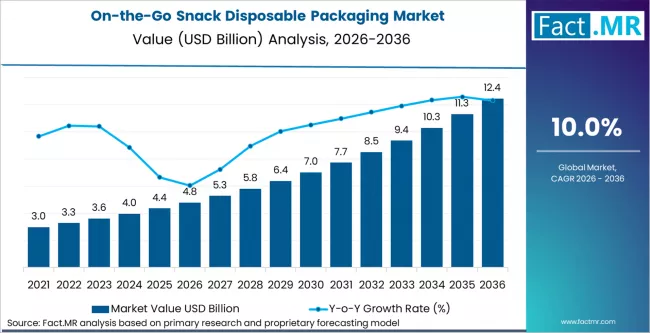
On The Go Snack Disposable Packaging Market Market Value Analysis | Source: Fact.MR
This segment serves products bought for immediate consumption in transit, at workplaces, and in convenience retail. Packs need to open easily, hold shape during handling, and limit spills or grease transfer. Retailers and food producers favor formats that stack well, move smoothly through filling lines, and fit standard display units.
Portion control and clear labeling matter since many purchases are made quickly with limited inspection. Once a tray, pouch, or wrap format is approved, it often stays in use because any change affects packing speed, case counts, and shelf layouts. Buyers focus on cost stability, supply reliability, and consistent performance more than on frequent design updates. Growth follows higher snacking frequency and wider availability across travel, office, and urban retail channels rather than rapid changes in pack structures.
On-the-Go Snack Disposable Packaging Market
| Metric | Value |
|---|---|
| Market Value (2026) | USD 4.8 billion |
| Forecast Value (2036) | USD 12.4 billion |
| Forecast CAGR (2026-2036) | 10.0% |
Source: Fact.MR analysis. Updated Jan 27, 2026
Category
| Category | Segments |
|---|---|
| End-use | Convenience stores; Supermarkets; Street food and kiosks; Vending retail; Quick-service food |
| Packaging Format | Pouches and wraps; Paper cups and trays; Folding cartons; Rigid snack boxes |
| Material | Multilayer films; Paperboard; Coated paper; PET |
| Region | North America; Europe; Asia Pacific; Latin America; Middle East & Africa |
Source: Fact.MR analysis. Updated Jan 27, 2026
On-the-Go Snack Disposable Packaging Market Segmental Analysis
Why Do Convenience Stores Drive the Largest Share of On-The-Go Snack Packaging Demand?
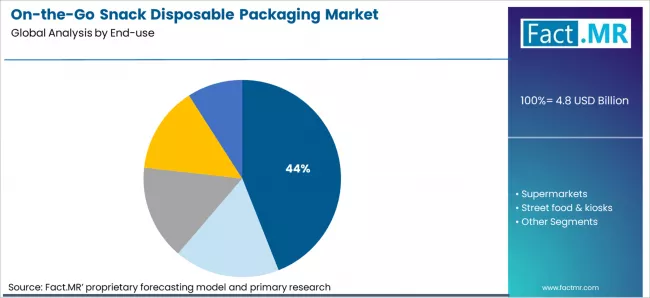
On The Go Snack Disposable Packaging Market Analysis By End Use | Source: Fact.MR
Convenience stores account for 44% of end-use demand in the on-the-go snack disposable packaging market. These outlets operate long hours and serve customers seeking quick purchases rather than planned shopping. Product ranges focus on single-serve items that require immediate consumption and simple handling. Replenishment cycles run daily or even multiple times per day, which increases packaging throughput compared to larger retail formats. Shelf space remains limited, so assortments favor compact packs with fast turnover. Location density near transit points and offices also adds to unit movement. Supermarkets, street vendors, and vending channels contribute steady volume. The constant flow of short stop purchases keeps convenience stores as the main driver of disposable snack packaging consumption.
What Makes Pouches and Wraps the Most Common Format for On-The-Go Snacks?
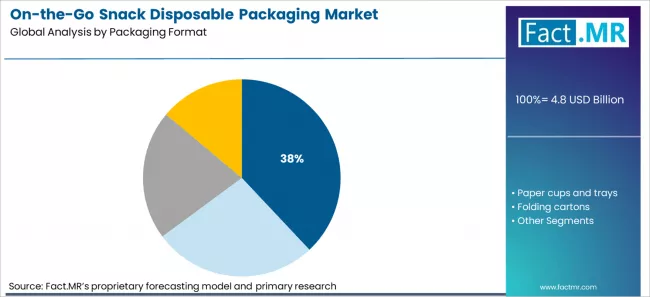
On The Go Snack Disposable Packaging Market Analysis By Packaging Format | Source: Fact.MR
Pouches and wraps represent 38% of packaging format usage in this market. This format supports quick packing, easy opening, and disposal without creating bulky waste. Snack producers use these packs for bars, sandwiches, and small baked items that do not require rigid protection. Filling and sealing equipment for flexible formats operates at high speed, which suits mass snack production. Storage and transport efficiency also remain high, with rolls and flat packs occupying limited space. Paper cups, cartons, and rigid boxes serve specific product types. Most high turnover snack lines still rely on pouches and wraps as the default format for immediate consumption products.
What are the Drivers, Restraints, and Key Trends of the On-the-Go Snack Disposable Packaging Market?
- Drivers: Requirements for convenient, single-use formats that support portability, product protection, and ease of consumption are influencing packaging choices for snacks across retail, convenience, and impulse channels.
- Restraint: Cost constraints in high-volume snack categories and environmental scrutiny over single-use disposables create pressure on brands to balance functional performance with consumer and regulatory expectations.
- Trend 1: Development of packaging formats that optimize portion control and ease of opening while maintaining barrier properties for freshness and shelf life.
- Trend 2: Expanded range of lightweight, easy-dispense sachets, pouches, and wrappers tailored to specific snack formats and consumption occasions.
Analysis of the On-the-Go Snack Disposable Packaging Market by Key Country
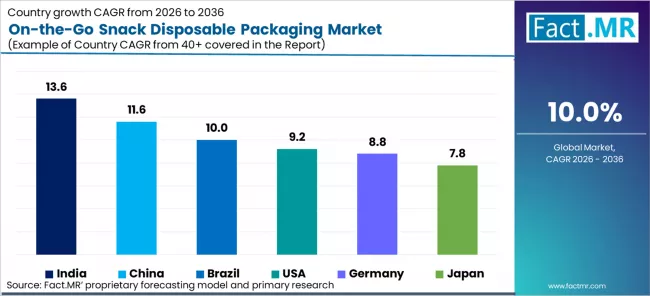
On The Go Snack Disposable Packaging Market Cagr Analysis By Country | Source: Fact.MR
| Country | CAGR (2026-2036) |
|---|---|
| USA | 9.2% |
| Germany | 8.8% |
| China | 11.6% |
| Japan | 7.8% |
| India | 13.6% |
| Brazil | 10.0% |
Source: Fact.MR analysis. Updated Jan 27, 2026
The report covers an in-depth analysis of 40+ countries; top-performing countries are highlighted below.
How Are Convenience Retail and Commuter Eating Habits Shaping This Market in USA?
Convenience driven eating patterns define how snack packaging is specified and purchased in USA. The market grows near 9.2% per year through 2036 as commuting, workplace snacking, and travel consumption remain strong. Demand centers on portability, easy opening, and portion control. Buyers focus on line speed, sealing reliability, and compatibility with high volume filling equipment. Procurement decisions balance material cost, shelf impact, and waste handling requirements. Volume growth follows expansion of convenience stores, vending, and food delivery assortments. Market development stays tied to lifestyle habits and channel growth rather than premiumization or complex package engineering programs.
Why Do Retail Standards and Waste Policies Influence This Market in Germany?
Packaging decisions in Germany are shaped by retail requirements and strict waste management expectations. With growth near 8.8% per year through 2036, disposable snack packs expand mainly in convenience retail, travel outlets, and discount stores. Demand focuses on controlled portion sizes, material efficiency, and recyclability signaling. Buyers emphasize documentation, supplier audits, and predictable performance on packing lines. Procurement decisions remain conservative and specification driven. Volume growth follows steady increases in ready to eat snack ranges. Market development remains process oriented and tied to compliance culture rather than impulse driven product launches or aggressive promotional packaging formats.
What Is Driving Faster Scaling of Disposable Snack Packaging in China?
Urban lifestyles and high frequency snacking shape packaging demand more than brand storytelling in China. The market expands near 11.6% per year through 2036 as convenience retail, delivery platforms, and travel consumption continue to rise. Demand centers on lightweight packs, multi unit bundles, and fast production cycles. Buyers prioritize speed, supply continuity, and compatibility with automated lines. Procurement strategies favor large suppliers with integrated converting capacity. Volume increases follow platform promotions and expansion of ready to eat categories. Market development remains tied to consumption scale and distribution reach rather than premium materials or complex opening features.
How Do Presentation Discipline and Portion Control Shape This Market in Japan?
Snack packaging in Japan reflects strong attention to neatness, order, and portion accuracy. With growth near 7.8% per year through 2036, disposable packs expand mainly through convenience stores, transit retail, and vending channels. Demand focuses on clean opening, precise portioning, and tidy disposal. Buyers emphasize defect avoidance and consistent appearance. Procurement decisions favor long term supplier relationships and stable specifications. Volume growth follows gradual increases in single serve and on the move eating occasions. Market development stays measured and tied to consumer behavior patterns rather than rapid format changes or aggressive size upselling strategies.
What Is Accelerating Disposable Snack Packaging Adoption in India?
Changing eating habits and rapid growth of organized retail are reshaping snack packaging demand in India. The market advances near 13.6% per year through 2036 as commuting, schooling, and urban work patterns increase reliance on packaged snacks. Demand focuses on low cost, basic protection, and ease of carrying. Buyers emphasize availability and ability to scale volumes quickly. Procurement decisions often favor suppliers with wide regional reach. Volume growth follows expansion of branded snacks and small pack formats. Market development depends more on distribution reach and price accessibility than on packaging sophistication or premium shelf presentation.
How Are Retail Expansion and Mobility Patterns Supporting This Market in Brazil?
Snack consumption in Brazil is closely linked to commuting, street retail, and small store formats. With growth near 10.0% per year through 2036, disposable snack packaging gains presence in convenience outlets, bakeries, and kiosks. Demand centers on simple protection, easy handling, and low unit cost. Buyers focus on supply reliability and compatibility with basic packing equipment. Procurement decisions emphasize distributor coverage and stable pricing. Volume growth follows expansion of organized snack brands and wider retail penetration. Market development remains tied to mobility patterns and retail access rather than premium materials or complex packaging features.
How Do Shelf Turnover Rates and Packing Line Economics Shape Competition in the On the Go Snack Disposable Packaging Market?
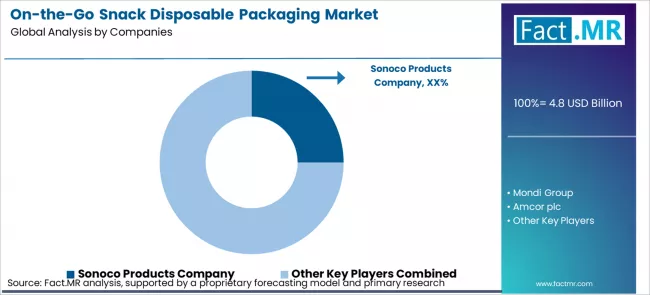
On The Go Snack Disposable Packaging Market Analysis By Company | Source: Fact.MR
Format choice in the on the go snack disposable packaging market is set by merchandising velocity and unit cost per packed piece rather than by material preference alone. Brand owners first define pack size, opening behavior, and shelf facing targets, then test options on high speed lines. Sonoco, Mondi, Amcor, Sealed Air, and Huhtamaki compete by aligning structures to form fill seal, flow wrap, and cup filling equipment used across multiple snack categories. Operations teams compare candidates using run speed stability, seal reliability, waste rates, and pallet density. Procurement also weighs regional production coverage and resin or paper supply continuity. Once a format is approved, volumes follow distribution expansion and promotion cycles. Supplier changes usually occur after line upgrades, range resets, or margin pressure reviews.
Key Players in On-the-Go Snack Disposable Packaging Market
- Sonoco Products Company
- Mondi Group
- Amcor plc
- Sealed Air Corporation
- Huhtamäki Oyj
References
- Codex Alimentarius Commission. (2023). General standard for food contact materials and articles (CXS 386-2023). FAO/WHO Codex Alimentarius.
- European Commission. (2024). Proposal for a regulation of the European Parliament and of the Council on packaging and packaging waste and repealing Directive 94/62/EC. European Commission.
- United States Food and Drug Administration. (2023). Guidance for industry: Food contact substance notifications. U.S. Department of Health and Human Services.
- European Food Safety Authority. (2023). Guidance on the submission of a dossier for the safety evaluation of a substance to be used in food contact materials. EFSA Journal.
Segmentation
Scope of the Report
| Items | Values |
|---|---|
| Quantitative Units (2026) | USD billion |
| End-use | Convenience stores, supermarkets, street food and kiosks, vending retail, quick-service food |
| Packaging Format | Pouches and wraps, paper cups and trays, folding cartons, rigid snack boxes |
| Material | Multilayer films, paperboard, coated paper, PET |
| Regions Covered | Asia Pacific, Europe, North America, Latin America, Middle East & Africa |
| Countries Covered | United States, Canada, Mexico, Germany, United Kingdom, France, Italy, Spain, China, Japan, South Korea, India, Australia & New Zealand, ASEAN, Brazil, Chile, Saudi Arabia, Turkey, South Africa, and other regional markets |
| Key Companies Profiled | Sonoco Products Company, Mondi Group, Amcor plc, Sealed Air Corporation, Huhtamäki Oyj |
| Additional Attributes | Dollar sales by end-use, packaging format, and material; focus on portion control, ease of opening, and spill resistance; demand driven by growth in convenience retail, commuting, and on-the-go snacking |
Source: Fact.MR analysis. Updated Jan 27, 2026
On-the-Go Snack Disposable Packaging Market Segmentation
-
End-use :
- Convenience stores
- Supermarkets
- Street food & kiosks
- Vending retail
- Quick-service food
-
Packaging Format :
- Pouches & wraps
- Paper cups & trays
- Folding cartons
- Rigid snack boxes
-
Material :
- Multilayer films
- Paperboard
- Coated paper
- PET
-
Region :
- Asia Pacific
- China
- Japan
- South Korea
- India
- Australia & New Zealand
- ASEAN
- Rest of Asia Pacific
- Europe
- Germany
- United Kingdom
- France
- Italy
- Spain
- Nordic
- BENELUX
- Rest of Europe
- North America
- United States
- Canada
- Mexico
- Latin America
- Brazil
- Chile
- Rest of Latin America
- Middle East & Africa
- Kingdom of Saudi Arabia
- Other GCC Countries
- Turkey
- South Africa
- Other African Union
- Rest of Middle East & Africa
- Asia Pacific
Frequently Asked Questions
How big is the on-the-go snack disposable packaging market in 2026?
What will be the size of on-the-go snack disposable packaging market in 2036?
How much will be the on-the-go snack disposable packaging market growth between 2026 and 2036?
What are the key product types in the on-the-go snack disposable packaging market?
Which packaging format segment to contribute significant share in the on-the-go snack disposable packaging market in 2026?
Who worked on this report


Preview the report firsthand - request a free sample
Free SampleGet the brochure for pricing and purchase details
Download PDF