- Market Value (2025): USD 358.1 Mn
- Estimated Value (2026): USD 379.2 Mn
- Forecast Value (2036): USD 671.4 Mn
- CAGR (2026-2036): 5.9%
What is the Open Heel Nursing Clogs Market forecast to be worth by 2036?
USD 379.2 million in 2026 to USD 671.4 million by 2036 at a 5.9% CAGR.
- Fact.MR estimates the open heel nursing clogs market at USD 358.1 million for 2025, with leather pairs bought by hospital nurses forming the core of that base.
- Value will move from USD 379.2 million in 2026 to USD 671.4 million by 2036 as more people join nursing and care work and swap out worn pairs on a steady cycle.
- Backless clog sales for healthcare will compound at a 5.9% CAGR through 2036, helped by slip-resistant soles and a wider spread of sizes and colors.
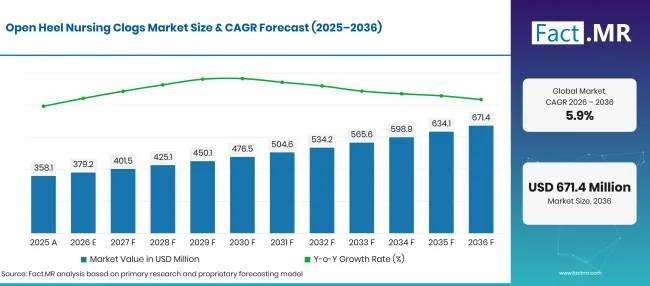
Open Heel Nursing Clogs Market Forecast Global | Source: Fact.MR
| Year | Basis | Market Value (USD million) |
|---|---|---|
| 2025 | Actual | 358.1 |
| 2026 | Estimate | 379.2 |
| 2036 | Forecast | 671.4 |
| CAGR 2026 to 2036 | Forecast period | 5.9% |
Source: Fact.MR analysis. Updated Oct 24, 2026
What are the defining numbers behind Open Heel Nursing Clogs Market growth?
Between 2026 and 2036, sales will gain USD 292.2 million, with women’s hospital footwear taking most of the new value.
- Demand Drivers in the Market
- Nursing workforce growth widens the pool of clog buyers each year. WHO reported that the world had 29.8 million nurses in 2023, while the global shortfall eased to 5.8 million from 6.2 million in 2020 [1]. Every new hire on a ward is a likely buyer of shift footwear within the first months.
- Workplace safety programs in hospitals push staff toward shoes with grip and support. The U.S. Bureau of Labor Statistics reported that health care and social assistance recorded 3.4 injury and illness cases per 100 full-time workers in 2024, down from 3.6 in 2023 [2]. Infection control and floor safety teams often name slip-resistant, closed-toe footwear in their dress codes.
- Comfort during 12-hour shifts is the reason nurses pay a premium for a good clog. A wide toe box lets the foot spread, and a raised heel with a rocker bottom eases strain on the calf and lower back. Many buyers add orthotic insoles for extra arch support.
- Easy cleaning keeps clogs in favor for clinical areas. Molded polyurethane and rubber pairs can be washed or autoclaved after a spill. That suits theater, emergency and maternity units.
- Color, print and patent finishes turn work shoes into personal items. Nurses often own two or three pairs and rotate them, which raises the number of pairs bought per worker.
- Key Segments Analyzed
- By Material Type: Leather will hold 40.0% share in 2026, given that oiled and patent uppers last for years and mold to the foot over time.
- By End User: Women will account for 62.3% share in 2026 as nursing and care rosters in most countries are largely female.
- By Distribution Channel: Specialty Stores will capture 32.1% share in 2026, since buyers want a fitting before paying for a premium pair.
- Analyst Opinion at Fact.MR
- Shambhu Nath Jha, Principal Consultant at Fact.MR, states, “Nurses treat a clog as a work tool, and they judge it by how their feet feel after the twelfth hour on the floor. Brands that publish slip-resistance data and offer half sizes will keep repeat buyers. Growth will lean toward synthetic and rubber models that clean easily, while leather keeps its loyal base in hospital wards.”
- Strategic Implications
- Footwear brands should test every healthcare clog for slip resistance on wet hospital floors and print the result on the box and product page.
- Specialty retailers should train staff to fit clogs by heel slip and toe room, since a poor fit is the main cause of returns.
- Hospital procurement teams should list approved clog features in staff dress codes, which helps nurses buy with confidence.
- Online sellers should add size charts by brand last and offer free exchanges, because nurses often switch between European and US sizing.
Germany will lead the five listed countries at 6.7% CAGR, where rising nursing employment and trainee intake lift footwear demand. Brazil follows at 6.1% with a large and mostly female nursing workforce. The United States will grow at 5.5% as registered nurse jobs keep expanding. A 4.9% pace in the United Kingdom reflects steady NHS clinical hiring. Japan will post 4.4%, supported by a growing registered nurse base and an aging patient population.
How does the Open Heel Nursing Clogs Market break down by segment?
Leather will lead Material Type at 40.0%; Women will top End User at 62.3%; Specialty Stores will head Distribution Channel at 32.1%.
Which Material Type dominates?
Leather makes up 40.0% of 2026 revenue.
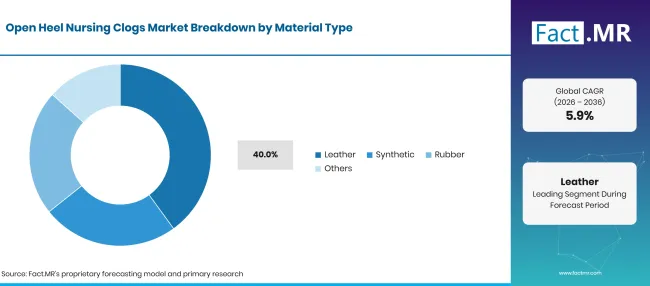
Open Heel Nursing Clogs Market Breakdown Material Type | Source: Fact.MR
| Material Type | Share (2026) |
|---|---|
| Leather (Leading segment) | 40.0% |
| Other segments combined | 60.0%* |
| Total | 100.0% |
Source: Fact.MR analysis. Updated Oct 24, 2026
Leather nursing clogs appeal to staff who want a shoe that breathes and keeps its shape for years. Oiled, box and patent leathers resist stains and wipe clean after a shift. A stapled or stitched upper on a wide polyurethane sole gives the stable base that long hours on hard floors call for. Synthetic clogs made from molded EVA and polyurethane weigh less and cost less, so they suit students and agency nurses. Rubber clogs serve theater and sterile areas where staff need pairs that can be soaked or autoclaved. Material choices in this field follow broader trends in footwear sole materials toward lighter foams with better grip.
What leads the End User segment?
Women purchase 62.3% of 2026 pairs.
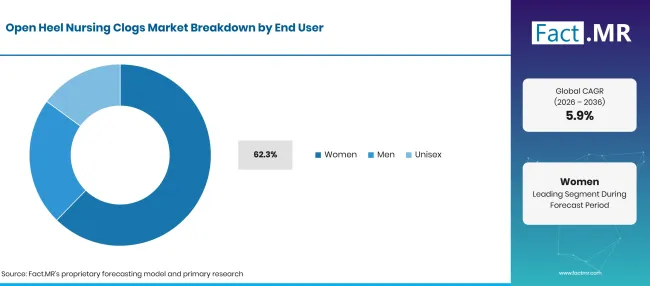
Open Heel Nursing Clogs Market Breakdown End User | Source: Fact.MR
| End User | Share (2026) |
|---|---|
| Women (Leading segment) | 62.3% |
| Other segments combined | 37.7%* |
| Total | 100.0% |
Source: Fact.MR analysis. Updated Oct 24, 2026
Most nurses on hospital wards are women, and clog makers design narrow lasts, colors and prints for them. The U.S. Bureau of Labor Statistics reported that women accounted for 87.3% of the 3.5 million employed registered nurses in 2025 [3]. Female staff also tend to own several pairs, which raises spending per buyer. Men’s open heel clogs grow from male nurses, surgeons and paramedics who want a wider fit and larger sizes. Unisex models in plain black and white serve operating rooms and laboratories where dress codes favor simple colors. These buyers often compare clogs with closed heel nursing shoes before they decide.
How does Distribution Channel shape demand?
Specialty Stores sell 32.1% of 2026 units.
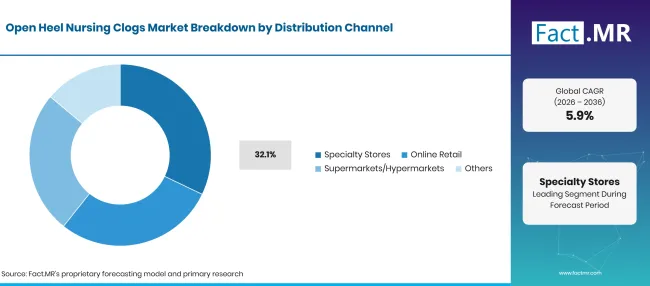
Open Heel Nursing Clogs Market Breakdown Distribution Channel | Source: Fact.MR
| Distribution Channel | Share (2026) |
|---|---|
| Specialty Stores (Leading segment) | 32.1% |
| Other segments combined | 67.9%* |
| Total | 100.0% |
Source: Fact.MR analysis. Updated Oct 24, 2026
Nursing clogs in specialty stores come with a fitting, and that is what keeps first-time buyers coming in. Uniform shops, comfort shoe stores and pedorthic outlets let a nurse test heel slip and toe room. Staff can also add orthopedic footwear advice or custom inserts in the same visit. Online retail serves repeat buyers who already know their size and want a new color. The U.S. Census Bureau reported that e-commerce represented 17.1% of total retail sales in the second quarter of 2026 [4]. Supermarkets and hypermarkets carry basic molded clogs at lower prices for students and care workers.
What is accelerating Open Heel Nursing Clogs Market adoption, and what is holding it back?
More nurses and care aides will keep demand growing, and safer soles that clean easily add to the pull. Some hospitals ban backless shoes in acute areas, and cheaper sneaker-style work shoes compete for the same budget.
Drivers Impact Analysis
| DRIVER | (~) % IMPACT ON CAGR | GEOGRAPHIC RELEVANCE | IMPACT TIMELINE |
|---|---|---|---|
| Hiring of nurses and care staff in hospitals and care homes | +1.4% | Western Europe, North America, Latin America | Short term (<= 2 years) |
| Comfort needs during long standing shifts | +1.1% | Global | Short term (<= 2 years) |
| Slip-resistant soles linked to workplace safety rules | +0.9% | North America, Western Europe | Medium term (2-4 years) |
| Easy-clean and autoclavable designs for clinical areas | +0.7% | Western Europe, East Asia | Medium term (2-4 years) |
| Color and print variety that drives multi-pair ownership | +0.5% | North America, Latin America | Long term (>= 4 years) |
Source: Fact.MR analysis. Updated Oct 24, 2026
Opportunity Impact Analysis
| OPPORTUNITY | (~) % IMPACT ON CAGR | GEOGRAPHIC RELEVANCE | IMPACT TIMELINE |
|---|---|---|---|
| Wide and half-size fits for men and unisex buyers | +0.6% | North America, Western Europe | Medium term (2-4 years) |
| Group orders through hospital uniform programs | +0.5% | Western Europe, East Asia | Medium term (2-4 years) |
| Lighter synthetic clogs for nursing students | +0.4% | Latin America, South Asia & Pacific | Short term (<= 2 years) |
Source: Fact.MR analysis. Updated Oct 24, 2026
Restraints Impact Analysis
| RESTRAINT | (~) % IMPACT ON CAGR | GEOGRAPHIC RELEVANCE | IMPACT TIMELINE |
|---|---|---|---|
| Hospital dress codes that require closed heels in acute areas | -0.6% | North America, Western Europe | Long term (>= 4 years) |
| Competition from slip-resistant work sneakers | -0.5% | Global | Short term (<= 2 years) |
| Leather and polyurethane input cost swings | -0.3% | Global | Short term (<= 2 years) |
Source: Fact.MR analysis. Updated Oct 24, 2026
Which countries are scaling the Open Heel Nursing Clogs Market through 2036?
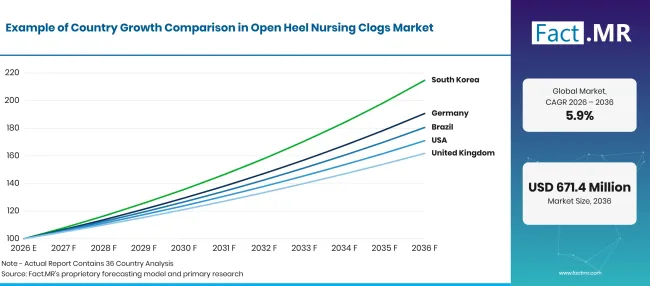
Open Heel Nursing Clogs Market Growth Index | Source: Fact.MR
| Country | CAGR (2026 to 2036) |
|---|---|
| Germany | 6.7% |
| Brazil | 6.1% |
| United States | 5.5% |
| United Kingdom | 4.9% |
| Japan | 4.4% |
Source: Fact.MR analysis. Updated Oct 24, 2026
What supports Germany’s adoption?
6.7% CAGR, driven by more nursing staff in hospitals and care homes.
Nursing clogs in Germany have a long tradition on hospital wards, and new staff keep adding to the buyer pool. Destatis reported that hospitals, rehabilitation centers and care services employed 49,000 more nursing staff at the end of 2024 than a year earlier [5]. That was a rise of 3.4% [5]. New nursing training contracts reached about 63,900 in 2025, and 71% of new trainees were women [6]. Each trainee needs work footwear during clinical placements.
How is Brazil scaling demand?
6.1% CAGR, backed by a nursing workforce of almost 3 million.
Hospital footwear in Brazil reaches a large and mostly female buyer base. Cofen reported that the country had almost 3 million nursing professionals in 2026, and women formed 87.20% of them [7]. Nursing technicians form close to two thirds of this group and work long shifts in public and private hospitals. Lower-priced synthetic clogs sell well among these workers.
What supports United States growth?
5.5% CAGR, helped by steady hiring of registered nurses.
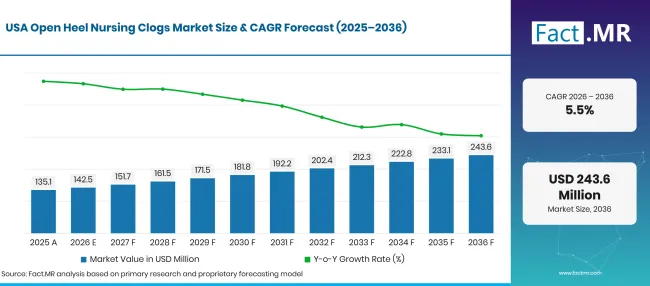
Open Heel Nursing Clogs Market Forecast Usa | Source: Fact.MR
Registered nurses form the core of clog demand in the United States. The Bureau of Labor Statistics projected registered nurse jobs at 3,660,100 in 2035, up from 3,465,400 in 2025 [8]. It also counted about 180,800 openings a year [8]. Each opening brings a new or returning worker who needs shift footwear, and hospital uniform programs often include clog allowances.
How is the United Kingdom developing demand?
4.9% CAGR, reflecting a growing pool of qualified clinical staff in the NHS.
NHS ward and theater staff in the United Kingdom buy clogs for comfort and easy cleaning. NHS England reported 755,801 full-time equivalent professionally qualified clinical staff in June 2026, up 1.9% from June 2025 [9]. Trusts set footwear rules in uniform policies, so wipe-clean and enclosed-toe clogs are common.
How does Japan perform?
4.4% CAGR, as the registered nurse base keeps expanding.
With an aging population, hospitals in Japan and care homes need more nursing staff. MHLW reported 1,363,142 working registered nurses at the end of 2024, up 3.9% from 2022 [10]. Slip-on footwear suits staff who change shoes often between wards and rest areas.
Who leads the Open Heel Nursing Clogs Market?
The nursing clog field splits into three groups. European clog makers with deep healthcare roots compete on footbed design, leather quality and durability.
Dansko lists a nurse and healthcare collection on its own site that pairs Professional clogs with molded mules, and it cites the APMA Seal of Acceptance [11]. Sanita lists Sonja, Ingrid and Ellis clogs within its professional range, which it says healthcare and hospitality staff trust [12]. Birkenstock sells a professional line with a healthcare section that includes Profi-Birki and Super-Birki models. A second group sells molded clogs built for wet and sterile areas. Calzuro offers Classic clogs for healthcare workers and describes its clogs as autoclavable, slip-resistant and anti-static [13]. Crocs sells its clog range through its own stores and online. Alegria wins buyers with printed clogs and a professional collection for work. Fit consistency, certified grip and easy cleaning will decide who gains share.
Which companies are the key providers?
Key companies include Dansko; Sanita; Birkenstock; Calzuro; Crocs; and Alegria.
- Dansko
- Sanita
- Birkenstock
- Calzuro
- Crocs
- Alegria
Bibliography
- [1] World Health Organization. (2025, May 12). Nursing workforce grows, but inequities threaten global health goals.
- [2] U.S. Bureau of Labor Statistics. (2026, January 22). Employer-Reported Workplace Injuries and Illnesses, 2023-2024.
- [3] U.S. Bureau of Labor Statistics. (2026, January). Employed people by detailed occupation, sex, race, and Hispanic or Latino ethnicity.
- [4] U.S. Census Bureau. (2026, August 18). Quarterly Retail E-Commerce Sales: 2nd Quarter 2026.
- [5] Statistisches Bundesamt (Destatis). (2026, January 27). 1,7 % mehr Beschäftigte im Gesundheitswesen 2024 [1.7% more employees in the health sector in 2024].
- [6] Statistisches Bundesamt (Destatis). (2026, July 2). Pflegeausbildung 2025: Zahl neuer Auszubildender zum dritten Mal in Folge gestiegen [Nursing training 2025: number of new trainees rose for the third year in a row].
- [7] Conselho Federal de Enfermagem (Cofen). (2026, May 5). Semana da Enfermagem reafirma protagonismo da maior força de trabalho da saúde brasileira [Nursing Week reaffirms the role of Brazil’s main health workforce].
- [8] U.S. Bureau of Labor Statistics. (2026, August 27). Registered Nurses: Occupational Outlook Handbook.
- [9] NHS England. (2026, August 27). NHS Workforce Statistics - June 2026.
- [10] Ministry of Health, Labour and Welfare, Japan. (2025, July 29). 令和6年衛生行政報告例(就業医療関係者)の概況 [Overview of the 2024 Report on Public Health Administration (Employed Medical Personnel)].
- [11] Dansko. (2026). Nurse / Healthcare Shoes.
- [12] Sanita. (2026). Professional.
- [13] Calzuro. (2026). Healthcare.
This Report Answers
- What will open heel nursing clogs be worth in 2026 and 2036, and what pace links the two?
- Why do leather uppers, female buyers and specialty stores lead their segments?
- How do nurse hiring, shift length and slip safety rules affect clog purchases?
- Where do Germany, Brazil, the United States, the United Kingdom and Japan differ on demand?
- Which clog brands target healthcare staff, and what helps them win repeat orders?
What does the Open Heel Nursing Clogs Market cover?
Healthcare clogs with an open or backless heel form the base of this market. Leather, synthetic and rubber versions are counted, as well as clogs with a heel strap that can be flipped forward.
Sales to women, men and unisex buyers are tracked across specialty stores, online retail and supermarkets. Purchases by individual nurses and bulk orders placed by hospitals both count.
What is included in the scope?
Open-back professional clogs, molded theater clogs and backless mules sold for ward use are included. Slip-resistant and autoclavable versions fall inside the boundary, along with antistatic models made for laboratories and operating rooms.
Replacement footbeds sold with a clog at the point of purchase are counted. Clogs bought by nursing students for clinical placements are also part of the total, as are pairs sold through hospital uniform programs alongside other work footwear.
What is excluded from the scope?
Closed heel clogs, nursing sneakers and safety boots fall outside this market. Garden clogs and fashion clogs not sold for healthcare use are also excluded.
Standalone shoe insoles, heel straps, charms and compression socks are not counted. Second-hand and refurbished clogs are left out as well.
How Was the Analysis Built?
The analysis draws on 120+ sources, 35+ company portfolios, 25+ countries, and more than 20 industry interviews.
- Primary Research: Primary research includes discussions with manufacturers, service providers, technology developers, distributors, end users, and subject-matter experts. These conversations examine purchasing priorities, product adoption, operational challenges, approval requirements, competitive positioning, and the factors that influence wider market acceptance.
- Desk Research: Desk research covers government statistics, regulatory publications, company filings, trade data, technical studies, industry associations, standards, public policy, and other authoritative sources. Every source used in the analysis is documented in the bibliography.
- Market Sizing and Forecasting: Market estimates combine historical performance, demand indicators, pricing and volume trends, segment shares, company participation, country-level growth, adoption patterns, investment activity, and barriers to market expansion.
- Data Validation and Update Cycle: Findings are validated by comparing primary interviews with public data, company activity, regulatory changes, trade patterns, and industry developments. Regular updates review new product launches, capacity changes, partnerships, approvals, and shifts in commercial adoption.
Segmentation
What is the report’s scope and coverage?
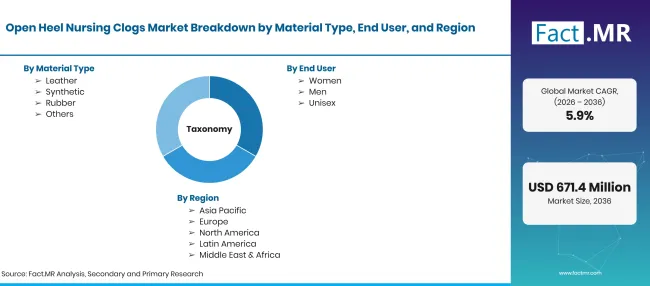
Open Heel Nursing Clogs Market Taxonomy | Source: Fact.MR
| Attribute | Details |
|---|---|
| Quantitative Units | USD million in 2026 to USD million by 2036 at CAGR |
| Market Definition | Backless or open heel clogs and mules sold for wear by nurses and other healthcare staff, including models with an optional pivoting heel strap. Value is counted at the first point of sale to individual and institutional buyers. |
| Material Type | Leather; Synthetic; Rubber; Others |
| End User | Women; Men; Unisex |
| Distribution Channel | Specialty Stores; Online Retail; Supermarkets/Hypermarkets; Others |
| Regions Covered | North America; Latin America; Western Europe; Eastern Europe; East Asia; South Asia & Pacific; Middle East & Africa |
| Countries Covered | Germany; Brazil; United States; United Kingdom; Japan |
| Companies Profiled | Dansko; Sanita; Birkenstock; Calzuro; Crocs; Alegria |
| Forecast Period | 2026 to 2036 |
| Approach | Hybrid top-down and bottom-up approach using nursing and care workforce counts by country; pairs bought per worker per year; replacement cycles; price points by material and channel; and review of brand healthcare ranges. |
Source: Fact.MR analysis. Updated Oct 24, 2026
How is the market segmented?
-
By Material Type
- Leather
- Synthetic
- Rubber
- Others
-
By End User
- Women
- Men
- Unisex
-
By Distribution Channel
- Specialty Stores
- Online Retail
- Supermarkets/Hypermarkets
- Others
-
By Region
- North America
- Latin America
- Western Europe
- Eastern Europe
- East Asia
- South Asia & Pacific
- Middle East & Africa
Frequently Asked Questions
How big is the open heel nursing clogs market in 2026?
What is the CAGR of the open heel nursing clogs market from 2026 to 2036?
Which material type leads the open heel nursing clogs market?
Which end user leads the open heel nursing clogs market?
Which distribution channel leads the open heel nursing clogs market?
Which country will grow the most in the open heel nursing clogs market?
Who are the main companies in the open heel nursing clogs market?
Who worked on this report


Preview the report firsthand - request a free sample
Free SampleGet the brochure for pricing and purchase details
Download PDF