- Base Value(2026): 0.6 Bn
- Estimated Value(2026): 0.6 Bn
- Forecast Value (2036): 1.3 Bn
- CAGR (2026 - 2036): 7.1%
Ophthalmic Gas Delivery Market Forecast and Outlook 2026 to 2036
The global ophthalmic gas delivery market is projected to total USD 0.64 billion in 2026, advancing to USD 1.26 billion by 2036, achieving a compound annual growth rate of 7.1%. This steady expansion is fundamentally tied to the critical role of intraocular gases, primarily SF6 and C3F8, as indispensable tools in modern vitreoretinal surgery.
Key Takeaways from the Ophthalmic Gas Delivery Market
- Market Value for 2026: USD 0.64 Billion
- Market Value for 2036: USD 1.26 Billion
- Forecast CAGR 2026 to 2036: 7.1%
- Leading Product Segment (2026): SF6 gas systems (40.0%)
- Leading Application Segment (2026): Retinal detachment surgery (55.0%)
- Leading End User Segment (2026): Ophthalmic hospitals (51.0%)
- Key Growth Countries: India (9.1% CAGR), China (8.9% CAGR), Brazil (8.4% CAGR), USA (8.2% CAGR)
- Key Players in the Market: Bausch + Lomb Corporation, Dutch Ophthalmic Research Center (International) B.V. (D.O.R.C.), Geuder AG, Rumex International Co., Others
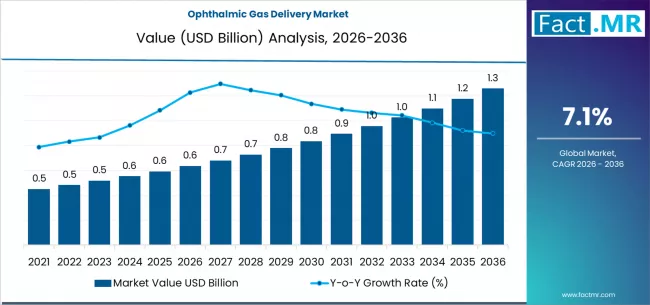
Ophthalmic Gas Delivery Market Market Value Analysis | Source: Fact.MR
These gases provide essential internal tamponade, facilitating the reattachment of the retina by flattening and holding it against the eye wall while underlying treatments heal. The market’s progression is driven by the rising global incidence of retinal disorders such as detachment and complex vitreoretinal pathologies, coupled with the increasing availability of advanced surgical care in developing regions.
Growth is characterized by the dominance of SF6 gas systems, favored for their moderate duration and predictable expansion properties, and the application in retinal detachment surgery, which represents the most common and critical use case.
Specialized ophthalmic hospitals serve as the primary end-users, centralizing the expertise and equipment required for these delicate procedures. Geographically, expansion is most dynamic in high-growth economies with rapidly improving healthcare infrastructure and a growing burden of diabetic retinopathy and myopia-related retinal issues.
Established markets are experiencing growth through the refinement of surgical techniques and the development of integrated gas delivery accessories that enhance procedural safety and consistency. The evolution of this niche but vital market reflects the ongoing advancements in minimally invasive ophthalmic surgery and the irreplaceable therapeutic function of these specialized medical gases.
Metric
| Metric | Value |
|---|---|
| Market Value (2026) | USD 0.64 Billion |
| Market Forecast Value (2036) | USD 1.26 Billion |
| Forecast CAGR 2026 to 2036 | 7.1% |
Source: Fact.MR analysis. Updated Jan 10, 2026
Category
| Category | Segments |
|---|---|
| Product | SF6 Gas Systems, C3F8 Gas Systems, Gas Delivery Accessories |
| Application | Retinal Detachment Surgery, Vitrectomy Procedures, Other Ophthalmic Uses |
| End User | Ophthalmic hospitals, Specialty Eye Clinics, ASCs |
| Region | North America, Latin America, Western Europe, Eastern Europe, East Asia, South Asia & Pacific, MEA |
Source: Fact.MR analysis. Updated Jan 10, 2026
Segmental Analysis
By Product, Which System Offers a Balanced Profile for Common Surgical Needs?
SF6 gas systems command a leading 40.0% share. This dominance is attributed to their favorable balance of intraocular longevity, typically 2-3 weeks, and controlled expansion, which provides sufficient retinal tamponade for many primary detachments without the prolonged visual obstruction associated with longer-lasting gases. Their predictable behavior and established safety profile make them the workhorse choice for a wide range of vitreoretinal procedures.
By Application, Which Surgical Indication is the Primary Clinical Driver?
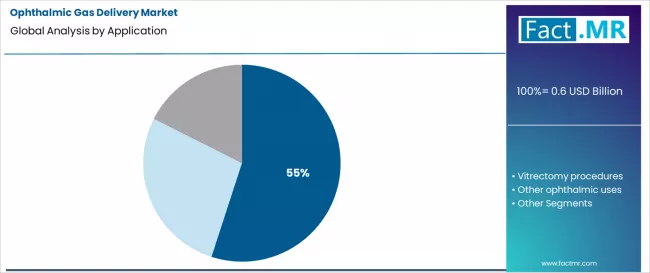
Ophthalmic Gas Delivery Market Analysis By Application | Source: Fact.MR
Retinal detachment surgery constitutes the dominant application with a 55.0% share. Rhegmatogenous retinal detachment is a sight-threatening emergency requiring prompt surgical intervention, with pneumatic retinopexy and vitrectomy combined with gas tamponade being standard of care. The critical need to achieve anatomical reattachment and preserve vision in these urgent cases drives consistent, high-value demand for ophthalmic gases.
By End User, Where is Complex Vitreoretinal Surgery Centralized?
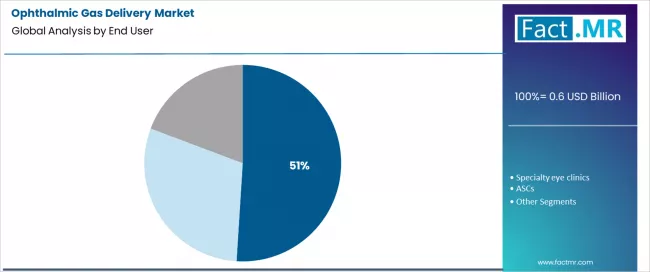
Ophthalmic Gas Delivery Market Analysis By End User | Source: Fact.MR
Ophthalmic hospitals are the primary end-user segment, holding a 51.0% share. These specialized tertiary care centers house the advanced surgical microscopes, vitrectomy systems, and multidisciplinary teams of retinal surgeons required to perform complex procedures like vitrectomy with gas tamponade. They serve as referral hubs, centralizing the procurement, storage, and use of these specialized medical gases.
What are the Principal Drivers, Constraints, and Evolving Dynamics Influencing Ophthalmic Gas Delivery Demand?
| Attribute | Analysis |
|---|---|
| Rising Global Prevalence of Retinal Disorders | Increasing incidence of myopia, diabetic retinopathy, and age-related ocular conditions expands the patient pool requiring surgical intervention with gas tamponade. |
| Stringent Regulatory Handling and Storage Requirements | Medical gases are highly regulated; strict protocols for storage, handling, and traceability increase operational complexity and cost for healthcare providers. |
| Development of Pre-mixed and Easy-Use Gas Cartridges | Innovation in delivery formats, such as pre-sterilized, single-use cartridges, improves operating room efficiency, reduces contamination risk, and enhances dosing accuracy. |
| Growth of Ambulatory Surgery Centers for Ophthalmic Procedures | The shift of retinal surgery to ASCs decentralizes demand, requiring reliable, smaller-volume gas supply chains and driving innovation in compact delivery systems. |
Source: Fact.MR analysis. Updated Jan 10, 2026
Analysis of the Ophthalmic Gas Delivery Market by Key Countries
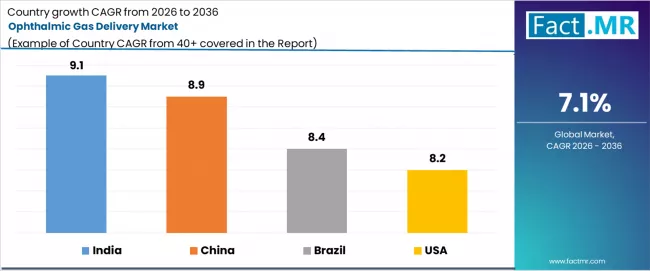
Ophthalmic Gas Delivery Market Cagr Analysis By Country | Source: Fact.MR
| Country | CAGR 2026 to 2036 |
|---|---|
| India | 9.1% |
| China | 8.9% |
| Brazil | 8.4% |
| USA | 8.2% |
Source: Fact.MR analysis. Updated Jan 10, 2026
How does the USA's Advanced Surgical Infrastructure and Reimbursement Support Market Stability?
A high volume of retinal surgeries, advanced vitreoretinal care networks, and established reimbursement pathways for procedures involving gas tamponade supports the USA’s 8.2% CAGR.
Growth is steady, driven by technological adoption of integrated gas-fluid exchange systems and a growing elderly population at risk for retinal detachment. The market demands high-purity, reliably supplied gases and user-friendly delivery accessories compatible with complex surgical workflows.
What Role does Brazil's Expanding Specialty Care Network Play in Market Penetration?
Brazil's 8.4% CAGR is linked to the expansion of specialized ophthalmology centers and improving access to vitreoretinal surgery within both the public health system and private sector.
The high prevalence of diabetic retinopathy and myopia creates significant procedural demand. Market growth is fueled by the need for reliable gas supply to support an increasing number of trained retinal surgeons across major urban centers.
How are China's Massive Investments in Healthcare and High Myopia Rates Catalyzing Demand?
China's 8.9% CAGR is driven by two powerful factors, which are enormous public and private investment in advanced hospital infrastructure and one of the world's highest rates of pathologic myopia, a major risk factor for retinal detachment.
The rapid scaling of ophthalmic surgical capabilities creates corresponding demand for surgical consumables, including medical gases. The market is characterized by growing domestic production capabilities and the presence of multinational surgical device companies.
Why is India's Growth Trajectory Exceptional within the Ophthalmic Surgical Sector?
India's leading 9.1% CAGR is fueled by a catastrophic combination of a very high burden of diabetic retinopathy, a massive population with increasing life expectancy, and a rapidly growing network of high-quality private eye hospitals and ASCs.
The proliferation of skilled vitreoretinal surgeons and the increasing affordability of complex surgery for the middle class are generating unprecedented growth in procedural volume, directly driving demand for ophthalmic gases and delivery systems.
Competitive Landscape of the Ophthalmic Gas Delivery Market
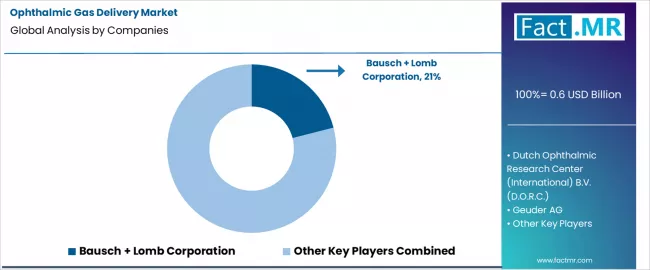
Ophthalmic Gas Delivery Market Analysis By Company | Source: Fact.MR
The competitive landscape is specialized, featuring a mix of large ophthalmic device corporations and niche players focused on surgical consumables and accessories. Competition revolves around the reliability and purity of gas supply, the innovation and ergonomics of delivery devices, and the depth of relationships with ophthalmic hospitals and surgical centers.
Success is heavily dependent on providing comprehensive solutions that seamlessly integrate with vitrectomy systems from major platform manufacturers, ensuring compatibility and ease of use in the operating room. These companies invest in educating surgeons and surgical staff on proper gas handling techniques to ensure optimal surgical outcomes.
Beyond core product supply, competition extends to offering specialized services, including timely logistics for medical gas delivery and providing technical support for gas-fluid exchange systems. The threat of local suppliers or hospital gas departments providing generic medical gases is a constant pressure, pushing specialized companies to differentiate through value-added services, device compatibility, and demonstrable product consistency.
Strategic partnerships with large hospital groups and ambulatory surgery center chains are crucial for securing bulk supply agreements. Long-term leadership requires maintaining an impeccable safety record, navigating complex regional medical gas regulations, and continuously refining delivery systems to match the evolving techniques of high-volume retinal surgeons.
Key Players in the Ophthalmic Gas Delivery Market
- Bausch + Lomb Corporation
- Dutch Ophthalmic Research Center (International) B.V. (D.O.R.C.)
- Geuder AG
- Rumex International Co.
- Others
References
- American Academy of Ophthalmology. (2025). Preferred practice pattern for retinal detachment. Ophthalmology.
- Charteris, D. G., & Stanga, P. E. (2024). Vitreoretinal surgery: Strategies and tactics. Springer.
- Kuhn, F., & Aylward, B. (2025). Ocular traumatology: Principles and practice of intraocular gas application. Kugler Publications.
- Sparrow, J. R., & Wong, D. T. (2024). Ophthalmic surgery: Principles and techniques of gas and oil tamponade. Elsevier.
- Williams, G. A., & Gallemore, R. P. (2025). Retinal detachment surgery: A guide to pneumatic retinopexy and vitrectomy. JP Medical Ltd.
Segmentation
Scope of Report
| Items | Values |
|---|---|
| Quantitative Units | USD Billion |
| Product | SF6 gas systems, C3F8 gas systems, Gas delivery accessories |
| Application | Retinal detachment surgery, Vitrectomy procedures, Other ophthalmic uses |
| End User | Ophthalmic hospitals, Specialty eye clinics, ASCs |
| Key Countries | India, China, Brazil, USA |
| Key Companies | Bausch + Lomb Corporation, Dutch Ophthalmic Research Center (International) B.V. (D.O.R.C.), Geuder AG, Rumex International Co., Others |
| Additional Analysis | Comparative analysis of gas longevity, expansion ratios, and intraocular pressure effects; study of surgical outcomes with different tamponade agents; cost-analysis of gas delivery systems; review of sterilization and single-use trends for accessories; assessment of regulatory pathways for medical gases in ophthalmic use. |
Source: Fact.MR analysis. Updated Jan 10, 2026
Market by Segments
-
Product :
- SF6 gas systems
- C3F8 gas systems
- Gas delivery accessories
-
Application :
- Retinal detachment surgery
- Vitrectomy procedures
- Other ophthalmic uses
-
End User :
- Ophthalmic hospitals
- Specialty eye clinics
- ASCs
-
Region :
- North America
- USA
- Canada
- Latin America
- Brazil
- Mexico
- Argentina
- Rest of Latin America
- Western Europe
- Germany
- France
- Italy
- Spain
- UK
- BENELUX
- Rest of Western Europe
- Eastern Europe
- Russia
- Poland
- Czech Republic
- Rest of Eastern Europe
- East Asia
- China
- Japan
- South Korea
- Rest of East Asia
- South Asia & Pacific
- India
- ASEAN
- Australia
- Rest of South Asia & Pacific
- MEA
- GCC Countries
- South Africa
- Turkiye
- Rest of MEA
- North America
Frequently Asked Questions
How big is the ophthalmic gas delivery market in 2026?
What will be the size of ophthalmic gas delivery market in 2036?
How much will be the ophthalmic gas delivery market growth between 2026 and 2036?
What are the key product types in the ophthalmic gas delivery market?
Which application segment to contribute significant share in the ophthalmic gas delivery market in 2026?
Who worked on this report


Preview the report firsthand - request a free sample
Free SampleGet the brochure for pricing and purchase details
Download PDF