- Market Value (2025): USD 3.21 Bn
- Estimated Value (2026): USD 3.35 Bn
- Forecast Value (2036): USD 5.11 Bn
- CAGR (2026-2036): 4.3%
What is the Organobromine Market forecast to be worth by 2036?
USD 3.4 billion in 2026 to USD 5.1 billion by 2036 at a 4.3% CAGR.
- Revenue from organobromine compounds came to USD 3.21 billion in 2025, with flame retardants for laminates and plastics as the main outlet.
- Annual value will move from USD 3.35 billion in 2026 to USD 5.11 billion by 2036 as electronics output and specialty synthesis widen the customer base.
- A 4.3% CAGR will hold from 2026 to 2036, paced by circuit board demand and tempered by substance-level reviews in the United States and Europe.
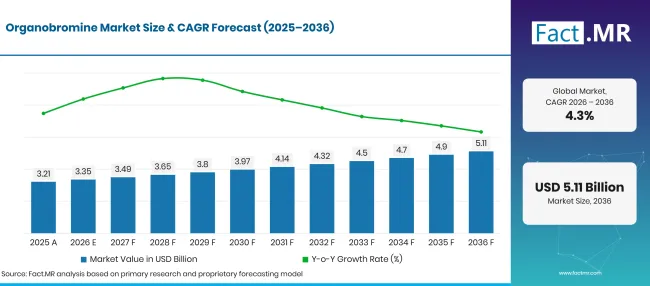
Organobromine Market Forecast Global | Source: Fact.MR
| Year | Basis | Market Value (USD billion) |
|---|---|---|
| 2025 | Actual | 3.21 |
| 2026 | Estimate | 3.35 |
| 2036 | Forecast | 5.11 |
| CAGR 2026 to 2036 | Forecast period | 4.3% |
Source: Fact.MR analysis. Updated Oct 26, 2026
What are the defining numbers behind Organobromine Market growth?
The 2026 to 2036 period adds USD 1.7 billion in new value, most of it tied to electronics and flame-retardant polymers.
- Demand Drivers in the Market
- New electronics capacity is pulling in brominated laminates. India raised the outlay of its Electronics Components Manufacturing Scheme to Rs 40,000 crore in February 2026, and approved projects include multi-layer printed circuit boards [1]. Each new board line needs flame-retardant epoxy laminate, which is where reactive TBBPA ends up.
- Feedstock is concentrated in a few countries. World bromine output reached 430,000 metric tons in 2025, and Israel alone produced about 200,000 tons [2]. Derivative makers with captive brine therefore hold a steady cost position against buyers of merchant bromine.
- Regulatory review shapes which compounds keep their customers. In June 2026, the U.S. EPA released a draft risk evaluation of TBBPA covering uses in electrical and electronic products, batteries, textiles and building materials [3]. The draft found risk to workers and surface water under some conditions, but no unreasonable risk to consumers.
- Polymer makers are moving from small-molecule additives to polymeric and reactive grades. These grades bind into the resin, which limits migration out of finished parts and helps converters meet customer specifications.
- Pharmaceutical and agrochemical synthesis keeps a second stream of demand. Bromine atoms act as leaving groups in many coupling reactions, so intermediates makers buy brominated aromatics in steady, smaller lots.
- Key Segments Analyzed
- By Product Type: Tetrabromobisphenol A (TBBPA) will command 56.5% share in 2026, since it reacts into epoxy resin for FR-4 boards and stays locked in the polymer.
- By Application: Flame Retardants will take 48.3% share in 2026, given that cables, housings and laminates must pass ignition tests before sale.
- By End-User Industry: Electronics will account for 42.5% share in 2026 through steady orders from laminate presses and component molders.
- Analyst Opinion at Fact.MR
- Shambhu Nath Jha, Principal Consultant at Fact.MR, states, “Organobromine demand follows the circuit board more closely than any other product. That link will keep TBBPA central through 2036. Producers with their own brine and their own derivative plants will absorb regulatory costs more easily than toll producers. The next wave of value will come from polymeric flame retardants and pharmaceutical intermediates, where buyers pay for purity and documentation.”
- Strategic Implications
- Bromine derivative producers should invest in polymeric and reactive flame-retardant grades, since these hold up better under substance-by-substance review.
- Laminate and resin makers should qualify at least two TBBPA sources, as world bromine output depends on a few brine fields.
- Intermediates suppliers should build regulatory dossiers and impurity data for pharmaceutical customers, who audit every brominated input.
- Procurement teams in electronics should track the U.S. EPA review and EU restriction work on aromatic brominated flame retardants when signing multi-year contracts.
Germany heads the five-country group at 4.8%, where engineering plastics and vehicle electronics keep flame-retardant compounding busy. Brazil follows at 4.4% with mining, oil and industrial growth lifting chemical use. In the United States, a 4.0% pace rests on circuit board, battery and specialty synthesis demand. A 3.6% rate for the United Kingdom reflects tighter waste rules that favor newer polymeric grades. Japan rounds out the list at 3.2%, with its own bromine output feeding a mature electronics base.
How does the Organobromine Market break down by segment?
TBBPA will lead Product Type at 56.5%; Flame Retardants will top Application at 48.3%; Electronics will hold first place in End-User Industry at 42.5%.
Which Product Type leads?
TBBPA represents 56.5% of 2026 sales.
| Product Type | Share (2026) |
|---|---|
| Tetrabromobisphenol A (TBBPA) (Leading segment) | 56.5% |
| Other segments combined | 43.5%* |
| Total | 100.0% |
Source: Fact.MR analysis. Updated Oct 26, 2026
Laminate presses use TBBPA as a reactive monomer, so the bromine becomes part of the cured epoxy backbone. That chemistry gives FR-4 boards their fire rating without a separate additive. Most supply moves from bromine producers in Israel, Jordan, the United States and China to copper clad laminate plants across East Asia. TBBPA has been under U.S. review since EPA named it a high-priority chemical in December 2019, and the Federal Register notice for the draft evaluation followed on June 16, 2026 [4]. Ethylene dibromide serves fumigation and synthesis in small volumes. HBCD is a legacy foam additive now restricted under persistent pollutant rules, so its sales are falling.
What leads the Application segment?
Flame Retardants take 48.3% of 2026 sales.
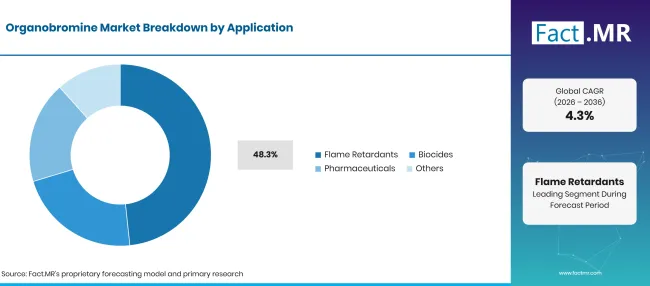
Organobromine Market Breakdown Application | Source: Fact.MR
| Application | Share (2026) |
|---|---|
| Flame Retardants (Leading segment) | 48.3% |
| Other segments combined | 51.7%* |
| Total | 100.0% |
Source: Fact.MR analysis. Updated Oct 26, 2026
Fire codes for electronics, cables and insulation set a minimum test result that a part must reach before sale. Brominated grades reach that result at low loading, which keeps mechanical properties close to the base polymer. Upstream cost follows the bromine price set by a few integrated producers. Construction is the soft spot for this application. ICL reported that bromine-based flame retardant sales fell in the third quarter of 2025 due to continued softness in construction, although higher prices lifted profitability [5]. Biocides for cooling water and pulp mills form the second outlet, while intermediates for drugs and crop protection account for the remainder.
What supports Electronics within End-User Industry?
Electronics buyers account for 42.5% of 2026 demand.
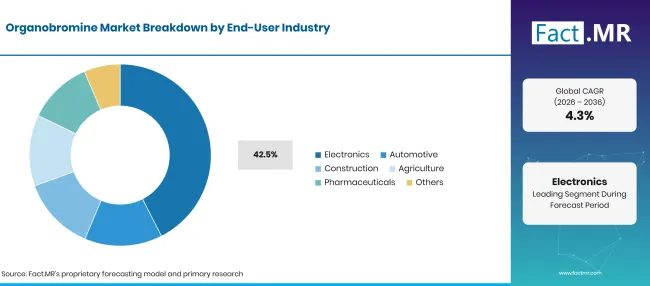
Organobromine Market Breakdown End User Industry | Source: Fact.MR
| End-User Industry | Share (2026) |
|---|---|
| Electronics (Leading segment) | 42.5% |
| Other segments combined | 57.5%* |
| Total | 100.0% |
Source: Fact.MR analysis. Updated Oct 26, 2026
Board, connector and housing makers want flame retardants that pass tests and survive lead-free solder heat. Reactive TBBPA in laminates and polymeric grades in housings answer both needs. India’s ECMS approvals covered 46 applications across 11 states by January 2026, adding new board and component lines [1]. Automotive demand grows as vehicles carry more power electronics and battery packs that need fire-safe plastics. Construction uses brominated grades in insulation foam, while agriculture and pharmaceuticals buy intermediates. Battery and absorption chiller users rely on lithium bromide, an inorganic salt that falls outside this market.
What is accelerating Organobromine Market adoption, and what is holding it back?
Circuit board capacity, fire codes and drug synthesis keep orders flowing to bromine derivative plants. Substance reviews in the United States, Europe and the United Kingdom slow the pace and push buyers toward newer polymeric grades. Weak construction demand adds a further drag.
Drivers Impact Analysis
| DRIVER | (~) % IMPACT ON CAGR | GEOGRAPHIC RELEVANCE | IMPACT TIMELINE |
|---|---|---|---|
| Fire safety tests for electronics, cables and housings | +1.2% | Global | Short term (<= 2 years) |
| New printed circuit board and laminate capacity | +1.0% | East Asia, South Asia & Pacific | Short term (<= 2 years) |
| Brominated intermediates for drug and crop chemical synthesis | +0.7% | Western Europe, South Asia & Pacific | Medium term (2-4 years) |
| Bromine biocides for cooling water and paper mills | +0.5% | North America, Middle East & Africa | Medium term (2-4 years) |
| Captive brine supply in Israel, Jordan and the United States | +0.4% | Middle East & Africa, North America | Long term (>= 4 years) |
Source: Fact.MR analysis. Updated Oct 26, 2026
Opportunity Impact Analysis
| OPPORTUNITY | (~) % IMPACT ON CAGR | GEOGRAPHIC RELEVANCE | IMPACT TIMELINE |
|---|---|---|---|
| Polymeric flame retardants that limit migration from plastics | +0.6% | Western Europe, North America | Medium term (2-4 years) |
| Fire-safe plastics for EV battery packs and power electronics | +0.4% | East Asia, Western Europe | Medium term (2-4 years) |
| New bromine capacity from U.S. Smackover brines | +0.3% | North America | Long term (>= 4 years) |
Source: Fact.MR analysis. Updated Oct 26, 2026
Restraints Impact Analysis
| RESTRAINT | (~) % IMPACT ON CAGR | GEOGRAPHIC RELEVANCE | IMPACT TIMELINE |
|---|---|---|---|
| Substance-level reviews of TBBPA and aromatic brominated flame retardants | -0.6% | North America, Western Europe | Medium term (2-4 years) |
| Tighter waste limits for brominated diphenyl ethers | -0.4% | Western Europe | Short term (<= 2 years) |
| Shift to phosphorus and other halogen-free systems in some plastics | -0.3% | Global | Long term (>= 4 years) |
Source: Fact.MR analysis. Updated Oct 26, 2026
Which countries are scaling the Organobromine Market through 2036?
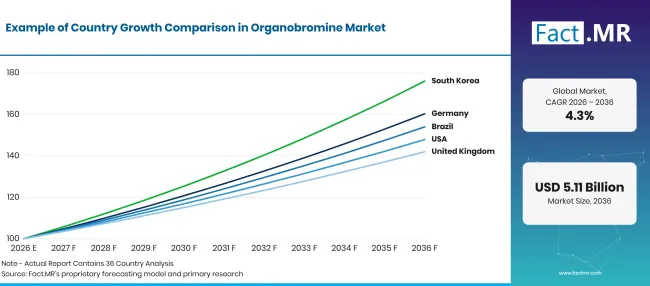
Organobromine Market Growth Index | Source: Fact.MR
| Country | CAGR (2026 to 2036) |
|---|---|
| Germany | 4.8% |
| Brazil | 4.4% |
| United States | 4.0% |
| United Kingdom | 3.6% |
| Japan | 3.2% |
Source: Fact.MR analysis. Updated Oct 26, 2026
What supports Germany’s adoption?
4.8% CAGR, driven by engineering plastics and vehicle electronics that need fire-safe compounds.
German compounders blend brominated and phosphorus flame retardants into polyamide and polyester parts for cars and appliances. Destatis reported that output in energy-intensive industries rose 1.9% in February 2026 from January, while automotive production gained 1.7% [6]. Chemical parks in the Rhine region host flame-retardant formulation, and EU restriction work on aromatic brominated grades steers buyers toward polymeric versions.
How is Brazil scaling demand?
4.4% CAGR, backed by extraction and industrial growth that widen chemical use.
IBGE reported that Brazilian industrial production rose 0.6% in 2025, with extractive industries up 4.9% [7]. Mining, oil and gas activity draws on bromine biocides and specialty chemicals, while agriculture buys brominated intermediates for crop protection. Brazil imports most of its bromine derivatives, so local distributors and blenders link suppliers in Israel and the United States with industrial users.
What supports United States adoption?
4.0% CAGR, helped by circuit board, battery and specialty synthesis demand.
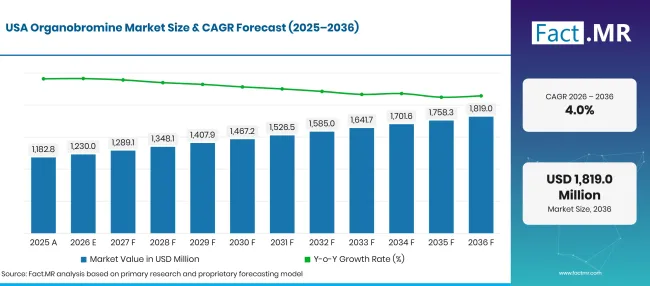
Organobromine Market Forecast Usa | Source: Fact.MR
The United States produces bromine from Arkansas brines but still imports large volumes. USGS estimated 2025 imports of bromine and compounds at 40,000 tons, about 30% below 2024. Israel supplied about 89% of imports through July 2025 [2]. Domestic derivative plants serve flame-retardant, oilfield and water treatment customers, and new Smackover projects aim to add brine supply.
How is the United Kingdom developing demand?
3.6% CAGR, reflecting tighter waste rules that reward newer flame-retardant grades.
From April 1, 2025, Great Britain cut the waste concentration limit for the sum of tetra- to decabromodiphenyl ethers from 1,000 mg/kg to 500 mg/kg [8]. A companion order changed the permitted uses of Dechlorane Plus, another flame retardant, from the same date [9]. Recyclers and electronics brands now favor reactive and polymeric grades that leave fewer legacy compounds in waste plastics.
How does Japan perform?
3.2% CAGR, as domestic bromine output serves a mature electronics base.
Japan produced about 20,000 tons of bromine in 2025, according to USGS [2]. That output feeds local flame-retardant and intermediates plants run by chemical groups such as Tosoh. Japanese laminate and component makers set tight purity standards, and demand follows electronics production more than construction.
Who leads the Organobromine Market?
Three groups shape competition. Integrated brine owners control feedstock: Albemarle, ICL, Jordan Bromine Company and Archean Chemical Industries sell both elemental bromine and derivatives such as TBBPA. Their edge is cost and continuity of supply. ICL reported that clear brine fluid sales rose in the fourth quarter of 2025 on demand in South America and Europe, while higher prices offset lower flame-retardant volumes [11].
Formulation specialists, led by LANXESS and Tosoh, compete on product design. At K 2025, LANXESS presented Emerald Innovation 5000, a polymeric flame retardant offered as an alternative to DBDPE [10]. Neogen Chemicals serves pharmaceutical and agrochemical buyers with aromatic and cyclic bromine derivatives. TETRA Technologies is building a bromine position in Arkansas, where the Evergreen Unit expanded to 6,953 gross acres in April 2025 [12]. Captive brine, polymeric grades and regulatory dossiers will separate the stronger suppliers through 2036.
Which companies are the key providers?
Key companies include Albemarle Corporation; ICL Group Ltd.; LANXESS AG; Jordan Bromine Company; Tosoh Corporation; Archean Chemical Industries Ltd.; Neogen Chemicals Limited; and TETRA Technologies, Inc.
- Albemarle Corporation
- ICL Group Ltd.
- LANXESS AG
- Jordan Bromine Company
- Tosoh Corporation
- Archean Chemical Industries Ltd.
- Neogen Chemicals Limited
- TETRA Technologies, Inc.
Bibliography
- [1] Press Information Bureau, Government of India. (2026, February 3). Electronics Components Manufacturing Scheme: Union Budget 2026-27 Raises Scheme Outlay to Rs 40,000 Crore.
- [2] U.S. Geological Survey. (2026, February). Mineral Commodity Summaries 2026: Bromine.
- [3] U.S. Environmental Protection Agency. (2026, June 12). EPA Takes Next Step in TSCA Review of Flame Retardant to Better Protect Workers and the Environment by Releasing Draft Risk Evaluation TBBPA.
- [4] U.S. Environmental Protection Agency. (2026, October 20). Risk Evaluation for 4,4’-(1-Methylethylidene)bis[2,6-dibromophenol] (TBBPA).
- [5] ICL Group. (2025, November 12). ICL Reports Third Quarter 2025 Results and Announces New Strategic Principles.
- [6] Statistisches Bundesamt (Destatis). (2026, April 9). Production in February 2026: -0.3% on the previous month.
- [7] Instituto Brasileiro de Geografia e Estatística (IBGE). (2026, February 3). Indústria nacional recua 1,2% em dezembro e fecha 2025 com alta de 0,6% [National industry falls 1.2% in December and closes 2025 up 0.6%].
- [8] UK Government. (2025, March 11). The Persistent Organic Pollutants (Amendment) Regulations 2025 (S.I. 2025 No. 296).
- [9] UK Government. (2025, March 11). The Persistent Organic Pollutants (Amendment) (No. 2) Regulations 2025 (S.I. 2025 No. 297).
- [10] LANXESS AG. (2025, September 25). LANXESS at K 2025: Focus on additives, colorants and pigments.
- [11] ICL Group. (2026, February 18). ICL Reports Fourth Quarter and Full Year 2025 Results.
- [12] TETRA Technologies, Inc. (2025, April 24). TETRA Technologies, Inc. Announces Expansion of Smackover Formation Evergreen Unit and Update on Additional Test Well Results.
This Report Answers
- Organobromine revenue is tracked by product type, application and end-user industry from 2026 to 2036.
- Readers learn why TBBPA, flame retardants and electronics hold the top position in each segment.
- Bromine supply, waste rules and electronics output frame the comparison of Germany, Brazil, the United States, the United Kingdom and Japan.
- Profiles group brine owners, formulation specialists and intermediates makers by how they compete.
- The U.S. TBBPA review and UK waste limits are traced to show where reformulation pressure will build.
What does the Organobromine Market cover?
Organobromine compounds contain at least one carbon-bromine bond and serve as flame retardants, biocides or building blocks for synthesis. TBBPA, ethylene dibromide, HBCD and other brominated aromatics and aliphatics fall within this market.
Value is measured at the compound level, before the chemical is reacted into a laminate, blended into a plastic or converted into a drug. Demand is followed across electronics, automotive, construction, agriculture and pharmaceutical users.
What is included in the scope?
Reactive and additive brominated flame retardants count in full, including polymeric grades sold to compounders. Brominated biocides such as DBNPA and bromochlorodimethylhydantoin for cooling water and paper mills also qualify.
Brominated aromatics and aliphatic intermediates sold to drug, agrochemical and fine chemical makers are counted at the sale price of the intermediate. Elemental bromine enters the model only as the feedstock cost behind these products.
What is excluded from the scope?
Inorganic bromide salts are left out. These include calcium bromide and sodium bromide used in clear brine drilling fluids. Lighter brines based on calcium chloride are also outside this study.
Finished laminates, plastic parts and drugs that contain bromine do not count at their own value. Bromine recovered from recycled plastics is excluded until it is sold again as a compound.
How Was the Analysis Built?
The analysis draws on 120+ sources, 35+ company portfolios, 25+ countries, and more than 20 industry interviews.
- Primary Research: Primary research includes discussions with manufacturers, service providers, technology developers, distributors, end users, and subject-matter experts. These conversations examine purchasing priorities, product adoption, operational challenges, approval requirements, competitive positioning, and the factors that influence wider market acceptance.
- Desk Research: Desk research covers government statistics, regulatory publications, company filings, trade data, technical studies, industry associations, standards, public policy, and other authoritative sources. Every source used in the analysis is documented in the bibliography.
- Market Sizing and Forecasting: Market estimates combine historical performance, demand indicators, pricing and volume trends, segment shares, company participation, country-level growth, adoption patterns, investment activity, and barriers to market expansion.
- Data Validation and Update Cycle: Findings are validated by comparing primary interviews with public data, company activity, regulatory changes, trade patterns, and industry developments. Regular updates review new product launches, capacity changes, partnerships, approvals, and shifts in commercial adoption.
Segmentation
What is the report’s scope and coverage?
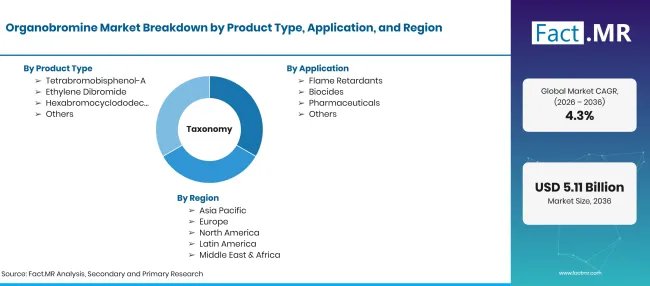
Organobromine Market Taxonomy | Source: Fact.MR
| Attribute | Details |
|---|---|
| Quantitative Units | USD billion in 2026 to USD billion by 2036 at CAGR |
| Market Definition | Organic compounds containing carbon-bromine bonds, sold as flame retardants, biocides and synthesis intermediates. Revenue is counted at the first sale by the compound producer. |
| Product Type | Tetrabromobisphenol A (TBBPA); Ethylene Dibromide; Hexabromocyclododecane (HBCD); Others |
| Application | Flame Retardants; Biocides; Pharmaceutical and Chemical Intermediates; Others |
| End-User Industry | Electronics; Automotive; Construction; Agriculture; Pharmaceuticals; Others |
| Regions Covered | North America; Latin America; Western Europe; Eastern Europe; East Asia; South Asia & Pacific; Middle East & Africa |
| Countries Covered | Germany; Brazil; United States; United Kingdom; Japan |
| Companies Profiled | Albemarle Corporation; ICL Group Ltd.; LANXESS AG; Jordan Bromine Company; Tosoh Corporation; Archean Chemical Industries Ltd.; Neogen Chemicals Limited; TETRA Technologies, Inc. |
| Forecast Period | 2026 to 2036 |
| Approach | Hybrid top-down and bottom-up approach using bromine output by country; derivative yields; laminate, plastics and intermediates demand; substance rules by country; and supplier portfolio review. |
Source: Fact.MR analysis. Updated Oct 26, 2026
How is the market segmented?
-
By Product Type
- Tetrabromobisphenol A (TBBPA)
- Ethylene Dibromide
- Hexabromocyclododecane (HBCD)
- Others
-
By Application
- Flame Retardants
- Biocides
- Pharmaceutical and Chemical Intermediates
- Others
-
By End-User Industry
- Electronics
- Automotive
- Construction
- Agriculture
- Pharmaceuticals
- Others
-
By Region
- North America
- Latin America
- Western Europe
- Eastern Europe
- East Asia
- South Asia & Pacific
- Middle East & Africa
Frequently Asked Questions
How big is the organobromine market in 2026?
What is the CAGR of the organobromine market from 2026 to 2036?
Which product type leads the organobromine market?
Which application leads the organobromine market?
Which end-user industry leads the organobromine market?
Which country will grow the most in the organobromine market?
Who are the main companies in the organobromine market?
Who worked on this report


Preview the report firsthand - request a free sample
Free SampleGet the brochure for pricing and purchase details
Download PDF