- Base Value(2025): 725 Mn
- Forecast Value (2035): 1250 Mn
- CAGR (2035): 6.1%
Lithium Bromide Market Outlook 2025 to 2035
The global Lithium Bromide market is expected to reach USD 1,250 Million by 2035, up from USD 725 million in 2025. During the forecast period 2025 to 2035, the industry is projected to register at a CAGR of 5.6%.
The market is experiencing a boost because it plays a central role in the adoption of green absorption chillers in HVAC systems and is expected to continue its proliferation in the pharmaceutical and chemical industry. Its relevance to the rest of the world is supported by an increase in demand in Asia based on energy-efficiency objectives and infrastructure development.
Quick Stats for Lithium bromide market
- Industry Value(2025):USD 725 Million
- Projected Value (2035):USD 1,250 Million
- Forecast CAGR(2025 to 2035):5.6%
- Leading Segment(2025):Lithium Bromide Solution (70% Market Share)
- Fastest Growing Country (2025-35):China (7.1% CAGR)
- Top Key Players:Ottokemi, Westman Chemicals Pvt. Ltd., Deep Pharm‑Chem Pvt. Ltd., Powder Pack Chem, Sontara Organo Industries, and Leverton Lithium
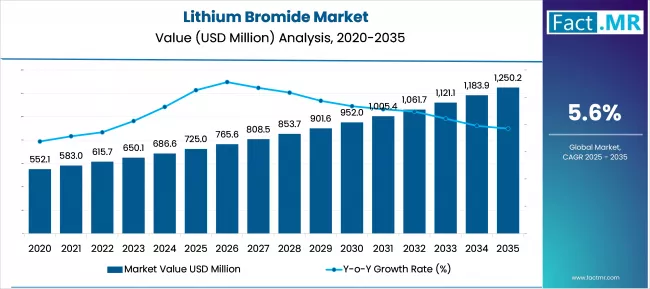
Lithium Bromide Market Market Value Analysis | Source: Fact.MR
What are the drivers of Lithium bromide market?
Lithium bromide is used intensively as an absorption chiller, primarily in commercial and industrial buildings HVAC systems, which makes the segment very strong in the lithium bromide market. It has a high moisture absorption and heat capacity which makes it a perfect product in the eco-friendly cooling applications, and also in line with the global demands of sustainable and low emission that has increased.
There is also increased consumption after the increase in pharmaceutical and chemical industries and use as a reagent and an intermediate. Infrastructure development and energy-efficiency requirement is making the absorption systems gain popularity in emerging markets in Asia. Lithium bromide has found an emerging application in heat recovery and renewable energy applications with the favorable development of regulations.
All these are combining together to boost the demand in various sectors which solidifies the importance lithium bromide has on both classical and new energy-friendly uses.
What are the regional trends of Lithium bromide market?
Asia Pacific has been the leading region in the lithium bromide market, as China, Japan, and India invest in cooling infrastructure that is energy efficient. Regional demand is being driven by the combined trend of government-sponsored programs in favor of smart buildings and green industrialization that are backed locally by the supply of lithium and competitive production.
In North America, there is a dual trend of steady uptake in the field of commercial cooling, mostly in hospitals, data centers and building dedicated to sustainability in the field of structures.
In Europe, the demand also depends on environmental control policies and adopting lithium bromide systems in district cooling systems. The notable adopters are Germany and Nordic countries because they have climate-conscious plans in terms of infrastructure development.
In the meantime, Middle East is becoming an important market because of the use of non-electric cooling in hot climates. Such variations of regions show the increasing importance of lithium bromide in the different climate and regulation circumstances of different regions of the world.
What are the challenges and restraining factors of Lithium bromide market?
The corrosiveness of Lithium bromide is a significant limitation to its use as it necessitates anti-corrosive reagents and special materials in the absorption systems. This increases the installation and maintenance price, and this aspect makes it unattractive to smaller users or those industries that have to use low-cost technologies.
Also, the weaknesses on the supply chain because of the dependence on lithium raw materials production and fluctuations on prices affects market stability. Strict handling and environmental disposal laws make things more complicated to the manufacturers and users. The adoption of the lithium bromide-based systems in the developing economies is hindered by their high investments as compared to that of conventional technologies.
Further, there is a surge in the popularity of substitute refrigerant and developing absorption fluid such as ammonia-water mixes, which is creating competition. All these technical, economic and regulatory obstacles only limit the controversial growth of the market particularly within spheres that do not have favorable infrastructure or motivation.
Country-Wise Outlook
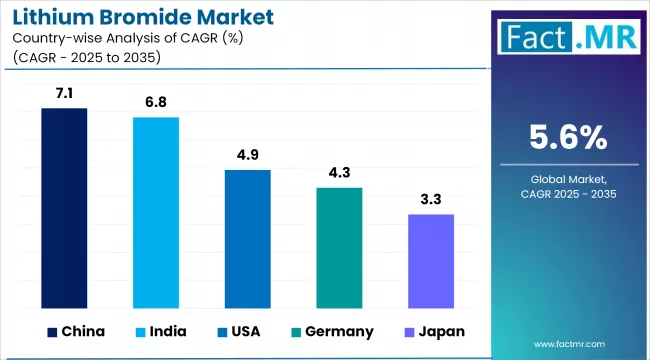
Lithium Bromide Market Cagr Analysis By Country | Source: Fact.MR
Industrial Heat Transfer and HVAC Drive Demand in the U.S.
U.S. has very dominant presence in market of lithium bromide and it is mainly due to the presence of absorption chiller in HVAC and other industrial cooling applications. As the area of the energy-efficient building infrastructure and district cooling projects gain more attention, the demand has a foundation in the commercial and manufacturing segments.
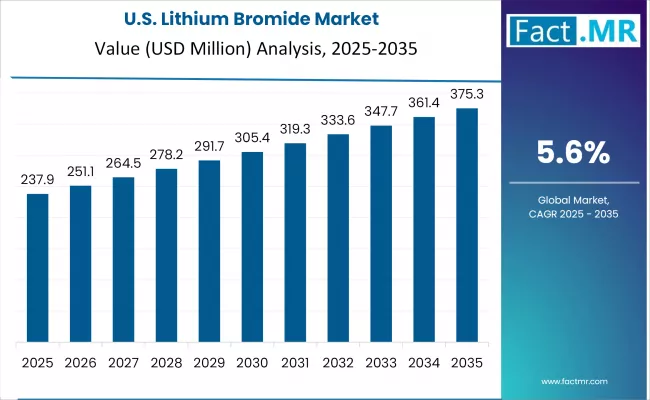
Lithium Bromide Market Country Value Analysis | Source: Fact.MR
Intentionally, the technological developments of the sustainable integration of LiBr-based absorption refrigeration with renewable energy systems have been particularly quickened by solar thermal energy. There is inadequate domestic lithium production available but at the same time the U.S. is investing in lithium strategic supply chains. The major stakeholders are involved in recycling programs to decrease import reliance.
China Capitalizes on HVAC and Pharma-Grade LiBr Demand
China is the world leader in lithium bromide production and consumption, due to its industry of large-scale chemical production, expanding HVAC system and strong pharmaceutical sector. LiBr is employed as a desiccant in air conditioning systems and as a reagent in the pharmaceutical cycling of compound synthesis.
The country has both massive reserves of lithium and inbuilt deep refining capacity, which will allow the cost-effective production of LiBr. Absorption cooling is on the path of adoption as smart cities and green building requirements are enforced in tier 2 and 3 cities. In addition, advanced materials research is being promoted by the government through the ongoing incentive schemes under Made in China 2025, such as lithium derivatives.
Japan Banks on Precision Cooling and Specialty Chemicals
One of the drivers of the lithium bromide market in Japan is the demand of precision cooling in the manufacture of goods in the electronics and medical device industries, and the consistent demand of the chemical in the manufacture of drugs. The LiBr-type chillers are specially chosen in semiconductor fabs where the low temperature is a must.
LiBr absorption cooling systems in hospitals facilities, laboratories and clean rooms have become an important component of the infrastructure in Japan due to its high energy efficiency requirements. Under Society 5.0, the industrial policy is promoting smarter energy usage such as hybrid absorption-compression cooling.
Category-Wise Analysis
Lithium Bromide Solution Powers Efficient Absorption in HVAC Cooling Systems
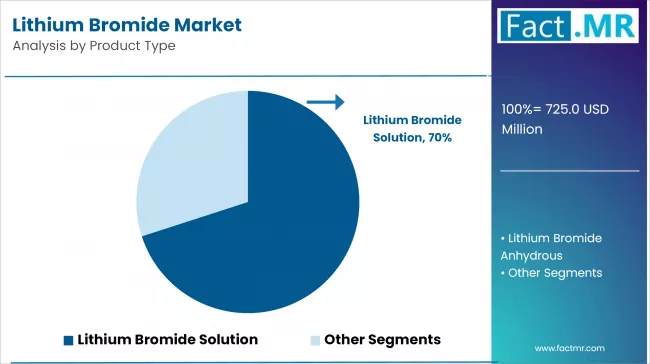
Lithium Bromide Market Analysis By Product Type | Source: Fact.MR
The lithium bromide solution is amongst the chief industrial substances with the core functionality being the absorbent in the vapor absorption refrigeration technology. Its high degree of hygroscopicity enables it to absorb water vapor with high efficiency and this helps keep vacuum conditions in closed-loop Air Conditioners. The increase in environmentally friendly cooling systems and energy saving frameworks of structures has reinforced the demand of this particular type of product.
Liquid Form Enhances Thermal Transfer and Maintenance Efficiency in HVAC Applications
Absorption based cooling systems use lithium bromide liquid as the standard because it is homogenous in thermal conductivity and is easily pumped through equipment. The fluid form reduces any friction in the operations and facilitates quick absorption of water vapor as it is yet another requirement to ensure the efficient sustainability of the operation across loads. The type is as well less complicated on maintenance and improves equipment life span especially in massive commercial buildings and district cooling facilities. It prefers OEM as well as maintenance service providers because it has a ready to use format.
Air Conditioning Systems Drive Industrial Uptake of Lithium Bromide Solutions
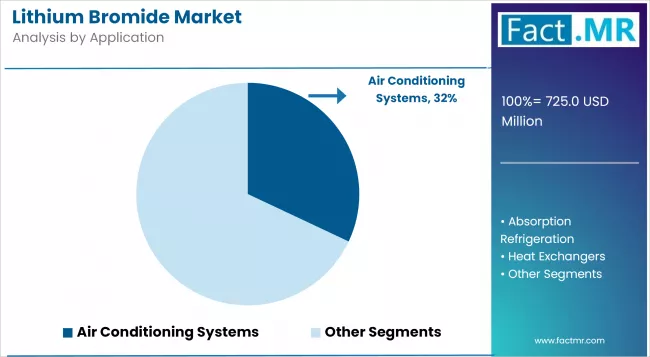
Lithium Bromide Market Analysis By Application | Source: Fact.MR
Air conditioning systems, and especially those relying on absorption chillers, are the most prevalent use of lithium bromide solutions. They are typically non-conventional systems usually being utilized in commercial complexes, hospitals, data centers, and industrial buildings with either inefficiencies or unsustainability in electricity driven compression cooling. Chillers based on lithium bromide are highly valued because they can make use of low-grade sources of heat like waste buildings or solar energy to provide a greener cooling infrastructure. Since the world is becoming stricter on the use of HFC based refrigerants, lithium bromide absorption systems is a viable mode to have a better, eco-friendly alternative.
Competitive Analysis
Lithium bromide industry is highly fragmented with no single company that can be considered dominant in the space. The competitive tools that players deploy in pursuit of the long-term supply relations to HVAC system manufacturer and absorption chiller OEMs are the cost leadership and purity of products players offer.
Close-in manufacturing centers especially in Asia Pacific provide companies with benefits both in access to raw materials as well as access to major end user industries. The North America and the European markets are more regulated, but provide stable demand in industrial refrigeration and pharmaceutical synthesis. This is in a leverage relationship that has given rise to strategic alliances in terms of technology upgrade and scaling production.
In spite of having a low visibility in the market, competition escalates based on production stability and product tailoring. Companies engage in research and development intending to optimize the recovery technologies of the lithium and lower the impact on the environment and achieve superior credentials in sustainability and win industrial contracts.
Key players in the market are Ottokemi, Westman Chemicals Pvt. Ltd., Deep Pharm‑Chem Pvt. Ltd., A. B. Enterprises, Axiom Chemicals Pvt. Ltd., Mody Chemi Pharma Ltd, Oxford Lab Fine Chem LLP, Alpha Chemika, Powder Pack Chem, Sontara Organo Industries, Leverton Lithium, and other players.
Recent Development
- In February 2025, PotlatchDeltic Corporation announced it granted TETRA Brine Leaseco LLC exclusive rights to explore and produce lithium and bromine from approximately 900 acres in the Smackover Formation in Lafayette County, Arkansas. The five‑year lease includes provisions for bromine production payments and lithium royalties.
- In January 2024, TETRA Technologies published a SK‑1300 compliant resource assessment for its Evergreen Brine Unit, estimating 22 tons of lithium per acre the highest of any U.S. lithium brine resource and confirmed significant bromine volumes. A front-end engineering & design (FEED) study targeting early 2024 completion was also announced.
Fact.MR has provided detailed information about the price points of key manufacturers of Lithium bromide market positioned across regions, sales growth, production capacity, and speculative technological expansion, in the recently published report.
Methodology and Industry Tracking Approach
Fact.MR market analysis of more than 1,300 players in 10 countries shows that there is growing excitement about the use of lithium bromide in absorption cooling systems and industrial drying machines as well as chemical catalysts. By October 2025, 39 companies such as HVAC engineers, developers of desiccant solutions, and specialized bromide formulators have reported increasing interest in high-concentration lithium bromide solutions, anhydrous grades and low-corrosive formulations of compact thermal systems.
In June of 2024 and June of 2025 the manufacture of lithium bromide furthered the solvent-less synthesis techniques, regenerative bromide recovery system, and an independent lithium purification module. These inventions have improved purity yield, reduced halide byproducts and have scaled up, to the end user levels.
Closed-cycle bromine practice, cradle-to-gate sustainability standards, and digital traceability using QR-enabled QR integrated batch management systems have been in use since 2018 by the producers to support traceability, regulatory compliance, and ESG suitability.
Segmentation
Segmentation of Lithium bromide market
-
By Product Type :
- Lithium Bromide Solution
- Lithium Bromide Anhydrous
-
By Form :
- Liquid
- Powder
-
By Application :
- Air Conditioning Systems
- Absorption Refrigeration
- Heat Exchangers
- Desiccant Systems
- Industrial Drying
- Water Treatment
-
By End Use Industry :
- HVAC & Industrial Cooling
- Chemical Processing
- Pharmaceuticals
- Electronics & Semiconductors
- Oil & Gas
- Food & Beverage
-
By Region :
- North America
- Latin America
- Western Europe
- Eastern Europe
- East Asia
- South Asia & Pacific
- Middle East & Africa
Frequently Asked Questions
What was the global Lithium bromide market size reported by Fact.MR for 2025?
Who are the major players operating in the Lithium bromide market?
What is the Estimated Valuation of the Lithium bromide market in 2035?
What value CAGR did the Lithium bromide market exhibit over the last five years?
Who worked on this report


Preview the report firsthand - request a free sample
Free SampleGet the brochure for pricing and purchase details
Download PDF