- Base Value(2025): 2.10 Bn
- Estimated Value(2026): 2.22 Bn
- Forecast Value (2036): 3.90 Bn
- CAGR (2026 - 2036): 5.80%
Bromine Market Size, Market Forecast and Outlook By Fact.MR
The bromine market was valued at USD 2.10 billion in 2025, projected to reach USD 2.22 billion in 2026, and is forecast to expand to USD 3.90 billion by 2036 at a 5.80% CAGR.

Bromine Market Market Value Analysis | Source: Fact.MR
Summary of Bromine Market
- Market Overview
- The bromine market is valued at USD 2.10 billion in 2025 and is projected to reach USD 3.90 billion by 2036.
- The industry is expected to grow at a 5.80% CAGR from 2026 to 2036, creating an incremental opportunity of USD 1.68 billion.
- The market operates as a halogen commodity category where brine extraction access, downstream bromination capability, and oilfield completion fluid specification compliance define competitive positioning across energy, flame retardant, and water treatment procurement channels.
- Demand and Growth Drivers
- Oil and gas clear brine fluid consumption remains the largest application, with calcium bromide and sodium bromide completion fluid demand tracking deepwater well activity in the Gulf of Mexico and unconventional completions in the Permian Basin.
- Flame retardant intermediate demand is stabilizing as brominated flame retardant reformulation programs address PBDE and HBCD regulatory restrictions while maintaining bromine-based chemistry in compliant replacement formulations for electronics and construction.
- Zinc-bromine flow battery development for grid-scale energy storage represents an emerging high-growth demand channel, with pilot and commercial deployments creating incremental bromine electrolyte procurement volumes.
- Among key countries, USA at 6.5%, China at 6.2%, India at 6.0%, Germany at 5.7%, Japan at 5.4%, Brazil at 5.1%, Saudi Arabia at 4.8% define the global growth distribution.
- Product and Segment View
- The market covers elemental bromine, sodium bromide, calcium bromide, and other bromine compounds used in clear brine completion fluids, water treatment biocides, flame retardant intermediates, and emerging battery electrolyte applications.
- Elemental Bromine leads by Product with 50.0% share in 2026.
- Clear Brine Fluids leads by Application with 41.0% share in 2026.
- The scope includes all bromine products extracted from brine sources and sold to downstream chemical processors and end users. It excludes finished flame retardant compounds, completed well service operations, and bromine recycling and recovery services.
- Geography and Competitive Outlook
- The USA leads with a 6.5% CAGR, anchored by Gulf of Mexico deepwater completion fluid demand and emerging zinc-bromine battery deployment for grid-scale energy storage.
- China and India follow at 6.2% and 6.0% CAGR, driven by flame retardant intermediate production growth and expanding water treatment biocide consumption.
- Competition is shaped by technical capabilities, certification portfolios, and service depth, with key players including ICL Group Ltd, Albemarle Corporation, LANXESS AG, Tosoh Corporation, TETRA Technologies Inc., Tata Chemicals, Hindustan Salts Ltd.
- Analyst Opinion at Fact.MR
- Shambhu Nath Jha , Principal Consultant for Chemicals & Materials, opines: 'In my analysis, I have observed that brine extraction access concentration between the Dead Sea (ICL, Jordan Bromine) and Arkansas brine deposits (Albemarle, LANXESS) creates a structural supply oligopoly that gives these producers pricing power exceeding what downstream demand fundamentals would otherwise support. End users in completion fluids and flame retardants face limited supplier alternatives, making long-term contract pricing negotiations the critical procurement competency for bromine-consuming industries.'
- Strategic Implications / Executive Takeaways
- Completion fluid service companies must negotiate long-term bromine supply contracts with guaranteed allocation provisions to protect deepwater and unconventional well programme schedules from spot market price volatility.
- Flame retardant formulators should evaluate compliant brominated chemistry alternatives to restricted PBDE and HBCD compounds before regulatory phase-out deadlines compress reformulation timelines.
- Energy storage developers deploying zinc-bromine flow battery systems must secure dedicated bromine electrolyte supply agreements to decouple battery production schedules from oilfield and flame retardant demand cycles.
Bromine Market Key Takeaways
| Metric | Details |
|---|---|
| Industry Size (2026) | USD 2.22 billion |
| Industry Value (2036) | USD 3.90 billion |
| CAGR (2026 to 2036) | 5.80% |
| Incremental Opportunity | USD 1.68 billion |
| Leading Product | Elemental Bromine (50.0% share) |
| Leading Application | Clear Brine Fluids (41.0% share) |
| Fastest-growing Country | USA (6.5% CAGR) |
| Forecast Period | 2026 to 2036 |
Source: Fact.MR analysis. Updated Apr 7, 2026
Source: Fact.MR, 2026
This translates to an incremental opportunity of approximately USD 1.68 billion over the forecast period. Oil and gas clear brine fluid consumption remains the largest application, with calcium bromide and sodium bromide completion fluid demand tracking deepwater and unconventional well completion activity in the Gulf of Mexico, Permian Basin, and Middle East producing regions. Flame retardant intermediate demand is stabilizing as brominated flame retardant reformulation programs address regulatory restrictions on specific PBDE and HBCD chemistries while maintaining bromine content in compliant replacement formulations. Zinc-bromine flow battery development for grid-scale energy storage represents an emerging high-growth demand channel that could reshape bromine consumption patterns over the forecast period.
As per Fact.MR analysis, country-level growth rates vary based on local industrial infrastructure and regulatory frameworks. USA at 6.5%, China at 6.2%, India at 6.0%, Germany at 5.7%, Japan at 5.4%, Brazil at 5.1%, Saudi Arabia at 4.8% define the global growth distribution through the forecast period.
Why is the Bromine Market Growing?
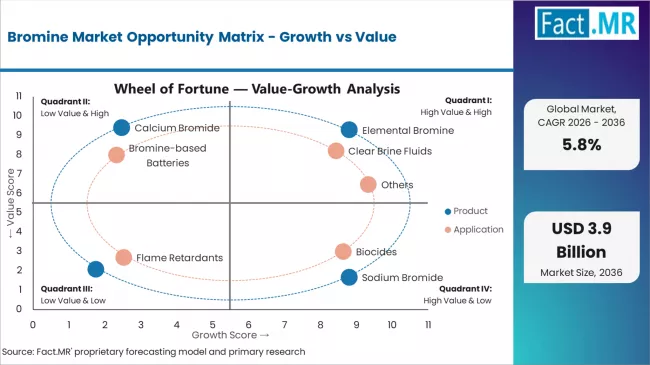
Bromine Market Opportunity Matrix Growth Vs Value | Source: Fact.MR
Market expansion is being supported by the exponential increase in offshore drilling activities and the corresponding need for high-density completion fluid solutions in oil and gas applications across global energy operations. Drilling operators are increasingly focused on bromine-based fluids that can improve wellbore stability, enhance formation protection, and optimize drilling protocols while meeting stringent environmental requirements.
The proven efficacy of bromine compounds in various industrial applications makes them an essential component of comprehensive energy production strategies and specialty chemical programs. The growing emphasis on fire safety regulations and flame retardant integration is driving demand for bromine products that meet stringent performance specifications and operational requirements for industrial applications.
Electronics manufacturers' preference for reliable, high-performance brominated flame retardants that can ensure consistent fire safety outcomes is creating opportunities for innovative brominated compound formulations and customized bromine solutions. The rising influence of environmental regulations and sustainable chemistry mandates is also contributing to increased adoption of efficiently produced bromine across different industry categories and manufacturing systems requiring specialty halogen chemistry.
Opportunity Pathways - Bromine Market
The bromine market represents a transformative growth opportunity, expanding from USD 2.1 billion in 2025 to USD 3.7 billion by 2035 at a 5.8% CAGR. As industrial operators prioritize drilling efficiency, fire safety optimization, and specialty chemical performance in complex industrial environments, bromine has evolved from a commodity chemical to an essential specialty element enabling precise completion fluid formulation, comprehensive flame retardant strategies, and multi-application functionality operations across oil and gas platforms and electronics manufacturing applications.
The convergence of offshore drilling acceleration, increasing electronics production penetration, advanced brominated chemistry integration, and stringent safety mandates creates momentum in demand. High-purity elemental bromine offering superior performance, cost-effective bromide salts balancing functionality with economics, and specialty compounds for advanced applications will capture market premiums, while geographic expansion into high-growth Asian manufacturing markets and emerging energy ecosystems will drive volume leadership. Industrial operator emphasis on performance reliability and environmental compliance provides structural support.
- Pathway A - Elemental Bromine Product Segment Dominance: Leading with 50.0% market share, elemental bromine drives primary demand through diverse industrial workflows requiring comprehensive chemical solutions for specialty compound production. Advanced production protocols enabling improved purity levels, enhanced yield efficiency, and superior performance outcomes command premium pricing from industrial manufacturers requiring stringent quality specifications and application reliability. Expected revenue pool: USD 1.1-1.9 billion.
- Pathway B - Clear Brine Fluids Application Leadership: Dominating with 41.0% market share through optimal balance of drilling necessity and wellbore stability requirements, clear brine fluid applications serve primary bromine consumption requirements while meeting diverse completion fluid demands. This application addresses both offshore drilling operations and onshore well completion needs, making it the preferred category for oil and gas operators and drilling fluid suppliers seeking comprehensive completion fluid capabilities. Opportunity: USD 0.9-1.6 billion.
- Pathway C - North American and Asian Market Acceleration: USA (6.5% CAGR) and China (6.2% CAGR) lead global growth through drilling activity expansion, electronics manufacturing infrastructure development, and bromine application capability advancement. Strategic partnerships with local industrial operators, product localization expertise, and supply chain optimization enable the expansion of bromine across major energy production and chemical manufacturing hubs. Geographic expansion upside: USD 0.6-1.2 billion.
- Pathway D - Flame Retardants Application Segment: Flame retardants with 32.0% market share serve critical fire safety requirements for diverse electronics and textile products. Optimized brominated formulations supporting multiple industry categories, regulatory compliance requirements, and proven fire protection effectiveness maintain significant volumes from electronics manufacturers and polymer processing facilities. Revenue potential: USD 0.7-1.2 billion.
- Pathway E - Advanced Production Technologies & Purification Systems: Companies investing in solution mining optimization techniques, recovery process innovations, and advanced purification systems gain competitive advantages through consistent quality delivery and environmental performance. Advanced capabilities enabling customized purity specifications and rapid product qualification capture premium industrial partnerships. Technology premium: USD 0.4-0.7 billion.
- Pathway F - Supply Chain Optimization & Technical Service Excellence: Dedicated application support programs, strategic industrial partnership integration, and reliable logistics systems create competitive differentiation in industrial markets requiring consistent bromine availability. Companies offering guaranteed supply security, technical formulation assistance, and environmental compliance support gain preferred supplier status with quality-focused industrial operators. Supply chain value: USD 0.3-0.6 billion.
- Pathway G - Emerging Applications & Market Development: Beyond traditional drilling fluid applications, bromine in flow batteries, pharmaceutical intermediates, and specialized water treatment technologies represent growth opportunities. Companies developing new brominated compounds, supporting innovation initiatives, and expanding into adjacent specialty chemical and energy storage markets capture incremental demand while diversifying revenue streams. Emerging opportunity: USD 0.3-0.5 billion.
Segmental Analysis
The market is segmented by product, application, and region. By product, the market is divided into elemental bromine, calcium bromide, sodium bromide, and others. Based on application, the market is categorized into clear brine fluids (CBF), flame retardants, biocides, bromine-based batteries, and others. Regionally, the market is divided into North America, Asia Pacific, Europe, Latin America, and Middle East & Africa.
Why Does Elemental Bromine Product Command Market Dominance?

Bromine Market Analysis By Product | Source: Fact.MR
The elemental bromine product segment is projected to account for 50.0% of the bromine market in 2025, reaffirming its position as the category's dominant product specification. Chemical manufacturers increasingly recognize the optimal balance of reactivity and versatility offered by elemental bromine for specialty chemical production applications, particularly in brominated compound synthesis and pharmaceutical intermediate manufacturing.
This product category addresses both direct application requirements and derivative compound production demands while providing reliable chemical performance outcomes across diverse industrial operations. This segment forms the foundation of most brominated chemical manufacturing protocols for flame retardant production and pharmaceutical intermediate synthesis, as it represents the most chemically versatile and industrially established product form in the bromine industry.
Quality validation standards and extensive industrial testing continue to strengthen confidence in elemental bromine among chemical engineers and production professionals. With increasing recognition of brominated compound importance in fire safety and specialty chemical requirements, elemental bromine production aligns with both current industrial chemistry practices and specialty chemical evolution goals, making it the central growth driver of comprehensive bromine utilization strategies across multiple industrial platforms.
Why do Clear Brine Fluids Applications maintain Primary Market Leadership?

Bromine Market Analysis By Application | Source: Fact.MR
Clear brine fluids application is projected to represent 41.0% of bromine demand in 2025, underscoring its role as the primary consumption category driving market adoption and oil field chemistry deployment. Drilling operators recognize that completion fluid requirements, including diverse well conditions, varied formation pressures, and comprehensive wellbore stability needs, provide the largest addressable market for bromine consumption.
Bromine utilized in clear brine fluid production offers enhanced density control and superior formation compatibility essential for serving offshore drilling operations, deepwater completions, and high-pressure well applications. The segment is supported by the expanding nature of global offshore drilling industry development, requiring fluids capable of addressing deepwater exploration, horizontal well completion, and workover operations, and the increasing recognition that bromide-based fluids can improve drilling efficiency and well integrity.
Operators are increasingly adopting high-density completion fluid approaches that mandate bromide salt integration for optimal formation pressure control and wellbore stability. As understanding of completion fluid technology advances and offshore drilling becomes more prevalent, bromine-based clear brine fluid applications will continue to play a crucial role in comprehensive oil and gas production differentiation strategies.
What drives Bromine Applications for Flame Retardants?
The flame retardants application segment is projected to account for 32.0% of the bromine market in 2025, establishing its position as a significant industrial category. Electronics and polymer manufacturers increasingly recognize that brominated flame retardants, providing superior fire protection with minimal material impact, represent a functionally critical application due to safety requirements and regulatory standards.
This application addresses both electronics fire safety requirements and textile flame resistance needs while delivering essential fire protection outcomes across varied industrial products. The segment is supported by the continuing nature of electronics manufacturing expansion in both developed and emerging economies, driven by consumer electronics demand, automotive electronics integration, and building safety regulations requiring effective flame retardants.
Manufacturers are increasingly focusing on halogenated flame retardant protocols that enhance fire safety and product compliance while maintaining material performance standards. As fire safety awareness expands and electronic device usage accelerates, brominated flame retardant applications will continue to serve a crucial role in ensuring product safety and regulatory compliance within the global manufacturing market.
What are the Drivers, Restraints, and Key Trends of the Bromine Market?
The bromine market is advancing rapidly due to increasing recognition of oil field chemistry importance and growing demand for specialty brominated compound solutions across the industrial sector.
The market faces challenges, including environmental concerns regarding brominated chemical disposal in sensitive applications, limited production facility availability in key consuming regions, and concerns about substitution pressure from alternative technologies in certain applications. Innovation in extraction technologies and advanced environmental management methodologies continues to influence product development and market expansion patterns.
Proliferation of Advanced Extraction Technologies and Production Systems
The accelerating adoption of sophisticated extraction platforms is enabling the development of more efficient bromine recovery processes and enhanced purity systems that can meet stringent industrial quality and environmental requirements.
Industrial operators demand comprehensive production integration for bromine, including consistent quality capabilities and optimized extraction formulations that are particularly important for achieving superior performance requirements in complex industrial applications.
Advanced extraction technologies provide access to enhanced production efficiency that can optimize manufacturing economics and improve environmental performance while maintaining cost-effectiveness for diverse industrial production environments.
Integration of Sustainable Production Platforms and Environmental Management Capabilities
Modern chemical organizations are incorporating advanced technologies such as emission control systems, brine recycling capabilities, and environmental compliance interfaces to enhance bromine production sustainability and regulatory performance.
These systems improve resource efficiency opportunities, enable seamless conventional-to-sustainable production transitions, and provide better integration between bromine producers and industrial operators throughout the supply chain experience.
Advanced environmental capabilities also enable customized compliance protocols and early identification of environmental concerns or process optimization opportunities, supporting proactive environmental management and improved operational outcomes.
Analysis of the Bromine Market by Key Countries
.webp "Top Country Growth Comparison Bromine Market Cagr (2026 2036)")
Top Country Growth Comparison Bromine Market Cagr (2026 2036) | Source: Fact.MR
| Country | CAGR (2026-2036) |
|---|---|
| USA | 6.5% |
| China | 6.2% |
| India | 6.0% |
| Germany | 5.7% |
| Japan | 5.4% |
| Brazil | 5.1% |
| Saudi Arabia | 4.8% |
Source: Fact.MR analysis. Updated Apr 7, 2026

Bromine Market Cagr Analysis By Country | Source: Fact.MR
The bromine market is experiencing exceptional growth globally, with the USA leading at a 6.5% CAGR through 2036, driven by expanding offshore drilling capacity, growing flame retardant adoption, and increasing specialty chemical infrastructure development across major energy and manufacturing centers.
China follows at 6.2%, supported by massive electronics manufacturing industry, rising battery technology development, and comprehensive chemical production modernization initiatives. India records 6.0% growth, benefiting from expanding agrochemical sector and growing water treatment infrastructure.
Germany demonstrates 5.7% growth, emphasizing regulatory compliance leadership and specialty chemical segment expansion. Japan shows 5.4% growth with electronics industry maturity and specialty chemical focus. Brazil records 5.1% growth, representing agrochemical expansion and industrial development, while Saudi Arabia shows 4.8% growth, representing oil and gas sector integration and petrochemical development.
How Does the USA Demonstrate Exceptional Market Potential with Expanding Drilling Activity?

Bromine Market Country Value Analysis | Source: Fact.MR
Revenue from bromine in the USA is projected to exhibit exceptional growth with a CAGR of 6.5% through 2036, driven by expanding offshore drilling capacity and increasing recognition of specialty chemicals as an essential component for energy production and fire safety enhancement. The country's growing offshore exploration sector and improving availability of brominated chemical infrastructure are creating significant opportunities for bromine deployment across both clear brine fluid and emerging flame retardant segments. Major international bromine producers and domestic chemical manufacturers are establishing comprehensive distribution facilities to serve the expanding population of drilling operators and electronics manufacturers requiring bromine across offshore operations, completion fluid applications, and fire safety formulations throughout the USA's diverse energy and industrial regions.
The USA government's strategic emphasis on energy independence and manufacturing competitiveness is driving substantial investments in domestic chemical production capabilities and specialty material availability. This policy support, combined with the country's significant offshore drilling activity and large electronics manufacturing base, creates a favorable environment for bromine market development. American industrial operators are increasingly focusing on high-performance chemical solutions to improve operational efficiency, with bromine-based products representing a key component in this performance enhancement capability building.
- Industry initiatives supporting offshore energy development and fire safety standards are driving demand for bromine across drilling and electronics segments
- Production capacity maintenance and specialty chemical expertise are supporting appropriate utilization of bromine products among operators and manufacturing facilities nationwide
- Operators and manufacturers are increasingly recognizing bromine compound importance in operational efficiency, creating new chemical demand capabilities
- Rising specialty chemical investment and growing awareness of performance benefits are accelerating bromine adoption across application categories
What Makes China Demonstrate Market Leadership with Massive Electronics Manufacturing?
Revenue from bromine in China is expanding at a CAGR of 6.2%, supported by the world's largest electronics manufacturing industry, rapidly expanding battery technology sector, and advancing chemical production modernization integration across the country's developing industrial and coastal corridors. The country's massive flame retardant consumption scale and increasing sophistication of brominated chemical platforms are driving demand for bromine solutions in both traditional and emerging applications. International bromine suppliers and domestic producers are establishing production capacity to serve the growing demand for quality bromine while supporting the country's position as a leading electronics manufacturing and specialty chemical market.
China's chemical sector continues to benefit from favorable industrial policies, developing electronics infrastructure, and growing industry commitment to fire safety standards. The country's focus on expanding battery technology capabilities is driving investments in critical bromine compound services including battery electrolyte development and specialty chemical synthesis. This development is particularly important for bromine applications, as manufacturers seek reliable chemical sources for electronics production to maintain global competitiveness and meet growing domestic and international electronics demand.
- Rising electronics manufacturing and improving domestic chemical capabilities are creating opportunities for bromine solutions
- Growing fire safety awareness and battery technology modernization are supporting increased deployment of bromine across product categories
- Expanding chemical capacity and emerging quality standards are driving innovative applications of bromine in electronics and energy storage applications
- Specialty chemical capability advancement is enabling delivery of sophisticated brominated products, supporting market growth and enhancing industrial competitiveness
Why Does India Maintain Agrochemical Sector Growth?
Revenue from bromine in India is projected to exhibit strong growth with a CAGR of 6.0% through 2036, driven by expanding agrochemical operations and growing water treatment sector. The country's position as a major agricultural economy and increasing water treatment infrastructure are creating significant opportunities for bromine integration across both pesticide intermediate and biocide applications. Indian chemical manufacturers are leveraging production capabilities to serve the growing demand for bromine while supporting the country's position as an emerging specialty chemical economy.
The Indian market benefits from strong agricultural sector supporting chemical demand, enabling optimized bromine deployment and comprehensive agrochemical integration. This development is particularly important for bromine applications, as manufacturers seek effective chemical building blocks that maximize product performance while ensuring cost-effectiveness in commercial agrochemical production and water treatment environments.
Strategic Market Considerations:
- Agrochemical and water treatment segments leading growth with focus on biocide effectiveness and pesticide intermediate applications
- Agricultural economics and growing sanitation infrastructure driving diverse bromine portfolios from basic chemical intermediates to specialty biocide platforms
- Chemical manufacturing capabilities and agricultural expertise supporting competitive positioning in Asian specialty chemical markets
- Industry requirements and quality standards beginning to influence product specifications and brominated compound adoption timelines
How Does Germany Maintain Regulatory Compliance Leadership?
Germany's advanced chemical market demonstrates sophisticated bromine deployment with documented effectiveness in specialty chemical platforms and regulatory compliance applications through integration with cutting-edge production technologies and environmental protocols. The country leverages chemical industry leadership and comprehensive environmental compliance infrastructure to maintain a 5.7% CAGR through 2036. Specialty chemical manufacturers, including major bromine consumers in industrial regions and pharmaceutical companies, showcase advanced bromine implementations where high-purity chemicals integrate with comprehensive compliance platforms and ongoing environmental optimization to ensure product quality and regulatory adherence.
German chemical manufacturers prioritize environmental performance and regulatory compliance in production development, creating demand for responsibly-produced bromine with advanced characteristics, including verified sustainability credentials and integration with comprehensive environmental systems. The market benefits from established specialty chemical infrastructure and commitment to environmental excellence that provides superior compliance outcomes and adherence to stringent European standards and industrial requirements.
Strategic Market Considerations:
- Specialty chemicals and pharmaceutical segments leading growth with focus on regulatory compliance and environmental performance applications
- Stringent environmental expectations driving sophisticated bromine portfolios from conventional production to advanced sustainable platforms
- Chemical technology excellence and environmental leadership supporting continued advancement in bromine application development
- Environmental standards and regulatory requirements ensuring consistent production quality and sustainability outcome optimization
What Drives Japan Market Growth with Electronics Industry Maturity?
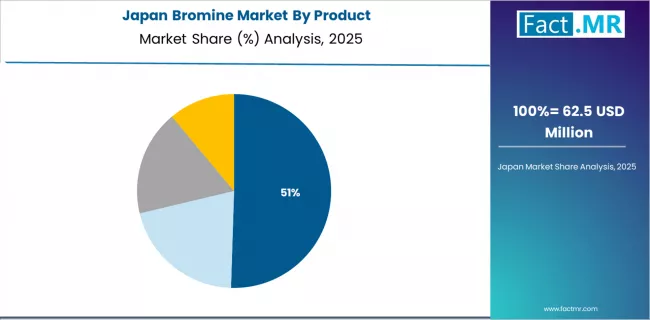
Bromine Market Japan Market Share Analysis By Product | Source: Fact.MR
Japan's advanced chemical market demonstrates sophisticated bromine deployment with documented effectiveness in electronics platforms and specialty applications through integration with cutting-edge manufacturing systems and quality control. The country leverages specialty chemical excellence and precision production methodology to maintain a 5.4% CAGR through 2036. Chemical manufacturing facilities, including major electronics suppliers in industrial centers, showcase advanced bromine implementations where high-quality chemicals integrate with comprehensive quality programs and ongoing technology optimization to ensure product consistency and performance reliability.
Japanese manufacturers prioritize chemical quality and long-term product excellence in material selection, creating demand for premium bromine with advanced features, including ultra-consistent specifications and integration with Japanese quality standards. The market benefits from established specialty chemical infrastructure and commitment to manufacturing excellence that drives continuous product advancement.
Strategic Market Considerations:
- Electronics and specialty chemical segments leading growth with focus on quality precision and comprehensive application requirements
- Stringent quality requirements driving sophisticated bromine portfolios from conventional chemicals to specialty ultra-pure platforms
- Chemical manufacturing excellence and technology leadership supporting competitive positioning in Asian specialty markets
- Professional standards and industry collaboration emphasizing precision production approaches and continuous quality improvement
How Does Brazil Maintain Agrochemical Expansion?
Brazil's expanding bromine market demonstrates accelerating specialty chemical adoption with a 5.1% CAGR through 2036, driven by agrochemical expansion, industrial development, and growing chemical production across major agricultural regions. The country's position as a major agricultural producer and developing industrial chemical sector are creating opportunities for bromine integration across both pesticide and industrial applications. Brazilian chemical manufacturers are developing production capabilities to serve growing demand for bromine while supporting the country's position as a regional chemical market.
Market dynamics focus on cost-effective bromine products that balance performance characteristics with economic considerations important to agricultural and industrial sectors. Growing domestic chemical expertise creates opportunities for integrated production programs and bromine deployment.
Strategic Market Considerations:
- Agrochemical and industrial segments demonstrating focused growth with emphasis on pesticide intermediates and specialty chemical applications
- Agricultural economics and growing industrial development driving diverse bromine portfolios from basic intermediates to specialty compound platforms
- Chemical capabilities and agricultural expertise supporting competitive positioning in Latin American specialty markets
- Industry development and quality requirements beginning to influence product specifications and brominated chemical adoption timelines
What Drives Saudi Arabia Market Growth with Oil and Gas Integration?
Saudi Arabia's expanding bromine market demonstrates accelerating specialty chemical adoption with a 4.8% CAGR through 2036, driven by oil and gas sector integration, petrochemical development, and growing industrial chemical production across major energy regions. The country's position as a major oil producer and developing petrochemical sector are creating opportunities for bromine integration across both drilling fluid and industrial applications. Saudi petrochemical operators are leveraging energy sector integration to serve growing demand for bromine while supporting the country's position as a regional chemical producer.
Market dynamics focus on integrated bromine products that balance performance characteristics with production efficiency important to oil and gas operations. Growing domestic petrochemical expertise creates opportunities for integrated chemical programs and bromine deployment.
Strategic Market Considerations:
- Oil and gas and petrochemical segments demonstrating focused growth with emphasis on completion fluid and specialty chemical applications
- Energy sector integration and growing downstream capabilities driving diverse bromine portfolios from drilling chemicals to specialty petrochemical platforms
- Petrochemical expertise and energy sector presence supporting competitive positioning in Middle East chemical markets
- Industry development and value-addition initiatives beginning to influence production specifications and specialty chemical adoption timelines
Europe Market Split by Country
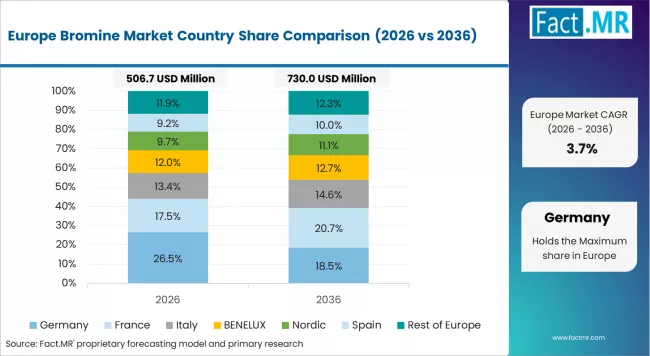
Bromine Market Europe Country Market Share Analysis, 2026 & 2036 | Source: Fact.MR
The bromine market in Europe is projected to grow from USD 0.4 billion in 2026 to USD 0.7 billion by 2036, registering a CAGR of 5.5% over the forecast period. Germany is expected to maintain its leadership position with a 35.0% market share in 2026, rising to 36.4% by 2036, supported by its dominant specialty chemical infrastructure, comprehensive environmental compliance capabilities, and advanced brominated compound expertise throughout major chemical facilities and pharmaceutical networks.
France follows with a 22.5% share in 2026, projected to reach 23.2% by 2036, driven by pharmaceutical intermediate excellence, flame retardant presence, and expanding specialty chemical sophistication serving both domestic and European markets. The UK holds a 18.8% share in 2026, expected to increase to 19.3% by 2036, supported by comprehensive pharmaceutical infrastructure and specialty chemical development. Italy commands a 13.1% share in 2026, projected to reach 12.3% by 2036, while Spain accounts for 8.0% in 2026, expected to reach 7.3% by 2036. The Rest of Europe region, including Nordic countries with advanced environmental standards, Eastern European emerging chemical markets, and smaller Western European specialty producers, is anticipated to hold 2.6% in 2026, declining slightly to 1.5% by 2036, attributed to market consolidation toward larger core markets with established specialty chemical infrastructure and bromine processing expertise.
Competitive Landscape of the Bromine Market

Bromine Market Analysis By Company | Source: Fact.MR
The bromine market is characterized by intense competition among established mineral extraction companies, specialty chemical producers, and comprehensive bromine derivative manufacturers focused on delivering high-quality, reliable, and consistently specified bromine solutions.
Companies are investing in sustainable extraction programs, advanced production technology acquisition, strategic industrial partnerships, and comprehensive technical service initiatives to deliver effective, consistent, and environmentally responsible bromine that meets stringent quality standards and customer expectations. Supply security, product consistency emphasis, and environmental compliance strategies are central to strengthening product portfolios and market presence.
ICL Group Ltd leads the market with a 22.0% market share, offering comprehensive bromine solutions with a focus on Dead Sea extraction expertise and advanced derivative production capabilities for industrial applications. Albemarle Corporation provides diversified bromine platforms with emphasis on flame retardant leadership and comprehensive specialty chemical solutions across global markets.
LANXESS AG focuses on brominated flame retardant production and comprehensive polymer additive solutions serving international manufacturing communities. Tosoh Corporation delivers specialty bromine compound expertise with strong electronics industry partnerships and pharmaceutical intermediate integration.
TETRA Technologies Inc. operates with a focus on clear brine fluid development and comprehensive completion fluid solutions for oil and gas applications. Tata Chemicals provides integrated bromine production emphasizing cost competitiveness and comprehensive industrial chemical platforms. Hindustan Salts Ltd specializes in domestic bromine extraction with emphasis on regional market supply and comprehensive salt-based chemical solutions.
Honeywell International Inc. delivers advanced flame retardant technologies to enhance fire safety accessibility and provide specialty brominated products. Gulf Resources Inc. and Agrocel Industries Pvt Ltd focus on regional bromine production and agrochemical intermediate manufacturing with emphasis on supply reliability and application support through dedicated bromine extraction strategies.
Key Players in the Bromine Market
- ICL Group Ltd
- Albemarle Corporation
- LANXESS AG
- Tosoh Corporation
- TETRA Technologies Inc.
- Tata Chemicals
- Hindustan Salts Ltd
- Honeywell International Inc.
- Gulf Resources Inc.
- Agrocel Industries Pvt Ltd
Bibliography
- U.S. Geological Survey. (2025, January). Mineral commodity summaries: Bromine production and reserves. USGS.
- American Petroleum Institute. (2024). API Spec 13A: Specification for drilling-fluid materials, brine completion fluids. API.
- European Chemicals Agency. (2024). REACH restriction dossier: Brominated flame retardants risk assessment. ECHA.
- International Energy Agency. (2024). Energy storage technology roadmap: Flow battery chemistry assessment. IEA.
- U.S. Environmental Protection Agency. (2024). Toxic Substances Control Act: Brominated flame retardant risk evaluation. EPA.
This bibliography is provided for reader reference. The full Fact.MR report contains the complete reference list with primary research documentation.
This Report Addresses
- Market sizing and quantitative forecast metrics detailing expenditure on bromine across major countries through 2036.
- Segmentation analysis mapping adoption velocity of specific product categories and evaluating technical and commercial factors driving segment leadership.
- Country-level deployment intelligence comparing growth dynamics across USA, China, India, Germany, Japan, Brazil, Saudi Arabia.
- Regulatory compliance assessment analyzing how industry standards and mandates affect procurement specifications and product development priorities.
- Competitive posture evaluation tracking market structure, supplier positioning, and strategic variables determining contract award outcomes.
- Capital project strategic guidance defining procurement specifications and performance thresholds for next-generation applications.
- Supply chain assessment identifying specific constraints and logistics factors affecting delivery timelines and cost structures.
- Custom data delivery formats encompassing interactive dashboards, raw Excel datasets, and comprehensive PDF narrative reports.
Bromine Market Definition
Bromine is a halogen element extracted from brines (primarily Dead Sea and underground brines in the USA and China) through chlorine displacement and steam distillation processes. Product forms include elemental bromine, sodium bromide, calcium bromide, and hydrogen bromide. Bromine compounds serve as clear brine completion and workover fluids in oil and gas drilling, water treatment biocides, flame retardant intermediates for electronics and construction materials, and emerging electrolyte components for zinc-bromine and vanadium-bromine flow battery energy storage systems.
Bromine Market Inclusions
Market scope includes elemental bromine, sodium bromide, calcium bromide, and other bromine compounds sold for completion fluids, biocides, flame retardant intermediates, and battery electrolyte applications. Global and regional market sizes with segment breakdowns by Product and Application are covered through the 2026 to 2036 forecast period.
Bromine Market Exclusions
Finished flame retardant compounds, completed well service operations, and bromine recycling and recovery services are excluded. Iodine, chlorine, and fluorine halogen products fall outside the scope.
Bromine Market Research Methodology
- Primary Research: Analysts engaged with procurement directors, plant engineers, and supply chain managers to map specific decision gates triggering product selection, supplier qualification, and volume commitment patterns.
- Desk Research: Data collection phases aggregated regulatory filings, industry standards documentation, trade association publications, and company annual reports to establish baseline market parameters.
- Market-Sizing and Forecasting: Baseline values derive from a bottom-up aggregation of product-level revenue data, applying segment-specific growth curves calibrated against macroeconomic indicators and regulatory implementation timelines.
- Data Validation and Update Cycle: Projections are tested against publicly reported financial data from leading industry participants, with annual refresh cycles incorporating updated regulatory schedules and trade flow data.
Segmentation
Scope of the Report
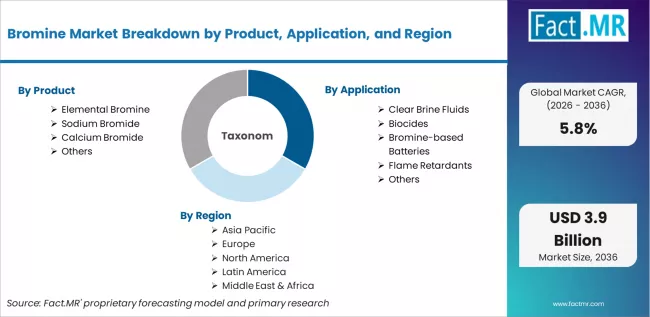
Bromine Market Breakdown By Product, Application, And Region | Source: Fact.MR
| Metric | Value |
|---|---|
| Quantitative Units | USD 2.22 billion to USD 3.90 billion, at a CAGR of 5.80% |
| Market Definition | Bromine is a halogen element extracted from brines (primarily Dead Sea and underground brines in the USA and China) through chlorine displacement and steam distillation processes. Product forms includ... |
| Product Segmentation | Elemental Bromine, Sodium Bromide, Calcium Bromide, Others |
| Application Segmentation | Clear Brine Fluids, Biocides, Bromine-based Batteries, Flame Retardants, Others |
| Countries Covered | USA, China, India, Germany, Japan, Brazil, Saudi Arabia |
| Key Companies Profiled | ICL Group Ltd, Albemarle Corporation, LANXESS AG, Tosoh Corporation, TETRA Technologies Inc., Tata Chemicals, Hindustan Salts Ltd, Honeywell International Inc., Gulf Resources Inc., Agrocel Industries Pvt Ltd |
| Forecast Period | 2026 to 2036 |
| Approach | Bottom-up methodology starting with product-level installed base metrics, cross-validated against industry financial disclosures. |
Source: Fact.MR analysis. Updated Apr 7, 2026
Bromine Market by Segments
-
Product :
- Elemental Bromine
- Calcium Bromide
- Sodium Bromide
- Others
-
Application :
- Clear Brine Fluids (CBF)
- Flame Retardants
- Biocides
- Bromine-based Batteries
- Others
-
Region :
-
North America
- USA
- Canada
- Mexico
-
Asia Pacific
- China
- India
- Japan
- South Korea
- ASEAN
- Australia & New Zealand
- Rest of Asia Pacific
-
Europe
- Germany
- France
- UK
- Italy
- Spain
- Nordic
- BENELUX
- Rest of Europe
-
Latin America
- Brazil
- Argentina
- Chile
- Rest of Latin America
-
Middle East & Africa
- Kingdom of Saudi Arabia
- Other GCC Countries
- Turkey
- South Africa
- Other African Countries
- Rest of Middle East & Africa
-
Frequently Asked Questions
How large is the demand for Bromine in 2026?
What will be the market size of Bromine by 2036?
What is the expected CAGR for Bromine between 2026 and 2036?
Which Product segment is poised to lead sales by 2026?
How significant is Clear Brine Fluids in driving Bromine adoption?
Which country shows the fastest growth for Bromine?
What incremental opportunity does this market present through 2036?
What is Bromine and what is it mainly used for?
What is included in the scope of this report?
How does Fact.MR build and validate the Bromine forecast?
Who worked on this report


Preview the report firsthand - request a free sample
Free SampleGet the brochure for pricing and purchase details
Download PDF