- Market Value (2025): USD 268.5 Mn
- Estimated Value (2026): USD 276.9 Mn
- Forecast Value (2036): USD 362.8 Mn
- CAGR (2026-2036): 2.8%
What is the Paper & Paperboard Market forecast to be worth by 2036?
USD 276.9 billion in 2026 to USD 362.8 billion by 2036 at a 2.8% CAGR.
- As per Fact.MR analysis, the paper & paperboard market reached USD 268.5 billion in 2025.
- Demand will increase from USD 276.9 billion in 2026 to USD 362.8 billion by 2036.
- The paper & paperboard market will record 2.8% CAGR from 2026 to 2036.
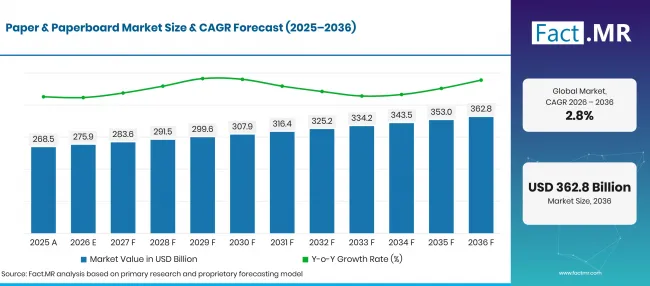
Factmr Paper And Paperboard Market Forecast Global | Source: Fact.MR
| Year | Basis | Market value (USD Billion) |
|---|---|---|
| 2025 | Actual | 268.5 |
| 2026 | Estimate | 276.9 |
| 2036 | Forecast | 362.8 |
| CAGR, 2026 to 2036 | 2.8% | |
What are the defining numbers behind Paper & Paperboard Market growth?
An absolute opportunity of USD 86.8 billion will be created between 2026 and 2036.
- Demand Drivers in the Market
- Global output recovered after a weak 2023. The Food and Agriculture Organization of the United Nations reported that paper and paperboard production rose by between 4% and 5% in 2024, while recovered paper consumption edged up 1% to 243 million tonnes [1]. Packaging grades will absorb most new fibre demand as graphic grades shrink.
- Packaging law in Europe now sets design rules for every pack. Regulation (EU) 2025/40 on packaging and packaging waste was published on 22 January 2025 and applies from 12 August 2026 [2]. It requires packaging to meet recyclability performance grades from 1 January 2030, which favors mono-material fibre formats over mixed plastic laminates [2].
- Food and beverage distribution creates steady demand that holds up in downturns. Cartons, cups, trays and shipping cases are bought every week. Converters therefore keep paperboard orders running through the cycle.
- Integrated producers that own forests, pulp lines and recovered fibre collection can hold input costs steadier. This control helps them keep delivery promises to box plants when fibre prices swing.
- Printing and writing grades will keep shrinking as bills, statements and advertising move online. Producers will convert or close graphic paper machines, which shifts the growth base of the market toward packaging.
- Key Segments Analyzed
- By Product Type: Containerboard will hold 42.1% share in 2026 since it forms the liners and fluting of corrugated shipping cases.
- By Application: Packaging will account for 42.1% share in 2026, supported by recurring demand from retail, food service and parcel shipping.
- By End-User Industry: Food & Beverage will capture 42.1% share in 2026 owing to weekly purchases of packaged food and drinks.
- Analyst Opinion at Fact.MR
- Shambhu Nath Jha, Principal Consultant at Fact.MR, states, “Packaging will carry nearly all net growth in paper and paperboard through 2036, while graphic grades keep losing volume. Buyers will judge suppliers on fibre security, grade mix and proof of recyclability alongside price. Integrated producers with strong containerboard and folding boxboard positions will be best placed as mills move from printing paper to packaging.”
- Strategic Implications
- Producers should direct capital toward containerboard and boxboard capacity, given that packaging grades will deliver most of the demand growth.
- Owners of printing and writing machines should plan conversions to packaging grades early, since each year of falling graphic volume lowers mill utilization.
- Suppliers to food and beverage brands should document food-contact compliance, barrier performance and recyclability grades ahead of the 2030 EU design rules.
- Converters should secure long-term fibre and recovered paper contracts, as input availability decides delivery reliability and contract awards.
Poland will lead at 3.5% CAGR, helped by fast online retail growth and a large corrugated base. South Korea will follow at 3.1% as e-commerce and food delivery lift packaging use. U.S. demand will reach 2.7% on the back of rising online sales. The United Kingdom will post 2.3% with packaging EPR fees that reward fibre formats, while Switzerland will close at 2.0% in a mature market with high paper recovery.
How does the Paper & Paperboard Market break down by segment?
Containerboard will lead Product Type at 42.1%; Packaging will lead Application at 42.1%; Food & Beverage will lead End-User Industry at 42.1%.
Which Product Type dominates?
Containerboard will hold 42.1% share in 2026.
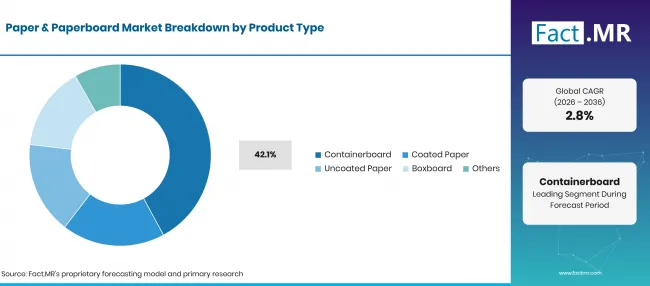
Factmr Paper And Paperboard Market Breakdown Product Type | Source: Fact.MR
Paper & Paperboard Market Breakdown by Product Type
| Product Type | Share (2026) |
|---|---|
| Containerboard (Leading Segment) | 42.1% |
| Other Segments Combined | 57.9% |
| Total | 100.0% |
Containerboard will lead because it supplies the linerboard and corrugating medium used in shipping boxes for retail, food and online orders. Demand for corrugated packaging moves in step with goods volumes and parcel counts.
Corrugated cases form a large part of collected packaging waste. Eurostat reported that paper and cardboard made up 40.4% of EU packaging waste in 2023, or 32.3 million tonnes [1]. Boxboard serves folding cartons, and coated grades such as C1S packaging paper serve labels and cartons. Uncoated paper covers office and book papers.
What leads the Application segment?
Packaging will account for 42.1% share in 2026.
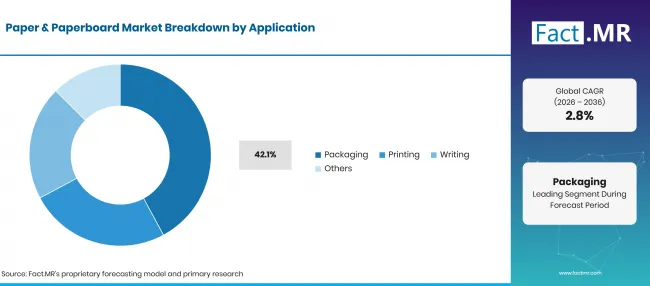
Factmr Paper And Paperboard Market Breakdown Application | Source: Fact.MR
| Application | Share (2026) |
|---|---|
| Packaging (Leading Segment) | 42.1% |
| Other Segments Combined | 57.9% |
| Total | 100.0% |
Packaging will lead since corrugated, folding carton and paper bag formats serve nearly every consumer and industrial category. Brand owners replacing plastic are adding to the use of paper packaging materials in shelf and shipping packs.
Printing and writing are losing volume as mail and office paper move online. The U.S. Postal Service reported that First-Class Mail volume fell by 2.2 billion pieces, or 5.0%, in fiscal year 2025 [4].
What supports Food & Beverage within End-User Industry?
Food & Beverage will capture 42.1% share in 2026.
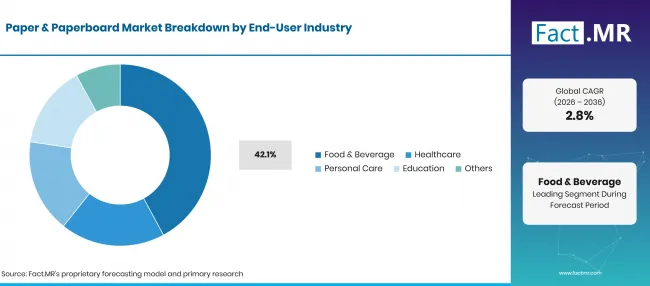
Factmr Paper And Paperboard Market Breakdown End User Industry | Source: Fact.MR
Paper & Paperboard Market Breakdown by End-User Industry
| End-User Industry | Share (2026) |
|---|---|
| Food & Beverage (Leading Segment) | 42.1% |
| Other Segments Combined | 57.9% |
| Total | 100.0% |
Food & Beverage will lead as producers need cartons, cups, trays and cases for every product they ship. These packs must meet hygiene and strength specifications, and many need paper barrier coatings to resist grease and moisture.
Food spending stays large even when consumers trade down. The U.S. Department of Agriculture’s Economic Research Service reported that U.S. food spending reached USD 2.51 trillion in 2025, with food away from home at USD 1.41 trillion [5]. Healthcare uses folding cartons and leaflet papers for medicines, while personal care relies on boxboard for cosmetics and toiletries.
What is accelerating Paper & Paperboard Market adoption, and what is holding it back?
Demand will rise through online retail, the move from plastic to fibre packaging and steady food and beverage consumption. Growth is constrained by the decline in printing and writing grades, volatile fibre and energy costs and the high energy use of papermaking.
Drivers Impact Analysis
| DRIVER | (~) % IMPACT ON CAGR | GEOGRAPHIC RELEVANCE | IMPACT TIMELINE |
|---|---|---|---|
| E-commerce and parcel shipping lifting corrugated demand | +0.9% | North America, East Asia, Eastern Europe | Short term (<= 2 years) |
| Shift from plastic toward recyclable fibre packaging | +0.7% | Western Europe, Eastern Europe | Medium term (2-4 years) |
| Steady food and beverage packaging consumption | +0.5% | Global | Short term (<= 2 years) |
| Food delivery and takeaway packaging growth | +0.4% | East Asia, North America | Medium term (2-4 years) |
Opportunity Impact Analysis
| OPPORTUNITY | (~) % IMPACT ON CAGR | GEOGRAPHIC RELEVANCE | IMPACT TIMELINE |
|---|---|---|---|
| Conversion of graphic paper machines to packaging grades | +0.7% | North America, Western Europe, East Asia | Medium term (2-4 years) |
| Barrier-coated fibre formats for food and beverage | +0.5% | Global | Long term (>= 4 years) |
| Lightweight containerboard for parcel shipping | +0.4% | North America, Western Europe | Medium term (2-4 years) |
Restraints Impact Analysis
| RESTRAINT | (~) % IMPACT ON CAGR | GEOGRAPHIC RELEVANCE | IMPACT TIMELINE |
|---|---|---|---|
| Structural decline in printing and writing paper demand | -0.9% | North America, Western Europe, East Asia | Long term (>= 4 years) |
| Volatility in fibre, energy and chemical input costs | -0.6% | Global | Short term (<= 2 years) |
| Carbon and energy costs in papermaking | -0.4% | Western Europe | Medium term (2-4 years) |
Which countries are scaling the Paper & Paperboard Market through 2036?
- Only 1.5 percentage points separate Poland at 3.5% from Switzerland at 2.0%.
- Poland will keep a 0.4-point lead over South Korea, helped by online shopping that reached most adults and a box industry serving EU supply chains.
- Food delivery orders packed in paper bags and cartons will give South Korea a 0.4-point edge over the United States.
- In the United States, double-digit growth in online sales supports containerboard, leaving the country 0.4 points clear of the United Kingdom.
- Lower EPR fees for paper and card than for plastic will hold the United Kingdom 0.3 points ahead of Switzerland.
- Switzerland will close the range, where high paper recovery and a mature retail base limit new volume.
Comparable CAGRs create different entry conditions, since fibre access, energy costs, packaging rules and the pace of digital substitution vary by country. Full report coverage includes North America, Latin America, Western Europe, Eastern Europe, East Asia, South Asia & Pacific, Middle East & Africa.
As per Fact.MR, global paper and paperboard consumption is estimated at USD 33.3 per capita in 2026, compared with USD 32.7 per capita in 2025. It will grow to USD 40.8 per capita by 2036 as online retail, food delivery and plastic replacement add to packaging use. Demand will rise across box plants, carton converters, food producers and retailers in both mature and emerging economies. As per Fact.MR, the growth of paper and paperboard will come less from printing and writing papers and more from containerboard, folding boxboard and barrier-coated food packaging.
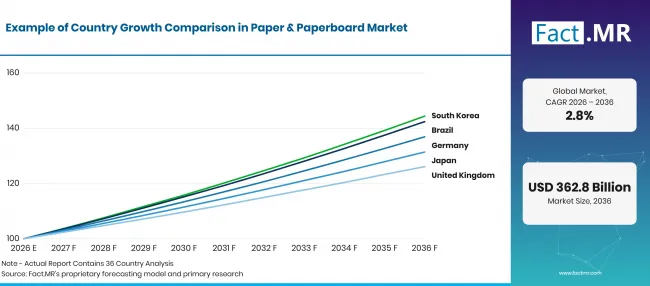
Paper And Paperboard Market Growth Index | Source: Fact.MR
| Country | CAGR (2026-2036) |
|---|---|
| Poland | 3.5% |
| South Korea | 3.1% |
| United States | 2.7% |
| United Kingdom | 2.3% |
| Switzerland | 2.0% |
What supports Poland’s growth?
3.5% CAGR, supported by online retail growth and a corrugated base serving export manufacturing.
Poland is a manufacturing and logistics hub for the EU, and much of its output moves in corrugated cases. Statistics Poland reported that 69.7% of people aged 16 to 74 ordered or bought goods or services online in 2025, up 2.3 percentage points from the previous year [6]. More parcels will lift demand for containerboard and box plant output in the country.
How is South Korea scaling demand?
3.1% CAGR, driven by high online retail penetration and food delivery packaging.
The U.S. International Trade Administration reported that e-commerce accounts for roughly half of Korea’s total retail sales [7]. Food delivery services accounted for 15% of total online shopping transactions in 2025 [7].
What supports United States adoption?
2.7% CAGR, supported by rising online sales and containerboard demand.
The U.S. Census Bureau reported that retail e-commerce sales reached USD 340.2 billion in the second quarter of 2026, up 12.2% from a year earlier [8]. Online sales accounted for 17.1% of total retail sales in that quarter [8].
How is the United Kingdom developing demand?
2.3% CAGR, backed by packaging EPR fees that favor paper and card.
The UK environment department (Defra) reported provisional paper and cardboard packaging waste of 4.852 million tonnes in 2025, with a recycling rate of 80.3% [9]. Under the packaging EPR scheme, the 2025 base fee was set at GBP 196 per tonne for paper and card, compared with GBP 423 per tonne for plastic [10]. This gap will push retailers toward fibre packs.
How does Switzerland perform?
2.0% CAGR, shaped by a mature market with high paper recovery.
Swiss mills rely heavily on recovered fibre, and households sort paper and cardboard at high rates. The Federal Office for the Environment reported that Switzerland collected 1.135 million tonnes of paper and cardboard in 2024, equal to 124.9 kg per person [11]. The collection rate reached 85% in the same year [11]. Growth will come from packaging, since graphic paper use keeps falling.
Who leads the Paper & Paperboard Market?
Competition runs across three groups. Integrated containerboard and corrugated producers such as International Paper, Smurfit Westrock and Mondi compete on mill cost, box plant reach and fibre security.
International Paper completed its acquisition of DS Smith in January 2025 [12] and sold its Global Cellulose Fibers pulp business in January 2026 [13]. It now plans to separate into a North American company and an EMEA packaging company [14]. Board specialists such as Stora Enso, Klabin and Nine Dragons Paper compete on virgin fibre cartonboard and kraftliner. Stora Enso started a consumer board line at Oulu in Finland in March 2025, converted from an idle paper machine [15]. Graphic paper makers face shrinking demand and are consolidating. UPM and Sappi signed a definitive agreement in May 2026 to combine their European graphic paper businesses in a jointly owned venture [16]. Nippon Paper and Oji Holdings balance falling newsprint volumes with containerboard and cartons in Japan. Competition will be decided by fibre cost, energy efficiency, recyclable barrier grades and the speed of moving capacity into packaging.
Which companies are the key providers?
Key companies include International Paper Company (including DS Smith); Smurfit Westrock plc; Stora Enso Oyj; UPM-Kymmene Corporation; Sappi Limited; Nippon Paper Industries Co., Ltd.; Mondi Group; Oji Holdings Corporation; Nine Dragons Paper (Holdings) Limited; and Klabin S.A.
- International Paper Company (including DS Smith)
- Smurfit Westrock plc
- Stora Enso Oyj
- UPM-Kymmene Corporation
- Sappi Limited
- Nippon Paper Industries Co., Ltd.
- Mondi Group
- Oji Holdings Corporation
- Nine Dragons Paper (Holdings) Limited
- Klabin S.A.
Bibliography
- [1]Food and Agriculture Organization of the United Nations. (2025, December 24). Global forest products trade and production show signs of recovery in 2024.
- [2] European Parliament and Council of the European Union. (2025, January 22). Regulation (EU) 2025/40 of the European Parliament and of the Council of 19 December 2024 on packaging and packaging waste, amending Regulation (EU) 2019/1020 and Directive (EU) 2019/904, and repealing Directive 94/62/EC.
- [3] Eurostat. (2025, October). Packaging waste statistics.
- [4] United States Postal Service. (2025, November 14). U.S. Postal Service Reports Fiscal Year 2025 Results.
- [5] U.S. Department of Agriculture, Economic Research Service. (2026, June 1). Ag and Food Statistics: Charting the Essentials: Food Prices and Spending.
- [6] Statistics Poland. (2025, October 21). Information society in Poland in 2025.
- [7] International Trade Administration, U.S. Department of Commerce. (2026, June 29). South Korea: eCommerce.
- [8] U.S. Census Bureau. (2026, August 18). Quarterly Retail E-Commerce Sales: 2nd Quarter 2026.
- [9] Department for Environment, Food & Rural Affairs. (2026, September 23). UK statistics on waste.
- [10] Department for Environment, Food & Rural Affairs. (2025, June 27). Extended producer responsibility for packaging: 2025 base fees.
- [11] Federal Office for the Environment FOEN. (2025, November). Abfallmengen und Recycling 2024 im Überblick [Waste quantities and recycling 2024 at a glance].
- [12] International Paper Company. (2025, January 31). International Paper Completes Acquisition of DS Smith, Creating a Global Leader in Sustainable Packaging Solutions.
- [13] International Paper Company. (2026, January 23). International Paper Completes Sale of Global Cellulose Fibers Business to American Industrial Partners (AIP).
- [14] International Paper Company. (2026, January 29). International Paper to Create Two Independent Public Companies.
- [15] Stora Enso Oyj. (2025, March 19). Stora Enso’s new consumer board line at the Oulu site in Finland has started operations.
- [16] UPM-Kymmene Corporation. (2026, May 28). Inside information: UPM and Sappi have signed a definitive agreement on the graphic paper Joint Venture.
This Report Answers
- The report explains how paper and paperboard demand splits by product type, application and end-user industry.
- Segment analysis identifies the subsegment that leads each segment and the buying factors behind its 2026 share.
- Country analysis compares the five listed countries through online retail, packaging rules and paper recovery.
- Competitive analysis reviews integrated producers across containerboard, boxboard and graphic paper grades.
- Application analysis assesses how strength, recyclability, barrier performance and fibre supply shape purchase decisions.
What does the Paper & Paperboard Market cover?
The Paper & Paperboard Market covers containerboard, coated paper, uncoated paper and boxboard made from wood pulp and recovered fibre. Material is counted when it leaves the mill as reels or sheets for converters, printers and end users.
The assessment tracks packaging, printing, writing and education applications across food and beverage, healthcare and personal care industries.
What is included in the scope?
The scope includes linerboard, corrugating medium, folding boxboard, solid bleached board, coated and uncoated printing papers and writing papers. It covers grades with barrier coatings applied at the mill.
Label, release and flexible packaging grades are counted where they are sold as paper reels, and wider specialty papers demand is tracked where it overlaps these grades.
What is excluded from the scope?
The scope excludes finished boxes, cartons, bags and printed products sold as end goods. The value of cardboard box and container manufacturing is outside the revenue boundary.
Market pulp traded on its own, tissue and hygiene papers and non-fibre packaging materials are also excluded.
How Was the Analysis Built?
The analysis draws on 120+ sources, 35+ company portfolios, 25+ countries, and more than 20 industry interviews.
- Primary Research: Primary research includes discussions with manufacturers, service providers, technology developers, distributors, end users, and subject-matter experts. These conversations examine purchasing priorities, product adoption, operational challenges, approval requirements, competitive positioning, and the factors that influence wider market acceptance.
- Desk Research: Desk research covers government statistics, regulatory publications, company filings, trade data, technical studies, industry associations, standards, public policy, and other authoritative sources. Every source used in the analysis is documented in the bibliography.
- Market Sizing and Forecasting: Market estimates combine historical performance, demand indicators, pricing and volume trends, segment shares, company participation, country-level growth, adoption patterns, investment activity, and barriers to market expansion.
- Data Validation and Update Cycle: Findings are validated by comparing primary interviews with public data, company activity, regulatory changes, trade patterns, and industry developments. Regular updates review new product launches, capacity changes, partnerships, approvals, and shifts in commercial adoption.
What is the report’s scope and coverage?
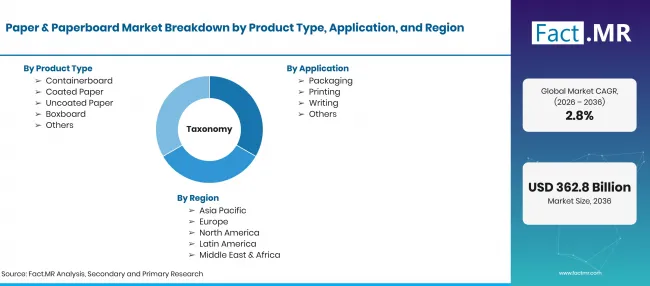
Paper And Paperboard Market Taxonomy | Source: Fact.MR
| Attribute | Details |
|---|---|
| Quantitative Units | USD billion in 2026 to USD billion by 2036 at a CAGR |
| Market Definition | Paper and paperboard made from virgin and recovered fibre and sold as reels or sheets, including containerboard, coated paper, uncoated paper and boxboard. The scope covers material used for packaging, printing, writing and education across food and beverage, healthcare and personal care industries. |
| Product Type | Containerboard; Coated Paper; Uncoated Paper; Boxboard |
| Application | Packaging; Printing; Writing; Education |
| End-User Industry | Food & Beverage; Healthcare; Personal Care |
| Regions Covered | North America; Latin America; Western Europe; Eastern Europe; East Asia; South Asia & Pacific; Middle East & Africa |
| Countries Covered | Poland; South Korea; United States; United Kingdom; Switzerland |
| Key Companies Profiled | International Paper Company (including DS Smith); Smurfit Westrock plc; Stora Enso Oyj; UPM-Kymmene Corporation; Sappi Limited; Nippon Paper Industries Co., Ltd.; Mondi Group; Oji Holdings Corporation; Nine Dragons Paper (Holdings) Limited; Klabin S.A. |
| Forecast Period | 2026 to 2036 |
| Approach | Hybrid top-down and bottom-up approach using paper and paperboard production and consumption volumes; grade price trends; application and end-user mix; country growth; and producer portfolio review. |
How is the market segmented?
-
By Product Type
- Containerboard
- Coated Paper
- Uncoated Paper
- Boxboard
-
By Application
- Packaging
- Printing
- Writing
- Education
-
By End-User Industry
- Food & Beverage
- Healthcare
- Personal Care
-
By Region
- North America
- Latin America
- Western Europe
- Eastern Europe
- East Asia
- South Asia & Pacific
- Middle East & Africa